A humming refrigerator can be worrying, especially when the sound suddenly becomes louder or continues longer than usual. However, not every hum means that your appliance is failing.
If you are wondering, “Why is my GE refrigerator making a humming noise?” the sound may be coming from the compressor, evaporator fan, condenser fan, ice maker, or water inlet valve. A soft hum that comes and goes during normal cooling is usually harmless. A loud, constant, or unfamiliar humming sound especially when combined with clicking, poor cooling, frost, or water problems deserves closer attention.
This guide will help you identify where the noise is coming from, understand whether it is normal, and safely troubleshoot the most likely causes.
Is It Normal for a GE Refrigerator to Make a Humming Noise?
Yes, a soft humming sound can be completely normal in a GE refrigerator. The compressor, cooling fans, ice maker, and water valve all make some noise while operating.
GE Appliances explains that buzzing or humming is commonly associated with the ice maker or the ice maker’s water valve. These sounds are generally considered normal when they are brief and occur during an ice-making or water-dispensing cycle.
You are more likely to have a problem when the noise:
- Suddenly becomes much louder
- Continues without stopping
- Is accompanied by repeated clicking
- Comes with scraping or grinding
- Starts while the refrigerator is no longer cooling
- Changes when you open the freezer door
- Occurs while the water dispenser produces little or no water
- Is accompanied by a burning smell or an unusually hot power cord
The timing, location, and type of sound can reveal which refrigerator component is responsible.
Quick Diagnosis: Where Is the Humming Coming From?
Before removing anything or calling a technician, listen carefully and try to locate the sound.
| Noise location or pattern | Likely source | First thing to check |
|---|---|---|
| Inside the freezer | Evaporator fan or frost buildup | Look for heavy frost around the rear freezer panel |
| Behind the refrigerator | Compressor, condenser fan, or vibration | Check wall clearance and loose objects |
| Under the refrigerator | Condenser fan, drain pan, or tubing | Look for dust, debris, or a loose panel |
| During water dispensing | Water inlet valve | Check water flow and filter installation |
| Every 10–15 minutes | Ice maker water valve | Confirm that the water supply is turned on |
| About once an hour | Ice maker or filter-related valve | Observe whether the sound lasts only a few seconds |
| Stops when the freezer door opens | Evaporator fan area | Check for frost or fan obstruction |
| Hums and then clicks repeatedly | Compressor starting system | Check whether the refrigerator is cooling |
| Hums while the cabinet vibrates | Levelling or contact issue | Move and level the refrigerator |
A brief humming noise may be normal. A noise that is unusually loud, newly developed, or connected to a performance problem requires further investigation.
10 Reasons Your GE Refrigerator Is Making a Humming Noise
1. The Compressor Is Running Normally
The compressor circulates refrigerant through the cooling system. It usually produces a low, steady hum while the refrigerator is cooling.
Modern refrigerators may run longer than older models because longer, lower-powered cycles can help maintain a consistent temperature. GE states that refrigerator and freezer compressors may operate for a large percentage of the day, so frequent humming does not automatically indicate a fault.
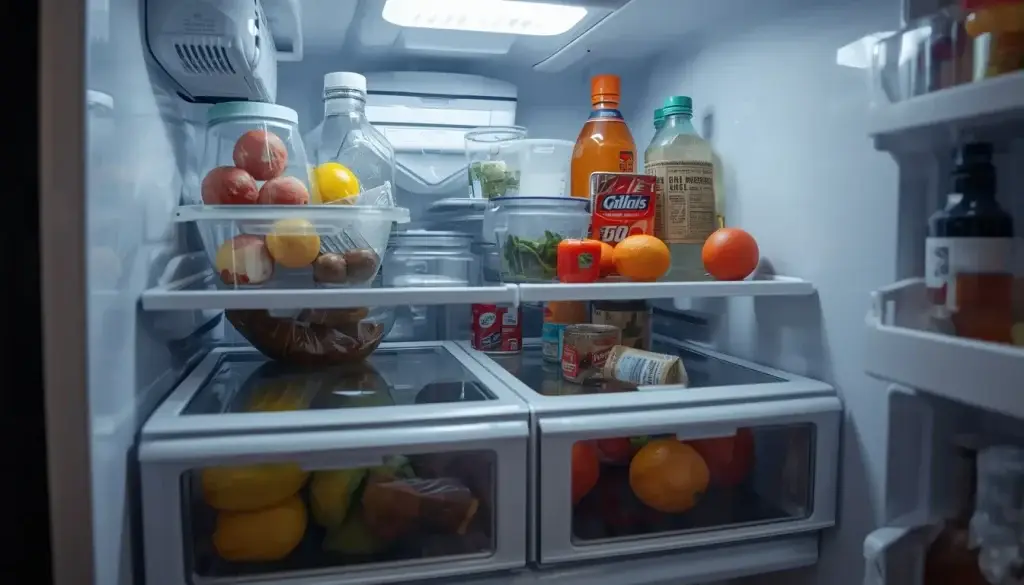
The compressor may run for longer when:
- The refrigerator has recently been installed
- A large amount of warm food was added
- The doors were opened repeatedly
- The room temperature is high
- The temperature setting was recently changed
- The door gasket is not sealing correctly
The hum is probably normal when the refrigerator is cooling properly and the sound remains low and steady.
However, professional diagnosis may be necessary if the compressor hums loudly, repeatedly fails to start, becomes excessively hot, or produces clicking while the refrigerator remains warm.
2. A New Refrigerator Is Producing a High-Pitched or Pulsating Hum
A new GE refrigerator may sound different from the appliance it replaced. High-efficiency compressors and variable-speed fans can create a higher-pitched hum, pulsating tone, or changing motor sound.
A new refrigerator may also run for an extended period while reaching its target temperature. GE notes that a refrigerator can take approximately 24 hours to stabilise after initial installation or after its temperature settings are changed.
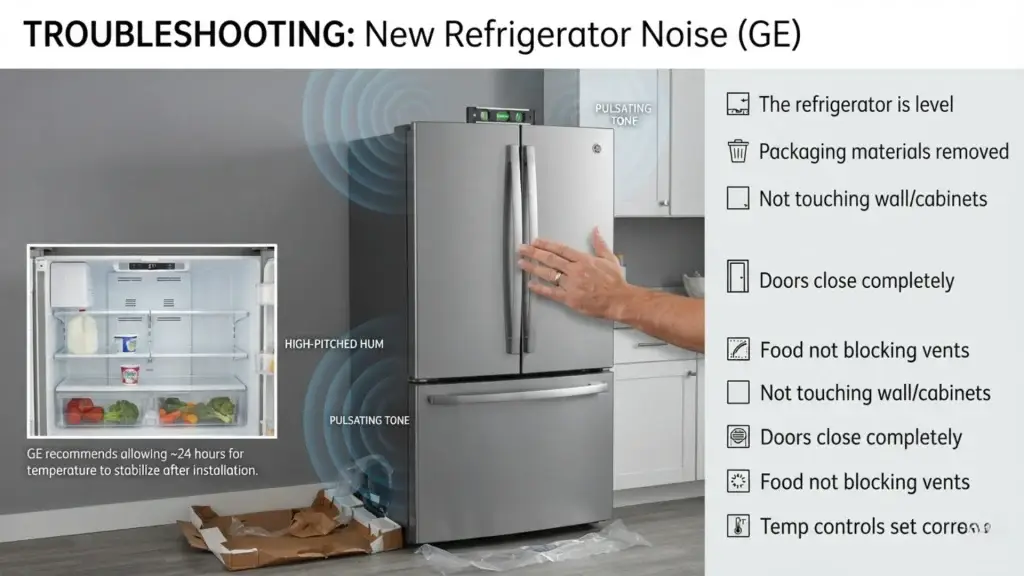
During the first day, check that:
- The refrigerator is level
- Packaging materials have been removed
- It is not touching the wall or surrounding cabinets
- The doors close completely
- Food is not blocking internal air vents
- The temperature controls are set correctly
A changing compressor tone can be normal. A sharp electrical buzz, repeated clicking, burning smell, or failure to cool is not something to ignore.
3. The Ice Maker Is Filling With Water
The ice maker uses an electrically operated water valve to fill its mould. When the valve opens, you may hear a short hum or buzz.
This noise is normally brief and may occur even when nobody is using the refrigerator. It is simply part of the automatic ice-making process.
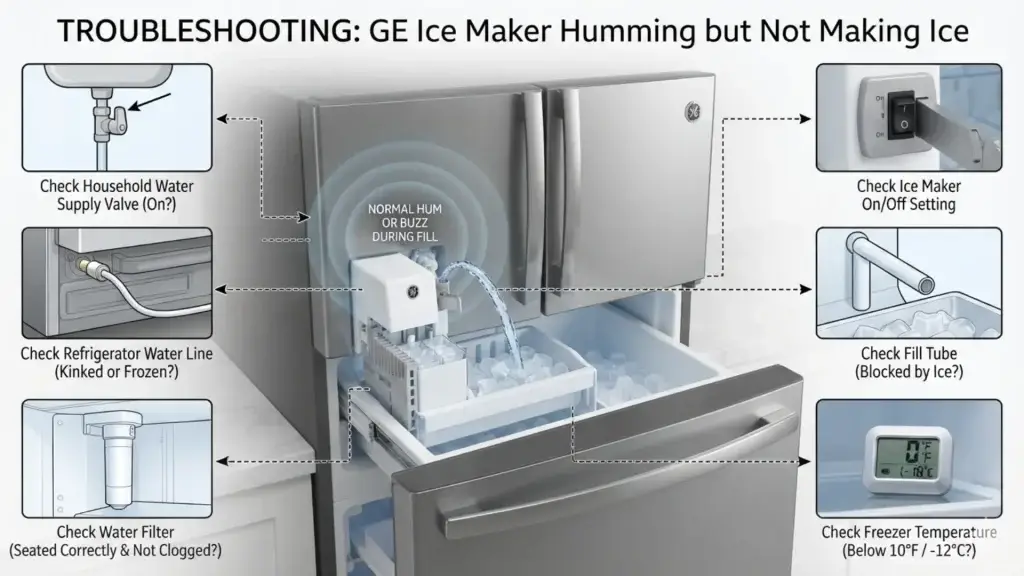
If the sound happens occasionally and the ice maker continues producing ice, no repair may be necessary. However, if the GE ice maker is humming but not making ice, check:
- The household water supply valve
- The refrigerator’s water line
- The water filter
- The freezer temperature
- The ice maker’s on/off setting
- The fill tube for possible freezing
Do not assume that the ice maker itself is defective until the water supply and filter have been checked.
4. The Ice Maker Is On but the Water Supply Is Off
A common cause of repeated humming is an ice maker that is switched on even though no water is reaching the refrigerator.
The water valve may continue trying to fill the ice maker, causing a brief humming or buzzing noise at regular intervals. GE identifies repeated buzzing around every 15 minutes as a possible sign that the ice maker is trying to fill while the water supply is unavailable.
Check whether:
- The water shut-off valve is fully open
- The supply line is bent or kinked
- The refrigerator was recently moved
- The water filter is clogged or incorrectly fitted
- The appliance has been connected to a water supply
If the refrigerator is not connected to water, turn the ice maker off. The exact switch or control location varies by model, so refer to your owner’s manual. GE refrigerators may use a toggle switch, control panel setting, feeler arm, or another model-specific control.
5. The Water Inlet Valve or Dispenser Is Humming
The water inlet valve supplies water to both the dispenser and ice maker. A short hum while dispensing water is usually normal.
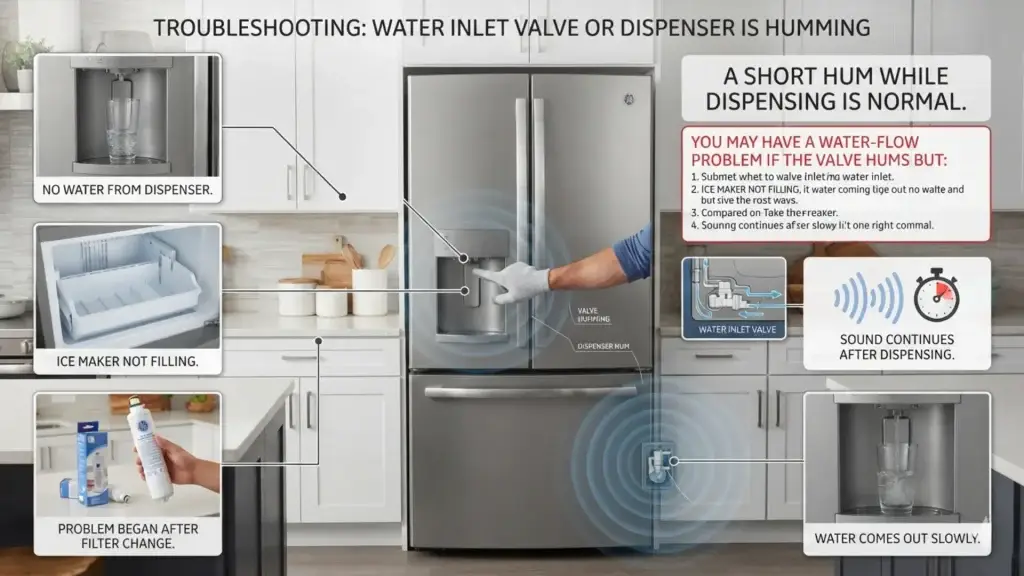
You may have a water-flow problem if the valve hums but:
- No water comes from the dispenser
- Water comes out very slowly
- The ice maker is not filling
- The sound continues after dispensing stops
- The problem began after replacing the filter
Start by checking the water filter. Make sure it is the correct type for your refrigerator and that it has been fully inserted and locked into position.
Next, inspect the visible water line behind the refrigerator for kinks. Confirm that the household water valve is completely open.
If the filter and supply line are in good condition but the valve continues humming without delivering water, the valve may be restricted or defective. Replacing it normally requires access to water and electrical connections, so professional service is the safer option.
6. Frost Is Touching the Evaporator Fan
The evaporator fan circulates cold air from the freezer through the refrigerator. If frost accumulates around the fan, the blades may touch the ice and create a humming, buzzing, vibrating, or scraping sound.
Possible warning signs include:
- The sound comes from inside the freezer
- The sound changes when the freezer door opens
- Frost covers the rear freezer panel
- Airflow inside the refrigerator is weak
- The freezer is cold but the fresh-food compartment is warm
- The refrigerator runs continuously
GE advises that a sound resembling a fan blade hitting something in the freezer is not considered normal and may require service.
Check whether food packages are pressed against the rear panel or blocking an air vent. You can also inspect the door gasket for gaps, cracks, or loose sections that may allow warm, humid air to enter.
Heavy frost may indicate more than a temporary ice buildup. A damaged gasket, blocked drain, faulty defrost component, or fan problem may be responsible.
Do not use a knife, screwdriver, or other sharp object to remove ice. Doing so could puncture an internal panel or refrigerant line.
7. The Condenser Fan Is Dirty or Obstructed
Many GE refrigerators have a condenser fan near the compressor at the lower rear of the appliance. It helps move air across the condenser and compressor area.
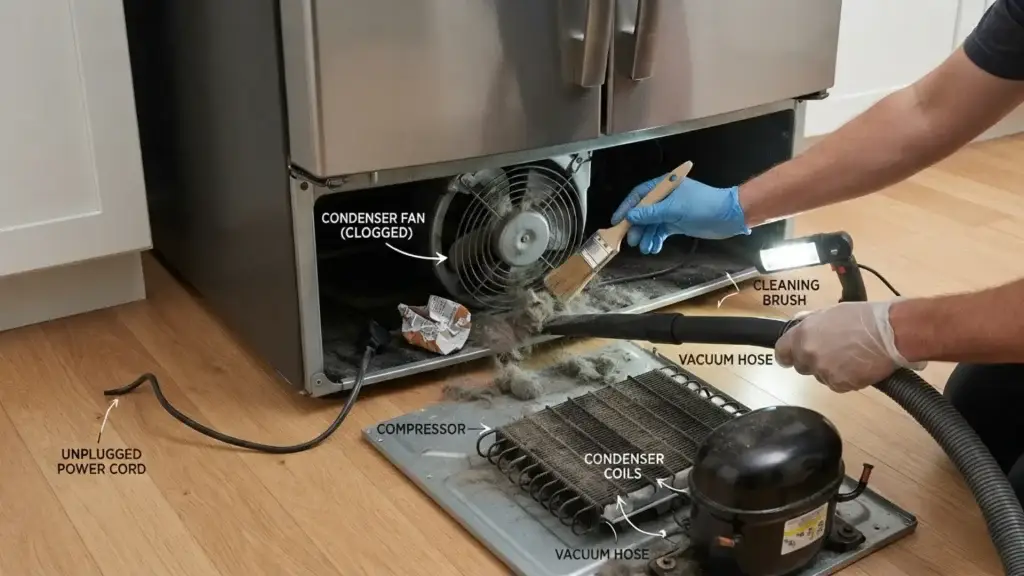
Dust, pet hair, packaging, insulation, or another object may interfere with the fan. This can produce humming, rattling, or a sound similar to a fan blade striking something.
To inspect the area safely:
- Unplug the refrigerator.
- Carefully pull it away from the wall.
- Remove only an easily accessible exterior cover if your manual permits it.
- Look for visible debris around the fan.
- Clean loose dust with a soft brush or vacuum attachment.
- Check that tubing and wires are not touching the fan blade.
- Reinstall the cover before reconnecting power.
Do not reach into the fan area while the refrigerator is connected to electricity.
If the fan blade is damaged, the motor is difficult to turn, or the noise returns immediately, arrange professional repair.
8. Restricted Airflow Is Making the Refrigerator Work Harder
Restricted airflow can cause the compressor and fans to run longer, making normal humming more noticeable.
Airflow can be restricted by:
- Food blocking internal vents
- Dust around accessible ventilation openings
- Insufficient space around the appliance
- A refrigerator packed too tightly
- A door that does not close completely
- A damaged door seal
- Heavy frost in the freezer
Check your model’s installation instructions for the required clearance around the refrigerator. Avoid pushing the appliance tightly against a wall if doing so compresses the water line or causes the cabinet to vibrate.
Not every GE refrigerator has exposed condenser coils that require routine cleaning. Some models use condenser systems designed to reduce or eliminate owner cleaning. Follow the maintenance instructions for your exact model instead of removing panels unnecessarily.
9. The Refrigerator Is Not Level or Is Touching Another Surface
A normal motor hum can become much louder when vibration travels through the floor, wall, cabinets, water line, or refrigerator body.
Common vibration points include:
- The refrigerator touching the wall
- A water line tapping against the rear panel
- An uneven floor
- Incorrectly adjusted levelling legs
- A loose drain pan
- Bottles or containers touching inside the refrigerator
- Items stored on top of the appliance
- A loose exterior panel
Move the refrigerator slightly away from the wall and listen again. If the sound becomes quieter, cabinet contact or tubing vibration was probably amplifying it.
Use a spirit level to check the appliance from side to side and front to back. Adjust the levelling legs according to the owner’s manual. The refrigerator should remain stable and should not rock when gently pushed.
10. The Compressor Hums and Then Clicks
A refrigerator that hums briefly and then clicks may be attempting to start the compressor.
An occasional click can be normal when the compressor cycles. GE also explains that clicking may occur for several minutes after a power outage while the compressor tries to restart.
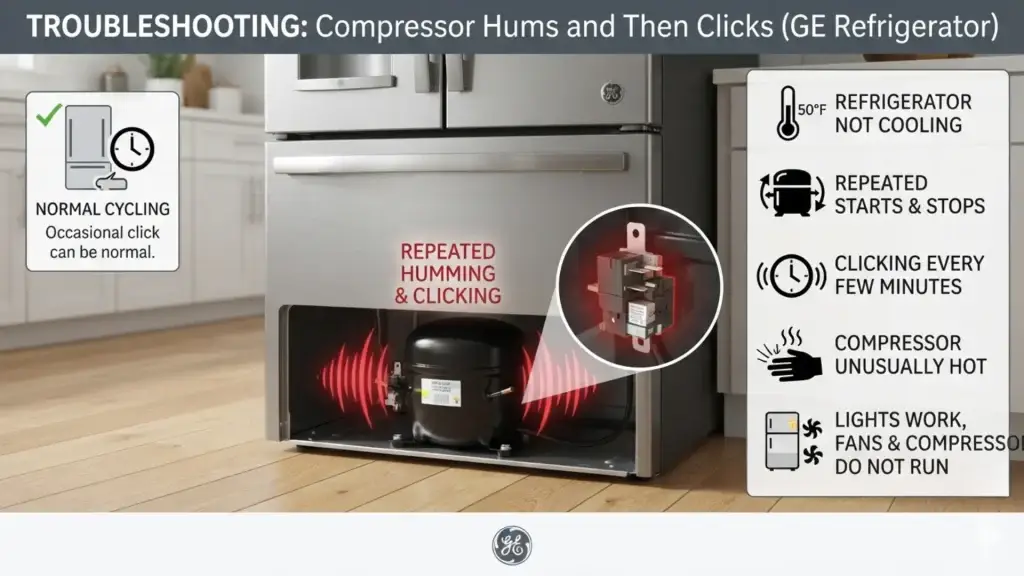
Repeated humming and clicking becomes more concerning when:
- The refrigerator is not cooling
- The compressor repeatedly starts and stops
- The clicking happens every few minutes
- The compressor becomes unusually hot
- The interior lights work but the fans and compressor do not remain running
Possible causes include a starting component, condenser fan, control problem, power issue, or compressor fault. GE repair guidance identifies the start relay and condenser fan among the components that may be involved when a refrigerator repeatedly clicks on and off.
Avoid repeatedly unplugging and reconnecting the refrigerator in an attempt to force the compressor to start. If the clicking continues and cooling has stopped, arrange professional service.
What Different Humming Patterns Can Mean
The pattern of the noise can be more useful than its volume alone.
| Humming pattern | Possible explanation |
|---|---|
| Soft, steady hum during cooling | Normal compressor or fan operation |
| Brief hum during ice production | Ice maker water valve opening |
| Buzz every 10–15 minutes | Ice maker on but water may be unavailable |
| Brief intermittent hum | Ice maker or water valve operation |
| High-pitched or pulsating hum | High-efficiency compressor or variable-speed fan |
| Humming during water dispensing | Normal valve operation or restricted water flow |
| Humming followed by a click | Compressor cycling or attempting to start |
| Loud hum inside the freezer | Frost or an obstruction near the evaporator fan |
| Humming with cabinet vibration | Levelling, wall contact, tubing, or a loose panel |
| Humming with poor cooling | Airflow, fan, compressor, or starting problem |
Record when the sound occurs and how long it lasts. A technician will find this information useful if professional diagnosis becomes necessary.
How to Fix a Humming GE Refrigerator Step by Step
Step 1: Identify When the Noise Happens
Listen for at least one complete cooling cycle.
Ask:
- Is the hum constant or intermittent?
- Does it happen during water dispensing?
- Does it occur shortly before ice drops into the bin?
- Does it happen every 10–15 minutes?
- Does it begin after the compressor clicks?
- Does it stop when a door opens?
Avoid diagnosing the appliance based on a few seconds of normal operation.
Step 2: Locate the Sound
Listen near:
- The freezer compartment
- The rear freezer panel
- The water filter
- The water dispenser
- The lower rear of the appliance
- The compressor area
- The floor beneath the refrigerator
Do not remove internal panels while the refrigerator is running.
Step 3: Check Cooling Performance
Noise alone does not always indicate a fault. Check whether the appliance is maintaining a safe temperature.
GE commonly recommends settings around 37°F for the fresh-food compartment and 0°F for the freezer on compatible models.
Remember that a display may show the selected temperature rather than the current internal temperature. Use an appliance thermometer when you need to confirm the actual temperature.
Step 4: Check the Ice Maker and Water Supply
Confirm that:
- The water valve is open
- The supply line is not kinked
- The water filter is installed correctly
- The dispenser has normal flow
- The ice maker is switched on only when water is connected
- The freezer is cold enough to make ice
Turn off the ice maker if it cannot receive water.
Step 5: Move and Level the Refrigerator
Pull the refrigerator slightly away from the wall. Remove objects from the top and check whether bottles or containers are touching inside.
Adjust the feet if the appliance rocks or sits unevenly.
Step 6: Look for Frost and Obstructions
Unplug the refrigerator before inspecting an accessible fan or machine compartment.
Look for:
- Frost around the freezer’s rear panel
- Food blocking vents
- Debris near the condenser fan
- Tubing touching a panel
- A loose drain pan
- Packaging left from installation
Do not dismantle electrical controls, refrigerant components, or sealed-system parts.
Step 7: Reset the Controls When Appropriate
If the appliance appears to be running incorrectly, disconnecting power for approximately 30 seconds may reset the control panel on some GE models. GE includes this step in its troubleshooting guidance for certain cooling problems.
After reconnecting power, allow time for normal cooling to resume. Do not expect the temperature to stabilise immediately.
Step 8: Monitor the Refrigerator
After completing basic checks:
- Note whether the sound is quieter
- Confirm that the compressor stays running
- Check that air is moving inside the appliance
- Monitor the fresh-food and freezer temperatures
- Test the water dispenser
- Check for newly produced ice
Stop troubleshooting and contact a technician if the refrigerator loses cooling or produces signs of an electrical problem.
Why Is My GE Refrigerator Humming but Not Cooling?
Humming without proper cooling is more serious than a normal operational sound.
Begin with basic checks:
- Confirm that the refrigerator has power
- Make sure the temperature controls are not turned off
- Check whether the appliance is in demonstration or showroom mode
- Verify that the doors close completely
- Remove food blocking air vents
- Inspect the freezer for heavy frost
- Check whether the condenser fan is running
- Listen for repeated compressor clicking
GE notes that a refrigerator can appear inactive during a defrost cycle because the compressor and fans stop temporarily. Depending on the model, a defrost cycle may last approximately 30–45 minutes and occur once or twice per day.
If the refrigerator remains warm after the expected defrost period, further diagnosis is needed.
The Freezer Is Cold but the Refrigerator Is Warm
When the freezer remains cold but the refrigerator compartment becomes warm, the sealed cooling system may still be operating. The problem may involve the movement of cold air into the fresh-food compartment.
Possible causes include:
- A blocked air vent
- An overfilled freezer
- Frost around the evaporator
- A weak or obstructed evaporator fan
- A damaged door gasket
- A faulty air damper
- A defrost-system problem
A worn fan motor, damper assembly, or compressor can also contribute to a warm refrigerator compartment.
Move food away from vents and check for visible frost. Arrange service if airflow remains weak or frost quickly returns after defrosting.
Why Does the Humming Stop When I Open the Freezer Door?
On many refrigerators, opening the freezer door changes fan operation. Therefore, a sound that stops or changes when the door opens often points toward the evaporator fan area.
The fan may be:
- Touching frost
- Striking a loose object
- Vibrating because of a damaged blade
- Producing noise from a worn motor
- Surrounded by heavy ice buildup
Do not rely only on the door-opening test because fan behaviour varies by model. However, it is a useful clue when combined with frost, weak airflow, or uneven cooling.
If you hear scraping or a blade-contact sound from the freezer, GE recommends professional service rather than treating it as a normal operating noise.
Why Is My GE Refrigerator Humming After a Power Outage?
After electricity is restored, the compressor may not restart immediately. You may hear humming or clicking while the system equalises and attempts to resume operation.
GE states that compressor-related clicking after a power outage may continue for approximately three to five minutes.
Check that:
- The refrigerator is connected directly to a working outlet
- The circuit breaker has not tripped
- The interior lights work
- The controls have retained the correct settings
- The compressor eventually starts
- Cooling begins to return
Contact a technician if repeated humming and clicking continues, the compressor does not remain running, or the refrigerator stays warm.
Does the GE Refrigerator Type Affect the Humming Sound?
GE Profile, French-door, side-by-side, top-freezer, and bottom-freezer refrigerators may place fans, ice makers, valves, and compressors in different locations.
However, the basic diagnostic process remains the same:
- Identify when the noise occurs.
- Find where it is loudest.
- Check whether cooling is affected.
- Check whether water or ice functions are involved.
- Look for vibration, frost, or obstruction.
- Refer to the manual for the exact model.
GE’s support system allows owners to access model-specific manuals and troubleshooting resources, including support through model and serial information or a QR code on compatible appliances.
Avoid assuming that a repair method for one GE refrigerator design is suitable for every other model.
Can a Humming Refrigerator Be Dangerous?
Most soft humming sounds are not dangerous. They are produced by motors and valves performing normal work.
Disconnect the refrigerator and seek qualified assistance when you notice:
- Smoke
- A burning or melting smell
- Sparks
- Repeated circuit-breaker trips
- A hot or damaged power cord
- A hot electrical outlet
- Loud electrical buzzing
- Water leaking near electrical components
- A compressor that repeatedly tries and fails to start
Do not touch internal wiring, capacitors, sealed-system tubing, or electrical terminals unless you are trained and authorised to service refrigeration appliances.
If cooling has stopped, protect perishable food by moving it to another working refrigerator or a properly chilled cooler.
When Should You Call a GE Refrigerator Technician?
Arrange professional service when:
- The refrigerator hums but does not cool
- The compressor repeatedly hums and clicks
- A fan blade is damaged
- Heavy frost returns after defrosting
- The water valve hums but does not supply water
- The noise remains after levelling and removing obstructions
- An internal panel must be removed for diagnosis
- The power cord, plug, or outlet becomes hot
- The refrigerator leaks near electrical components
- You suspect a compressor, relay, fan motor, or control-board problem
A technician can safely test electrical components, fan motors, control circuits, starting devices, and the sealed refrigeration system.
How to Prevent Future Humming and Vibration
You cannot eliminate every operating sound, but basic maintenance can prevent unnecessary noise.
- Keep internal air vents clear.
- Avoid overpacking the freezer.
- Make sure the doors close completely.
- Clean the door gaskets regularly.
- Keep the refrigerator level.
- Maintain the installation clearance required by the manual.
- Prevent the water line from touching the rear panel.
- Replace the water filter with the correct model.
- Turn off the ice maker when no water supply is connected.
- Clean accessible ventilation and fan areas safely.
- Investigate new sounds before they develop into larger problems.
- Keep the model number available for accurate support information.
Frequently Asked Questions On GE Refrigerator Making a Humming Noise
Why is my GE refrigerator humming constantly?
A constant low hum may come from the compressor or cooling fans. Modern refrigerators can run for extended periods, particularly in warm rooms, after frequent door openings, or after warm food has been added. Check cooling performance, airflow, door seals, and ventilation if the sound has become noticeably louder.
Why is my GE refrigerator humming every 15 minutes?
The ice maker may be trying to fill even though it is not receiving water. Confirm that the household water valve is open and that the supply line is not kinked. Turn the ice maker off when the refrigerator is not connected to water.
Why is my GE ice maker humming but not making ice?
The water supply may be closed, the line may be kinked, the filter may be restricted, or the fill tube may be frozen. Also confirm that the freezer is cold enough and that the ice maker is switched on.
Why is my GE refrigerator humming but no water is coming out?
A restricted filter, closed water valve, kinked supply line, low household water pressure, frozen line, or faulty inlet valve may prevent water flow. Check the filter and visible water connections before arranging valve service.
Why is my GE refrigerator humming and clicking?
An occasional click may be part of normal compressor cycling. Repeated humming and clicking, especially with no cooling, may indicate that the compressor is struggling to start or that a starting, fan, control, or power component requires diagnosis.
Why is my GE fridge making a high-pitched humming sound?
High-efficiency compressors and variable-speed fans can produce higher-pitched or pulsating sounds. It may be normal if cooling is stable and the sound is not excessively loud. Investigate it if the noise is new, disruptive, or accompanied by clicking or temperature problems.
Why is the humming coming from inside the freezer?
The evaporator fan may be running normally, or frost may be touching the fan blade. Check for heavy frost, blocked vents, damaged food packaging, and weak airflow.
Why does my GE refrigerator stop humming when I open the freezer door?
Opening the door may stop or change the evaporator fan’s operation. This suggests that the noise could be coming from the fan, frost around the fan, or an obstruction near the rear freezer panel.
Why is my GE refrigerator humming after replacing the water filter?
The filter may not be fully seated, air may remain in the water system, or water flow may be restricted. Reinstall the filter according to the manual and dispense water to clear trapped air. Confirm that the replacement filter is compatible with your model.
Why is my new GE refrigerator so loud?
A newly installed refrigerator may run longer while reaching its target temperature. It may also have a different compressor tone from your previous appliance. Check levelling, wall clearance, packaging, internal airflow, and door closure. Allow approximately 24 hours for the temperature to stabilise.
Can a dirty condenser fan cause humming?
Yes. Dust, debris, or an object touching the condenser fan can create humming, rattling, or vibration. Unplug the refrigerator before inspecting any accessible fan area.
Should I unplug my refrigerator if it is humming loudly?
Unplug it immediately if the humming is accompanied by a burning smell, smoke, sparks, a hot cord, electrical buzzing, or repeated breaker trips. A loud mechanical hum without electrical warning signs should still be investigated, especially if cooling has stopped.
How can I make my GE refrigerator quieter?
Level the refrigerator, move it away from the wall, prevent tubing from touching exterior panels, remove objects stored on top, separate vibrating containers, clear internal vents, and check accessible fan areas for debris.
Is it better to repair or replace a humming refrigerator?
The answer depends on the refrigerator’s age, condition, repair cost, energy efficiency, and the component that has failed. A loose panel or fan obstruction may be inexpensive to correct, while a major sealed-system or compressor repair may require a broader cost comparison.
Final Verdict
A GE refrigerator making a humming noise is not automatically broken. A soft, steady, or occasional hum usually comes from the compressor, cooling fan, ice maker, or water valve performing normal work.
Begin by identifying where the sound is coming from and when it happens. Check the water supply, ice maker, internal airflow, frost buildup, refrigerator level, wall clearance, and accessible fan areas.
Pay closer attention when the hum is loud, constant, followed by repeated clicking, or accompanied by poor cooling, failed water flow, heavy frost, or electrical warning signs. Basic external checks are suitable for many minor problems, but compressor, electrical, sealed-system, and internal fan repairs should be handled by a qualified refrigerator technician.

Hi, I’m the lead researcher and appliance enthusiast behind RefrigeratorSolve. With years of hands-on experience troubleshooting cooling systems and testing home appliances, I am dedicated to bringing you honest reviews, energy-saving tips, and practical solutions to keep your refrigerator running perfectly.