Why does my KitchenAid refrigerator make noise? In many cases, the sound comes from normal operation, such as the compressor running, refrigerant moving through the cooling system, fans circulating air, the ice maker filling, or the appliance entering a defrost cycle.
However, loud grinding, scraping, squealing, repeated clicking, or buzzing combined with poor cooling may indicate a blocked fan, restricted water line, installation problem, ice buildup, or failing component.
The best way to find the cause is to identify:
- What the noise sounds like
- Where the noise is coming from
- When the noise happens
- Whether the refrigerator is still cooling normally
This guide explains the most common KitchenAid refrigerator noises, which ones are normal, how to troubleshoot them safely, and when to contact a qualified appliance technician.
Safety note: Disconnect the refrigerator from power before cleaning accessible mechanical areas or inspecting for loose parts. Do not test live electrical components, open the sealed refrigeration system, or attempt compressor repairs unless you are properly qualified.
Is Your KitchenAid Refrigerator Noise Normal?
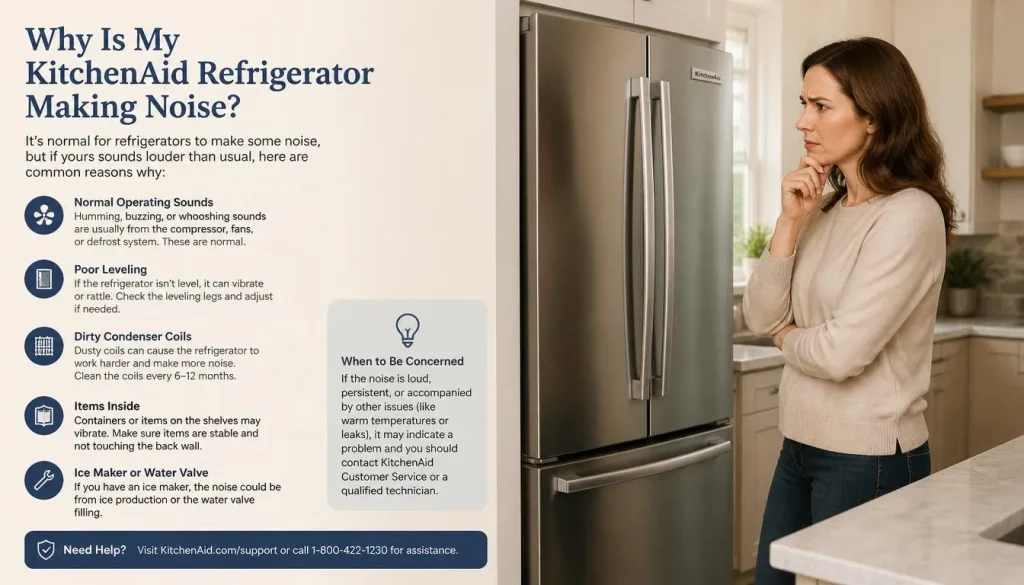
Modern refrigerators are not completely silent. They use compressors, fans, valves, refrigerant lines, ice makers, water dispensers, and automatic defrost systems that produce different sounds throughout the day.
A new KitchenAid refrigerator may also sound different from an older appliance. Brief and predictable sounds that occur during cooling, defrosting, ice production, or water dispensing are often normal. KitchenAid lists buzzing, gurgling, popping, rattling, hissing, dripping, pulsating, and thumping among the sounds that may occur during normal operation.
Use this table for a quick diagnosis:
| Sound | Most Likely Source | Usually Normal? | First Thing to Check |
|---|---|---|---|
| Low humming | Compressor or fan | Usually | Check whether cooling is normal |
| Brief buzzing | Ice maker or water valve | Often | Check the water supply |
| Repetitive clicking | Cooling valve or ice maker | Sometimes | Check whether the refrigerator is cooling |
| Rattling | Water line, refrigerant flow, or leveling | Often | Make sure the refrigerator is level |
| Popping or cracking | Interior-wall expansion | Usually | Monitor when the sound occurs |
| Gurgling | Refrigerant or defrost water | Usually | No action unless cooling is affected |
| Hissing or sizzling | Defrost water contacting the heater | Usually | Monitor during the defrost cycle |
| Grinding or scraping | Door contact, fan obstruction, or motor problem | Not always | Locate the exact source |
| Thumping or hammering | Water line during a fill cycle | Sometimes | Inspect the water line |
| High-pitched pulsing | Compressor or fan speed changes | Often | Check whether the sound is brief |
| Beeping | Door, temperature, or filter alert | Depends | Check the control panel |
| Constant loud noise | Fan, compressor, installation, or airflow issue | Usually not | Begin troubleshooting |
A sound is more likely to require attention when it is unusually loud, continues without stopping, begins suddenly, or is accompanied by poor cooling, leaking water, heavy frost, overheating, or an electrical smell.
Why Is My KitchenAid Refrigerator Making Noise?
The cause depends largely on the sound itself. Listen from the front, inside the freezer, near the dispenser, and around the lower or rear section of the refrigerator. You do not need to pull the appliance apart to identify the general location.
KitchenAid Refrigerator Making a Buzzing Noise
A brief buzzing noise commonly comes from the water inlet valve when the ice maker fills or someone uses the water dispenser.
If the refrigerator has an ice maker but is not connected to a water supply, the inlet valve may buzz or click as it attempts to fill the ice maker. In that situation, the ice maker should normally be switched off according to the instructions for the model.
A louder-than-usual buzzing sound may also be associated with:
- A partially closed household water valve
- A kinked or pinched water supply line
- An incorrectly installed water filter
- A restricted or overdue water filter
- The refrigerator vibrating against surrounding cabinetry
- Increased cooling demand after adding groceries
- Frequent or prolonged door openings
What to do
Confirm that the household water supply is fully open. Inspect the visible section of the water line for bends or compression, especially if the refrigerator was recently installed or moved.
Make sure the filter is correctly fitted and fully locked into its housing. If the refrigerator is not connected to water, switch off the ice maker using the model-specific instructions.
A brief buzz during ice production is usually normal. A constant, harsh buzz combined with poor cooling or overheating should be inspected by a technician.
KitchenAid Refrigerator Making a Humming or Whirring Noise
A low humming or whirring sound often comes from the compressor or one of the circulation fans.
The refrigerator may hum more frequently when:
- The kitchen is warm
- A large amount of food was recently added
- The doors have been opened frequently
- The temperature setting was recently changed
- The refrigerator is recovering after a power interruption
- The appliance was recently installed
- A high-efficiency compressor is changing speed
KitchenAid explains that humming and pulsating noises may occur while the fan and compressor adjust to maintain the selected temperature.
What to do
First, confirm that the refrigerator and freezer are reaching the correct temperatures. Make sure food containers are not blocking the interior air vents.
Check that the refrigerator has the installation clearance recommended in its manual and is not pressed tightly against a wall or cabinet.
If the humming is soft and cooling is normal, it is usually part of regular operation. If it becomes much louder, continues with little interruption, or is accompanied by poor cooling, professional diagnosis may be needed.
KitchenAid Refrigerator Making a Clicking, Ticking, Tapping, or Clacking Noise
A brief click can occur when a cooling component switches on or off, when the ice maker cycles, or when a valve changes position.
Some KitchenAid refrigerators use a dual evaporator valve to direct cooling between compartments. Rapid repetitive clicking can be normal while that valve switches cooling from one compartment to another.
A clacking sound may also occur when:
- Ice is released into the storage bin
- The ice maker ejector moves
- A water valve opens or closes
- A control switches between operating cycles
- Interior materials shift during temperature changes
When clicking may indicate a problem
Pay closer attention when the clicking:
- Repeats continuously without normal cooling starting
- Occurs with a warm refrigerator or freezer
- Is followed by electrical buzzing
- Began suddenly and is getting louder
- Is accompanied by a burning smell
- Occurs after repeated power interruptions
If the refrigerator is clicking but not cooling, disconnecting and reconnecting power once may help rule out a temporary control issue. If the problem returns, avoid repeated resets and contact a qualified technician.
KitchenAid Refrigerator Making a Rattling or Vibrating Noise
Rattling is often caused by installation, objects touching the appliance, water movement, or normal refrigerant flow.
KitchenAid identifies several common sources of rattling and vibration:
- Refrigerant flowing through the cooling system
- Water flowing through the supply line
- Objects stored on top of the refrigerator
- A refrigerator that is not fully level
- An uneven floor beneath the appliance
What to do
Remove loose items from the top of the refrigerator. Make sure bottles, jars, shelves, and containers inside are not touching and vibrating against one another.
Gently press different exterior areas while the sound is occurring. If the noise changes, a nearby cabinet, wall, water line, grille, or loose item may be amplifying normal vibration.
Check whether the refrigerator rocks when light pressure is applied to its corners. Adjust the leveling feet according to the installation manual. If the floor itself is uneven, suitable shims may be required.
Do not make the appliance unstable or excessively tilt it while adjusting the feet.
KitchenAid Refrigerator Making a Knocking, Banging, Thumping, or Hammering Noise
A brief thump may occur when the water valve opens or closes during an ice-maker fill cycle. Water moving suddenly through the supply line can also produce a hammering sound. KitchenAid includes thumping or hammering from the water line during a fill cycle among recognised refrigerator noises.
Other possible sources include:
- A water line striking the wall or cabinet
- Ice dropping into the storage bin
- A large ice piece moving in the ice maker
- Interior materials expanding during cooling
- A refrigerator that is not level
- A loose external panel or grille
- Excessive vibration during compressor operation
What to do
Observe whether the sound happens immediately before or after the ice maker fills. Inspect the visible water line and make sure it has enough space to avoid hitting the wall.
Check the ice bin for large clumps or misplaced ice. Make sure the bin is fully seated.
If the knocking is constant, extremely loud, or coming from the compressor area while cooling performance is declining, arrange professional service.
KitchenAid Refrigerator Making a Grinding, Scraping, or Squealing Noise
Grinding or squealing should be investigated more carefully, especially when it continues after the doors are closed.
KitchenAid notes that grinding or squeaking during door movement may occur when the refrigerator doors rub against surrounding cabinets or other surfaces.
A grinding or scraping sound may also be associated with:
- A door or hinge rubbing against a nearby surface
- A drawer, shelf, or bin sitting incorrectly
- Ice buildup near an internal circulation fan
- Debris near an accessible fan area
- A damaged or worn fan motor
- An ice-dispenser mechanism struggling to move ice
What to do
Open and close each refrigerator and freezer door separately. If the sound happens only during door movement, inspect the door clearance, alignment, hinges, drawers, and surrounding cabinets.
If the noise comes from inside the freezer and changes when the freezer door opens, an internal fan or ice buildup may be involved. Look for visible frost accumulation on the rear interior panel, but do not remove the panel unless the owner’s manual specifically provides a safe user procedure.
Persistent grinding from behind an internal panel or near the compressor should be handled by a technician.
KitchenAid Refrigerator Making a Popping or Cracking Noise
Popping and cracking are usually caused by the refrigerator’s interior surfaces expanding and contracting as temperatures change.
These sounds may be more noticeable:
- During initial cooling after installation
- After the doors have been open for a long time
- During or after a defrost cycle
- After a large amount of warm food is added
- When the kitchen becomes significantly warmer or cooler
KitchenAid states that contraction and expansion of the refrigerator’s interior walls can cause popping or cracking, particularly during initial cooling or defrosting. This is generally normal.
No repair is normally needed when the sound is brief and cooling remains consistent.
KitchenAid Refrigerator Making a Gurgling, Bubbling, or Dripping Noise
A gurgling or bubbling sound often comes from refrigerant moving through the cooling tubing after a cooling cycle. Dripping may come from water moving through the defrost drain system.
These sounds are generally normal when they are:
- Soft or moderate
- Intermittent
- Heard after the compressor stops
- Heard during or after defrosting
- Not accompanied by visible water leakage
KitchenAid identifies refrigerant flow as a common source of gurgling and defrost water as a source of dripping or sizzling sounds.
When to investigate
Check for a problem if you also notice:
- Water on the floor
- Water collecting beneath drawers
- Ice forming under the freezer basket
- A blocked or overflowing drain area
- Unusual odours
- Rising refrigerator temperatures
A dripping sound alone may be normal. A dripping sound combined with visible leakage requires further inspection.
KitchenAid Refrigerator Making a Hissing or Sizzling Noise
Hissing or sizzling often occurs when water from the defrost cycle contacts the defrost heater or moves through the drain system.
A short hiss may also occur as refrigerant pressure balances after a cooling cycle. These sounds usually stop on their own.
Contact a technician if the hissing is unusually loud, continuous, accompanied by poor cooling, or associated with an oily residue. Do not attempt to open or repair the sealed refrigerant system.
KitchenAid Refrigerator Making a High-Pitched, Pulsating, or Whining Noise
High-efficiency compressors and fans can change speed according to cooling demand. These speed changes may produce a brief high-pitched, pulsating, or whining sound.
KitchenAid explains that high-frequency sounds may result from fan operation, refrigerant movement, pressure equalisation, or a variable-speed compressor adjusting its output. A normal high-pitched sound is generally soft, brief, and connected to regular cooling cycles.
When it may not be normal
Arrange further inspection when the sound:
- Becomes piercing or extremely loud
- Continues without interruption
- Is accompanied by vibration
- Comes from a fan that appears to be struggling
- Occurs with poor cooling
- Began immediately after an electrical problem
KitchenAid Refrigerator Making a Swooshing or Whooshing Noise
A soft swooshing sound is often moving air. The evaporator and condenser fans circulate air through the appliance and across cooling components.
You may hear the sound:
- After closing a door
- When a fan starts
- During rapid cooling
- After adding groceries
- When the compressor changes speed
- While air moves between compartments
A faint airflow sound is generally normal. A loud whooshing sound combined with weak cooling may indicate blocked vents, an overfilled compartment, frost accumulation, or a fan problem.
Make sure packages are not pressed against the interior vents. Leave enough space for cold air to circulate around the food.
Why Is My KitchenAid Refrigerator Beeping or Chirping?
Beeping usually comes from an alert rather than a mechanical component.
Possible causes include:
- A door left open
- A door that is not sealing correctly
- A temperature warning
- A recent power interruption
- A water-filter alert
- A control-panel notification
- A filter that was replaced but not correctly installed
- A filter status that was not reset
On some KitchenAid models, the filter indicator may flash and an alert tone may sound when the water filter needs replacement or has not been fitted correctly.
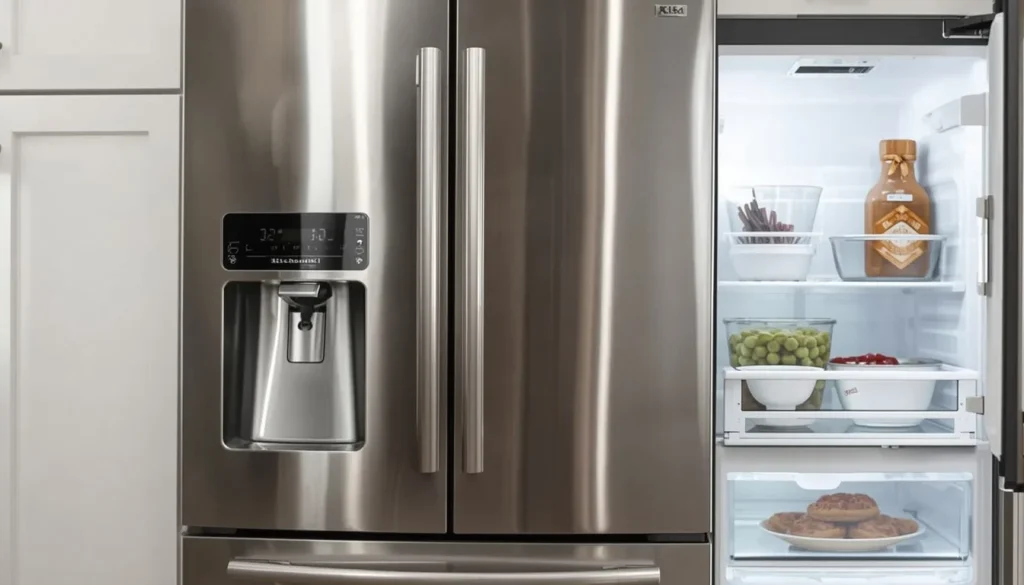
Check that all doors and drawers are fully closed. Look at the control panel for a temperature, power, door, or filter message.
For persistent chirping from a built-in model, KitchenAid recommends verifying that the sound is actually coming from the refrigerator, cycling power, and arranging service if the sound continues.
Why Does My KitchenAid Refrigerator Chatter When Dispensing Water?
Chattering or rapid clicking during water dispensing is often related to restricted water flow or rapidly changing water pressure.
Possible causes include:
- A kinked water line
- A partially closed water valve
- An incorrectly installed filter
- A clogged filter
- Air trapped after filter replacement
- A water inlet valve reacting to inconsistent flow
KitchenAid specifically identifies a kinked supply line as a possible cause of chattering or rapid clicking during dispensing.
Inspect the visible water line and confirm that the filter is properly installed. If the filter was recently changed, flush the water system according to the instructions supplied with the refrigerator or filter.
Diagnose the Noise by Where It Is Coming From
When you cannot describe the sound clearly, its location can provide the next clue.
Noise Coming From the Back or Bottom
The compressor, condenser area, drain pan, water line, and some cooling components may be located near the lower or rear section, depending on the model.
Possible sounds include:
- Compressor humming
- Fan whirring
- Water-line vibration
- Drain-pan rattling
- Refrigerant gurgling
- Brief clicking as a component switches
- Vibration against a wall or cabinet
Check the installation clearance and make sure the refrigerator is not touching surrounding surfaces.
Do not remove electrical covers or sealed-system components. Only clean areas that the owner’s manual identifies as user-accessible.
Noise Coming From Inside the Freezer
The freezer contains or connects to components involved in air circulation, ice production, and defrosting.
Possible causes include:
- Normal evaporator-fan airflow
- Ice dropping into the bin
- The ice maker filling
- Frost or ice interfering with airflow
- An internal fan problem
- Defrost water moving through the system
If the noise changes or stops when the freezer door opens, an internal circulation fan may be involved. Check for visible frost and blocked vents.
Loud clicking, buzzing, or humming combined with a freezer that is not staying cold may require inspection of the evaporator fan or another cooling component.
Noise Coming From the Refrigerator Compartment
Sounds from the fresh-food compartment may come from:
- Air moving through the vents
- A damper changing position
- Shelves or containers vibrating
- Bottles touching each other
- A fan circulating cold air
- A cooling valve switching compartments
- Interior walls expanding or contracting
Rearrange food so that the vents remain open. Make sure shelves, drawers, and door bins are correctly installed.
Noise Coming From the Door, Ice Maker, or Dispenser
Sounds around the dispenser may be related to:
- The water inlet valve
- Water moving through the line
- A restricted water filter
- Air in the water system
- The ice maker ejecting cubes
- Ice falling into the bin
- The dispenser motor
- Ice cubes becoming stuck
Observe whether the noise occurs only when dispensing water, dispensing ice, or filling the ice maker. That timing can quickly narrow the cause.
When Does Your KitchenAid Refrigerator Make the Noise?
The timing of the noise is often as useful as the sound itself.
The Noise Stops When You Open the Freezer Door
A sound that stops or changes when the freezer door opens may be connected to the internal circulation fan because some models alter fan operation when a door is opened.
Possible causes include:
- Normal evaporator-fan operation
- Frost near the fan area
- A fan blade contacting ice
- A worn fan motor
- Restricted interior airflow
Check for heavy frost on the freezer’s rear interior wall and make sure food is not blocking the vents. Repeated frost accumulation or persistent fan noise requires professional diagnosis.
The Noise Happens While Making Ice
The ice maker may produce several normal sounds:
- Buzzing as the water valve opens
- Water flowing into the ice mould
- Clicking or clacking as the mechanism cycles
- Ice cracking during freezing
- Cubes dropping into the storage bin
- A brief motor sound during ice ejection
Check that the water supply is fully open, the line is not kinked, and the ice bin is correctly positioned.
If the ice maker is switched on without a connected water supply, turn it off according to the model instructions.
The Noise Happens While Dispensing Water
Noise during dispensing is commonly connected to the water line, filter, or inlet valve.
Check:
- Whether the filter is fully locked in place
- Whether the water line is bent
- Whether the water valve is completely open
- Whether water flow has become slower
- Whether the filter is due for replacement
- Whether the noise began immediately after replacing the filter
An incorrectly installed or clogged filter can reduce water flow and contribute to dispenser concerns.
The Noise Started After Replacing the Water Filter
A recently replaced filter may introduce air into the water system. This can cause temporary sputtering, dripping, irregular water flow, or unusual dispenser sounds.
Flush the system using the amount of water specified for the filter and refrigerator model. KitchenAid states that flushing after a filter change helps remove excess air and loose carbon from the system.
Also confirm that the filter:
- Matches the refrigerator model
- Is installed in the correct direction
- Is fully inserted
- Has formed a proper seal
- Is not damaged
The Noise Happens Every Few Minutes
A sound that repeats every few minutes may correspond with a normal operating cycle, such as:
- Compressor cycling
- A fan changing speed
- The ice maker requesting water
- A cooling valve switching compartments
- The refrigerator recovering after a door opening
- A defrost-related process
Record what the refrigerator is doing when the sound happens. If the sound is brief and cooling remains stable, it may be normal.
Repeated attempts to start cooling followed by silence, rising temperatures, or continuous clicking should be inspected.
The Refrigerator Makes Noise Constantly
A refrigerator may run for extended periods when cooling demand is high. Common reasons include:
- Warm room conditions
- Frequent door openings
- A large grocery load
- Blocked interior vents
- Incorrect temperature settings
- Poor door sealing
- Recent installation
- Dust in a user-accessible condenser area
- Insufficient installation clearance
If the refrigerator never seems to become quiet and the compartments are too warm, begin with airflow, door seals, temperature settings, leveling, and accessible condenser cleaning.
A New KitchenAid Refrigerator Is Making Loud Noise
A new refrigerator may sound different from the appliance it replaced. Modern fans and variable-speed compressors may operate at different frequencies, and the refrigerator may run longer while reaching its initial temperature.
Initial sounds may include:
- Humming
- Pulsating
- Popping
- Cracking
- Water filling
- Ice dropping
- Gurgling
- Fan airflow
Allow the refrigerator time to stabilise after installation. KitchenAid advises allowing approximately 24 hours for a recently installed appliance to reach the proper temperature.
Also verify that all packaging has been removed, the appliance is level, doors seal correctly, and the water line is not trapped behind the refrigerator.
The Noise Started After Moving the Refrigerator
Moving the refrigerator can change its leveling, water-line position, clearance, or internal component alignment.
Check for:
- A pinched water line
- The cabinet touching a wall
- Uneven leveling feet
- A loose grille
- Items shifted inside
- The ice bin sitting incorrectly
- The power cord or water line touching a vibrating surface
Allow the refrigerator to return to normal operating temperature after it has been repositioned.
The Refrigerator Is Louder at Night
Many normal refrigerator sounds seem louder at night because the kitchen and surrounding rooms are quieter.
Compressor speed changes, water-valve buzzing, ice dropping, and refrigerant movement may become more noticeable without daytime background noise.
The sound is not necessarily abnormal simply because it is easier to hear at night. Focus on whether it is new, unusually loud, continuous, or connected to a cooling problem.
How to Troubleshoot a Noisy KitchenAid Refrigerator
Follow these steps in order. Avoid replacing parts until you have identified the type, location, and timing of the noise.
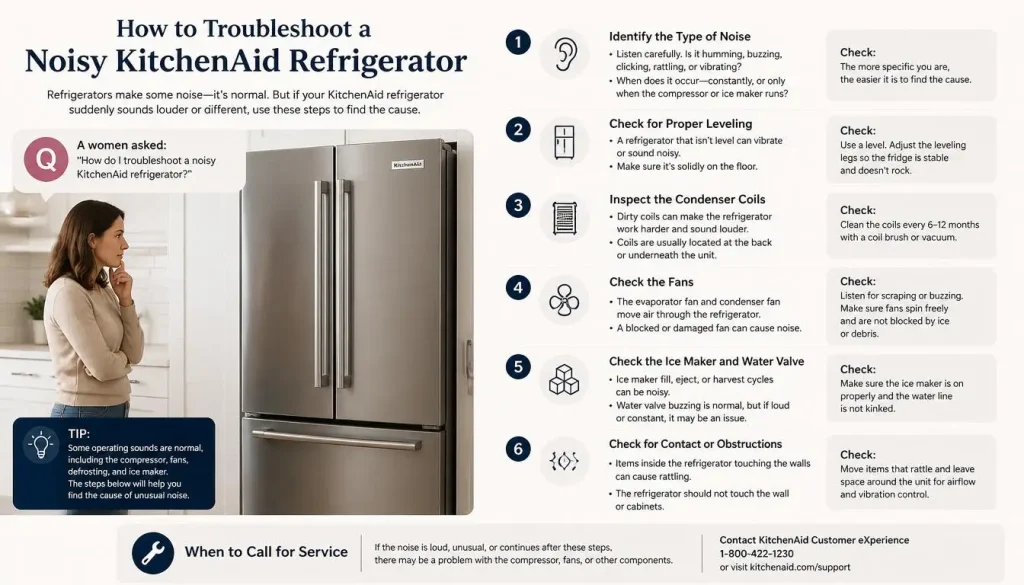
1. Identify the Sound
Try to describe it accurately:
- Buzzing
- Humming
- Clicking
- Rattling
- Grinding
- Popping
- Gurgling
- Hissing
- Beeping
- Thumping
- Whining
Record a short audio or video clip if the sound is intermittent. This can help a technician diagnose the issue later.
2. Locate the Source
Listen near:
- The freezer interior
- The refrigerator compartment
- The water dispenser
- The ice maker
- The lower front grille
- The rear of the appliance
- The surrounding cabinets
Do not place your hands near moving parts or exposed electrical areas.
3. Check Whether the Refrigerator Is Level
A refrigerator that rocks or leans may transmit vibration through the floor and cabinetry.
Use a spirit level or suitable leveling tool. Adjust the feet or rollers using the procedure in the owner’s manual. Make sure all corners are stable and the doors align and seal correctly.
4. Remove Items Causing Vibration
Check for:
- Bottles touching each other
- Loose shelves
- Incorrectly fitted door bins
- Containers resting against an interior wall
- Objects stored on top
- A refrigerator touching nearby cabinets
- A water line contacting the wall
Small adjustments can make a noticeable difference.
5. Check the Ice Maker and Water Supply
Confirm that:
- The water valve is fully open
- The water line is not kinked
- The filter is correctly installed
- The filter is not overdue for replacement
- The ice bin is fully seated
- Ice is not jammed in the dispenser
- The ice maker is switched off if no water supply is connected
6. Inspect the Interior for Frost and Blocked Vents
Look for:
- Heavy frost on the freezer’s rear wall
- Food packages covering vents
- Ice around the ice-maker area
- Drawers preventing doors from closing
- A loose or misplaced shelf
Do not use sharp objects to remove ice. They can damage internal surfaces or refrigerant tubing.
7. Clean the Accessible Condenser Area
Not every KitchenAid refrigerator requires the same condenser maintenance. Follow the instructions for your exact model.
Where user cleaning is permitted:
- Disconnect the refrigerator from power.
- Remove only the grille or cover identified in the owner’s manual.
- Use a vacuum with a soft brush to remove accessible dust and debris.
- Reinstall all user-removable parts.
- Reconnect power.
KitchenAid recommends disconnecting power before cleaning the accessible condenser area and using a soft vacuum brush where applicable.
8. Check Door Clearance and Seals
Open each door slowly and listen for scraping or squeaking. Make sure the doors are not rubbing against cabinets, walls, trim, drawers, or each other.
Inspect the door seals for:
- Food residue
- Tears
- Folded sections
- Gaps
- Items preventing full closure
Poor sealing can increase cooling demand and make normal operating sounds occur more frequently.
9. Check the Temperature and Airflow
Make sure the controls are not set unnecessarily cold. Confirm that interior vents are clear and the refrigerator is not installed next to a major heat source.
Blocked vents can cause uneven temperatures and longer cooling cycles. KitchenAid advises keeping airflow paths open between the freezer and refrigerator compartments.
10. Find the Model Number
KitchenAid refrigerator designs vary. The location of fans, coils, filters, valves, and service panels depends on whether the appliance is:
- French door
- Side-by-side
- Bottom freezer
- Built-in
- Multi-door
- Counter-depth
Use the model number to locate the correct owner’s manual before adjusting, cleaning, or replacing anything.
What Does the Noise Mean When the Refrigerator Has Another Problem?
A noise becomes more concerning when it occurs with another symptom.
KitchenAid Refrigerator Making Noise but Still Cooling
If the refrigerator is cooling normally, the sound may come from:
- Regular compressor operation
- Fan airflow
- Ice production
- Refrigerant movement
- Defrosting
- Leveling or vibration
- Containers touching
- Water moving through the supply line
Start with simple installation and vibration checks. Monitor whether the sound changes or becomes more frequent.
KitchenAid Refrigerator Making Noise and Not Cooling
Noise combined with poor cooling may indicate a more serious airflow, fan, control, compressor, or refrigeration-system problem.
Before requesting service, check:
- The refrigerator has power
- Cooling is switched on
- The appliance is not in showroom or demonstration mode
- Temperature controls are correctly set
- Doors are fully closed
- Air vents are clear
- The refrigerator is level
- The accessible condenser area is clean
- The room is within the operating range specified in the manual
KitchenAid’s troubleshooting guidance also recommends checking cooling settings, airflow, installation conditions, door use, recent food loads, and condenser cleanliness when both compartments are not cooling properly.
If basic checks do not restore cooling, arrange professional service.
KitchenAid Refrigerator Clicking and Not Cooling
Continuous clicking without normal cooling may indicate that a cooling or electrical component is repeatedly attempting to operate.
Disconnect the refrigerator from power if you notice:
- A burning smell
- Smoke
- Scorched wiring
- A hot electrical connection
- Repeated circuit-breaker trips
Otherwise, verify the settings, power supply, door closure, vents, and installation conditions. Persistent clicking with rising temperatures requires technician diagnosis.
KitchenAid Refrigerator Buzzing and Not Cooling
Buzzing with poor cooling may come from:
- A fan that is obstructed or failing
- A cooling component working under excessive load
- Restricted airflow
- A refrigerator installed too close to surrounding surfaces
- A water valve buzzing independently of the cooling issue
- A compressor or electrical problem requiring diagnosis
Determine whether the buzz comes from the water-valve area or the cooling-system area. This distinction can prevent unnecessary part replacement.
Freezer Is Cold but Refrigerator Is Warm and Noisy
When the freezer remains cold but the refrigerator compartment becomes warm, cold-air circulation may be restricted.
Possible causes include:
- Blocked vents
- Food packed too tightly
- Heavy frost accumulation
- A circulation-fan problem
- An air-control component not opening correctly
- A door that is not sealing
Move food away from the vents and check for visible frost. If airflow does not improve, arrange service.
Refrigerator Is Noisy and Has Heavy Frost Buildup
Heavy frost may restrict airflow and interfere with internal fan operation.
Check for:
- A door left partly open
- Food preventing the door from closing
- A damaged or dirty door seal
- Frequent door openings
- Warm food placed near vents
- Recurring frost after manual defrosting
Recurring frost may indicate a defrost-system, airflow, sensor, or sealing problem that requires professional diagnosis.
Refrigerator Makes a Dripping Noise and Leaks Water
A dripping noise without visible water may be normal during defrosting. Visible water changes the diagnosis.
Check:
- Whether the filter is installed correctly
- Whether the filter housing is leaking
- Whether the water line is damaged
- Whether the drain pan is incorrectly positioned
- Whether ice is melting because of a cooling problem
- Whether water is collecting beneath drawers
Disconnect the water supply if a water line or connection is actively leaking and arrange repair.
Does the KitchenAid Refrigerator Style Affect the Noise?
Yes. The source may be in a different location depending on the refrigerator design.
French-Door and Bottom-Freezer Models
Fan and ice-maker sounds may be more noticeable near the freezer drawer or rear freezer wall. Some models also use valves that switch cooling between compartments.
Side-by-Side Models
Water-dispenser, ice-maker, and freezer-fan sounds may be easier to hear because the freezer and dispenser systems occupy one side of the appliance.
Built-In Models
Built-in refrigerators may place certain mechanical components near the top. A noise from the upper grille may therefore have a different source from a similar noise in a freestanding model.
Multi-Door and Quad-Door Models
These models may use additional airflow controls, fans, or cooling zones. Brief switching and airflow sounds can occur as the appliance regulates different compartments.
Always use the model-specific manual when locating components.
When Is KitchenAid Refrigerator Noise Not Normal?
Arrange further inspection when you notice one or more of these warning signs:
- The noise suddenly becomes much louder
- Grinding or scraping continues after the doors are closed
- Clicking repeats while the refrigerator becomes warmer
- A loud fan sound occurs with heavy frost
- The refrigerator is not cooling properly
- Water is leaking onto the floor
- The compressor area becomes unusually hot
- There is a burning or electrical smell
- The appliance repeatedly trips a circuit breaker
- The noise continues after basic troubleshooting
- A high-pitched sound becomes piercing or constant
- The refrigerator vibrates excessively despite being level
Do not ignore unusual noise combined with electrical smells, smoke, sparking, or overheating. Disconnect power when it is safe to do so and seek professional assistance.
When Should You Call a KitchenAid Technician?
Contact a qualified appliance technician when:
- The refrigerator is not maintaining safe temperatures
- A fan motor appears damaged
- Grinding comes from behind an internal panel
- Frost quickly returns after defrosting
- Repeated clicking occurs without cooling
- The refrigerator leaks from an internal component
- The compressor or sealed system is unusually noisy
- Electrical testing is required
- The appliance remains under warranty
- The troubleshooting steps in the owner’s manual do not solve the problem
Attempting sealed-system or live-electrical repairs without the correct tools and training can damage the refrigerator and create a safety risk.
How to Prevent Your KitchenAid Refrigerator From Becoming Noisy
Regular care can prevent some avoidable refrigerator noises.
- Keep the refrigerator level and stable.
- Maintain the installation clearance specified in the manual.
- Avoid placing loose objects on top of the appliance.
- Keep bottles and containers from touching.
- Do not block the interior air vents.
- Check the visible water line after moving the refrigerator.
- Install the correct water filter securely.
- Flush the water system after replacing the filter.
- Keep the ice bin properly positioned.
- Clean the accessible condenser area as directed for the model.
- Keep door seals clean and make sure nothing prevents closure.
- Address unusual frost buildup early.
- Use the model-specific manual for maintenance and adjustments.
Frequently Asked Questions
Why is my new KitchenAid refrigerator so loud?
A new KitchenAid refrigerator may use a different compressor, fan system, cooling layout, or ice maker from your previous appliance. It may also run longer during initial cooling. Humming, pulsating, popping, airflow, gurgling, and ice-making sounds can be normal if cooling performance is stable.
Why does my KitchenAid refrigerator make noise at night?
Refrigerator sounds often seem louder at night because the surrounding environment is quieter. Compressor speed changes, fan airflow, ice dropping, water-valve buzzing, and refrigerant movement may be easier to hear.
Why does my KitchenAid refrigerator noise stop when I open the door?
A sound that changes or stops when the freezer door opens may be related to the internal circulation fan. Normal fan operation, frost near the fan area, or a fan problem may be involved. Check for visible frost and blocked vents.
Why is my KitchenAid refrigerator buzzing every few minutes?
The ice maker may be requesting water, the water inlet valve may be opening, or the refrigerator may be entering a cooling cycle. Check the water supply, filter, and ice-maker settings. Switch off the ice maker if it is not connected to water.
Is clicking normal in a KitchenAid refrigerator?
Brief clicking can be normal when a valve, ice maker, control, or cooling component changes state. Some models produce repetitive clicks while switching cooling between compartments. Clicking is more concerning when it continues with poor cooling.
Why is my KitchenAid refrigerator humming constantly?
The refrigerator may run longer because of warm room conditions, frequent door openings, a large grocery load, blocked vents, poor door sealing, recent installation, or high cooling demand. If temperatures are incorrect, inspect airflow, leveling, door seals, and accessible condenser areas.
Why is my KitchenAid refrigerator making a loud fan noise?
A fan may be running at a higher speed because cooling demand has increased. A loud or irregular fan sound may also be caused by frost, blocked airflow, debris, or motor wear. A fan-related sound that occurs with poor cooling should be professionally diagnosed.
Why does my KitchenAid refrigerator make noise after replacing the filter?
Air may have entered the water system, or the filter may not be fully seated. Confirm correct installation and flush the system according to the model instructions.
Can a clogged water filter make a refrigerator noisy?
A clogged filter can restrict water flow to the dispenser and ice maker. This may contribute to buzzing, chattering, reduced water flow, or slow ice production. Replace the filter when required and make sure the replacement is correctly installed.
Can a dirty condenser make a refrigerator noisy?
Dust and debris in a user-accessible condenser area may restrict airflow and increase cooling-system workload. Follow the model-specific cleaning instructions, disconnect power first, and clean only the areas intended for user maintenance.
Should I unplug a noisy KitchenAid refrigerator?
Normal humming, popping, gurgling, or brief buzzing does not usually require unplugging the appliance. Disconnect power if the refrigerator produces smoke, a burning smell, severe grinding, electrical arcing, repeated breaker trips, or signs of overheating.
How do I know whether the compressor is making the noise?
Compressor sounds generally come from the lower rear or mechanical area of the refrigerator, although the location varies by model. A soft hum, pulse, or brief change in pitch may be normal. Loud knocking, repeated failed starting sounds, overheating, or poor cooling requires professional diagnosis.
Final Verdict
Most KitchenAid refrigerator noises come from normal compressor operation, fan airflow, refrigerant movement, ice production, water dispensing, or automatic defrosting.
Start by identifying what the noise sounds like, where it is loudest, and when it occurs. Then check the refrigerator’s leveling, surrounding clearance, interior airflow, water supply, water filter, ice maker, door seals, and accessible condenser area.
Brief humming, gurgling, popping, hissing, clicking, and buzzing may be normal when the refrigerator is cooling properly. Persistent grinding, scraping, repeated clicking, extreme vibration, or noise combined with poor cooling, leaking, heavy frost, or an electrical smell should be inspected by a qualified appliance technician.

Hi, I’m the lead researcher and appliance enthusiast behind RefrigeratorSolve. With years of hands-on experience troubleshooting cooling systems and testing home appliances, I am dedicated to bringing you honest reviews, energy-saving tips, and practical solutions to keep your refrigerator running perfectly.