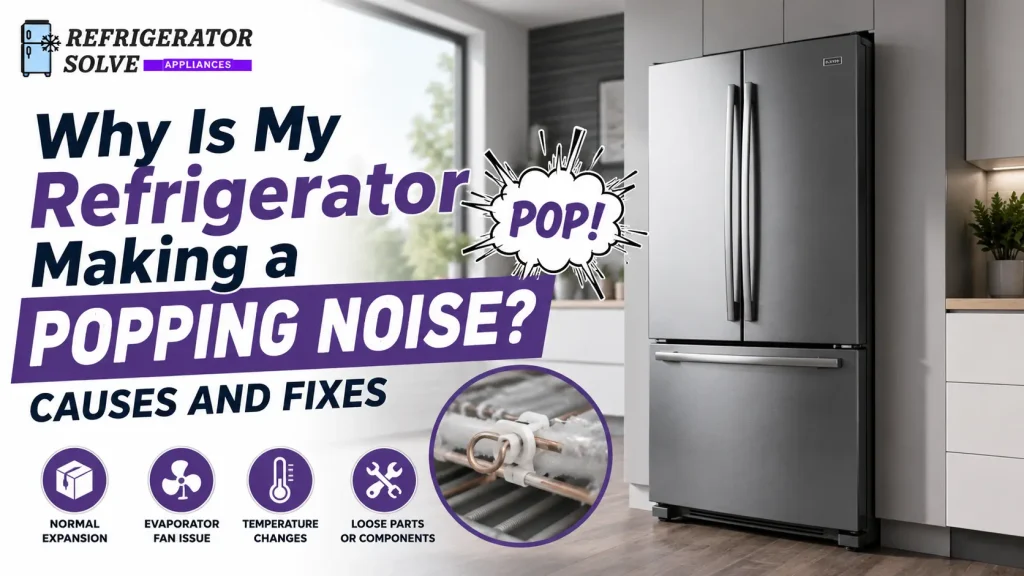
You are sitting in a quiet kitchen when your refrigerator suddenly makes a sharp pop. A few minutes later, it happens again. Naturally, you may wonder whether something inside the appliance is breaking.
The good news is that an occasional popping or cracking sound is usually part of normal refrigerator operation. Temperature changes can cause plastic liners, metal panels, cooling coils, and other internal components to expand or contract. Automatic defrost cycles and ice makers can also produce surprisingly loud pops.
However, repeated popping accompanied by poor cooling, rapid clicking, sparks, a burning smell, frost buildup, or a tripped circuit breaker may indicate a problem that needs professional attention.
This guide explains what causes a refrigerator to make a popping noise, how to identify the source, which fixes are safe to try yourself, and when you should stop troubleshooting and contact an appliance technician.
Quick Answer
Your refrigerator is most likely making a popping noise because its internal walls and other components are expanding or contracting as the temperature changes. This is particularly common during the automatic defrost cycle, after the refrigerator starts cooling, and during the first few weeks of using a new appliance.
Other possible causes include:
- Ice dropping into an empty ice bin
- The ice maker ejecting cubes
- A water valve operating
- The compressor starting or stopping
- A refrigerator that is not level
- Loose shelves, trays, bottles, or external panels
- The refrigerator touching a wall or cabinet
- Ice buildup interfering with a fan
- A faulty compressor start relay
An isolated pop with normal cooling is rarely an emergency. Frequent clicking or popping combined with cooling problems should be investigated.
Official guidance from Whirlpool, Samsung, LG, and GE confirms that expansion and contraction during cooling or defrosting commonly produce normal popping and cracking sounds. al for a Refrigerator to Make Popping Noises?
Yes, an occasional popping noise is usually normal.
A modern refrigerator does not run silently. It uses a compressor, circulating fans, refrigerant lines, a defrost system, water valves, dampers, and sometimes an automatic ice maker. Different components switch on and off throughout the day, creating clicks, pops, hums, hisses, and cracking sounds.
A normal popping sound usually has these characteristics:
- It happens occasionally rather than continuously.
- The refrigerator is still cooling properly.
- There is no burning smell or electrical odor.
- The power cord and outlet are not unusually hot.
- There is no water leaking from the appliance.
- The noise often occurs after a cooling or defrost cycle.
- The sound may be louder when the kitchen is quiet.
- The frequency may decrease as a new refrigerator settles.
Samsung notes that plastic refrigerator parts can expand and contract as temperatures change, especially during defrosting. The company also explains that these sounds may be more noticeable in new refrigerators as they adjust to the temperature and humidity of their surroundings. nd becomes more concerning when it happens every few seconds, becomes progressively louder, or appears with another symptom such as weak cooling, a non-running compressor, scraping, excessive frost, electrical problems, or repeated power interruptions.
What Causes a Refrigerator to Make a Popping Noise?
The exact cause depends on where the noise comes from, when it occurs, and whether the refrigerator has an ice maker or water dispenser.
Here are the most common explanations.
1. Thermal Expansion and Contraction
The most common cause is thermal expansion and contraction.
The temperature inside a refrigerator changes throughout the day. When the compressor runs, the interior becomes colder. When the compressor stops or the defrost heater activates, the temperature rises slightly.
These changes cause plastic liners, shelves, insulation, tubing, and metal panels to expand or contract at different rates. The materials may shift suddenly and create a pop, snap, or cracking sound.
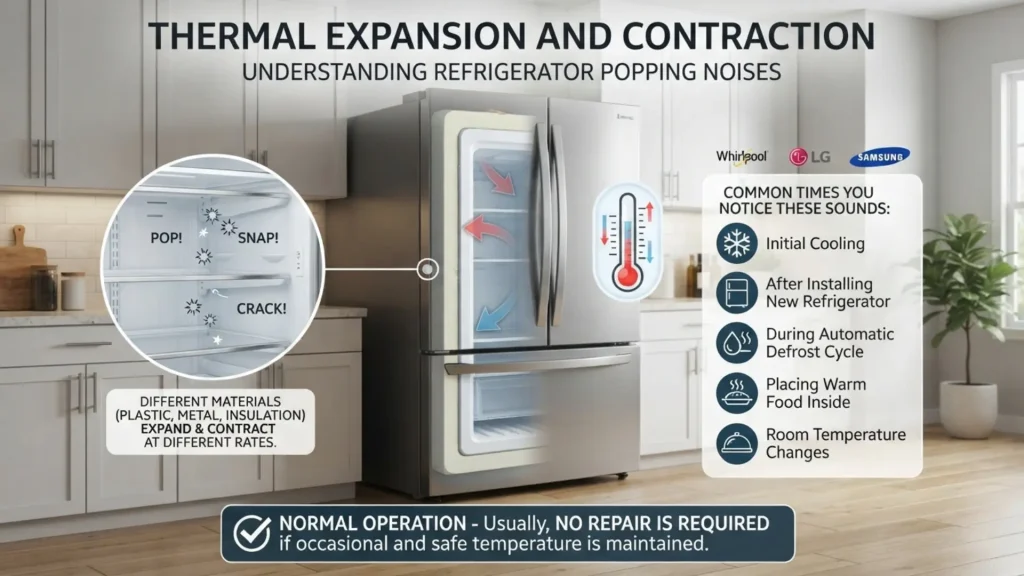
You are more likely to notice this sound:
- When the refrigerator first starts cooling
- After installing a new refrigerator
- During or after an automatic defrost cycle
- After placing a large amount of warm food inside
- After leaving the doors open for an extended period
- When room temperature changes significantly
- During hot weather when the refrigerator runs more often
Whirlpool identifies contraction and expansion of the refrigerator’s interior walls as a normal cause of popping, particularly during initial cooling and defrosting. LG and Samsung provide similar explanations for cracking and snapping noises caused by temperature changes. mal Popping Need to Be Fixed?
Usually, no repair is required.
If the sound is occasional and the refrigerator maintains a safe, stable temperature, the appliance is probably operating normally. You may be able to make the noise less noticeable by ensuring that the refrigerator is level, has the correct ventilation clearance, and is not touching nearby cabinets.
2. The Automatic Defrost Cycle
Most frost-free refrigerators run an automatic defrost cycle periodically. During this cycle, the refrigerator temporarily warms the evaporator area to melt accumulated frost.
As frost melts and internal components change temperature, you may hear:
- Popping
- Crackling
- Sizzling
- Dripping
- Hissing
- Light tapping
The sound may appear to come from the freezer compartment or behind its rear interior panel.
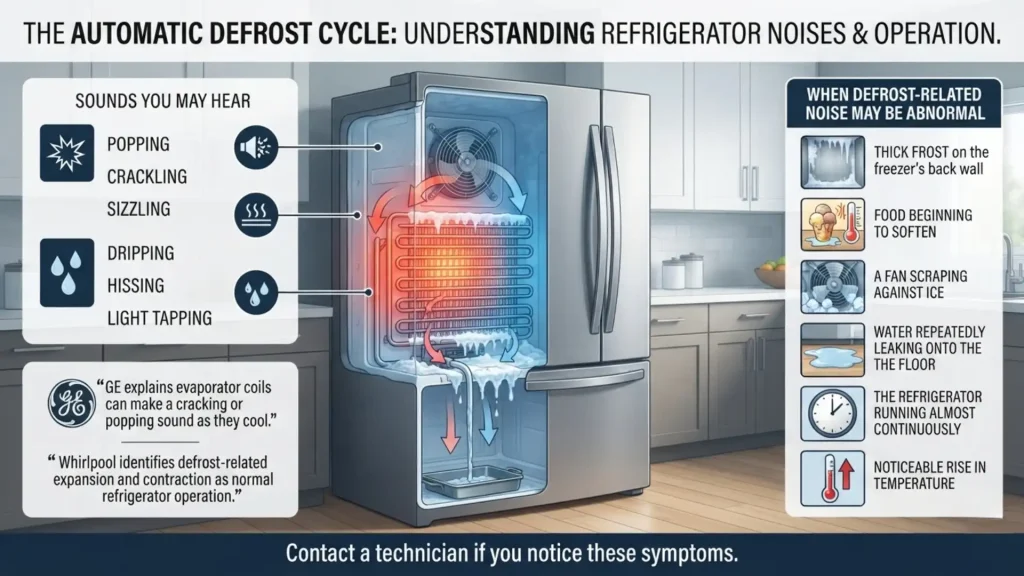
GE explains that evaporator coils can make a cracking or popping sound as they cool following a defrost cycle. Whirlpool also identifies defrost-related expansion and contraction as normal refrigerator operation. frost-Related Noise May Be Abnormal
Contact a technician if the popping is accompanied by:
- Thick frost on the freezer’s back wall
- Food beginning to soften
- A fan scraping against ice
- Water repeatedly leaking onto the floor
- The refrigerator running almost continuously
- A noticeable rise in temperature
These symptoms may suggest a defrost-system, drain, sensor, fan, or airflow problem rather than ordinary expansion.
3. Ice Maker Operation
If your refrigerator has an automatic ice maker, the sound may be completely normal.
An ice maker can produce a pop or crack when:
- Cubes are released from the ice mold
- The ice tray twists or rotates
- Ice falls into the storage bin
- A water valve opens or closes
- Water enters the ice maker
- Cubes shift inside the bin
Ice falling into an empty plastic bin can sound much louder than expected. Whirlpool specifically notes that ice ejection and cubes falling into an empty bucket can create loud cracking or banging sounds during normal operation. st the Ice Maker
Turn the ice maker off using the control panel, switch, or shutoff arm described in your owner’s manual. Monitor the refrigerator long enough to determine whether the popping stops.
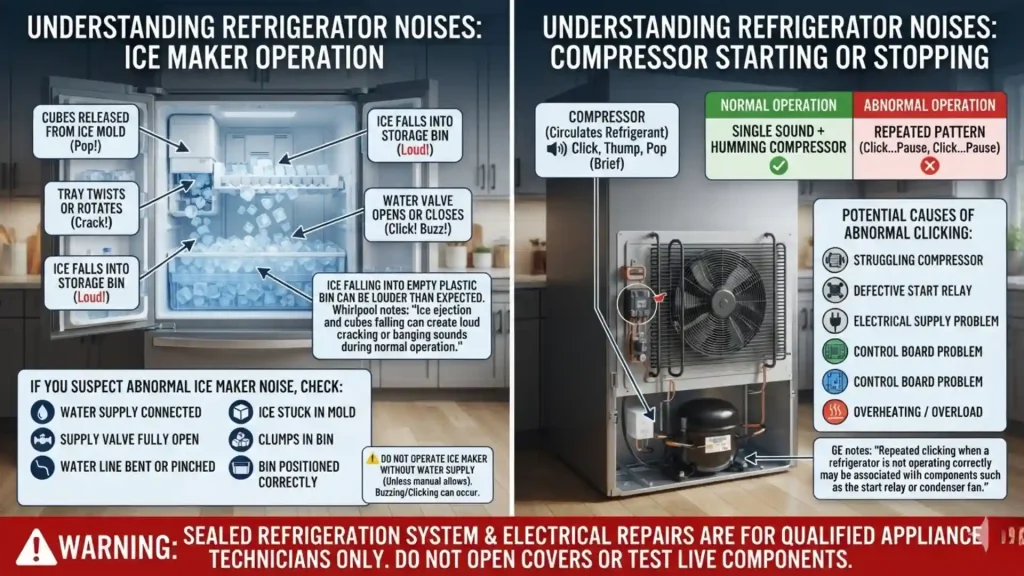
If the noise disappears while the ice maker is off, check:
- Whether the water supply is connected
- Whether the supply valve is fully open
- Whether the water line is bent or pinched
- Whether ice is stuck in the mold
- Whether large clumps have formed inside the bin
- Whether the bin is positioned correctly
Do not leave an ice maker operating without a connected water supply unless your refrigerator’s manual specifically allows it. Some refrigerators may make repeated buzzing or clicking sounds when the water valve attempts to fill an ice maker that has no water connection. pressor Starting or Stopping
The compressor is responsible for circulating refrigerant through the cooling system. When it starts or stops, you may hear a brief click, thump, or pop from the lower rear section of the refrigerator.
A single sound followed by a normal humming compressor is not usually a problem.
However, pay attention if you hear a repeated pattern like this:
Click, pause, click, pause—without the compressor staying on.
Rapid or repeated clicking accompanied by inadequate cooling can indicate:
- A struggling compressor
- A defective compressor start relay
- An electrical supply problem
- A control-board problem
- Overheating or overload protection
GE notes that repeated clicking when a refrigerator is not operating correctly may be associated with components such as the start relay or condenser fan. d sealed-refrigeration-system repairs should be handled by a qualified appliance technician. Do not open electrical covers, test live components, or attempt to replace compressor parts unless you have the required training and testing equipment.
5. Refrigerant Moving Through the Cooling System
Refrigerant moving through tubes can create gurgling, tapping, bubbling, or occasional popping sounds. Pressure changes are particularly noticeable when the compressor starts, stops, or when the appliance finishes defrosting.
A light tapping or popping sound without any cooling problem may be normal. GE notes that refrigerant movement can create a normal tapping sound after a defrost cycle. However, a newly developed or unusual noise in an older refrigerator may require service to diagnose. frigerant system should never be opened as a DIY repair. Refrigerant work requires appropriate training, equipment, and compliance with local regulations.
6. A Loose Panel, Shelf, Drawer, or Container
A normal vibration can sound like a loud pop when another object amplifies it.
Possible sources include:
- A refrigerator touching the wall
- A loose rear access panel
- A removable drip tray that is not seated properly
- Bottles touching one another
- Glass shelves that are not positioned correctly
- A drawer or ice bin that is not fully inserted
- Items stored on top of the refrigerator
- A water line tapping against the back panel
- A nearby cabinet touching the refrigerator
Remove items from the top of the appliance and create a small gap between bottles, jars, and glass containers. Check that shelves, drawers, door bins, and the ice bucket are properly seated.
Do not tighten or remove internal panels unless your owner’s manual specifically identifies them as user-serviceable.
7. The Refrigerator Is Not Level
An unlevel refrigerator can transfer vibration into the floor, wall, cabinets, shelves, or body panels. A small internal movement may then sound like a loud pop or knock.
Use a spirit level to check the appliance from side to side and front to back. Follow the leveling procedure in your refrigerator’s installation guide because the adjustment method differs between models.
Whirlpool states that a refrigerator and the floor beneath it should be level to reduce vibration-related noise. Samsung also notes that correct leveling can help prevent noise and other operating problems. ls, the front may need to sit slightly higher than the rear so the doors close correctly. Use the specifications in your manual rather than guessing.
8. Insufficient Clearance Around the Refrigerator
A refrigerator positioned tightly against a wall or kitchen cabinet can transfer normal compressor and fan vibrations into the surrounding structure.
Check that:
- The rear panel is not touching the wall.
- The sides are not pressed against cabinets.
- The top has the required ventilation space.
- The power cord or water line is not trapped behind the appliance.
- The doors can open without striking a wall.
Required clearance differs by model. Consult the installation manual rather than applying one measurement to every refrigerator. Some official Samsung troubleshooting guidance recommends approximately two inches of space in certain situations, while model-specific installation instructions may give different requirements. ldup Around a Fan
A refrigerator fan normally produces a smooth humming or blowing sound. If ice forms around the evaporator fan, the blades may strike the ice and create tapping, popping, clicking, or scraping noises.
A useful clue is whether the noise changes when you open the freezer door. On many models, opening the door stops or changes the evaporator fan.
Possible related symptoms include:
- Frost on the freezer’s rear interior wall
- Reduced airflow
- Uneven cooling
- A warm refrigerator compartment
- A freezer that remains cold while the fresh-food section warms
- A scraping or “playing card in bicycle spokes” sound
A fan blade hitting ice or another obstruction is not considered a normal operating sound and may need professional diagnosis. nives, screwdrivers, boiling water, heat guns, or hair dryers to remove hidden ice. These methods can damage the liner, wiring, drainage system, or refrigerant tubing.
10. A Door Hinge or Closing Cam
If the popping occurs only when you open or close the refrigerator door, the cooling system may not be responsible.
Possible causes include:
- A worn door-closing cam
- A dry or damaged hinge
- A misaligned door
- A loose hinge fastener
- The door rubbing against a cabinet
- The refrigerator being out of level
- A damaged hinge washer
- An overloaded door bin
Watch the top and bottom hinges while another person slowly opens the door. If the door rises, drops, shifts sideways, or makes a pop at the same point every time, the hinge or closing cam may require adjustment or replacement.
Check the owner’s manual before lubricating a hinge. Some lubricants can damage plastic components or attract dirt.
Why Does My Refrigerator Make a Loud Popping Noise?
A normal refrigerator pop can sound alarmingly loud because of the appliance’s large hollow cabinet. The interior walls and panels can amplify a small movement in the same way that a drum amplifies vibration.
The sound may be especially noticeable when:
- The home is quiet at night.
- The refrigerator is new.
- The appliance has just completed a defrost cycle.
- Ice falls into an empty bin.
- The refrigerator is installed in an alcove.
- The appliance is touching a wall or cabinet.
- The floor is hard or uneven.
- The refrigerator is lightly loaded.
- Large temperature changes occur inside the cabinet.
A loud sound does not automatically indicate a serious failure. The timing, frequency, location, and presence of other symptoms are more important than volume alone.
Why Is My New Refrigerator Making Popping Noises?
New refrigerators commonly make noises that are different from those produced by older appliances.
After installation, the refrigerator must cool a room-temperature cabinet, food compartments, shelves, insulation, and internal tubing. The materials experience larger temperature changes than they will during normal daily operation.
A new appliance may also:
- Run longer during initial cooling
- Produce its first batches of ice
- Complete early defrost cycles
- Adjust to the room’s temperature and humidity
- Settle after transportation and installation
- Sound different because of a variable-speed compressor
Samsung states that popping and cracking can be more common in new refrigerators while they adjust to the temperature and humidity of the home, and that these sounds often become less noticeable with time. l shipping materials have been removed and that the appliance was installed according to the manufacturer’s instructions. Contact the retailer or manufacturer if the noise is extreme, continuous, or accompanied by poor cooling, damage, leaking, or electrical symptoms.
How to Locate the Source of the Popping Noise
Before attempting a repair, identify the pattern.
Note When It Happens
Ask yourself:
- Does it happen after the compressor stops?
- Does it occur during the night?
- Does it follow water-dispenser use?
- Does it happen when ice drops?
- Does it occur only when opening the door?
- Did it start after moving the refrigerator?
- Did it begin after a power outage?
- Does it happen during a visible defrost cycle?
- Does it repeat every few seconds?
The timing can narrow the cause considerably.
Identify the Location
Listen near these areas without removing any electrical covers:
Inside the freezer: The sound may involve the evaporator fan, ice maker, ice bin, defrost cycle, or interior liner.
Inside the refrigerator compartment: Shelves, dampers, air ducts, drawers, and the plastic liner may be responsible.
Lower rear section: The compressor, condenser fan, water valve, tubing, or rear panel may be involved.
At the door: Check hinges, door-closing cams, door bins, and cabinet contact.
Behind the refrigerator: Check for contact with the wall, a vibrating water line, trapped power cord, or loose removable item.
Check Whether Cooling Is Normal
Noise without another symptom is often harmless. Noise combined with cooling failure is more significant.
Check whether:
- Drinks feel properly chilled.
- Frozen food remains solid.
- The doors seal completely.
- Air is moving through the vents.
- The compressor runs for reasonable periods.
- Excessive frost is developing.
- The control panel shows an error code.
For an accurate temperature reading, use an appliance thermometer and follow the temperature guidance in your refrigerator’s manual.
Record the Sound
A short video or audio recording can help a technician identify the problem, especially if the noise is intermittent.
Include:
- The sound itself
- The area where it is loudest
- The control-panel display
- Any visible frost, leaking, or vibration
- The refrigerator’s model number
Do not place your phone or hand near a moving fan, exposed wire, compressor terminal, or other internal component.
How Do You Fix a Popping Noise on a Refrigerator?
The correct fix depends on the cause. Start with safe, non-invasive checks.
1. Give a New Refrigerator Time to Settle
If the refrigerator is new, confirm that it is cooling properly and monitor the sound. Occasional thermal popping may decrease as the appliance completes its initial cooling cycles and adjusts to the home.
2. Level the Refrigerator
Check the floor and appliance with a spirit level. Adjust the leveling feet or rollers according to the installation manual.
Do not place unstable materials under the refrigerator. Use manufacturer-approved adjustments or suitable appliance shims where permitted.
3. Provide the Correct Clearance
Move the appliance away from the wall if it is touching. Confirm the required side, rear, and top clearance in the installation guide.
Before moving the refrigerator:
- Switch it off and unplug it.
- Protect the floor.
- Avoid pulling on the doors or handles.
- Make sure the water line has enough slack.
- Ask another person to help with a large appliance.
4. Rearrange Shelves and Containers
Make sure bottles and glass jars are not touching. Reseat shelves, drawers, door bins, the ice bucket, and removable trays.
Remove objects stored on top of the refrigerator that may jump or shift when the compressor starts.
5. Test the Ice Maker
Temporarily turn the ice maker off using the approved control. If the popping stops, inspect the water connection, ice bin, and visible ice maker area according to the manual.
If the refrigerator is not connected to a water supply, leave the ice maker switched off unless the manufacturer says otherwise.
6. Check the Door and Hinges
Open and close each door slowly. Look for cabinet contact, movement at the hinge, an overloaded door bin, or a door that drops as it opens.
Minor leveling may correct door alignment. Damaged hinges, cams, or wiring inside the door should be repaired professionally.
7. Check for External Vibration
Ensure that the appliance is not touching:
- A wall
- Kitchen cabinets
- Countertop trim
- A water pipe
- Another appliance
- Loose flooring
- Items stored beside or above it
Move only the external objects you can access safely.
8. Monitor the Cooling Cycle
If the noise happens only occasionally while cooling remains normal, no mechanical repair may be needed.
If it becomes frequent, create a simple log showing:
- Time of the noise
- Approximate duration
- Refrigerator temperature
- Whether the compressor was running
- Whether the ice maker was operating
- Any error code or warning light
This information can prevent guesswork during a service visit.
Safe DIY Checks You Can Perform
You can safely perform the following checks without opening the sealed cooling system:
- Confirm that the refrigerator is cooling normally.
- Check whether the appliance is level.
- Verify the required ventilation clearance.
- Move bottles and containers apart.
- Reseat removable shelves, bins, and drawers.
- Confirm that the ice maker has a water supply.
- Turn off an unused ice maker.
- Check whether the sound happens when the door moves.
- Look for visible frost or leaking.
- Check the display for an error code.
- Inspect the visible power cord for damage.
- Record the noise for a technician.
Always unplug the appliance before moving it or inspecting any area near electrical or moving components.
Do not attempt to:
- Open refrigerant lines
- Test live electrical terminals
- Bypass safety devices
- Disassemble the compressor
- Remove hidden ice with sharp tools
- Apply direct heat to the freezer liner
- Replace a control board without proper diagnosis
- Continue operating an appliance that smells burnt or causes electrical problems
When Should You Call a Refrigerator Repair Technician?
Arrange professional service if the popping noise is accompanied by any of the following:
- The refrigerator is no longer cooling adequately.
- The compressor repeatedly clicks but does not remain running.
- The freezer fan appears to be striking ice or another object.
- The sound is new, severe, and worsening on an older refrigerator.
- Thick frost develops on the freezer wall.
- Water leaks repeatedly from the appliance.
- The refrigerator displays an error code.
- The doors no longer align or seal properly.
- The sound continues after basic leveling and clearance checks.
- The refrigerator repeatedly trips a circuit breaker.
- The plug or outlet becomes unusually hot.
- You notice sparks, smoke, or a burning smell.
- The appliance gives you an electrical shock or tingling sensation.
The U.S. Consumer Product Safety Commission recommends unplugging an appliance and having it repaired or replaced if it repeatedly trips a breaker, blows a fuse, or gives the user an electric shock. sible arcing, or a strong burning smell, switch off power only if it is safe to do so and follow the emergency guidance applicable in your country.
Normal Popping Noise vs. a Possible Fault
| What You Notice | Likely Explanation | Recommended Action |
|---|---|---|
| An occasional pop during cooling | Thermal expansion or contraction | Usually no action needed |
| Popping after defrosting | Coils, liner, or panels changing temperature | Monitor normal operation |
| A loud bang near the ice bin | Ice falling into an empty bin | Normal if ice production works |
| Popping only when opening the door | Hinge, closing cam, or alignment | Check leveling and door movement |
| Noise after moving the refrigerator | Unlevel installation or wall contact | Level the unit and check clearance |
| Repeated clicking with no cooling | Start relay, compressor, or electrical fault | Arrange professional service |
| Scraping or tapping from the freezer | Fan hitting ice or an obstruction | Stop invasive DIY work and request service |
| Popping with a burning smell | Possible electrical failure | Unplug if safe and obtain urgent service |
| Popping with thick freezer frost | Defrost or airflow problem | Arrange diagnosis |
| Popping in a new refrigerator | Initial cooling and material movement | Monitor unless other symptoms appear |
Frequently Asked Questions About Why Is My Refrigerator Making a Popping Noise
Why Does My Refrigerator Keep Making a Popping Noise?
Repeated but widely spaced pops may occur as the refrigerator moves through cooling and defrost cycles. Materials inside the cabinet expand and contract each time the temperature changes.
Check the appliance more carefully if the sound occurs every few seconds, the compressor does not stay running, or the refrigerator is becoming warm.
Why Does My Refrigerator Make Loud Popping Noises at Night?
The refrigerator may not be making more noise at night; the surrounding environment is simply quieter. Defrost cycles, thermal contraction, and ice dropping into a bin can sound much louder in a silent kitchen.
Make sure the refrigerator is level and not touching a wall or cabinet, as nearby surfaces can amplify vibration.
Why Does a Refrigerator Make Popping Noises After Defrosting?
During defrosting, ice melts and cooling components warm slightly. When active cooling resumes, the coils, liner, tubing, and panels change temperature again. This movement can create normal cracking or popping sounds. Refrigerator Making Popping Noises After a Power Outage?
After power returns, the refrigerator may work for an extended period to restore its set temperature. The larger temperature change can increase thermal popping.
A brief compressor-protection delay may also occur after an interruption. Do not repeatedly unplug and reconnect the appliance. Follow the restart instructions in the owner’s manual.
How Do I Stop the Refrigerator From Making a Popping Noise?
You may not be able to eliminate normal thermal popping completely. You can reduce unnecessary noise by:
- Leveling the refrigerator
- Providing proper clearance
- Moving it away from cabinets
- Separating bottles and jars
- Reseating bins and shelves
- Correcting the ice maker’s water supply
- Turning off an unused ice maker
- Repairing a worn door hinge or closing cam
Persistent abnormal noise requires diagnosis rather than soundproofing.
Can a Popping Refrigerator Noise Be Electrical?
Yes, but most occasional refrigerator pops are not electrical.
Treat the noise as potentially electrical if it occurs with sparks, smoke, a burning smell, a hot plug, flickering lights, repeated breaker trips, or a compressor that constantly clicks without starting. Unplug the appliance if it is safe and arrange qualified service.
Should I Unplug a Refrigerator That Is Making a Popping Noise?
You do not normally need to unplug a refrigerator because of an occasional pop when it is cooling properly.
Unplug it if the noise is accompanied by:
- Smoke
- Sparks
- A burning odor
- Electrical shock
- A damaged cord
- A hot or discolored outlet
- Repeated breaker trips
- Severe mechanical scraping
Avoid moving a heavy refrigerator or reaching behind it while it remains connected to power.
Why Does My Refrigerator Door Make a Popping Noise?
A pop that occurs only when the door moves usually points to the hinge, door-closing cam, alignment, or contact with a nearby cabinet. Check whether the refrigerator is level and whether the door rises or drops as it opens.
A worn closing cam or damaged hinge may need replacement.
How Long Will a New Refrigerator Make Popping Noises?
There is no universal timeline. The frequency often decreases as the appliance settles into regular cooling and defrost cycles.
Contact the manufacturer if the popping remains extreme, occurs continuously, or appears with poor cooling, leaking, frost buildup, physical damage, or an error code.
Why Would a Refrigerator Make Loud Popping Noises but Still Cool Normally?
If cooling remains normal, loud pops are commonly caused by thermal movement, a defrost cycle, ice ejection, ice falling into an empty bin, or vibration being amplified by a wall, cabinet, or uneven floor.
Check the installation before assuming that an internal component has failed.
Final Thoughts
So, why is your refrigerator making a popping noise?
In most cases, the appliance is responding to normal temperature changes. Its internal liner, panels, coils, and other components expand and contract as the refrigerator cools and defrosts. An ice maker, water valve, compressor cycle, unlevel cabinet, or nearby surface can also create or amplify popping sounds.
Start by observing when and where the noise occurs. Confirm that the refrigerator is level, properly ventilated, cooling normally, and not touching nearby cabinets. Check the ice maker, shelves, containers, and door movement without opening electrical or refrigerant components.
An occasional pop with normal cooling is usually nothing to worry about. Repeated clicking with cooling failure, fan scraping, excessive frost, leaking, sparks, a burning smell, or electrical problems requires professional attention.

Hi, I’m the lead researcher and appliance enthusiast behind RefrigeratorSolve. With years of hands-on experience troubleshooting cooling systems and testing home appliances, I am dedicated to bringing you honest reviews, energy-saving tips, and practical solutions to keep your refrigerator running perfectly.