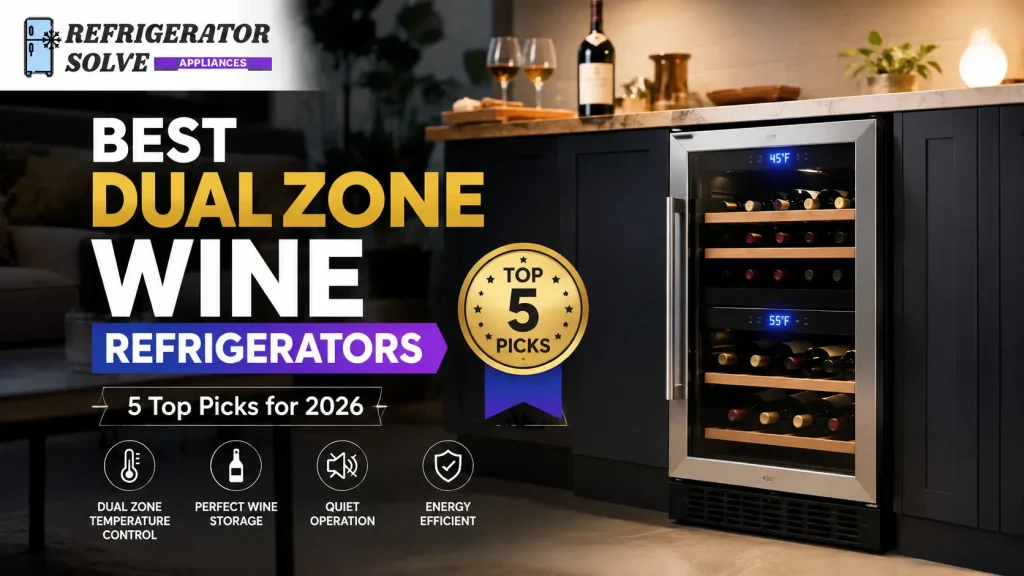
A good bottle of wine deserves better than a warm kitchen cabinet or an overcrowded household refrigerator. Wine needs a stable environment, controlled temperature, and protection from heat and light to preserve its intended flavor.
That becomes more challenging when your collection includes both reds and whites. Red wines are generally stored and served warmer than white and sparkling wines, so keeping everything inside a single-temperature cooler is not always convenient.
A dual-zone wine refrigerator solves this problem by giving you two independently controlled temperature compartments. You can keep white wine chilled in one zone while storing reds at a warmer temperature in the other.
However, bottle capacity, installation type, temperature range, shelf design, and ventilation vary considerably from one model to another. To make your decision easier, I compared five dual-zone wine refrigerators currently listed on Amazon.
Affiliate Disclosure: As an Amazon Associate, RefrigeratorSolve earns from qualifying purchases. This does not increase the price you pay.
Quick Comparison of the Best Dual Zone Wine Refrigerators
| Product | Advertised Capacity | Installation | Best For | Check Price |
|---|---|---|---|---|
| Wine Enthusiast 32-Bottle Dual Zone MAX Wine Cooler | 32 bottles | Freestanding | Best overall | View on Amazon |
| Ivation 33-Bottle Dual Zone Wine Cooler | 33 bottles | Freestanding | Apartments and compact spaces | View on Amazon |
| Kalamera 24-Inch Dual Zone Wine Cooler | Up to 46 bottles* | Built-in or freestanding | Under-counter installation | View on Amazon |
| BODEGA COOLER 56-Bottle Dual Zone Wine Refrigerator | 56 bottles | Built-in or freestanding | Larger wine collections | View on Amazon |
| ICEVIVAL 54-Bottle Dual Zone Wine Cooler | 54 bottles | Built-in or freestanding | Black kitchens and UV protection | View on Amazon |
*The Kalamera listing presents different capacity figures in its title and product details. Your actual capacity will depend heavily on bottle size and shape.
1. Wine Enthusiast 32-Bottle Dual Zone MAX Wine Cooler — Best Overall
Credit: Amazon
Check the Current Price on Amazon
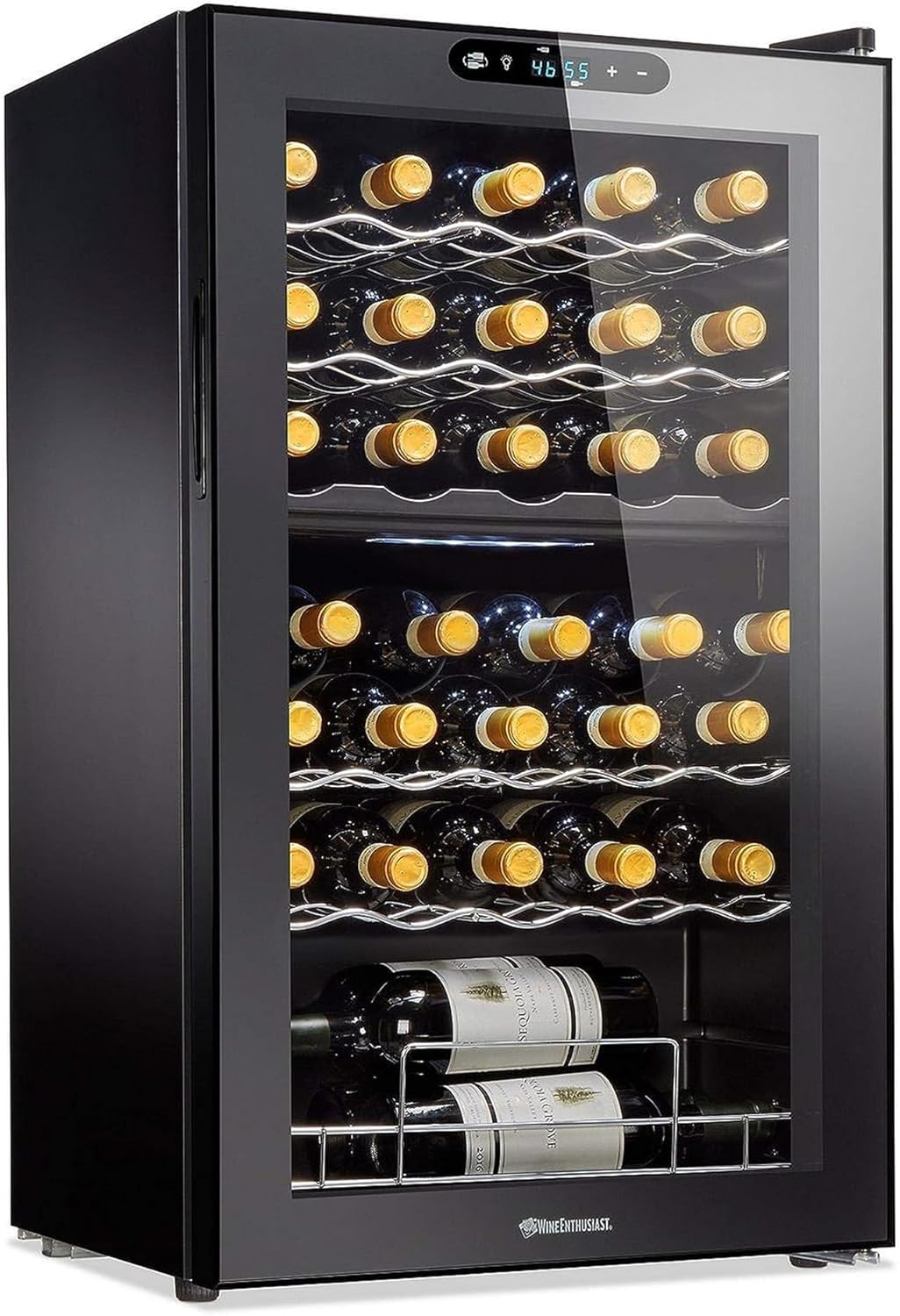
The Wine Enthusiast 32-Bottle Dual Zone MAX Wine Cooler offers a practical balance between capacity, temperature flexibility, and footprint. It is large enough for a developing collection without taking over an entire kitchen or dining area.
Its two independently controlled compartments allow you to separate red and white wines. The listed temperature range extends from approximately 41°F to 64°F, giving you enough flexibility for chilled whites, rosé, sparkling wine, and most reds. Independent testing by Serious Eats also highlighted its compact dimensions, quiet performance, and useful dual-zone arrangement.
Pros
- Two independently controlled temperature zones
- Balanced 32-bottle advertised capacity
- Compressor-based cooling
- Compact enough for many kitchens and dining rooms
- Digital temperature controls
- Suitable for mixed red-and-white collections
- Clean, contemporary exterior
Cons
- Designed primarily for freestanding installation
- Champagne and wide Burgundy bottles may reduce usable capacity
- Requires ventilation space around the cabinet
- Not the best choice for a collection that is growing beyond 30 bottles
My Honest Take
This is the strongest all-around option for most households. It provides meaningful dual-zone functionality without forcing you to purchase a full-size 24-inch built-in refrigerator.
The 32-bottle capacity is also more realistic for casual collectors than the extremely large numbers advertised by some models. You still need to remember that manufacturer capacities are usually calculated using standard Bordeaux-style bottles. Wider bottles may require rearranging or removing shelves.
Choose this model when you want a dependable freestanding cooler for a moderate collection of reds and whites.
Best for: Most wine drinkers, couples, casual collectors, and mixed wine collections.
2. Ivation 33-Bottle Dual Zone Wine Cooler — Best for Compact Spaces
Credit: Amazon
Check the Current Price on Amazon
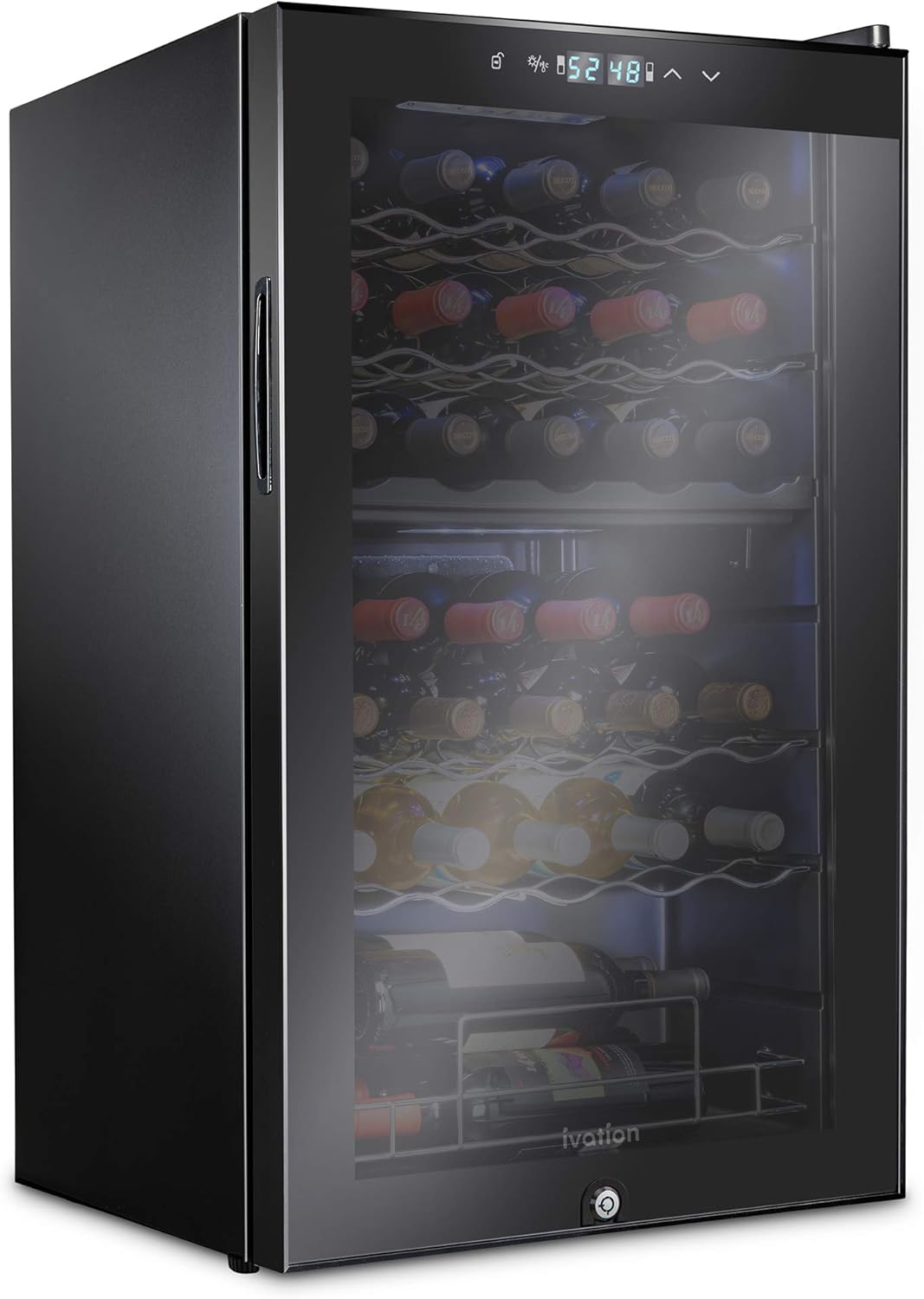
The Ivation 33-Bottle Dual Zone Wine Cooler is a useful choice when floor space is limited. It measures approximately 19.49 inches wide, 16.93 inches deep, and 33.39 inches high, making it narrower and shallower than many 24-inch wine refrigerators.
Its upper compartment is listed with a 54°F to 64°F range, while the lower compartment operates between approximately 41°F and 57°F. This layout is particularly convenient when you want warmer reds in the upper zone and chilled whites or rosé in the lower zone. It is a freestanding appliance rather than a built-in under-counter model.
Pros
- Narrow design works well in smaller rooms
- Advertised 33-bottle capacity
- Separate controls for red and white wine
- Built-in lock helps prevent unwanted access
- Compressor cooling system
- Digital temperature display
- Useful temperature separation between the two zones
Cons
- Not designed for enclosed built-in installation
- Upper zone does not become cold enough for very chilled sparkling wine
- Wire shelving looks less premium than natural wood shelving
- Taller or wider bottles may require shelf adjustments
My Honest Take
The Ivation is one of the more practical options for an apartment, condominium, home office, or small dining room. Its relatively narrow cabinet gives you useful storage without requiring a standard 24-inch opening.
The separate temperature ranges also make sense. You can reserve the warmer upper section for reds and use the cooler lower compartment for whites and rosé.
The main limitation is installation. Because it is a freestanding model, you should not place it tightly inside enclosed cabinetry unless the manufacturer specifically permits the necessary ventilation.
Best for: Apartments, compact kitchens, home offices, and wine drinkers with limited floor space.
3. Kalamera 24-Inch Dual Zone Wine Cooler — Best Built-In Option
Credit: Amazon
Check the Current Price on Amazon
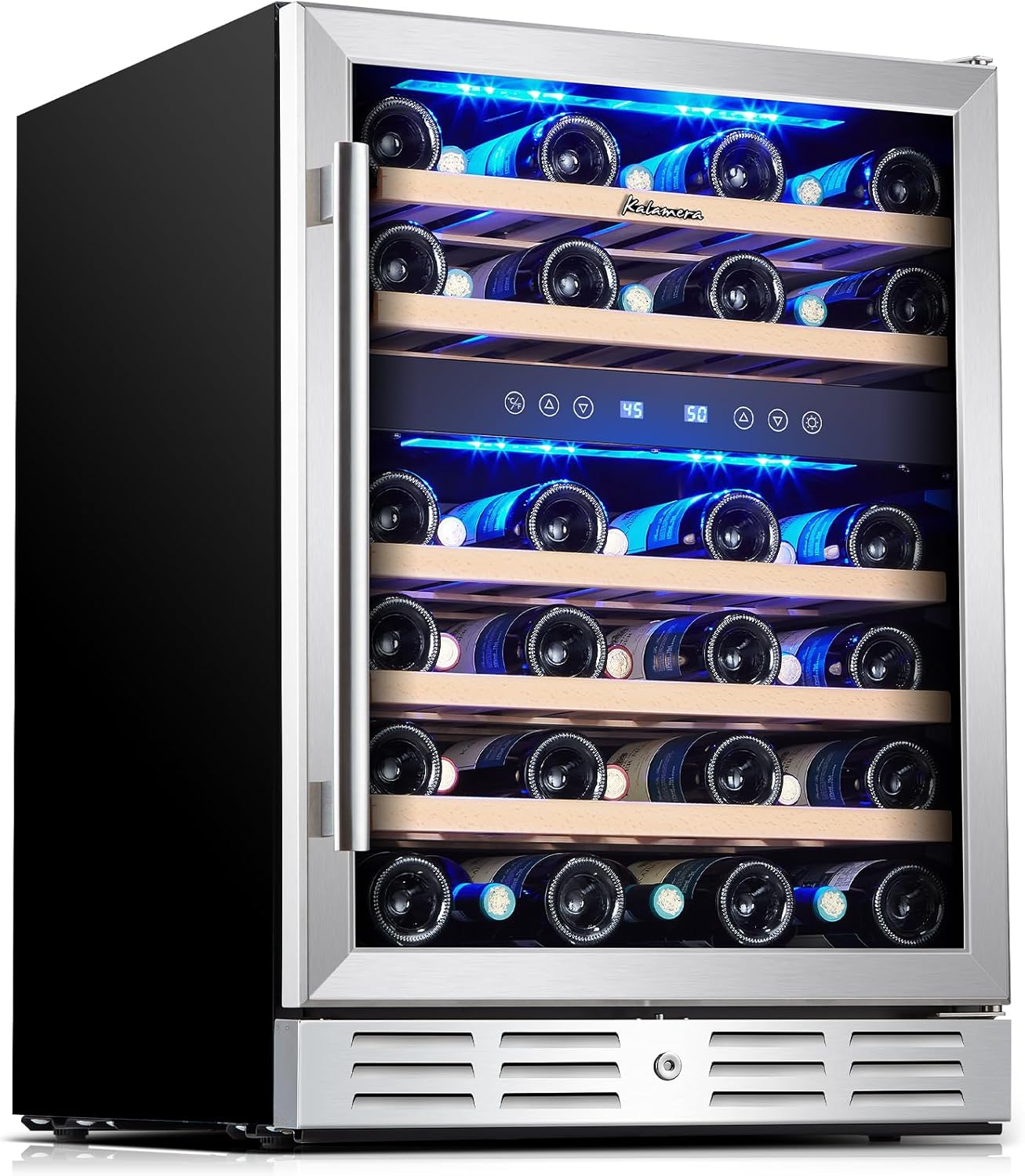
The Kalamera 24-Inch Dual Zone Wine Cooler is designed for buyers who want a more permanent under-counter installation. Its front ventilation system allows it to release heat through the front rather than relying entirely on open space around the sides.
The unit measures approximately 23.4 inches wide, 22.4 inches deep, and 33 inches high. Its upper temperature zone is listed at approximately 40°F to 50°F, while the lower zone operates from approximately 50°F to 66°F. It also includes wooden shelves, a reversible door, and temperature-memory functionality.
Pros
- Suitable for built-in or freestanding installation
- Standard 24-inch under-counter format
- Front ventilation
- Separate cooling zones for whites and reds
- Wooden shelves provide a more refined appearance
- Reversible door improves installation flexibility
- Temperature-memory function
- Wide combined temperature range
Cons
- The Amazon title and product details show inconsistent capacity figures
- Wide Burgundy and Champagne bottles reduce practical storage
- A precise cabinet opening is required for built-in installation
- Heavier and less portable than compact freestanding models
My Honest Take
Kalamera is the most suitable option here for a kitchen remodel, wet bar, butler’s pantry, or purpose-built beverage area. Its front ventilation and standard 24-inch format make installation more straightforward than with a freestanding-only refrigerator.
However, do not buy it based solely on the headline bottle count. At the time of checking, the Amazon listing title referenced 37 bottles while some listing details described capacity as high as 46 bottles. That difference is important.
Plan your purchase around the cabinet dimensions, shelf layout, and bottles you actually collect. A refrigerator that holds 40 standard Bordeaux bottles may hold considerably fewer Champagne, Pinot Noir, or Burgundy bottles.
Best for: Built-in kitchen installations, home bars, renovations, and buyers who prefer wooden shelving.
4. BODEGA COOLER 56-Bottle Dual Zone Wine Refrigerator — Best Large-Capacity Option
Credit: Amazon
Check the Current Price on Amazon
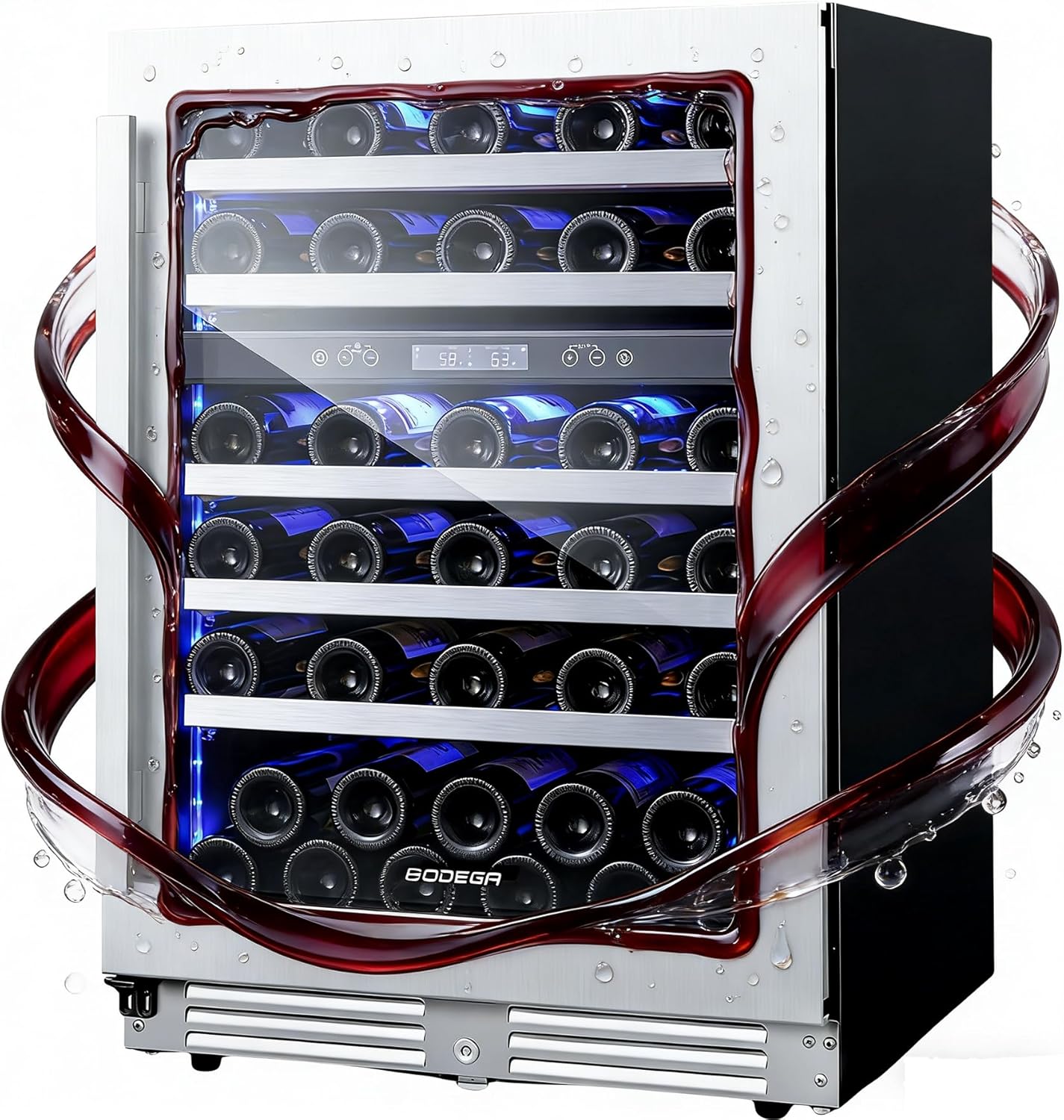
The BODEGA COOLER 56-Bottle Dual Zone Wine Refrigerator is aimed at collectors who have already outgrown smaller 20- or 30-bottle appliances.
Its two zones support a broad listed temperature range of approximately 41°F to 68°F. The refrigerator measures about 23.8 inches wide, 23.5 inches deep, and 34.2 inches high. Front ventilation makes it suitable for either built-in or freestanding placement, provided the installation follows the manufacturer’s clearance requirements.
Pros
- Advertised capacity of up to 56 bottles
- Built-in or freestanding installation
- Front ventilation
- Broad 41°F to 68°F temperature range
- Door lock
- Temperature-memory feature
- Suitable for a growing wine collection
- Standard 24-inch format
Cons
- Requires substantially more space than compact models
- Advertised capacity assumes mostly standard bottles
- Compressor operation may be noticeable in a very quiet room
- Larger cabinet may be difficult to move after installation
- More storage can encourage overcrowding if bottles are not organized
My Honest Take
This is the better choice when your collection is already approaching 40 bottles or you expect it to grow. Buying a slightly larger refrigerator now may prevent you from replacing a smaller unit after only a year or two.
The broad temperature range is another advantage. It gives you flexibility to use one compartment for serving-temperature whites and the other for reds that need a warmer environment.
Before ordering, measure your available width, depth, height, door clearance, and nearby walking space. A wine refrigerator can technically fit inside an opening while still creating problems when the door is fully extended.
Best for: Growing collections, dedicated home bars, entertainment spaces, and serious wine enthusiasts.
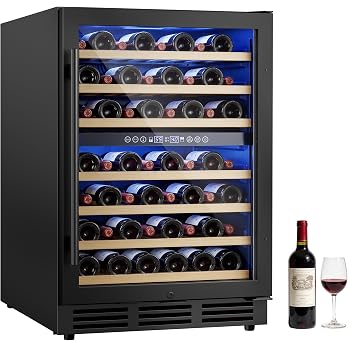
5. ICEVIVAL 54-Bottle Dual Zone Wine Cooler — Best Black-Finish Model
Credit: Amazon
Check the Current Price on Amazon
The ICEVIVAL 54-Bottle Dual Zone Wine Cooler combines a large advertised capacity with a darker exterior that may blend more naturally with black appliances, dark cabinetry, or a contemporary home bar.
Its listing describes a temperature range of approximately 40°F to 65°F, dual cooling zones, UV-resistant glass, compressor cooling, and support for built-in or freestanding installation. The UV-resistant door is useful because prolonged light exposure is undesirable for wine storage, especially when the cooler is positioned in a bright room.
Pros
- Advertised 54-bottle capacity
- Built-in or freestanding configuration
- Dual temperature controls
- Wide 40°F to 65°F operating range
- UV-resistant glass door
- Dark finish works with black cabinetry and appliances
- Compressor cooling
- Suitable for red, white, and sparkling wine
Cons
- Dark styling may not match a stainless-steel kitchen
- Real capacity will decrease with oversized bottles
- Requires accurate measurements for under-counter installation
- Shelves may need rearranging for Champagne bottles
- Less suitable for buyers who prefer a fully stainless exterior
My Honest Take
This ICEVIVAL model is an interesting alternative to the more familiar stainless-steel wine refrigerators. Its black finish gives it a quieter, more integrated appearance in darker kitchens and home bars.
The UV-resistant door is another useful feature for rooms with windows or strong ambient lighting. However, temperature stability still depends on appropriate placement. Keep any wine refrigerator away from direct sunlight, ovens, radiators, and other major heat sources.
Best for: Dark kitchens, contemporary home bars, larger mixed collections, and rooms where light protection matters.
How to Choose the Best Dual Zone Wine Refrigerator
The best wine refrigerator is not automatically the one with the highest bottle count. Your collection, available space, installation plan, and preferred wine styles matter much more.
Here are the most important factors to consider.
1. Start With Your Real Bottle Collection
Count how many bottles you currently own and estimate how quickly your collection is growing.
A 20- to 35-bottle cooler may be sufficient when you normally keep only a case or two at home. A 45- to 60-bottle model makes more sense when you buy wine by the case, collect bottles for aging, or entertain frequently.
It is usually wise to purchase slightly more capacity than you currently need. Wine collections have a habit of expanding.
2. Do Not Take Advertised Capacity Too Literally
Wine refrigerator capacities are normally calculated using standard 750-milliliter Bordeaux-style bottles arranged in a very specific way.
Real-world capacity drops when your collection includes:
- Champagne bottles
- Burgundy bottles
- Pinot Noir bottles
- Wide-shouldered bottles
- Magnum bottles
- Unusually tall Riesling bottles
You may need to remove or reposition shelves to accommodate these formats. That improves flexibility but reduces the total number of bottles you can store.
3. Check Both Temperature Ranges
Not every dual-zone refrigerator gives both compartments the same temperature range.
Some models have a colder upper compartment and warmer lower compartment. Others reverse this arrangement. A few have overlapping ranges that allow either section to hold reds or whites.
A practical starting point is:
- Sparkling wine: approximately 40°F to 50°F
- White and rosé wine: approximately 42°F to 55°F
- Lighter red wine: approximately 50°F to 58°F
- Full-bodied red wine: approximately 55°F to 64°F
These are starting points rather than rigid rules. The ideal setting depends on whether you are storing wine for a longer period or bringing it closer to serving temperature.
4. Understand Built-In Versus Freestanding Installation
This is one of the most important buying decisions.
A freestanding wine refrigerator needs ventilation space around its cabinet. Placing it tightly inside enclosed cabinetry can trap heat and affect cooling performance.
A built-in wine refrigerator normally has front-facing ventilation. This allows the unit to release heat through the front while sitting beneath a counter.
Some models support both configurations, but you should still follow the manufacturer’s installation instructions and clearance requirements.
5. Measure the Entire Installation Area
Do not measure only the cabinet opening.
Check:
- Opening width
- Opening height
- Available depth
- Electrical outlet location
- Baseboard clearance
- Door-swing direction
- Handle projection
- Walking space with the door open
- Ventilation requirements
A quarter-inch difference can matter when you are installing a 24-inch appliance beneath a counter.
6. Look at Shelf Construction
Wood shelves often feel smoother and more refined. They may also reduce vibration transfer and provide a presentation similar to a traditional wine cellar.
Wire shelves are usually lighter and easier to reposition. However, some buyers may find them less attractive, and irregular bottle shapes can be harder to arrange.
Regardless of material, check whether the shelves slide out far enough to let you read labels without removing several bottles.
7. Consider Door Protection
A glass door makes it easy to see your collection, but protection from light remains important.
Look for:
- UV-resistant or UV-filtering glass
- Double- or triple-pane construction
- A strong door seal
- A lock when children or guests may access the refrigerator
- A reversible door for installation flexibility
Even with protected glass, avoid positioning the refrigerator in direct sunlight.
8. Think About Noise
Compressor wine refrigerators cycle on and off to maintain temperature. Some sound is normal, particularly when the compressor starts or internal fans circulate air.
Noise will matter more when the refrigerator is installed in:
- A bedroom
- A quiet home office
- A studio apartment
- A media room
- An open-plan living area
A noise level that is harmless in a kitchen may be distracting beside a desk or bed.
9. Look for Temperature Memory
A temperature-memory function restores your selected settings after a brief power interruption.
This does not replace a surge protector or backup-power plan, but it can prevent the refrigerator from restarting at an unsuitable default temperature.
10. Choose Capacity Before Cosmetic Features
Interior lighting, touchscreen controls, decorative handles, and display shelves are attractive, but they should not distract you from the essentials:
- Stable cooling
- Suitable temperature ranges
- Correct installation type
- Appropriate dimensions
- Enough space for your real bottles
- Reliable door sealing
A beautiful refrigerator that cannot fit your Champagne bottles is not the right refrigerator.
Dual Zone Wine Refrigerator FAQs
What Is a Dual Zone Wine Refrigerator?
A dual-zone wine refrigerator has two separately controlled temperature compartments. This allows you to keep different types of wine at different temperatures inside the same appliance.
For example, one section can hold white and sparkling wines at a colder setting while the second section keeps red wine warmer.
Is a Dual Zone Wine Refrigerator Worth It?
A dual-zone refrigerator is worth considering when you regularly keep both red and white wine at home.
It may be unnecessary when you collect only one style of wine or use the refrigerator strictly for long-term storage at a single cellar-like temperature. In that situation, a single-zone cooler may give you more usable capacity for the same cabinet size.
Which Zone Should Hold Red Wine?
That depends on the refrigerator.
On some models, the upper zone is warmer. On others, the lower zone has the higher temperature range. Always check the individual temperature limits instead of assuming that red wine belongs in a particular physical section.
Can Champagne Bottles Fit in a Wine Refrigerator?
Most wine refrigerators can hold at least some Champagne bottles, but shelf adjustment may be necessary.
Champagne bottles are wider than standard Bordeaux bottles. Storing several of them will usually reduce the refrigerator’s total capacity.
Can I Store Beer or Soft Drinks in a Wine Cooler?
You can store some beverages in a wine refrigerator when its temperature range is suitable, but a wine cooler may not become as cold as a standard beverage refrigerator.
Many beers and soft drinks are normally served colder than red wine. Check the refrigerator’s minimum temperature before using part of it for other beverages.
Can a Built-In Wine Refrigerator Be Used as a Freestanding Unit?
Many built-in wine refrigerators can also operate as freestanding units, particularly models with front ventilation.
However, you should verify this in the product listing or manufacturer’s instructions. The appliance still needs appropriate airflow and should not be positioned directly against a heat source.
Why Does My Wine Cooler Hold Fewer Bottles Than Advertised?
Advertised capacities are generally based on standard Bordeaux bottles arranged in an optimized pattern.
Wider bottles, decorative bottle shapes, shelf spacing, label protection, and the way you organize your collection can all reduce practical capacity.
What Temperature Should I Set for Long-Term Wine Storage?
Many collectors use a stable temperature around 55°F for general long-term storage.
Dual-zone operation is more useful when you want different wines maintained closer to their preferred serving temperatures. Stability is usually more important than repeatedly adjusting the controls by one or two degrees.
Should Wine Be Stored Horizontally?
Traditional cork-sealed bottles are commonly stored horizontally so the wine remains in contact with the cork.
Bottles with screw caps, glass closures, or synthetic closures are less dependent on horizontal storage, although horizontal shelving remains the most space-efficient arrangement in most wine refrigerators.
How Long Should a New Wine Refrigerator Stand Before Plugging It In?
The appropriate waiting period depends on how the refrigerator was transported and what the manufacturer recommends.
If the unit was carried horizontally or tilted heavily, the compressor oil may need time to settle. Follow the manual rather than relying on a universal waiting time.
Final Verdict
The Wine Enthusiast 32-Bottle Dual Zone MAX Wine Cooler is the best overall choice for most households. It offers a useful capacity, separate temperature compartments, and a compact freestanding design without becoming unnecessarily large.
Choose the Ivation 33-Bottle Dual Zone Wine Cooler when you need a narrower freestanding refrigerator for an apartment or compact room.
The Kalamera 24-Inch Dual Zone Wine Cooler is the stronger option for a permanent under-counter installation, although you should treat its stated bottle capacity cautiously.
For a larger collection, the BODEGA COOLER 56-Bottle Dual Zone Wine Refrigerator provides more room and a broad operating range.
The ICEVIVAL 54-Bottle Dual Zone Wine Cooler is worth considering when you prefer a black finish and want UV-resistant glass for a brighter room.
Whichever model you choose, measure your space carefully and estimate capacity using the bottles you actually buy—not only the number printed in the product title.
Check the Wine Enthusiast 32-Bottle Dual Zone MAX Wine Cooler on Amazon

Hi, I’m the lead researcher and appliance enthusiast behind RefrigeratorSolve. With years of hands-on experience troubleshooting cooling systems and testing home appliances, I am dedicated to bringing you honest reviews, energy-saving tips, and practical solutions to keep your refrigerator running perfectly.