Quick Answer: If your refrigerator makes popping noises, don’t panic. In most cases, the sound is completely normal and happens as the appliance cools, warms during the automatic defrost cycle, or when metal and plastic components expand and contract due to temperature changes.
However, loud popping sounds accompanied by poor cooling, burning smells, water leaks, or repeated electrical clicking may indicate a problem that requires inspection or professional repair.
Why You Can Trust This Guide
Refrigerators operate through repeated cooling and defrost cycles, which naturally create a variety of sounds. While occasional popping noises are usually harmless, understanding when the sound is normal and when it signals a mechanical issue can help you avoid unnecessary repair costs or prevent a small problem from becoming an expensive one.
This guide explains:
- Why refrigerators make popping noises
- Which sounds are completely normal
- What unusual popping sounds may indicate
- Simple DIY troubleshooting steps
- When it’s time to call a technician
- How to prevent future popping noises
Whether you own an LG, Samsung, GE, Whirlpool, Frigidaire, Bosch, Maytag, KitchenAid, or another brand, the causes and solutions covered below apply to most modern refrigerators.
Is It Normal for a Refrigerator to Make Popping Noises?
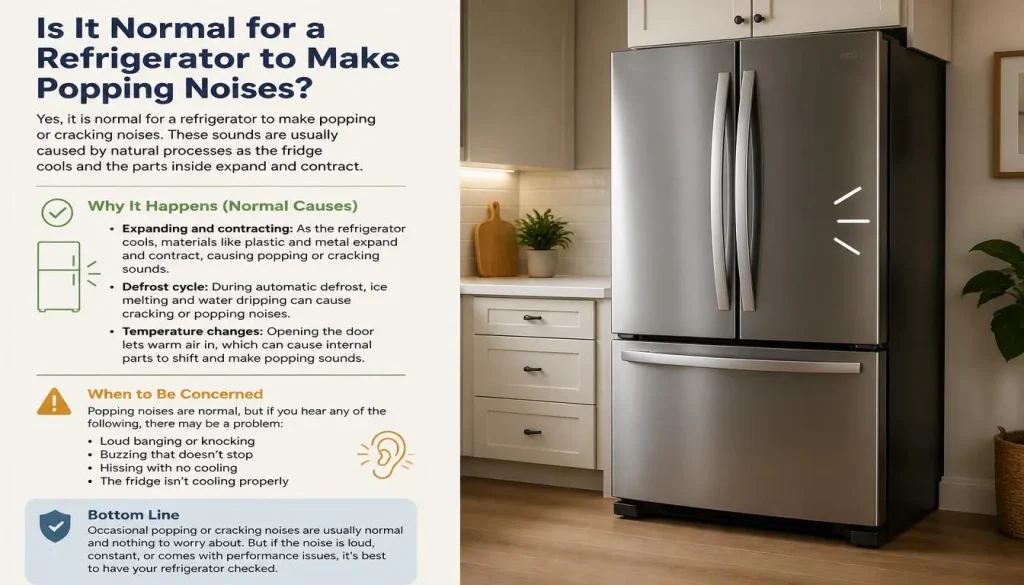
Yes. In most situations, occasional popping noises are a normal part of refrigerator operation.
Unlike many household appliances, a refrigerator continuously changes temperature throughout the day. Every cooling cycle causes different materials inside the appliance to expand and contract.
These temperature changes can produce sounds such as:
- Small pops
- Light cracking
- Gentle snapping
- Occasional ticking
- Soft knocking
These sounds often occur:
- After the compressor starts
- When the compressor shuts off
- During the automatic defrost cycle
- After closing the refrigerator door
- During nighttime when the home is quieter
Most homeowners simply notice these sounds more because the refrigerator runs 24 hours a day.
Normal vs. Problematic Popping Noises
| Noise | Usually Normal? | Should You Worry? |
|---|---|---|
| Small pop every few hours | Yes | No |
| Light cracking during cooling | Yes | No |
| Plastic snapping after door closes | Yes | No |
| Pop during defrost cycle | Yes | No |
| Loud explosive bang | No | Yes |
| Pop followed by loss of cooling | No | Yes |
| Burning smell with popping | No | Immediate attention |
| Constant popping every few seconds | Usually not | Inspect the refrigerator |
If your refrigerator continues cooling properly and the popping happens only occasionally, it’s usually functioning exactly as designed.
Why Does My Refrigerator Make Popping Noises?
Several different components can create popping sounds. Understanding the source makes it much easier to determine whether the noise is harmless or requires attention.
1. Metal Expanding and Contracting (Most Common Cause)
This is the number one reason refrigerators make popping noises.
Every time the compressor cools the refrigerator, the temperature inside the cabinet changes. As metal parts become colder, they shrink slightly. When they warm up again, they expand.
This constant movement creates a popping or cracking sound.
Common components involved
- Interior metal panels
- Evaporator housing
- Refrigerator frame
- Refrigerant tubing
- Cabinet supports
Signs this is normal
- Sound occurs only occasionally
- Refrigerator cools normally
- No warning lights
- No burning smell
- No food spoilage
In most homes, this type of popping noise becomes more noticeable at night because background noise is lower.
2. Plastic Interior Expanding and Contracting
Modern refrigerators contain a large amount of molded plastic.
The interior liner expands when temperatures rise slightly and contracts when temperatures drop again.
This movement creates sounds that many people describe as:
- Pop
- Crack
- Snap
- Tick
This is especially common when:
- You place warm food inside
- The door stays open for several minutes
- The refrigerator finishes a cooling cycle
- The appliance is new
Plastic expansion is completely expected and does not indicate damage.
3. The Automatic Defrost Cycle
Many homeowners are surprised to learn that their refrigerator intentionally warms itself several times each day.
During the automatic defrost cycle:
- Cooling temporarily stops.
- A small heater melts frost on the evaporator coils.
- Melted frost drains away.
- Cooling resumes.
As temperatures rise and fall inside the freezer compartment, both metal and plastic parts expand and contract rapidly.
The result is a series of popping or cracking sounds.
Common signs you’re hearing the defrost cycle
- Noise lasts only a few minutes.
- It happens once or several times daily.
- Cooling returns immediately afterward.
- The refrigerator continues working normally.
This is one of the most common and most misunderstood sources of refrigerator popping noises.
4. Refrigerant Flow Inside the Cooling System
Your refrigerator constantly circulates refrigerant through sealed tubing.
As refrigerant changes pressure and temperature, it may produce sounds such as:
- Soft pops
- Gurgling
- Bubbling
- Hissing
- Gentle clicking
Although many people worry these sounds indicate a refrigerant leak, they are usually a normal part of the refrigeration cycle.
When refrigerant noises are normal
- Cooling performance remains excellent.
- Noise is occasional.
- No oily residue appears around tubing.
- The compressor cycles normally.
A true refrigerant leak is relatively uncommon and is usually accompanied by poor cooling performance.
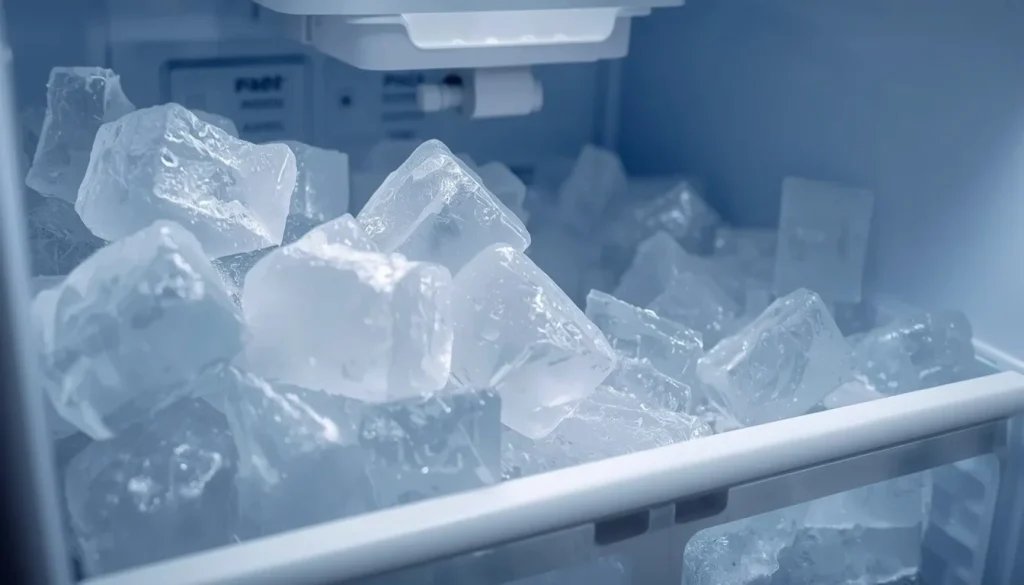
5. Ice Maker Operation
If your refrigerator has an automatic ice maker, it can generate several different popping sounds throughout the day.
Common sounds include:
- Ice cubes releasing from the mold
- Water entering the ice maker
- Ice dropping into the storage bin
- Plastic movement inside the assembly
These sounds are often mistaken for mechanical problems.
If the popping only occurs shortly before fresh ice appears, your ice maker is probably working exactly as intended.
6. Compressor Starting or Stopping
The compressor is the heart of your refrigerator.
Every time it starts or stops, internal pressure changes can create:
- Pop
- Click
- Knock
- Snap
A single pop when the compressor begins running is usually nothing to worry about.
However, repeated popping followed by repeated clicking without cooling may indicate:
- A failing start relay
- Compressor overload protection
- Electrical component failure
We’ll cover these warning signs later in this guide.
7. Cabinet Settling in a New Refrigerator
If you’ve recently purchased a refrigerator, occasional popping noises are expected during the first few weeks.
New refrigerators experience:
- Temperature stabilization
- Plastic settling
- Insulation adjustment
- Frame expansion
Many manufacturers note that these sounds are part of normal operation.
The noises usually become less frequent after the appliance has been running for several weeks.
8. Heavy Temperature Changes
Large temperature swings inside the refrigerator can increase popping noises.
This often happens when you:
- Load large amounts of groceries
- Store hot leftovers
- Leave the door open too long
- Frequently open the refrigerator during meal preparation
Each of these actions forces the cooling system to work harder, increasing the expansion and contraction of internal components.
As a result, you may hear more popping sounds than usual.
Why Does My Refrigerator Make Popping Noises All of a Sudden?
If your refrigerator has been quiet for months and suddenly starts popping, don’t assume the worst.
Ask yourself these questions:
- Did you recently add warm food?
- Is the weather significantly hotter or colder?
- Did you move or level the refrigerator?
- Has the automatic defrost cycle just started?
- Did you recently install a new ice maker?
- Is the refrigerator fully loaded after grocery shopping?
In many cases, these everyday changes temporarily increase normal operating sounds.
However, if the new popping noises are very loud, happen continuously, or are accompanied by cooling problems, further troubleshooting is necessary.
What Does a Refrigerator Popping Noise Actually Sound Like?
Different homeowners describe the same sound in different ways.
Here are the most common descriptions:
| What You Hear | Possible Cause |
|---|---|
| Pop | Metal expansion |
| Crack | Plastic liner movement |
| Snap | Cabinet contraction |
| Tick | Defrost cycle |
| Knock | Compressor pressure changes |
| Loud bang | Mechanical issue requiring inspection |
Identifying the type of sound can help narrow down the source before you begin troubleshooting.
Why Does My Refrigerator Make Popping Noises at Night?
Many homeowners notice refrigerator noises only after everyone has gone to bed. Fortunately, this is usually completely normal.
Your refrigerator doesn’t work harder at night—it simply becomes easier to hear because your home is quieter.
Several normal refrigerator functions commonly occur overnight, including:
- Automatic defrost cycles
- Compressor cycling
- Refrigerant pressure changes
- Expansion and contraction of metal components
- Ice maker operation (if enabled)
Signs the nighttime popping is normal
- The refrigerator maintains the correct temperature (37–40°F or 3–4°C).
- The freezer stays at 0°F (-18°C).
- The sound happens only occasionally.
- Food stays fresh.
- No warning lights appear.
When nighttime popping is a concern
You should investigate further if you notice:
- Extremely loud bangs
- Repeated popping every few seconds
- Burning odors
- Water leaking onto the floor
- The refrigerator running continuously without cooling properly
If none of these symptoms are present, nighttime popping is rarely a reason to worry.
Why Does My Refrigerator Pop After I Close the Door?
Many people become concerned because they hear a pop just seconds after closing the refrigerator door.
In most cases, this is expected.
When you close the door:
- Warm air enters the refrigerator while the door is open.
- The cooling system immediately begins lowering the temperature again.
- Plastic panels and metal components contract.
- Internal pressure changes slightly.
These rapid temperature changes often create a small popping or cracking sound.
Other possible reasons
- Door gasket resealing
- Air pressure equalizing
- Plastic shelves shifting slightly
- Interior liner expanding
A single pop after closing the door is generally considered normal.
Why Does My Refrigerator Pop When It Turns On?
Every cooling cycle begins with the compressor starting.
As the compressor starts:
- Refrigerant pressure changes.
- Cooling begins.
- Metal tubing contracts.
- Internal components adjust to temperature changes.
This can create:
- Pop
- Click
- Snap
- Tick
These sounds usually last only a few seconds.
If the refrigerator starts cooling immediately afterward, there is typically nothing wrong.
Why Does My Refrigerator Pop When It Turns Off?
The cooling cycle doesn’t end silently.
When the compressor shuts off:
- Refrigerant pressure equalizes.
- Metal tubing relaxes.
- Plastic parts slowly warm.
- Cabinet materials shift slightly.
This often creates another soft popping sound.
Many homeowners notice both:
- One pop when cooling starts
- Another pop when cooling stops
Both are considered normal operating sounds.
Why Does My Refrigerator Make Popping Noises Every Few Minutes?
Occasional popping is expected.
Frequent popping every few minutes deserves closer attention.
Possible normal causes
- Active defrost cycle
- Large amount of warm food
- Frequent door openings
- Heavy cooling demand
Possible problems
- Loose interior shelves
- Refrigerator touching the wall
- Poor leveling
- Ice maker cycling repeatedly
- Failing start relay
- Compressor issues
Quick inspection checklist
✔ Check that the refrigerator is level.
✔ Leave at least 2 inches (5 cm) of space behind the unit.
✔ Ensure shelves are seated properly.
✔ Listen for whether the noise comes from the rear, inside the freezer, or underneath the appliance.
If popping becomes constant for several days, further inspection is recommended.
Why Does My Refrigerator Pop After the Compressor Stops?
This is one of the most frequently misunderstood refrigerator noises.
After the compressor stops:
- Refrigerant pressure changes
- Copper tubing expands
- Plastic cabinet warms slightly
- Metal supports relax
These changes naturally create popping sounds.
As long as cooling performance remains normal, these sounds usually require no repair.
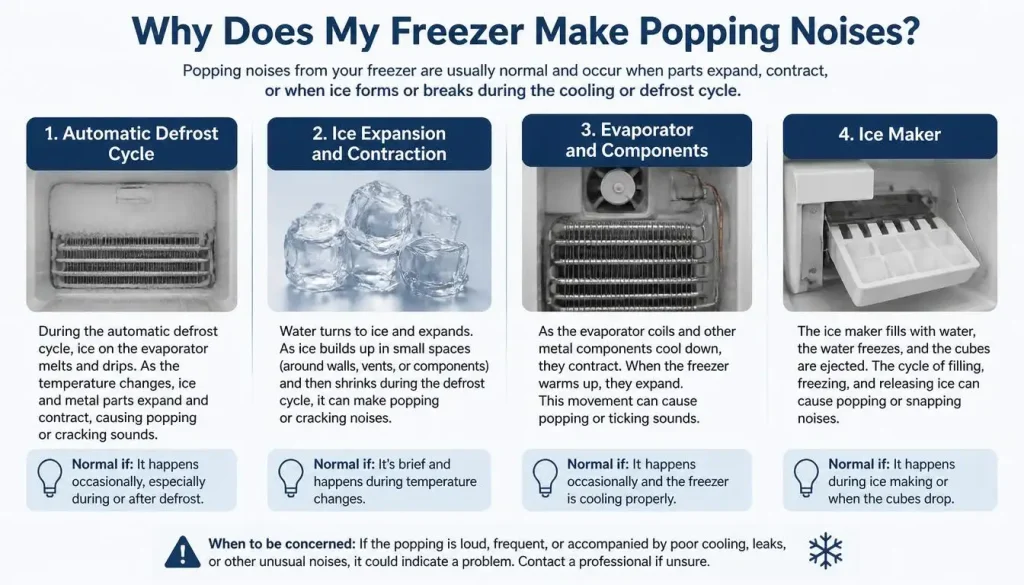
Why Does My Freezer Make Popping Noises?
The freezer often produces more popping sounds than the refrigerator compartment because it experiences greater temperature changes.
Common causes include:
Automatic Defrost
The freezer warms briefly before cooling again.
Ice Expansion
Ice naturally expands and contracts as temperatures fluctuate.
Evaporator Components
Metal around the evaporator coils frequently changes temperature.
Ice Maker
Ice dropping into the bin often sounds like a pop or crack.
Most freezer popping noises are harmless.
Refrigerator Making Popping and Cracking Noises
Many homeowners hear both sounds together.
This usually indicates normal expansion and contraction.
Typical sequence:
Cooling starts →
Metal contracts →
Plastic shifts →
Small crack →
Light pop →
Cooling continues
If cooling remains consistent, these combined sounds are usually expected.
Refrigerator Making Loud Popping Noises
Not every loud pop indicates a serious problem, but louder sounds deserve closer attention.
Possible causes include:
Cabinet Expansion
Large refrigerators sometimes produce louder pops because of larger metal panels.
Ice Maker
Large ice cubes dropping into the bin can sound surprisingly loud.
Defrost Cycle
Rapid heating and cooling may create stronger expansion noises.
Mechanical Issues
A loud pop followed by other symptoms should never be ignored.
Examples include:
- Refrigerator stops cooling
- Electrical burning smell
- Circuit breaker trips
- Repeated clicking
- Compressor fails to restart
These situations require further diagnosis.
Is a Popping Refrigerator Dangerous?
Usually, no.
Most popping sounds are simply part of normal refrigerator operation.
However, certain combinations of symptoms can indicate a safety issue.
Usually Safe
- Occasional pops
- Cooling works normally
- Food remains cold
- No unusual smells
- No visible damage
Potentially Dangerous
- Burning smell
- Smoke
- Electrical sparking
- Loud explosion-like bang
- Refrigerator no longer cools
- Melted wiring
- Repeated breaker trips
If you notice any of these warning signs:
- Unplug the refrigerator if it is safe to do so.
- Avoid using extension cords.
- Contact a qualified appliance technician.
When Are Refrigerator Popping Noises NOT Normal?
While most popping sounds are harmless, some indicate a mechanical or electrical problem.
Watch for these warning signs.
1. Loud Bang Followed by No Cooling
Possible causes:
- Failed compressor
- Broken start relay
- Electrical overload protector
- Compressor lock-up
This is one of the most serious situations.
2. Burning Smell
Never ignore this.
Possible causes:
- Electrical short
- Damaged wiring
- Overheated compressor
- Failed relay
Disconnect power if it is safe and arrange for professional service.
3. Water Leaking Along With Popping
Possible causes:
- Frozen drain
- Defrost drain blockage
- Ice buildup
- Damaged water line
4. Constant Clicking and Popping
A refrigerator should not repeatedly attempt to start every few seconds.
This often indicates:
- Bad start relay
- Compressor failure
- Power supply problems
5. Poor Cooling Performance
If food no longer stays cold while popping noises increase, the issue may involve:
- Compressor
- Refrigerant system
- Condenser coils
- Evaporator fan
- Temperature control system
This combination deserves immediate attention.
Can I Fix Refrigerator Popping Noises Myself?
In many cases, yes.
Simple maintenance can eliminate unnecessary noises without professional repair.
DIY solutions include:
- Leveling the refrigerator
- Cleaning condenser coils
- Organizing shelves
- Leaving enough ventilation space
- Checking the ice maker
- Inspecting door seals
However, DIY repairs should stop if you suspect:
- Electrical problems
- Refrigerant leaks
- Compressor failure
- Damaged wiring
Those issues require specialized tools and expertise.
DIY Troubleshooting: How to Stop Refrigerator Popping Noises
Before calling a technician, work through these simple troubleshooting steps.
Step 1: Make Sure the Refrigerator Is Level
A refrigerator that rocks slightly can amplify normal operating sounds.
Use a level to verify:
- Front-to-back alignment
- Side-to-side alignment
Adjust the leveling feet if necessary.
Step 2: Leave Proper Ventilation Space
Insufficient airflow forces the compressor to work harder.
Most manufacturers recommend leaving space around:
- Back
- Top
- Sides
Always follow the clearance recommendations in your owner’s manual.
Step 3: Check for Loose Shelves and Bins
Sometimes the noise isn’t coming from the cooling system at all.
Inspect:
- Glass shelves
- Door bins
- Crisper drawers
- Ice bucket
Reinstall anything that isn’t fully seated.
Step 4: Clean the Condenser Coils
Dust-covered condenser coils increase compressor workload, which can lead to more noticeable operating noises.
For most households, cleaning the coils every 6–12 months is good preventive maintenance.
Step 5: Inspect the Door Seals
A damaged or loose door gasket can allow warm air to enter the refrigerator. As the cooling system works to restore the correct temperature, you may hear more frequent popping, cracking, or snapping sounds.
How to check the door gasket
- Look for cracks, tears, or gaps.
- Clean the gasket with warm water and mild soap.
- Make sure it sits flat against the refrigerator frame.
- Close the door on a dollar bill. If it slides out easily, the seal may need replacement.
A properly sealing door helps maintain stable temperatures and reduces unnecessary cooling cycles.
Step 6: Check the Ice Maker
If your refrigerator has an automatic ice maker, it may be responsible for the popping sounds.
Inspect the following:
- Ice bin for jams
- Ice mold for stuck cubes
- Water supply line
- Ice maker arm or sensor
If you don’t regularly use the ice maker, temporarily turning it off can help determine whether it’s the source of the noise.
Step 7: Avoid Overloading the Refrigerator
Overpacking your refrigerator restricts airflow and forces the cooling system to work harder.
For better performance:
- Leave space between food items.
- Don’t block air vents.
- Allow hot leftovers to cool before refrigerating them.
- Avoid packing the freezer too tightly.
Better airflow helps maintain consistent temperatures and may reduce normal operating noises.
Step 8: Listen to Where the Noise Comes From
Identifying the location of the sound can help narrow down the cause.
| Noise Location | Most Likely Cause |
|---|---|
| Inside refrigerator compartment | Plastic liner expanding |
| Freezer compartment | Defaporator or defrost cycle |
| Rear of refrigerator | Compressor or refrigerant lines |
| Bottom of refrigerator | Compressor or condenser components |
| Ice maker area | Ice production cycle |
| Near the doors | Door gasket or air pressure changes |
Pinpointing the location often makes troubleshooting much easier.
Refrigerator Popping Noise by Brand
Although every manufacturer designs refrigerators differently, the most common causes of popping noises are similar across brands.
LG Refrigerator Making Popping Noises
LG refrigerators often make popping sounds during:
- Automatic defrost
- Linear compressor operation
- Cabinet expansion
- Ice maker cycles
Occasional pops without cooling problems are generally normal.
Samsung Refrigerator Making Popping Noises
Samsung refrigerators commonly produce popping or cracking sounds due to:
- Twin Cooling™ temperature changes
- Plastic liner movement
- Ice maker operation
- Refrigerant pressure changes
If cooling remains consistent, these sounds are usually expected.
GE Refrigerator Making Popping Noises
GE refrigerators may pop when:
- Defrost heaters activate
- Compressor cycles
- Cabinet materials expand
- Ice cubes are released
These sounds typically require no repair unless accompanied by cooling issues.
Whirlpool Refrigerator Making Popping Noises
Whirlpool models may produce popping sounds from:
- Defrost cycle
- Compressor startup
- Interior cabinet movement
- Refrigerant tubing expansion
Monitor the refrigerator for additional symptoms before assuming a mechanical failure.
Frigidaire Refrigerator Making Popping Noises
Many Frigidaire refrigerators generate occasional popping sounds because of:
- Frost removal
- Plastic contraction
- Ice maker operation
- Cooling cycle changes
These sounds are considered normal in most cases.
Bosch, Maytag, KitchenAid, Kenmore, Haier, Hisense, Midea, and Insignia
These brands may also produce occasional popping sounds during normal operation.
Regardless of the manufacturer, the same basic rule applies:
If the refrigerator cools properly and the popping is occasional, the appliance is usually operating normally.
Refrigerator Makes a Loud Pop Then Stops Cooling
This situation is different from normal operating sounds.
Possible causes include:
- Failed compressor
- Defective start relay
- Compressor overload protector
- Control board malfunction
- Electrical failure
What to do
- Verify the refrigerator still has power.
- Check whether interior lights turn on.
- Listen for repeated clicking.
- Confirm the freezer is still freezing food.
- Contact a qualified appliance technician if cooling has stopped.
Avoid repeatedly unplugging and reconnecting the refrigerator, as this can place additional stress on the compressor.
Can a Dirty Condenser Cause Popping Noises?
Indirectly, yes.
Dirty condenser coils make it harder for the refrigerator to release heat.
As a result:
- The compressor runs longer.
- Temperature fluctuations increase.
- Expansion and contraction become more noticeable.
- Normal popping sounds may occur more frequently.
Cleaning the condenser coils every 6 to 12 months is one of the easiest ways to improve refrigerator performance.
Can Low Refrigerant Cause Popping Noises?
Low refrigerant is not one of the most common causes of popping sounds.
However, if a refrigerant leak develops, you may also notice:
- Poor cooling
- Longer compressor run times
- Warm freezer
- Frost buildup in unusual locations
- Hissing noises
Because refrigerant systems are sealed, they should only be serviced by a qualified technician.
How Much Does It Cost to Repair a Refrigerator Making Popping Noises?
The cost depends on the underlying problem.
| Problem | Typical Repair Cost (USD)* |
|---|---|
| Leveling the refrigerator | $0–$50 |
| Cleaning condenser coils | $0–$150 |
| Replacing a door gasket | $100–$300 |
| Replacing a start relay | $100–$250 |
| Ice maker repair | $150–$350 |
| Fan motor replacement | $150–$400 |
| Compressor replacement | $600–$1,200+ |
*Costs vary by location, refrigerator model, and labor rates.
How to Prevent Refrigerator Popping Noises
While normal operating sounds cannot be eliminated entirely, proper maintenance can reduce unnecessary noise.
Follow these best practices:
- Keep the refrigerator level.
- Leave enough ventilation space around the appliance.
- Clean condenser coils regularly.
- Replace damaged door seals.
- Avoid placing hot food directly inside.
- Don’t overload shelves or block air vents.
- Maintain the recommended temperature settings.
- Schedule repairs promptly if unusual noises develop.
Preventive maintenance helps improve efficiency and extend the lifespan of your refrigerator.
Expert Maintenance Tips
Appliance technicians generally recommend these habits to keep refrigerators running efficiently:
- Vacuum condenser coils every 6–12 months.
- Check door seals several times each year.
- Keep the refrigerator temperature between 37°F and 40°F (3°C–4°C).
- Keep the freezer at 0°F (-18°C).
- Allow proper airflow around stored food.
- Listen for changes in noise patterns instead of focusing on occasional normal sounds.
- Address cooling problems early before they become expensive repairs.
Following these simple practices can reduce wear on the cooling system and help your refrigerator operate more quietly.
Refrigerator Popping Noise Troubleshooting Table
| Symptom | Most Likely Cause | Serious? | Recommended Action |
|---|---|---|---|
| Small pop during cooling | Metal expansion | No | Normal operation |
| Pop during defrost | Defrost cycle | No | No action needed |
| Crack after closing the door | Plastic contraction | No | Normal operation |
| Pop with ice maker running | Ice production | No | Monitor only |
| Loud bang followed by no cooling | Compressor problem | Yes | Schedule service |
| Pop with burning smell | Electrical issue | Yes | Unplug if safe and call for repair |
| Repeated clicking and popping | Start relay or compressor | Yes | Professional diagnosis |
| Pop with water leaking | Drain or water line issue | Yes | Inspect and repair promptly |
Frequently Asked Questions
Why does my refrigerator make popping noises at night?
Your home is quieter at night, making normal refrigerator sounds—such as the defrost cycle, compressor operation, and material expansion—more noticeable.
Is it normal for a new refrigerator to make popping noises?
Yes. New refrigerators often produce popping and cracking sounds during the first few weeks as materials settle and adjust to repeated temperature changes.
Why does my freezer make popping sounds?
The freezer experiences larger temperature changes than the refrigerator compartment. Ice expansion, the defrost cycle, and evaporator components commonly produce popping noises.
Should I unplug my refrigerator if it pops?
Not usually. Occasional popping is normal. However, unplug the refrigerator if the noise is accompanied by smoke, a burning smell, visible electrical damage, or other signs of a safety hazard.
Why does my refrigerator pop after I close the door?
Closing the door changes the internal air pressure and allows the cooling system to quickly lower the temperature again. This can cause plastic and metal components to contract and produce a popping sound.
Can a dirty condenser coil cause popping noises?
Dirty coils don’t directly create popping sounds, but they can force the compressor to work harder, making normal operating noises more noticeable.
Is a popping noise different from a clicking noise?
Yes. Popping usually results from normal material expansion or contraction, while repeated clicking may indicate an electrical problem, such as a faulty start relay or compressor issue.
Can I repair refrigerator popping noises myself?
Many causes, such as poor leveling, dirty condenser coils, or loose shelves, can be fixed at home. Compressor, refrigerant, and electrical problems should be handled by a qualified technician.
When should I call a technician?
Call for professional service if popping noises occur along with:
- Poor cooling
- Burning smells
- Water leaks
- Repeated clicking
- Loud explosive bangs
- Error codes
- Frequent circuit breaker trips
Will popping noises damage my refrigerator?
Normal popping sounds caused by temperature changes will not damage your refrigerator. However, noises related to compressor or electrical failures should be repaired promptly to prevent further damage.
How often should I clean my refrigerator’s condenser coils?
For most homes, cleaning the condenser coils every 6 to 12 months helps maintain efficient cooling and may reduce unnecessary operating noise.
What temperature should my refrigerator be set to?
For optimal food safety and performance:
- Refrigerator: 37–40°F (3–4°C)
- Freezer: 0°F (-18°C)
Keeping these temperatures helps the appliance run efficiently and minimizes excessive cooling cycles.
Final Thoughts
If you’ve been asking, “Why does my refrigerator make popping noises?”, the good news is that the answer is usually reassuring.
In most cases, occasional popping, cracking, or snapping sounds are simply the result of normal temperature changes, automatic defrost cycles, refrigerant movement, or the natural expansion and contraction of metal and plastic components. These sounds are a normal part of how modern refrigerators operate.
However, it’s important to pay attention to changes in the sound. If popping noises become unusually loud, happen constantly, or occur alongside warning signs like poor cooling, burning odors, repeated clicking, water leaks, or electrical issues, don’t ignore them. Addressing these problems early can help prevent more expensive repairs later.
Regular maintenance such as keeping the refrigerator level, cleaning the condenser coils, checking the door seals, and maintaining proper airflow can improve performance, reduce unnecessary noise, and extend the life of your appliance.
By understanding the difference between normal operating sounds and potential warning signs, you can troubleshoot with confidence, avoid unnecessary service calls, and keep your refrigerator running efficiently for years to come.

Hi, I’m the lead researcher and appliance enthusiast behind RefrigeratorSolve. With years of hands-on experience troubleshooting cooling systems and testing home appliances, I am dedicated to bringing you honest reviews, energy-saving tips, and practical solutions to keep your refrigerator running perfectly.