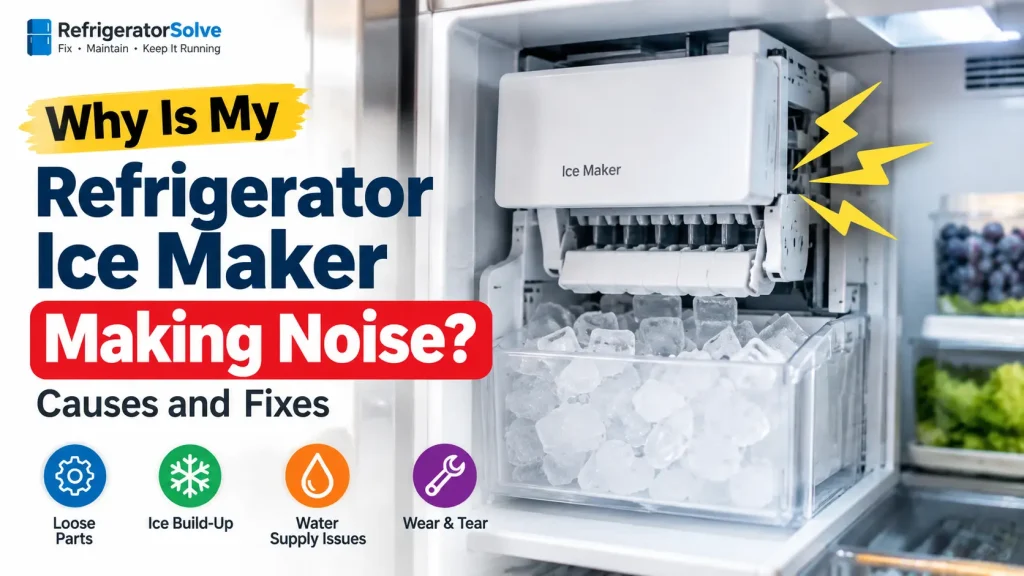
A refrigerator ice maker is not completely silent. During a normal cycle, you may hear water entering the tray, the ice maker motor moving, or ice dropping into the bin. Those sounds are usually brief and predictable.
The problem starts when the noise becomes unusually loud, repetitive, or mechanical. A buzzing sound may come from the water inlet valve. A grinding noise can point to jammed ice or worn gears. Clicking may happen during a normal cycle, but repeated clicking without ice production deserves a closer look.
The good news is that you can often narrow down the problem without immediately replacing the ice maker. Start by paying attention to what the sound is, where it is coming from, and when it happens.
Is It Normal for a Refrigerator Ice Maker to Make Noise?
Yes. An automatic ice maker has several moving and water-controlled parts, so some noise is expected.
During a normal cycle, you may hear:
- A short humming or buzzing sound while the water valve opens
- Water flowing into the ice mold
- A click as the ice maker starts or stops a cycle
- A motor running during the harvest cycle
- Ice cubes dropping into the storage bin
- A brief pop or crack as ice separates from the mold
- A low vibration while the mechanism operates
The important difference is pattern.
A normal sound is generally short and occurs at a predictable point in the ice-making cycle. A loud grinding sound that continues for several minutes, a valve that buzzes repeatedly, or clicking that happens without producing ice is more concerning.
For a broader look at common refrigerator noises, see our guide to refrigerator noises and sounds.
First, Find Where the Noise Is Coming From
Before taking anything apart, identify the loudest point.
Noise Inside the Freezer Near the Ice Maker
The likely sources include:
- Ice maker motor
- Ice ejector mechanism
- Ice cubes stuck in the mold
- Ice storage bin
- Evaporator fan
- Frost interfering with a fan or nearby component
If the noise becomes quieter or stops when you open the freezer door, a fan or component inside the freezer deserves attention.
Noise Near the Ice Dispenser
A dispenser-related noise can come from:
- Auger motor
- Clumped ice
- Ice stuck in the chute
- Dispenser mechanism
- Water inlet valve
This is especially important if the noise happens only when you press the ice dispenser.
Noise From the Back of the Refrigerator
A sound that seems to come from the rear may not actually be caused by the ice maker. The condenser fan, compressor, water line, or a vibrating rear panel can create sounds that travel through the cabinet.
Our guide on checking refrigerator compressor and fan noise can help distinguish a cooling-system problem from an ice-maker problem.
Noise That Vibrates Through the Cabinet
Sometimes the component itself is working normally, but its vibration is being transferred to the refrigerator cabinet, wall, floor, or nearby cabinets.
A refrigerator that is not level can also amplify an otherwise minor vibration.
What Does Your Refrigerator Ice Maker Sound Like?
The type of sound gives you one of the best clues.
Buzzing or Humming
A short buzz can be normal when the water inlet valve opens or the ice maker begins a cycle.
A persistent buzzing may indicate:
- Restricted water flow
- Low water pressure
- A frozen fill tube
- A failing water inlet valve
- An ice maker trying to cycle without receiving water
If the ice mold stays empty while you repeatedly hear buzzing, investigate the water supply before assuming the motor has failed.
Clicking
Occasional clicking is often normal. The ice maker may click when a cycle begins or ends.
Repeated clicking is different.
It may indicate:
- A motor attempting to move
- Ice blocking the ejector mechanism
- A faulty ice maker module
- A water valve opening without adequate water flow
- Another refrigerator component cycling abnormally
If the refrigerator clicks every few minutes and the ice maker never fills, the water supply and ice maker assembly should be checked.
Grinding or Crunching
Grinding is one of the sounds that deserves more attention.
Common causes include:
- Ice stuck in the ejector mechanism
- Large pieces of frozen ice blocking movement
- Worn gears inside the ice maker
- A failing motor
- Ice cubes clumped together inside the dispenser
Do not keep forcing the ice maker through repeated cycles if the motor is clearly struggling. Continuing to run a jammed mechanism can turn a simple obstruction into a damaged assembly.
Knocking or Thumping
A knocking sound can be caused by ice moving inside the bin, the ice maker vibrating against its mounting point, or another part of the refrigerator transferring vibration through the cabinet.
Check whether:
- The ice bin is correctly seated
- Ice cubes are piled unevenly
- The refrigerator is level
- The appliance is touching the wall
- The water line is striking the back panel
Rattling or Vibrating
A rattling sound is not necessarily an ice maker failure.
The ice maker may be operating normally while its vibration is transferred to:
- The freezer wall
- The ice bin
- A shelf
- The refrigerator cabinet
- The wall behind the appliance
- The water supply line
Our guide on what causes a refrigerator to make a vibrating noise covers these installation and vibration issues in more detail.
Squealing or Screeching
A high-pitched squeal is more likely to indicate mechanical friction.
Possible sources include:
- Worn motor bearings
- Damaged gears
- A struggling ice maker motor
- A fan contacting ice or frost
- Another moving refrigerator component
A persistent squeal should not be treated as a normal ice-making sound.
Hissing or Water-Filling Sound
A brief hissing or rushing-water sound may simply mean that the ice maker is filling.
It becomes more suspicious when:
- The sound continues longer than usual
- The ice mold remains empty
- Water pressure appears weak
- The refrigerator has recently had its filter changed
- Water is leaking
- The sound is accompanied by repeated buzzing
12 Common Reasons Your Refrigerator Ice Maker Is Making Noise
1. Ice Is Jammed in the Ejector Mechanism
During the harvest cycle, the ice maker has to release the frozen cubes from the mold.
If a cube is stuck, the motor may continue trying to move the ejector. This can produce clicking, grinding, or repeated motor noise.
Turn the ice maker off and inspect the mold and ejector area. Remove loose ice carefully rather than using a knife or another sharp object.
2. Ice Cubes Are Clumped Together
Moisture can cause cubes in the storage bin to freeze together.
When the auger or dispenser motor tries to move a large clump, you may hear grinding, knocking, or a strained motor sound.
Emptying and breaking apart large ice clumps can sometimes solve the problem immediately.
3. The Ice Maker Motor or Gears Are Worn
The ice maker motor drives the harvest mechanism. Over time, its gears can wear.
Common signs include:
- Grinding during harvest
- Repeated clicking
- Slow or incomplete movement
- Ice maker noise with little or no ice production
- Noise that has gradually become louder
A worn motor or gear mechanism may require replacement of the ice maker assembly rather than a simple cleaning.
4. The Water Inlet Valve Is Buzzing
The water inlet valve opens to allow water into the ice maker.
A buzzing or chattering valve may be associated with restricted water flow, low pressure, or a valve that is beginning to fail.
If the sound happens specifically when the ice maker is supposed to fill, check the water supply before replacing the ice maker.
5. The Fill Tube Is Frozen
A frozen fill tube prevents water from reaching the ice mold.
You may hear the valve activate and even hear buzzing, but no water enters the tray.
This can lead to a frustrating combination: the ice maker is making noise but not making ice.
6. The Water Filter Is Restricting Flow
A clogged, incorrectly installed, or incompatible filter can restrict water flow.
This is particularly worth checking if the noise appeared soon after a filter replacement.
Make sure the filter is correctly seated and compatible with the refrigerator. Follow the manufacturer’s instructions for filter replacement and flushing.
For related troubleshooting, you can also read our guide on how to troubleshoot a refrigerator ice maker.
7. Water Pressure Is Too Low
The ice maker needs enough water flow to fill the mold correctly.
Low pressure can cause:
- Weak water flow
- Long buzzing sounds
- Small or hollow cubes
- Incomplete fills
- Repeated attempts to cycle
Check for a partially closed shutoff valve, a kinked supply line, or another restriction in the water system.
8. The Ice Maker or Surrounding Parts Are Vibrating
An ice maker that is slightly loose can transfer its operating vibration into the freezer compartment.
Before assuming a mechanical failure, check that the ice maker, ice bin, and nearby removable components are properly seated.
9. The Ice Dispenser Auger Motor Is Struggling
If the noise happens only when you press the ice dispenser, the ice maker itself may not be the problem.
The dispenser’s auger motor has to push ice forward through the chute. Clumped cubes or an obstruction can make the motor sound unusually loud.
10. Freezer Temperature or Ice Buildup Is Interfering With the Cycle
Temperature matters because the ice maker has to freeze water before it can harvest the cubes.
A freezer that is too warm may delay or interrupt normal ice production. Excessive frost can also interfere with airflow or nearby fan operation.
A refrigerator temperature guide such as fridge temperature vs. freezer temperature can help when you suspect a temperature-related issue.
11. A Fan Is Being Mistaken for the Ice Maker
This is an easy mistake to make.
The evaporator fan is located in the freezer area and can produce humming, rattling, grinding, or vibrating noises. Because it is near the ice maker on many refrigerators, the two sounds can be confused.
A good diagnostic clue is timing. If the noise continues independently of the ice-making cycle, inspect the fan area as well.
12. The Refrigerator Is Not Level
A refrigerator that is slightly out of level can amplify vibration.
Check whether the unit rocks when you gently press on opposite corners. Also make sure it is not touching a wall, cabinet, or other hard surface.
Why Is My Ice Maker Making Noise but Not Making Ice?
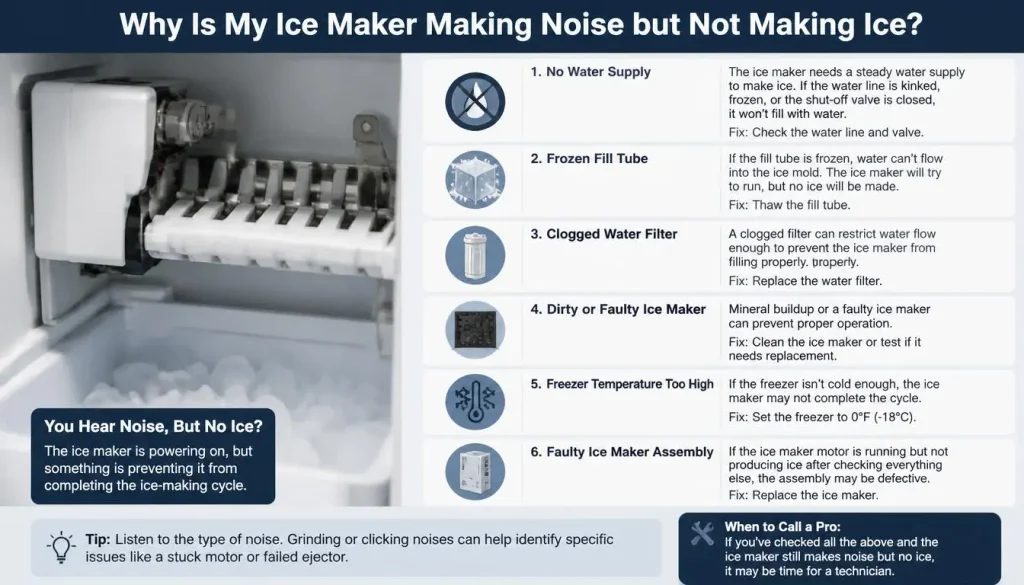
This combination narrows the problem considerably.
If the ice maker is making noise but the mold remains empty, check these areas first:
- Water supply
- Water filter
- Frozen fill tube
- Water inlet valve
- Ice maker shutoff arm or switch
- Ice maker motor and module
- Freezer temperature
- Ice maker assembly
For example, a buzzing noise followed by no water entering the mold often points toward a water-supply or valve problem. A repeated mechanical clicking without an ice harvest is more suggestive of an obstruction or a failing ice maker mechanism.
We also have a detailed guide for situations where the ice maker is not making ice but the water dispenser works.
Why Does My Ice Maker Make Noise When Dispensing Ice?
If the sound occurs only when you press the dispenser lever, focus on the dispenser rather than the automatic ice-making cycle.
The most common possibilities are:
- Ice cubes frozen together
- Ice trapped in the chute
- Auger motor strain
- Dispenser mechanism obstruction
- Damaged or worn auger components
Start by emptying the ice bin and checking for large frozen clumps. If the noise continues even with loose ice, the auger mechanism may need further inspection.
Why Does My Ice Maker Make Noise During the Harvest Cycle?
The harvest cycle is when the ice maker removes frozen cubes from the mold.
A brief motor sound, click, or movement noise can be completely normal.
The concern is when the mechanism repeatedly tries to move but cannot complete the cycle.
Watch for:
- Repeated clicking
- Grinding
- Motor hum without movement
- Ice remaining stuck in the mold
- No cubes dropping after several cycles
An ice jam should be removed safely. If the mechanism cannot move after the obstruction is cleared, the motor or ice maker module may be failing.
Why Does My Ice Maker Make Noise at Night?
A refrigerator often sounds louder at night simply because the kitchen is quieter.
A normal water fill, ice harvest, compressor vibration, or ice cube dropping into the bin can seem surprisingly loud when everything else is silent.
However, nighttime is also useful for diagnosis. Stand near the refrigerator when the sound occurs and note:
- Where the sound begins
- How long it lasts
- Whether it happens during ice harvesting
- Whether it stops when you open the freezer
- Whether the refrigerator is vibrating against anything nearby
If the sound is only more noticeable at night but the refrigerator is cooling correctly, that does not necessarily indicate a fault.
Why Is My New Refrigerator Ice Maker Making Noise?
New refrigerators can make unfamiliar sounds during their first cycles.
You may hear:
- Water entering the ice maker
- Ice releasing from the mold
- Plastic components expanding or contracting
- Fans starting and stopping
- Normal cabinet vibration
Before assuming the new appliance is defective, verify that the refrigerator is level, the water line is correctly installed, and the ice maker is turned on.
Also give the refrigerator enough time to reach its normal operating temperature. A newly installed refrigerator may need time to stabilize before the ice maker produces its normal amount of ice.
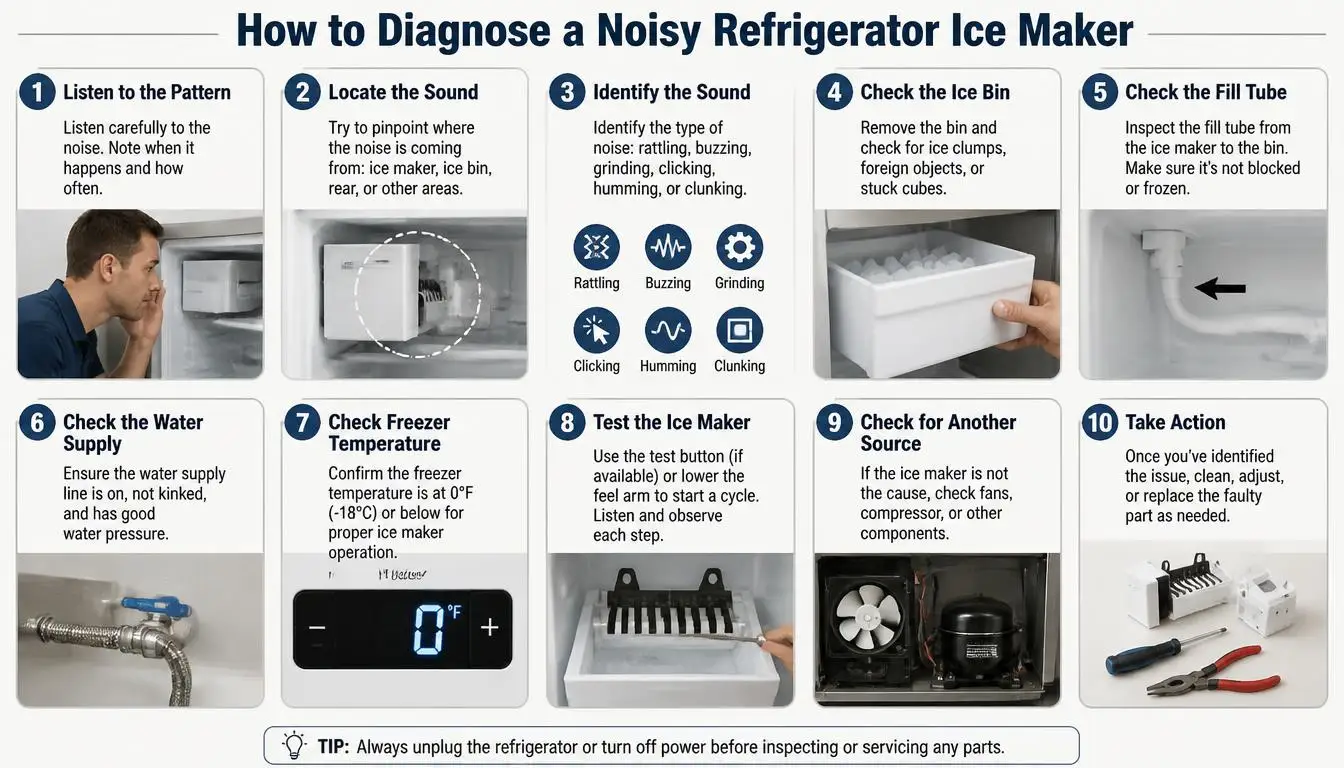
How to Diagnose a Noisy Refrigerator Ice Maker Step by Step
Step 1: Listen to the Pattern
Does the noise happen:
- Every few hours?
- Only when making ice?
- Only when dispensing ice?
- Continuously?
- After the refrigerator starts cooling?
- When the freezer door is closed?
The timing can be more useful than the volume of the sound.
Step 2: Locate the Sound
Determine whether it is loudest near:
- The ice maker
- The dispenser
- The freezer fan area
- The rear of the refrigerator
- The water supply line
- The cabinet or floor
Step 3: Identify the Sound
Compare the noise with the descriptions above.
Buzzing points you toward water flow or electrical components. Grinding suggests mechanical resistance. Rattling often suggests vibration or loose parts.
Step 4: Check the Ice Bin
Look for:
- Large clumps
- Ice blocking the mechanism
- An incorrectly seated bin
- Foreign objects
- Ice buildup
Step 5: Check the Fill Tube
Look for visible ice blocking the tube that supplies water to the ice maker.
Do not use a sharp object to break through the ice, and avoid applying excessive heat to plastic components or wiring.
Step 6: Check the Water Supply
Make sure the shutoff valve is fully open and the supply line is not kinked behind the refrigerator.
If the water filter was recently changed, verify that it is correctly installed.
Step 7: Check Freezer Temperature
Use an appliance thermometer rather than relying only on the refrigerator display.
A properly cold freezer is important for reliable ice production.
Step 8: Test the Ice Maker
Some refrigerators have a test button or a model-specific test procedure.
Use the manufacturer’s instructions rather than forcing the mechanism manually.
Step 9: Check for Another Source
If the sound continues when the ice maker is inactive, the noise may come from a fan, compressor, valve, or vibration elsewhere in the refrigerator.
How to Fix a Noisy Refrigerator Ice Maker
The correct fix depends on the cause.
For a simple ice jam, carefully remove the obstruction.
For clumped ice, empty the bin and separate or replace the old ice.
For a frozen fill tube, use the manufacturer’s recommended defrost procedure rather than applying direct high heat.
For water-flow problems, check the filter, supply line, and shutoff valve.
For a refrigerator that vibrates, correct its position and make sure it is not touching surrounding surfaces.
For a damaged motor, gear set, valve, or ice maker assembly, replacing the defective component may be necessary.
Avoid removing electrical covers or reaching near a moving fan unless the appliance has been safely disconnected and you are following the manufacturer’s service instructions.
When Is an Ice Maker Noise a Warning Sign?
A noisy ice maker deserves more attention when the sound is accompanied by another problem.
Watch for:
- Continuous grinding
- Repeated electrical buzzing
- Burning smell
- Water leaks
- No ice production
- Ice maker repeatedly attempting to cycle
- Poor freezer performance
- Excessive frost
- Error codes
- A motor that sounds strained or cannot complete its cycle
A brief operating noise is very different from a refrigerator that is struggling to complete the same action repeatedly.
When Should You Replace the Ice Maker?
Replacement becomes more likely when:
- The motor or gears are damaged
- The assembly cannot complete a harvest cycle
- The ice maker repeatedly jams after the obstruction is removed
- The module has failed
- A compatible replacement assembly is readily available
- Repairing individual parts is impractical
Do not replace the ice maker simply because you hear a noise. First determine whether the sound is actually coming from the ice maker.
When Should You Call a Refrigerator Repair Technician?
Call for professional help when the problem involves electrical components, persistent leaks, damaged wiring, severe mechanical noise, or a refrigerator that is no longer cooling correctly.
Professional diagnosis is also appropriate when:
- The ice maker has been tested but still will not cycle
- A new inlet valve does not solve the problem
- The motor repeatedly stalls
- The refrigerator is making noise and not cooling properly
- You see damaged wiring or burnt components
- The same problem returns after temporary fixes
If you are unsure which refrigerator component is responsible, stop before disassembling the appliance. A short video of the noise can be useful when contacting the manufacturer or a technician.
How to Prevent Refrigerator Ice Maker Noise
A few simple habits can reduce unnecessary noise and mechanical strain.
Keep the ice bin from becoming severely overfilled. Break up large clumps before they interfere with the dispenser. Replace the water filter according to the manufacturer’s recommendations, and keep the water supply line free of kinks.
Make sure the refrigerator remains level and has enough clearance around it. Do not allow shelves, bins, bottles, or containers to press against vibrating components.
Regularly check that the ice maker is seated correctly and that unusual frost or water buildup is not developing around it.
Frequently Asked Questions
Why is my refrigerator ice maker making noise?
Your refrigerator ice maker may be making noise because it is filling with water, harvesting ice, dispensing ice, or operating its motor normally. Unusually loud buzzing, grinding, repeated clicking, or noise accompanied by no ice production can indicate a jam, water-flow problem, worn motor, faulty valve, or another component problem.
Is it normal for an ice maker to make noise?
Yes. Short humming, clicking, water-filling, and ice-dropping sounds are normal parts of automatic ice production. The concern is usually a sound that becomes unusually loud, continuous, repetitive, or mechanically strained.
Why is my ice maker making a loud buzzing noise?
A loud buzzing sound can be associated with the water inlet valve, restricted water flow, low water pressure, a frozen fill tube, or an ice maker motor attempting to operate.
Why is my ice maker clicking but not making ice?
Repeated clicking with no ice may indicate an ice jam, a failed motor or module, a water-supply problem, a frozen fill tube, or a valve that is activating without supplying enough water.
Why is my ice maker making a grinding noise?
Grinding often suggests mechanical resistance. Check for jammed ice, clumped cubes, worn gears, a struggling motor, or a dispenser auger problem.
Why is my ice maker making noise but not making ice?
Start with the water supply, filter, fill tube, freezer temperature, shutoff control, and ice maker assembly. If the valve or motor activates but the mold remains empty, water flow is one of the first areas to investigate.
Why does my ice maker make noise when dispensing ice?
Noise that occurs only during dispensing is more likely related to the auger motor, clumped ice, the dispenser chute, or another part of the ice-dispensing mechanism.
Why does my ice maker make noise every few hours?
Automatic ice makers operate in cycles, so periodic noise can be normal. The key question is whether the sound corresponds to filling, harvesting, or dispensing. A repetitive noise without successful ice production is more concerning.
Why does my ice maker make noise at night?
Normal refrigerator sounds are easier to notice when the kitchen is quiet. A brief ice harvest, water fill, or ice drop may sound much louder at night even when nothing is wrong.
How do I stop my refrigerator ice maker from making noise?
First identify the sound and its source. Remove ice jams, separate clumped ice, check water flow, inspect the fill tube, verify the ice bin is seated correctly, and make sure the refrigerator is level. A persistent mechanical or electrical noise may require part replacement or professional diagnosis.
Final Takeaway
A noisy refrigerator ice maker is not automatically a sign of failure. Many sounds are simply part of the normal ice-making process.
The most useful clues are the type of sound, where you hear it, and when it happens.
A brief buzz during water filling or a click during the harvest cycle may be normal. Grinding, repeated clicking, persistent buzzing, or motor noise accompanied by no ice production deserves closer attention.
Start with the simple checks: inspect the ice bin, look for jams, verify water flow, check the fill tube and filter, confirm the freezer is cold enough, and make sure the refrigerator is level.
When the noise remains after those checks—or when it is accompanied by leaking, poor cooling, electrical smells, or obvious mechanical failure—professional service is the safer choice.

Hi, I’m the lead researcher and appliance enthusiast behind RefrigeratorSolve. With years of hands-on experience troubleshooting cooling systems and testing home appliances, I am dedicated to bringing you honest reviews, energy-saving tips, and practical solutions to keep your refrigerator running perfectly.