
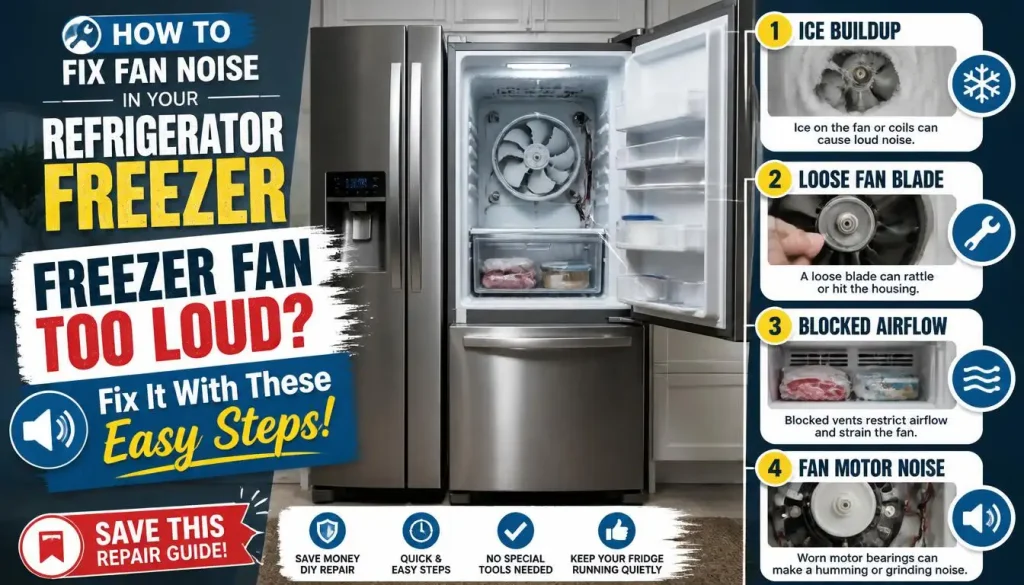
A strange fan noise coming from the freezer can be annoying, but it can also be an early warning that something needs attention.
In many refrigerators, the evaporator fan sits behind the rear panel inside the freezer. Its job is to move cold air through the freezer and refrigerator compartments. When ice builds up around the fan, the blade becomes damaged, or the motor starts wearing out, you may hear grinding, buzzing, rattling, scraping, or squealing sounds.
The good news is that some freezer fan noise problems are easy to fix at home. Others may require a new evaporator fan motor or professional repair.
This guide explains how to find the source of the noise, what each sound may mean, and how to fix fan noise in the freezer compartment safely.
Why Is the Fan in My Refrigerator Freezer Making Noise?
A noisy freezer fan usually means the fan blade is touching something, the motor is struggling to run, or ice has formed around the fan assembly.
Common causes include:
- Ice touching the fan blade
- Heavy frost around the evaporator
- Food blocking an air vent
- A bent or damaged fan blade
- A loose fan cover
- A worn evaporator fan motor
- A freezer door that is not sealing correctly
- A problem with the automatic defrost system
Before replacing any part, spend a few minutes identifying exactly where the sound is coming from.
Is Freezer Fan Noise Normal?
Some refrigerator fan noise is normal.
You may hear a gentle humming or whirring sound when the fan runs. The sound may become slightly louder when the refrigerator is working harder after the door has been open or after you add warm food.
The sound is more likely to indicate a problem if you hear:
- Loud grinding
- Scraping
- Repeated rattling
- Squealing
- Harsh buzzing
- Clicking from the fan area
- A sound that suddenly becomes much louder than usual
A sudden change in sound deserves more attention than a quiet fan noise that has always been present.
Where Is the Evaporator Fan Located?
In most frost-free refrigerators, the evaporator fan is located behind a panel at the rear of the freezer compartment.
The exact position varies by model. It may be near the top, middle, or lower part of the freezer.
Do not start removing panels until the refrigerator is unplugged.
Is the Noise From the Evaporator Fan or Condenser Fan?
Refrigerators may have more than one fan.
The evaporator fan is normally inside the freezer. The condenser fan, when present, is usually near the compressor at the bottom or rear of the refrigerator.
If the sound clearly comes from inside the freezer, the evaporator fan is a more likely source.
If the sound is strongest near the bottom or back of the appliance, inspect the condenser fan area instead.
This distinction can save you from taking apart the wrong section of the refrigerator.
Quick Diagnosis Before You Take the Freezer Apart
You can learn a lot about the problem before removing a single screw.
Check Whether the Noise Stops When You Open the Freezer Door
Open the freezer door while the noise is happening.
On many refrigerators, the evaporator fan stops when the door opens. If the noise immediately disappears, the evaporator fan becomes a strong suspect.
However, not every refrigerator works this way. Some models keep the fan running, use electronic door sensors, or control the fan differently.
Use this test as a clue rather than absolute proof.
Test the Evaporator Fan With the Freezer Door Switch
If your freezer has a visible door switch, you may be able to press it manually while the door is open.
On some models, pressing the switch tells the refrigerator that the door is closed and allows the evaporator fan to run.
Listen carefully.
If the grinding, scraping, buzzing, or rattling starts when the fan begins turning, the problem is probably somewhere around the evaporator fan assembly.
Never put your fingers or tools near a moving fan blade.
Listen for the Type of Noise
Different sounds can point toward different problems.
| Sound | Possible Cause |
|---|---|
| Grinding | Ice touching the blade, damaged blade, or worn motor |
| Scraping | Fan blade rubbing against ice or the housing |
| Buzzing | Ice obstruction or struggling fan motor |
| Rattling | Loose cover, blade, or mounting part |
| Squealing | Worn motor bearing |
| Whirring | Fan blade or motor issue |
| Chirping | Fan motor or bearing problem |
| Clicking | Fan blade interference or another moving component |
The sound alone cannot confirm the failed part, but it can tell you where to start looking.
Check Whether the Freezer Is Still Cooling Normally
Fan noise together with poor cooling is more serious than noise alone.
Check whether:
- Ice cream is becoming soft
- Frozen food feels warmer than normal
- The refrigerator section is also getting warm
- Airflow from the vents feels weak
- Frost is covering the back freezer panel
If cooling has dropped significantly, the evaporator fan may not be moving enough cold air.
Common Causes of Fan Noise in the Freezer Compartment
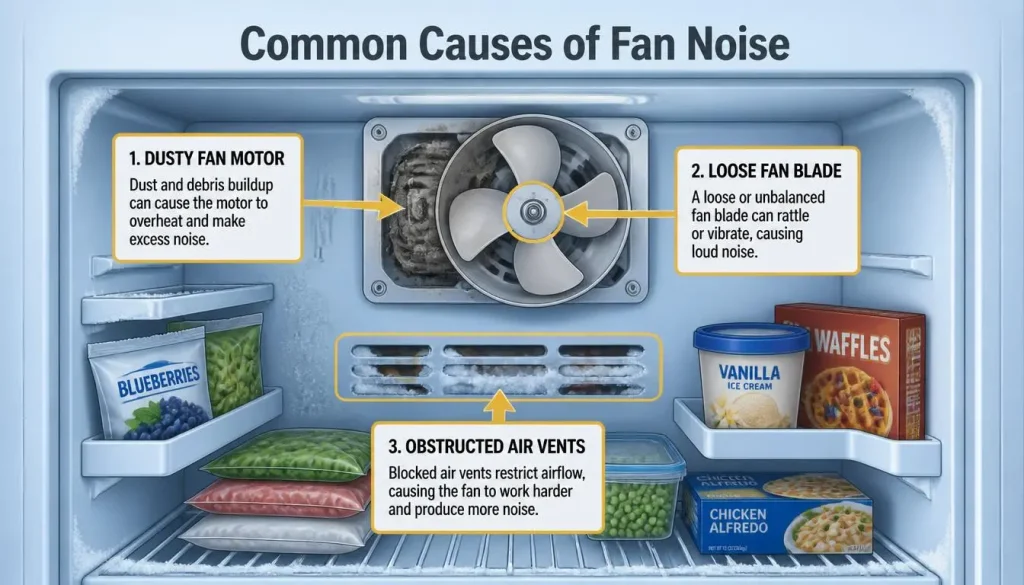
Several problems can create almost the same sound. Inspect the simple causes first.
Ice or Frost Is Hitting the Evaporator Fan
This is one of the most common reasons for a freezer fan to make a grinding or scraping sound.
Moisture freezes around the evaporator fan. As the ice grows, it eventually reaches the spinning fan blade.
The noise may start quietly and become louder as more ice forms.
You may also notice frost on the rear wall of the freezer.
Freezer Door Was Left Open and Ice Formed Around the Fan
If the freezer door stays partly open, warm and humid air enters the compartment.
That moisture can freeze around the evaporator, fan housing, and air passages.
Even leaving the door slightly open overnight may cause enough frost to create noise.
Check that food packages, drawers, or ice containers are not preventing the door from closing completely.
Frosted Evaporator Coils Are Restricting Airflow
Heavy frost behind the freezer panel can do more than create noise.
It can restrict airflow through the evaporator coils and reduce the amount of cold air reaching the refrigerator.
If thick frost keeps returning after you defrost the appliance, the refrigerator may have an automatic defrost problem.
Food or Packaging Is Blocking the Fan or Air Vent
A full freezer is not necessarily a problem, but food should not block the vents.
Plastic bags, boxes, and loose packaging can also move toward the rear panel and create vibration or airflow noise.
Keep a little space around air vents and do not push food tightly against the rear freezer wall.
Evaporator Fan Blade Is Loose, Bent, or Damaged
A fan blade that is cracked, bent, loose, or out of balance may wobble while spinning.
The blade may then touch the fan housing or create vibration.
A damaged blade should normally be replaced rather than bent back into position.
Fan Blade Is Rubbing Against the Housing
Sometimes there is little or no ice around the fan, but the blade still makes a scraping noise.
A loose motor mount, shifted fan cover, or damaged blade may cause the blade to rub against the housing.
Look for scrape marks around the fan shroud.
Evaporator Fan Motor Is Wearing Out
Fan motors do not last forever.
A worn motor may become louder before it stops completely.
Signs of a failing evaporator fan motor can include:
- Squealing
- Grinding
- Loud humming
- Slow fan speed
- Fan starting and stopping
- Excessive vibration
- Fan failing to start
- Weak airflow from refrigerator vents
If the blade is clear and undamaged but the motor itself sounds rough, replacement may be necessary.
Fan Cover or Mounting Parts Are Vibrating
Loose screws, clips, covers, or motor mounts can produce a rattling sound.
The fan may still work normally.
After unplugging the refrigerator, inspect the fan cover and mounting hardware for anything loose or out of position.
Freezer Door Gasket Is Letting Warm Air In
A damaged or dirty door gasket can allow humid room air into the freezer.
That extra moisture can lead to excessive frost.
Inspect the gasket for:
- Tears
- Cracks
- Dirt
- Gaps
- Sections pulling away from the door
Clean the gasket with mild soap and water and make sure the door closes evenly.
Defrost System Is Not Working Properly
If ice repeatedly builds up around the evaporator fan, there may be a deeper problem.
Possible causes can include the defrost heater, temperature sensor, thermostat, wiring, control board, or another component in the automatic defrost system.
The exact design varies between refrigerator models.
Repeatedly melting the ice may stop the noise temporarily, but it will not solve a failed defrost system.
How to Fix Fan Noise in Freezer Compartment of Refrigerator
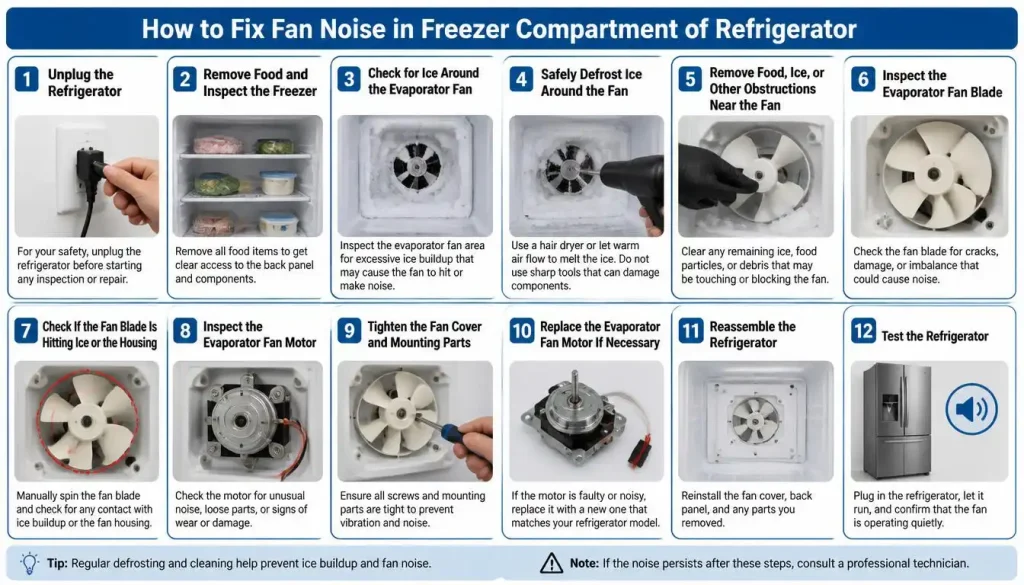
Start with the safest and easiest checks.
Step 1: Unplug the Refrigerator
Disconnect the refrigerator from power before removing covers or reaching near the fan.
Do not rely only on opening the door or turning down the temperature control.
The fan may start unexpectedly.
Step 2: Remove Food and Inspect the Freezer
Take out enough food, shelves, baskets, and drawers to see the rear freezer panel clearly.
Look for:
- Thick frost
- Ice around vents
- Loose packaging
- Objects touching the rear wall
- Water or unusual ice patterns
Sometimes the problem becomes obvious at this stage.
Step 3: Check for Ice Around the Evaporator Fan
If your model allows safe access to the evaporator area, inspect behind the freezer panel after disconnecting power.
Do not force a panel that is frozen in place.
If you see ice around the fan blade or housing, allow it to melt naturally.
Step 4: Safely Defrost Ice Around the Fan
The safest method is usually to unplug the refrigerator, remove the food, leave the freezer door open, and allow the ice to melt naturally.
Place towels around the appliance to collect water.
Do not chip ice away with a knife, screwdriver, or other sharp tool. You can easily damage a refrigerant line, wiring, coil, or plastic panel.
Avoid using a hair dryer, heat gun, open flame, or high-temperature heater inside the freezer. Excessive heat can damage plastic parts, electrical components, and the refrigerator liner.
Step 5: Remove Food, Ice, or Other Obstructions Near the Fan
Once the ice has melted, remove anything that could interfere with the blade.
Make sure:
- Packaging is not touching the fan area
- Air vents are clear
- No loose ice remains around the fan
- Drainage areas are not packed with debris
Step 6: Inspect the Evaporator Fan Blade
With the refrigerator unplugged, inspect the blade carefully.
Look for:
- Cracks
- Bent sections
- Wobbling
- Loose attachment
- Missing pieces
- Scrape marks
If the blade is damaged, replace it with the correct part for your refrigerator model.
Step 7: Check If the Fan Blade Is Hitting Ice or the Housing
Turn the blade gently by hand while the refrigerator is unplugged.
It should move freely without scraping against the surrounding housing.
If it touches the housing, determine whether the blade, motor mount, or fan cover is out of position.
Do not force the blade.
Step 8: Inspect the Evaporator Fan Motor
If the blade is clear but the noise continues, the motor may be worn.
A motor that feels rough when turned, has excessive shaft movement, or repeatedly makes grinding or squealing sounds may need replacement.
Electrical testing should only be performed if you understand appliance electrical systems and have the correct service information for the model.
Step 9: Tighten the Fan Cover and Mounting Parts
Check screws, clips, and mounting brackets around the fan assembly.
Tighten anything obviously loose, but do not overtighten plastic parts.
A cracked fan shroud may need replacement.
Step 10: Replace the Evaporator Fan Motor If Necessary
If the motor has failed, use a replacement designed for your exact refrigerator model.
Before ordering a part, locate the model number of the refrigerator.
It is commonly found on a label inside the refrigerator or freezer compartment.
Do not assume a fan motor that looks similar will work correctly.
If replacing the motor requires extensive disassembly, wiring work, or removal of delicate evaporator components, calling a technician may be safer.
Step 11: Reassemble and Test the Refrigerator
After the repair:
- Reinstall all covers correctly.
- Make sure wiring is secured.
- Return shelves and drawers.
- Plug the refrigerator back in.
- Allow it to begin cooling.
- Listen for the fan.
- Check airflow from the vents.
Do not judge the cooling performance immediately. A refrigerator that has been unplugged for a long defrost may need several hours to return to normal temperature.
How to Tell If the Freezer Fan Is Hitting Ice
Fan blades hitting ice usually create a very recognizable sound.
Listen for Scraping or Grinding
The sound may resemble plastic rubbing against hard ice.
It may also change in volume as the fan speeds up or slows down.
Look for Frost on the Rear Freezer Panel
A thick layer of frost on the inside rear wall often suggests there is even more frost behind the panel.
That does not automatically mean the defrost system has failed, but it deserves investigation.
Check the Fan Area After Disconnecting Power
Once the refrigerator is unplugged, inspect the fan area if it is safely accessible.
If you find a clear ring of ice around the blade or scrape marks in the frost, you have probably found the source of the sound.
What If the Freezer Fan Is Not Spinning?
A fan that does not spin can cause weak cooling even if the compressor is running.
Check for Ice Blocking the Blade
Ice can physically lock the fan in place.
Do not force a frozen blade to turn.
Defrost the area first.
Check for a Stuck or Damaged Fan Blade
With the power disconnected, gently rotate the blade.
If it is jammed, broken, or rubbing heavily against the housing, repair the obstruction before testing the motor.
Check the Fan Motor
If the blade moves freely but the motor does not run when it should, the motor may have failed.
However, lack of power to the motor can also be caused by another electrical or control problem.
Consider an Electrical or Control Problem
A new fan motor will not solve the problem if the motor is not receiving the correct power.
If the fan is not running and the cause is not obvious, professional diagnosis can prevent unnecessary parts replacement.
Freezer Fan Making Noise but Stops When Door Opens
This symptom often points toward the evaporator fan.
Many refrigerators stop the evaporator fan when the freezer door opens so cold air is not blown out of the compartment.
If the noise disappears the moment the fan stops, inspect the evaporator fan area for ice, damage, or motor wear.
Still, refrigerator designs vary. Confirm how the fan operates on your particular model before treating this test as a final diagnosis.
Freezer Fan Making Noise and Refrigerator Is Not Cooling
Fan noise combined with poor cooling should be addressed quickly.
Evaporator Fan Is Not Moving Enough Cold Air
The evaporator fan distributes cold air.
If it spins slowly, stops intermittently, or fails completely, the freezer may remain somewhat cold while the refrigerator section becomes warm.
Evaporator Coils Are Covered With Frost
Heavy frost can block airflow through the evaporator.
You may hear the fan hitting ice while also noticing weak cooling.
Air Vents Are Blocked
Food pushed against vents can prevent cold air from moving properly.
Rearrange food so air can circulate around the compartment.
Fan Motor Has Failed
A failed motor may make noise shortly before it stops.
If the compressor runs but airflow is weak or absent, inspect the evaporator fan.
Poor cooling can also have causes unrelated to the fan, so avoid replacing parts until the problem has been properly diagnosed.
Freezer Fan Making Grinding or Scraping Noise
Grinding and scraping usually mean something is physically touching the fan or the motor is badly worn.
Fan Blade Is Hitting Ice
This is often the first thing to check.
Defrost the fan area safely and see whether the sound disappears.
Fan Blade Is Touching the Housing
Inspect the fan shroud and motor mount.
A loose component may have shifted into the blade.
Fan Blade Is Damaged
A warped or cracked blade may no longer spin evenly.
Replace it rather than continuing to operate the refrigerator with a damaged blade.
Fan Motor Bearing Is Worn
If nothing is touching the blade but the motor itself grinds or squeals, the internal bearing may be worn.
The usual repair is motor replacement.
Freezer Fan Making Buzzing, Rattling, or Whirring Noise
These sounds can have several causes.
Ice Is Around the Fan
A small amount of ice can create buzzing or vibration before it becomes a full grinding noise.
Inspect for early frost buildup.
Fan Cover or Motor Mount Is Loose
A loose cover can vibrate whenever the fan starts.
Check mounting screws and clips with the refrigerator unplugged.
Fan Motor Is Starting to Fail
An aging motor may hum, buzz, or whir unevenly before it stops working.
If the sound remains after removing ice and tightening loose parts, inspect the motor more closely.
What to Do If Freezer Fan Noise Comes Back After Defrosting
A fan that becomes quiet after defrosting but starts making noise again several days or weeks later needs more investigation.
The ice is probably a symptom rather than the root problem.
Check the Freezer Door Gasket
Look for damaged, dirty, or loose sections that may allow warm air into the freezer.
Make Sure the Door Closes Fully
Check for food containers, shelves, drawers, or ice bins preventing the door from closing.
Look for New Frost on the Back Panel
If frost quickly returns, note how long it takes.
Repeated heavy frost may suggest a moisture, airflow, door-seal, or defrost-system problem.
Check for Blocked Air Vents
Restricted airflow can contribute to uneven temperatures and frost problems.
Keep vents clear.
Suspect a Defrost System Problem
If the evaporator repeatedly becomes covered with ice even though the door seals properly, part of the automatic defrost system may not be working correctly.
This problem may require electrical testing and model-specific service information.
When Repeated Ice Buildup Needs Professional Diagnosis
Call a technician if the fan keeps freezing after you have checked the door seal, airflow, and obvious causes.
Repeatedly defrosting the refrigerator is not a good long-term repair.
How to Prevent Freezer Fan Noise From Coming Back
A few simple habits can reduce the chance of another fan problem.
Keep Freezer Air Vents Clear
Leave space around vents so cold air can circulate.
Avoid Overpacking the Freezer
A packed freezer can restrict airflow and make it easier for food or packaging to contact vents and panels.
Keep Food Away From the Rear Fan Area
Do not push boxes or bags tightly against the back wall.
Check and Clean the Door Gasket
Wipe dirt and food residue from the gasket so it can seal properly.
Avoid Leaving the Freezer Door Open
Close the freezer as soon as possible after loading or removing food.
Address Excessive Frost Early
A light frost problem is easier to investigate than a freezer covered in thick ice.
If frost repeatedly returns, find the cause instead of simply removing it again.
When Should You Replace the Evaporator Fan Motor?
You may need a new fan motor if:
- Grinding continues after all ice is removed
- The fan turns slowly
- The fan repeatedly stops
- The motor squeals
- The fan shaft has excessive movement
- The fan does not start
- The motor vibrates heavily
- Airflow is weak even though the blade is clear
Before replacing the motor, make sure the blade, housing, wiring, and ice buildup are not causing the symptom.
When Should You Call a Refrigerator Repair Technician?
Some freezer fan problems are suitable for a simple DIY inspection. Others should be left to an appliance technician.
Consider professional repair if:
- Frost keeps returning after defrosting
- The evaporator fan receives no power
- Wiring appears burned or damaged
- The refrigerator is no longer cooling correctly
- You suspect a defrost-system failure
- The evaporator area requires difficult disassembly
- You cannot safely access the fan
- The noise continues after removing ice and checking the blade
- You are unsure which component is causing the problem
A correct diagnosis can cost less than replacing several parts based on guesswork.
Frequently Asked Questions
Why Is My Freezer Fan Suddenly Making a Loud Noise?
A sudden loud freezer fan noise can be caused by ice touching the fan blade, a loose fan cover, damaged blade, or worn fan motor. Start by checking for frost and whether the noise stops when the freezer door opens.
Why Does My Freezer Fan Stop Making Noise When I Open the Door?
Many refrigerators stop the evaporator fan when the freezer door opens. If the noise stops at the same time, the evaporator fan area is a likely source. The exact operation depends on the refrigerator model.
How Do I Know If My Refrigerator Evaporator Fan Is Bad?
Common signs include loud grinding or squealing, weak airflow, intermittent operation, a fan that will not start, and poor cooling. Make sure ice or another obstruction is not stopping the blade before replacing the motor.
Why Is My Freezer Fan Hitting Ice?
Moisture can freeze around the evaporator fan because of a door left open, a poor door seal, heavy frost buildup, or a defrost-system problem. Once enough ice forms, the spinning blade begins touching it.
Can Ice Buildup Cause a Refrigerator Fan to Make Noise?
Yes. Ice touching the evaporator fan can create scraping, grinding, buzzing, or rattling noises.
Why Is My Freezer Fan Not Spinning?
The fan may be frozen in place, blocked by an object, damaged, or have a failed motor. An electrical or control problem can also prevent the motor from receiving power.
Why Does My Freezer Fan Make Noise Only Sometimes?
Intermittent noise can happen when the fan only touches ice at certain speeds, a motor bearing is beginning to fail, or a loose cover vibrates only when the fan runs.
Why Does My Freezer Fan Keep Freezing Up?
Repeated freezing can be caused by warm air entering through a bad door seal, a door that is not closing properly, excessive moisture, blocked airflow, or an automatic defrost problem.
Can I Use a Hair Dryer to Defrost a Refrigerator Fan?
It is safer to unplug the refrigerator and allow the ice to melt naturally. Direct heat from a hair dryer or heat gun can damage plastic parts, wiring, and other refrigerator components.
Why Does the Fan Noise Return After Defrosting?
If the noise returns because ice forms again, defrosting only removed the symptom. Check the door seal, door closure, airflow, and automatic defrost system to find the underlying cause.
Can a Bad Evaporator Fan Stop the Refrigerator From Cooling?
Yes. The evaporator fan helps move cold air through the appliance. If it fails, airflow can drop and temperatures may rise, particularly in the refrigerator compartment.
Can I Run a Refrigerator With a Bad Evaporator Fan?
The refrigerator may continue running, but cooling can become uneven or inadequate. Food temperatures may become unsafe if the appliance cannot maintain proper cooling. A failed evaporator fan should be repaired as soon as practical.
Final Thoughts
When a fan starts making noise inside the freezer compartment, do not immediately assume the motor needs replacing.
Start with the simple causes.
Check whether the sound stops when the door opens. Look for frost on the rear freezer panel. Make sure food is not blocking the vents. Then inspect the evaporator fan for ice, blade damage, loose parts, or motor wear.
If removing the ice stops the noise permanently, you may have solved the problem. If the ice or noise keeps returning, however, look for the reason it is happening. A bad door seal, airflow problem, or failed defrost component can cause the same problem again.
The most important rule is simple: disconnect power before working around the fan, avoid sharp tools and high heat when removing ice, and call a qualified appliance technician when the repair requires electrical testing or difficult disassembly.

Hi, I’m the lead researcher and appliance enthusiast behind RefrigeratorSolve. With years of hands-on experience troubleshooting cooling systems and testing home appliances, I am dedicated to bringing you honest reviews, energy-saving tips, and practical solutions to keep your refrigerator running perfectly.





3 Responses