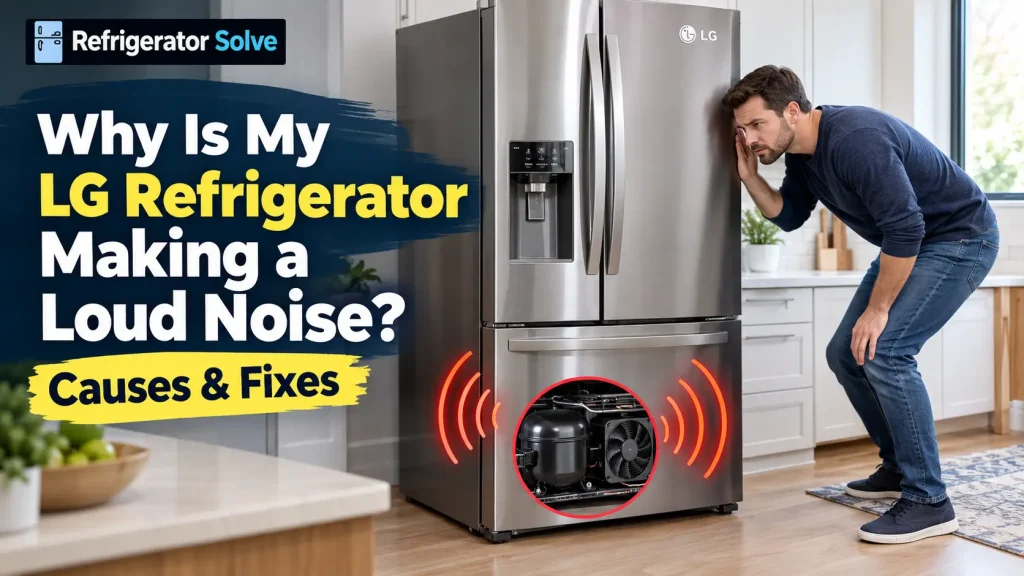
A loud LG refrigerator can be alarming, especially when the sound suddenly becomes much stronger than usual. The good news is that not every loud sound means the refrigerator is failing. Compressors, fans, refrigerant, ice makers, water valves, and automatic defrost systems can all produce sounds during normal operation.
The important question is not simply whether your LG refrigerator is making noise. You need to determine what the noise sounds like, where it is coming from, when it happens, and whether the refrigerator is still cooling properly.
Occasional humming, clicking, popping, gurgling, and water-flow sounds can be normal. However, persistent grinding, scraping, repeated loud clicking, or a new noise accompanied by poor cooling deserves closer attention. LG’s own refrigerator documentation confirms that compressor startup sounds, refrigerant movement, fan operation, and some rattling can be normal, while vibration can also result from an uneven floor or objects contacting the appliance.
This guide will help you identify the most likely cause of a loud LG refrigerator and determine what you can safely check yourself.
Is It Normal for an LG Refrigerator to Make Loud Noises?
Yes, some LG refrigerator sounds are completely normal.
Modern refrigerators contain several mechanical and electronic components that cycle on and off throughout the day. The compressor may become louder when it starts, fans may run to circulate air, refrigerant may create gurgling or hissing sounds, and the automatic defrost system can produce clicking, dripping, or sizzling sounds.
LG explains that a refrigerator may also sound louder when the compressor first starts because operating pressure is higher at the beginning of the cycle. The sound should generally settle as the refrigerator continues operating.
Sounds That Are Often Normal
- Low humming from the compressor or fan
- Brief buzzing during an operating cycle
- Occasional clicking
- Gurgling or flowing-water sounds
- Short popping or cracking sounds
- Light hissing
- Water dripping during defrost
- A brief change in compressor pitch
- Ice maker filling or dropping ice
Sounds That Deserve Investigation
Be more cautious when the noise is:
- Suddenly much louder than before
- Continuous rather than occasional
- Grinding or scraping
- Accompanied by poor cooling
- Accompanied by repeated clicking
- Getting progressively louder
- Associated with heavy vibration
- Accompanied by an error code
- Associated with an electrical or burning smell
The sound itself is only part of the diagnosis. What the refrigerator is doing at the same time is often more important.
Why Is My LG Refrigerator Suddenly Making a Loud Noise?
If your LG refrigerator was relatively quiet and has suddenly become loud, start by looking for a change in operating conditions.
The refrigerator may be working harder because the doors were left open, warm food was recently added, the room temperature has increased, or the appliance has just completed a defrost cycle. A fan can also become noisy when frost or debris begins interfering with its operation.
Another possibility is a simple installation issue. The refrigerator may have shifted slightly and begun touching a wall, cabinet, floor, or another object.
Start with these quick checks:
- Make sure the refrigerator is level and does not rock.
- Check whether it is touching the wall or cabinets.
- Look for objects vibrating on top of or around the appliance.
- Listen to determine whether the noise comes from the freezer, rear, bottom, or dispenser area.
- Check whether the refrigerator is maintaining normal temperatures.
- Look for excessive frost inside the freezer.
- Check the display for an error code.
LG specifically identifies uneven flooring, refrigerator movement, and vibrating objects as possible causes of rattling and vibration.
What Does the Loud Noise Sound Like?
The type of sound can narrow down the possible source.
| Sound | Possible Source | Usually Normal? |
|---|---|---|
| Humming | Compressor or fan | Often |
| Buzzing | Compressor, fan, or water valve | Sometimes |
| Rattling | Loose parts, leveling, wall contact | Sometimes |
| Clicking | Controls, compressor cycle, ice maker | Often brief |
| Knocking | Compressor, tubing, ice maker | Depends |
| Popping | Thermal expansion, compressor, ice maker | Often |
| Hissing | Refrigerant, airflow, defrost | Often |
| Gurgling | Refrigerant circulation | Often |
| Grinding | Fan or moving component | Usually not |
| Scraping | Fan contacting ice or obstruction | Usually not |
| Squealing | Fan motor or bearing | Usually not |
| Repeated loud clicking | Compressor, control, or electrical issue | Usually not |
For a broader explanation of individual LG refrigerator sounds, see our guide to why an LG refrigerator is making noise.
Why Is My LG Refrigerator Making a Loud Humming or Buzzing Noise?
A low hum or soft buzz is commonly produced by the compressor or one of the refrigerator’s fans.
The compressor circulates refrigerant through the cooling system, while the fans move air through the refrigerator and freezer compartments. The noise can become more noticeable when the compressor starts or when the refrigerator is working harder to recover its temperature.
A louder hum does not automatically mean the compressor is failing.
When Humming Is Usually Normal
A humming sound is generally less concerning when:
- It starts and stops with normal cooling cycles.
- The refrigerator remains cold.
- The sound eventually settles.
- There are no error codes.
- There is no unusual heat or burning smell.
When Humming Becomes Concerning
Investigate further when:
- The hum suddenly becomes much louder.
- It never settles down.
- The refrigerator stops cooling properly.
- The compressor repeatedly starts and stops.
- The rear of the refrigerator becomes unusually hot.
- The sound changes into grinding or scraping.
LG notes that compressors can produce louder sounds during startup because of higher operating pressure, with the sound normally leveling off as the cycle continues.
Why Is My LG Refrigerator Making a Loud Rattling or Vibrating Noise?
Rattling is often easier to fix than compressor or fan problems.
The refrigerator can vibrate against a wall or cabinet, or the appliance itself may rock slightly because the floor is uneven. Bottles, containers, shelves, pans, or items sitting on top can also vibrate as the compressor or fan runs.
LG lists an uneven or weak floor and vibrating objects as common causes of refrigerator rattling.
How to Fix Refrigerator Rattling
Check the following:
- Does the refrigerator rock when you gently push it?
- Is it touching the wall?
- Are cabinets touching the sides?
- Are items sitting on top?
- Are bottles or containers touching one another?
- Is the water line vibrating against the cabinet?
- Is a drain pan or rear panel loose?
Adjust the refrigerator’s leveling feet according to your model’s installation instructions.
Do not force the refrigerator against a wall simply to stop vibration. The goal is to correct the source of the movement rather than transfer the vibration somewhere else.
Why Is My LG Refrigerator Making a Loud Grinding or Scraping Noise?
Grinding and scraping deserve more attention than a soft hum or occasional click.
One common possibility is a fan blade contacting frost or ice inside the freezer. A damaged fan blade, failing fan motor, loose object, or another obstruction can produce a similar sound.
Pay particular attention if the noise appears to come from inside the freezer and changes or stops when the freezer door is opened.
Signs of a Fan-Related Problem
You may also notice:
- Weak airflow
- Frost buildup around the freezer’s rear panel
- The noise changing with fan speed
- A scraping sound that repeats at regular intervals
- The freezer becoming warmer
- A fan-related error code
Do not insert a knife, screwdriver, or other sharp object through a vent to remove ice. Doing so can damage wiring, internal panels, insulation, or sealed refrigeration components.
For a more detailed diagnostic approach, see our guide on how to check refrigerator compressor and fan noise.
Why Is My LG Refrigerator Making a Loud Clicking Noise?
A brief click is not automatically a problem.
Refrigerators can click when controls cycle, the compressor starts or stops, the defrost system operates, or the ice maker begins a cycle. LG specifically describes clicking from the defrost timer and thermostat/control system as normal operating sounds on applicable models.
The concern is repeated clicking without successful cooling.
Repeated Clicking but No Cooling
If your refrigerator repeatedly clicks, attempts to start, and then goes quiet while the refrigerator remains warm, the problem may involve the compressor, electrical controls, or another component.
Do not repeatedly unplug and reconnect the refrigerator in an attempt to force it to start.
Check the temperature and display first. If cooling continues to deteriorate, professional diagnosis is appropriate.
Why Is My LG Refrigerator Making a Knocking, Banging, or Thumping Noise?
A knocking or thumping sound can come from several different sources.
A compressor may produce a brief change in sound when starting or adjusting its operation. Tubing, a loose panel, the ice maker, or water line can also create an impact-like noise.
An isolated thump is less concerning when the refrigerator is cooling normally.
A repeated knock becomes more important when it happens continuously or is accompanied by vibration, poor cooling, or a significant change from the refrigerator’s normal operating sound.
Why Is My LG Refrigerator Making a Loud Popping or Cracking Noise?
Popping and cracking sounds are commonly associated with temperature changes.
Interior materials can expand and contract as the refrigerator cools, warms slightly, and enters or leaves a defrost cycle. This can create a sharp pop that sounds surprisingly loud in a quiet kitchen.
Our detailed guide explains why an LG refrigerator can make a popping noise and how to distinguish normal thermal sounds from symptoms that deserve attention.
A brief, occasional pop is usually less concerning when:
- Cooling is normal.
- No error code is displayed.
- There is no water leak.
- There is no heavy frost buildup.
- The frequency is not increasing.
- There is no grinding or electrical smell.
Why Is My LG Refrigerator Making a Hissing, Gurgling, or Water-Like Noise?
Hissing and gurgling can sound like a leak, but the sound alone does not prove that the refrigerator is leaking.
Refrigerant and compressor oil move through the sealed cooling system, and this movement can create water-like sounds. During automatic defrost, melting water can also drip toward the drain area.
LG’s documentation specifically describes refrigerant movement, evaporator fan operation, defrost-related dripping, and condenser airflow as potential sources of normal refrigerator sounds.
When to Investigate
Look more closely if the sound is accompanied by:
- Water collecting on the floor
- Poor cooling
- Heavy frost
- An unusual electrical or burning smell
- A continuous unusually loud hiss
- Water leaking from the dispenser area
Never attempt to open or repair the sealed refrigerant system yourself.
Why Is My LG Refrigerator Making Noise When Dispensing Water?
If the noise happens only when you press the water dispenser, the water system is a more likely source than the compressor.
A brief humming or buzzing may occur as the water inlet valve opens and water moves through the system.
Check the Water Supply
Make sure:
- The household water supply valve is fully open.
- The water line is not kinked.
- The line is not trapped underneath the refrigerator.
- The refrigerator has not recently been moved in a way that stressed the water line.
- The water filter is installed correctly.
If the noise began immediately after replacing a filter, check the filter installation.
If water pressure is restricted, the valve may sound different because water cannot flow normally.
Why Is My LG Ice Maker Making a Loud Noise?
Ice makers can make several different sounds during a normal cycle.
You may hear:
- Water entering the ice maker
- A motor rotating
- Ice cubes separating from the mold
- Ice dropping into the bin
- The dispenser auger turning
- A brief click during the cycle
The noise becomes more concerning when the ice maker makes a loud grinding or buzzing sound but does not produce ice.
Check These Things First
- Is the ice maker connected to water?
- Is the water supply turned on?
- Is the ice bin installed correctly?
- Are ice cubes jammed together?
- Is the dispenser chute blocked?
- Is there visible frost around the ice-maker area?
- Has the noise changed recently?
If the ice maker is turned on but the refrigerator is not connected to a water supply, check your model’s instructions before continuing to run the ice-making system.
Could the Damper Control Be Making the Noise?
Some LG refrigerators use a damper assembly to regulate airflow between compartments.
A damper can produce clicking, tapping, or grinding sounds as it moves. A problem becomes more likely when the noise is accompanied by a refrigerator compartment that is too warm or airflow that seems abnormal.
If the noise repeatedly comes from the same air-vent area and the refrigerator is not maintaining the expected temperature, the damper may need professional inspection.
Do not force the damper door open or try to remove internal panels without model-specific instructions.
Why Is My LG Refrigerator Loud When I Open or Close the Door?
Door behavior can provide a useful clue.
If a noise stops almost immediately when you open the freezer door and returns when you close it, a fan inside the freezer becomes more likely.
This is because some refrigerator fans operate differently when a door is open.
Try this simple test:
- Stand near the refrigerator when the noise starts.
- Open the freezer door.
- Listen for whether the sound stops or changes.
- Close the door.
- Wait for the sound to return.
Do not place your hands near moving fan blades or remove covers to inspect them.
Why Is My LG Refrigerator Making a Loud Noise and Not Cooling?
This combination deserves more attention than noise alone.
A refrigerator can make normal operating sounds while cooling. But if a loud noise appears together with rising temperatures, you need to determine whether the fan, compressor, airflow, or another cooling component is involved.
Loud Humming and Not Cooling
Check:
- Are the freezer vents blocked?
- Is there heavy frost?
- Is air coming from the vents?
- Is the compressor running?
- Is an error code displayed?
Grinding Noise and Not Cooling
A grinding or scraping sound from the freezer combined with weak airflow may point toward a fan obstruction or fan problem.
Repeated Clicking and Not Cooling
Repeated clicking followed by silence can indicate that the refrigerator is attempting to operate but is not completing the cooling cycle normally.
Loud Noise and One Compartment Is Warm
If the freezer remains cold but the refrigerator compartment becomes warm, or vice versa, airflow, fan, damper, or cooling-system problems may require professional diagnosis.
If food temperatures are rising, protect perishable food rather than waiting for the noise problem to resolve itself.
Why Is My New LG Refrigerator So Noisy?
A new LG refrigerator can sound different from an older appliance.
Modern compressors and fans may operate for longer periods, and the first cooling cycle can be more noticeable while the refrigerator brings its compartments down to the selected temperature.
LG also explains that newer refrigerators can sound louder because of their operating design and that compressor startup can temporarily increase noise.
After installation, check:
- The refrigerator is level.
- It does not touch the wall or cabinets.
- Shipping materials have been removed.
- Shelves and bins are seated correctly.
- The water line is not vibrating.
- Doors close and seal properly.
- The ice maker is configured correctly.
A new refrigerator should not produce a persistent grinding, scraping, or electrical noise simply because it is new.
Why Does My LG Refrigerator Sound Louder at Night?
Sometimes the refrigerator only seems louder at night.
During the day, background sounds from conversations, HVAC systems, appliances, traffic, and other activity can mask normal refrigerator operation. At night, a compressor hum, ice drop, click, or pop can suddenly seem much louder.
The refrigerator may also enter a defrost or cooling cycle during the night.
If the sound is occasional and cooling remains normal, it may not indicate a problem.
If the refrigerator has become noticeably louder every night and the sound is progressively worsening, use the location-and-sound tests in this guide.
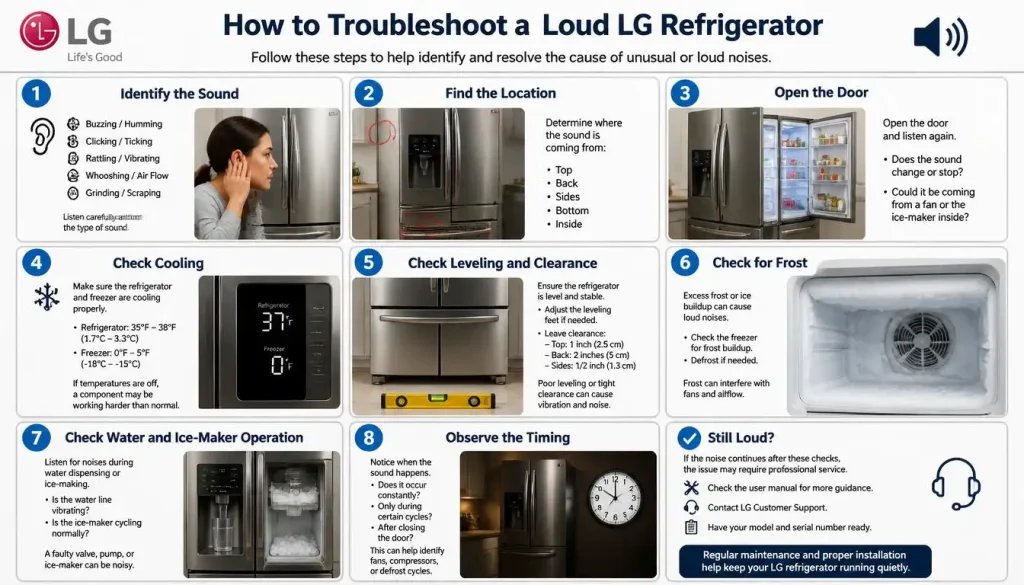
How to Troubleshoot a Loud LG Refrigerator Step by Step
Before calling for service, you can perform a basic five-minute noise test.
Step 1: Identify the Sound
Describe it as accurately as possible:
- Humming
- Buzzing
- Rattling
- Clicking
- Knocking
- Popping
- Hissing
- Gurgling
- Grinding
- Scraping
- Squealing
Recording the sound on your phone can also help a technician.
Step 2: Find the Location
Listen near:
- The rear of the refrigerator
- The bottom
- Inside the freezer
- The refrigerator compartment
- The ice maker
- The water dispenser
You do not need to remove protective covers.
Step 3: Open the Door
When the noise starts, open the freezer door and listen.
Does the sound:
- Stop immediately?
- Become quieter?
- Continue unchanged?
- Return after you close the door?
A sound that changes when the freezer door opens can provide a useful clue about the internal fan system.
Step 4: Check Cooling
Confirm whether:
- The freezer is still freezing food.
- The refrigerator compartment is cold.
- Air is coming from the vents.
- Food temperatures seem normal.
- An error code appears.
Step 5: Check Leveling and Clearance
Make sure the refrigerator:
- Does not rock.
- Is not touching the wall.
- Is not touching cabinetry.
- Has no loose objects on top.
- Has no containers vibrating against one another.
LG recommends checking the floor and leveling when a refrigerator vibrates or rattles.
Step 6: Check for Frost
Look at the freezer’s rear wall and air vents.
Heavy frost can interfere with airflow and may eventually contact a fan.
Do not use sharp tools to remove ice.
Step 7: Check Water and Ice-Maker Operation
If the noise happens only during dispensing or ice production, focus on the water line, filter, valve, ice maker, and dispenser instead of immediately assuming the compressor is the problem.
Step 8: Observe the Timing
Write down when the noise occurs:
- When the compressor starts
- After closing a door
- During water dispensing
- During ice production
- During defrost
- Every few minutes
- Continuously
- After the refrigerator was moved
- After a power interruption
The timing can sometimes identify the source faster than the sound itself.
What Can You Fix Yourself?
Some refrigerator noise problems are simple installation issues.
You can usually check:
- Leveling
- Wall or cabinet contact
- Loose objects
- Shelves and containers
- Visible frost
- Water-line positioning
- Water-filter installation
- Ice-bin positioning
More complex components should be left to a qualified appliance technician.
These include:
- Compressor replacement
- Condenser or evaporator fan motor replacement
- Sealed-system repairs
- Refrigerant work
- Electrical control diagnosis
- Internal wiring repairs
- Damaged refrigeration tubing
Always follow the instructions for your exact LG model before removing any component.
When Should You Call a Technician?
Professional service is appropriate when the noise is:
- Persistent and unusually loud
- Getting progressively worse
- Grinding or scraping continuously
- Accompanied by poor cooling
- Accompanied by repeated compressor clicking
- Associated with a fan error code
- Associated with water leaking from an unexpected location
- Accompanied by an electrical or burning smell
- Associated with excessive heat around electrical components
Do not try to diagnose a compressor or sealed-system problem by opening the refrigeration system.
What If My LG Refrigerator Is Noisy and Shows an Error Code?
An error code changes the troubleshooting approach.
Before disconnecting power, write down the exact code shown on the display. Different LG models use different codes and diagnostic procedures.
A fan-related error, for example, may point toward a motor or airflow problem rather than a compressor problem.
The important combination is:
Noise + error code + cooling problem
When these symptoms occur together, professional diagnosis is often more appropriate than repeatedly resetting the appliance.
How to Prevent Your LG Refrigerator From Becoming Noisy
Regular basic maintenance can reduce unnecessary vibration and prevent small issues from becoming larger problems.
Keep the refrigerator properly leveled and make sure it is not pressed against the wall or cabinets.
Avoid storing objects on top if they vibrate when the compressor runs. Keep shelves, bottles, and containers arranged so they do not knock against each other.
Keep the freezer’s internal vents clear and pay attention to unusual frost buildup.
Also pay attention to changes in sound. A refrigerator does not need to be completely silent. What matters is recognizing when its normal sound has changed.
Quick Diagnostic Guide for a Loud LG Refrigerator
| If You Hear | Check First |
|---|---|
| Loud humming | Compressor and fans |
| Buzzing during water dispensing | Water valve and water supply |
| Rattling | Leveling, wall contact, loose parts |
| Grinding from freezer | Fan and frost buildup |
| Scraping from freezer | Fan contacting ice |
| Repeated clicking | Compressor/control operation |
| Popping | Thermal expansion, defrost, compressor, ice maker |
| Gurgling | Refrigerant circulation |
| Hissing | Refrigerant or defrost cycle |
| Loud noise + poor cooling | Fan, compressor, airflow, or cooling system |
| Noise + error code | Check model-specific error information |
| Noise after installation | Leveling, clearance, water line, loose components |
Frequently Asked Questions
Why is my LG refrigerator suddenly making a loud noise?
A sudden increase in noise can result from a compressor or fan working harder, frost interfering with a fan, vibration against a wall, a loose component, or a change in ice-maker or water-system operation. Start by identifying the sound and its location.
Why is my LG refrigerator so loud but still cooling?
The refrigerator may simply be producing a louder normal operating sound, especially when the compressor starts or cooling demand increases. However, a significant change from its previous sound level should still be investigated.
Why is my LG refrigerator making a loud humming noise?
A compressor or fan is a common source of humming. A moderate hum that changes with normal cooling cycles can be normal. A sudden, persistent, unusually loud hum combined with poor cooling needs further diagnosis.
Why is my LG refrigerator making a loud buzzing noise?
Buzzing may come from the compressor, fan, water inlet valve, or ice maker. The timing is an important clue. If the buzzing happens only when dispensing water, inspect the water system first.
Why is my LG refrigerator making a loud grinding noise?
Grinding often indicates a moving component that is contacting something it should not, such as a fan contacting frost or a damaged mechanical component. Grinding from the freezer is particularly worth investigating.
Why is my LG refrigerator making a loud rattling noise?
Check whether the refrigerator is level and whether it touches the wall or cabinets. Also inspect objects on top, shelves, bottles, the water line, and loose exterior components.
Why does my LG refrigerator stop making noise when I open the door?
Some refrigerator fans change operation when a door opens. If the noise stops or changes immediately when the freezer door opens, the internal fan system becomes a stronger possibility.
Why is my LG refrigerator making loud noises at night?
Normal refrigerator sounds can seem much louder at night because the surrounding environment is quieter. Occasional compressor, defrost, ice-maker, and thermal-expansion sounds can all occur overnight.
Can a dirty or blocked fan make an LG refrigerator loud?
Yes. Frost, ice, debris, or a damaged fan component can cause unusual sounds such as scraping, grinding, or rattling. Do not use sharp tools to remove ice near a fan.
Should I unplug my LG refrigerator if it is making a loud noise?
Do not repeatedly unplug and reconnect the refrigerator to force it to restart. First determine whether the refrigerator is cooling and whether an error code is displayed. If you notice smoke, sparking, a burning smell, or another electrical hazard, prioritize safety and seek professional assistance.
Final Takeaway
An LG refrigerator making a loud noise does not automatically mean that a major component has failed.
The fastest way to narrow down the problem is to identify four things:
What does it sound like?
Where is it coming from?
When does it happen?
Is the refrigerator still cooling normally?
A soft hum, occasional click, gurgle, pop, or water-flow sound can be part of normal operation. On the other hand, persistent grinding, scraping, repeated clicking, severe vibration, or a loud noise combined with poor cooling should not be ignored.
Start with the simple checks: leveling, clearance, loose objects, frost, water-line position, and the timing of the noise. If the problem points toward the compressor, fan motor, sealed refrigeration system, or an electrical fault, professional service is the safer option.

Hi, I’m the lead researcher and appliance enthusiast behind RefrigeratorSolve. With years of hands-on experience troubleshooting cooling systems and testing home appliances, I am dedicated to bringing you honest reviews, energy-saving tips, and practical solutions to keep your refrigerator running perfectly.