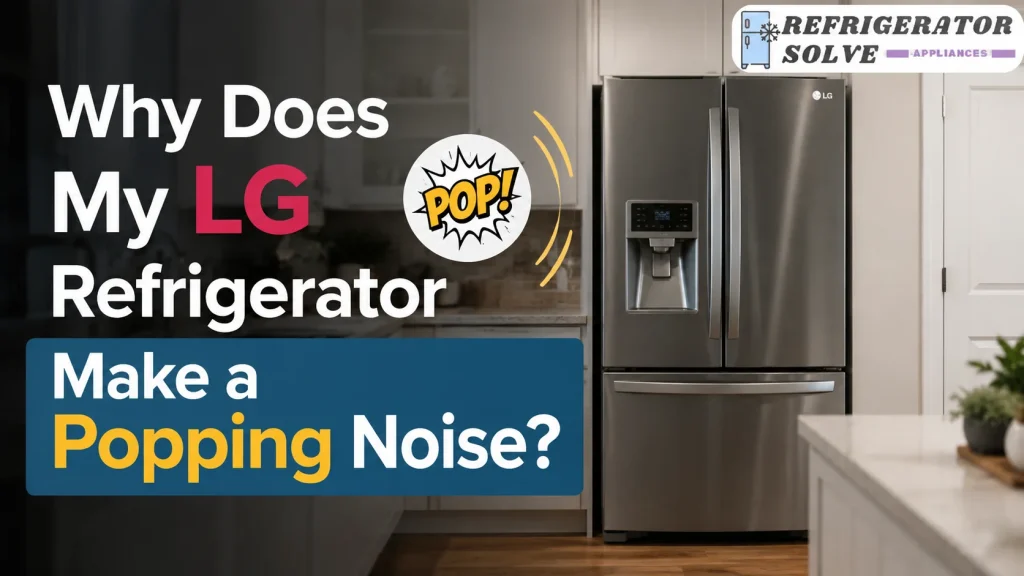
A sharp pop from your LG refrigerator can be difficult to ignore. It may sound like plastic cracking, ice breaking, or a component suddenly shifting behind the freezer wall.
The reassuring news is that an occasional popping or cracking sound is usually normal. LG refrigerators contain plastic liners, storage bins, cooling pipes, valves, fans, and metal panels that repeatedly warm and cool. As these parts expand or contract, they can release a sudden pop.
The sound may also come from the automatic defrost system, an ice maker filling or dropping ice, refrigerant moving through the cooling system, or the compressor changing speed.
LG’s official troubleshooting guidance explains that cracking, clicking, and popping sounds commonly occur when interior parts expand or contract as the refrigerator temperature changes. These sounds do not normally require repair when cooling remains stable and the noise is occasional.
However, not every loud sound should be dismissed. Repeated popping accompanied by poor cooling, heavy frost, fan scraping, water leaks, error codes, smoke, or an electrical smell may indicate a fault that requires professional diagnosis.
This guide explains what causes an LG refrigerator to make a popping noise, how to identify the likely source, which troubleshooting steps are safe to perform, and when to contact LG Support or an appliance technician.
Quick Answer
Your LG refrigerator is most likely making a popping noise because its interior panels, shelves, bins, or cooling components are expanding and contracting as the temperature changes.
Common causes include:
- Normal expansion and contraction of plastic parts
- The automatic defrost cycle starting or ending
- The refrigerant changeover valve operating
- The compressor starting, stopping, or changing speed
- Ice being released into the storage bin
- The water valve filling the ice maker
- A Craft Ice ball dropping into its bin
- Refrigerant flowing through the cooling system
- The refrigerator touching a wall or cabinet
- An unlevel refrigerator
- A door hinge or door stopper moving
- Ice buildup interfering with a fan
If the refrigerator is cooling properly and the sound happens only occasionally, it is usually a normal operating noise.
The sound deserves closer attention if it occurs continuously, becomes progressively louder, happens every few seconds, or appears with a noticeable loss of cooling.
Is It Normal for an LG Refrigerator to Make Popping Noises?
Yes. Occasional popping, cracking, and clicking noises are normal in many LG refrigerators.
A modern LG refrigerator contains several systems that operate at different times. These may include:
- A standard, Smart Inverter, or Linear Compressor
- Evaporator and condenser fans
- A frost-free defrost system
- Refrigerant valves and pipes
- One or more automatic ice makers
- A water inlet valve
- Electronic switches and temperature controls
- Automatic door-closing components
Each system can create a different sound. LG identifies cracking, clicking, water dripping, humming, thumping, hissing, and gurgling as sounds that may occur during normal refrigerator operation.
A normal pop usually has these characteristics:
- It occurs occasionally rather than constantly.
- The refrigerator and freezer maintain their temperatures.
- The sound may occur during or after a cooling cycle.
- It may happen when the defrost system starts or stops.
- It may coincide with ice production.
- There is no smoke, sparking, or burning smell.
- No error code appears on the control panel.
- The frequency does not steadily increase.
The timing and accompanying symptoms are more important than the loudness of one isolated pop.
Normal LG Refrigerator Popping vs. a Possible Fault
| What You Notice | Most Likely Explanation | Recommended Action |
|---|---|---|
| An occasional pop from inside the cabinet | Normal expansion or contraction | No repair is usually needed |
| Clicking at the beginning or end of defrosting | Defrost control operating | Monitor normal operation |
| A crack followed by ice entering the bin | Normal ice-maker operation | No action unless ice production fails |
| A heavy thump from a Craft Ice bin | Craft Ice dropping into the bin | Check that the bin pad is installed |
| Buzzing or clicking with no water connection | Ice-maker water valve attempting to fill | Turn off the ice maker or connect water |
| A pop after moving the refrigerator | Cabinet movement, poor leveling, or wall contact | Check installation |
| Popping only when a door moves | Hinge, door stopper, or alignment | Inspect and level the refrigerator |
| Fast tapping from the freezer | Fan blade contacting ice | Arrange diagnosis |
| Repeated clicking with rising temperatures | Compressor, fan, control, or electrical issue | Request professional service |
| Popping with heavy frost | Defrost or airflow problem | Arrange service |
| Popping with smoke or a burning smell | Possible electrical failure | Disconnect power if safe |
What Causes an LG Refrigerator to Make a Popping Noise?
The source is usually easier to identify when you consider where the sound comes from and what the refrigerator is doing at the time.
1. Interior Panels Expanding and Contracting
Thermal expansion is the most common cause of an LG refrigerator popping noise.
The temperature inside a refrigerator changes throughout the day. It drops when the compressor and fans are actively cooling and rises slightly when cooling pauses or the defrost system operates.

Plastic liners, shelves, drawers, insulation, tubing, and metal panels respond to these changes at different rates. A part may remain under slight pressure and then shift suddenly, producing a pop, snap, or crack.
The sound may be more noticeable:
- During initial cooling
- After changing the temperature setting
- After adding warm groceries
- After leaving a door open
- During or after automatic defrosting
- After a power interruption
- During very warm weather
- When the kitchen is quiet
LG describes these sounds as natural movement from plastic parts such as interior panels, crispers, shelves, and bins responding to temperature changes.
Does Thermal Popping Need to Be Repaired?
Usually, no.
If the refrigerator is cooling normally and the sound is brief and occasional, replacing the compressor, control board, or fan is unlikely to stop it. The noise is caused by ordinary material movement rather than a failed component.
You may still be able to make the sound less noticeable by leveling the refrigerator, correcting door alignment, and ensuring that the cabinet is not touching a wall or kitchen unit.
2. The Automatic Defrost Cycle
LG frost-free refrigerators periodically warm the evaporator area to remove accumulated frost.
The defrost control may click when the cycle begins and again when it ends. As frost melts, water can drip onto a warm heater and create hissing, sizzling, or crackling sounds. The surrounding components also expand and contract as their temperature changes.
LG states that the defrost control can produce a normal click at the beginning and end of an automatic defrost cycle. LG also explains that melting frost may drip near the heater and create additional sounds during defrosting.
During a normal defrost cycle, you may hear:
- Popping
- Clicking
- Cracking
- Hissing
- Sizzling
- Dripping
- Light tapping
When Defrost-Related Noise May Be Abnormal
Arrange an inspection if the popping appears with:
- Thick frost on the freezer’s rear wall
- A repeated scraping sound
- Weak airflow from the vents
- A refrigerator compartment that is becoming warm
- Water collecting under the drawers
- Water leaking onto the floor
- An ice-fan error code
- The compressor running almost continuously
These symptoms may indicate a defrost heater, sensor, drain, fan, door-seal, or airflow problem rather than normal defrost activity.
3. Linear or Inverter Compressor Operation
Many LG refrigerators use a Linear Compressor or variable-speed inverter compressor.
Unlike a basic compressor that simply runs at one speed and stops, a variable-speed design can change its output according to the refrigerator’s cooling needs. The sound may therefore change when the doors have been open, warm food has been added, or the kitchen temperature rises.

Depending on the model, normal compressor-related sounds may include:
- Humming
- Buzzing
- Thumping
- Knocking
- A brief clunk
- A change in pitch
- A short pop when operation changes
LG explains that compressors and fans can create thudding, clunking, humming, or knocking noises as they start, stop, or adjust their operation. LG also notes that a Linear Compressor can become more audible when it changes speed to meet a higher cooling demand.
A brief sound followed by normal cooling is usually not a concern.
When Compressor Noise Requires Attention
Contact a technician if:
- The sound continues without settling.
- It is loud enough to be clearly heard from another room.
- The compressor repeatedly tries to start but stops immediately.
- The refrigerator is no longer cooling.
- The rear of the appliance becomes unusually hot.
- The sound began suddenly and is getting worse.
LG’s current noise guidance recommends service when unusually loud compressor-related noise continues for an extended period rather than fading as operation stabilizes.
Do not remove the compressor terminal cover or test live electrical connections yourself.
4. A Refrigerant Changeover Valve
Some LG refrigerators use a valve to direct refrigerant to different parts of the cooling system.
When the valve opens, closes, or changes position, it may create a click, crack, or brief pop. This can be confused with a shelf cracking or an object striking the cabinet.
LG’s refrigerator-noise guidance identifies refrigerant valve operation and changes in internal pressure as possible sources of snapping, cracking, and clicking sounds.
If the noise is brief and the refrigerator continues cooling evenly, no action is normally needed.
If one compartment becomes warm while another remains cold, the sound may require professional investigation.
5. Refrigerant and Compressor Oil Moving Through the System
Refrigerant changes pressure as it circulates through the refrigerator’s sealed pipes and coils. Compressor oil also moves through parts of the system.
This movement may create:
- Gurgling
- Bubbling
- Hissing
- Tapping
- Light knocking
- Occasional popping
LG explains that hissing and gurgling can result from refrigerant and oil flowing through the coils while the compressor produces cold air. Pressure changes within the sealed system may temporarily make these sounds more noticeable.
The sealed cooling system is not a DIY repair area. Never cut, puncture, bend, heat, or loosen refrigerant tubing.
6. Ice Being Released Into the Storage Bin
LG ice makers can produce several normal noises while making and releasing ice.
You may hear:
- A crack as ice separates from the mold
- A click as the ejector operates
- A bang as cubes fall into the bin
- A short hum as the mechanism moves
- A buzz as the water valve opens
Ice falling into an empty plastic bin can sound much louder than expected.
LG notes that many ice-maker noises are normal and that thermal contraction around the ice-making area can also create cracking or clicking sounds.
How to Test the Ice Maker
Temporarily switch the ice maker off using the control panel or switch described in the manual for your model.
Monitor the refrigerator through several cooling cycles.
If the popping stops, inspect:
- Whether ice is dropping normally
- Whether cubes are jammed together
- Whether the ice bin is fully seated
- Whether the water supply is connected
- Whether the supply line is kinked
- Whether the ice maker is switched on without water
Do not force the tray, ejector arms, gears, or motor by hand.
7. Craft Ice Dropping Into the Bin
Some LG refrigerators have a Craft Ice maker that produces large, slow-melting ice spheres.
A Craft Ice ball is heavier than a standard cube, so it can create a distinct thump, pop, or bang when it drops into the storage bin.
LG advises that the rubber pad inside the Craft Ice bin helps reduce the impact noise. If the pad is removed or installed incorrectly, the dropping sound can become noticeably louder.
Check that:
- The correct Craft Ice bin is installed.
- The rubber sound-dampening pad remains in place.
- The pad is clean and dry.
- The bin is fully seated.
- Ice is not obstructing the mechanism.
The normal sound of a Craft Ice ball dropping should occur only when a new piece of ice is released.
Continuous knocking or grinding from the Craft Ice area requires further troubleshooting.
8. The Water Inlet Valve
The water inlet valve opens briefly when an ice maker needs water or when the dispenser is used.
A short buzz, vibration, click, or knock may be normal. The noise can become louder or more persistent when:
- The water supply is not connected.
- The household valve is closed.
- The supply line is kinked.
- The line is pressed against the wall.
- The filter is incorrectly installed.
- The ice maker remains switched on without water.
- Water pressure is unstable.
LG states that an ice maker switched on without a connected water supply can cause the valve to produce repeated buzzing or clicking.
What to Check Safely
Confirm that:
- The household water valve is open.
- The refrigerator’s water line is connected.
- The visible line is not bent or crushed.
- The line is not tapping against the cabinet or wall.
- The water filter is installed correctly.
- The ice maker is off if no water connection is available.
- No water is leaking behind or beneath the appliance.
Do not dismantle the inlet valve while the refrigerator remains connected to electricity and water.
9. The Refrigerator Is Not Level
An unlevel refrigerator can amplify normal compressor, cabinet, fan, and door noises.
If the appliance rocks or leans sideways:
- The cabinet may remain under uneven pressure.
- Shelves and drawers may shift.
- Doors may not align.
- The compressor can vibrate more noticeably.
- A water line may strike the rear panel.
- The refrigerator may move when a heavy door is opened.
LG advises leveling the appliance to prevent vibration and recommends using the front leveling legs to eliminate side-to-side tilt.
LG also notes that some refrigerators should have a slight backward slope so the doors close correctly. Always follow the installation instructions for your exact model.
How to Check the Level
Use a spirit level and confirm that:
- The refrigerator does not rock.
- Both front feet firmly contact the floor.
- There is no significant side tilt.
- The doors are aligned.
- The doors close properly.
- The appliance does not move when opened.
Recheck the popping after the refrigerator has completed several cooling cycles.
10. The Refrigerator Is Touching a Wall or Cabinet
A minor internal noise can become much louder when vibration transfers into a wall, cabinet, countertop, pipe, or nearby appliance.
Check whether:
- The back touches the wall.
- A side panel touches a kitchen cabinet.
- The water line strikes the rear panel.
- The power cord is trapped.
- Something has fallen behind the appliance.
- Items are stored on top of the refrigerator.
- The appliance was pushed back too far after cleaning.
LG recommends moving the refrigerator slightly away from the wall or repositioning the water line when contact behind the appliance is creating noise.
Required ventilation clearances vary by model. Use the dimensions and spacing instructions in the manual rather than applying one universal measurement.
11. The Refrigerator Was Recently Moved or Cleaned
If the popping began after the appliance was moved, several installation issues may be responsible.
The refrigerator may now be:
- Unlevel
- Touching the wall
- Resting on an uneven floor
- Pressing against cabinetry
- Pinching the water line
- Sitting with a loose shelf or drawer
- Vibrating because it has not settled
After being reconnected, the compressor and fans may also run more actively while restoring the internal temperature.
LG explains that compressor and fan noises may be more noticeable after a refrigerator has been moved, cleaned, reconnected, or restarted.
Check the appliance’s level, clearance, door alignment, water line, and removable components before assuming that an internal part has failed.
12. A Door Hinge, Stopper, or Auto-Closing Mechanism
If the pop occurs only when you open or close a door, it may come from the door hardware rather than the cooling system.
Possible sources include:
- An auto-closing hinge
- A door stopper
- A misaligned door
- An unlevel refrigerator
- A hinge under strain
- A folding center flap on a French-door model
- An overloaded door bin
- A gasket catching on the cabinet
- A door rubbing against surrounding furniture
LG identifies the auto-closing hinge and door stopper as possible causes of popping during door movement.
Open each door slowly and watch for:
- The door lifting or dropping
- A pop at the same point
- The hinge shifting
- The gasket folding
- The center flap catching
- Contact with a cabinet or countertop
Correct leveling and storage problems first. Avoid removing hinge covers or door wiring unless the model-specific manual provides an owner procedure.
13. Ice Buildup Around a Fan
A repeated “popping” noise from the freezer may actually be a fan blade hitting ice.
Common signs include:
- Rapid tapping or clicking
- Scraping from behind the freezer panel
- Noise that changes when the door opens
- Visible frost on the rear interior wall
- Weak airflow
- The refrigerator section becoming warm
- An IF, F1, or similar fan-related error code
LG’s error-code guidance states that an IF or F1 code can indicate a problem involving the ice-maker fan. Frost and door-alignment issues can contribute to airflow and fan problems in applicable models.
Do not remove hidden ice with a knife, screwdriver, heat gun, boiling water, or hair dryer. These methods can damage the liner, wiring, insulation, and refrigerant tubing.
Why Does My LG Refrigerator Make a Loud Popping Noise?
A refrigerator cabinet can amplify a small internal movement. Its metal shell, plastic liner, insulation, floor, and nearby cabinets can act like a sound box.
A normal pop may sound unusually loud when:
- The kitchen is quiet at night.
- The refrigerator is almost empty.
- Ice drops into an empty bin.
- A Craft Ice ball lands in its bucket.
- The unit is installed in a tight recess.
- The refrigerator touches the wall.
- The appliance is not level.
- A major temperature change has occurred.
- The refrigerator has just completed defrosting.
- The compressor has increased speed.
One loud pop does not automatically indicate compressor failure.
Pay more attention to whether the noise repeats, whether cooling is affected, and whether frost, leaking, error codes, or electrical symptoms are present.
Why Is My New LG Refrigerator Making Popping Noises?
A newly installed LG refrigerator may make more popping and cracking sounds during its first days of operation.
It must cool the cabinet, shelves, bins, insulation, food compartments, and stored items from room temperature. This produces larger temperature changes than the refrigerator normally experiences after it stabilizes.
A new refrigerator may also be louder because:
- The compressor is running at a higher output.
- The ice makers are beginning their first cycles.
- The ice bins are empty.
- The appliance has not been leveled correctly.
- The cabinet is too close to the wall.
- The water line is vibrating.
- Shipping materials remain in place.
- The doors are not aligned.
LG states that noise can be more noticeable when a compressor and fan resume operation after installation or restarting, and it should generally reduce as the internal temperature stabilizes.
Contact the retailer or LG Support if a new refrigerator also has:
- Poor cooling
- Physical damage
- Continuous extreme noise
- A door that does not seal
- Water leaking
- Heavy frost
- An error code
- A damaged plug or cord
How to Locate the Source of the Popping Noise
Avoid replacing parts until you understand the sound’s pattern.
Note When It Happens
Record whether the pop occurs:
- When cooling starts
- When the compressor stops
- During or after defrosting
- When ice drops
- After using the water dispenser
- When opening a door
- After closing a door
- After moving the refrigerator
- Following a power outage
- Every few seconds
- Only once or twice per hour
The timing can eliminate several possible causes.
Identify the General Location
Inside the refrigerator compartment: Check shelves, bins, drawers, interior liners, air vents, and containers.
Inside the freezer: Consider the ice maker, Craft Ice system, evaporator fan, frost buildup, and defrost cycle.
At the lower rear: Consider the compressor, condenser fan, water valve, refrigerant pipes, and wall contact.
At a door: Check the hinges, stopper, center flap, gasket, door bins, and alignment.
Behind the refrigerator: Look for a moving water line, trapped power cord, or contact with the wall.
Do not remove electrical panels or reach near moving fans.
Check Whether Cooling Is Normal
Observe whether:
- Frozen food remains solid.
- Food in the refrigerator remains properly chilled.
- Cold air is moving through the vents.
- The doors seal completely.
- Excessive frost is developing.
- The compressor remains running normally.
- An error code is displayed.
A noise without another symptom is more likely to be normal than a noise combined with rising temperatures.
Record the Sound
A short audio or video recording can help LG Support or a technician identify an intermittent problem.
Try to capture:
- The sound itself
- The area where it is loudest
- The control-panel display
- Any visible frost
- Door movement
- Ice-maker activity
- Water-line movement
Do not place your phone or hands near exposed wires, moving fans, or compressor terminals.
How to Fix an LG Refrigerator Popping Noise
You cannot always eliminate normal thermal popping. You can, however, rule out installation, water-supply, ice-maker, door, and vibration problems.
Step 1: Confirm That the Refrigerator Is Cooling
Before focusing on the sound, make sure the appliance is performing its main function.

Check:
- Refrigerator temperature
- Freezer temperature
- Airflow from the vents
- Door closure
- Visible frost
- Water leaks
- Control-panel warnings
- Error codes
If cooling has failed, arrange diagnosis instead of concentrating only on noise reduction.
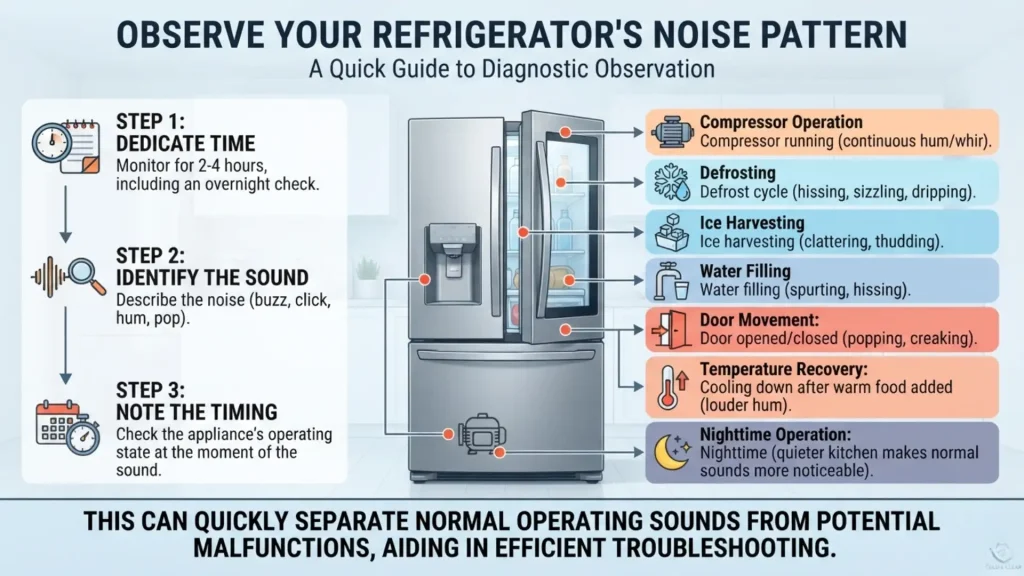
Step 2: Observe the Noise Pattern
Monitor the refrigerator for several hours.
Note whether the sound occurs during:
- Compressor operation
- Defrosting
- Ice harvesting
- Water filling
- Door movement
- Temperature recovery
- Nighttime operation
This can quickly separate normal thermal pops from a mechanical or electrical fault.
Step 3: Level the Refrigerator
Use a spirit level and adjust the front leveling legs according to the model’s manual.
Make sure:
- The appliance does not rock.
- There is no side-to-side tilt.
- Both front feet firmly contact the floor.
- The doors align.
- The doors close correctly.
- The cabinet is not leaning against another surface.
LG specifically recommends leveling to prevent unnecessary vibration.
Step 4: Check Installation Clearance
Inspect the area around the refrigerator.
Confirm that:
- The back does not touch the wall.
- The sides are not pressed against cabinets.
- The top has the required clearance.
- The water line is not tapping the cabinet.
- The power cord is not trapped.
- No loose object is behind the appliance.
Unplug the refrigerator before moving it, and use another person to help with a large appliance.
Step 5: Rearrange Food and Removable Parts
Separate bottles, jars, and hard containers.
Reseat:
- Glass shelves
- Door bins
- Crisper drawers
- Freezer baskets
- Ice buckets
- Craft Ice bins
- Removable trays
Remove loose objects stored on top of the appliance.
Step 6: Test the Ice Maker
Temporarily switch off the ice maker according to the manual.
If the noise stops:
- Confirm that water is connected.
- Check that the household valve is open.
- Inspect the visible line for kinks.
- Check for ice clumps.
- Reseat the bin.
- Verify that the mechanism is not obstructed.
Do not repeatedly run an ice-maker test unless LG’s instructions for your exact model direct you to do so.
Step 7: Inspect the Craft Ice Bin
For Craft Ice models:
- Check that the correct bin is installed.
- Confirm that the rubber pad remains inside.
- Clean the pad with a mild detergent if necessary.
- Dry it completely before reinstalling it.
- Make sure the bin sits correctly.
A missing pad can make each Craft Ice drop sound much louder.
Step 8: Check the Water Supply
Verify that:
- The household valve is open.
- The supply line is connected.
- The line is not kinked.
- The line is not vibrating against the wall.
- The water filter is seated correctly.
- The ice maker is off when no water is connected.
- No leaks are visible.
Persistent valve chatter, weak water flow, or leaking may require plumbing or appliance service.
Step 9: Inspect Door Movement
Open and close each door slowly.
Look for:
- A pop at the same point
- A hinge lifting or dropping
- A gasket sticking
- A center flap catching
- A door rubbing against a cabinet
- An overloaded door bin
- Poor alignment
Correct the level and remove obstructions before assuming that the hinge is damaged.
Step 10: Check for Frost and Fan Contact
Inspect the freezer’s rear interior panel.
Arrange service if you find:
- Heavy frost
- Fast tapping
- Fan scraping
- Weak airflow
- Rising refrigerator temperatures
- A fan-related error code
- Ice that repeatedly returns
Do not use direct heat or sharp tools to remove hidden ice.
Step 11: Allow the Refrigerator to Stabilize
If the refrigerator is new, recently moved, or recently restarted, allow it to complete normal cooling cycles.
Compressor and fan sounds usually become less noticeable once the cabinet reaches a stable temperature.
Where to Find the LG Refrigerator Model Number
You will need the complete model and serial numbers when downloading a manual, checking warranty coverage, ordering parts, or requesting repair.
On many current LG refrigerators, the label is located:
- Inside the refrigerator compartment on the left interior wall
- Inside the top-freezer compartment on applicable models
Some older models place the label on the right interior wall of the refrigerator compartment.
Take a clear photograph of the entire label.
Do not rely only on the marketing name printed on the front of the refrigerator. The full model code may contain additional letters or suffixes identifying the exact design and regional version.
Safe DIY Checks You Can Perform
You can safely:
- Confirm that the refrigerator is cooling.
- Check the appliance with a spirit level.
- Correct wall or cabinet contact.
- Rearrange bottles and containers.
- Reseat shelves, drawers, and bins.
- Inspect the visible water line.
- Turn off an unused ice maker.
- Check the Craft Ice bin pad.
- Observe door and hinge movement.
- Look for visible frost or leaking.
- Record the noise.
- Check for error codes.
- Locate the model and serial numbers.
Avoid attempting to:
- Open the sealed refrigeration system
- Test live compressor terminals
- Bypass a safety switch
- Remove hidden ice with a sharp object
- Apply direct heat to the freezer liner
- Force ice-maker gears or ejector arms
- Replace a control board without diagnosis
- Continue using an appliance that smells burnt
When to Contact LG Support or a Technician
Request professional help if:
- The popping is continuous or increasingly loud.
- The refrigerator is no longer cooling properly.
- The compressor repeatedly clicks but does not remain running.
- A fan is scraping or striking ice.
- Heavy frost repeatedly forms.
- Water leaks from the refrigerator.
- A door no longer aligns or seals.
- An error code appears.
- The ice maker repeatedly jams.
- The noise remains after leveling and clearance checks.
- The sound can be clearly heard from another room for an extended period.
- The refrigerator requires compressor, electrical, or sealed-system testing.
LG advises arranging service when operational noise is irregular, continuous, excessive, or does not settle after the appliance stabilizes.
Disconnect the refrigerator from power, provided it is safe to do so, if you notice:
- Smoke
- Sparks
- A strong burning smell
- A damaged or melting power cord
- An unusually hot plug or outlet
- Repeated circuit-breaker trips
- An electrical shock or tingling sensation
Do not reach behind the refrigerator if active sparking, melted wiring, water, or smoke makes the area unsafe.
Frequently Asked Questions About LG Refrigerator Make a Popping Noise
Why Does My LG Refrigerator Keep Making a Popping Noise?
Widely spaced popping noises are usually caused by repeated temperature changes, defrost cycles, compressor adjustments, or ice production.
Investigate further if the noise occurs every few seconds, cooling becomes weak, or the refrigerator displays an error code.
Why Is My LG Refrigerator Making Loud Popping Noises at Night?
The appliance may not be louder at night; the surrounding home is simply quieter.
Defrost cycles, thermal contraction, compressor speed changes, and ice dropping into an empty bin can all occur overnight.
Check that the refrigerator is level and not touching a wall or cabinet that could amplify the sound.
Why Is My New LG Refrigerator Making a Popping Noise?
A new refrigerator experiences large temperature changes as it cools for the first time. Interior liners, bins, pipes, and panels may pop as they contract.
The compressor and fans may also run more actively during initial cooling.
Confirm correct leveling, clearance, water-line installation, and door alignment.
Why Does My LG Refrigerator Pop During Defrosting?
The temperature around the evaporator changes during defrosting. Plastic and metal components may shift, and melting frost can create clicking, crackling, hissing, and dripping sounds.
An occasional pop during defrosting is generally normal.
Can an LG Linear Compressor Cause a Popping Noise?
A Linear Compressor can change speed as cooling demand rises or falls. This may produce changes in pitch, humming, knocking, thumping, or brief impact-like sounds.
Persistent loud noise accompanied by poor cooling should be professionally diagnosed.
Can the LG Ice Maker Make a Popping Sound?
Yes. Ice separating from the mold and falling into the bin can make a crack or bang. The water valve may also click or buzz while filling the ice maker.
Temporarily switching off the ice maker can help confirm whether it is the source.
Why Does My LG Craft Ice Maker Make a Loud Bang?
Craft Ice pieces are larger and heavier than standard cubes. They can create a noticeable thump when they drop into the bin.
Make sure the rubber pad inside the Craft Ice bin is present, clean, dry, and correctly positioned.
Why Does My LG Refrigerator Pop After I Use the Water Dispenser?
The water valve and supply line experience pressure changes during and after dispensing. A line touching the wall or rear panel may produce a knock or pop.
Check the visible line for kinks, movement, and contact with surrounding surfaces.
Why Does My LG Refrigerator Pop After a Power Outage?
After electricity returns, the refrigerator must restore its internal temperature. The larger temperature change can increase expansion noises, and the compressor may operate more actively.
Monitor the temperature and check the display for an error code.
Why Does My LG Refrigerator Pop When I Open the Door?
A pop linked specifically to door movement may come from an auto-closing hinge, door stopper, gasket, center flap, or alignment problem.
Level the refrigerator and check whether the door rises, drops, sticks, or rubs.
Can I Completely Stop My LG Refrigerator From Popping?
You may be able to eliminate noise caused by poor leveling, wall contact, loose containers, the water line, a missing Craft Ice pad, or door misalignment.
Normal thermal popping cannot always be eliminated because it results from materials responding to temperature changes.
Should I Reset My LG Refrigerator Because It Is Popping?
Usually not.
Resetting will not stop normal expansion, defrosting, compressor adjustments, or ice-drop noises. It may also clear an error that could help a technician diagnose a real problem.
Follow a reset procedure only when LG’s instructions for your model recommend it.
Should I Unplug an LG Refrigerator That Makes a Popping Noise?
An occasional pop with normal cooling does not require unplugging the refrigerator.
Disconnect it if the noise occurs with smoke, sparks, a burning smell, a damaged cord, an overheating outlet, electrical shock, or repeated breaker trips.
How Long Will a New LG Refrigerator Make Popping Noises?
There is no fixed period that applies to every model or home.
The frequency often decreases after the refrigerator completes its initial cooling cycles and settles into normal operation. Persistent or worsening noise should be investigated.
Final Thoughts
So, why does your LG refrigerator make a popping noise?
Most often, it is the sound of interior liners, shelves, bins, valves, or cooling components expanding and contracting as the temperature changes. Automatic defrosting, refrigerant movement, ice production, Craft Ice drops, and Linear or Inverter Compressor adjustments can create additional clicks, cracks, pops, and thumps.
Begin by checking whether the refrigerator is cooling properly. Identify when and where the sound occurs, level the appliance, provide the correct clearance, separate containers, inspect the visible water line, and observe the ice maker and door movement.
An occasional pop with stable temperatures is usually harmless. Continuous popping accompanied by cooling failure, heavy frost, fan scraping, leaking, error codes, smoke, a burning smell, or electrical problems requires professional attention.
Always use the complete model number when consulting an LG manual or contacting support because compressor types, ice-maker designs, control settings, clearances, and troubleshooting procedures vary between models and countries.

Hi, I’m the lead researcher and appliance enthusiast behind RefrigeratorSolve. With years of hands-on experience troubleshooting cooling systems and testing home appliances, I am dedicated to bringing you honest reviews, energy-saving tips, and practical solutions to keep your refrigerator running perfectly.