
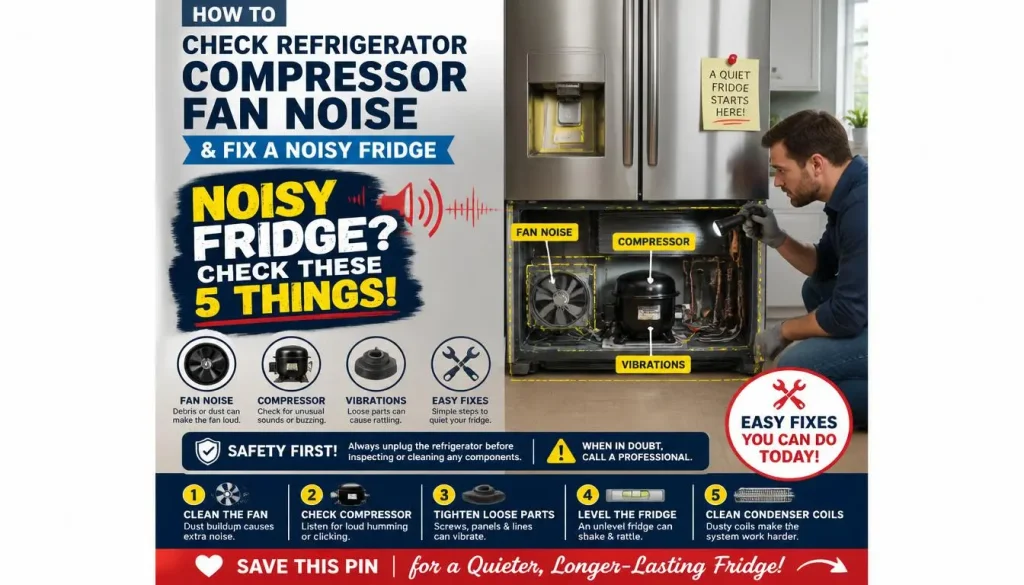
A refrigerator is never completely silent. A soft hum, a short click, or the sound of moving air can all be part of normal operation. But when your refrigerator suddenly starts buzzing, rattling, grinding, squealing, or making a much louder hum than usual, it is worth checking.
The difficult part is finding where the noise is actually coming from.
Many people describe the problem as “refrigerator compressor fan noise,” but the compressor and the condenser fan are two separate parts. They are often located close together near the bottom or back of the refrigerator, which is why the sounds can be easy to confuse.
This guide explains how to check refrigerator compressor fan noise, identify whether the sound is coming from the condenser fan, evaporator fan, compressor, or another nearby part, and decide what you can safely fix yourself.
Is the Noise Coming From the Compressor or a Refrigerator Fan?
Before replacing anything, find the general location of the sound.
Your refrigerator usually has several parts that may produce noise during normal operation.
Where the Compressor Is Located
On most refrigerators, the compressor is located near the bottom rear of the appliance.
It usually looks like a black, rounded metal container with copper or metal tubing connected to it.
A working compressor often produces a low humming sound while the refrigerator is cooling.
Where the Condenser Fan Is Located
On refrigerators equipped with a condenser fan, it is normally located near the compressor and condenser coils at the bottom rear of the refrigerator.
Its job is to move air across the condenser area and help remove heat.
Because the fan sits close to the compressor, rattling or grinding from the condenser fan is often mistaken for compressor noise.
Where the Evaporator Fan Is Located
The evaporator fan is usually inside the freezer compartment behind an interior panel.
It circulates cold air through the freezer and refrigerator compartments.
If the noise is clearly coming from inside the freezer rather than the bottom rear of the appliance, the evaporator fan is a more likely suspect.
Quick Way to Find the Noise Source
Use the location of the sound as your first clue:
- Noise from the bottom rear may come from the condenser fan, compressor, drain pan, tubing, or loose panel.
- Noise from inside the freezer often points to the evaporator fan or ice buildup around it.
- A deep, steady hum from the rear is often related to compressor operation.
- A rattling or scraping sound near the compressor area is often caused by a fan blade, loose panel, or debris.
- A noise that changes when you open the freezer door may be related to the evaporator fan.
Do not assume that a loud noise automatically means the compressor is failing.
What Refrigerator Noises Are Normal and Which Are Not?
Different sounds can point to different parts of the refrigerator.
| Noise | Possible Cause | Usually Normal? | What to Check |
|---|---|---|---|
| Soft humming | Compressor or fan | Often | Listen for changes in volume |
| Light clicking | Compressor cycle or control | Often | Check if it becomes repetitive |
| Rattling | Fan, drain pan, tubing, loose panel | Sometimes | Inspect loose parts |
| Grinding | Fan motor or blade obstruction | Usually not | Check fan blades |
| Scraping | Fan blade touching ice or housing | Usually not | Inspect fan area |
| Squealing | Fan motor or worn bearing | Usually not | Check fan motor |
| Buzzing | Compressor, water valve, fan motor | Depends | Locate exact source |
| Hissing or gurgling | Refrigerant flow | Often | Usually no repair needed |
| Knocking | Tubing, ice maker, compressor movement | Depends | Locate source |
The key question is not simply whether the refrigerator is making noise. Pay attention to whether the sound is new, much louder than before, constant, or accompanied by poor cooling.
How to Check Refrigerator Compressor Fan Noise Step by Step
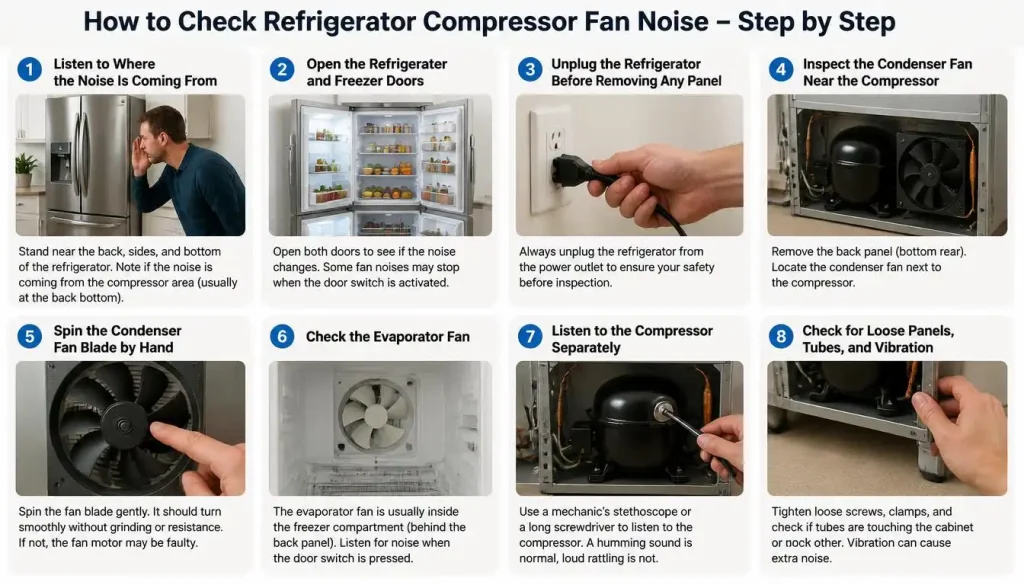
A simple inspection can often tell you whether the compressor or a fan is responsible.
Step 1: Listen to Where the Noise Is Coming From
Stand near the refrigerator and listen carefully.
Check:
- the freezer
- the fresh-food compartment
- the bottom front
- the bottom rear
- both sides of the cabinet
Move slowly around the refrigerator instead of judging the sound from one position.
A hard kitchen floor or nearby wall can reflect sound and make the noise seem like it is coming from somewhere else.
Step 2: Open the Refrigerator and Freezer Doors
Open the freezer door and listen for a change.
If the noise becomes quieter or stops shortly after the door opens, the evaporator fan may be involved.
Keep in mind that fan behavior varies by refrigerator design, so this test is only a clue, not a final diagnosis.
Step 3: Unplug the Refrigerator Before Removing Any Panel
Before touching a fan blade, removing a rear panel, or inspecting electrical parts, disconnect the refrigerator from power.
Do not work around a moving fan or exposed electrical components while the appliance is plugged in.
If diagnosis requires live electrical testing, it is safer to call a qualified appliance technician.
Step 4: Inspect the Condenser Fan Near the Compressor
If your refrigerator has a condenser fan, remove the lower rear access panel after unplugging the appliance.
Look around the fan for:
- dust
- pet hair
- food debris
- paper
- insulation
- loose wires
- damaged blades
- objects touching the fan
Even a small piece of debris can cause a surprisingly loud rattling or scraping sound.
Step 5: Spin the Condenser Fan Blade by Hand
With the refrigerator unplugged, gently rotate the fan blade.
It should normally turn without scraping against the housing.
Look for:
- resistance
- wobbling
- grinding
- rubbing
- a loose blade
- damaged or cracked blades
If the blade is difficult to turn, the motor bearing may be worn or the fan may be obstructed.
Step 6: Check the Evaporator Fan
If the noise comes from inside the freezer, inspect the evaporator fan area.
Ice buildup is a common reason for fan noise.
A fan blade hitting ice can sound like:
- grinding
- scraping
- clicking
- buzzing
- repeated tapping
If heavy frost or ice is surrounding the fan, the refrigerator may also have a defrost or airflow problem that needs further diagnosis.
Step 7: Listen to the Compressor Separately
After checking the fans, listen to the compressor area.
A normal compressor may make a low hum and may become slightly louder when starting.
More concerning signs include:
- unusually loud buzzing
- repeated click-hum-click cycles
- strong vibration
- knocking
- failure to start
- excessive heat combined with poor cooling
If the fan is quiet but the sound clearly comes from inside the compressor shell, professional diagnosis may be needed.
Step 8: Check for Loose Panels, Tubes, and Vibration
Sometimes the compressor is working normally but causes another part to vibrate.
Check for:
- loose rear panels
- a vibrating drain pan
- tubing touching the cabinet
- refrigerator touching the wall
- loose fan brackets
- uneven flooring
A simple vibration can sound much worse than it really is.
How to Tell If the Refrigerator Compressor Is Actually Noisy
The compressor is one of the easiest refrigerator parts to blame because it naturally produces sound.
The goal is to separate normal compressor operation from abnormal noise.
Normal Compressor Humming
A low, steady hum is usually normal.
Modern refrigerators may run for long periods, especially when:
- the kitchen is warm
- the doors have been opened frequently
- a large amount of warm food was added
- the refrigerator was recently installed
- the temperature was recently changed
Long compressor runtime does not automatically mean the compressor is damaged.
Loud Buzzing From the Compressor
A louder-than-normal buzz deserves attention if it is accompanied by:
- weak cooling
- repeated stopping and starting
- excessive heat
- strong cabinet vibration
First make sure the sound is not actually coming from the condenser fan or another nearby component.
Compressor Clicking On and Off Repeatedly
A single click when the compressor starts or stops can be normal.
Repeated clicking every few seconds or minutes is different.
Possible causes may include:
- start relay problems
- overheating
- condenser airflow problems
- compressor start problems
- electrical issues
Repeated clicking combined with poor cooling should not be ignored.
Compressor Knocking When Starting or Stopping
A brief movement sound can sometimes happen when the compressor cycles.
Loud or worsening knocking may indicate excessive movement, worn mounting components, or an internal compressor problem.
Compressor Running Constantly and Making Noise
A compressor that seems to run all day may simply be responding to high cooling demand.
However, check for:
- dirty condenser area
- poor ventilation
- open door seals
- warm room temperature
- blocked airflow
- cooling problems
If the refrigerator is not reaching the correct temperature, further diagnosis is needed.
How to Tell If the Condenser Fan Is Making the Noise
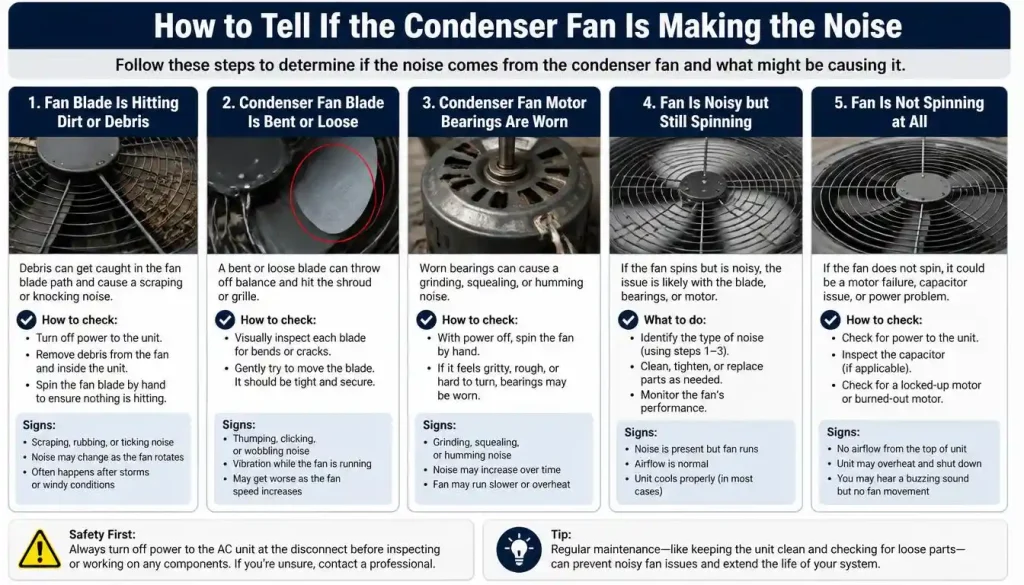
A condenser fan problem is often easier and less expensive to deal with than a compressor problem.
Fan Blade Is Hitting Dirt or Debris
This often creates a repetitive ticking, scraping, or rattling sound.
Turn off the refrigerator and remove the obstruction.
Clean the surrounding area carefully before restarting the appliance.
Condenser Fan Blade Is Bent or Loose
A damaged blade may wobble and hit the housing.
Watch for:
- uneven blade movement
- cracks
- looseness on the motor shaft
- contact with the fan shroud
A damaged blade should normally be replaced rather than bent back repeatedly.
Condenser Fan Motor Bearings Are Worn
Worn bearings can cause:
- grinding
- squealing
- rough rotation
- vibration
If the blade is clean and unobstructed but the motor still sounds rough, the motor may be wearing out.
Fan Is Noisy but Still Spinning
A spinning fan can still be faulty.
Noise may come from a worn motor bearing, loose blade, debris, or vibration at the mounting point.
Do not assume the fan is healthy just because it is moving.
Fan Is Not Spinning at All
A non-running fan may be blocked, have a damaged motor, or have an electrical problem.
Some refrigerator designs do not use a condenser fan, so confirm your model’s design before diagnosing a missing fan as a failure.
What If the Compressor Is Running but the Condenser Fan Is Not?
If your model uses a condenser fan and the compressor is running while the fan remains completely still, inspect the fan carefully.
Check Whether Your Refrigerator Actually Has a Condenser Fan
Not every refrigerator uses the same condenser design.
Some models rely on different airflow arrangements and may not have an exposed condenser fan near the compressor.
Use your model number and owner’s information to confirm the design.
Check the Fan Blade for an Obstruction
With power disconnected, look for anything preventing the blade from turning.
Common obstructions include:
- dust clumps
- pet hair
- insulation
- small objects
- damaged wiring
- bent fan housing
Spin the Fan Blade by Hand With the Power Off
The blade should move without severe resistance.
If it feels stiff or rough, the motor bearing may be damaged.
Check for a Seized or Worn Fan Motor
A fan motor may fail even when the blade looks fine.
Possible signs include:
- humming without turning
- rough hand rotation
- burning smell
- intermittent operation
- grinding noise before stopping
Electrical diagnosis should be left to a technician if you are not trained to work safely with appliance wiring.
How to Test a Refrigerator Condenser Fan Motor
You can perform a useful basic test without using live electrical measurements.
Unplug the Refrigerator First
Disconnect power before touching the fan.
Inspect the Fan Blade
Look for dirt, damage, or anything touching the blade.
Check Whether the Blade Spins Freely
Rotate it gently by hand.
A healthy fan should not feel severely stiff or gritty.
Check for Wobbling, Grinding, or Resistance
These symptoms may point to:
- worn bearings
- damaged blade
- bent motor shaft
- debris
- loose mounting
Inspect the Motor and Wiring
Look for obvious signs such as:
- burned connectors
- damaged wires
- loose plugs
- melted insulation
Do not perform live-voltage tests unless you know how to work safely around electrical appliances.
How to Check the Evaporator Fan for Noise
If the sound is coming from the freezer, do not keep focusing on the compressor.
Does the Noise Come From Inside the Freezer?
A freezer-area noise strongly suggests checking the evaporator fan.
Does the Noise Change When the Door Opens?
A change in sound when the freezer door opens can help narrow the source to the evaporator fan area.
Is Ice Hitting the Fan Blade?
Ice buildup can cause loud scraping or grinding.
Do not force the fan through heavy ice.
The underlying reason for the frost should also be investigated.
Is the Evaporator Fan Motor Failing?
A failing evaporator fan motor may produce:
- squealing
- grinding
- buzzing
- irregular speed
- intermittent operation
Poor airflow may also cause temperature problems.
Why Is My Refrigerator Compressor or Fan Suddenly Louder?
A refrigerator that becomes noisy suddenly usually deserves inspection.
Dust and Debris Around the Condenser Fan
Dust and pet hair can interfere with airflow and fan movement.
Cleaning the area may reduce noise and help the refrigerator release heat more effectively.
Ice Buildup Around the Evaporator Fan
Ice can contact the fan blade and create a grinding or scraping sound.
Heavy frost can also restrict airflow.
Refrigerator Is Not Level
An uneven refrigerator may vibrate against the floor, cabinets, or internal mounting points.
Use the leveling feet to make sure the appliance sits securely.
Refrigerator Is Too Close to the Wall
The rear panel, water line, or tubing can vibrate against the wall.
Give the appliance the clearance recommended for your model.
Loose Fan Blade or Mounting
A loose fan blade or bracket may rattle whenever the motor runs.
Worn Fan Motor Bearings
Fan bearings can wear over time and produce grinding or squealing.
Dirty Condenser Area
A dirty condenser area can increase heat and cooling workload.
Clean only the parts your refrigerator manufacturer allows users to access.
Compressor Mount or Vibration Problem
The compressor is mounted to reduce vibration.
If mounting hardware becomes damaged or nearby tubing starts touching the cabinet, normal compressor movement can become noisy.
Failing Compressor
A compressor can develop internal mechanical problems, but this should not be your first assumption.
Rule out fans, loose panels, tubing, drain pans, and normal operating sounds before deciding the compressor is bad.
Is the Clicking Noise From the Compressor, Fan, or Start Relay?
Clicking near the compressor area can be confusing.
Normal Compressor Start and Stop Click
An occasional click as the cooling system cycles can be normal.
Repeated Clicking Every Few Minutes
Repeated clicking combined with failed compressor starts may indicate a problem.
The refrigerator may also struggle to cool.
Start Relay vs Condenser Fan Problem
A bad fan and a compressor start problem can both create symptoms near the same area.
Check the fan mechanically first.
If the fan is free and the compressor repeatedly tries to start, professional diagnosis may be required.
Clicking With a Hot Compressor
A very hot compressor combined with repeated clicking and poor cooling should be taken seriously.
Unplugging the refrigerator and arranging professional service may be appropriate if the problem continues.
Is the Refrigerator Making Noise and Not Cooling?
Noise becomes more important when cooling performance changes.
Noisy Fan and Warm Refrigerator
A weak or blocked fan may reduce airflow or heat removal.
Freezer Cold but Refrigerator Warm
This can sometimes point to an airflow problem between the freezer and fresh-food compartment.
The evaporator fan, ice buildup, vents, or dampers may need inspection.
Noisy Compressor and Poor Cooling
If the compressor runs loudly but the refrigerator does not cool properly, do not assume the compressor alone is responsible.
Airflow, condenser condition, fan operation, and sealed-system problems can all contribute.
Hot Compressor With Little or No Cooling
A compressor may feel warm or hot during operation.
However, extreme heat together with repeated clicking, fan failure, or poor cooling deserves professional diagnosis.
Refrigerator Noises Commonly Mistaken for Compressor or Fan Noise
Not every rear or bottom noise comes from the cooling system.
Loose Drain Pan Rattling
The drain pan can vibrate while the compressor is running.
A loose pan may make the sound seem like a compressor failure.
Ice Maker or Water Inlet Valve Buzzing
A water valve may buzz briefly when the ice maker or water dispenser calls for water.
If the refrigerator has no water supply connected but the ice maker remains active, unusual valve noise may occur.
Refrigerant Hissing or Gurgling
Refrigerant and oil moving through the cooling system can create hissing, bubbling, or gurgling sounds.
These sounds are often normal.
Defrost Cycle Sizzling or Popping
During automatic defrost, water can contact warm components and create sizzling or popping sounds.
Water Line or Ice Maker Knocking
Water pressure changes and ice-making components can sometimes create knocking sounds.
Cabinet and Internal Parts Expanding or Contracting
Temperature changes can make plastic liners and metal parts pop or crack slightly.
This does not automatically indicate a mechanical failure.
Why Are the Compressor and Fan Not Running During a Defrost Cycle?
Do not immediately assume the refrigerator is broken when the compressor and fans stop.
Many frost-free refrigerators periodically enter a defrost cycle.
During this period, the compressor and some fans may temporarily stop.
After defrosting is complete, normal cooling operation should resume.
If the refrigerator remains warm for a long period and never restarts, then further troubleshooting is needed.
How to Fix Refrigerator Fan Noise
Once you know the sound is fan-related, start with the simplest solutions.
Clean the Condenser Fan and Surrounding Area
Disconnect power and remove accessible dust and debris.
Avoid damaging wiring or tubing.
Remove Debris From the Fan Blade
Anything touching the blade can create noise.
Make sure the blade has clear space to rotate.
Defrost Ice Around the Evaporator Fan
If ice is contacting the evaporator fan, the ice must be removed safely.
Do not use sharp tools to chip ice around refrigerant tubing.
If heavy frost returns, diagnose the reason for the recurring ice buildup.
Tighten Loose Panels and Fan Mounts
A loose screw or bracket can turn normal fan vibration into a loud rattle.
Level the Refrigerator
Adjust the feet so the refrigerator stands firmly without rocking.
Give the Refrigerator Enough Ventilation Space
Keep the required clearance around the refrigerator so heat can escape properly.
Replace a Damaged Fan Blade or Fan Motor
A cracked blade, seized motor, or badly worn bearing normally needs replacement.
Use parts made for your exact refrigerator model.
What to Do If the Compressor Itself Is Making Loud Noise
If you have ruled out the fans, panels, tubing, and other common noise sources, the compressor may need closer attention.
Check Whether the Refrigerator Is Still Cooling
A noisy refrigerator that maintains normal temperature is a different situation from one that is warm inside.
Cooling performance gives you an important clue.
Check for Repeated Clicking and Failed Starts
Repeated clicking followed by a short hum may indicate that the compressor is struggling to start.
Check for Excessive Vibration
Make sure the refrigerator is level and that no tubing or panels are vibrating against the cabinet.
Avoid DIY Sealed-System Compressor Repair
Compressor replacement involves refrigerant, specialized equipment, electrical work, and sealed-system procedures.
This is not a typical DIY repair.
When Compressor Replacement May Be Necessary
Professional diagnosis may confirm compressor failure if the unit has poor cooling, abnormal noise, repeated failed starts, or internal mechanical damage.
Before approving an expensive compressor repair, compare the repair cost with the refrigerator’s age, condition, and replacement value.
Refrigerator Noise Troubleshooting Chart
| What You Hear | Where It Comes From | Likely Cause | First Check |
|---|---|---|---|
| Rattling | Bottom or rear | Fan, drain pan, panel | Check loose parts |
| Grinding | Freezer | Evaporator fan or ice | Inspect fan area |
| Grinding | Bottom rear | Condenser fan motor | Check fan rotation |
| Deep humming | Rear | Compressor | Check cooling performance |
| Repeated clicking | Rear | Start system or overheating | Check fan and cooling |
| Scraping | Fan area | Blade obstruction | Inspect blade |
| Squealing | Fan area | Motor bearing | Check fan motor |
| Buzzing | Rear | Compressor, fan, water valve | Locate exact source |
| Gurgling | Inside cabinet | Refrigerant flow | Often normal |
| Popping | Interior | Defrost or expansion | Often normal |
When Should You Stop Troubleshooting and Call a Technician?
Call a qualified appliance technician if you notice:
- burning smell
- melted wiring
- repeated breaker trips
- compressor repeatedly failing to start
- very hot compressor with poor cooling
- fan motor electrical failure
- refrigerator completely stops cooling
- loud compressor noise after other causes are ruled out
- repeated ice buildup around the evaporator fan
- sealed-system problems
- refrigerant-related repair needs
Also call a professional if reaching the part requires disassembling electrical or sealed cooling-system components.
How to Prevent Refrigerator Compressor and Fan Noise
A few simple habits can reduce future problems.
Keep the Condenser Area Clean
Dust, hair, and debris can collect around the bottom or rear of the refrigerator.
Inspect accessible areas periodically.
Keep Air Vents Clear
Do not block interior air vents with food containers.
Good airflow helps the refrigerator maintain an even temperature.
Keep the Refrigerator Level
A stable refrigerator vibrates less and puts less stress on doors and moving parts.
Leave Proper Ventilation Around the Fridge
Follow the clearance requirements for your refrigerator model.
Investigate New Noises Early
A new scraping or grinding noise is easier to deal with before a fan blade or motor becomes badly damaged.
Frequently Asked Questions
How do I know if my refrigerator fan or compressor is making noise?
First locate the sound. Noise from inside the freezer usually points toward the evaporator fan. Noise from the bottom rear may come from the condenser fan, compressor, drain pan, or nearby tubing. Check the fan blades with the refrigerator unplugged before assuming the compressor is faulty.
What does a bad refrigerator compressor sound like?
A failing compressor may produce unusually loud buzzing, knocking, strong vibration, or repeated failed-start clicking. However, many other parts can create similar noises, so compressor failure should be confirmed rather than guessed.
What does a bad refrigerator condenser fan sound like?
A failing condenser fan may grind, squeal, scrape, rattle, or buzz. The blade may also wobble or become difficult to rotate by hand when the refrigerator is unplugged.
Is a humming refrigerator compressor normal?
Yes. A low, steady compressor hum is usually normal. Investigate if the sound becomes unusually loud or is accompanied by poor cooling, repeated clicking, or excessive vibration.
Why does my refrigerator fan make a rattling noise?
Possible causes include debris touching the blade, a loose mounting bracket, a damaged blade, worn motor bearings, or a nearby panel vibrating.
Can a bad condenser fan affect the compressor?
Yes. On refrigerators that use a condenser fan, poor airflow around the condenser and compressor can increase operating temperatures and reduce cooling efficiency.
Why does my refrigerator noise stop when I open the freezer door?
If the sound changes or stops when the freezer door opens, the evaporator fan may be involved. Ice around the fan or a worn fan motor are common things to inspect.
Can I run a refrigerator with a noisy fan?
A minor temporary noise may not mean immediate failure, but grinding, scraping, or a fan that stops spinning should be checked quickly. A failed fan can contribute to airflow or cooling problems.
Should the condenser fan run whenever the compressor runs?
Fan behavior depends on refrigerator design and control logic. On many models the condenser fan operates during cooling, but it may not run continuously. Check the service information for your exact model before deciding the fan is faulty.
Why is my refrigerator clicking after a power outage?
A refrigerator may click while its cooling system attempts to restart after power is restored. If normal operation returns shortly afterward, it may not indicate a fault. Repeated clicking with no cooling needs further diagnosis.
Is inverter refrigerator compressor noise normal?
Inverter and variable-speed refrigerators can change compressor and fan speed depending on cooling demand. This can create changing hums or airflow sounds. A new grinding, scraping, knocking, or repeated failed-start sound is more concerning than normal speed changes.
Final Diagnosis: Fan Noise or Compressor Problem?
Start with the location of the sound.
If the noise comes from inside the freezer, inspect the evaporator fan and check for ice buildup.
If the noise comes from the bottom rear near the compressor, inspect the condenser fan, loose panels, drain pan, tubing, and surrounding debris first.
If the fan turns freely, nothing is vibrating, and a deep abnormal noise clearly remains inside the compressor, professional compressor diagnosis may be needed.
Most importantly, combine the sound with the refrigerator’s cooling performance.
A refrigerator that is noisy but cooling normally may only have a minor vibration or fan issue. A refrigerator that is noisy, repeatedly clicking, overheating, and failing to cool needs more urgent attention.
Finding the exact source before replacing parts can save time, prevent unnecessary repairs, and help you decide whether the problem is a simple fan issue or a more serious compressor fault.

Hi, I’m the lead researcher and appliance enthusiast behind RefrigeratorSolve. With years of hands-on experience troubleshooting cooling systems and testing home appliances, I am dedicated to bringing you honest reviews, energy-saving tips, and practical solutions to keep your refrigerator running perfectly.






4 Responses