A refrigerator is never completely silent. You may hear a soft hum, a short buzz, a click, or even the occasional gurgling sound while it works. In many cases, these sounds are completely normal.
But when refrigerator makes buzzing noise that suddenly becomes louder, lasts longer than usual, or comes with cooling problems, it deserves a closer look.
The source may be as simple as a vibrating bottle, an uneven refrigerator, or the ice maker filling with water. In other cases, the buzzing may come from a fan, water inlet valve, start relay, or compressor.
This guide will help you identify where the noise is coming from, understand what it means, and decide whether you can fix it yourself or need a refrigerator technician.
Is It Normal for a Refrigerator to Make a Buzzing Noise?
Yes, a refrigerator can make a mild buzzing or humming sound during normal operation.
Modern refrigerators use compressors, fans, valves, and automatic ice-making systems. Each of these parts can create some noise.
A quiet, steady buzz that comes and goes is usually not a problem, especially if the refrigerator is cooling normally.
Common normal sounds include:
- A low hum while the compressor runs
- A short buzz when the ice maker fills with water
- Fan noise while cold air circulates
- Brief humming during a defrost cycle
- Increased compressor noise after the doors have been open
- Louder operation after adding a large amount of warm food
You should pay more attention when the sound becomes unusually loud, starts suddenly, continues almost nonstop, or happens together with poor cooling.
Refrigerator Buzzing vs. Humming: Is There a Difference?
People often use the words “buzzing” and “humming” to describe the same refrigerator sound.
A soft hum usually comes from a running compressor or fan. Buzzing tends to sound slightly sharper and may come from a water valve, vibrating panel, fan blade, or electrical component.
The exact word matters less than where the sound comes from and what the refrigerator is doing when it happens.
Signs the Buzzing May Not Be Normal
The noise may need attention if:
- It is much louder than before
- The refrigerator is not cooling properly
- Buzzing is followed by repeated clicking
- The sound becomes constant
- You hear grinding along with the buzz
- The freezer is building up heavy frost
- The ice maker or water dispenser stops working
- You notice a burning smell or unusual heat
Quick Diagnosis: What Does the Refrigerator Buzzing Mean?
Use the table below to narrow down the likely source.
| What You Notice | Possible Cause |
|---|---|
| Soft buzz while cooling | Normal compressor operation |
| Buzzing during ice production | Ice maker or water inlet valve |
| Buzz every 10–15 minutes | Ice maker trying to fill |
| Buzz stops when freezer door opens | Evaporator fan or ice buildup |
| Buzz from inside freezer | Evaporator fan |
| Buzz from lower back | Compressor or condenser fan |
| Buzz while dispensing water | Water valve, filter, or supply problem |
| Buzzing with clicking | Start relay or compressor problem |
| Whole refrigerator vibrates | Leveling or contact with nearby surfaces |
| Buzzing but refrigerator still cools | Often normal operation or minor vibration |
| Buzzing and refrigerator is warm | Cooling-system problem needs investigation |
Start by listening carefully. Knowing whether the sound comes from the freezer, back, bottom, ice maker, or water dispenser can save a lot of time.
Why Is My Refrigerator Making a Buzzing Noise?
There are several possible causes. Some are harmless, while others require repair.
1. The Compressor Is Running
The compressor circulates refrigerant through the cooling system. It normally produces a low humming or buzzing sound while operating.
You may notice it more when:
- The refrigerator has just been plugged in
- The doors were open for a long time
- You recently loaded groceries
- The kitchen is unusually warm
- The refrigerator is trying to recover after a power outage
If the refrigerator is cooling correctly and the sound is fairly steady, the compressor may simply be doing its job.
However, very loud buzzing followed by clicking or failure to cool may point to a compressor or starting-component problem.
2. The Ice Maker Is Filling
A refrigerator with an automatic ice maker may buzz briefly when the water valve opens to refill the ice tray.
This usually lasts only a few seconds.
If the refrigerator is not connected to a water supply but the ice maker is switched on, you may hear repeated buzzing as the system tries to draw water.
If you do not use the ice maker, turn it off and see whether the noise stops.
3. The Water Inlet Valve Is Buzzing
The water inlet valve controls water flowing to the ice maker and dispenser.
A short buzz while water enters the refrigerator can be normal. A loud or prolonged buzz may indicate:
- Restricted water flow
- A partially closed supply valve
- A clogged filter
- A kinked water line
- A worn inlet valve
If the buzzing happens only while making ice or dispensing water, start your troubleshooting here.
4. The Water Filter Is Clogged
An old or clogged refrigerator water filter can reduce water flow.
The inlet valve may then become noisier because it is working against that restriction.
Other signs include:
- Slow water dispenser flow
- Small or hollow ice cubes
- Longer ice-making cycles
- Buzzing during water dispensing
- Reduced ice production
If the filter is overdue for replacement, install the correct filter recommended for your refrigerator model.
5. The Water Supply Line Is Kinked or Restricted
Move the refrigerator carefully away from the wall and inspect the water line.
Look for:
- Sharp bends
- Crushed tubing
- Kinks
- Pinched areas
- A supply valve that is not fully open
Do not pull the refrigerator too far forward if the water line is short.
6. Water Pressure Is Too High or Too Low
Incorrect water pressure may also create noise around the inlet valve.
Low pressure can make filling slow and cause the valve to operate longer. Excessive pressure can make water movement and valve operation sound louder.
If water flow from the dispenser has suddenly changed, check the filter, water line, and household supply before assuming the valve itself has failed.
7. The Condenser Fan Is Dirty or Obstructed
Some refrigerators use a condenser fan near the compressor.
If dust, debris, or another object touches the fan blade, you may hear buzzing, rubbing, or vibrating.
Unplug the refrigerator before inspecting any accessible fan area.
If your refrigerator has an exposed condenser area, remove loose dust carefully. Do not disassemble electrical parts unless you know exactly what you are doing.
8. The Evaporator Fan Is Hitting Ice
The evaporator fan is usually located inside or behind the freezer compartment.
It moves cold air through the refrigerator.
If ice builds up around the fan, the blades may hit the frost and create:
- Buzzing
- Humming
- Scraping
- Grinding
- Clicking
One useful clue is that the noise may stop when you open the freezer door because many refrigerators temporarily stop the evaporator fan when the door opens.
Repeated ice buildup may indicate a defrost-system, door-seal, or airflow problem.
9. The Refrigerator Is Not Level
A slightly uneven refrigerator can create surprisingly loud vibration.
The compressor and fans naturally produce small vibrations. If the refrigerator rocks or sits unevenly, those vibrations can travel through the cabinet and sound like buzzing.
Check that:
- All feet touch the floor
- The refrigerator does not rock
- The front is adjusted according to the manufacturer’s instructions
Small leveling adjustments can sometimes eliminate the noise immediately.
10. The Refrigerator Is Touching a Wall or Cabinet
If one side of the refrigerator touches a cabinet, countertop, or wall, normal compressor vibration may become much louder.
Move the appliance slightly away from surrounding surfaces.
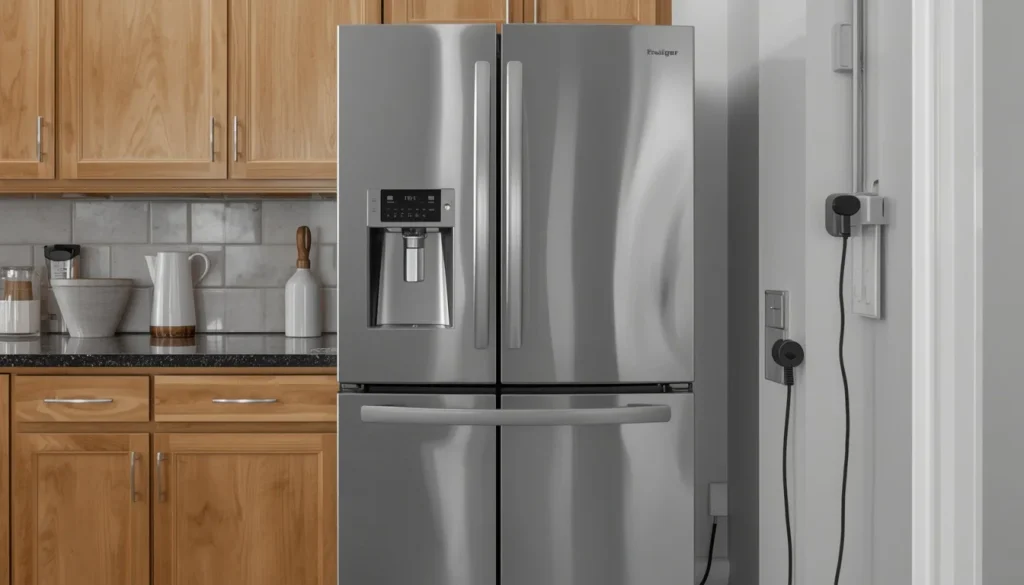
Also check whether the water line or power cord is vibrating against the wall.
11. Bottles, Shelves, or Containers Are Vibrating
Sometimes the refrigerator itself is fine.
Glass bottles, food containers, metal trays, or loose shelves can vibrate while the compressor runs.
Try separating bottles and containers so they are not touching each other.
Also check:
- Door bins
- Freezer baskets
- Removable shelves
- Items stored on top of the refrigerator
If the buzzing disappears after rearranging the contents, no repair is needed.
12. The Start Relay or Compressor May Have a Problem
A more serious situation is a refrigerator that makes a loud buzz and then clicks.
You may hear something like:
Buzz… click… silence… buzz… click.
This can happen when the compressor tries to start but cannot stay running.
Possible causes include:
- Faulty compressor start relay
- Overload protector problem
- Compressor failure
- Electrical supply issue
If the refrigerator is also getting warmer, professional diagnosis is usually the best option.
Where Is the Refrigerator Buzzing Coming From?
The location of the noise is one of your best diagnostic clues.
Buzzing From the Back of the Refrigerator
The back or lower rear area contains several mechanical components.
Possible sources include:
- Compressor
- Condenser fan
- Water inlet valve
- Water line vibration
A mild compressor hum is usually normal. Loud buzzing, clicking, or overheating deserves further inspection.
Buzzing From the Bottom
Buzzing near the bottom may come from:
- Compressor vibration
- Condenser fan
- Drain pan vibration
- Uneven leveling feet
Check whether the refrigerator rocks slightly when pushed.
Buzzing Inside the Freezer
A freezer buzzing noise often points toward the evaporator fan.
If the noise stops when you open the freezer door, fan-related trouble becomes more likely.
Ice buildup around the fan should not be ignored if it repeatedly returns.
Buzzing Near the Ice Maker
Short buzzing while the ice maker fills can be normal.
Repeated buzzing with little or no ice production may indicate:
- No water supply
- Kinked supply line
- Clogged filter
- Water valve problem
Buzzing Near the Water Dispenser
If the refrigerator buzzes only when dispensing water, check:
- The water filter
- Water supply valve
- Supply line
- Water pressure
- Inlet valve
Refrigerator Buzzing in Different Situations
The timing of the buzzing can reveal just as much as its location.
Refrigerator Buzzing but Still Cooling
If the refrigerator is buzzing but still cooling normally, the cause is often less serious.
Possible explanations include:
- Normal compressor operation
- Fan operation
- Ice maker filling
- Cabinet vibration
- Uneven flooring
- Bottles touching each other
Monitor the noise and check whether it becomes louder or more frequent.
Refrigerator Buzzing and Not Cooling
Buzzing combined with poor cooling needs more attention.
Check whether:
- The interior lights work
- Fans are running
- The compressor starts
- You hear repeated clicking
- Freezer vents are blocked
- Heavy frost is covering the freezer panel
If the refrigerator temperature continues to rise, avoid repeatedly unplugging and restarting it. A technician may need to test the compressor, start relay, fans, sensors, or sealed cooling system.
Refrigerator Buzzing and Clicking
A single occasional click can be normal.
Repeated buzzing followed by clicking is different.
It may mean the compressor is trying to start but cannot continue running.
If this cycle repeats every few minutes and the refrigerator is becoming warm, schedule professional service.
Refrigerator Buzzing Stops When Door Opens
This is an important clue.
If the buzzing stops when you open the freezer door and returns after closing it, the evaporator fan may be responsible.
Possible problems include:
- Ice touching the fan blades
- A worn fan motor
- A loose fan component
Listen carefully near the freezer’s rear interior panel.
Refrigerator Buzzing Every Few Minutes
Periodic buzzing can come from:
- Compressor cycling
- Ice maker operation
- Water valve operation
- Compressor start attempts
Notice whether the sound happens at the same time as water filling or ice making.
Refrigerator Buzzing Every 10–15 Minutes
If the buzzing repeats at regular intervals, check the ice maker.
An ice maker that is switched on without a proper water supply may repeatedly try to fill.
Make sure:
- The refrigerator is connected to water
- The supply valve is open
- The line is not kinked
- The water filter is not blocked
If you do not use the ice maker, switch it off.
Refrigerator Buzzing Constantly
A refrigerator may run for long periods during hot weather, after grocery loading, or after frequent door opening.
Constant loud buzzing, however, may indicate:
- Compressor working excessively
- Dirty airflow areas
- Poor door sealing
- Fan obstruction
- Cooling-system trouble
Check whether the refrigerator reaches and maintains its normal temperature.
Refrigerator Buzzing When Dispensing Water
This usually directs attention to the water system.
Start with the easiest checks:
- Replace an overdue filter
- Make sure the water valve is fully open
- Straighten the supply line
- Check whether dispenser flow is weak
A short valve buzz may be normal. A new, loud, or prolonged sound is worth investigating.
Refrigerator Buzzing When the Ice Maker Is On
Turn the ice maker off temporarily.
If the buzzing stops, inspect the water supply and ice-making system.
Do not leave an automatic ice maker switched on for long periods when the refrigerator is not connected to water.
Refrigerator Buzzing After Opening the Door
Opening the refrigerator allows warm air to enter.
The compressor and fans may then run harder to restore the correct temperature.
A temporary increase in humming or buzzing can therefore be normal.
Refrigerator Buzzing After Adding Groceries
Loading several room-temperature or warm items increases the cooling demand.
You may hear the compressor run longer or louder for a while.
The noise should reduce after the refrigerator returns to its normal temperature.
Refrigerator Buzzing After a Power Outage
After power returns, the refrigerator may need time to restore the set temperature.
The compressor may run longer than usual.
If the refrigerator repeatedly buzzes and clicks but does not begin cooling, there may be a start or compressor problem.
New Refrigerator Making a Buzzing Noise
New refrigerators sometimes seem noisier than older models because of different compressors, high-efficiency fans, variable-speed systems, and automatic controls.
During the first day or two, the refrigerator may also run longer while cooling down for the first time.
A moderate hum is usually normal.
Loud grinding, repeated clicking, poor cooling, or extreme vibration is not something you should simply accept as normal.
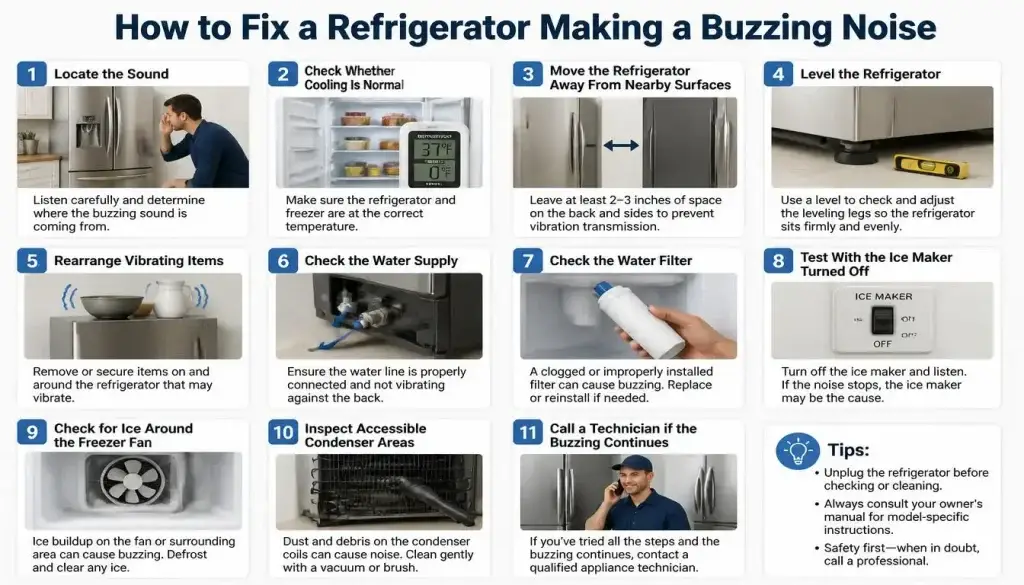
How to Fix a Refrigerator Making a Buzzing Noise
Try these steps in order.
Step 1: Locate the Sound
Listen from:
- The freezer
- Refrigerator compartment
- Lower back
- Bottom
- Ice maker
- Water dispenser
Do not start replacing parts until you know which area is making the noise.
Step 2: Check Whether Cooling Is Normal
If both compartments are maintaining the correct temperature, the problem may be minor.
If food is becoming warm, prioritize troubleshooting the compressor, fans, and cooling system.
Step 3: Move the Refrigerator Away From Nearby Surfaces
Make sure it is not touching:
- A wall
- Cabinet
- Counter
- Water line
- Loose object
Even a small gap can reduce vibration noise.
Step 4: Level the Refrigerator
Check all leveling feet.
The appliance should feel stable and should not rock when gently pushed.
Step 5: Rearrange Vibrating Items
Separate bottles and containers.
Secure loose shelves, bins, and trays.
Remove anything stored on top that may be vibrating.
Step 6: Check the Water Supply
If the buzzing happens during ice production or water dispensing:
- Make sure the supply valve is open
- Inspect the line for kinks
- Confirm water reaches the refrigerator
Step 7: Check the Water Filter
Replace the filter if it is old, clogged, or incorrectly installed.
Use the filter type recommended for your refrigerator.
Step 8: Test With the Ice Maker Turned Off
Switch off the ice maker temporarily.
If the buzzing disappears, focus on the water supply, valve, filter, or ice maker.
Step 9: Check for Ice Around the Freezer Fan
If the sound comes from inside the freezer and stops when the door opens, ice may be interfering with the evaporator fan.
Do not poke tools into the fan area while the refrigerator is powered.
Step 10: Inspect Accessible Condenser Areas
Unplug the refrigerator first.
Remove visible dust or loose debris only from areas that are safely accessible.
Avoid opening sealed electrical or refrigeration components.
Step 11: Call a Technician if the Buzzing Continues
Professional service is appropriate when:
- Cooling is failing
- Buzzing is followed by clicking
- The compressor repeatedly fails to start
- Fan noise continues after obvious ice or debris checks
- The appliance overheats
- You suspect an electrical problem
When Should You Worry About Refrigerator Buzzing?
Not every buzzing sound is dangerous, but certain symptoms should not be ignored.
Arrange service if you notice:
- Refrigerator or freezer temperatures rising
- Repeated buzz-and-click cycles
- Strong grinding or scraping
- Heavy recurring frost
- Compressor area becoming unusually hot
- Water leaking near electrical components
- Breaker repeatedly tripping
- Burning smell
- Smoke or visible sparking
If you smell burning, see smoke, or notice sparking, disconnect power if it is safe to do so and stop using the appliance until it has been inspected.
How to Prevent Refrigerator Buzzing Noise
A few simple habits can reduce unnecessary refrigerator noise.
- Keep the refrigerator level
- Leave proper ventilation space around the appliance
- Avoid pushing it directly against a wall
- Keep bottles and containers from touching
- Replace water filters when required
- Keep the water supply line straight
- Keep freezer vents clear
- Avoid blocking internal air circulation
- Clean accessible dust from approved condenser areas
- Repair damaged door seals
- Pay attention when a familiar sound suddenly changes
Regular observation is useful. You do not need to worry about every small sound, but you should know what your refrigerator normally sounds like.
Frequently Asked Questions About When Refrigerator Makes Buzzing Noise
Why is my refrigerator suddenly buzzing?
A refrigerator may suddenly buzz because the compressor has started, the ice maker is filling, the water valve is operating, a fan is rubbing against ice, or part of the cabinet is vibrating. Check where the sound is coming from and whether cooling is still normal.
Why is my fridge buzzing but still cold?
If the refrigerator is still cooling normally, a low buzzing sound is often caused by the compressor, fan, ice maker, or minor vibration. The sound becomes more concerning if it gets louder or is followed by clicking.
Why does my refrigerator buzz every few minutes?
It may be normal compressor cycling, ice maker activity, or the water inlet valve. Repeated buzzing followed by clicking may indicate a compressor starting problem.
Why does my refrigerator buzz every 15 minutes?
Check the automatic ice maker. It may be attempting to fill with water. Make sure the water supply is connected, the valve is open, and the line or filter is not restricted.
Why does my fridge stop buzzing when I open the door?
If the noise stops when the freezer door opens, the evaporator fan may be the source. Ice buildup or a worn fan motor can cause buzzing or scraping.
Why is my refrigerator buzzing and clicking?
Repeated buzzing and clicking can occur when the compressor tries to start but cannot stay running. A start relay, overload device, electrical issue, or compressor problem may be involved.
Why is my refrigerator buzzing but not cooling?
Possible causes include a fan problem, compressor starting issue, compressor failure, heavy frost buildup, or another cooling-system fault. If temperatures continue rising, professional diagnosis is recommended.
Why does my refrigerator buzz when getting water?
The water inlet valve normally makes some sound when it opens. Excessive buzzing can be related to a clogged filter, restricted supply line, water-pressure problem, or failing valve.
Can a bad compressor make a buzzing sound?
Yes. A failing compressor can buzz, especially when trying to start. However, compressor noise alone does not confirm failure. Repeated clicking, poor cooling, and unsuccessful start attempts are more concerning signs.
Should I unplug my refrigerator if it is buzzing?
A normal low buzz does not require unplugging the refrigerator. Disconnect power if you notice smoke, burning smells, sparking, serious overheating, or another clear electrical safety problem.
How do I know if refrigerator buzzing is normal?
The sound is usually less concerning when it is quiet, temporary, predictable, and the refrigerator maintains the correct temperature. New, loud, constant, grinding, or clicking noises deserve closer inspection.
Final Thoughts
When a refrigerator makes a buzzing noise, there is no need to assume the compressor is failing right away.
Start with simple checks. Find where the sound is coming from, make sure the refrigerator is level, move it away from nearby surfaces, separate vibrating bottles, and inspect the water supply if the noise happens during ice making or water dispensing.
A soft buzz from a compressor, fan, or water valve is often part of normal refrigerator operation.
The situation changes when the buzzing becomes loud, continues constantly, stops only when the freezer door opens, comes with repeated clicking, or appears together with poor cooling.
Those clues can point toward a fan, water valve, start relay, or compressor problem.
By paying attention to when and where the sound occurs, you can often separate normal refrigerator noise from a problem that actually needs repair.

Hi, I’m the lead researcher and appliance enthusiast behind RefrigeratorSolve. With years of hands-on experience troubleshooting cooling systems and testing home appliances, I am dedicated to bringing you honest reviews, energy-saving tips, and practical solutions to keep your refrigerator running perfectly.