A sudden pop from your Frigidaire refrigerator can sound much more serious than it actually is. You may hear it after the compressor stops, during the night, following a defrost cycle, or while using the ice dispenser.
In many cases, an occasional popping or cracking sound is normal. Refrigerator components regularly change temperature, pressure, and position. Plastic liners, metal panels, cooling pipes, ice-maker parts, and defrost components can all produce brief pops as they operate.
Frigidaire specifically notes that a popping sound may occur after a defrost cycle. Its official refrigerator noise guide also identifies the ice-dispenser solenoid, automatic ice maker, water valve, electronic controls, refrigerant movement, and high-efficiency compressor as sources of normal operating sounds.
However, repetitive popping accompanied by poor cooling, heavy frost, leaking, fan scraping, electrical clicking, smoke, or a burning smell should not be ignored.
This guide explains why your Frigidaire refrigerator is making a popping noise, how to locate the source, which checks are safe to perform, and when you should contact Frigidaire or an appliance technician.
Quick Answer
Your Frigidaire refrigerator is most likely making a popping noise because of one of the following:
- The refrigerator has just completed an automatic defrost cycle.
- Plastic or metal components are expanding or contracting.
- The ice-dispenser chute is opening or closing.
- Ice cubes are falling into the storage bin.
- The water inlet valve is filling the ice maker.
- Refrigerant pressure is changing inside the cooling system.
- The compressor or a fan is starting or changing speed.
- The refrigerator is touching a wall or cabinet.
- The appliance is not level.
- A shelf, drawer, bottle, or water line is vibrating.
- A fan is striking ice behind the freezer panel.
- A door hinge or closing component is moving.
An isolated pop with normal cooling is usually harmless.
A continuous or repetitive sound deserves attention when the refrigerator is becoming warm, frost is building up, water is leaking, an error code appears, or the compressor repeatedly clicks without staying on.
Is It Normal for a Frigidaire Refrigerator to Make Popping Noises?
Yes. Occasional popping, clicking, cracking, humming, and gurgling sounds are normal in many Frigidaire refrigerators.
A refrigerator contains several mechanical and electronic systems that operate at different times. These include:
- The compressor
- Evaporator and condenser fans
- The automatic defrost system
- Refrigerant tubing
- Electronic temperature controls
- Motorised air dampers
- An automatic ice maker
- A water inlet valve
- An ice-dispenser chute and solenoid
Frigidaire’s official noise guide explains that popping may occur after defrosting. Snapping, clicking, or popping can also occur when the ice-dispenser solenoid opens and closes the ice chute. Refrigerant flow may produce gurgling, while modern compressors may create a high-pitched hum or pulsating sound.
A normal popping sound usually has these characteristics:
- It happens occasionally rather than continuously.
- The refrigerator and freezer remain properly cold.
- The sound lasts only a moment.
- It may occur after defrosting.
- It may happen when ice is produced or dispensed.
- There is no smoke, burning smell, or sparking.
- The refrigerator does not repeatedly lose power.
- The sound does not become steadily louder every day.
The context matters more than the volume of one isolated pop.
Normal Frigidaire Popping Noise vs. a Possible Fault
| What You Notice | Most Likely Cause | Recommended Action |
|---|---|---|
| One or two pops after defrosting | Normal temperature and pressure changes | No action is usually needed |
| A pop while dispensing ice | Ice-chute solenoid operating | Usually normal |
| A bang followed by ice entering the bin | Ice-maker operation | Usually normal |
| Brief clicking when cooling begins | Control or compressor operation | Monitor normal cooling |
| Popping after installation | Initial cooling and cabinet movement | Allow the refrigerator to stabilise |
| Noise after moving the refrigerator | Poor levelling or wall contact | Check installation |
| Buzzing or chattering without a water supply | Ice-maker valve attempting to fill | Turn off the ice maker |
| Rapid tapping from the freezer | Fan contacting ice | Arrange diagnosis |
| Repeated clicking with poor cooling | Compressor, electrical, or control problem | Request service |
| Popping with thick frost | Defrost, door-seal, or airflow problem | Arrange diagnosis |
| Popping with smoke or a burning smell | Possible electrical failure | Disconnect power if safe |
What Causes a Frigidaire Refrigerator to Make a Popping Noise?
The best clue is usually when and where the sound occurs.
1. The Refrigerator Has Just Finished Defrosting
The automatic defrost cycle is one of the most common Frigidaire-specific explanations.
A frost-free refrigerator periodically warms the evaporator area to remove frost. During this process, ice melts, water moves towards the drain pan, and internal components change temperature.
As cooling resumes, plastic liners, metal panels, evaporator parts, and nearby tubing may shift slightly. That movement can create a brief pop or crack.
Frigidaire states that water dripping onto the defrost heater may produce hissing or sizzling and that a popping sound may occur after defrosting. Water may also be heard dripping or running into the drain pan during the cycle.
You may also hear:
- Clicking
- Crackling
- Hissing
- Sizzling
- Dripping
- Gurgling
- Running water
These sounds are generally normal when cooling remains stable and frost is not accumulating excessively.
When Defrost-Related Popping May Be Abnormal
Arrange an inspection if the noise appears with:
- Thick frost on the freezer’s rear interior wall
- Weak airflow from the vents
- A warm fresh-food compartment
- A fan scraping behind the freezer panel
- Water repeatedly collecting beneath drawers
- Water leaking onto the floor
- Food beginning to thaw
- A high-temperature warning
- The refrigerator running almost continuously
Frigidaire advises checking door closure, gasket condition, ice-chute closure, and blocked vents when frost builds up. These issues can allow moisture to enter or restrict airflow.
2. Plastic and Metal Parts Are Expanding or Contracting
Refrigerator temperatures change throughout the day.
The interior becomes colder when active cooling begins and warms slightly when the compressor stops or defrosting starts. Plastic liners, shelves, insulation, tubing, and metal panels do not respond to temperature changes at exactly the same rate.
A panel may remain under slight tension and then move suddenly, creating a pop or crack.
This is more likely:
- During the first cooling cycle
- After changing the temperature setting
- After loading warm groceries
- After leaving a door open
- Following a power outage
- During hot weather
- During or after defrosting
- When the kitchen is quiet at night
Frigidaire’s freezer guidance similarly explains that popping or cracking can result from metal parts expanding and contracting with temperature changes or from refrigerant circulation. The sound often becomes less noticeable as operation stabilises.
Does Thermal Popping Require Repair?
Usually, no.
If the refrigerator is cooling correctly and the sound happens only occasionally, replacing the compressor, control board, or fan is unlikely to solve it.
The sound may become less noticeable after the appliance stabilises. Proper levelling and installation can also prevent the cabinet or nearby surfaces from amplifying it.
3. The Ice-Dispenser Chute Is Opening or Closing
A popping sound that happens specifically while dispensing ice may come from the dispenser mechanism.
When you press the ice paddle, a solenoid opens the ice chute so cubes can pass through. It closes again when dispensing stops. The movement may create a sharp snap, click, or pop.
Frigidaire identifies this sound as normal operation of the ice-dispenser paddle and chute solenoid.
The sound is likely normal when:
- It occurs only as dispensing begins or ends.
- Ice passes through the chute normally.
- The chute closes completely.
- No error code appears.
- Water is not leaking from the dispenser.
When to Check the Ice Chute
Inspect the accessible chute area if:
- The popping continues after dispensing stops.
- Ice becomes stuck.
- The chute door does not close.
- Frost develops around the dispenser.
- The display shows a DI SP or DISP error.
- The dispenser motor grinds without releasing ice.
Frigidaire associates the DI SP or DISP code with ice jammed in the chute or around the auger. Temperature changes and power outages can contribute to ice melting and refreezing in that area.
Do not force the chute door or insert sharp tools into the dispenser.
4. Ice Cubes Are Falling Into the Storage Bin
Ice falling into an empty plastic bin can sound like a loud pop, knock, or bang.
The noise may be particularly noticeable when:
- The ice bin is empty.
- Several cubes fall together.
- Ice production has just resumed.
- The refrigerator is new.
- The freezer is quiet.
- The bin is not fully seated.
Frigidaire states that cubes falling into the ice bin, the ice-maker fan, water-valve activation, and refrigerant gas can all create normal sounds during ice-making operation.
How to Confirm That the Ice Maker Is Responsible
Listen for the sound and then check whether new cubes have entered the bin.
You can also temporarily turn off the ice maker using the switch, control panel, or wire shutoff arm described in your model’s manual.
If the popping stops while the ice maker is off, check:
- Whether the storage bin is properly installed
- Whether ice cubes are clumped together
- Whether a cube is stuck near the ejector
- Whether the water supply is connected
- Whether the water line is kinked
- Whether the freezer is cold enough
Do not force the ice-maker tray, gears, or ejector components by hand.
5. The Ice Maker Is On Without a Water Supply
A Frigidaire ice maker that is switched on without a connected water supply may create loud buzzing, chattering, clicking, or popping-like noises.
The inlet valve attempts to open and fill the ice maker, but no water arrives.
Frigidaire recommends switching the ice maker off when a water supply cannot be connected. Otherwise, the fill valve may make a loud chattering noise while attempting to operate without water.
Check that:
- The household water valve is open.
- The refrigerator is connected to the supply.
- The visible line is not kinked.
- The water filter is correctly installed.
- The ice maker is switched off if no water supply is available.
- No connection is leaking.
Do not dismantle the inlet valve while the appliance remains connected to power and water.
6. The Water Valve Is Filling the Ice Maker
Even with a correctly connected water supply, the inlet valve produces sound when it opens.
Frigidaire describes buzzing from the valve during each ice-making fill cycle as normal. Depending on the surrounding surfaces and water pressure, some owners may perceive the brief valve movement as a click or pop.
The noise may become more noticeable when:
- The water line touches the wall.
- The line touches the rear panel.
- The shutoff valve is not fully open.
- The line is trapped behind the appliance.
- The filter is restricted.
- Air remains in a newly installed water system.
Inspect the visible supply line for contact, bends, and leaks.
Frigidaire’s installation guidance states that refrigerators with an ice maker or dispenser require an appropriate working shutoff valve and water line. Installation details vary by appliance and market, so the model-specific manual should remain the final authority.
7. Refrigerant Is Moving Through the Evaporator
Refrigerant changes pressure and state while moving through the sealed cooling system.
This may produce:
- Boiling sounds
- Gurgling
- Hissing
- Light tapping
- Bubbling
- Occasional popping
Frigidaire specifically notes that refrigerant flowing through the evaporator can produce boiling or gurgling noises.
These sounds are normally harmless when:
- The refrigerator remains cold.
- The noise is intermittent.
- No oily residue appears around tubing.
- No error or high-temperature warning is present.
- The compressor continues operating normally.
The sealed refrigeration system is not suitable for DIY repair. Do not bend, puncture, heat, cut, or loosen refrigerant tubing.
8. The Compressor Is Starting or Adjusting Its Speed
The compressor circulates refrigerant through the cooling system.
A brief click or pop may occur when electrical controls activate the compressor or when pressure changes as operation begins or ends.
Modern Frigidaire refrigerators may sound different from older appliances. Frigidaire explains that high-efficiency compressors can produce a high-pitched hum or pulsating sound. It also notes that many French-door models use variable-speed compressors designed to run for long periods, often continuously except during defrosting.
A compressor sound is more likely to be normal when:
- It lasts briefly.
- It is followed by steady cooling.
- The refrigerator temperature remains stable.
- The sound changes as cooling demand changes.
- No electrical warning signs are present.
When Compressor Clicking May Be Abnormal
Be concerned if the sound follows a repeated pattern:
Click, pause, click, pause
and the refrigerator is becoming warm.
Possible service-level causes include:
- A compressor start problem
- An unstable electrical supply
- Compressor overheating
- A control-system fault
- A compressor fault
- A loose electrical connection
Do not remove the compressor terminal cover or test live wiring. These checks require proper electrical training and diagnostic equipment.
9. The Refrigerator Is New and Still Stabilising
A newly installed Frigidaire refrigerator may make more popping noises during its first day of operation.
The appliance must cool the cabinet, shelves, drawers, insulation, freezer compartment, and stored food from room temperature. This creates larger temperature changes than normal daily operation.
Frigidaire states that a newly installed refrigerator may take about 24 hours for its temperature to stabilise and recommends avoiding unnecessary temperature adjustments during that initial period. Its suggested electronic-control settings are generally 37°F for the fresh-food compartment and 0°F for the freezer.
That is approximately:
- Refrigerator: 37°F or 3°C
- Freezer: 0°F or -18°C
Check your model’s manual before changing the controls because designs and recommended procedures vary.
A new refrigerator may also be louder because:
- The compressor is running for longer periods.
- The ice bin is still empty.
- The water system has recently been connected.
- The appliance has not been properly levelled.
- The cabinet is touching a wall.
- Shelves or drawers shifted during delivery.
- The water line is moving behind the appliance.
Contact the installer or retailer if the refrigerator also has physical damage, leaking, poor cooling, a door that will not close, or continuous extreme noise.
10. The Refrigerator Is Not Level
An unlevel refrigerator can create new noises or amplify ordinary ones.
When the cabinet does not sit evenly:
- Plastic panels can remain under uneven tension.
- Shelves and bottles may shift.
- Doors may rise or drop.
- The appliance may rock.
- Compressor vibration may transfer into the floor.
- A water line may strike the back panel.
- Door gaskets may not seal evenly.
Frigidaire recommends levelling an appliance that rocks and checking whether it is touching the wall. It also suggests removing loose items stored on top when investigating rattling or vibration.
How to Check the Level
Use a spirit level and check:
- Side-to-side position
- Front-to-back position
- Contact between the levelling feet and floor
- Whether the refrigerator rocks
- Door alignment
- Freezer-drawer movement
Follow the adjustment method in your model’s installation manual. Top-freezer, side-by-side, French-door, and four-door models may use different levelling systems.
11. The Refrigerator Is Touching a Wall or Cabinet
A normal internal pop can sound much louder when vibration passes into another surface.
Possible contact points include:
- The rear wall
- Kitchen cabinets
- Countertop trim
- Water pipes
- The power cord
- The water supply line
- Another appliance
- An object stored beside or above the refrigerator
Move the appliance slightly away from surrounding surfaces and listen for a change.
Before moving it:
- Unplug it if access is safe.
- Protect the floor.
- Ask another person to help.
- Avoid pulling on the doors or handles.
- Make sure the water line has enough slack.
Required clearance varies by model. Frigidaire’s installation guide notes that nearby walls or cabinets may require additional width so doors can open completely, but the exact amount depends on the refrigerator.
12. Shelves, Drawers, Bottles, or Bins Are Shifting
Sometimes the refrigerator produces a normal vibration, but a loose item turns it into a noticeable pop.
Check for:
- Glass bottles touching each other
- Containers resting against an interior wall
- A shelf that is not seated correctly
- A loose door bin
- A freezer basket that is not fully inserted
- An incorrectly positioned ice bin
- Items stored on top of the refrigerator
- A tray or drawer striking another component
- Food blocking an air vent
Separate glass containers and reseat removable components.
Do not pack food tightly against vents. Frigidaire warns that blocked vents can prevent proper airflow and interfere with cooling.
13. The Evaporator Fan Is Striking Ice
A sound described as popping may actually be rapid tapping from a fan blade hitting ice.
Clues include:
- The noise comes from behind the freezer panel.
- It sounds like a card striking bicycle spokes.
- The sound changes when the freezer door opens.
- Frost is visible on the rear wall.
- Airflow is weak.
- The fresh-food compartment is becoming warm.
- The freezer remains cold while the refrigerator section warms.
- The noise becomes more frequent over time.
This is not the same as one or two thermal pops after defrosting.
Possible underlying causes include:
- A door left slightly open
- A damaged or dirty gasket
- An ice chute that does not close
- Blocked airflow
- A drainage problem
- A defrost-system fault
Frigidaire recommends checking door closure, gaskets, the ice chute, and airflow vents when frost develops.
Do not use a knife, screwdriver, hair dryer, heat gun, or boiling water to remove hidden ice. These methods can damage the liner, wiring, fan housing, insulation, or refrigerant tubing.
14. A Door Hinge or Closing Component Is Popping
When the pop occurs only as a door opens or closes, the cooling system may not be responsible.
Possible causes include:
- An unlevel refrigerator
- A hinge under strain
- A worn closing cam
- A misaligned French door
- A centre flap moving
- A gasket sticking
- An overloaded door bin
- A door rubbing against cabinetry
- A loose hinge cover
Open the door slowly and look for:
- A pop at the same point every time
- The door lifting or dropping
- Sideways movement
- A gasket folding
- A centre flap catching
- Contact with a nearby wall or cabinet
Correct levelling and storage problems first.
Do not remove hinge covers containing wiring unless your model’s manual provides a specific owner procedure.
15. The Electronic Control or Motorised Damper Is Operating
Frigidaire refrigerators may use electronic controls and motorised dampers to regulate airflow and temperature.
The control system may make a click when switching components. Motorised dampers can create humming or brief movement sounds as they open and close.
Frigidaire identifies the electronic control, automatic defrost control, and motorised dampers as normal potential noise sources.
A brief sound with stable temperatures is usually harmless.
Professional diagnosis may be necessary if:
- The clicking continues constantly.
- Airflow stops.
- One compartment becomes too warm or too cold.
- An error code appears.
- The damper grinds or repeatedly attempts to move.
Why Does My Frigidaire Refrigerator Make a Loud Popping Noise?
A refrigerator cabinet can amplify a small internal movement.
The hollow metal shell, plastic liner, insulation, kitchen floor, and surrounding cupboards may act like a sound box. A minor shift inside the appliance can therefore sound like a much larger impact.
A normal pop may be especially noticeable when:
- The home is quiet at night.
- The refrigerator is nearly empty.
- Ice falls into an empty bin.
- The appliance sits in a tight cabinet opening.
- The cabinet touches the wall.
- The floor is hard or uneven.
- The refrigerator has just defrosted.
- A large temperature change has occurred.
- The unit is cooling for the first time.
A loud sound does not automatically mean the compressor has failed.
Pay closer attention to:
- How often it occurs
- Where it originates
- Whether cooling is affected
- Whether frost is developing
- Whether water is leaking
- Whether an error code appears
- Whether electrical symptoms are present
How to Locate the Source of a Frigidaire Refrigerator Popping Noise
Avoid replacing parts until you have identified a pattern.
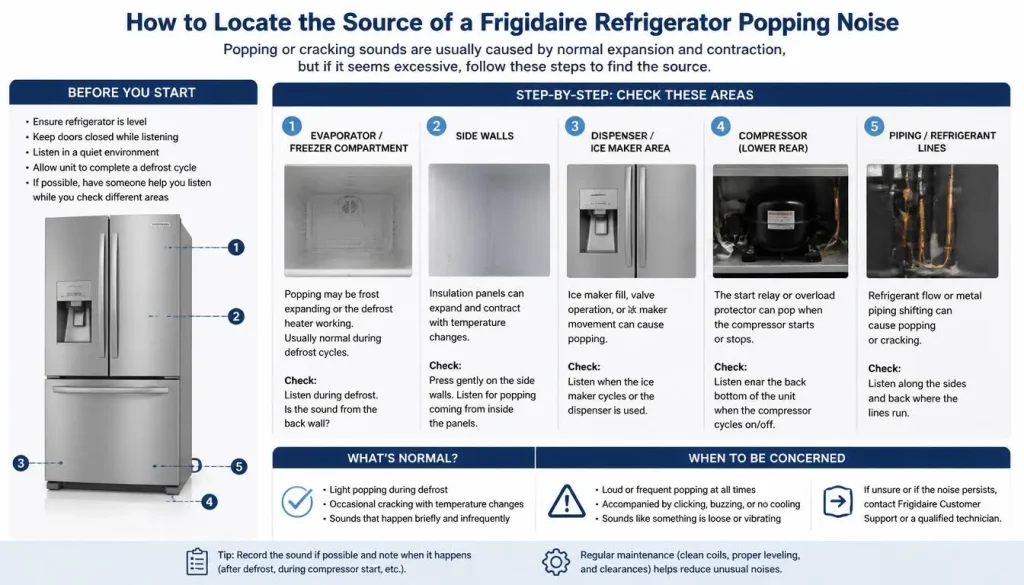
Note When It Happens
Record whether the sound occurs:
- After defrosting
- When cooling begins
- When the compressor stops
- While dispensing ice
- When ice drops into the bin
- After using the water dispenser
- When opening a door
- When closing a door
- Following a power outage
- After moving the refrigerator
- Every few seconds
- Only once or twice per hour
Timing can quickly narrow the likely cause.
Identify the General Location
Inside the freezer: Consider ice production, falling cubes, fan contact, frost buildup, or defrosting.
Inside the fresh-food compartment: Check shelves, drawers, containers, vents, dampers, and liner movement.
At the dispenser: Consider the chute solenoid, ice jam, auger, or dispenser paddle.
At the lower rear: Consider the compressor, condenser fan, water valve, refrigerant tubing, or wall contact.
At a door: Check the hinge, gasket, closing mechanism, centre flap, and alignment.
Behind the refrigerator: Look for a trapped cord, moving water line, fallen object, or contact with the wall.
Do not remove electrical covers or reach near moving components while the refrigerator is connected to power.
Check Whether Cooling Is Normal
Use an appliance thermometer if necessary.
Frigidaire’s suggested electronic-control settings are generally 37°F or about 3°C for the refrigerator and 0°F or -18°C for the freezer, although the correct procedure depends on the model.
Check whether:
- Frozen food remains solid.
- Fresh food remains properly chilled.
- Air moves through the vents.
- Doors close completely.
- Excessive frost is developing.
- The display shows an H or HI warning.
- The compressor remains operational.
Frigidaire’s H or HI warning indicates that a compartment has remained too warm. Possible causes include prolonged door opening, incorrect settings, or a poor door seal.
Record the Sound
A short video can help a technician identify an intermittent problem.
Try to capture:
- The sound
- The area where it is loudest
- The control-panel display
- Any visible frost
- Door movement
- Ice-maker or dispenser activity
- Water-line vibration
Keep your hands and phone away from moving fans, exposed wiring, and compressor terminals.
How to Fix a Frigidaire Refrigerator Popping Noise
Normal thermal or defrost-related popping cannot always be eliminated. You can still rule out installation, dispenser, water-line, ice-maker, and vibration problems.
Step 1: Confirm That Cooling Is Normal
Check the refrigerator and freezer temperatures.
Look for:
- Properly chilled food
- Solidly frozen food
- Airflow from the vents
- Fully closing doors
- No excessive frost
- No water leak
- No high-temperature warning
- Normal compressor operation
If temperatures are rising, treat the cooling problem as the priority.
Step 2: Observe the Noise Pattern
Monitor the refrigerator through several operating cycles.
Note whether the pop occurs during:
- Defrosting
- Compressor startup
- Compressor shutdown
- Ice harvesting
- Water filling
- Ice dispensing
- Door movement
- Temperature recovery
An occasional pop directly after defrosting is usually normal according to Frigidaire’s noise guidance.
Step 3: Level the Refrigerator
Use a spirit level and follow the model-specific installation instructions.
Make sure:
- The appliance does not rock.
- All supporting feet contact the floor.
- The cabinet has no significant side tilt.
- The doors align.
- The freezer drawer operates smoothly.
- The refrigerator does not lean against another surface.
Recheck the noise after several cooling cycles.
Step 4: Check the Space Around the Appliance
Inspect the rear, sides, and top.
Confirm that:
- The refrigerator is not touching the wall.
- The sides do not vibrate against cabinetry.
- The power cord is not trapped.
- The water line is not hitting the rear panel.
- No loose object has fallen behind the appliance.
- Doors have enough room to open completely.
Use the spacing requirements in your manual rather than assuming all Frigidaire models need identical clearance.
Step 5: Rearrange Containers and Removable Parts
Separate bottles and jars.
Reseat:
- Shelves
- Door bins
- Crisper drawers
- Freezer baskets
- Ice bins
- Dispenser trays
- Removable accessories
Remove loose objects stored on top of the refrigerator.
Keep food away from airflow vents.
Step 6: Test the Ice Maker
Temporarily turn off the ice maker according to your model’s manual.
If the noise stops:
- Check whether cubes were falling into the bin.
- Confirm that the bin is correctly installed.
- Look for visible ice clumps.
- Confirm that the water supply is connected.
- Inspect the line for kinks.
- Make sure the household valve is open.
Do not force the ice-maker mechanism.
Step 7: Test the Ice Dispenser
If the sound occurs while dispensing:
- Dispense a small amount of ice.
- Listen for a single snap or pop as the chute opens.
- Confirm that the chute closes afterwards.
- Check for visible jammed cubes.
- Watch for a DI SP or DISP code.
- Stop if the auger grinds without moving ice.
A brief pop from the chute solenoid is normal. Continued grinding, an open chute, or an ice-jam warning requires attention.
Step 8: Check the Water Supply
Verify that:
- The household valve is open.
- The supply line is connected.
- The line is not kinked or crushed.
- The line is not touching the wall.
- The water filter is properly installed.
- The ice maker is off if no water is connected.
- No leaks are visible.
If the refrigerator was newly connected, follow the model’s instructions for priming or purging the water system.
Step 9: Inspect the Doors and Gaskets
Open and close each door slowly.
Look for:
- A pop at the same point
- A hinge lifting or dropping
- A gasket sticking
- A centre flap catching
- A door rubbing against a cabinet
- A bin striking an interior part
- A door that remains slightly open
Clean dirty gaskets with mild soap and water. Replace damaged seals according to model-specific instructions.
Step 10: Check for Frost and Fan Contact
Inspect the freezer’s rear interior panel.
Arrange service if you notice:
- Heavy frost
- Fast tapping
- Scraping
- Weak airflow
- Rising temperatures
- Ice repeatedly returning
- A sound that changes when the door opens
Do not apply direct heat or use sharp tools.
Step 11: Allow a New Refrigerator to Stabilise
If the refrigerator is new or was recently restarted, allow approximately 24 hours for the temperature to stabilise before making repeated control adjustments.
During this period:
- Avoid opening the doors unnecessarily.
- Do not repeatedly unplug the appliance.
- Avoid loading large amounts of warm food.
- Keep vents unobstructed.
- Confirm that the doors close completely.
Step 12: Monitor the Appliance
If cooling remains normal and no installation fault is found, keep a short noise log.
Record:
- Time of the noise
- Frequency
- Location
- Whether the refrigerator had just defrosted
- Whether ice was being made or dispensed
- Whether the compressor was running
- Compartment temperatures
- Any warning or error code
This information can make a repair visit more efficient.
Where to Find the Frigidaire Refrigerator Model Number
The complete model and serial numbers are important when downloading a manual, checking warranty information, ordering parts, or requesting repair.
Frigidaire lists these common locations:
- Top-freezer refrigerator: Upper-left side wall inside the fresh-food compartment
- French-door refrigerator: Upper-right side inside the fresh-food compartment
- Side-by-side refrigerator: Upper-right side inside the fresh-food compartment
The label is normally visible after opening the refrigerator door.
Take a clear photograph of the entire label.
Do not rely only on the product name printed on the front. The complete model code may contain letters or suffixes that identify the exact version, controls, dispenser system, and regional configuration.
For an imported Frigidaire refrigerator in the UK or Australia, the local service provider may also request the product number or rating-plate details. Always use the documentation supplied with the appliance.
Safe DIY Checks You Can Perform
You can safely:
- Confirm that the refrigerator is cooling.
- Measure compartment temperatures.
- Check the appliance with a spirit level.
- Correct wall or cabinet contact.
- Separate bottles and containers.
- Reseat shelves, bins, and drawers.
- Inspect the visible water line.
- Turn off an unused ice maker.
- Check the accessible ice chute.
- Observe door and hinge movement.
- Look for visible frost or leaking.
- Record the sound.
- Locate the model and serial numbers.
Avoid attempting to:
- Open the sealed refrigeration system
- Test live compressor terminals
- Bypass a safety device
- Force the ice-maker gears
- Insert tools into the dispenser
- Remove hidden ice with a knife
- Apply direct heat to the freezer liner
- Replace a control board without diagnosis
- Continue using an appliance with electrical damage
When to Contact Frigidaire or a Refrigerator Technician
Arrange professional diagnosis when:
- The popping becomes continuous.
- The sound grows progressively louder.
- The refrigerator is not cooling correctly.
- The compressor repeatedly clicks without remaining on.
- A fan is scraping or striking ice.
- Heavy frost repeatedly develops.
- Water leaks from the appliance.
- The ice chute will not close.
- The dispenser displays an ice-jam error.
- An H or HI temperature warning remains active.
- A door no longer aligns or seals.
- The noise continues after levelling and clearance checks.
- Electrical or sealed-system testing is required.
Frigidaire’s noise guide directs owners of recently installed units back to the installer when troubleshooting does not resolve the issue and recommends arranging service for established appliances that continue to have problems.
Stop using the refrigerator and disconnect it from power, provided it is safe to do so, if you notice:
- Smoke
- Sparks
- A burning or melting smell
- A damaged power cord
- An unusually hot plug or outlet
- Repeated circuit-breaker trips
- An electrical shock or tingling sensation
The U.S. Consumer Product Safety Commission advises unplugging an appliance that repeatedly trips a breaker, blows a fuse, or gives an electrical shock, followed by repair or replacement.
Do not reach behind the refrigerator if active sparking, smoke, water, or melted wiring makes the area unsafe.
Frequently Asked Questions About Frigidaire Refrigerator Make a Popping Noise
Why Does My Frigidaire Refrigerator Keep Making a Popping Noise?
Widely spaced pops are commonly caused by repeated cooling and defrost cycles. Frigidaire specifically notes that popping can occur after defrosting.
Investigate further if the noise occurs every few seconds, the refrigerator becomes warm, or the compressor repeatedly attempts to start.
Why Is My Frigidaire Refrigerator Making Loud Popping Noises at Night?
The refrigerator may not be operating differently at night; the house is simply quieter.
Defrosting, thermal contraction, ice falling into an empty bin, water-valve operation, and compressor adjustments may all occur overnight.
Check that the refrigerator is level and not touching a wall or cabinet that could amplify the sound.
Why Is My New Frigidaire Refrigerator Making a Popping Noise?
A new refrigerator undergoes substantial temperature changes during its first cooling period. Interior materials may pop as they cool, while the compressor and fans may run for longer periods.
Frigidaire advises allowing approximately 24 hours for a newly installed refrigerator’s temperature to stabilise.
Why Does My Frigidaire Refrigerator Pop After Defrosting?
The evaporator area warms during defrosting and cools again afterwards. Water, frost, panels, tubing, and other components respond to these temperature changes.
Frigidaire specifically lists popping after defrosting as a normal refrigerator sound.
Can the Frigidaire Ice Maker Cause a Loud Pop?
Yes. Ice falling into the bin can create a thump or bang. The ice-maker fan, water valve, and refrigerant system may also make sounds during ice production.
Temporarily switch off the ice maker to determine whether it is responsible.
Why Does My Frigidaire Refrigerator Pop When I Dispense Ice?
The ice-chute solenoid opens and closes when the dispenser paddle is used. Frigidaire states that this may create a snapping, clicking, or popping sound.
A brief pop is normal. Grinding, a jammed chute, or a persistent DISP error is not.
Why Does My Frigidaire Refrigerator Chatter Without a Water Connection?
The ice-maker fill valve may be attempting to operate without water.
Turn off the ice maker until a suitable water supply is connected. Frigidaire warns that leaving it on without water may cause loud valve chatter.
Why Does My Frigidaire Refrigerator Pop After a Power Outage?
After power returns, the refrigerator must restore its internal temperature. Larger temperature and refrigerant-pressure changes can increase popping temporarily.
A PF indication means the refrigerator detected a power failure or surge. A high-temperature warning may also appear if the compartments warmed during the interruption.
Why Does My Frigidaire Refrigerator Pop After I Move It?
Moving the appliance may leave it unlevel, trap the water line, place the cabinet against the wall, or shift shelves and bins.
Check its level, clearance, water connection, doors, and removable parts.
Why Does My Frigidaire Refrigerator Pop When I Open the Door?
A pop that occurs only during door movement may come from a hinge, gasket, closing component, centre flap, or alignment issue.
Check whether the refrigerator is level and whether the door rises, drops, sticks, or rubs.
Can a Frigidaire Variable-Speed Compressor Run Constantly?
Many Frigidaire French-door refrigerators use variable-speed compressors designed to run for long periods and potentially continuously except during defrosting. This supports steadier temperatures and does not by itself indicate failure.
Repeated clicking with poor cooling is a different issue and should be diagnosed.
Can I Completely Stop My Frigidaire Refrigerator From Popping?
You may be able to eliminate noise caused by poor levelling, wall contact, loose containers, a moving water line, an unconnected ice maker, or a door-alignment problem.
Normal popping caused by defrosting, material movement, or the ice-dispenser solenoid cannot always be eliminated.
Should I Reset My Frigidaire Refrigerator Because It Is Popping?
Usually not.
A reset will not stop normal defrost, expansion, refrigerant, ice-drop, or dispenser-solenoid sounds.
Frigidaire provides model-dependent reset procedures for specific error codes, but resetting without identifying a fault may clear useful diagnostic information.
Should I Unplug a Frigidaire Refrigerator That Makes a Popping Noise?
An occasional pop with normal cooling does not require unplugging the refrigerator.
Disconnect it if the sound occurs with smoke, sparks, a burning smell, a damaged cord, an overheating outlet, repeated breaker trips, or electrical shock.
How Long Will a New Frigidaire Refrigerator Make Popping Noises?
There is no fixed period that applies to every model.
Popping often becomes less noticeable after the appliance reaches a stable temperature and begins normal cooling and defrost cycles. Frigidaire recommends allowing about 24 hours for initial temperature stabilisation.
Persistent, worsening, or continuous noise should be investigated.
Final Thoughts
So, why does your Frigidaire refrigerator make a popping noise?
Most commonly, it is connected to automatic defrosting, expansion and contraction, ice production, the dispenser-chute solenoid, water-valve operation, refrigerant flow, or compressor and fan activity.
Begin by confirming that the refrigerator is cooling properly. Identify when and where the sound occurs, check the appliance’s level, provide the correct clearance, separate containers, inspect the visible water line, and observe the ice maker, dispenser, and doors.
An occasional pop after defrosting or while dispensing ice is usually normal. Continuous popping accompanied by cooling failure, heavy frost, fan scraping, leaking, persistent error codes, smoke, burning smells, or electrical problems requires professional attention.
Always use the complete model number when consulting a Frigidaire manual or arranging repair because controls, compressors, ice makers, dispenser mechanisms, clearances, and troubleshooting procedures vary between models.

Hi, I’m the lead researcher and appliance enthusiast behind RefrigeratorSolve. With years of hands-on experience troubleshooting cooling systems and testing home appliances, I am dedicated to bringing you honest reviews, energy-saving tips, and practical solutions to keep your refrigerator running perfectly.