Yes, new refrigerators make noise. Soft humming, buzzing, clicking, popping, gurgling, and airflow sounds are usually part of normal operation.
A newly installed refrigerator may also sound louder during its first day because the compressor and fans must work harder to lower the internal temperature. Additional sounds can come from the ice maker, water valve, automatic defrost system, and other modern components.
However, not every refrigerator noise should be ignored. Loud grinding, scraping, repeated clicking without cooling, or noise combined with leaking, overheating, or a burning smell may indicate a problem.
This guide explains why new refrigerators make noise, which sounds are normal, how long the noise may last, and when you should contact the manufacturer or a qualified appliance technician.
Do New Refrigerators Make Noise?
All refrigerators make some noise while operating. A refrigerator is not a silent appliance because several mechanical and electrical components must work together to keep food cold.
Common noise-producing components include:
- The compressor
- The evaporator fan
- The condenser fan
- The automatic defrost system
- The refrigerant moving through the cooling lines
- The ice maker
- The water inlet valve
- Electronic controls and air dampers
A new refrigerator may sound different from your previous appliance. This does not automatically mean that the new unit is louder or defective.
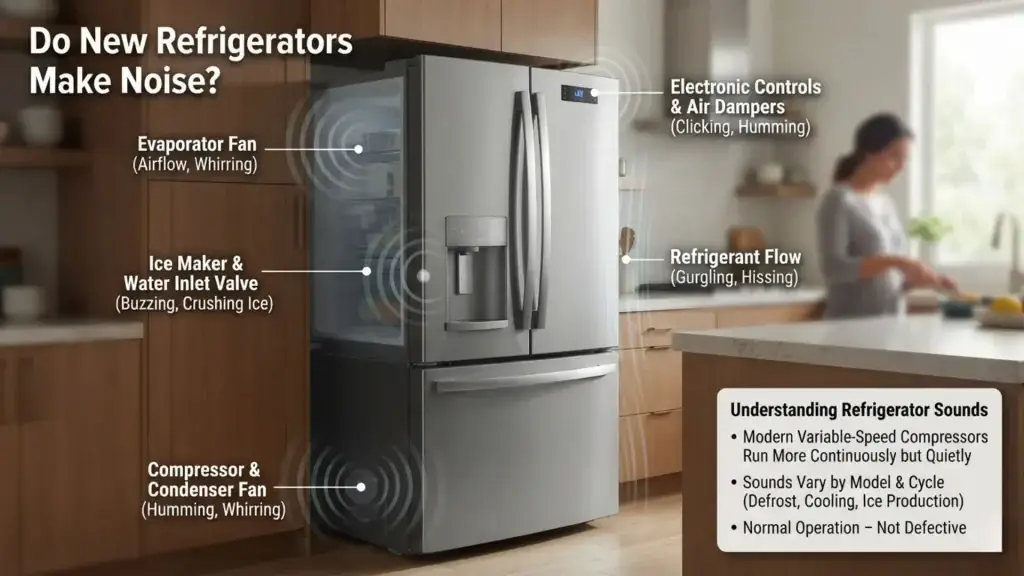
Older refrigerators often used compressors that switched on and off more noticeably. Many modern refrigerators use variable-speed compressors that run for longer periods at lower speeds. This can create a more continuous humming sound.
Modern refrigerators may also have more fans, sensors, cooling zones, water systems, and automatic features than older models. Each component can produce its own normal operating sound.
Why Is My New Refrigerator Making More Noise Than My Old One?
Your new refrigerator may make more noticeable sounds for several reasons.
It Is Cooling Down for the First Time
A refrigerator is usually close to room temperature when it is delivered and installed. After you plug it in, the appliance must cool both the refrigerator and freezer compartments.
During this initial cooling period, the compressor and fans may run for long periods. The refrigerator may produce more humming, buzzing, airflow, or clicking sounds than it will during normal daily operation.
Adding a large amount of room-temperature food can make the cooling system work even harder.
The refrigerator should gradually become less noticeable as the temperature stabilizes. However, it will not become completely silent.
Modern Compressors Operate Differently
Many new refrigerators use high-efficiency or variable-speed compressors.
Instead of frequently turning on at full power and then switching off, a variable-speed compressor may run continuously at a lower level. It may also change speed depending on the temperature inside the appliance.
This can produce:
- A steady low hum
- A changing humming tone
- A soft pulsing sound
- A brief higher-pitched sound
- Longer compressor run times
Longer operation does not necessarily mean that the refrigerator is using excessive electricity or that the compressor is failing.
New Refrigerators Have More Working Components
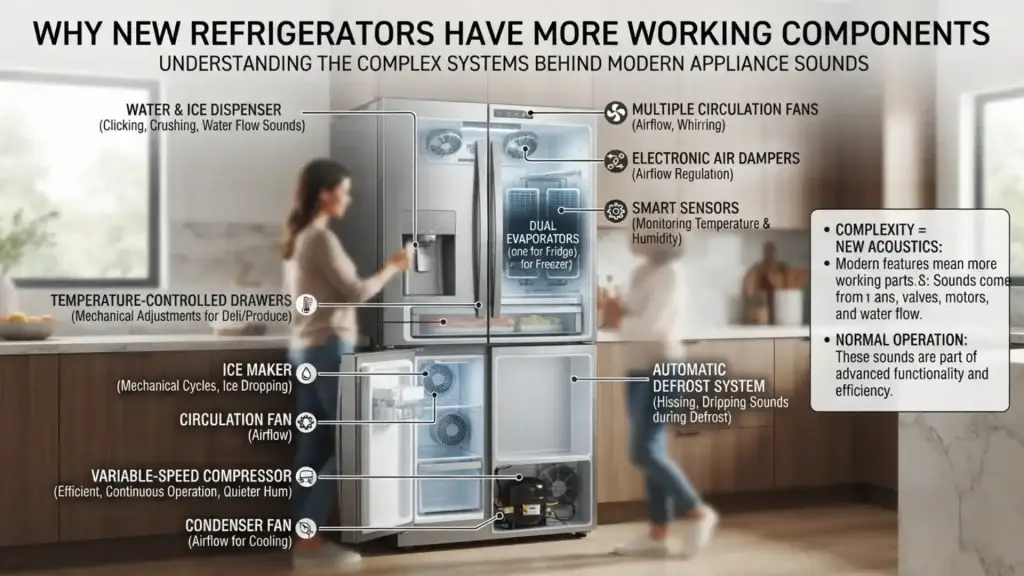
New refrigerators often include features that were not present in older basic models.
These may include:
- Dual evaporators
- Multiple circulation fans
- Automatic humidity controls
- Electronic air dampers
- Water dispensers
- Ice makers
- Smart sensors
- Automatic defrost systems
- Temperature-controlled drawers
These extra components can create sounds that you did not hear from your previous refrigerator.
The Refrigerator Is Settling After Delivery
Temperature changes can cause plastic liners, metal panels, shelves, and internal tubes to expand or contract.
This may produce popping, cracking, snapping, or creaking sounds, especially during the first few cooling and defrost cycles.
Delivery can also slightly move shelves, trays, drain pans, tubing, or other components. A loose item may vibrate when the compressor or fan starts.
The New Refrigerator Is in a Different Environment
The room can affect how loud a refrigerator seems.
A refrigerator may sound more noticeable when it is installed:
- In an open-plan kitchen
- Near a bedroom
- On a hard tile or wooden floor
- Between cabinets that reflect sound
- In a nearly empty room
- Close to a wall
- In a quiet home at night
Even a normal refrigerator may seem loud if the room reflects or amplifies its sound.
What to Expect During the First 24 to 48 Hours
A new refrigerator may behave differently during its first one or two days of operation.
You may notice:
- Longer compressor run times
- More frequent fan operation
- Stronger airflow sounds
- Popping or cracking from temperature changes
- Gurgling from refrigerant movement
- Buzzing from the water valve
- Ice dropping into the storage bin
- Clicking as controls switch components on and off
Try to avoid opening the doors repeatedly during the initial cooling period. Frequent door opening allows warm air to enter and can extend the time needed to reach the correct temperature.
You should also check that:
- All shipping tape and foam have been removed
- The refrigerator is level
- Shelves and drawers are properly installed
- The doors close completely
- The water line is connected correctly
- The ice maker is turned off if no water supply is connected
- The temperature controls are set according to the manual
- There is enough ventilation space around the appliance
Noise should not be the only thing you monitor. Check whether the refrigerator and freezer are becoming properly cold.
A refrigerator that makes normal operating sounds and reaches the correct temperature is usually working as expected. A refrigerator that makes repeated mechanical noises but does not cool may require service.
Normal Noises a New Refrigerator Can Make
The following table explains some of the most common refrigerator sounds.
| Sound | Likely Source | Usually Normal? |
|---|---|---|
| Humming | Compressor or fan | Yes |
| Buzzing | Compressor, ice maker, or water valve | Usually |
| Clicking | Controls, valve, relay, or ice maker | Usually |
| Popping | Thermal expansion or defrost cycle | Yes |
| Cracking | Plastic or metal changing temperature | Usually |
| Gurgling | Refrigerant or defrost water | Yes |
| Bubbling | Refrigerant moving through cooling lines | Yes |
| Hissing | Refrigerant pressure or defrost water | Usually |
| Sizzling | Water touching the defrost heater | Usually |
| Whooshing | Air moving through vents | Yes |
| Whirring | Fan or compressor | Usually |
| Pulsating | Variable-speed compressor | Usually |
| Rattling | Loose tray, tubing, container, or drain pan | Sometimes |
| Thumping | Ice falling or water line movement | Usually |
| Hammering | Water line filling or pressure change | Sometimes |
| Beeping | Door alarm, temperature alarm, or control alert | Depends |
| Grinding | Fan obstruction or mechanical problem | Usually not |
| Scraping | Fan blade touching ice or another object | Usually not |
| Screeching | Fan motor or moving component problem | Usually not |
Humming or Low Buzzing
A soft hum is one of the most common refrigerator sounds.
It usually comes from:
- The compressor
- The condenser fan
- The evaporator fan
- The electrical system
A new refrigerator may hum for long periods, especially while it is cooling for the first time.
The tone may become louder or quieter as a variable-speed compressor changes its operating speed. This can be normal.
You should investigate the sound if the humming becomes extremely loud, causes strong vibration, or occurs with poor cooling.
Clicking Sounds
Occasional clicking is usually normal.
A refrigerator may click when:
- The compressor starts or stops
- A control board activates a component
- The defrost cycle begins or ends
- The ice maker rotates
- The water valve opens
- An air damper changes position
Repeated clicking every few seconds is more concerning, especially if the refrigerator is not cooling. This may indicate that a component is trying and failing to start.
Popping, Cracking, or Snapping
Plastic and metal parts change size slightly as they become colder or warmer. This can create popping, cracking, or snapping sounds.
These sounds may be more noticeable:
- During initial cooling
- After the door has been open
- During the automatic defrost cycle
- When the compressor changes operating speed
- At night when the house is quiet
An occasional pop is usually normal. A loud repeated bang combined with shaking or movement should be checked.
Gurgling, Bubbling, or Dripping
Gurgling and bubbling sounds are often caused by refrigerant moving through the cooling system.
The sound may resemble:
- Water boiling
- Liquid flowing through a pipe
- Bubbles moving through a tube
- Water draining
You may also hear water moving into the drain pan after a defrost cycle.
These sounds are usually normal and do not mean that the refrigerator is leaking.
Hissing or Sizzling
A brief hissing sound can occur when pressure changes inside the sealed cooling system.
A sizzling sound may occur when water from the defrost cycle reaches a warm defrost heater.
These noises are usually brief.
Contact a technician if the hissing is unusually loud, continuous, or accompanied by poor cooling, a chemical smell, or visible damage.
Fan and Airflow Noise
Fans circulate cold air through the refrigerator and freezer compartments.
Normal fan sounds may include:
- Whirring
- Blowing
- Whooshing
- A soft high-pitched tone
- Air moving through a narrow vent
The sound may change when you open a door. Some refrigerators stop certain fans when a door opens and restart them after the door closes.
A loud grinding or scraping fan sound may mean that:
- Ice has formed around the fan
- A fan blade is touching a wire or cover
- Packaging material was not removed
- The fan motor is damaged
Do not remove internal panels while the appliance is connected to power. Contact the manufacturer if you suspect an internal fan problem.
Ice Maker and Water-Valve Noises
Refrigerators with automatic ice makers and water dispensers can produce several normal sounds.
These may include:
- A short buzz when the water valve opens
- Water flowing through the supply line
- A click when the ice maker starts
- A motor sound during the ice-making cycle
- A thump when ice falls into the storage bin
- A cracking sound as ice is released from the mold
If the refrigerator is not connected to a water supply, turn off the ice maker. An active ice maker may repeatedly try to fill, producing buzzing or clicking noises.
Beeping or Alarm Sounds
Beeping usually comes from the refrigerator’s control or warning system.
Possible causes include:
- A refrigerator door is open
- The freezer door is not completely closed
- Food or packaging is blocking the door
- The internal temperature is too high
- Power was recently interrupted
- A control setting was changed
- The water filter needs attention
- The appliance has detected an error
Make sure all doors are fully closed. Check the control panel for an error code, warning symbol, or temperature message.
If the refrigerator keeps beeping with the doors closed, consult the owner’s manual or contact the manufacturer.
Whistling or High-Pitched Sounds
A soft high-pitched tone may come from a fan, electronic control, or variable-speed compressor.
It can be normal if it is brief and does not affect cooling.
A loud whistling, squealing, or screeching sound may indicate:
- A worn fan motor
- A restricted airflow path
- A fan blade rubbing against something
- A damaged moving component
Pay attention to whether the sound changes when a door opens. If it stops, a circulation fan may be the source.
Rattling or Vibrating
Rattling is often caused by installation rather than an internal failure.
Possible causes include:
- The refrigerator is not level
- The appliance is touching a wall or cabinet
- The water line is tapping against the back
- Bottles are touching each other
- A shelf or drawer is loose
- The drain pan is not secure
- The power cord is vibrating against the cabinet
- The floor is uneven
Most external rattling can be reduced by leveling the refrigerator, securing loose items, and providing enough clearance.
How Long Will a New Refrigerator Make Noise?
Some sounds may become less noticeable after the first 24 to 48 hours. Others will continue throughout the life of the refrigerator.
Initial cooling sounds that may decrease include:
- Longer compressor operation
- Strong airflow
- Frequent popping
- Temperature-related cracking
- Water-system air noises
- Repeated ice-maker activity
Normal ongoing sounds may include:
- Low humming
- Occasional clicking
- Fan noise
- Gurgling
- Ice dropping
- Water-valve buzzing
- Defrost-cycle sounds
A refrigerator should not be expected to become silent.
The important question is whether the sound is stable and whether the refrigerator is cooling correctly. A sudden major change in noise is often more important than a sound that has been present since installation.
What Does the Timing of the Refrigerator Noise Mean?
Knowing when the sound occurs can help identify its source.
The Refrigerator Makes Noise Every Few Minutes
A sound that repeats every few minutes may come from:
- The compressor cycling
- The ice maker attempting to fill
- The water inlet valve
- A temperature control
- An automatic air damper
- A component trying to restart
If you hear repeated buzzing and the refrigerator does not have a connected water line, turn off the ice maker.
Repeated clicking with no cooling may require professional service.
The Noise Stops When the Door Opens
If the noise stops when you open the refrigerator or freezer door, a circulation fan may be the source.
The fan itself may be operating normally. However, a loud scraping or grinding sound may mean that the fan is touching ice or another object.
Do not attempt to reach the fan through internal panels while the refrigerator is powered.
The Refrigerator Makes Noise After the Door Closes
After you close a door, you may hear:
- A fan restarting
- Air moving through the vents
- Pressure equalizing
- A soft gurgling sound
- The door seal settling
- An air damper moving
These sounds are usually normal.
The Refrigerator Sounds Louder at Night
Refrigerators often seem louder at night because there is less background noise.
Televisions, conversations, traffic, cooking, and other daytime sounds can hide a refrigerator’s normal operation. When the house becomes quiet, the same hum or click may suddenly seem more noticeable.
Hard floors, walls, and cabinets can also reflect sound through the room.
Is It Normal for a New Refrigerator to Run Constantly?
A new refrigerator may run almost continuously during its first day of operation.
It may also run longer when:
- The room is warm
- The doors are opened frequently
- A large amount of food was added
- Warm food was placed inside
- The temperature setting is too cold
- The refrigerator is located near an oven
- Airflow around the appliance is restricted
- The door is not sealing correctly
- A high-efficiency compressor is operating at low speed
Long run times can be normal for modern energy-efficient refrigerators.
However, you should investigate if the refrigerator runs constantly and:
- The compartments remain warm
- Frost develops heavily
- The doors do not seal
- The compressor repeatedly clicks
- The appliance becomes unusually hot
- The noise suddenly becomes much louder
- An error code appears
Can the Water Line Make a New Refrigerator Noisy?
Yes. The water line can produce buzzing, knocking, chattering, thumping, or hammering sounds.
Buzzing When the Ice Maker Fills
A short buzz may occur when the water inlet valve opens. This is usually normal.
A loud or extended buzz may occur when:
- The water supply is turned off
- The line is kinked
- The water pressure is low
- The ice maker is on without a water connection
- The filter is not installed correctly
Chattering From a Restricted Water Line
A partially blocked or kinked water line may cause the valve to open and close unevenly.
Check the visible external line for bends or pressure. Do not disconnect plumbing unless you know how to shut off the water safely.
Water-Hammer or Thumping Sounds
A thump may occur when water flow starts or stops quickly.
The sound may travel through the household plumbing and appear to come from the refrigerator.
If the noise is severe or affects other plumbing fixtures, a qualified plumber may need to inspect the water supply.
Air in a New Water Line
A newly connected water system may contain trapped air. This can cause sputtering, gurgling, or uneven water flow.
Follow the manufacturer’s instructions for flushing the dispenser and preparing the ice maker.
What Refrigerator Noises Are Not Normal?
Normal refrigerator sounds are usually moderate, temporary, or connected to an obvious operating cycle.
The following sounds deserve closer attention.
Loud Grinding or Scraping
Possible causes include:
- A fan blade touching ice
- A fan blade touching a cover or wire
- A damaged fan motor
- A loose internal component
- A mechanical failure
Turn the refrigerator off and contact the manufacturer if the sound is severe or the appliance is not cooling.
Repeated Clicking Without Cooling
Repeated clicking may mean that the compressor or another component is attempting to start.
Check that:
- The plug is secure
- The outlet has power
- The appliance is not connected through a damaged extension cord
- The control panel is on
If clicking continues and the refrigerator remains warm, request warranty service.
High-Pitched Squealing or Screeching
This may come from:
- A failing fan motor
- A damaged bearing
- A rubbing fan blade
- A moving air damper
- Another mechanical component
A brief electronic tone can be normal. A continuous mechanical squeal is not.
Loud Knocking or Banging
Possible causes include:
- Water-line movement
- A loose compressor mount
- Tubing touching the cabinet
- The refrigerator rocking on an uneven floor
- Ice falling into an empty bin
- A loose drain pan
An occasional ice-related thump may be normal. Repeated violent banging should be checked.
Excessive Vibration
A refrigerator should not shake strongly or move across the floor.
Excessive vibration may be caused by:
- Poor leveling
- An unstable floor
- The cabinet touching a wall
- Incorrect installation
- Loose external tubing
- A mechanical problem
Noise With Other Warning Signs
Contact the manufacturer or a qualified technician when noise occurs with:
- Poor cooling
- Food becoming warm
- Melting freezer items
- A burning smell
- An electrical smell
- Smoke
- Water leaking near electrical parts
- Repeated power interruptions
- A hot plug or power cord
- An error code
- Severe frost buildup
- The circuit breaker repeatedly tripping
Disconnect the refrigerator from power if you notice smoke, sparks, or a burning electrical smell.
How to Find Where the Noise Is Coming From
You can often narrow down the cause without opening the refrigerator.
Noise From Inside the Refrigerator
Check for:
- Bottles touching each other
- Loose shelves
- Unsecured drawers
- Items blocking air vents
- Food touching the rear wall
- Ice-maker movement
Move containers slightly apart and make sure shelves are seated correctly.
Noise From the Freezer
Possible sources include:
- The evaporator fan
- Frost around the fan
- The ice maker
- Ice falling into the bin
- Air moving through vents
- The automatic defrost system
A scraping sound that stops when the freezer door opens may point to the fan area.
Noise From the Back
Possible sources include:
- The compressor
- The condenser fan
- The water line
- The drain pan
- Refrigerant tubing
- The power cord touching the cabinet
Do not reach near moving or electrical parts while the refrigerator is plugged in.
Noise From the Bottom
Check whether:
- The refrigerator rocks
- A leveling foot is not touching the floor
- The drain pan is loose
- The floor is uneven
- The refrigerator is touching nearby cabinets
A Five-Minute Test to Identify the Noise
Use this simple process before calling for service.
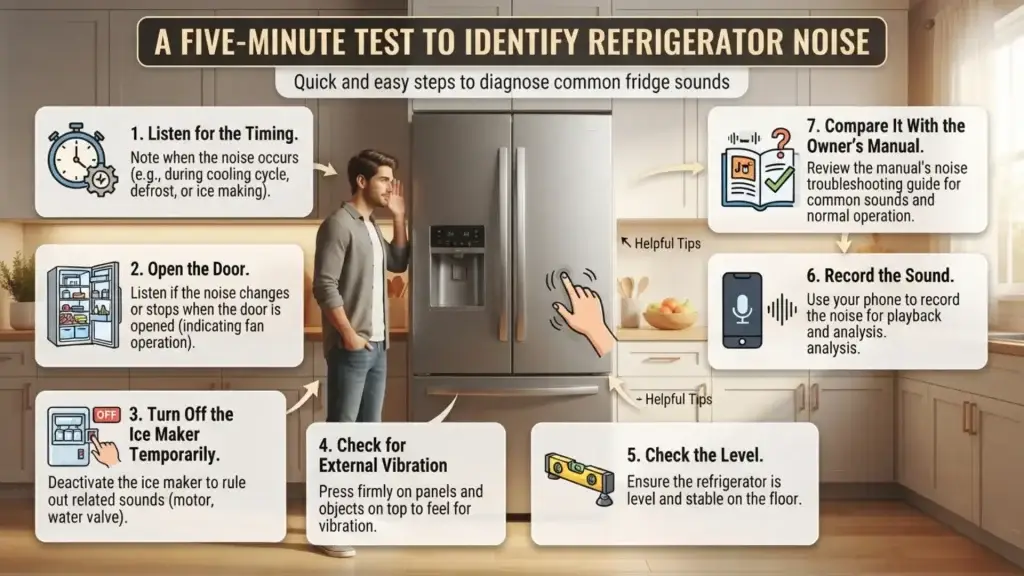
Step 1: Listen for the Timing
Notice whether the sound happens:
- When the compressor starts
- After a door closes
- When water is dispensed
- When the ice maker fills
- During the night
- Every few minutes
- During a defrost cycle
Step 2: Open the Door
Open the refrigerator or freezer door.
If the noise stops, a fan or airflow component may be involved.
Step 3: Turn Off the Ice Maker Temporarily
If the sound is a repeated buzz, click, or water-related noise, switch off the ice maker for a short test.
This is especially important when no water line is connected.
Step 4: Check for External Vibration
Make sure the refrigerator is not touching:
- The wall
- A cabinet
- A countertop
- A water line
- The power cord
- Another appliance
Step 5: Check the Level
Gently press the refrigerator from different sides. It should feel stable and should not rock.
Adjust the leveling feet according to the owner’s manual.
Step 6: Record the Sound
Use your phone to record the noise.
Also note:
- The time it happened
- How long it lasted
- Where it seemed to come from
- Whether the refrigerator was cooling
- Whether opening the door changed it
A recording can be useful when speaking with customer support.
Step 7: Compare It With the Owner’s Manual
Some manufacturers provide model-specific sound explanations or audio examples.
Use information for your exact model whenever possible.
How to Reduce Noise From a New Refrigerator
You cannot eliminate every operating sound, but you may be able to reduce unnecessary vibration and rattling.
Make Sure the Refrigerator Is Level
An uneven refrigerator may rock or vibrate when the compressor runs.
Use the adjustable feet to stabilize the appliance. Follow the manual because some refrigerators should lean slightly backward to help the doors close.
Leave Enough Space Around the Refrigerator
The appliance needs airflow and should not press directly against the wall or surrounding cabinets.
Use the clearance measurements provided by the manufacturer. Do not assume that every model requires the same amount of space.
Remove All Shipping Materials
Look for:
- Tape
- Cardboard
- Foam
- Shelf supports
- Drawer packaging
- Ice-maker packaging
- Protective film
Do not remove permanent insulation, covers, or factory-installed parts.
Secure Shelves, Drawers, and Containers
Make sure all internal parts are properly seated.
Separate bottles and containers that touch each other. A small amount of compressor vibration can make touching glass containers rattle loudly.
Check the Water Line
Make sure the visible water line:
- Is not kinked
- Is not trapped under the refrigerator
- Does not strike the rear panel
- Has enough space when the refrigerator moves
- Is connected securely
Use Recommended Temperature Settings
Setting the refrigerator colder than necessary may increase compressor operation.
Start with the manufacturer’s recommended settings and allow enough time before making further adjustments.
Keep Air Vents Clear
Do not pack food tightly against internal vents.
Blocked airflow can cause:
- Longer fan operation
- Uneven temperatures
- Frost buildup
- Increased compressor run time
Give the Refrigerator Time
A newly installed refrigerator needs time to stabilize.
Avoid making repeated temperature changes during the first day unless the manual instructs you to do so.
What If the Noise Is Normal but Still Too Loud?
A refrigerator can be working correctly and still be too noticeable for your home.
This may be a concern in:
- Small apartments
- Studio homes
- Open-plan kitchens
- Kitchens next to bedrooms
- Very quiet households
- Rooms with hard reflective surfaces
First, confirm that the refrigerator is level and installed with proper clearance.
You can also:
- Move loose objects away from the appliance
- Secure external tubing
- Place bottles apart
- Check for contact with cabinets
- Record the sound from your normal sitting or sleeping area
- Compare the sound with another unit of the same model
- Ask the retailer or manufacturer whether the sound is typical
Do not block ventilation openings or surround the refrigerator with soundproofing material. Restricted airflow can reduce performance and create a safety risk.
Are New Refrigerators Louder Than Older Refrigerators?
Not always.
Some new refrigerators are quieter than older models, but their sounds may be more varied.
An older refrigerator may have produced a short, obvious compressor hum followed by a long quiet period. A modern refrigerator may produce a softer hum for much longer.
New appliances may also make additional sounds from:
- Multiple fans
- Electronic dampers
- Ice makers
- Water valves
- Defrost systems
- Smart controls
- Variable-speed compressors
This different sound pattern can make a new refrigerator seem louder even when its measured sound level is lower.
How Quiet Should a New Refrigerator Be?
A new refrigerator should make operating sounds, but those sounds should generally remain in the background.
The exact noise level depends on:
- The refrigerator model
- Compressor type
- Fan design
- Installation
- Room size
- Flooring
- Cabinet placement
- Distance from living areas
A universal refrigerator noise limit is difficult to use because manufacturers test appliances under different conditions.
Instead of focusing only on a decibel number, ask:
- Can normal conversation continue comfortably?
- Can the sound be heard throughout the house?
- Does the refrigerator shake?
- Has the noise suddenly increased?
- Does the sound occur with poor cooling?
- Does it sound like metal scraping or grinding?
- Is the appliance installed correctly?
A soft hum in a quiet room is usually normal. A sound that interrupts conversation or sleep may deserve further evaluation, even if the appliance still cools.
Should You Return or Exchange a Noisy New Refrigerator?
Do not immediately return a refrigerator because of normal initial cooling sounds.
First:
- Allow the refrigerator to complete its initial cooling period.
- Confirm that it is level.
- Check the required clearances.
- Remove shipping materials.
- Secure shelves, containers, and external tubing.
- Turn off the ice maker if no water supply is connected.
- Record the sound.
- Confirm that the refrigerator is cooling correctly.
You should contact the retailer or manufacturer promptly if:
- The noise is extremely loud
- The refrigerator does not cool
- Grinding or scraping continues
- Repeated clicking occurs
- The cabinet shakes strongly
- The noise is getting worse
- A technician confirms a defect
Return and exchange periods vary by retailer and country. Check the purchase documents as soon as possible so that you do not miss an important deadline.
Avoid opening internal panels or attempting repairs on a brand-new appliance. Unauthorized work may affect the warranty.
When Should You Call the Manufacturer or a Technician?
Contact the manufacturer or a qualified technician when:
- Grinding or scraping continues
- A high-pitched squeal does not stop
- The refrigerator repeatedly clicks but does not cool
- The compressor will not start
- The refrigerator is unusually hot
- Food temperatures are unsafe
- The appliance leaks near electrical parts
- A burning smell is present
- The noise becomes progressively louder
- A fan appears to be hitting ice
- An error code is displayed
- The refrigerator is still under warranty
- Installation checks do not reduce severe vibration
For a new refrigerator, begin with the manufacturer’s warranty service rather than an independent repair whenever possible.
What You Should Not Do to Quiet a New Refrigerator
Avoid actions that could cause damage or create a safety risk.
Do not:
- Open electrical panels while the refrigerator is plugged in
- Touch the compressor or refrigerant lines
- Bend sealed-system tubing
- Block ventilation openings
- Place unstable materials under the leveling feet
- Spray lubricant inside fan areas
- Remove permanent internal covers
- Attempt compressor repairs
- Continue using the appliance if it smells like burning
- Ignore leaking water near electrical parts
Safe checks include leveling the appliance, moving bottles apart, checking external clearances, and securing visible external tubing.
Normal vs. Abnormal Refrigerator Noise Checklist
Usually Normal
- Soft humming
- Gentle buzzing
- Occasional clicking
- Brief popping
- Gurgling or bubbling
- Airflow or fan noise
- A short water-valve buzz
- Ice falling into the bin
- Temporary louder operation after installation
- A brief change in compressor pitch
- Defrost-cycle hissing or sizzling
Needs Attention
- Loud grinding
- Metal scraping
- Continuous screeching
- Repeated clicking with no cooling
- Violent shaking
- Strong banging
- Noise with a burning smell
- Noise with smoke or sparks
- Water leaking near electrical parts
- A sudden major change in sound
- Noise that becomes louder every day
- Noise combined with warm food or melting ice
Frequently Asked Questions
Is It Normal for a Brand-New Refrigerator to Be Loud?
A brand-new refrigerator may sound louder during its first day because it is cooling from room temperature. The compressor and fans may run for long periods. The sound should not include severe grinding, scraping, or violent vibration.
Why Is My New Refrigerator Humming Constantly?
A steady hum may come from a high-efficiency compressor or circulation fan. Modern compressors can run for long periods at low speed. Constant humming is more concerning when the refrigerator is not cooling or the sound is extremely loud.
Why Does My New Fridge Make Popping Noises at Night?
Plastic and metal parts can pop as they expand or contract during cooling and defrost cycles. The sound may seem louder at night because the room is quieter.
Is Gurgling Normal in a New Refrigerator?
Yes. Gurgling often comes from refrigerant moving through the cooling lines or water draining after a defrost cycle.
Why Does My Refrigerator Buzz Every Few Minutes?
Repeated buzzing may come from the ice maker or water inlet valve. If no water supply is connected, turn off the ice maker. Buzzing can also occur during normal compressor operation.
How Long Does It Take for a New Refrigerator to Become Quieter?
Initial cooling noise may decrease after the first 24 to 48 hours. However, normal compressor, fan, refrigerant, water-valve, and ice-maker sounds will continue throughout the appliance’s life.
Should a New Refrigerator Run All the Time?
It may run almost continuously during initial cooling or in warm conditions. Many modern variable-speed compressors also run for long periods. Continuous operation is a concern when cooling is poor, the doors do not seal, or the appliance becomes unusually hot.
Why Does My Refrigerator Make Noise When I Close the Door?
A fan may restart, air pressure may equalize, or an air damper may move after the door closes. These sounds are usually normal.
Why Does the Noise Stop When I Open the Freezer Door?
Some freezer fans stop when the door opens. If a loud scraping sound stops with the door open, the fan may be touching ice or another object.
Can an Uneven Floor Make a Refrigerator Noisy?
Yes. An uneven floor can cause rocking, rattling, and vibration. Adjust the leveling feet until the refrigerator is stable.
Should I Turn Off the Ice Maker If No Water Line Is Connected?
Yes. An ice maker that is turned on without a water connection may repeatedly activate the water valve, causing buzzing or clicking.
Should I Use the Warranty for Refrigerator Noise?
Use the warranty when the sound is unusually loud, mechanical, or combined with poor cooling, leaking, overheating, error codes, or other performance problems.
Final Verdict
New refrigerators do make noise, and most operating sounds are normal. Humming, buzzing, clicking, popping, gurgling, airflow, and occasional ice-maker sounds usually come from the compressor, fans, refrigerant, defrost system, or water components.
A new refrigerator may be more noticeable during its first 24 to 48 hours while it reaches the correct temperature. Proper leveling, adequate clearance, secure shelves, and a correctly connected water line can reduce unnecessary rattling and vibration.
Pay attention to loud grinding, scraping, repeated clicking without cooling, severe shaking, leaking, overheating, or burning smells. These warning signs should be reported to the manufacturer or a qualified appliance technician, especially while the refrigerator is still covered by warranty.

Hi, I’m the lead researcher and appliance enthusiast behind RefrigeratorSolve. With years of hands-on experience troubleshooting cooling systems and testing home appliances, I am dedicated to bringing you honest reviews, energy-saving tips, and practical solutions to keep your refrigerator running perfectly.