Your Samsung refrigerator may be making a noise because of normal compressor operation, refrigerant movement, the circulation fan, the automatic defrost cycle, or the ice maker. Soft humming, occasional clicking, gurgling, popping, and the sound of ice dropping are usually normal.
However, loud grinding, repeated knocking, continuous clicking, or a noise that stops when you open the refrigerator door may indicate a problem that needs attention.
The fastest way to identify the cause is to consider three things:
- What does the noise sound like?
- Where is it coming from?
- When does it happen?
This guide explains the most common Samsung refrigerator noises, what they mean, how to quiet them, and when to contact a technician.
Is It Normal for a Samsung Refrigerator to Make Noise?
A Samsung refrigerator is not designed to be completely silent. It contains moving parts, fans, valves, refrigerant, an ice maker, and a compressor that may produce different sounds throughout the day.
A new Samsung refrigerator may also seem louder while it reaches the selected temperature, begins making ice, and adjusts to its installation environment. Normal operating sounds should generally remain in the background and should not regularly interrupt a conversation.
The following table can help you decide whether the sound is likely to be normal.
| Sound or symptom | Usually normal? | First thing to check |
|---|---|---|
| Soft humming | Yes | Listen for changes in volume |
| Brief buzzing | Usually | Check whether the ice maker is filling |
| Occasional clicking | Usually | Notice whether the compressor is starting or stopping |
| Popping or cracking | Usually | Allow the cooling or defrost cycle to finish |
| Gurgling or bubbling | Usually | No action may be necessary |
| Light rattling | Sometimes | Check levelling, clearance, and loose items |
| Ice dropping into a bucket | Yes | No action is normally required |
| Loud grinding | Usually not | Check the ice dispenser and fan area |
| Noise stops when the door opens | Usually not | Suspect the internal fan or ice buildup |
| Constant clicking with no cooling | No | Arrange professional diagnosis |
| Beeping with an open door | Usually | Close the door completely |
| Beeping with a warm interior | No | Check the door seal and cooling performance |
A sound is more concerning when it is unusually loud, begins suddenly, continues without stopping, or appears with poor cooling, water leakage, an error code, or a burning smell.
Identify the Noise Before Trying to Fix It
Do not immediately assume that the compressor is failing. Many refrigerator noises come from simple issues such as bottles touching, an uneven floor, a vibrating water line, or the appliance touching a nearby cabinet.
Use the following three-step check before moving or dismantling anything.
What Does the Noise Sound Like?
Try to describe the sound as accurately as possible:
- Buzzing
- Humming
- Rattling
- Vibrating
- Clicking
- Ticking
- Popping
- Cracking
- Snapping
- Grinding
- Scraping
- Whirring
- Beeping
- Chiming
- Knocking
- Banging
- Gurgling
- Bubbling
- Hissing
- Sizzling
- Whistling
- Blowing
- Squeaking
Record the sound on your phone if it happens intermittently. A recording can be helpful if the noise stops before a technician arrives.
Where Is the Noise Coming From?
Listen near each of these areas without removing electrical panels:
- Inside the refrigerator compartment
- Inside the freezer
- Behind the refrigerator
- Underneath the refrigerator
- Near the ice maker
- Near the water dispenser
- Around the doors or hinges
When Does the Noise Happen?
Notice whether the sound occurs:
- When the compressor starts
- After the door closes
- When the door opens
- While dispensing ice
- While dispensing water
- Every few minutes
- Every few hours
- During the night
- After adding warm food
- After replacing the water filter
- After moving or installing the refrigerator
- Continuously
The location and timing of the sound are often more useful than the sound itself.
Where Is the Noise Coming From?
The same noise can have different causes depending on where it originates.
Noise From the Back of the Samsung Refrigerator
A noise from behind the refrigerator may be related to the compressor, water inlet valve, water supply line, or a rear fan on models that use one.
Before arranging a repair, check whether:
- The refrigerator is touching the wall
- The power cord is vibrating against the appliance
- The water supply line is hitting the wall or cabinet
- The refrigerator is touching another appliance
- A nearby object is vibrating when the compressor operates
Move the refrigerator forward slightly and listen again. If the noise becomes quieter, contact with the wall, cabinet, water line, or another object was probably causing the vibration.
Samsung also identifies water-line position and water pressure as possible causes of unusual sounds from the back of a refrigerator.
Noise From the Bottom of the Refrigerator
A rattling or vibrating sound from underneath may be caused by:
- An uneven floor
- Incorrectly adjusted levelling feet
- A loose drain pan
- A vibrating lower panel
- A rear or lower fan, depending on the model
- An object trapped beside or underneath the appliance
Make sure all levelling feet are firmly supported by the floor. Do not place cardboard, folded paper, or other unstable materials underneath the refrigerator to level it.
Noise From Inside the Refrigerator Compartment
Noise inside the fresh-food section commonly comes from the circulation fan, blocked air vents, loose shelves, or containers touching one another.
Check that:
- Food is not blocking the air vents
- Shelves are seated correctly
- Glass bottles are not touching
- Containers are not pressed against an interior panel
- The door is closing completely
- There is no visible frost on the interior back panel
A scraping or whirring noise that stops when the door opens may be caused by the circulation fan hitting accumulated ice.
Noise From the Freezer
Common sources of freezer noise include:
- The evaporator fan
- Ice buildup around the fan
- The ice maker
- Ice falling into the storage bucket
- The automatic defrost cycle
- Loose food packages or drawers
An occasional thump from ice falling into the bucket is normally harmless. Repeated scraping or grinding when the ice dispenser is not operating is more concerning.
Noise Near the Ice Maker or Water Dispenser
The ice maker and water system can produce buzzing, knocking, grinding, or clicking sounds while filling, freezing, releasing, or dispensing ice.
Check for:
- Ice jammed in the bucket
- Clumped ice blocking the dispenser
- An incorrectly installed ice bucket
- A water filter that is not seated correctly
- Air trapped in the water line
- A loose water supply line
- An ice maker operating without a connected water supply
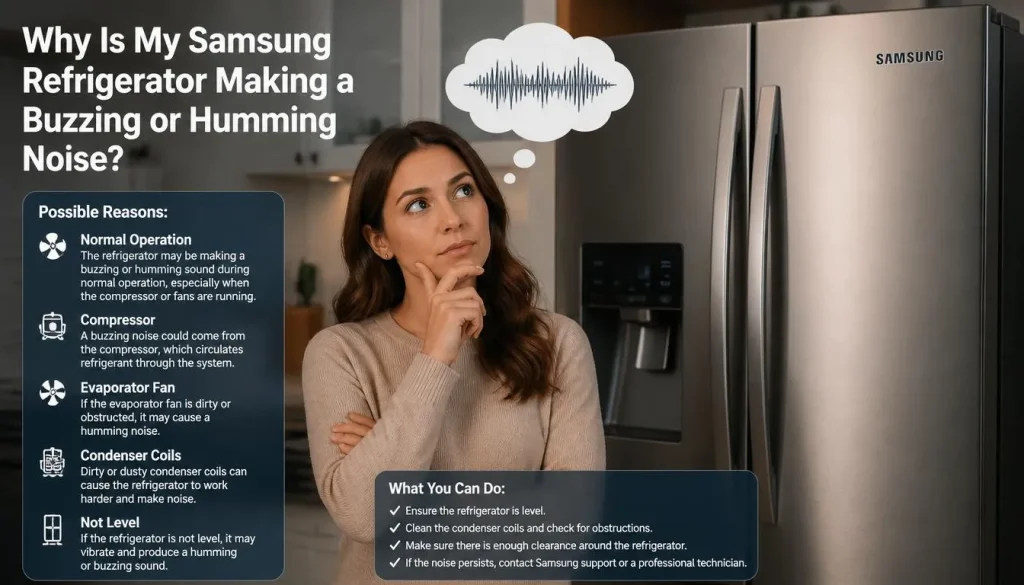
Why Is My Samsung Refrigerator Making a Buzzing or Humming Noise?
A low humming sound is one of the most common refrigerator noises. It usually comes from the compressor or a fan and may change as the refrigerator adjusts its cooling output.
The compressor may run longer or sound more noticeable when:
- The refrigerator has recently been installed
- A large amount of food has been added
- The doors have been opened frequently
- The room is unusually warm
- The refrigerator is recovering after a power interruption
- The temperature setting has recently been changed
A steady background hum is generally normal. A sudden, extremely loud hum accompanied by poor cooling requires further investigation.
Buzzing From the Ice Maker
A brief buzzing sound can occur when the water inlet valve opens to fill the ice maker.
If the refrigerator is not connected to a water line, turn the ice maker off. Allowing the ice maker to request water without an available supply can cause repeated buzzing. Samsung specifically recommends switching off the ice maker when a water supply is not connected.
Buzzing From a Vibrating Water Line
The water line may vibrate when the inlet valve opens. Make sure the line is not pressed against:
- The wall
- A cabinet
- The refrigerator
- Another pipe
- The power cord
Secure the line without sharply bending or crushing it.
Why Is My Samsung Refrigerator Making a Rattling or Vibrating Noise?
Rattling is frequently caused by installation or contact with another object rather than an internal failure.
Start with these checks:
- Move the refrigerator slightly away from the wall.
- Remove items stored on top of the appliance.
- Separate bottles and glass containers inside.
- Confirm that shelves and drawers are correctly installed.
- Check that the floor is firm and level.
- Adjust the levelling feet according to the model’s user manual.
An uneven refrigerator can create vibration and may prevent the doors from aligning or closing correctly. Samsung Australia notes that an uneven installation surface can contribute to refrigerator noise.
If the rattling stops after moving the refrigerator forward, the appliance or water line was probably touching another surface.
Persistent rattling from behind or underneath the refrigerator may require inspection of the drain pan, fan, compressor mounting, or another internal component.
Why Is My Samsung Refrigerator Making a Clicking or Ticking Noise?
An occasional click may be normal when a compressor starts or stops, a valve operates, or the appliance changes between cooling cycles.
Samsung UK explains that some models with AC compressors can produce a normal click when the compressor starts or stops. Inverter compressor models may operate differently and may not use the same type of starting relay.
Repeated clicking every few seconds is less likely to be normal, especially when the refrigerator is not cooling.
Possible causes include:
- The compressor repeatedly trying to start
- A compressor starting component problem
- An unstable power supply
- A control or electrical fault
- A water valve cycling repeatedly
- A fan blade contacting an obstruction
Do not remove electrical covers or test live components unless you are properly qualified. Contact a technician if repeated clicking is accompanied by warmth inside the refrigerator, a non-running compressor, a burning smell, or an error code.
Why Is My Samsung Refrigerator Making a Popping, Cracking, or Snapping Noise?
Popping, cracking, snapping, and crackling sounds are often caused by materials expanding and contracting as the refrigerator temperature changes.
These sounds may be more noticeable:
- During initial cooling
- After a defrost cycle
- After the doors have been open
- After warm food has been placed inside
- In a newly installed refrigerator
- When the compressor changes its operating level
Small pieces of ice may also shift or fall during the automatic defrost process.
Occasional popping without any cooling problem is usually normal. Investigate further if the sound is extremely loud, happens continuously, or occurs with smoke, a burning smell, or electrical problems.
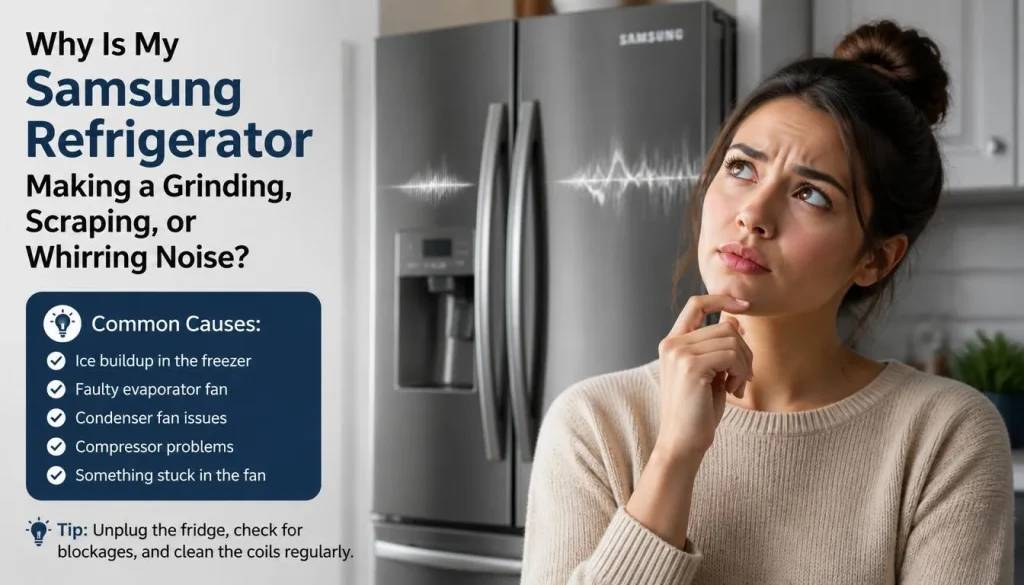
Why Is My Samsung Refrigerator Making a Grinding, Scraping, or Whirring Noise?
Grinding or scraping may come from the ice dispenser, an obstructed fan, or a moving part rubbing against ice or another surface.
Grinding While Dispensing Ice
Some motor noise is normal when dispensing ice, particularly when using a crushed-ice setting. However, a jammed ice bucket or blocked chute can make the sound much louder.
To check the ice system:
- Stop using the dispenser.
- Remove the ice bucket according to the user manual.
- Look for clumped or jammed ice.
- Empty loose or melted ice.
- Check that the bucket mechanism moves freely.
- Reinstall the bucket securely.
Do not force a frozen mechanism or use a sharp tool to break apart ice.
Scraping or Whirring Inside the Freezer
A scraping noise inside the freezer may indicate that the evaporator fan blade is hitting accumulated ice.
Common signs include:
- The noise stops when a door opens
- Frost is visible on the interior back panel
- The refrigerator section is warmer than expected
- The sound becomes louder over time
- The noise returns after a temporary defrost
A manual defrost may remove the ice and temporarily stop the sound, but it may not correct the underlying reason the ice formed. Samsung recommends service when ice repeatedly builds up around the fan.
Grinding When the Ice Dispenser Is Not Running
Loud grinding that occurs when nobody is using the ice dispenser is not considered a normal ice-dispensing sound. Stop attempting to dispense ice and arrange professional diagnosis if the source cannot be safely identified.
Why Is My Samsung Refrigerator Fan Making Noise?
Samsung refrigerators may contain multiple fans. Their number and location vary by model.
Evaporator or Circulation Fan Noise
The evaporator or circulation fan moves cold air through the refrigerator and freezer compartments.
Possible fan-related sounds include:
- Whirring
- Scraping
- Buzzing
- Rattling
- Fluttering
- A sound similar to a fan striking ice
The internal fan is a likely source when the noise stops shortly after a refrigerator or freezer door is opened.
Check for blocked vents, packages touching the back panel, an incomplete door seal, and visible frost. A damaged fan motor or repeated ice buildup usually requires service.
Condenser or Rear Fan Noise
Depending on the model, a rear or lower fan may help move air around the compressor and condenser area.
A problem in this area may cause:
- Rattling from the back or bottom
- Buzzing near the compressor
- Whirring that continues when the doors are open
- Vibration against a rear cover
- Noise caused by dust or a foreign object
Do not remove a rear electrical panel unless the model instructions specifically allow user access and the refrigerator has been safely disconnected from power.
Why Does My Samsung Refrigerator Stop Making Noise When I Open the Door?
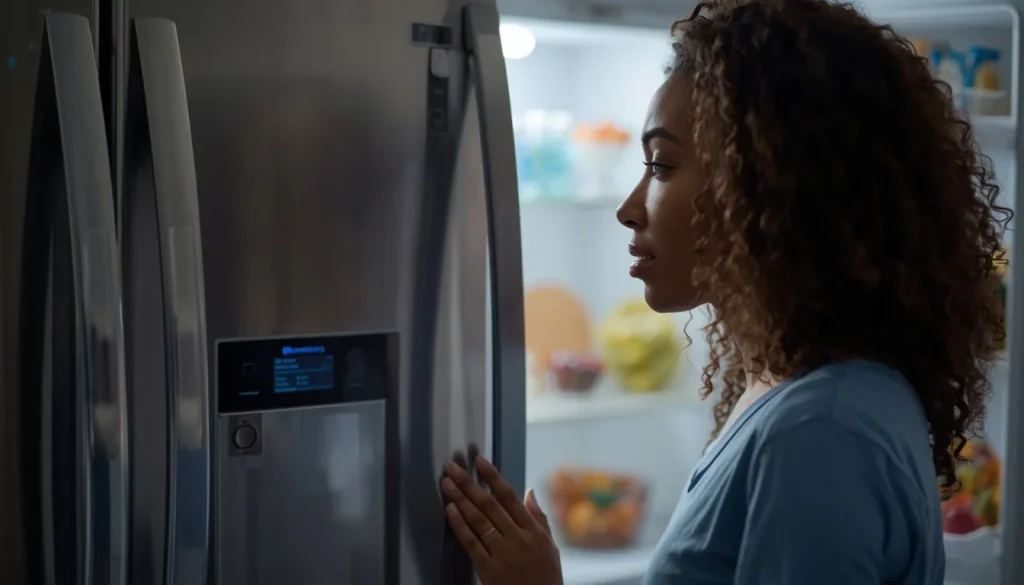
A Samsung fridge making noise when the door is closed but becoming quiet when the door opens often points to the internal circulation or evaporator fan.
Many refrigerators stop or change internal fan operation when a door opens. If the fan blade is rubbing against frost or ice, opening the door can stop both the fan and the noise.
This problem may sound like:
- Scraping
- Grinding
- Buzzing
- Rattling
- Rapid tapping
- A fan striking a solid object
Check whether frost is visible on the back wall inside the refrigerator or freezer.
A complete manual defrost may temporarily remove the ice. Before defrosting:
- Move food to another refrigerator or insulated cooler
- Disconnect the refrigerator from power
- Leave the doors open
- Place towels around the appliance to collect water
- Allow the ice to melt naturally
Never use a hair dryer, heat gun, space heater, knife, screwdriver, or another sharp tool to remove ice. Samsung warns that external heat sources can damage the refrigerator.
If the sound returns, professional service is recommended because the underlying defrost, airflow, sensor, seal, or drainage problem may still be present.
Why Is My Samsung Refrigerator Beeping or Chiming?
Beeping or chiming is normally an alert rather than a mechanical noise.
The most common cause is an open or incompletely closed door.
Check for:
- A food package blocking the door
- A drawer that is not fully inserted
- A dirty or folded door gasket
- A misaligned door
- An item preventing the freezer drawer from closing
- Ice buildup interfering with the seal
A temperature warning may also sound after:
- A power interruption
- The door has been open for too long
- A large amount of warm food has been added
- The refrigerator has stopped cooling correctly
If the doors were recently removed or reinstalled, inspect the visible door connections according to the user manual. Contact service if the alarm continues even though the doors are properly closed and the interior has returned to the selected temperature.
Why Is My Samsung Refrigerator Making a Gurgling, Bubbling, Hissing, or Sizzling Noise?
Gurgling, bubbling, and flowing-water sounds commonly come from refrigerant moving through the sealed cooling system.
Hissing or sizzling may occur when water from the defrost cycle reaches a warm surface. You may also hear dripping as melted frost flows toward the drain system.
These sounds are generally normal when they:
- Occur occasionally
- Last for a limited time
- Are not extremely loud
- Are not accompanied by poor cooling
- Do not occur with water leaking onto the floor
Contact a technician if the sound appears with a chemical smell, major cooling failure, visible damage, or a significant leak. Do not attempt to open or repair the sealed refrigerant system.
Why Is My Samsung Refrigerator Making a Knocking, Banging, or Thumping Noise?
An occasional thump or bang may simply be ice falling from the ice maker into the storage bucket.
Other possible causes include:
- Bottles falling against one another
- A loose shelf or drawer
- A water line moving when a valve closes
- High or unstable water pressure
- The refrigerator touching a wall
- A loose internal or external component
A single sound during an ice-making cycle is usually not concerning. Repeated, forceful knocking that continues when the ice maker and water dispenser are not operating should be investigated.
Why Is My Samsung Refrigerator Making a Whistling or Blowing Noise?
A soft blowing or whistling sound may come from air moving through the refrigerator vents.
The sound may become more noticeable when:
- The circulation fan changes speed
- A vent is partially blocked
- The refrigerator is heavily loaded
- Food is placed too close to the back wall
- The door has recently been opened
- The appliance is working to restore its temperature
Rearrange food so that air can move freely around the vents. Do not tightly pack containers against the back or side air passages.
A very loud whistle, squeal, or fan noise may indicate an obstruction or a worn fan motor.
Why Is My Samsung Refrigerator Door Squeaking?
A squeaking sound that happens only when a door opens or closes is usually related to the hinge, door alignment, or refrigerator levelling rather than the cooling system.
Check whether:
- The refrigerator is level
- The door is rubbing against another surface
- A hinge cover is loose
- The door was recently removed and reinstalled
- The refrigerator is overloaded on one side
Use only a lubricant approved for refrigerator hinges and food-area use. Samsung recommends food-grade silicone for applicable hinge lubrication and warns against using unsuitable general-purpose products. Always follow the instructions for your exact model.
Why Is the Water Line or Water Filter Making Noise?
Water-system noise may appear as buzzing, knocking, vibrating, sputtering, or hammering.
Noise After Replacing the Water Filter
A newly replaced filter may produce unusual sounds if:
- The filter is not fully locked into position
- Air remains trapped in the water line
- The filter is incorrect for the model
- Water flow is restricted
- The supply valve is not fully open
Confirm that the filter is correctly installed. Dispense water according to the flushing instructions in the model’s manual to help remove trapped air.
Knocking When Dispensing Water
A knocking or hammering sound may be related to:
- A loose supply line
- The inlet valve opening or closing
- Excessive water pressure
- Air in the line
- A pipe moving inside the wall
Check the visible line for contact with the wall or cabinet. Plumbing-related pressure or pipe movement may require a qualified plumber rather than an appliance technician.
Why Is My Samsung Refrigerator Making Noise and Not Cooling?
Noise combined with poor cooling deserves more attention than noise alone.
Possible causes include:
Ice Blocking the Evaporator Fan
Ice can prevent the fan from moving air through the refrigerator. You may hear scraping or buzzing while the freezer remains colder than the refrigerator compartment.
A Fan Is Not Operating Correctly
A damaged, obstructed, or frozen fan may reduce airflow. The refrigerator may run for longer periods while struggling to maintain the selected temperature.
The Compressor Is Trying to Start
Repeated clicking followed by silence may indicate that the compressor is attempting but failing to start. This requires professional diagnosis.
The Door Is Not Sealing
A blocked, damaged, or dirty gasket allows warm air to enter. This can make the compressor run longer and contribute to frost buildup.
Air Vents Are Blocked
Food packed tightly against the vents may prevent cold air from circulating even when the cooling system is operating.
If the refrigerator is becoming warm:
- Keep the doors closed as much as possible.
- Move perishable food to another working refrigerator or insulated cooler.
- Confirm that the appliance has power.
- Check that the doors close completely.
- Look for a displayed error code.
- Arrange service if normal cooling does not return.
Samsung’s cooling guidance also recommends checking the power connection, door closure, and door seals before proceeding to service.
What Does the Timing of the Noise Mean?
The timing of a refrigerator sound can help narrow down its source.
Noise Every Few Minutes
A sound every few minutes may be connected to normal compressor cycling, fan-speed changes, or a loose object vibrating when cooling starts.
Repeated clicking every few seconds is less likely to be normal.
Buzzing Every Few Hours
Buzzing every few hours often occurs when the ice maker requests water. Check whether the water line is connected and the supply valve is open.
Turn off the ice maker if no water supply is available.
Noise After Closing the Door
The circulation fan may restart after the door closes. If it strikes ice, the noise may begin shortly after closing the door and stop again when the door is opened.
Noise Only at Night
Normal refrigerator sounds often seem louder at night because the surrounding room is quieter.
However, do not ignore a sound simply because it happens at night. Investigate it if it is new, unusually loud, continuous, or associated with a cooling problem.
Constant or Continuous Noise
A refrigerator may run for an extended period after installation, frequent door opening, or the addition of warm food.
Continuous noise may also result from:
- A door that is not sealing
- Blocked air vents
- High room temperature
- Incorrect temperature settings
- A fan obstruction
- A cooling-system problem
Why Is My New Samsung Refrigerator Making Noise?
A new Samsung refrigerator may make more noticeable sounds during its initial cooling and ice-making cycles.
You may hear:
- Humming from the compressor
- Air moving through the vents
- Water entering the ice maker
- Ice dropping into the bucket
- Popping as interior materials change temperature
- Occasional clicks as components start or stop
Samsung notes that a new refrigerator may seem louder while settling into operation.
Check that the refrigerator:
- Is level
- Has the required ventilation clearance
- Is not touching a wall or cabinet
- Has a properly connected water supply
- Has had all packaging materials removed
- Has doors that close and seal correctly
Use the installation guide for the exact model because clearance and setup requirements can vary.
Eight Quick Ways to Quiet a Noisy Samsung Refrigerator
1. Identify the Sound and Location
Determine whether the sound comes from the back, bottom, freezer, fresh-food section, or ice maker.
2. Level the Refrigerator
Use a level and adjust the feet according to the installation manual. Make sure the appliance stands firmly without rocking.
3. Move It Away From Nearby Surfaces
Leave the model-specific clearance recommended by Samsung. Prevent the refrigerator, power cord, and water line from touching the wall or cabinets.
4. Rearrange Bottles and Containers
Separate glass items and make sure shelves, drawers, and bins are correctly installed.
5. Keep Air Vents Clear
Move food away from the internal vents and avoid overfilling the refrigerator.
6. Check the Doors and Gaskets
Remove obstructions, clean the gasket, and make sure every door and drawer closes completely.
7. Inspect the Ice and Water System
Check the ice bucket, dispenser chute, filter, visible water line, and water supply. Turn off the ice maker when no water line is connected.
8. Request Service for Persistent Abnormal Noise
Arrange professional service when the noise is loud, continuous, associated with poor cooling, or likely to involve an internal fan, compressor, electrical component, or repeated ice buildup.
When Should You Call a Samsung Refrigerator Technician?
Contact a qualified technician when:
- The noise interrupts normal conversation
- Grinding occurs without using the ice dispenser
- Scraping returns after the refrigerator has been defrosted
- The refrigerator is not cooling
- The compressor repeatedly clicks but does not start
- A displayed fan or cooling error returns
- Water is leaking onto the floor
- You notice a burning or electrical smell
- The appliance repeatedly trips a circuit breaker
- Frost continues building behind an interior panel
- The noise stops when the door opens and repeatedly returns
- A fan appears damaged or obstructed
- The refrigerator has visible electrical damage
Disconnect the appliance from power if there is smoke, a burning smell, exposed wiring, sparking, or another immediate electrical concern.
How to Prevent Samsung Refrigerator Noise
You cannot eliminate normal operating sounds, but proper installation and maintenance can reduce unnecessary noise.
- Keep the refrigerator level.
- Maintain the clearance specified in the model’s manual.
- Keep internal air vents unobstructed.
- Avoid overfilling shelves and door bins.
- Keep bottles and glass containers separated.
- Clean door gaskets regularly.
- Make sure doors and drawers close fully.
- Replace the water filter with the correct model.
- Keep the visible water line from touching nearby surfaces.
- Turn off the ice maker when the water supply is disconnected.
- Investigate frost buildup before it becomes severe.
- Use the correct regional manual for your refrigerator model.
Customers in the United States, United Kingdom, Canada, and Australia should use the Samsung support site for their own country because model availability, warranty conditions, service options, and installation instructions can differ.
Frequently Asked Questions
Why is my Samsung refrigerator suddenly making a loud noise?
A sudden loud noise may come from an ice-maker cycle, a vibrating container, the refrigerator touching a nearby surface, or a fan striking ice. Check where the sound originates and whether it stops when a door opens. Arrange service if the noise is continuous, extremely loud, or accompanied by poor cooling.
Why is my Samsung fridge buzzing loudly?
Buzzing may come from the compressor, a fan, or the water inlet valve. Brief buzzing while the ice maker fills is often normal. Check the water supply and turn off the ice maker if no water line is connected. Loud continuous buzzing with poor cooling needs professional diagnosis.
Why does my Samsung fridge make noise when the door is closed?
The internal circulation fan may begin operating after the door closes. If frost has formed around the fan, its blade may scrape against the ice. The sound may stop when the door opens because the fan stops or changes operation.
Why does the noise stop when I open the refrigerator door?
This symptom commonly points to the evaporator or circulation fan. The fan may be striking ice or another obstruction while running. A manual defrost may stop the noise temporarily, but repeated frost buildup usually requires service.
Is a humming Samsung refrigerator normal?
A soft, steady hum is usually normal and often comes from the compressor or fan. The sound may change as the refrigerator adjusts its cooling output. Investigate a hum that becomes extremely loud, starts suddenly, or occurs with poor cooling.
Why is my Samsung refrigerator rattling from the back?
The appliance, water line, power cord, or another object may be touching the wall or cabinet. Move the refrigerator forward slightly and listen again. Also check that it is level and standing firmly on the floor.
Why is my Samsung freezer making a loud fan noise?
A loud freezer fan may be obstructed by frost, ice, packaging, or a damaged component. If the sound stops when the door opens or visible frost is present on the back panel, ice around the evaporator fan is a likely cause.
Why is my Samsung ice maker making a grinding noise?
A brief motor sound may occur during ice dispensing, especially with crushed ice. Loud grinding may indicate jammed ice, a blocked chute, or an incorrectly installed bucket. Stop using the dispenser and inspect the removable ice components safely.
Can I use a hair dryer to defrost my Samsung refrigerator?
No. Do not use a hair dryer, heat gun, heater, or other external heat source. Excessive heat can damage plastic components, wiring, insulation, and the refrigerator cabinet. Allow ice to melt naturally with the appliance disconnected from power.
Why is my new Samsung refrigerator making a popping noise?
Popping or cracking may occur as interior materials expand and contract during initial cooling. It can also happen during a defrost cycle. Occasional popping without cooling problems is generally normal.
Why is my Samsung refrigerator clicking but not cooling?
Repeated clicking with no cooling may mean that the compressor is attempting to start or that an electrical component is malfunctioning. Confirm that the refrigerator has a stable power supply, then arrange professional service.
Should I unplug my Samsung refrigerator if it is making a loud noise?
Unplugging is appropriate when there is a burning smell, smoke, sparking, exposed wiring, severe grinding, or another immediate safety concern. For a normal hum, brief click, or occasional popping sound, unplugging is usually unnecessary.
How loud is too loud for a Samsung refrigerator?
A refrigerator should not normally produce sustained noise that interrupts conversation or is clearly audible throughout the home. A sudden major increase in volume, especially with warming, leaking, or an error code, should be investigated.
Final Thoughts
Most Samsung refrigerator noises are caused by normal compressor operation, refrigerant flow, fans, automatic defrosting, or the ice maker. Soft humming, occasional clicking, brief buzzing, gurgling, popping, and ice-dropping sounds are generally normal.
Start troubleshooting by identifying the sound, its location, and when it occurs. Then check the refrigerator’s levelling, wall clearance, shelves, bottles, air vents, doors, ice bucket, water filter, and visible water line.
Pay particular attention to scraping or grinding that stops when a door opens. This often indicates that an internal fan is striking ice. Loud continuous noise, repeated clicking, poor cooling, water leakage, an error code, or a burning smell requires professional attention.
Always follow the user manual for your exact Samsung refrigerator model and use the official Samsung support service for your country when a repair is needed.

Hi, I’m the lead researcher and appliance enthusiast behind RefrigeratorSolve. With years of hands-on experience troubleshooting cooling systems and testing home appliances, I am dedicated to bringing you honest reviews, energy-saving tips, and practical solutions to keep your refrigerator running perfectly.