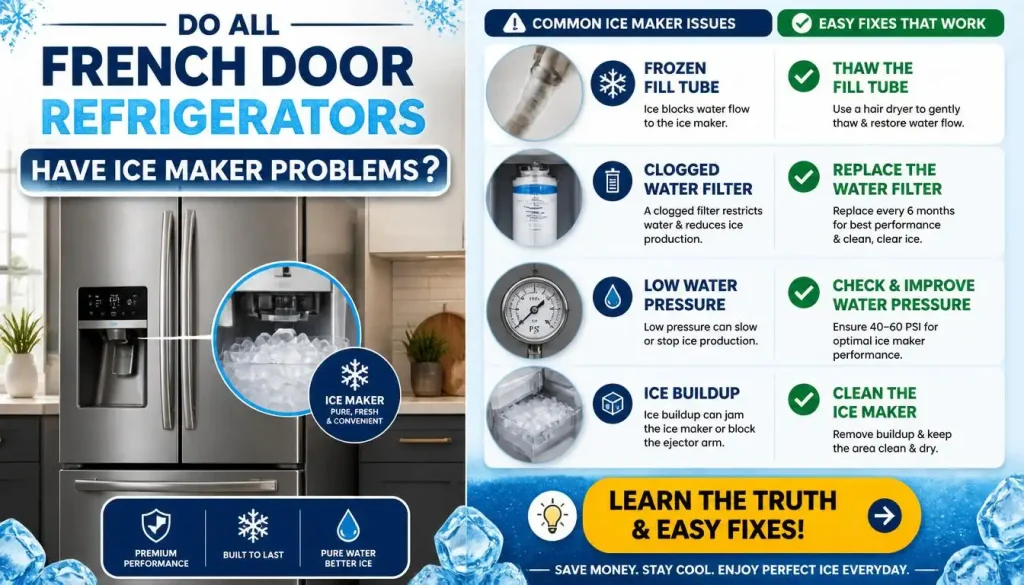
Quick Answer: No, not all French door refrigerators have ice maker problems, but French door designs are more vulnerable to specific ice maker issues than other refrigerator styles. The center mullion seal, upper ice maker position, and complex water routing make French door models more sensitive to temperature fluctuations, gasket wear, and water flow problems. Most issues are preventable with regular maintenance and correct temperature settings.
French door refrigerators are the most popular refrigerator style in the USA, UK, Canada, and Australia in 2026 — and ice maker complaints are one of the top reasons owners search for help online. If you own a French door fridge and your ice maker has stopped working, makes hollow cubes, leaks, or produces clumped ice, you are not alone.
But the real question is whether French door refrigerators are fundamentally flawed, or whether the problems come from specific brands, model generations, poor maintenance, or design features that are easy to understand and fix. This guide answers that honestly, with a brand-by-brand reliability comparison, every common cause explained, step-by-step fixes, error code guidance, repair costs for all four markets, and clear advice on when to call a technician.
Quick Diagnosis — Find Your Problem First
| Symptom You See | Most Likely Cause | Go To |
|---|---|---|
| No ice at all | Ice maker off, freezer too warm, or water supply blocked | Fix 1, 2, 4 |
| Small or hollow cubes | Restricted water filter or low water pressure | Fix 4 |
| Ice bin full of one solid frozen block | Center mullion or door gasket leak letting warm air in | Fix 3, 5 |
| Dispenser runs but no ice comes out | Auger jammed or ice bin not fully seated | Fix 5 |
| Ice maker keeps freezing over | Warm humid air entering through mullion gap | Fix 3 |
| Water leaking from ice area | Trapped air after filter change or misaligned bin | Fix 4, 5 |
| Ice production very slow | Freezer slightly too warm or frequent door openings | Fix 1 |
| Error code on display | Sensor, fan, or component fault | Error Codes section |
Are French Door Refrigerators More Prone to Ice Maker Problems?
Compared to top-freezer or single-door refrigerators, French door models do have a higher reported rate of ice maker complaints. This is not because the ice maker technology is worse, it is because of three design characteristics unique to French door refrigerators:
- The center mullion seal. French door refrigerators have two doors that meet in the middle. The vertical rubber mullion between them must press firmly against both doors simultaneously to create a complete seal. If this mullion is worn, dirty, bent, or slightly misaligned, warm humid air enters continuously — causing frost buildup, ice clumping, and fill tube freezing around the ice maker.
- Upper freezer drawer position. On many French door models, the ice maker sits in the upper fresh food section or at the top of the freezer drawer. This position makes the ice maker more exposed to temperature swings from door openings and more sensitive to seal failures than an ice maker buried deep inside a top-freezer compartment.
- Complex water routing. Water must travel from the back of the refrigerator, through the door hinge area, and up into the ice maker. This longer, more complex route creates more opportunities for kinking, freezing, and air entrapment, especially after filter changes.
Did You Know: Most French door refrigerators perform best with the fresh food section near 37°F / 3°C and the freezer near 0°F / -18°C. The center mullion seal should be inspected and cleaned at least once a month, it is the single most common cause of ice maker problems unique to French door designs.
Brand-by-Brand Reliability — Which French Door Fridges Have Fewer Ice Maker Problems?
Not all French door refrigerators are equally reliable. Based on long-term owner surveys, repair frequency data, and technician reports across the USA, UK, Canada, and Australia, here is how the major brands compare for ice maker reliability:
| Brand | Ice Maker Reliability | Key Known Issues | Best Markets |
|---|---|---|---|
| Whirlpool | High | Occasional fill tube freezing on older models; generally reliable | USA, Canada, Australia |
| Bosch | High | Lower ice output volume by design; rarely faulty | USA, UK, Canada, Australia |
| KitchenAid | High | Premium build; ice maker issues uncommon on well-maintained units | USA, Canada |
| GE / GE Profile | Moderate | Ice maker motor failures reported on some Profile series models | USA, Canada |
| Samsung | Moderate | Ice maker freezing issues widely reported on RF series (2017–2020); class action filed in USA | USA, UK, Canada, Australia |
| LG | Moderate | Linear compressor failures on French door models (2014–2019) affecting ice production; class action settled in USA | USA, UK, Canada, Australia |
| Maytag | Moderate | Ice maker motor and auger wear reported after 5–7 years | USA, Canada |
| Fisher & Paykel | High | Limited French door range; reliable ice performance on available models | Australia, New Zealand |
| Haier / Hisense | Lower | Budget models with more reported ice maker faults; shorter component lifespan | UK, Australia |
Samsung and LG owners: If your French door refrigerator was manufactured between 2014 and 2020 and repeatedly fails despite troubleshooting, check whether your model is covered by a recall or class action settlement before paying for repairs. See the Known Issues section below.
Known Issues, Recalls, and Class Actions
Two major brands have documented, widespread ice maker problems on specific French door model generations that go beyond normal maintenance issues:
Samsung French Door Refrigerators — Ice Maker Recall
Samsung French door refrigerators, particularly RF series models sold between approximately 2017 and 2020, experienced widespread ice maker freezing problems. The ice maker would freeze over internally, stop producing ice, and sometimes cause water to leak into the fresh food section. A class action lawsuit was filed in the USA, and Samsung issued a software update and extended warranty coverage on affected models.
Check your Samsung model:
USA: Visit samsung.com/us/support or cpsc.gov and search “Samsung refrigerator.”
UK: Check samsung.com/uk/support or gov.uk/product-safety-alerts.
Australia: Visit samsung.com/au/support or productsafety.gov.au.
Canada: Check samsung.com/ca/support or healthycanadians.gc.ca.
LG French Door Refrigerators — Compressor and Ice Maker Problems
LG French door refrigerators with linear compressors, manufactured approximately between 2014 and 2019, experienced compressor failures that caused the freezer to gradually warm, stopping ice production and eventually spoiling food.
A class action lawsuit was settled in the USA. If your LG French door refrigerator is from this period and the ice maker repeatedly fails, the compressor rather than the ice maker itself may be the root cause.
Check your LG model:
USA: Visit lgclassaction.com or cpsc.gov for recall and settlement information.
UK: Check lg.com/uk/support.
Australia: Visit lg.com/au/support or productsafety.gov.au.
Canada: Check lg.com/ca/support or healthycanadians.gc.ca.
7 Fixes for French Door Refrigerator Ice Maker Problems
Fix 1 — Check and Correct Freezer Temperature
Best for: Ice maker producing slowly, making small cubes, or stopping entirely — especially after warm weather, heavy grocery loading, or frequent door openings.
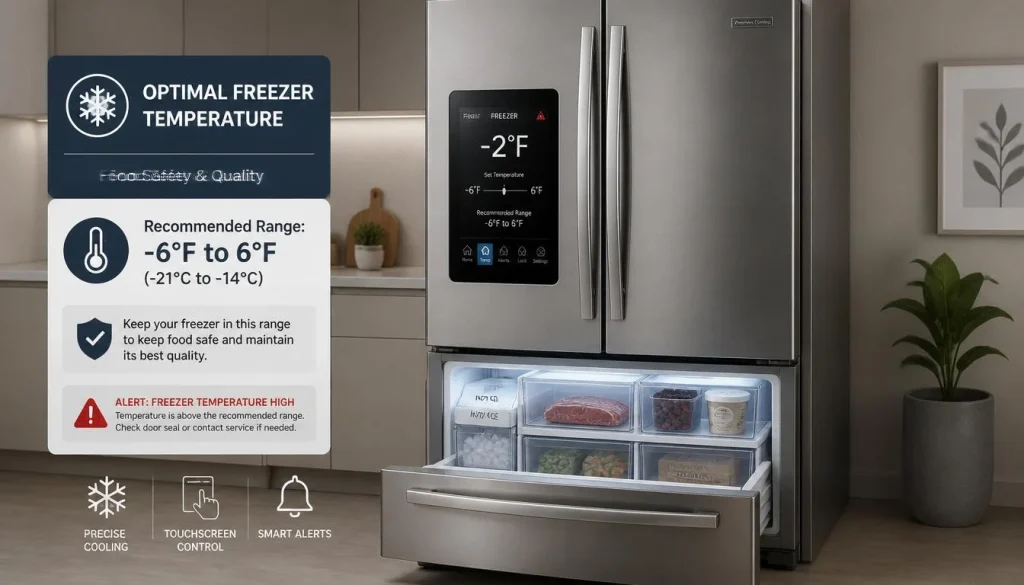
- Place a refrigerator thermometer between frozen packages in the freezer. Leave it for 30 minutes to get an accurate reading.
- Set the freezer to 0°F / -18°C. If your model has a dedicated ice maker or fast-freeze setting, use it for the first 24 hours.
- Keep freezer vents clear — bags or boxes pressed against the rear vents restrict cold airflow to the ice maker area.
- Wait 12 to 24 hours before judging output. Temperature stabilization takes time after adjustments or heavy loading.
Important: The control panel shows the set temperature, not the actual internal temperature. Always verify with a physical thermometer, a faulty sensor can display 0°F while the actual freezer reads 8–10°F warmer, which is enough to stop ice production entirely.
Expected result: Stable cold air reaches the ice maker consistently, and normal harvesting cycles resume.
Fix 2 — Confirm the Ice Maker Is Switched On
Best for: Refrigerators where the dispenser mechanism runs but no ice is being produced.
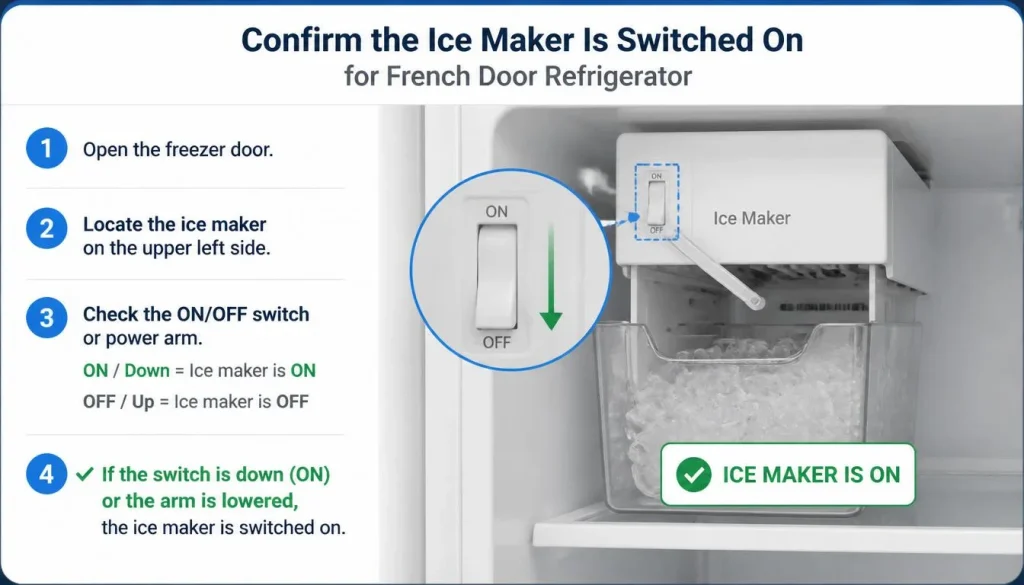
- Open the freezer drawer or ice room and check for a physical ice maker on/off switch or arm. On some models, the arm must be in the down position for the ice maker to run.
- On panel-controlled models: unlock the control panel and hold the Ice On/Off button for approximately 3 seconds.
- If your refrigerator connects to a smart app (Samsung SmartThings, LG ThinQ, GE SmartHQ), open the app and confirm the ice maker shows as active.
Expected result: The ice maker receives the signal to cycle and begins refilling within the hour.
Fix 3 — Inspect and Clean the Center Mullion Seal
Best for: Ice that melts, clumps, or turns wet in the bin; frost on freezer walls; ice maker freezing over repeatedly; or the refrigerator running constantly. This is the most common French door-specific ice maker problem.
- Close both French doors fully and look at where they meet in the center. The vertical rubber mullion strip should press firmly and evenly against the opposite door along its entire length.
- Run your hand along the closed door seam. If you feel cold air escaping at any point, the mullion is not sealing.
- Open the doors and inspect the mullion for dirt, food residue, cracks, bends, or sections that have flattened. Clean with warm soapy water and a soft cloth, then dry completely.
- If the mullion is bent or misshapen, try softening it with warm water and gently reshaping it by hand. Close the doors and leave them shut for several hours to allow the rubber to reset.
- If the mullion is cracked, torn, or permanently deformed, it needs replacing. Order a model-specific part — the mullion is not universal across brands or even across models within the same brand.
Do not ignore a mullion gap. Even a small gap allows warm, humid kitchen air to enter the freezer continuously. That moisture freezes around the ice maker fill tube and components, causing repeated freeze-overs that no amount of resetting will permanently fix, until the seal is restored.
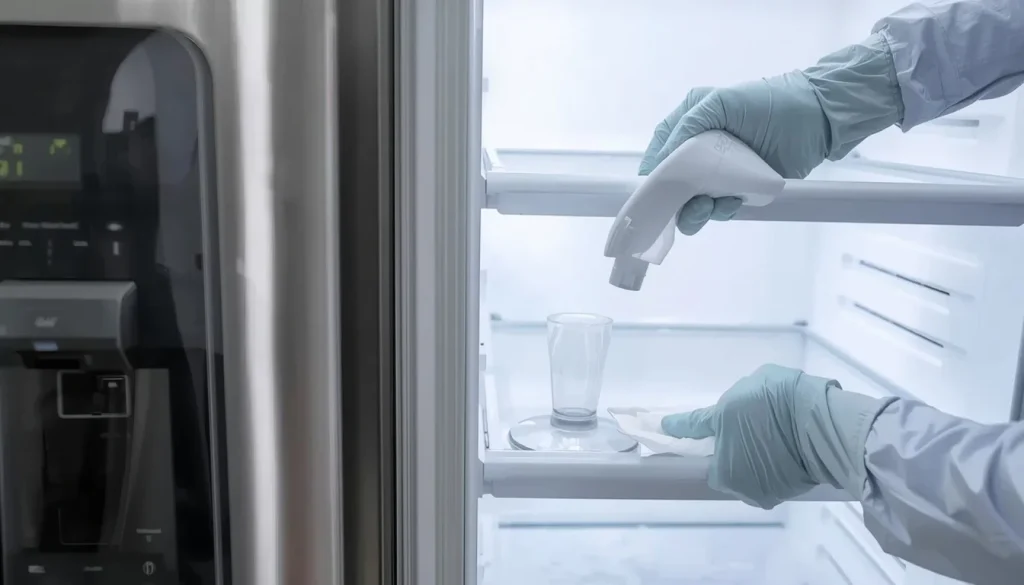
Expected result: Warm air entry stops. Frost and ice clumping reduce significantly within 24 to 48 hours of the mullion being properly sealed.
Fix 4 — Inspect Water Supply and Replace the Filter
Best for: Hollow or small cubes, no ice after a filter change, slow production, or water leaking from the ice area.
- Pull the refrigerator forward and trace the water supply line from the wall valve to the back of the unit. Confirm the shutoff valve is fully open — handle parallel to the pipe.
- Check the line along its entire length for kinks, crushing, or sections that have been pinched against the cabinet or wall.
- Replace the water filter if it has been more than 6 months or 300 gallons since the last change. Always use the filter specified for your exact refrigerator model.
- After installing any new filter, dispense and discard at least 2 to 3 litres / half a gallon of water before expecting ice production to resume. This clears trapped air from the line.
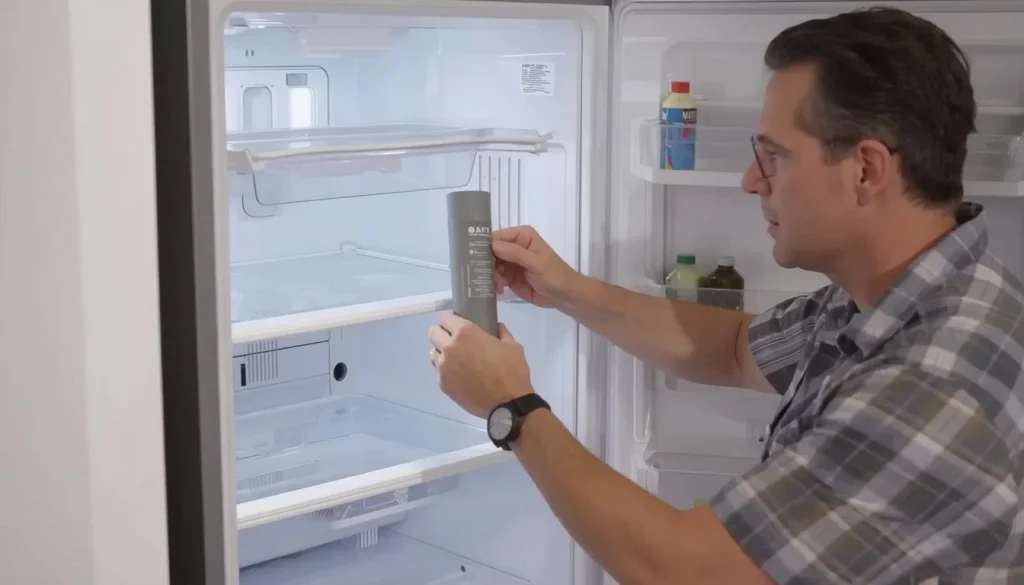
Water pressure note: French door ice makers typically require 20–120 PSI water pressure (USA/Canada standard). UK mains pressure usually falls between 30–80 PSI — generally sufficient. Australian mains pressure varies by state but is typically adequate. If production remains slow after a new filter and open valve, have a plumber check your incoming pressure.
Part verification: Always confirm the correct filter model for your specific refrigerator at the manufacturer’s support site before purchasing. Using a generic or incompatible filter can restrict flow, damage the inlet valve, and void any remaining warranty.
USA/Canada: Check at the manufacturer’s US support page. UK: manufacturer’s UK support page. Australia: manufacturer’s AU support page.
Expected result: The ice maker tray fills evenly and produces full, properly formed cubes.
Fix 5 — Reseat the Ice Bin and Clear Ice Clumps
Best for: Dispenser that runs but releases no ice, or an ice bin that contains one large frozen mass instead of individual cubes.
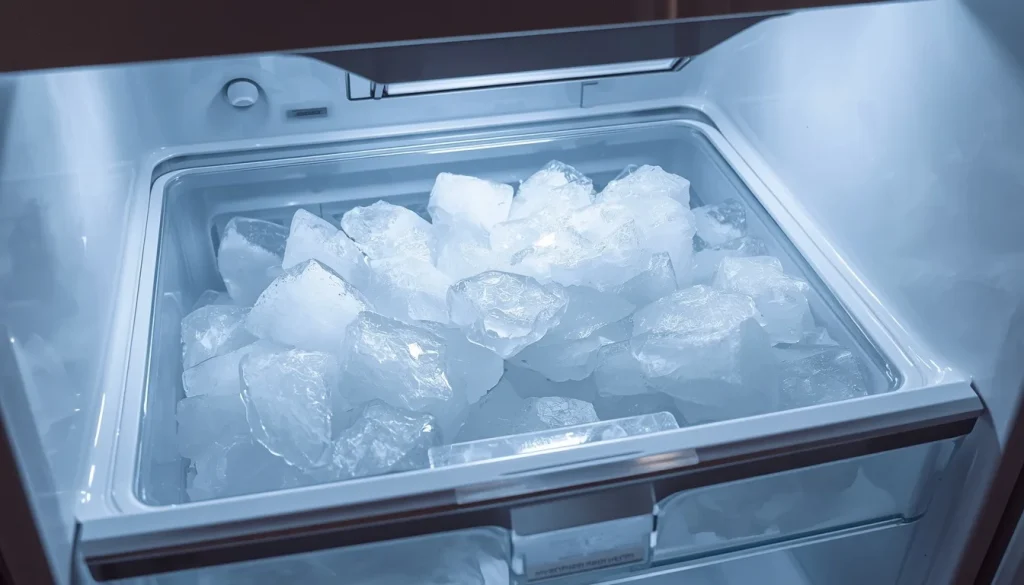
- Remove the ice bin. Discard any large frozen clumps, do not use sharp tools to break ice as this can crack the bin or damage the auger.
- Wash the bin and dry it completely with a clean towel before reinstalling. Any moisture left in the bin will refreeze loose cubes into a solid block within hours.
- Slide the bin fully back into position until you feel it click or seat firmly. The auger coupler at the back of the bin must align correctly with the dispenser drive shaft for ice to move through the chute.
- Check that the ice room inner door or flap (present on some models) closes fully after the bin is installed.
Expected result: Ice moves freely through the bin and dispenser chute without jamming.
Fix 6 — Reset the Ice Maker
Best for: Ice maker that stopped producing after a power outage, filter change, bin removal, or unexplained halt in a previously working unit.
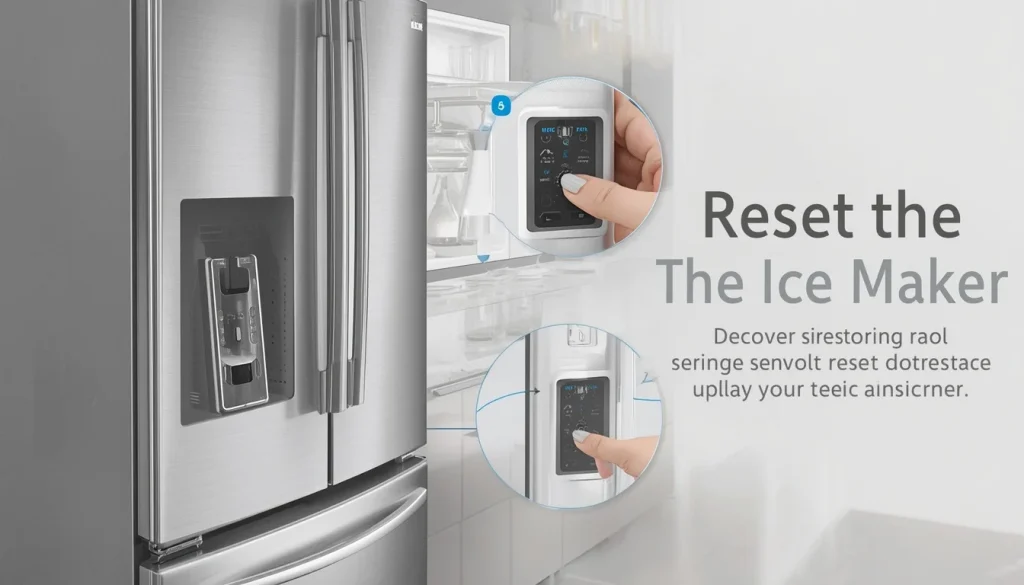
- Remove the ice bin and place a folded towel directly under the ice maker to catch any water or loose ice during the reset.
- Locate the test or reset button on the ice maker assembly — typically a small button on the front face or underside of the unit. Consult your model manual if you cannot locate it.
- Press and hold the button for 3 to 5 seconds. The tray should rotate or the ejector arms should move — this confirms the motor is working.
- Reinstall the ice bin and wait 4 to 6 hours for a complete ice cycle before judging results.
Expected result: The ice maker restarts its cycle. If the tray does not move at all during the reset, the motor or control module may need professional inspection.
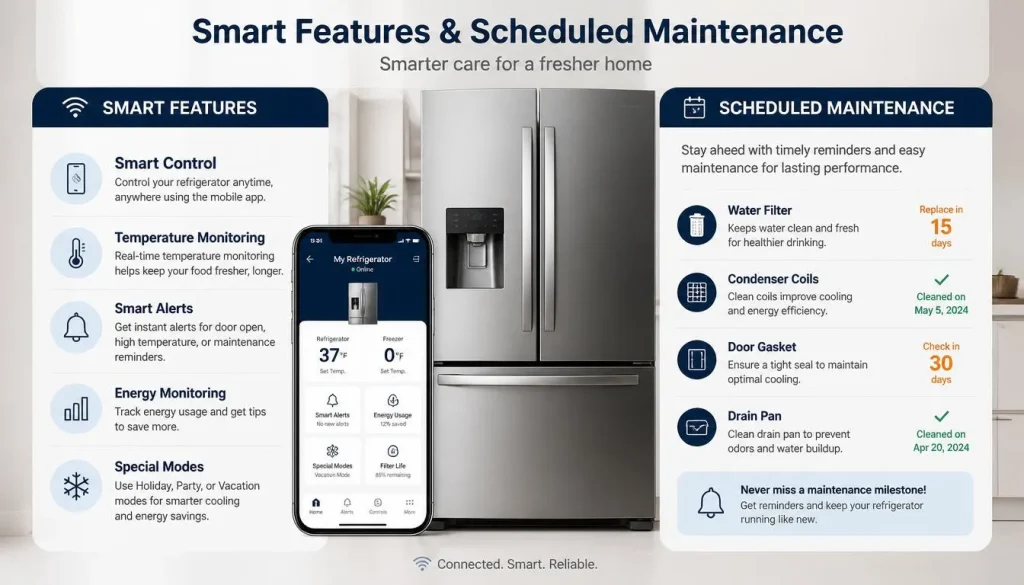
Fix 7 — Use Smart Features and Scheduled Maintenance
Best for: Owners of 2020–2026 smart French door refrigerators using connected apps and fast-freeze features.
- Open your refrigerator’s connected app (Samsung SmartThings, LG ThinQ, GE SmartHQ, or equivalent) and check for active alerts, temperature warnings, filter reminders, or door-open notifications.
- Use the Ice Plus, Express Freeze, or Quick Ice function 2 to 3 hours before parties or heavy demand rather than waiting until the bin is empty.
- Set a monthly reminder to inspect and clean the center mullion, door gaskets, and ice bin. This single habit prevents the majority of French door ice maker problems before they develop.
Expected result: Smart diagnostics catch problems early. Proactive maintenance prevents the most common French door-specific ice maker faults.
Step-by-Step Troubleshooting Guide
- Set correct temperatures. Freezer to 0°F / -18°C, fresh food section to 37°F / 3°C. Verify with a physical thermometer, not the display panel.
- Find your model number. Check inside the refrigerator, left liner on newer models, right liner on older models, or on the door frame. Use this number before ordering any parts.
- Confirm the ice maker is on. Check the physical switch, hold the Ice On/Off button for 3 seconds, or verify in your connected app.
- Inspect the center mullion. Close both doors and feel for cold air escaping at the center seam. Clean and reshape if needed. This is the most important French door-specific check.
- Remove and dry the ice bin. Discard clumps, wash, dry completely, and reinstall until the auger coupler seats correctly.
- Run the reset cycle. Towel under the ice maker, hold reset button 3 to 5 seconds, watch for tray movement.
- Check the water supply. Open shutoff valve fully, remove kinks from the line, replace the filter if overdue.
- Flush after filter change. Dispense and discard 2 to 3 litres after any filter replacement to clear trapped air.
- Monitor for 24 hours. If no ice appears after 24 hours at stable temperature, check error codes or call the manufacturer’s service line.
Common French Door Refrigerator Ice Maker Error Codes
Error codes vary by brand, but these are the most commonly reported codes related to ice maker and freezer faults across French door refrigerator brands sold in USA, UK, Canada, and Australia:
| Brand | Error Code | Meaning | First Step |
|---|---|---|---|
| LG | ER IF | Ice maker fan error | Check for ice blocking the fan. Manual defrost if heavy frost present. |
| LG | ER FF | Freezer fan motor fault | Manual defrost first. If code returns, fan motor needs replacement. |
| Samsung | 88 88 or PC ER | Communication error | Power cycle (unplug 60 seconds). If it persists, call Samsung service. |
| Samsung | OF OF | Demo mode active — ice maker disabled | Hold Energy Saver and Fridge buttons simultaneously for 3 seconds to exit demo mode. |
| GE | E1 or E2 | Freezer or fresh food sensor error | Power cycle. If it returns, sensor replacement needed. |
| Whirlpool | F5 E1 | Ice maker sensor fault | Reset the ice maker. If code persists, sensor or module replacement needed. |
| Bosch | E3 | Ice maker temperature sensor error | Power cycle. If code persists, contact Bosch service. |
Smart Diagnosis tip: If your French door refrigerator connects to a smart app, use the built-in diagnostic feature before calling service. Samsung SmartThings, LG ThinQ, and GE SmartHQ all offer self-diagnosis tools that read error data from the refrigerator and suggest model-specific fixes, often saving a service call fee.
Expert Tips for Reliable Ice Production
- Clean the center mullion monthly. This is the most important French door-specific maintenance task. Food residue, stickiness, or a slight bend in the mullion is enough to allow continuous warm air entry.
- Use a physical thermometer, not just the display. Many French door refrigerators with aging thermistors show an accurate-looking temperature on screen while the actual freezer is several degrees too warm for reliable ice production.
- Replace the water filter every 6 months. A partially clogged filter reduces water flow enough to produce hollow cubes or dramatically slow production, without stopping it entirely, making it hard to diagnose.
- Dry the ice bin after every cleaning. Moisture left in the bin refreezes loose cubes into an unusable solid block within hours of reinstallation.
- Minimize unnecessary door openings. Every time you open a French door refrigerator, warm air enters through the entire open face, far more than with a top-freezer design. The more frequently doors open, the harder the ice maker works to maintain temperature.
- Keep the freezer at least two-thirds full. A fuller freezer maintains stable cold temperatures more efficiently than an empty one, reducing temperature swings that affect ice production.
Common Mistakes to Avoid
Never ignore the center mullion. Owners often clean the door gaskets thoroughly and reset the ice maker repeatedly, but skip checking the mullion. If the mullion has even a small gap, every fix you try will provide only temporary relief.
- Setting the freezer too warm. A freezer that feels cold to the touch may still be too warm for reliable ice harvesting. Verify with a thermometer every time you troubleshoot an ice maker problem.
- Running the ice maker with water supply disconnected. Repeated dry cycles wear the motor and inlet valve unnecessarily. If the water supply is interrupted, switch the ice maker off until it is restored.
- Buying replacement parts by appearance rather than model number. Mullion seals, door gaskets, ice maker assemblies, and filters all vary by model, sometimes significantly, even within the same brand’s French door range. Always verify using your exact model number.
- Replacing the ice maker before checking the compressor. On Samsung and LG models from the known problem era, a failing compressor causes gradual freezer warming that eventually stops ice production. Replacing the ice maker without addressing the compressor will not solve the problem.
- Judging results within the first hour after a reset. Ice production takes 4 to 24 hours to resume after a reset or filter change. Do not assume failure based on checking too soon.
When to Call a Technician
Stop troubleshooting and call the manufacturer or an independent appliance technician if any of the following apply:
- The ice maker tray or arms do not move at all during the reset test, motor or module failure
- An error code returns within 24 hours of a power cycle
- The freezer temperature will not hold below 10°F / -12°C despite correct settings, possible compressor fault
- Your model is within the Samsung RF series (2017–2020) or LG linear compressor French door (2014–2019) known problem generation
- Ice maker components are visibly cracked, corroded, or water-damaged
- Unusual grinding, clicking, or loud compressor noise that does not resolve after a manual defrost
Manufacturer service contacts by region:
- USA: Contact your brand’s US support line or visit the brand’s US support website. For recall checks: cpsc.gov
- Canada: Contact your brand’s Canadian support line. For recalls: healthycanadians.gc.ca
- UK: Contact your brand’s UK support line. For product safety alerts: gov.uk/product-safety-alerts
- Australia: Contact your brand’s Australian support line. For recalls: productsafety.gov.au
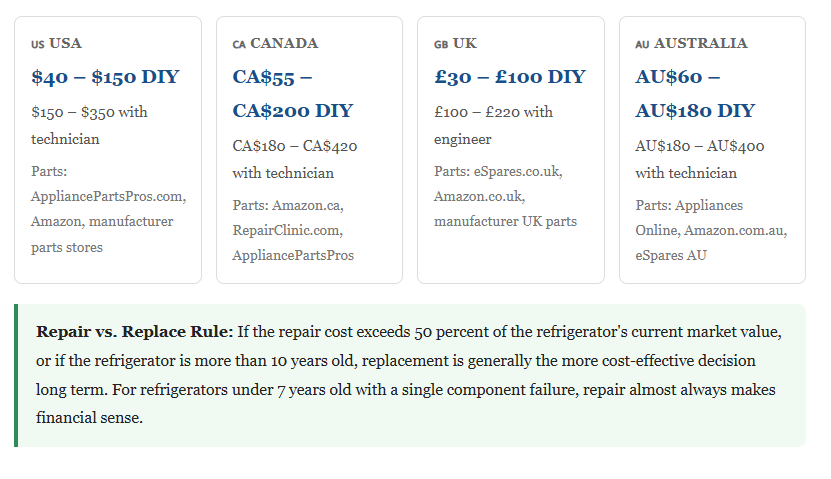
How Much Does It Cost to Fix a French Door Ice Maker?
Here are approximate repair costs across all four markets for the most common French door refrigerator ice maker repairs:
Frequently Asked Questions
Do all French door refrigerators have ice maker problems?
No. French door refrigerators are more vulnerable to specific ice maker issues than other designs, mainly because of the center mullion seal and complex water routing, but most problems are preventable with regular maintenance. Brands like Whirlpool, Bosch, and KitchenAid have strong long-term ice maker reliability records. Samsung and LG had significant issues on specific model generations from 2014 to 2020.
Which French door refrigerator brand has the fewest ice maker problems?
Whirlpool, Bosch, and KitchenAid consistently rank as the most reliable French door refrigerator brands for ice maker performance based on owner surveys and technician data. Bosch produces less ice volume than most competitors by design, but what it produces is consistently reliable. Fisher & Paykel performs well in the Australian market.
Why does my French door refrigerator ice maker keep freezing up?
Repeated ice maker freeze-overs in a French door refrigerator almost always come from warm, humid air entering through a faulty or dirty center mullion seal. The moisture in that air freezes around the fill tube and ice maker components. Inspect and clean the center mullion first, this is the most common cause of this specific symptom in French door designs.
Why does my French door refrigerator make ice slowly?
Slow ice production is usually caused by a freezer running slightly too warm, a partially clogged water filter, frequent door openings that raise the internal temperature, or a minor center mullion leak. Set the freezer to 0°F / -18°C, verify with a thermometer, replace the filter if overdue, and inspect the mullion seal.
How long should a French door refrigerator ice maker last?
A well-maintained French door ice maker typically lasts 5 to 10 years. Monthly gasket and mullion cleaning, filter changes every 6 months, and maintaining correct freezer temperature are the three habits that most reliably extend ice maker lifespan.
Is it worth repairing a French door refrigerator ice maker?
Generally yes, if the refrigerator is under 7 years old and the repair cost is below 50 percent of the unit’s current market value. For refrigerators from the known Samsung RF or LG linear compressor problem era, get a full diagnosis first, a repeatedly failing ice maker may indicate a compressor issue that makes replacement more economical.
What is the center mullion on a French door refrigerator?
The center mullion is the vertical rubber or magnetic seal strip that runs between the two French doors. When both doors are closed, the mullion presses against the opposite door to complete the air seal across the full height of the door opening. A worn, dirty, or bent mullion allows warm humid air to enter continuously, causing frost, ice clumping, fill tube freezing, and chronic ice maker problems unique to French door designs.
Conclusion
French door refrigerators are not inherently flawed, but they do have design characteristics that make ice maker maintenance more important than in other refrigerator styles. The center mullion seal, upper ice maker position, and complex water routing mean that small problems, if ignored, escalate into ice maker failures faster than they would in a simpler design.
The answer to whether all French door refrigerators have ice maker problems is no, but many owners experience them because the mullion goes uncleaned, the filter goes unreplaced, the freezer runs slightly too warm, or a documented brand-specific issue has not been addressed. All of these are fixable.
Start today by checking the center mullion seal, verifying your freezer temperature with a physical thermometer, and replacing your water filter if it is overdue. These three actions alone resolve the majority of French door ice maker complaints. If your refrigerator is a Samsung RF series (2017–2020) or LG linear compressor model (2014–2019), check the recall resources listed above before spending on parts.

Hi, I’m the lead researcher and appliance enthusiast behind RefrigeratorSolve. With years of hands-on experience troubleshooting cooling systems and testing home appliances, I am dedicated to bringing you honest reviews, energy-saving tips, and practical solutions to keep your refrigerator running perfectly.