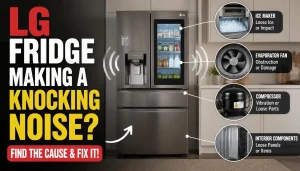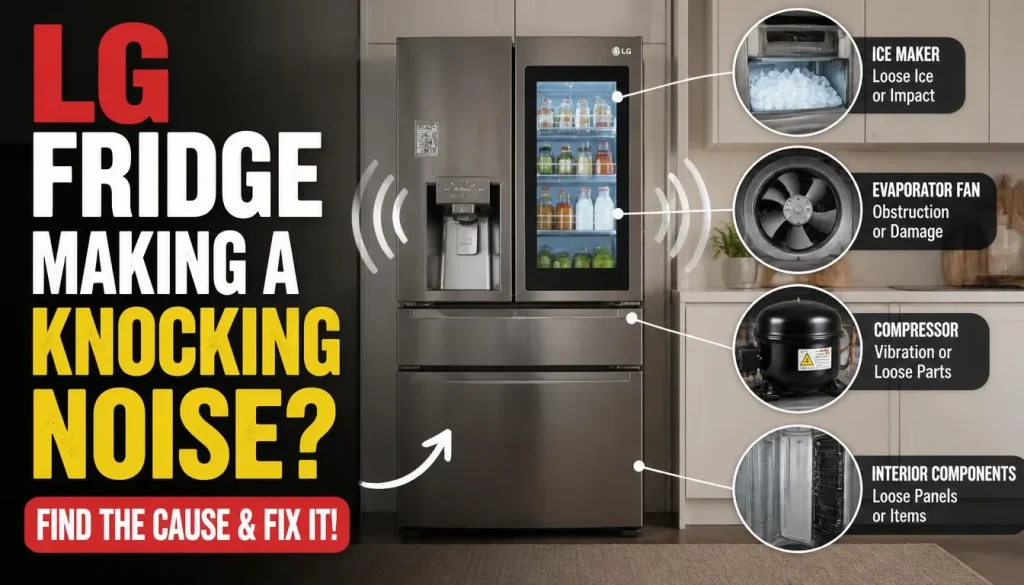
A knocking noise from an LG refrigerator can be unsettling, especially when it starts suddenly or becomes loud enough to notice from another room. The good news is that not every knocking sound means the refrigerator is failing. Some sounds come from normal cooling cycles, the ice maker, expanding materials, or minor vibration. Others can point to a fan, compressor, water line, or another component that needs attention.
The easiest way to narrow down the cause is to consider three things: where the knocking comes from, when it happens, and whether the refrigerator is still cooling normally.
A brief knock during an ice-making cycle is very different from a repeated mechanical knock from the rear of the refrigerator accompanied by poor cooling.
This guide explains the most common causes of an LG refrigerator making a knocking noise, what you can safely check at home, and when it is time to call a qualified technician.
Quick Answer: Why Is My LG Refrigerator Making a Knocking Noise?
Your LG refrigerator may be making a knocking noise because of:
- An ice maker completing a cycle or dropping ice
- A water line vibrating against the cabinet or wall
- An unlevel refrigerator
- A compressor transferring vibration to the cabinet
- A condenser or evaporator fan contacting ice or debris
- A loose drain pan, rear panel, shelf, drawer, or other component
- Normal expansion and contraction of internal materials
- A water inlet valve operating during an ice-making cycle
- A mechanical or electrical problem that requires professional diagnosis
The sound is more concerning when it is loud, repetitive, getting worse, or accompanied by poor cooling, excessive heat, a burning smell, unusual vibration, or an error code.
Is a Knocking Noise From an LG Refrigerator Normal?
Sometimes it is.
Refrigerators are not completely silent. The compressor cycles on and off, fans circulate air, the ice maker moves mechanically, water enters the ice maker, and interior materials respond to changing temperatures. Each of these processes can create sounds.
A short knock, tap, pop, or thump that happens occasionally can be normal, particularly when:
- The refrigerator has just started a cooling cycle
- The ice maker is harvesting or dropping ice
- The refrigerator is going through a defrost cycle
- The compressor starts or changes operating speed
- Internal plastic or metal components expand or contract
- The refrigerator was recently installed or moved
However, a constant mechanical knocking sound is not something to automatically dismiss.
Pay closer attention when the noise:
- Happens repeatedly every few seconds or minutes
- Becomes progressively louder
- Continues for long periods
- Is accompanied by strong vibration
- Comes from the compressor or rear mechanical area
- Appears together with reduced cooling
- Occurs with a burning or electrical smell
- Starts suddenly after the refrigerator has been operating normally for a long time
The key is not simply whether the refrigerator makes a sound. It is what the sound is doing and what the refrigerator is doing at the same time.
What Does the Knocking Sound Tell You?
“Knocking” can describe several different noises. Try to compare the sound you hear with these descriptions.
Knocking or Thumping
A regular thump or knock may come from vibration, the ice maker, the compressor, or something touching the cabinet.
Banging
A heavier bang may indicate ice dropping, a component moving, or a vibrating part hitting another surface.
Clunking
A mechanical clunk can occur when a motor-driven mechanism changes position or when a loose component shifts.
Tapping
A light tapping sound may be associated with thermal expansion, a fan, or a component responding to a cooling cycle.
Rhythmic Knocking
A knock that repeats at a consistent interval is particularly useful diagnostically because it may correspond to a rotating fan, compressor operation, or another recurring cycle.
Intermittent Knocking
A sound that appears only occasionally is more likely to be associated with a specific refrigerator function, such as ice making, defrosting, or compressor cycling.
Common Reasons Your LG Refrigerator Is Making a Knocking Noise
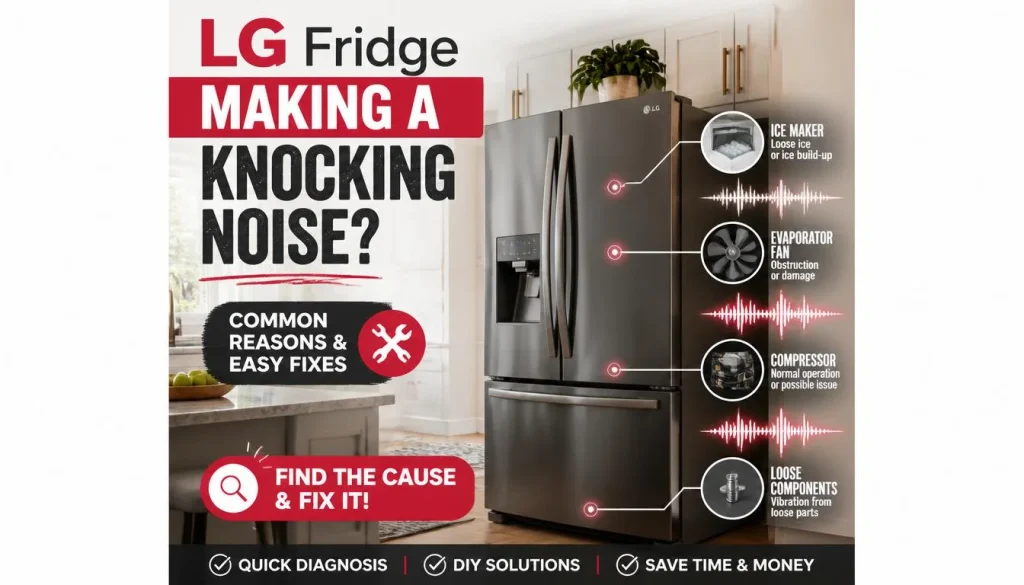
1. The Ice Maker Is Making or Dropping Ice
The ice maker is one of the first things to check when an LG refrigerator suddenly starts knocking.
During a normal ice-making cycle, the mechanism may move, release ice, refill with water, and reset for the next cycle. Ice falling into the storage bin can create a surprisingly loud thud, particularly when the bin is nearly empty.
Some LG models equipped with Craft Ice or multiple ice makers can produce different operating sounds from conventional ice makers.
Check whether the knocking happens:
- Shortly after the ice maker runs
- When ice falls into the bin
- Around the same time as a water-filling sound
- Mainly near the freezer or upper ice-making area
If the sound is clearly tied to ice production and the refrigerator is cooling normally, the noise may not indicate a fault.
2. The Refrigerator Is Not Level
An LG refrigerator that is slightly uneven can transfer vibration into the cabinet and floor.
When the compressor or fan runs, that vibration may become amplified by the refrigerator’s metal panels, shelves, floor, or surrounding cabinetry. Instead of hearing a soft hum, you may hear a repeating knock or rattle.
Check whether the refrigerator:
- Rocks slightly when pushed gently
- Vibrates when a door is opened
- Sits unevenly from side to side
- Moves noticeably during compressor operation
Use the leveling adjustment specified for your particular LG model. Avoid guessing how far to adjust the feet if you do not know the correct procedure.
3. The Refrigerator Is Touching a Wall or Cabinet
A refrigerator does not need to be mechanically defective to sound loud.
If the back or side of the cabinet touches a wall, cabinet, pipe, or another surface, normal compressor and fan vibration can be transferred directly into that object.
This can turn a mild vibration into a noticeable knocking sound.
Check the space around the refrigerator, particularly:
- The rear panel
- Side panels
- Water tubing
- Power cord
- Nearby cabinets
- Wall surfaces
Move the refrigerator only as much as is safe and use the clearance specified in the installation instructions for your model.
4. The Water Supply Line Is Vibrating
The water supply line can create a surprisingly convincing knocking or tapping sound.
When the refrigerator activates the water inlet system, pressure changes can cause a loose or poorly positioned line to move. If that line touches the rear cabinet or wall, the vibration can sound like a mechanical knock.
Check whether the noise happens when:
- The ice maker fills
- The water dispenser is used
- The refrigerator has just completed an ice cycle
Inspect the accessible portion of the line for kinks, tension, or obvious contact with another surface.
5. The Compressor Is Transferring Vibration
The compressor is one of the main mechanical components in the refrigerator and normally produces vibration while operating.
A small amount of vibration is expected. The problem occurs when that vibration becomes amplified by the cabinet, floor, surrounding surfaces, or a component that is loose.
Compressor-related knocking is more suspicious when:
- The sound comes from the lower rear area
- It starts when the compressor starts
- The refrigerator vibrates strongly
- The compressor area becomes unusually hot
- Cooling performance begins to deteriorate
- The sound becomes significantly louder over time
LG refrigerators can use variable-speed compressor systems, so the character of the sound may change as cooling demand changes. That does not mean every loud compressor noise should be considered normal.
6. A Condenser Fan Is Hitting Something
The condenser fan helps move air through the refrigerator’s mechanical area. If the fan blade contacts debris, frost, a damaged cover, or another object, the result can be a rhythmic tapping or knocking sound.
Because the fan rotates, the noise may repeat at a consistent pace.
Look for clues such as:
- Knocking that increases and decreases with fan speed
- Noise coming from the rear or bottom
- A scraping or tapping sound mixed with the knocking
- The refrigerator becoming unusually warm around the mechanical area
Do not reach into a moving fan or remove electrical covers to investigate.
7. An Evaporator Fan Is Hitting Ice or Debris
The evaporator fan is another important source of refrigerator noise.
If frost or ice forms around the fan area, or if another object interferes with the blades, the fan may produce clicking, tapping, scraping, or knocking sounds.
A useful clue is what happens when you open the refrigerator or freezer door.
If the sound suddenly stops when the door opens and returns after the door closes, a fan-related source becomes more likely.
Heavy or recurring frost should not be ignored because it may indicate an airflow, sealing, fan, or defrost problem.
8. A Loose Drain Pan or Rear Component Is Vibrating
Some refrigerator noises have nothing to do with a failing motor.
A loose drain pan, rear cover, shelf, drawer, or another component can vibrate whenever the compressor or fan operates.
Because these components can act like resonating surfaces, a small vibration may sound much louder than it actually is.
Check accessible areas for obvious signs of:
- A loose drain pan
- A panel touching the cabinet
- Shelves that are not seated correctly
- Drawers that are out of position
- An ice bin that is not installed correctly
Do not remove internal protective covers merely to locate a noise.
9. Internal Materials Are Expanding and Contracting
Temperature changes can produce sudden pops, taps, snaps, or light knocking sounds.
The refrigerator repeatedly moves between different temperature conditions as it cools, pauses, defrosts, and cools again. Plastic liners, shelves, panels, and other materials can expand and contract slightly during those changes.
This type of sound is usually less concerning when it:
- Happens only occasionally
- Lasts only a few seconds
- Is not getting louder
- Is not associated with vibration
- Occurs while the refrigerator is cooling normally
A brief thermal noise should not be confused with a continuous mechanical knock.
10. The Water Inlet Valve Is Operating
The water inlet valve controls water entering the refrigerator for functions such as ice making and, depending on the model, water dispensing.
Its operation can create a brief buzz, click, hum, or vibration. If that vibration is transferred through the water line or cabinet, it may sound like a knocking noise.
Pay attention to timing.
If the sound occurs immediately before or after water enters the ice maker, the water system deserves closer attention.
When Does the Knocking Noise Happen?
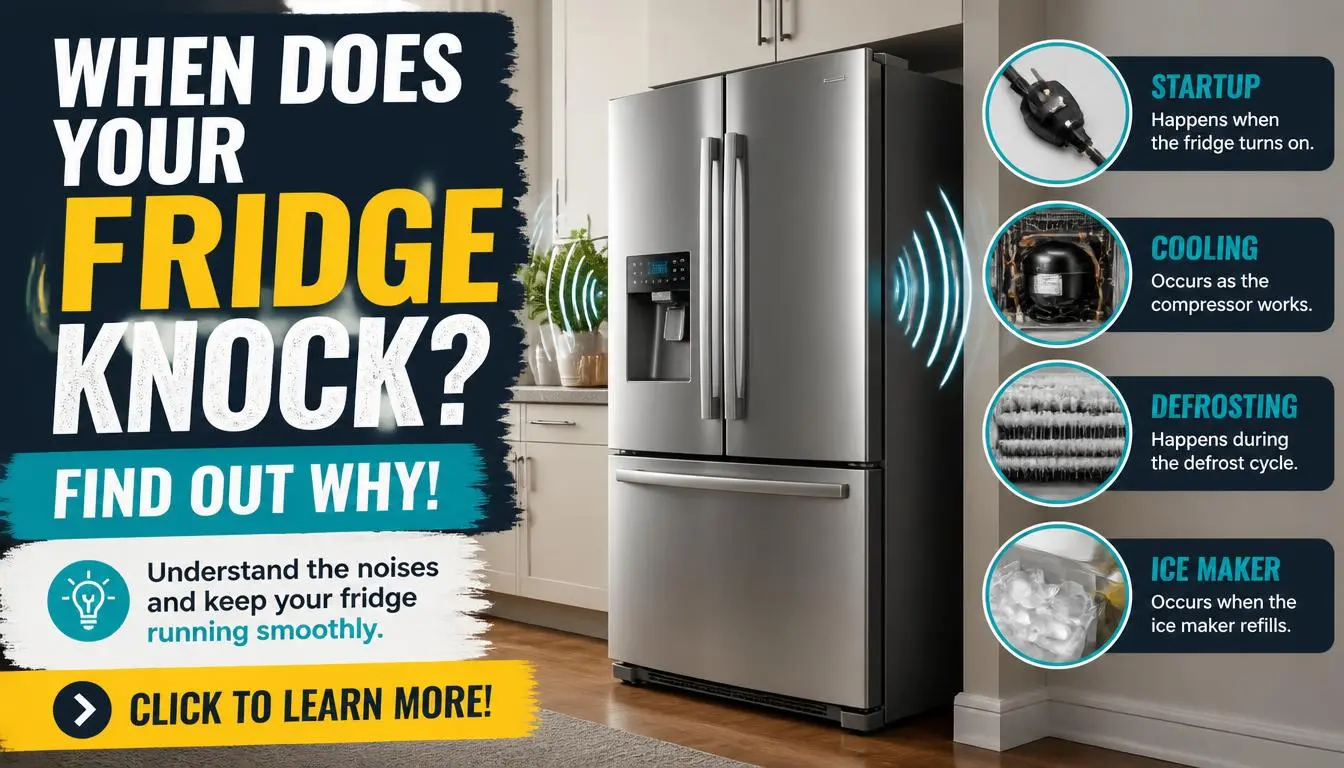
The timing of the noise can be just as useful as the sound itself.
Knocking When the Compressor Starts
A brief startup vibration can be normal. However, a heavy repetitive knock each time the compressor starts should be investigated, especially if cooling is becoming weaker.
Knocking Every Few Minutes
A repeating noise every few minutes may point toward a fan, compressor cycle, ice-making function, or another component that repeatedly operates.
Write down the interval and see whether it changes when the doors are opened or when the refrigerator enters a different cooling cycle.
Knocking During Ice Making
If the noise appears only during ice production, focus your attention on the ice maker, ice bin, water valve, and water supply line.
Knocking After Closing the Door
Closing a refrigerator door can change internal airflow and cause fans or other components to operate differently.
A short whoosh or brief mechanical sound can be normal. A loud repeating knock deserves further inspection.
Knocking at Night
A refrigerator can seem much louder at night simply because the kitchen is quiet.
The key question is whether the sound is actually abnormal or whether you are simply hearing a normal operating cycle more clearly.
If the noise is new, unusually loud, or accompanied by poor cooling, do not assume nighttime volume is the only explanation.
Where Is the Knocking Noise Coming From?
Knocking From the Back of the Refrigerator
Check:
- Compressor vibration
- Condenser fan
- Water line
- Rear panel
- Drain pan
- Wall or cabinet contact
The lower rear area is particularly important because several mechanical components are concentrated there.
Knocking From Inside the Freezer
Possible sources include:
- Ice maker
- Ice bin
- Evaporator fan
- Frost buildup
- Frozen items contacting the drawer or wall
If the sound stops when the freezer door opens, inspect the fan and ice-making area first.
Knocking From Inside the Refrigerator Compartment
Possible sources include:
- Interior fan
- Damper
- Shelves or drawers
- Bottles or containers touching each other
- Internal expansion and contraction
Knocking From Under the Refrigerator
Look for:
- Drain pan vibration
- Compressor vibration
- Condenser fan issues
- Uneven flooring
- Loose accessible components
Do not crawl underneath the appliance while it is operating.
Knocking Near the Water Dispenser
A sound near the dispenser may be related to:
- Water inlet valve
- Water pressure
- Water line
- Water filter
- Ice dispenser mechanism
Could the Compressor Be Causing the Knocking Noise?
Yes, but a knocking sound does not automatically mean the compressor is failing.
A compressor naturally produces vibration during operation. If the refrigerator is not level, if something is touching the cabinet, or if a mounting or surrounding component is vibrating, that normal movement can sound much louder.
A compressor-related issue becomes more concerning when the knocking is accompanied by:
- Poor cooling
- Repeated clicking
- Increasing heat around the compressor
- A dramatic change in operating noise
- Frequent failed starts
- Circuit breaker trips
- A refrigerator that keeps getting warmer
Compressor and sealed-system repairs are not suitable for casual DIY work. These areas should be handled by a qualified technician.
How to Find the Source of the Knocking Noise
Before trying to fix anything, spend a few minutes identifying the pattern.
Step 1: Listen Carefully
Try to describe the sound:
- Knock
- Thump
- Bang
- Tap
- Clunk
- Knock followed by a hum
- Knock followed by a click
If possible, record the sound on your phone. A recording can be useful when speaking with a technician.
Step 2: Identify the Location
Listen near:
- The freezer
- Fresh-food compartment
- Ice maker
- Lower rear area
- Water dispenser
- Bottom of the cabinet
Do not remove electrical covers just to get closer to the sound.
Step 3: Open the Doors
Observe what happens when a door opens.
Does the noise:
- Stop immediately?
- Become quieter?
- Continue unchanged?
- Return after the door closes?
A sound that stops when a door opens may point toward an internal fan.
Step 4: Check Cooling
Ask yourself:
- Is the freezer still freezing normally?
- Is the refrigerator compartment cold enough?
- Is air moving through the vents?
- Are foods staying at the expected temperature?
- Is there an error code?
A noise with normal cooling is often less urgent than the same noise accompanied by a temperature problem.
Step 5: Check the Installation
Make sure:
- The refrigerator does not rock
- It is not touching the wall
- Nothing is vibrating on top
- Bottles are not touching each other
- Shelves and drawers are seated correctly
- The water line is secure
Step 6: Observe the Timing
Write down when the sound occurs:
- During startup
- During ice making
- During water dispensing
- After closing a door
- Every few minutes
- During defrost
- After the refrigerator has been moved
- Continuously
This simple record can make diagnosis much easier.
How to Fix an LG Refrigerator Making a Knocking Noise
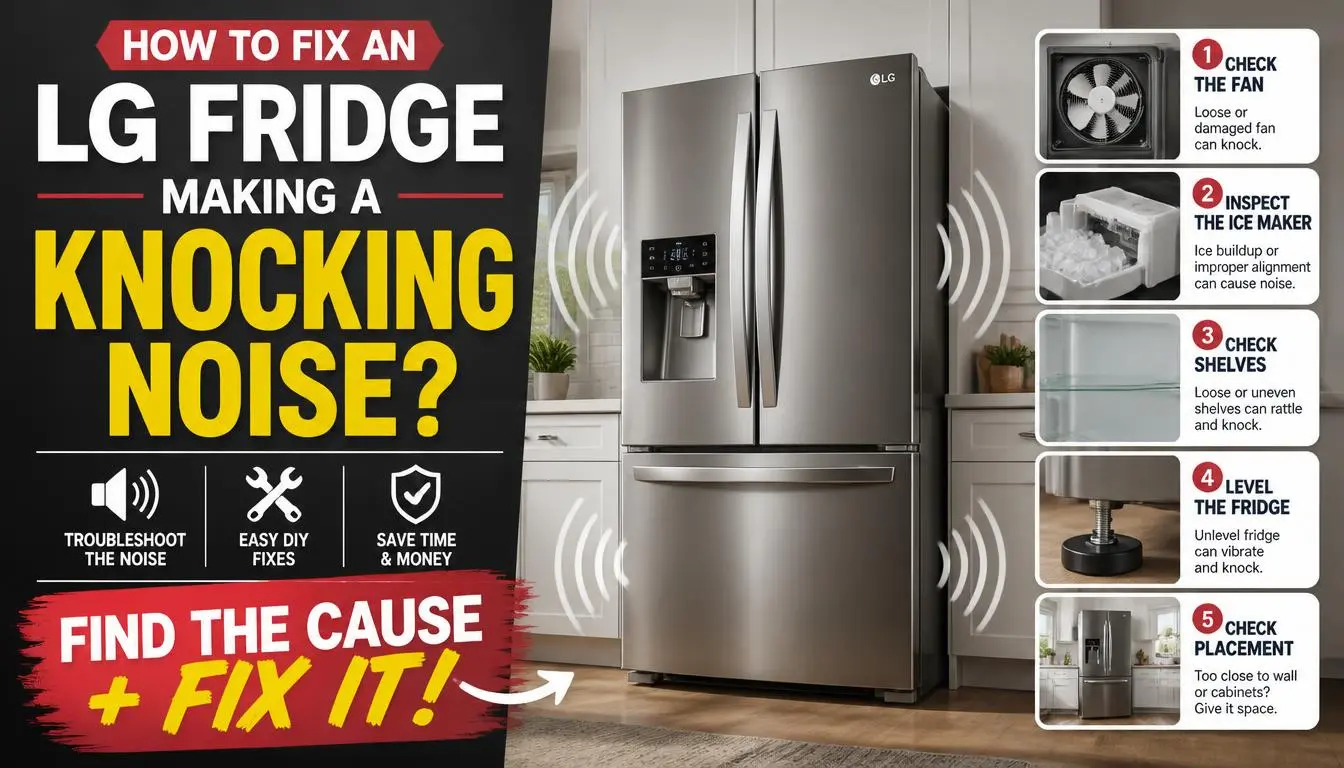
Start with the safest and simplest checks.
1. Level the Refrigerator
Check whether the appliance rocks or shifts.
Adjust the leveling feet according to your LG model’s installation instructions. A stable refrigerator should remain steady when a door is opened or closed.
2. Move It Away From Contact Points
Confirm that the cabinet is not pressed against:
- A wall
- Cabinetry
- Pipework
- Another appliance
Use the required clearance for your specific model.
3. Secure Loose Items
Inside the refrigerator, reposition:
- Bottles
- Containers
- Shelves
- Drawers
- Ice bins
A small vibration can become surprisingly loud when transmitted through glass or metal.
4. Secure the Water Line
Check the accessible portion of the water line for:
- Kinks
- Excessive tension
- Contact with a wall
- Contact with the rear panel
- Loose positioning
Do not pull aggressively on the line.
5. Check the Ice Maker and Ice Bin
Make sure the ice bin is properly seated and that ice is not jammed or clumped together.
If the sound clearly occurs during ice production, compare its timing with the ice maker cycle.
6. Check for Visible Frost
Look around freezer vents and accessible areas for excessive frost.
Do not use knives, screwdrivers, or other sharp objects to remove ice. Avoid directing high heat into the freezer unless the manufacturer specifically instructs you to do so.
7. Check Accessible Rear Areas Safely
If dust is visible around an accessible rear mechanical area, follow the manufacturer’s cleaning instructions.
Never touch exposed wiring, compressor terminals, moving fans, or refrigerant tubing.
8. Check the Door Gaskets
A poor seal allows warm air to enter, which can increase cooling demand and contribute to frost formation.
Clean dirty door gaskets with appropriate mild cleaning methods and make sure nothing prevents the door from closing correctly.
LG Refrigerator Making a Knocking Noise but Still Cooling
This situation is generally less urgent, but the cause still matters.
If the refrigerator is cooling properly, common possibilities include:
- Ice maker operation
- Water line vibration
- Compressor vibration
- A loose panel or drain pan
- Thermal expansion and contraction
- Refrigerator-to-wall contact
- Normal fan operation
Start with the installation checks before assuming that an expensive component has failed.
A refrigerator that cools normally but has developed a new, loud, mechanical knocking sound should still be monitored. A new noise can sometimes be an early indication of a developing mechanical issue.
LG Refrigerator Making a Knocking Noise and Not Cooling
This combination deserves more attention.
When a knocking noise appears together with poor cooling, possible causes include:
- Evaporator fan problems
- Condenser fan problems
- Heavy frost restricting airflow
- Compressor-related problems
- Airflow restrictions
- Control or electrical faults
- Other mechanical failures
First check the temperature, airflow, visible frost, door seals, and display for error codes.
If food is becoming noticeably warmer, avoid repeatedly resetting the refrigerator and hoping the noise disappears. A qualified technician should diagnose persistent cooling problems.
LG Refrigerator Making a Knocking Noise and Clicking
A single occasional click is not necessarily a problem.
However, repeated clicking combined with knocking and weak cooling is more concerning.
Possible areas include:
- Compressor startup
- Electrical controls
- Fan operation
- A control or mechanical component that is repeatedly cycling
Pay close attention to whether the refrigerator actually maintains temperature.
Do not replace electrical components based solely on the sound. The same noise can have different causes depending on the model and operating cycle.
LG Refrigerator Knocking Noise and Excessive Vibration
If the refrigerator is physically shaking while the knocking occurs, start with installation.
Check:
- Leveling
- Wall clearance
- Cabinet contact
- Water-line contact
- Loose shelves or bins
- Rear panels or drain areas
If the vibration appears to originate directly from the compressor and remains excessive after installation checks, professional diagnosis is appropriate.
Why Is My LG Refrigerator Making a Knocking Noise at Night?
It may simply be easier to hear at night.
During the day, kitchen appliances, conversations, television, HVAC systems, and outside traffic can mask refrigerator sounds. At night, even a normal compressor cycle or ice-making event can seem surprisingly loud.
Still, nighttime makes a useful diagnostic opportunity because you can clearly hear the timing.
Listen for:
- A brief knock followed by a compressor hum
- Knocking only during ice production
- A rhythmic fan-related sound
- Random popping during cooling
- Continuous mechanical knocking
A normal occasional operating sound is usually less concerning than a loud repetitive knock that continues throughout the night.
When Is an LG Refrigerator Knocking Noise a Serious Problem?
Contact a qualified technician when you notice one or more of these warning signs:
- The knocking is unusually loud
- The sound is becoming worse
- The refrigerator is no longer cooling properly
- The freezer temperature is rising
- The compressor becomes extremely hot
- The refrigerator repeatedly clicks and fails to cool
- The unit shakes heavily
- A burning or electrical smell is present
- The circuit breaker trips
- Water is leaking near electrical components
- A fan error or another fault code appears
- Heavy frost repeatedly returns
- The noise continues after basic installation checks
The most important distinction is between an unusual sound by itself and an unusual sound accompanied by a change in refrigerator performance.
What You Should Not Try to Repair Yourself
Some refrigerator checks are reasonable for a homeowner. Others are not.
Do not attempt to open or repair:
- The sealed refrigerant system
- The compressor
- Live electrical components
- Internal electrical controls
- Refrigerant tubing
- Compressor terminals
Do not insert sharp tools into the freezer to remove ice, and do not reach into moving fans.
If you see smoke, sparks, a damaged electrical cord, or signs of electrical burning, disconnect power when it is safe to do so and seek professional assistance.
When Should You Call an LG Refrigerator Technician?
Professional service is the right choice when the knocking remains after you have checked leveling, wall clearance, loose items, the ice maker, and other accessible causes.
You should be particularly cautious when the noise is combined with poor cooling or a major change in compressor behavior.
A technician can determine whether the cause is related to the compressor, fan system, electrical controls, ice-making assembly, or another internal component without unnecessary part replacement.
Before the appointment, record:
- The sound
- Where it occurs
- How often it occurs
- Whether it stops when a door opens
- Whether the refrigerator is cooling normally
- Any error code displayed
- Whether the refrigerator was recently moved or installed
That information can make diagnosis faster and more accurate.
Frequently Asked Questions
Is it normal for an LG refrigerator to make a knocking sound?
Occasional knocking, tapping, or thumping can be normal when it comes from the ice maker, compressor vibration, water line, or temperature-related expansion. A persistent or increasingly loud mechanical knock deserves investigation.
Why is my LG refrigerator making a knocking noise but still cooling?
Possible causes include the ice maker, water line, compressor vibration, loose components, wall contact, or normal expansion and contraction. Start by identifying where and when the noise occurs.
Why does my LG refrigerator knock every few minutes?
A repeating knocking sound may correspond to a fan, compressor cycle, ice-making function, or another recurring operation. The interval and location of the sound are important clues.
Why is my LG refrigerator knocking from the back?
Rear knocking can come from the compressor, condenser fan, drain pan, water line, rear panel, or contact with the wall or cabinetry.
Can a refrigerator compressor make a knocking noise?
Compressor vibration can sometimes be heard as a knock when it is transferred to the cabinet or surrounding surfaces. A significantly louder or harsher compressor sound, especially with poor cooling, should be professionally checked.
Can the LG ice maker cause a knocking sound?
Yes. The ice maker can make sounds while harvesting ice, filling with water, or moving through its operating cycle. Ice dropping into the bin can also create a noticeable thump.
How do I stop my LG refrigerator from making a knocking noise?
First identify the source. Level the refrigerator, prevent contact with nearby surfaces, secure loose items and the water line, check the ice maker, and look for visible frost. Avoid opening sealed or electrical components.
Why does my LG refrigerator make a knocking noise when the compressor starts?
A brief startup vibration can be normal, particularly if the refrigerator is not perfectly stable. If the sound is loud, repetitive, or accompanied by poor cooling, overheating, or repeated clicking, professional diagnosis is recommended.
Why does my LG refrigerator make noise when I open or close the door?
Opening a door can change fan operation, airflow, and internal pressure. A short sound may be normal, while repeated knocking or vibration may indicate a fan, leveling, or installation issue.
Should I unplug my LG refrigerator if it is making a knocking noise?
Not necessarily. A brief or occasional knocking sound with normal cooling does not automatically mean the refrigerator must be unplugged. Disconnect power and seek assistance when there are signs of electrical danger, such as smoke, sparks, a damaged cord, or a burning smell.
Final Takeaway
An LG refrigerator making a knocking noise does not automatically mean that the appliance is failing.
In many cases, the cause is relatively simple: the ice maker is operating, the refrigerator is touching a wall, the cabinet is not level, a water line is vibrating, or a loose component is amplifying normal compressor or fan vibration.
The best approach is to listen to the sound, locate its source, observe when it happens, and check whether the refrigerator is still cooling properly.
If the knocking becomes loud and continuous, grows worse, causes excessive vibration, or occurs together with poor cooling, overheating, repeated clicking, an error code, or an electrical smell, stop treating it as an ordinary operating noise and arrange professional service.
A careful diagnosis can help you avoid both unnecessary repairs and the risk of ignoring a problem that is genuinely developing.

Hi, I’m the lead researcher and appliance enthusiast behind RefrigeratorSolve. With years of hands-on experience troubleshooting cooling systems and testing home appliances, I am dedicated to bringing you honest reviews, energy-saving tips, and practical solutions to keep your refrigerator running perfectly.