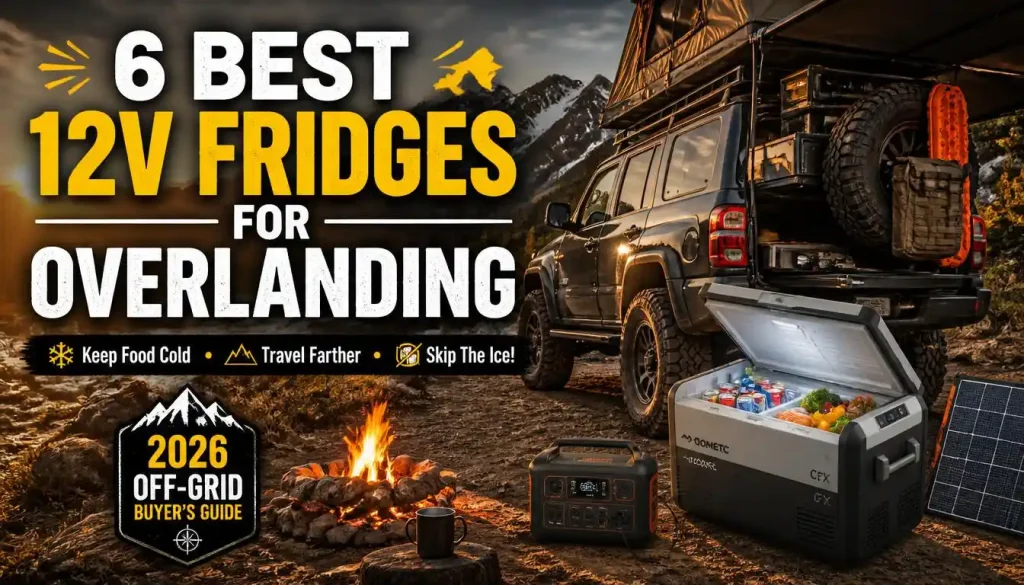
A good overland refrigerator changes the way you travel. Instead of buying ice every couple of days, draining melted water from a cooler, and worrying about spoiled meat or warm drinks, you can keep food at a steady temperature wherever your vehicle takes you.
The problem is choosing the right fridge.
Some portable refrigerators are huge but pull more power than you want. Others are compact but barely hold enough food for a weekend. And if you regularly drive rough forest roads, desert trails, or rocky tracks, durability matters just as much as cooling performance.
After comparing current Amazon-listed models, I narrowed the choices down to six refrigerators that make sense for different overland setups from compact SUVs to fully built trucks and long-distance camping rigs.
Amazon Affiliate Disclosure: As an Amazon Associate, I earn from qualifying purchases.
Quick Comparison: Best Overland Refrigerators
| Product | Capacity | Best For | Check Price |
|---|---|---|---|
| ICECO VL60 ProS | 60L | Best Overall | Check Price |
| ICECO APL55 Dual Zone | 55L | Best Dual-Zone | Check Price |
| ICECO VL45 ProS | 45L | Best Mid-Size | Check Price |
| BougeRV 42 Quart | 42 qt | Best Budget Pick | Check Price |
| EUHOMY 53QT | 53 qt / 50L | Best Large Value | Check Price |
| BougeRV 23 Quart | 23 qt | Best Compact | Check Price |
1. ICECO VL60 ProS – Best Overall Overland Refrigerator
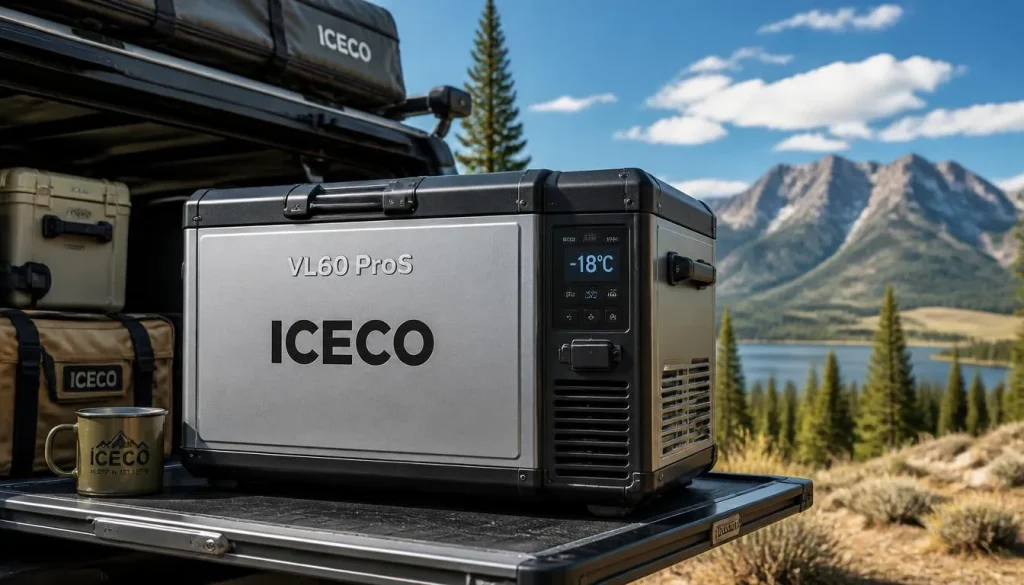
Check ICECO VL60 ProS Price on Amazon
The ICECO VL60 ProS is my top choice for an overland setup where you want plenty of storage without moving into full-size RV refrigerator territory.
Its 60-liter capacity works particularly well for couples, families, or anyone taking multi-day trips away from grocery stores. It uses a SECOP compressor and supports both 12/24V DC and 110–240V AC power. The listed cooling range is 0°F to 50°F, so it can operate as either a refrigerator or freezer depending on your trip.
One detail I especially like for vehicle installations is the multi-directional lid. Fridge access can become awkward once you add drawers, sleeping platforms, water tanks, recovery equipment, and other overland gear. Having more flexibility around the lid makes installation easier.
Dual USB ports also give you another convenient place to charge small devices at camp.
Pros
- ✓ Large 60L capacity for extended trips
- ✓ SECOP compressor
- ✓ Runs from 12/24V DC or AC power
- ✓ Multi-directional opening lid
- ✓ Can refrigerate or freeze
- ✓ Dual USB charging ports
- ✓ Strong choice for trucks, SUVs, and larger overland builds
Cons
- ✗ Takes up considerably more cargo space than a 30–45L fridge
- ✗ Heavier and less convenient to move when fully loaded
- ✗ May be more refrigerator than a solo weekend traveler actually needs
My Take
If I were building one fridge setup for regular overlanding and had enough cargo room, this is the model I would put near the top of the list.
The 60L size gives you enough space to stop treating every trip like a packing puzzle, while the SECOP compressor and flexible power options fit the demands of vehicle-based travel.
For long weekends, remote camping, and extended road trips, the VL60 ProS offers one of the best combinations of capacity, rugged design, and practical features.
2. ICECO APL55 Dual Zone – Best Dual-Zone Overland Fridge
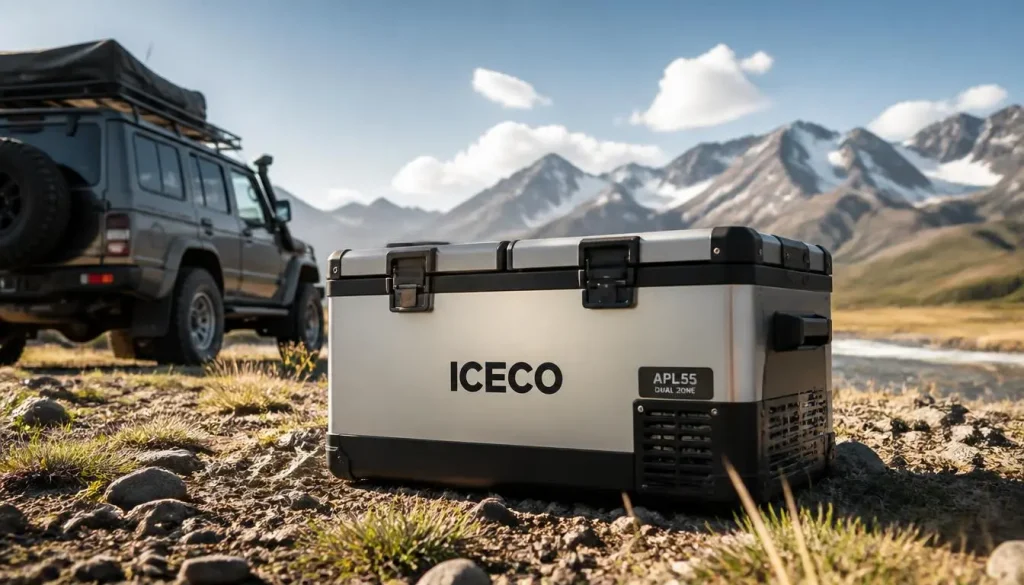
Check ICECO APL55 Price on Amazon
Sometimes one temperature zone isn’t enough.
Maybe you want cold drinks and vegetables on one side while keeping meat frozen on the other. That’s where a dual-zone refrigerator becomes much more useful than a traditional single-compartment 12V fridge.
The ICECO APL55 offers 55 liters of storage, dual-zone temperature control, Bluetooth control, and a SECOP compressor. Its Amazon listing specifies a temperature range of -4°F to 68°F along with 12/24V DC and 110–240V AC compatibility.
That versatility is especially valuable on longer overland trips where you’re carrying several days of fresh and frozen food.
Pros
- ✓ True dual-zone design
- ✓ Separate chilled and frozen storage possibilities
- ✓ 55L overall capacity
- ✓ SECOP compressor
- ✓ Bluetooth temperature control
- ✓ 12/24V DC and AC compatibility
- ✓ Excellent for longer off-grid trips
Cons
- ✗ Premium option compared with basic single-zone refrigerators
- ✗ Larger footprint requires careful cargo planning
- ✗ Dual-zone space may be unnecessary for short weekend trips
My Take
Dual-zone refrigeration sounds like a luxury until you start spending a week or more away from normal kitchen storage.
Being able to keep frozen meat separate from milk, vegetables, drinks, and leftovers makes food management noticeably easier.
If your overland trips regularly last several days and food storage is important, the APL55 is one of the most useful choices on this list.
3. ICECO VL45 ProS – Best Mid-Size Overlanding Refrigerator
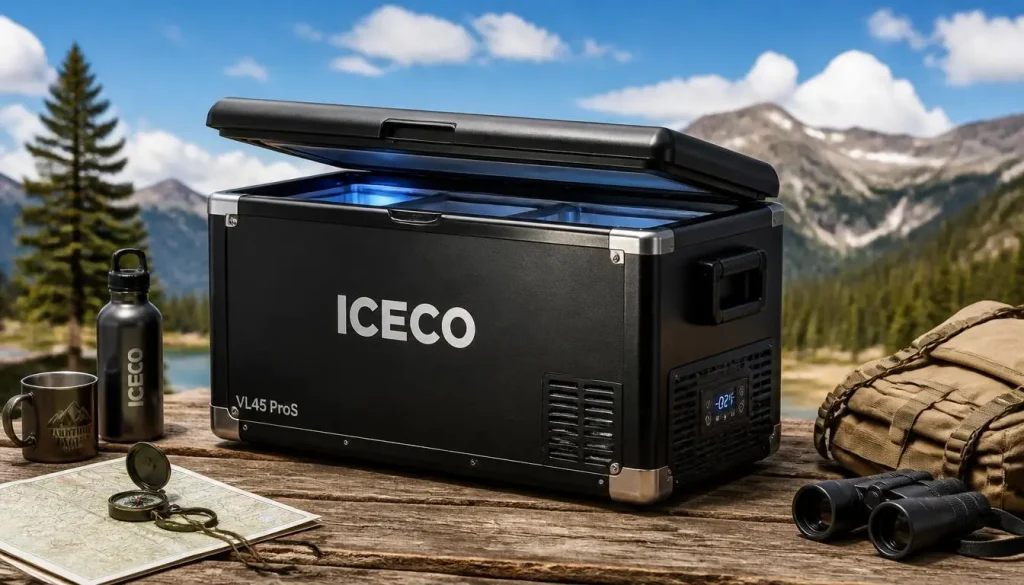
Check ICECO VL45 ProS Price on Amazon
Not every vehicle has room for a 55- or 60-liter fridge.
For many SUVs, Jeeps, crossovers, and midsize trucks, a refrigerator around 40–45 liters hits the sweet spot between usable food storage and reasonable cargo space.
The ICECO VL45 ProS provides 45 liters of capacity in a steel-bodied design. Its Amazon listing includes a SECOP compressor, a multi-directional lid, dual USB ports, 12/24V DC support, 110–240V AC support, and a listed operating range of 0°F to 50°F.
That makes it particularly attractive for people who need a serious overland refrigerator but don’t want half the cargo area occupied by it.
Pros
- ✓ Practical 45L capacity
- ✓ SECOP compressor
- ✓ Steel construction
- ✓ Multi-directional lid
- ✓ Dual USB ports
- ✓ AC and DC power compatibility
- ✓ Easier to fit than larger 55–60L models
Cons
- ✗ Less food storage for long family trips
- ✗ Single-zone layout isn’t as flexible as a dual-zone fridge
- ✗ Premium components can push the price above basic 12V coolers
My Take
The VL45 ProS may actually be the smartest size for the average overlander.
It’s large enough for real food storage but small enough to fit beside camping gear, tools, recovery equipment, and luggage.
If you’re unsure whether you really need 60 liters, I would look closely at this size first.
4. BougeRV 42 Quart – Best Budget Overland Refrigerator
Check BougeRV 42 Quart Price on Amazon
You don’t necessarily need a premium refrigerator to stop carrying bags of ice.
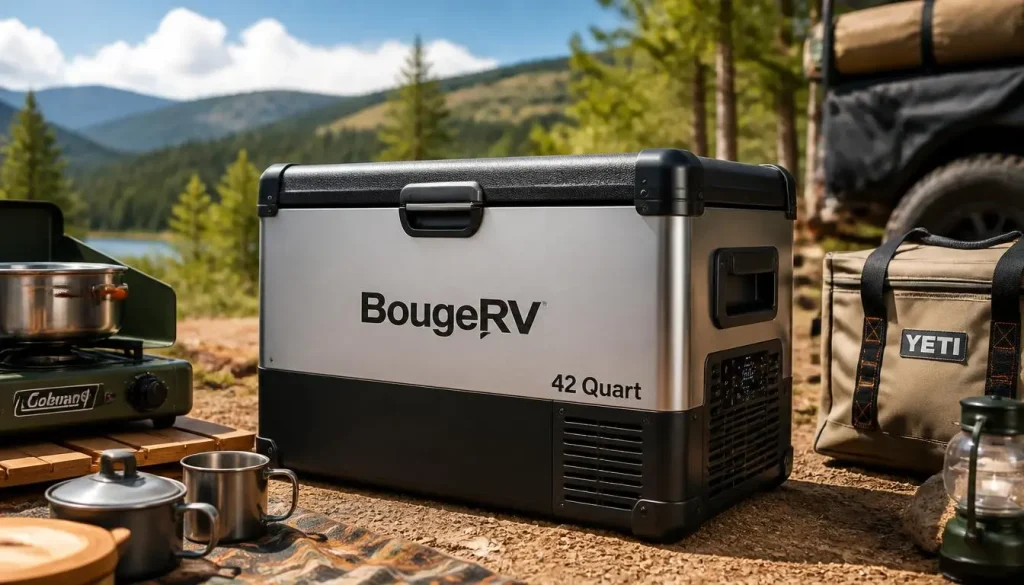
The BougeRV 42 Quart model gives budget-conscious campers a practical compressor refrigerator with enough room for normal weekend and short multi-day trips.
Amazon lists it at 42 quarts with dimensions of roughly 25.8 x 13.6 x 17.4 inches. That long, relatively narrow shape can work well in vehicle cargo areas where width is limited.
For someone moving from a traditional ice chest to their first powered refrigerator, this size is also easier to manage than jumping straight into a massive 60-liter unit.
Pros
- ✓ Good balance of price and capacity
- ✓ 42-quart storage
- ✓ Compressor cooling
- ✓ 12V-friendly design
- ✓ Manageable footprint for many SUVs and trucks
- ✓ Good entry point into powered overland refrigeration
Cons
- ✗ Less premium construction than higher-end ICECO models
- ✗ Single-zone configuration
- ✗ Serious long-term overlanders may eventually want more capacity
My Take
This is the type of fridge I would consider when the goal is simple: get rid of ice without spending premium-fridge money.
It doesn’t need to be the fanciest refrigerator in your vehicle. It needs to keep food cold, fit the available space, and work from your electrical system.
For weekend trips and occasional overlanding, the BougeRV 42 Quart makes a lot of sense.
5. EUHOMY 53QT – Best Large-Capacity Value
Check EUHOMY 53QT Price on Amazon
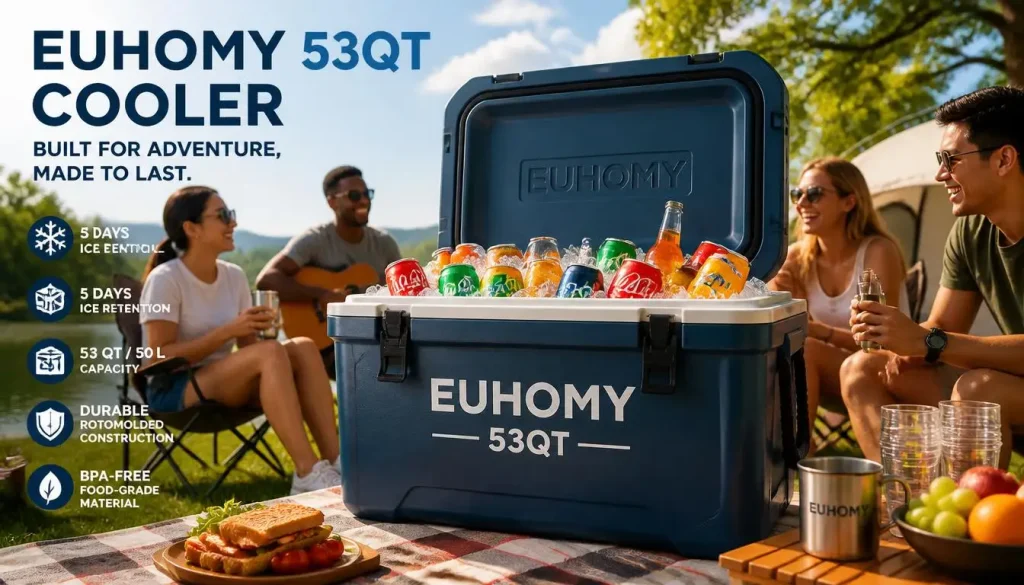
The EUHOMY 53QT is aimed at travelers who want a larger fridge without immediately stepping into premium overland pricing.
Its Amazon listing gives it a 53-quart, or approximately 50-liter, capacity. It comes with 12/24V DC and 110/240V AC adapters, two storage baskets, and a divider. Amazon also lists features such as anti-shake construction, low-noise operation, and touch controls.
The baskets are a small feature that can make a surprisingly large difference. Digging through a fully packed chest-style fridge gets old quickly, especially when the item you need is at the bottom.
Pros
- ✓ Large 53QT capacity
- ✓ 12/24V DC compatibility
- ✓ AC adapter support
- ✓ Includes two baskets and a divider
- ✓ Anti-shake design
- ✓ Good capacity for the money
- ✓ Suitable for larger camping food loads
Cons
- ✗ Requires more cargo space than 35–45L models
- ✗ Not as established in hardcore overland builds as some premium brands
- ✗ Larger capacity encourages overpacking if vehicle space is already tight
My Take
The EUHOMY makes sense for buyers who care more about usable space than having the most recognizable overland refrigerator brand.
Fifty liters is enough to carry a serious amount of food and drinks, yet the fridge still fits into the portable 12V category.
For family camping or longer road trips on a tighter budget, it’s a strong value option.
6. BougeRV 23 Quart – Best Compact Overland Refrigerator
Check BougeRV 23 Quart Price on Amazon
Sometimes smaller really is better.
A solo traveler, day-trip vehicle, compact SUV, or weekend camping setup may not need a giant refrigerator occupying valuable cargo room.
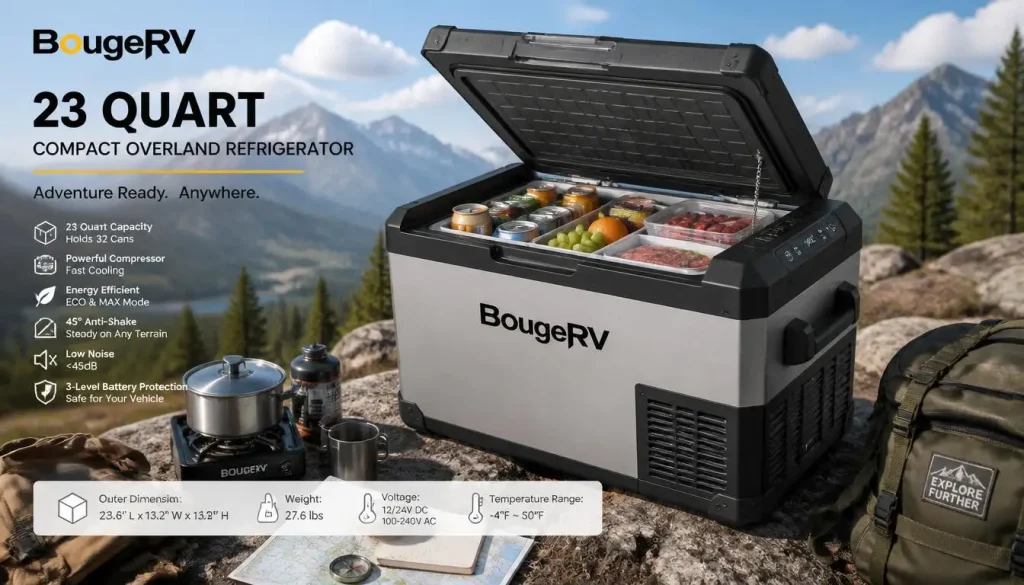
The BougeRV 23 Quart is designed for exactly that situation. The current Amazon listing describes a 23-quart compressor refrigerator with 12/24V DC and 110V AC support. BougeRV also states that it can cool from 77°F to 32°F in about 15 minutes under its specified test conditions.
The smaller size also means it should be easier to move between vehicles or bring inside when you’re not traveling.
Pros
- ✓ Compact 23-quart size
- ✓ Easier to fit in smaller vehicles
- ✓ Compressor-based cooling
- ✓ 12/24V DC and AC support
- ✓ Fast initial cooling specification
- ✓ Good for solo travelers and weekend trips
Cons
- ✗ Limited capacity for families
- ✗ Not ideal for a week of off-grid food storage
- ✗ You’ll need to pack more carefully than with a 45–60L fridge
My Take
Don’t buy a 60-liter refrigerator just because larger sounds better.
A big fridge takes up space every single day—even when it is half empty.
If your overland trips usually involve one or two people and a couple of nights away, a compact 23-quart model can be a much smarter use of cargo space.
Buyer’s Guide: 5 Things to Consider Before Buying an Overland Refrigerator
1. Capacity
Capacity should match both the length of your trips and the number of people traveling.
For one person or short weekends, roughly 20–30 quarts can be enough.
For couples and regular multi-day trips, the 40–50L range is usually much easier to live with.
Families and long-distance travelers may appreciate 55–60L or more.
But remember: every extra liter takes up vehicle space.
Measure your cargo area before buying.
2. Single Zone vs. Dual Zone
A single-zone refrigerator keeps the entire compartment at roughly one target temperature.
You can use it as a refrigerator or freezer, but not both at different temperatures at the same time.
Dual-zone models are more flexible because one compartment can keep food chilled while another handles frozen items.
For short trips, single zone is usually simpler.
For extended expeditions, dual zone becomes much more useful.
3. Power Consumption and Battery Protection
Your fridge may run 24 hours a day, so electrical efficiency matters.
Most overland refrigerators run from a vehicle’s 12V or 24V DC system. If you plan to keep the refrigerator running while the engine is off, consider how it fits into your auxiliary battery, power station, or solar setup.
Battery protection is also important because the last thing you want is cold drinks and a vehicle that won’t start.
4. Compressor and Off-Road Durability
Overland refrigerators have a harder life than kitchen appliances.
They deal with vibration, heat, steep trails, potholes, dust, and constant movement.
Compressor quality and overall construction therefore matter.
A refrigerator that works perfectly on pavement but repeatedly shuts down when the vehicle is tilted or bouncing down rough tracks isn’t very useful for serious travel.
5. Physical Dimensions
Capacity numbers can be misleading.
Two 45L refrigerators can have very different shapes.
Measure:
- Available width
- Available depth
- Lid-opening clearance
- Height under cargo covers or sleeping platforms
- Space around ventilation openings
- Room required for a fridge slide
Do this before placing your order.
A slightly smaller refrigerator that fits your build correctly is usually better than a larger one that blocks drawers or forces you to rearrange the whole vehicle.
Frequently Asked Questions
What is the best overland refrigerator?
For a larger all-around setup, the ICECO VL60 ProS is my top pick because it combines 60L of storage, SECOP compressor technology, flexible AC/DC power options, and an overland-friendly lid design.
For smaller builds, the ICECO VL45 ProS offers a better balance of storage space and footprint.
What size refrigerator is best for overlanding?
Around 40–50 liters is a useful starting point for many couples and regular weekend travelers.
Solo travelers may be comfortable with 20–30 quarts, while families and people taking longer remote trips may prefer 55–60 liters.
Your available vehicle space should ultimately decide the size.
Is a 12V fridge better than a cooler for overlanding?
For frequent travel, usually yes.
A compressor refrigerator doesn’t require constant ice replacement, gives you direct control over temperature, and doesn’t leave food sitting in melted ice water.
A traditional cooler still makes sense for occasional trips or situations where no electrical system is available.
Can an overland fridge drain my car battery?
It can if you run it from the starter battery for too long with the engine off.
A properly designed overland setup normally uses battery protection plus an auxiliary battery, portable power station, or another suitable power source for extended stationary use.
Should I get a single-zone or dual-zone overland refrigerator?
Choose single zone if you mainly need refrigerated food and drinks.
Choose dual zone if you regularly want frozen meat or other frozen food alongside chilled items.
Dual-zone models are especially useful on longer trips.
Can I run an overland refrigerator with solar power?
Yes, but the solar panels normally charge a battery or portable power station that then powers the fridge.
The correct battery and solar-panel size depends on refrigerator consumption, weather, temperature, other electrical loads, and how many hours you need the system to operate without driving.
Where should I install an overland refrigerator?
Install it where you can reach the lid comfortably while still allowing proper ventilation around the compressor area.
Popular locations include the rear cargo area of an SUV, a truck-bed drawer system, canopy, trailer, or dedicated fridge slide.
Always check the refrigerator’s ventilation requirements before enclosing it.
Final Verdict: Which Overland Refrigerator Should You Buy?
There isn’t one perfect refrigerator for every overland vehicle.
For a serious all-around setup with plenty of food storage, my first choice is the ICECO VL60 ProS. Its 60L capacity, SECOP compressor, flexible power options, and practical lid design make it well suited to longer trips.
If you want simultaneous refrigerator and freezer storage, choose the ICECO APL55 Dual Zone.
For a more space-conscious build, the ICECO VL45 ProS is probably the most balanced option.
Budget-focused buyers should look at the BougeRV 42 Quart, while people needing maximum value from a larger fridge should consider the EUHOMY 53QT.
And if cargo space matters more than maximum capacity, the BougeRV 23 Quart is the compact choice.
The most important thing is to buy for your actual vehicle and travel style—not simply the biggest refrigerator you can afford.
Measure your available space, think about how many days of food you normally carry, check your electrical system, and choose the fridge that fits the way you really travel.

Hi, I’m the lead researcher and appliance enthusiast behind RefrigeratorSolve. With years of hands-on experience troubleshooting cooling systems and testing home appliances, I am dedicated to bringing you honest reviews, energy-saving tips, and practical solutions to keep your refrigerator running perfectly.