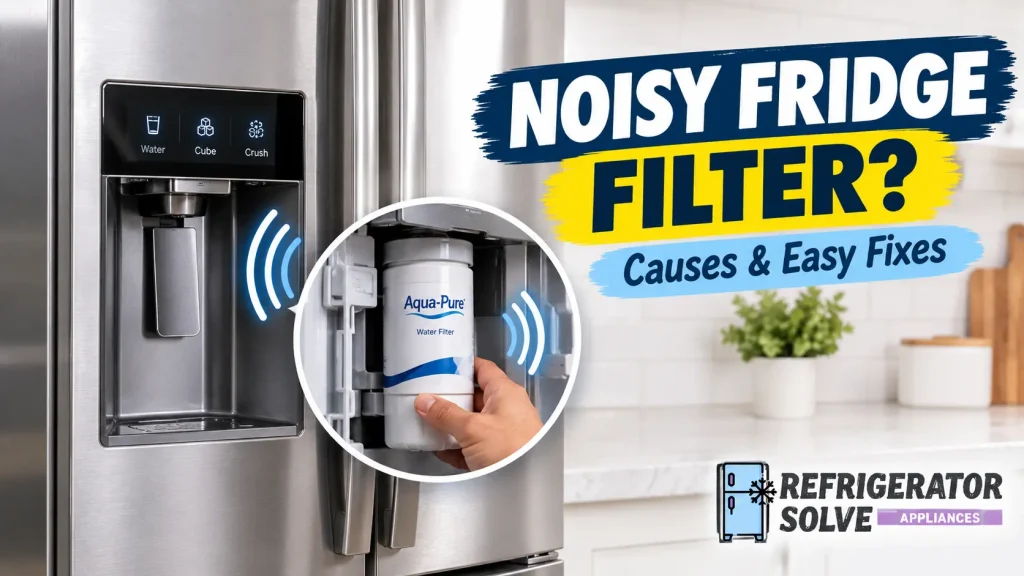
A refrigerator Aqua-Pure water filter can make noise when air is trapped in the water line, the filter is clogged or installed incorrectly, water pressure is unstable, the supply line is kinked, or the water inlet valve is struggling with restricted flow.
The sound may be a buzz, chatter, whistle, knock, gurgle, or vibration. In many cases, the problem is minor and can be fixed by checking the filter, opening the water valve fully, straightening the supply line, and flushing air from the system.
However, persistent noise combined with leaking, very slow water flow, no water, or repeated valve chattering deserves closer attention.
This guide will help you identify exactly what is causing the noise, what you can safely check yourself, and when it is better to call a refrigerator technician or plumber.
Quick Answer: Why Is My Refrigerator Aqua-Pure Water Filter Making Noise?
The most common causes are:
- Air trapped in the water line
- A newly installed filter that has not been flushed
- An old or clogged water filter
- An incorrectly installed filter
- A loose filter connection
- A damaged seal or O-ring
- Low or unstable household water pressure
- A partially closed water shutoff valve
- A kinked or vibrating refrigerator water line
- Water hammer in the plumbing
- A restricted filter head or housing
- A noisy or failing refrigerator water inlet valve
The timing of the noise gives you one of the best clues.
If it happens only when you dispense water, focus on the filter, water supply, and inlet valve. If it happens when the ice maker fills, check the same water system plus the ice maker connection. If the noise started immediately after replacing the filter, trapped air or incorrect filter installation is more likely.
| Noise or Symptom | Likely Cause | First Thing to Check |
|---|---|---|
| Gurgling after filter change | Trapped air | Flush the water system |
| Chattering while dispensing | Restricted or unstable water flow | Filter, valve, and water line |
| Buzzing during dispensing | Water inlet valve or low flow | Water supply and filter |
| Knocking when water stops | Pressure change or water hammer | Household plumbing |
| Whistling | Restricted flow | Filter and tubing |
| Vibrating near filter | Loose tubing or filter mounting | Filter and water line |
| Noise with slow water | Clogged filter or low pressure | Filter and shutoff valve |
| Noise during ice maker fill | Inlet valve or restricted supply | Ice maker water supply |
| Noise plus leaking | Seal, fitting, or housing problem | Stop water and inspect |
| Noise after new filter | Air or installation issue | Reseat and flush filter |
Is the Noise Coming From an Aqua-Pure In-Line Filter or the Refrigerator Filter?
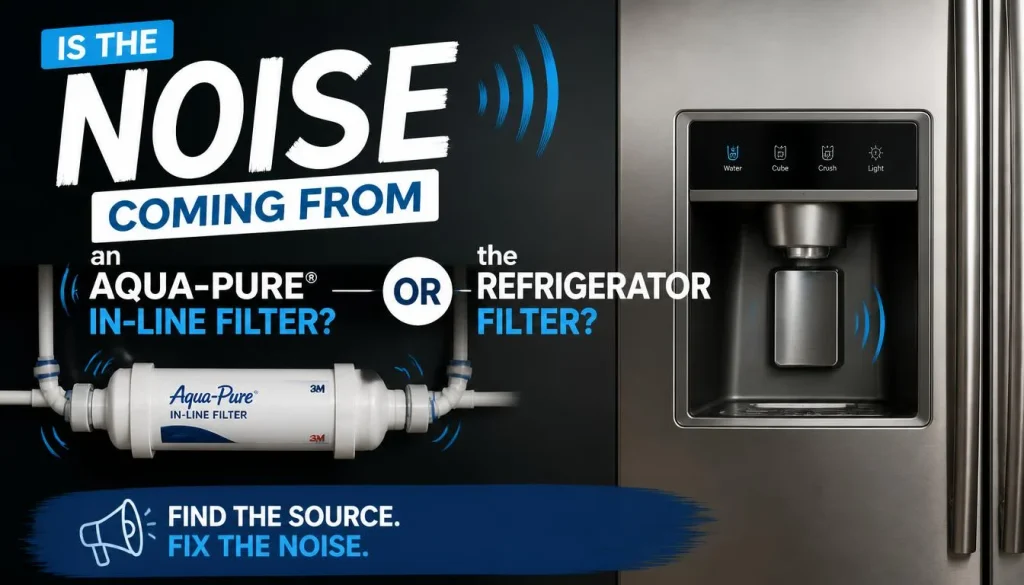
Before troubleshooting, identify what type of filter you have.
This matters because an Aqua-Pure in-line filter and an internal refrigerator cartridge are installed in different places.
Aqua-Pure In-Line Refrigerator Water Filter
Aqua-Pure models such as the AP717 are designed to be installed in the incoming cold-water line that supplies a refrigerator or ice maker.
The basic water path looks like this:
Household water supply → Aqua-Pure in-line filter → refrigerator → dispenser or ice maker
With this type of setup, noise may come from the filter itself, the tubing connected to it, a fitting, the refrigerator inlet valve, or a pressure problem elsewhere in the line.
If you are comparing replacement options, this guide to the best in-line water filters for refrigerators can help you understand how external filtration systems differ from internal refrigerator cartridges.
Built-In Refrigerator Water Filter
Many modern refrigerators have a cartridge installed inside the fresh-food compartment, lower grille, or another dedicated filter housing.
The water path is more like:
Household water supply → refrigerator inlet valve → internal filter system → dispenser or ice maker
A noise that sounds as though it comes from the filter may actually be coming from the nearby inlet valve.
That is why you should diagnose the timing and location of the sound before buying a new filter.
What Does Each Type of Water Filter Noise Mean?
Different noises often point toward different problems.
Buzzing or Humming
A brief buzz while the ice maker fills or while you dispense water can be normal. The refrigerator’s water inlet valve has to open to allow water into the appliance.
A louder or longer buzz can be caused by:
- Low water pressure
- A clogged filter
- A partially closed supply valve
- A kinked line
- A worn inlet valve
If you hear humming at other times as well, use this refrigerator loud humming noise troubleshooting guide to determine whether the water system, fan, or compressor is responsible.
Chattering
Chattering often sounds like rapid clicking, rattling, or a small machine gun.
This type of sound is especially important when it happens during water dispensing.
The inlet valve may be opening and closing rapidly because it is not receiving a steady flow of water.
Possible causes include:
- Restricted filter
- Low household pressure
- Partially closed water valve
- Kinked tubing
- Air in the line
- Valve vibration
Gurgling or Sputtering
Gurgling shortly after installing a new water filter usually points to air in the system.
You may also notice that water:
- Spits from the dispenser
- Comes out unevenly
- Contains small air bubbles
- Stops and starts for a short time
This often improves after the system is properly flushed.
Knocking or Banging
A knocking sound can happen when water flow starts or stops suddenly.
The problem may be related to:
- A moving water line
- High or changing household water pressure
- Water hammer
- A valve closing quickly
Do not assume the filter is defective just because the noise seems to come from behind the refrigerator.
Whistling or Squealing
A whistle usually suggests that water is being forced through a restricted point.
Check for:
- A clogged filter
- A pinched tube
- Incorrect filter installation
- A partly closed valve
- A restricted fitting
Vibrating or Rattling
The filter may not actually be producing the sound.
A plastic or copper water line can vibrate against the refrigerator cabinet, wall, floor, or another pipe when water begins flowing.
For more causes unrelated to the filter itself, see this guide on what causes a refrigerator to make a vibrating noise.
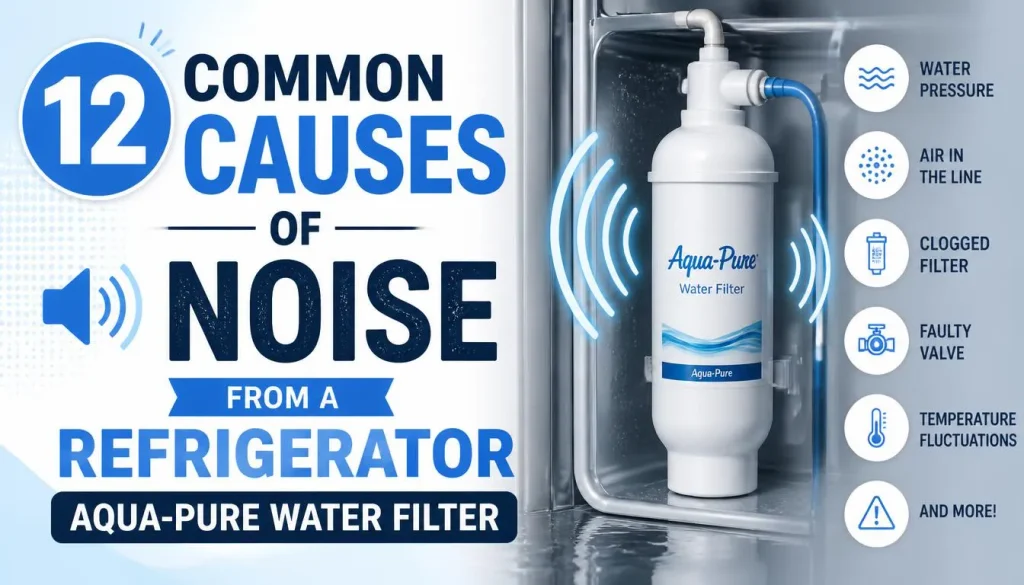
12 Common Causes of Noise From a Refrigerator Aqua-Pure Water Filter
1. Air Is Trapped in the Water Line
Trapped air is one of the first things to suspect if the noise started after:
- Replacing the water filter
- Installing a refrigerator
- Disconnecting the water line
- Turning the household water supply off and back on
- Plumbing work in the home
Air does not move through the system as smoothly as water. It can create gurgling, pulsing, sputtering, and temporary vibration.
How to Fix It
Dispense water continuously or in long intervals according to your refrigerator manufacturer’s flushing instructions.
Keep a large container nearby.
Do not rely on one universal amount of water because flushing requirements vary by refrigerator and filter model.
Continue until the water flows smoothly without sputtering.
2. The Filter Has Not Been Flushed After Installation
A new filter should normally be flushed before you begin using the water for drinking.
Flushing helps remove trapped air and loose filter media while allowing the cartridge to fill completely with water.
If you replace the filter and immediately hear gurgling or notice uneven water flow, flushing should be one of your first steps.
3. The Filter Is Not Installed Correctly
An internal filter cartridge must usually sit fully inside its housing and lock into the correct position.
An in-line filter must also be connected in the correct direction and have secure fittings.
An improperly installed filter may cause:
- Low flow
- Whistling
- Chattering
- Leaking
- Pulsing from the dispenser
- Air entering the line
Check the flow-direction arrow on an external filter and follow the filter manufacturer’s installation instructions.
Never force a filter into position if it does not fit normally.
4. The Aqua-Pure Filter Is Clogged or Overdue for Replacement
Filters collect sediment and other material as water passes through them.
Eventually, the restriction can increase.
A restricted filter may cause:
- Slow dispenser flow
- Smaller ice cubes
- Slow ice production
- Chattering
- Humming
- Whistling
- Longer fill cycles
Aqua-Pure AP717 documentation specifies cartridge replacement at the recommended interval and notes that reduced performance can occur when maintenance is delayed.
Water quality also matters. A household with more sediment may clog a filter sooner than another home using the same cartridge.
5. The Wrong Filter or Replacement Cartridge Is Installed
Not every filter that physically looks similar is compatible with every refrigerator or filter head.
An incompatible cartridge may:
- Seal poorly
- Restrict water
- Sit incorrectly
- Create unusual pressure changes
- Leak around the connection
Always match the replacement filter to the system or refrigerator model.
If you use an external system and are deciding whether that setup is right for your refrigerator, you can also review this guide to external refrigerator water filters.
6. The Household Water Shutoff Valve Is Partially Closed
This problem is easy to overlook.
If someone recently moved the refrigerator, repaired plumbing, installed a filter, or shut the water off for maintenance, the valve may not have been opened fully afterward.
A partially closed valve restricts the amount of water reaching the refrigerator.
That can cause:
- Weak dispenser flow
- Longer ice-maker fill times
- Chattering
- Buzzing from the inlet valve
- Pulsing water
Locate the refrigerator’s household shutoff valve and confirm that it is fully open according to the valve type.
If the valve is damaged, corroded, or difficult to operate, contact a plumber instead of forcing it.
7. Household Water Pressure Is Too Low or Unstable
The refrigerator’s water system needs adequate pressure to work normally.
If pressure drops too low or changes repeatedly, the water inlet valve may become noisy.
Pressure problems can be caused by:
- Plumbing work
- Multiple fixtures being used at once
- A failing pressure regulator
- A restricted household pipe
- A partly closed shutoff valve
- A reverse osmosis system
- A clogged filter
Do not assume a universal refrigerator pressure requirement. Check the owner’s manual for your exact model.
Aqua-Pure systems also have their own operating pressure limits, so installation should follow the filter documentation.
8. A Reverse Osmosis System Is Reducing Water Pressure
Some homes supply refrigerator water from a reverse osmosis, or RO, system.
Depending on the setup, an RO system can reduce pressure reaching the refrigerator.
If the refrigerator works normally when supplied directly but becomes noisy or slow when connected through another filtration system, water pressure should be checked.
Common symptoms include:
- Weak dispenser flow
- Slow ice production
- Chattering
- Pulsing water
- Loud valve buzzing
If you are unsure whether the pressure is adequate, a plumber can test it with the correct gauge.
9. The Refrigerator Water Supply Line Is Kinked
Pulling a refrigerator out and pushing it back into place can accidentally pinch the water line.
A kink can reduce flow just like a clogged filter.
Inspect the visible line behind the refrigerator.
Make sure it is not:
- Crushed against the wall
- Trapped under a wheel
- Bent at a sharp angle
- Twisted
- Pulled too tightly
Move the refrigerator carefully. Avoid damaging copper or plastic tubing.
10. The Water Line Is Vibrating Against Another Surface
Sometimes water pressure and filter performance are completely normal.
The noise is simply vibration.
When the inlet valve opens, the water line can move slightly. If it touches the rear refrigerator panel, wall, cabinet, or floor, that movement may become surprisingly loud.
Listen while someone dispenses water.
If the sound happens at exactly the same moment water begins moving, inspect the visible tubing.
Secure it correctly without crushing or sharply bending it.
11. The Filter Seal, O-Ring, Fitting, or Housing Has a Problem
Water-filter connections depend on properly seated seals.
Problems can develop if:
- An O-ring is damaged
- A fitting is loose
- Tubing is not inserted fully
- A filter head is cracked
- A cartridge is cross-threaded
- Dirt is trapped around the sealing surface
A connection problem becomes more serious if you also see moisture.
If there is active leaking, turn off the refrigerator’s water supply before continuing.
Do not keep operating a leaking filtration system.
12. The Refrigerator Water Inlet Valve Is Noisy or Failing
The water inlet valve controls water entering the refrigerator.
A short buzz while it operates is often normal.
A loud, prolonged, or repeated chatter may indicate that the valve is dealing with restricted flow or is wearing out.
Before blaming the valve, check:
- The filter
- Household water valve
- Supply line
- Water pressure
- Air in the system
If all of those are normal but the valve remains unusually loud, professional diagnosis may be necessary.
Why Is My Refrigerator Water Filter Making Noise and Dispensing Water Slowly?
Noise plus slow water flow is a useful combination of symptoms.
It usually means water is having difficulty moving through the system.
Start with these checks:
Check the Filter
If the filter is old or the water flow gradually became weaker, replace it with the correct cartridge.
Check the Shutoff Valve
Make sure the household valve supplying the refrigerator is fully open.
Check the Water Line
Look for a kink, pinch, or sharp bend.
Flush Air From the System
If the problem appeared immediately after replacing the filter, trapped air may be responsible.
Check Water Pressure
If other fixtures in the home also seem weaker than normal, the issue may not be inside the refrigerator.
Consider the Inlet Valve
If flow remains poor after the filter and supply have been checked, the refrigerator’s inlet valve or another internal water-system component may require service.
Why Is My Refrigerator Making Noise After Changing the Aqua-Pure Water Filter?
Noise that begins immediately after a filter replacement usually points toward the work that was just performed.
The most likely causes are:
- Air entered the line
- Filter was not fully seated
- External filter was installed in the wrong flow direction
- Tubing was moved or kinked
- A fitting is not fully secure
- Water valve was not fully reopened
- Replacement filter is incorrect
- Filter has not been flushed
Start by inspecting the installation rather than replacing refrigerator parts.
How Long Should the Noise Last?
Temporary gurgling and sputtering can occur while air is being removed.
The noise should improve as water flow becomes smooth.
Persistent chattering, loud buzzing, leaking, or very weak flow should not simply be ignored for days. Recheck the installation and water supply.
Why Does My Refrigerator Make Noise When Dispensing Water?
If the refrigerator is quiet until you press the dispenser paddle, the problem is probably connected to the water system.
Pay attention to both the sound and the water flow.
Normal Flow With a Short Buzz
A brief sound may simply be the inlet valve opening.
Slow Flow With Loud Buzzing
Check:
- Filter restriction
- Water pressure
- Supply valve
- Kinked tubing
Chattering or Pulsing
Look for unstable pressure, trapped air, or restricted flow.
Gurgling After a Filter Change
Flush the system.
If buzzing occurs at other times too, the broader guide on refrigerator buzzing noises and their causes may help you separate water-system noise from compressor or fan noise.
Why Does My Refrigerator Make Noise When the Ice Maker Fills?
The ice maker uses the same incoming water supply as the dispenser on many refrigerators.
During a fill cycle, the water inlet valve opens for a short period.
You may hear:
- A brief buzz
- Water rushing
- A click
- Mild vibration
Those sounds can be normal.
Investigate further if you hear loud buzzing but little or no water enters the ice maker.
Check:
- Is the water supply connected?
- Is the shutoff valve fully open?
- Is the line kinked?
- Is the filter clogged?
- Is the filter installed properly?
- Is water pressure adequate?
If the refrigerator is not connected to a water supply, do not leave an automatic ice maker running unless the manufacturer’s instructions specifically allow it.
How to Fix a Noisy Refrigerator Aqua-Pure Water Filter Step by Step
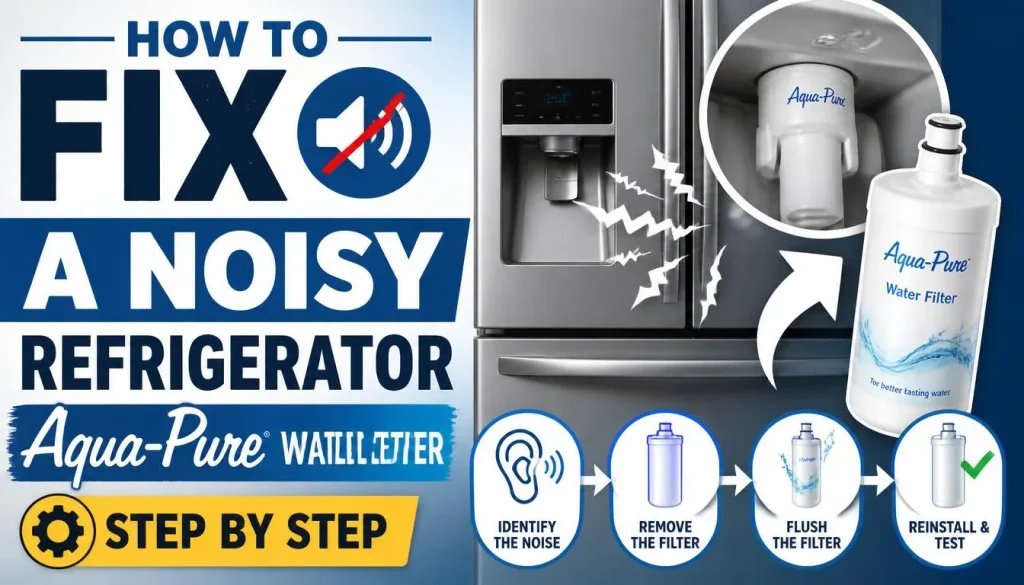
Use this order so you do not replace parts unnecessarily.
Step 1: Identify When the Noise Happens
Ask yourself:
- Does it happen while dispensing water?
- Does it happen while the ice maker fills?
- Did it start after changing the filter?
- Is water flow slower than before?
- Is the noise constant or brief?
Timing quickly narrows the problem.
Step 2: Inspect for Leaks
Check the filter, tubing, fittings, floor, and rear of the refrigerator.
If you find active leaking, shut off the water supply before continuing.
Step 3: Check the Filter Installation
For a built-in cartridge:
- Confirm it is the correct filter
- Make sure it is fully inserted
- Lock it according to the manufacturer’s instructions
For an external Aqua-Pure filter:
- Check the flow direction
- Inspect visible connections
- Make sure tubing is secure
- Look for signs of leaking
Step 4: Flush the Water System
Dispense water according to your refrigerator or filter manufacturer’s procedure.
Continue until the stream becomes smooth and air no longer spits from the dispenser.
Step 5: Check the Household Shutoff Valve
Confirm that it is open fully and is not damaged.
Step 6: Inspect the Supply Line
Straighten any gentle bends and correct visible pinching.
Do not aggressively bend old plastic or copper tubing because it may crack.
Step 7: Compare Water Flow
Notice whether water is strong and steady or unusually weak.
Weak flow supports the possibility of:
- Filter restriction
- Low water pressure
- Closed valve
- Kinked line
- Inlet valve problem
Step 8: Replace an Overdue Filter
Use the correct replacement cartridge.
Do not substitute a filter simply because the dimensions appear close.
Step 9: Listen Again
After each change, test the dispenser and wait for the next ice-maker fill cycle.
This tells you which step actually fixed the problem.
Step 10: Arrange Professional Diagnosis if Needed
If the water supply, filter, and tubing are correct but the noise remains loud, the inlet valve, filter head, or another internal component may need service.
For noises that are not limited to the water system, use this broader guide on how to fix a refrigerator making loud noise.
How to Test Whether the Filter Is Actually Causing the Problem
Some refrigerators with built-in filters support a manufacturer-approved filter bypass plug.
A bypass test can help determine whether a restricted filter is causing slow water flow.
The basic diagnostic idea is:
Poor flow with filter → install approved bypass plug → test dispenser → flow improves → filter or filter installation is likely involved
Important: not every refrigerator uses a bypass plug, and this procedure does not apply in the same way to an external Aqua-Pure in-line filter.
Check the owner’s manual for your refrigerator before removing or bypassing any filtration component.
Never improvise fittings or operate a water connection in a way the manufacturer does not approve.
Is Refrigerator Water Filter Noise Normal?
Some water-related noises are normal.
Usually Normal
You may hear:
- A short buzz when the inlet valve opens
- Water rushing during ice-maker filling
- Brief gurgling after installing a filter
- Temporary sputtering while trapped air is cleared
- A light click when a valve starts or stops
Needs Investigation
Pay more attention to:
- Continuous chattering
- Very loud buzzing
- New whistling
- Repeated banging
- Severe vibration
- Weak or pulsing water flow
- No water from the dispenser
- Water leaking around the filter
- Noise that becomes worse over time
The change in sound is often more important than the exact type of sound.
A refrigerator that has produced the same mild buzz for years is different from one that suddenly starts chattering loudly after a filter change.
Is a Noisy Aqua-Pure Refrigerator Water Filter Dangerous?
Noise alone is not usually an emergency.
For example, trapped air can sound unpleasant without creating a dangerous situation.
However, stop and investigate promptly if the noise is accompanied by:
- Water leaking
- A cracked filter housing
- A damaged fitting
- A loose water line
- Electrical smell
- Water near an electrical connection
- Violent pipe movement
- A filter that will not lock or connect correctly
If water is leaking, shut off the supply.
If water has reached electrical parts, disconnect power only when it is safe to do so and seek qualified help.
When Should You Replace an Aqua-Pure Refrigerator Water Filter?
Follow the replacement schedule for your exact Aqua-Pure cartridge.
The AP717 documentation calls for regular cartridge replacement and specifies a six-month replacement interval for that system.
However, a filter may require earlier replacement if:
- Water flow drops significantly
- Local water contains heavy sediment
- Taste or odor changes
- The filter shows physical damage
- The manufacturer recommends earlier replacement for your usage conditions
Do not assume every refrigerator filter uses the same replacement interval. Always check your specific model.
How to Prevent Aqua-Pure Refrigerator Water Filter Noise
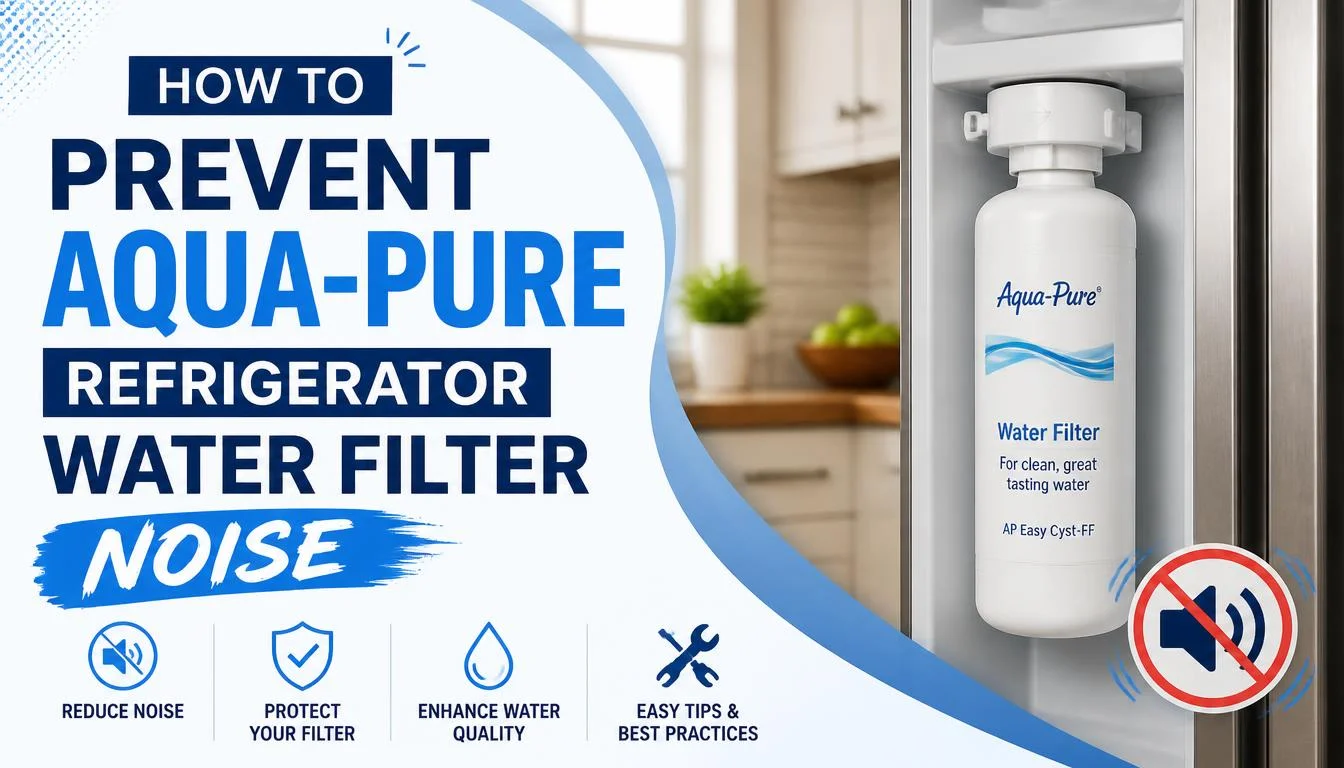
A few habits can prevent many water-system problems.
Use the Correct Filter
Match the replacement cartridge to the refrigerator or filtration system.
Flush Every New Filter
Flushing helps clear air and prepares the new cartridge for normal flow.
Replace Filters on Schedule
Do not wait until the dispenser barely works.
Keep the Water Valve Fully Open
A restricted household valve can make the refrigerator’s inlet valve work under poor conditions.
Protect the Supply Line
When moving the refrigerator, make sure the line does not become trapped or kinked.
Secure Loose Tubing
Tubing should not bang against the refrigerator or wall when water moves.
Watch for Changes in Flow
A gradual decrease in dispenser flow can warn you about restriction before the system becomes very noisy.
Check for Leaks After Filter Replacement
Look at every connection after installing an external filter or changing a cartridge.
When Should You Call a Refrigerator Technician or Plumber?
Call a refrigerator technician when:
- The inlet valve appears to chatter despite good water supply
- The refrigerator has internal leaking
- The filter housing appears damaged
- The dispenser still has poor flow after basic troubleshooting
- The ice maker does not fill correctly
- The refrigerator requires internal disassembly
- Electrical components may be involved
Call a plumber when:
- Household water pressure is unstable
- Pipes bang elsewhere in the home
- The shutoff valve is damaged
- You suspect water hammer
- Your RO system is affecting refrigerator pressure
- Supply plumbing needs modification
Knowing which professional to call can save time and money.
Frequently Asked Questions
Why is my Aqua-Pure refrigerator water filter making a buzzing noise?
A buzzing sound may come from the refrigerator’s water inlet valve rather than the filter itself. Restricted flow from a clogged filter, low pressure, a kinked line, or a partially closed water valve can make the buzzing louder.
Why is my refrigerator noisy after replacing the water filter?
Air may have entered the water line during replacement. The new filter may also be incorrectly seated, unflushed, incompatible, or restricting water flow.
Can air in a refrigerator water line cause noise?
Yes. Trapped air can cause gurgling, sputtering, pulsing, and temporary vibration. It commonly appears after a filter change, refrigerator installation, or interruption to the water supply.
Can a clogged refrigerator water filter make noise?
Yes. A restricted filter can reduce water flow and contribute to whistling, chattering, buzzing, and longer ice-maker fill cycles.
Why does my refrigerator make a chattering noise when I dispense water?
Chattering often happens when the inlet valve experiences restricted or unstable water flow. Check the filter, supply line, household shutoff valve, trapped air, and water pressure.
Why is my refrigerator water dispenser pulsing?
Pulsing can occur when air is trapped in the line or the water supply is restricted. A clogged filter, kinked tube, low pressure, or valve problem may be responsible.
Why is my refrigerator water filter making a whistling noise?
Whistling usually suggests that water is being forced through a narrow or restricted point. Check the filter, water line, shutoff valve, and fittings.
Can high water pressure cause refrigerator noise?
Yes. Sudden pressure changes can contribute to pipe movement, knocking, and water hammer. Aqua-Pure filtration systems also have specified operating-pressure limits, so follow the documentation for your particular model.
Can low water pressure make the refrigerator inlet valve noisy?
Yes. Low or inconsistent pressure may contribute to chattering or buzzing when the refrigerator calls for water.
Why does the refrigerator make noise only when the ice maker fills?
The water inlet valve opens during the ice-maker fill cycle. A short buzz may be normal. Louder noise can indicate restricted flow, a kinked line, low pressure, a clogged filter, or an ice maker trying to fill without adequate water.
Should I replace the water filter if my refrigerator is making noise?
Not automatically. First determine when the noise occurs and check water flow, installation, trapped air, the supply valve, and tubing. Replace the filter if it is overdue, restricted, damaged, or confirmed as the cause.
How do I know whether the Aqua-Pure filter or refrigerator is causing the noise?
Listen for where and when the sound occurs. Noise directly from an external filter or its tubing points toward the filter installation or supply. Noise from the refrigerator only during dispensing or ice filling may come from the inlet valve. Slow water flow provides another clue that the filtration or supply system is restricted.
Final Thoughts
So, what causes noise from a refrigerator Aqua-Pure water filter?
Most cases come down to a few practical problems: trapped air, a clogged or incorrectly installed filter, restricted water flow, a partially closed valve, a kinked or vibrating supply line, unstable water pressure, or a noisy refrigerator water inlet valve.
Start with the simple checks.
Look for leaks, confirm the filter installation, flush the system, open the water valve fully, and inspect the supply tubing. If the noise started immediately after changing the filter, focus on trapped air and installation before replacing refrigerator components.
A brief buzz, gurgle, or water-flow sound can be normal. Continuous chattering, severe vibration, leaking, or very slow water flow is a sign that the system deserves more attention.
If basic troubleshooting does not solve the problem, a refrigerator technician or qualified plumber can test the water pressure, inlet valve, filter housing, and supply system safely.

Hi, I’m the lead researcher and appliance enthusiast behind RefrigeratorSolve. With years of hands-on experience troubleshooting cooling systems and testing home appliances, I am dedicated to bringing you honest reviews, energy-saving tips, and practical solutions to keep your refrigerator running perfectly.