

A quiet hum from your refrigerator is usually nothing to worry about. Refrigerators contain compressors, fans, dampers, water valves, and other moving components that naturally produce some sound while the appliance is cooling.
However, you may have a genuine problem if the humming has suddenly become louder, continues for unusually long periods, or occurs alongside clicking, rattling, poor cooling, excessive frost, or overheating.
So, why is my Frigidaire refrigerator making a loud humming noise?
The most common causes include normal compressor operation, restricted airflow, a vibrating refrigerator cabinet, a dirty or obstructed condenser fan, ice around the evaporator fan, an ice maker with a water-supply problem, or a refrigerator that is running longer than usual.
The good news is that several of these issues can be identified and corrected without replacing any parts. This guide will help you locate the noise, determine whether it is normal, and decide whether you need professional refrigerator repair.
Quick answer: A steady, low humming sound is often part of normal refrigerator operation. A loud, new, irregular, or continuous hum may be caused by vibration, blocked airflow, a fan obstruction, ice buildup, an ice-maker water valve, or a mechanical fault. Start by identifying where and when the noise occurs.
Is a Humming Noise Normal in a Frigidaire Refrigerator?
Some humming sounds are normal because your refrigerator cannot cool food silently.
Frigidaire explains that modern high-efficiency compressors may produce a high-pitched hum or pulsating sound. Motorised dampers can also create a light hum, while the water valve may briefly buzz when it opens to fill the ice maker.
The important question is not simply whether your fridge is humming. You need to consider:
- How loud the sound is
- Where the sound is coming from
- How long it lasts
- Whether the refrigerator is still cooling
- Whether the sound has recently changed
- Whether another sound, such as clicking or grinding, occurs with it
Normal Frigidaire Refrigerator Humming Sounds
A humming sound is more likely to be normal when it is:
- Soft, steady, and only noticeable near the appliance
- Coming from the compressor during a cooling cycle
- Briefly heard when the ice maker fills with water
- Accompanied by normal airflow from the refrigerator vents
- More noticeable after groceries have been loaded
- More frequent during hot weather
- Present in a newly installed refrigerator that is still reaching its set temperature
Some Frigidaire French-door models use variable-speed compressors that may operate for extended periods to maintain a stable temperature efficiently. A compressor that runs for a long time is therefore not automatically defective.

Signs the Humming May Indicate a Problem
Investigate the noise when:
- It is much louder than it used to be
- It can be heard clearly from another room
- The refrigerator vibrates or shakes
- The hum changes into grinding, scraping, or rattling
- The refrigerator hums and repeatedly clicks
- The fresh-food section or freezer is too warm
- Ice or frost is building up around the freezer vents
- The compressor appears to run without stopping
- The outside of the refrigerator becomes unusually hot
- You notice an electrical or burning smell
- The circuit breaker repeatedly trips
A new sound does not always mean that a major component has failed. A bottle touching another container, a refrigerator pressed against a wall, or an unlevel cabinet can amplify a small operational sound.
Find Out Where the Humming Noise Is Coming From
Locating the sound is the fastest way to narrow down its cause.
Stand near the refrigerator and listen from several positions. Avoid removing covers or touching internal electrical components while the appliance is connected to power.
| Where or when you hear the noise | Possible cause | First thing to check |
|---|---|---|
| Back or bottom of the refrigerator | Compressor, condenser fan, vibration, or restricted airflow | Check wall clearance and visible dust |
| Inside the freezer | Evaporator fan or ice around the fan | Open the freezer door and listen for a change |
| Near the ice maker | Water inlet valve or water-supply issue | Turn the ice maker off temporarily |
| Against the wall or cabinet | Appliance vibration | Move the refrigerator slightly forward |
| Inside the fresh-food section | Motorised air damper | Determine whether the light hum is temporary |
| During each cooling cycle | Compressor or fan operation | Confirm that temperatures remain normal |
| With poor cooling | Restricted airflow, fan issue, or compressor fault | Check vents, door seal, and temperatures |
| With repeated clicking | Compressor start problem or electrical component | Disconnect power and arrange service |
A mobile phone can also help. Record the noise from the back, freezer, fresh-food compartment, and ice-maker area. Comparing the recordings may make the source easier to identify and can provide useful evidence for a repair technician.
1. The Compressor Is Producing a Normal Operating Hum
The compressor circulates refrigerant through the cooling system. It is normally located near the bottom rear of the refrigerator and often produces a low hum while running.
Modern Frigidaire compressors may sound different from older refrigerators. Instead of switching on at one fixed speed, some models adjust their operation to maintain a consistent internal temperature. This can make the refrigerator appear to run longer or produce a changing hum.
Frigidaire identifies humming or pulsating from a modern high-efficiency compressor as a normal refrigerator sound.
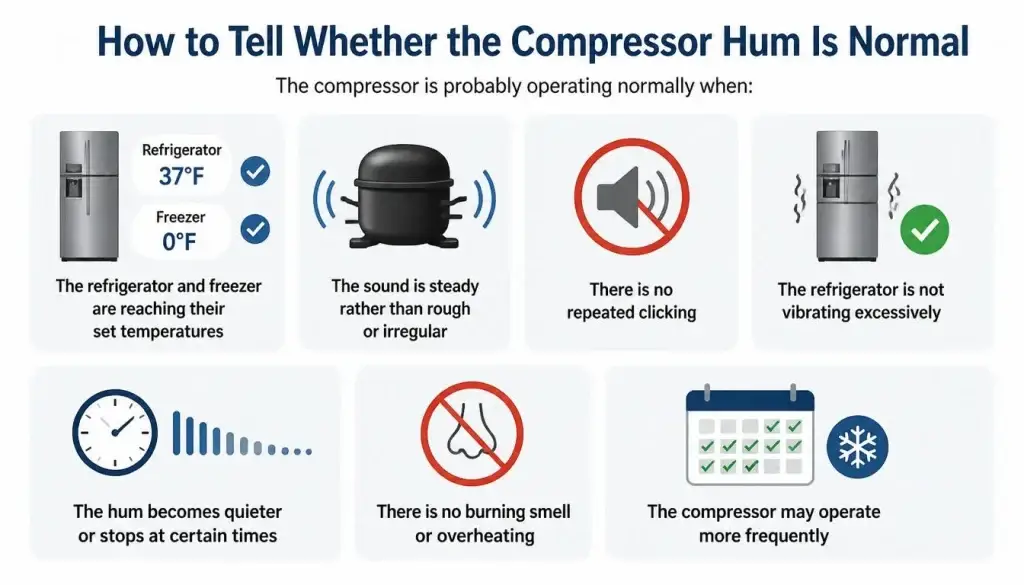
How to Tell Whether the Compressor Hum Is Normal
The compressor is probably operating normally when:
- The refrigerator and freezer are reaching their set temperatures
- The sound is steady rather than rough or irregular
- There is no repeated clicking
- The refrigerator is not vibrating excessively
- The hum becomes quieter or stops at certain times
- There is no burning smell or overheating
The compressor may operate more frequently after you load groceries, leave a door open, lower the temperature setting, or use the refrigerator in a warm room. These conditions introduce heat that the appliance must remove.
When the Compressor Sound May Be Abnormal
Contact a qualified technician when the compressor:
- Hums loudly but does not appear to start
- Hums for several seconds and then clicks off
- Repeats the humming-and-clicking pattern
- Runs while the refrigerator continues getting warmer
- Produces a harsh mechanical or metallic sound
- Becomes excessively hot
- Causes the circuit breaker to trip
A compressor is part of a sealed refrigeration system. Do not attempt to open, recharge, cut, or repair that system yourself.
2. Restricted Airflow Is Making the Refrigerator Work Harder
Your refrigerator needs sufficient airflow around and inside the appliance. Restricted airflow can force the compressor and fans to operate longer, making their normal sounds more noticeable.
Frigidaire states that a dust-blocked rear vent can restrict airflow and make the refrigerator work harder. The company also advises leaving at least 1 inch of space behind the appliance to support air circulation.
Check the Area Behind the Refrigerator
Carefully inspect whether:
- The refrigerator is pressed tightly against the wall
- A rear vent is covered with dust or pet hair
- Boxes, bags, or other objects are blocking ventilation
- The power cord or water line is vibrating against the cabinet
- The refrigerator has enough room to release heat
Before moving the refrigerator, make sure the floor is clear and ask another person for help if the appliance is heavy. Do not pull it forward by the doors or handles.
Check the Air Vents Inside the Refrigerator
Cold air also needs to circulate between the freezer and fresh-food compartments. Food packages placed directly in front of vents can restrict that airflow.

Blocked vents may result in:
- Uneven temperatures
- A compressor that runs for longer periods
- Food freezing in one area while remaining warm in another
- Frost accumulation
- Increased fan or airflow noise
Frigidaire recommends clearing items away from internal vents when troubleshooting a refrigerator that is not cooling correctly.
Leave some space between food and the rear or side walls of the compartment. Avoid packing the refrigerator so tightly that cold air cannot move around the stored items.
3. The Refrigerator Is Vibrating Against the Floor, Wall, or Cabinet
A normal compressor hum can become surprisingly loud when vibration transfers into the floor, wall, kitchen cabinet, or refrigerator shelves.
This is particularly common after:
- The refrigerator has been moved
- New flooring has been installed
- The adjustable feet have shifted
- The appliance has been pushed against a wall
- Bottles or containers have been rearranged
- A drain pan, water line, or power cord is touching the cabinet
How to Test for Vibration
While the humming is present, place your hand lightly on the side of the refrigerator. Do not touch the back mechanical compartment.
If the noise changes when you gently steady the cabinet, vibration is probably amplifying it.

Next, check the following:
- Make sure the refrigerator is not touching the wall.
- Confirm that it is not pressed against a kitchen cabinet.
- Look for bottles, jars, or containers touching each other.
- Check whether removable shelves and bins are seated correctly.
- Make sure the refrigerator does not rock when you press a front corner.
- Inspect accessible water lines and the power cord for contact with the cabinet.
How to Level the Refrigerator
Use a spirit level across the top of the refrigerator or on a stable interior shelf.
Adjust the levelling feet according to the instructions for your model. Many refrigerators are installed with the front slightly higher than the rear so the doors can close correctly, but you should follow the specifications in your Frigidaire use-and-care manual.
After making an adjustment, wait for the compressor to run again and listen for a difference.
4. The Condenser Fan Is Dirty, Obstructed, or Wearing Out
Depending on the model, the condenser fan may be located near the compressor at the bottom rear of the refrigerator. It helps move air through the condenser area and remove heat.
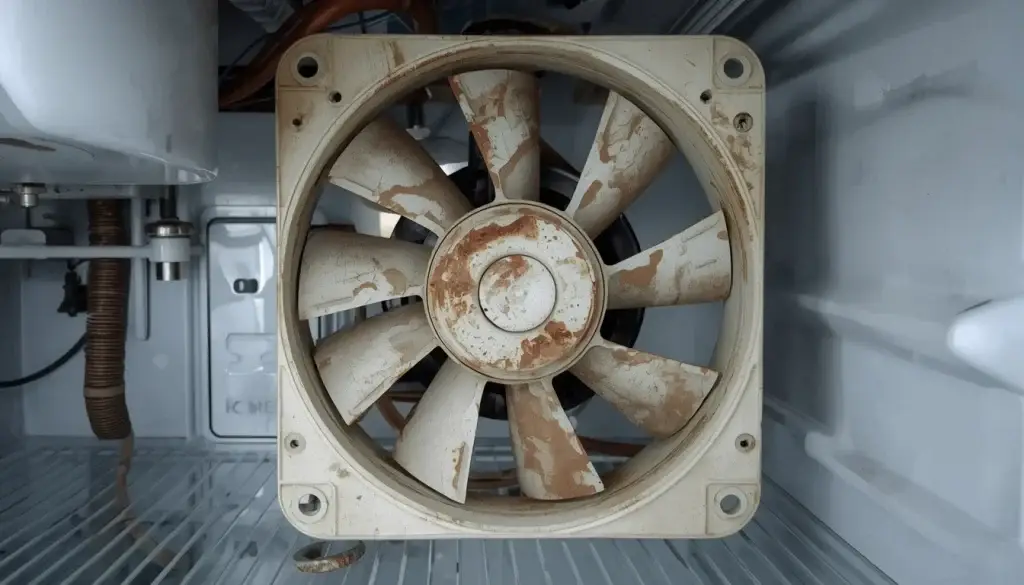
Frigidaire notes that both evaporator and condenser fans can create normal rushing or blowing-air sounds.
However, a condenser fan can become unusually loud when:
- Dust has accumulated around the fan
- Debris is touching a fan blade
- A wire or panel is vibrating against it
- A blade is loose, bent, or damaged
- The fan motor bearings are wearing out
Safe Condenser-Area Inspection
Unplug the refrigerator before cleaning around accessible mechanical or ventilation areas.
Use a flashlight to look for visible dust, pet hair, packaging material, or another obstruction. Clean only the areas that your model’s manual identifies as user-accessible.
Do not:
- Reach into a moving fan
- Remove electrical wiring
- bend refrigerant tubing
- Apply oil to a fan motor unless the manufacturer specifically instructs it
- Disassemble a sealed rear compartment
- Use water around electrical parts
Some modern refrigerators have covered or inaccessible condenser systems that are not intended for routine owner cleaning. Follow the instructions for your exact model instead of assuming that every refrigerator has exposed coils.
If the fan blade is damaged, the motor shaft feels loose, or the noise continues after accessible debris has been removed, arrange professional service.
5. Ice Is Touching the Evaporator Fan
The evaporator fan moves cold air through the freezer and refrigerator compartments. It is usually located behind an interior panel in the freezer.
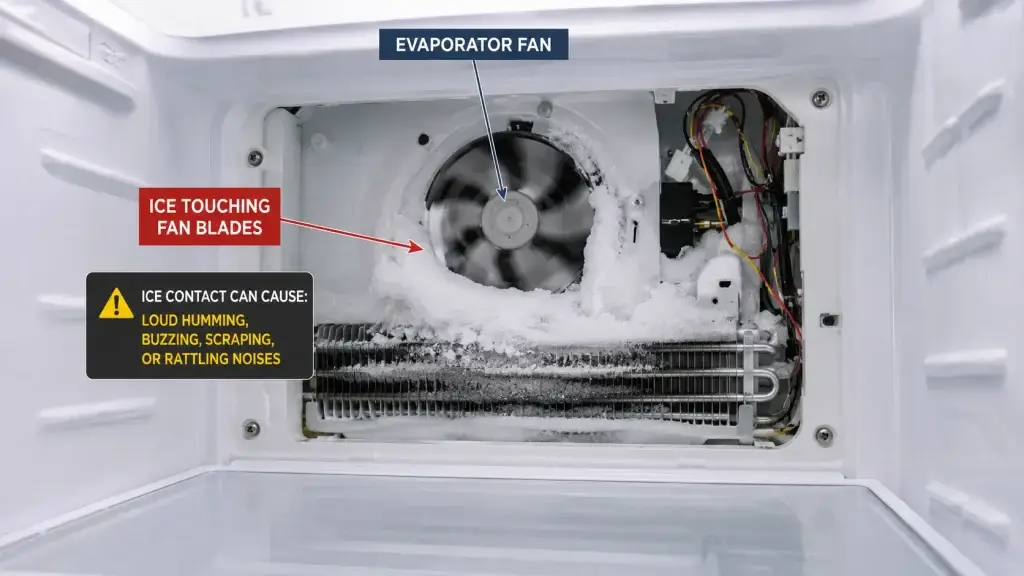
If frost or ice reaches the fan blade, you may hear:
- Loud humming
- Buzzing
- Scraping
- Rattling
- A sound that changes speed
- A noise that stops when the freezer door opens
Many refrigerator models switch off the evaporator fan when the freezer door opens. Therefore, a sound that stops immediately when you open the door may point towards the evaporator fan area.
However, this test is not conclusive for every Frigidaire model because fan and door-switch operation can vary.
Why Ice Builds Up Around the Fan
Possible causes include:
- A freezer door left partly open
- A damaged, dirty, or poorly sealing door gasket
- Food preventing the door from closing
- Blocked internal air vents
- Moist air entering the freezer
- A problem with the automatic defrost system
- A clogged or frozen defrost drain
Frigidaire states that a non-sealing door can create unstable temperatures and recommends cleaning the gasket with warm, soapy water. It also suggests checking whether the seal grips a paper bill when the door is closed.
What You Can Do
Check whether:
- Food or a drawer is preventing the freezer door from closing.
- The gasket is dirty, folded, cracked, or loose.
- Frost is visible around the freezer vents.
- Packages are blocking airflow.
- The freezer has recently been left open.
If a small amount of temporary frost formed because the door was left open, a complete manual defrost may remove the obstruction. Follow the manufacturer’s defrost instructions and protect food during the process.
Do not chip ice away with a knife, screwdriver, or sharp tool. You could puncture the evaporator or damage the fan assembly.
If the ice returns, the underlying problem may involve the heater, sensor, control, drain, door seal, or another defrost-system component. That requires proper diagnosis rather than repeated defrosting.
6. The Ice Maker or Water Inlet Valve Is Buzzing
A Frigidaire refrigerator with an automatic ice maker may produce a brief buzz when its water valve opens.
According to Frigidaire, the water valve may make a buzzing sound while filling the ice maker during each cycle. Ice dropping into the bin and other ice-making components can also create temporary operational sounds.
The sound may become louder or last longer when:
- The household water valve is closed
- The water line is kinked
- Water pressure is restricted
- The filter is clogged
- The refrigerator is not connected to a water supply
- The ice maker remains switched on without water
- The inlet valve is wearing out
Test the Ice Maker
Turn the ice maker off using the switch, control arm, or display setting provided for your model.
Listen to the refrigerator over the next several hours. If the humming or buzzing disappears, inspect the ice-maker water supply.
Check whether:
- The refrigerator is connected to a cold-water supply
- The household shut-off valve is fully open
- The water line is not kinked or crushed
- The water filter is correctly installed
- Water dispenses at a normal rate
- The ice maker was accidentally left on without water
Do not disconnect a pressurised water line unless you know how to shut off the water supply safely.
A brief buzz during a normal filling cycle is not usually a concern. A prolonged buzz with little or no water entering the ice maker requires further investigation.
7. The Refrigerator Is Running Longer Than Usual
The longer the compressor and fans run, the more time you have to notice their humming.
Extended operation does not necessarily mean that the refrigerator is failing. Frigidaire explains that compressor runtime can increase because of frequent door opening, grocery loading, colder settings, warm surroundings, or restricted rear airflow. Some variable-speed models may also run almost continuously except during defrost.
Common Reasons for Long Cooling Cycles
Your refrigerator may run longer when:
- The kitchen is unusually warm
- A large amount of food has just been added
- The doors are opened frequently
- A door has been left partly open
- The temperature setting is unnecessarily cold
- A gasket is not sealing
- Interior vents are blocked
- Rear ventilation is restricted
- The refrigerator was recently installed
- Power was recently restored
- The appliance is completing a defrost-and-recovery cycle
A newly installed Frigidaire refrigerator may require approximately 24 hours for its temperature to stabilise.
Check the Refrigerator Temperature
Frigidaire lists 37°F, or approximately 3°C, as a recommended refrigerator setting and 0°F, or -18°C, as the recommended freezer setting for many models. Check your model’s manual because control systems and recommended settings may differ.
For food safety, FoodSafety.gov advises keeping the refrigerator at 40°F, or 4°C, or below and the freezer at 0°F, or -18°C, or below. Use an appliance thermometer if you are unsure whether the displayed setting matches the actual compartment temperature.
A refrigerator set much colder than necessary may run more often without providing a practical benefit.
How to Stop a Frigidaire Refrigerator From Humming
Use the following troubleshooting sequence before requesting service.
Step 1: Identify the Location
Listen near the:
- Bottom rear
- Upper rear
- Freezer compartment
- Ice maker
- Fresh-food compartment
- Side panels
- Floor and surrounding cabinets
Record when the noise begins and how long it lasts.
Step 2: Check Whether the Noise Is Part of a Normal Cycle
Observe whether it happens:
- When the compressor starts
- After a door has been opened
- After groceries are added
- When the ice maker fills
- During hot weather
- For a few minutes at a time
- Continuously throughout the day
A temporary hum connected with a recognisable function is less concerning than a new, irregular sound accompanied by poor performance.
Step 3: Open the Freezer Door
If the noise immediately changes or stops, the evaporator fan area may be involved.
Check for visible frost, blocked vents, misplaced food, or a poorly closing freezer door. Do not remove the fan cover while the appliance is powered.
Step 4: Turn Off the Ice Maker Temporarily
Leave the ice maker off long enough to determine whether the noise returns.
If the buzzing stops, inspect the water connection, shut-off valve, line, filter, and ice-maker settings.
Step 5: Move the Refrigerator Away From the Wall
Provide adequate ventilation and prevent the cabinet, cord, or water line from touching another surface.
Frigidaire recommends at least 1 inch of rear clearance to help air circulate. Your installation guide may specify additional clearances at the top or sides.
Step 6: Check the Levelling
Make sure all supporting feet or rollers are stable and that the refrigerator does not rock.
Correct levelling may reduce vibration and help the doors seal properly.
Step 7: Rearrange Interior Items
Separate bottles and containers that are touching. Seat shelves, drawers, and bins correctly.
Move food away from internal air vents.
Step 8: Inspect Accessible Dust and Debris
Disconnect power before cleaning near accessible ventilation or mechanical areas.
Follow your model’s care instructions and avoid dismantling electrical or sealed-system components.
Step 9: Check the Door Gaskets
Clean the gaskets with warm, soapy water and dry them thoroughly.
Close the door on a thin piece of paper or paper currency. You should feel some resistance when pulling it out. Repeat the check around different parts of the door.
A weak area may indicate dirt, misalignment, gasket damage, or a door problem.
Step 10: Monitor Cooling Performance
Use an appliance thermometer to check the refrigerator and freezer.
Do not rely only on how cold a shelf feels. Record temperatures over several hours while keeping the doors closed as much as possible.
If the refrigerator remains warm despite continuous humming, professional diagnosis is recommended.
Troubleshooting Based on When the Noise Happens
The timing of the noise can reveal as much as its location.
Frigidaire Refrigerator Hums Continuously
Continuous humming may result from a variable-speed compressor, warm surroundings, frequent door opening, blocked airflow, an overly cold setting, or a door-seal issue.
Check the actual temperatures before assuming there is a fault. If temperatures are correct and the sound is steady, the refrigerator may simply be maintaining its set temperature.
If the appliance is running continuously while temperatures rise, check the vents, gaskets, wall clearance, and condenser area before arranging service.
Refrigerator Hums and Then Clicks
A single click as a component switches on or off can be normal. Repeated humming followed by clicking every few minutes is more concerning.
This pattern may indicate that the compressor is attempting to start but cannot remain running. It can involve the compressor, start device, control, voltage supply, or another electrical problem.
Disconnect the refrigerator and contact a qualified technician if the pattern continues, particularly when cooling has stopped.
Refrigerator Hums but Is Not Cooling
First check:
- Whether the interior lights and controls have power
- Whether air is moving from the vents
- Whether food is blocking the vents
- Whether the doors close and seal
- Whether heavy frost is visible
- Whether the refrigerator has recently been installed or powered on
- Whether the correct temperature settings are selected
Frigidaire advises allowing a newly installed or recently restarted refrigerator about 24 hours to stabilise. It also identifies blocked vents and poor door sealing as possible cooling problems.
If the refrigerator has operated for a full day without cooling, or food temperatures are becoming unsafe, arrange service.
Humming Stops When the Freezer Door Opens
This symptom often points towards the freezer fan because some models stop the fan when the door switch is released.
Look for frost, displaced food, or a damaged vent. If the sound resembles a blade striking ice, do not continue operating the appliance indefinitely because the fan or motor could be damaged.
New Frigidaire Refrigerator Is Humming Loudly
A new refrigerator may run for an extended period while pulling the cabinet and recently loaded food down to the selected temperature.
Also check for:
- Shipping materials that were not removed
- Incorrect levelling
- Insufficient ventilation
- A wall or cabinet touching the appliance
- An ice maker switched on without a water supply
- A kinked water line
- Loose installation components
Contact the installer if the noise began immediately after installation and basic positioning checks do not resolve it.
DIY Fix or Professional Refrigerator Repair?
Some causes are suitable for basic owner troubleshooting. Others involve electrical parts, moving components, refrigerant, or sealed systems.
| Suspected issue | Reasonable DIY action | Professional service? |
|---|---|---|
| Refrigerator touching a wall | Reposition the appliance | Usually not |
| Uneven cabinet | Adjust the levelling feet using the manual | Usually not |
| Bottles or shelves vibrating | Rearrange and secure items | Usually not |
| Ice maker on without water | Turn it off or restore the water supply | Usually not |
| Blocked interior vents | Move food away from vents | Usually not |
| Dirty door gasket | Clean with warm, soapy water | Usually not |
| Accessible dust near ventilation | Clean according to the manual | Sometimes |
| Fan scraping or rattling | Disconnect power and inspect only accessible areas | Often |
| Recurring ice around the freezer fan | Arrange defrost-system diagnosis | Yes |
| Humming followed by repeated clicking | Disconnect power | Yes |
| Loud compressor and poor cooling | Check airflow and temperature only | Yes |
| Burning smell, smoke, or arcing | Disconnect power if safe | Immediately |
| Refrigerant or sealed-system problem | No DIY repair | Yes |
When Should You Call a Refrigerator Technician?
Arrange professional service when:
- The refrigerator is humming but not cooling
- The freezer is thawing
- The sound is accompanied by repeated clicking
- A fan appears damaged or unable to turn
- Ice repeatedly returns around the evaporator fan
- The compressor is excessively hot
- The appliance trips a breaker
- You smell burning insulation or see smoke
- The sound becomes grinding, screeching, or metallic
- Water is leaking near electrical components
- Basic cleaning, levelling, and airflow checks make no difference
- The refrigerator displays a persistent high-temperature warning
- You suspect a compressor, control board, start device, or sealed-system fault
Unplug the refrigerator immediately if you see smoke, sparks, melted wiring, or another clear electrical hazard, provided you can reach the plug safely. Do not continue resetting a breaker that repeatedly trips.
Move perishable food to another working refrigerator or an ice-filled cooler if safe temperatures cannot be maintained.
How to Prevent Loud Refrigerator Humming
Regular checks can reduce unnecessary noise and help the appliance cool efficiently.
Maintain Proper Clearance
Do not press the refrigerator tightly against the wall. Follow the installation clearances listed in your model’s manual.
Keep Air Vents Clear
Avoid placing large packages directly in front of freezer or refrigerator vents.
Check the Doors
Make sure drawers, shelves, and food packages do not prevent the doors from closing. Clean the gaskets periodically and replace damaged seals when necessary.
Keep the Appliance Stable
Check the levelling after moving the refrigerator or installing new flooring.
Use the Ice Maker Correctly
Turn the ice maker off when the refrigerator is not connected to a water supply. Check water lines for kinks after moving the appliance.
Use Sensible Temperature Settings
Start with the manufacturer’s recommended settings and verify the actual temperature using an appliance thermometer.
Respond to New Sounds Early
A small vibration or light scraping sound is usually easier to correct before it damages a fan, panel, line, or nearby component.
Frequently Asked Questions About Frigidaire Refrigerator Making a Loud Humming Noise
Is It Normal for a Frigidaire Refrigerator to Make a Humming Noise?
Yes. A soft humming or pulsating sound can come from the compressor, while a motorised damper may produce a light hum. The ice-maker water valve can also buzz briefly while filling. The noise should be investigated when it becomes unusually loud, irregular, continuous, or accompanied by poor cooling.
Why Is My Frigidaire Refrigerator Humming So Loudly?
The sound may be amplified by an unlevel floor, contact with a wall, vibrating containers, restricted airflow, a fan obstruction, or ice around the evaporator fan. A compressor working harder because of warm conditions, frequent door opening, or poor ventilation may also be more noticeable.
Why Does My Refrigerator Hum and Then Click?
One click can be part of normal operation. Repeated humming followed by clicking may mean the compressor is struggling to start or an electrical component is interrupting the startup attempt. Disconnect the appliance and arrange service when the pattern repeats or cooling has stopped.
Why Does the Noise Stop When I Open the Freezer Door?
The noise may come from the evaporator fan. Some refrigerators stop that fan when the freezer door opens. Ice, frost, debris, or a failing fan motor can make the fan unusually loud.
Can Dirty Condenser Coils Cause Loud Humming?
Restricted airflow around the condenser area can make the refrigerator work harder and run longer. This may make normal compressor and fan sounds more noticeable. Clean only the parts identified as user-accessible in your model’s manual.
Why Is My Frigidaire Ice Maker Making a Buzzing Noise?
A brief buzz can occur when the water valve opens to fill the ice maker. A louder or prolonged buzz may occur when the water supply is closed, restricted, disconnected, or affected by a kinked line or clogged filter.
Can the Refrigerator Buzz When the Water Line Is Disconnected?
Yes. If the ice maker remains switched on, it may call for water even when no usable supply is available. Turn off the ice maker until the water connection has been correctly installed.
Does Loud Humming Mean the Compressor Is Failing?
Not always. Modern high-efficiency compressors can produce noticeable humming or pulsating sounds. Compressor trouble is more likely when the hum is accompanied by repeated clicking, overheating, poor cooling, breaker trips, or an inability to start.
Why Is My Frigidaire Refrigerator Humming but Not Cooling?
Possible causes include blocked vents, a poorly sealing door, heavy frost, a fan problem, a compressor-start issue, or a sealed-system fault. Confirm the settings, clear airflow obstructions, inspect the gaskets, and measure the temperature. Arrange service if cooling does not recover.
Should I Unplug a Refrigerator That Is Making a Loud Noise?
Unplug it when the sound is accompanied by smoke, a burning smell, electrical arcing, repeated breaker trips, severe overheating, or repeated failed-start clicking. For a stable operational hum with normal cooling, you can usually perform the basic external checks described above first.
Final Verdict
A Frigidaire refrigerator making a loud humming noise does not automatically need a new compressor. A soft, steady hum often comes from normal compressor, fan, damper, or ice-maker operation.
Start by identifying where the sound originates and when it occurs. Check the refrigerator’s wall clearance, levelling, internal vents, door gaskets, water supply, ice-maker setting, and actual temperatures. A sound from the freezer may involve the evaporator fan, while a buzz near the ice maker may involve the water valve.
Stop troubleshooting and call a qualified technician when the humming is accompanied by repeated clicking, poor cooling, recurring ice buildup, overheating, a burning smell, or an electrical problem.

Hi, I’m the lead researcher and appliance enthusiast behind RefrigeratorSolve. With years of hands-on experience troubleshooting cooling systems and testing home appliances, I am dedicated to bringing you honest reviews, energy-saving tips, and practical solutions to keep your refrigerator running perfectly.






2 Responses