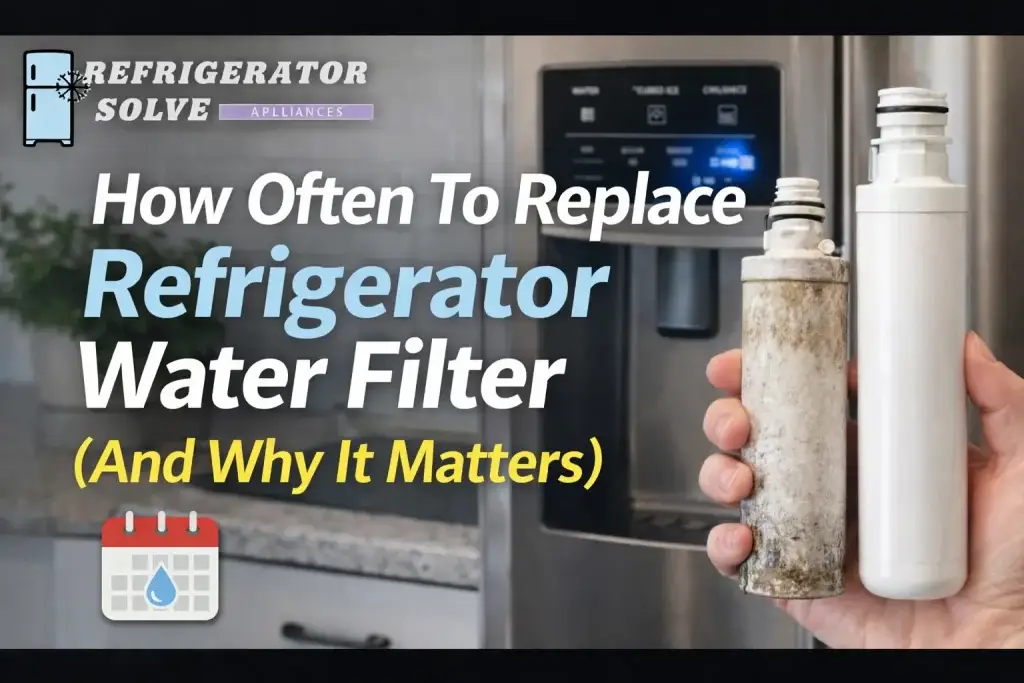
You should replace refrigerator water filter every 6 months or every 200–300 gallons, whichever comes first. A clogged or expired filter stops removing contaminants and can actually make your water worse over time.
Is Your Fridge Filter Actually Doing Its Job?
You grab a glass of water from the fridge door and assume it’s clean. It looks clear. It tastes okay. But here’s the uncomfortable truth: if you can’t remember the last time you changed your water filter, it probably hasn’t been doing much for a while.
I get it. Filter replacement is one of those tasks that’s easy to put off like changing your smoke alarm battery or rotating your tyres. Life gets busy. The water still comes out. So why bother?
Because an old refrigerator water filter doesn’t just stop working. It can start releasing trapped contaminants, bacteria, and mould back into your drinking water. That’s the part most people don’t know.
In this article, I’m going to walk you through exactly how often to replace your refrigerator water filter, the signs you’ve waited too long, how to do it yourself in under five minutes, and why this one small habit matters more than you think.
The 3 Biggest Problems People Face With Fridge Filters
1. Not Knowing When the Filter Was Last Changed
This is the number one issue I hear from people. You move into a new home, or you bought a second-hand fridge, and you have no idea when the filter was last replaced or if it ever was.
Why it happens: Filters don’t come with visible expiry dates on the outside. The indicator light on your fridge (if it has one) often resets on a timer, not based on actual water usage.
What to do: If you genuinely don’t know when it was last changed, replace it now. Don’t wait. A new filter costs between $20–$60 (USD/CAD/AUD) or £15–£40 in the UK, depending on your fridge brand. That’s a small price for peace of mind.
2. Assuming the Indicator Light Is Always Accurate
Many people trust the little “Change Filter” light on their fridge panel completely. The problem? Most of those lights run on a fixed 6-month timer they don’t actually measure water quality or flow rate.
Why it happens: Manufacturers set a conservative timer, but if your household uses the fridge dispenser heavily (a family of five, for example), you could be hitting the 200-gallon limit in just 3–4 months.
What to do: Track your actual usage. A family of four using the dispenser daily likely needs a replacement every 4–5 months. A single person or couple might stretch to 6–8 months. Use the light as a prompt, not a guarantee.
3. Buying the Wrong Replacement Filter
Walk into a hardware store in the US, Canada, Australia, or the UK, and you’ll find shelves full of generic filters claiming to fit “most fridges.” Some work fine. Others fit loosely, leak, or don’t filter properly.
Why it happens: There are dozens of filter model numbers across brands like Samsung, LG, Whirlpool, Bosch, and Fisher & Paykel. Generic filters aren’t always certified to the same standard as OEM (original equipment manufacturer) parts.
What to do: Always cross-check your fridge’s model number (usually on a sticker inside the fridge door) with the filter part number. Look for filters certified by NSF International NSF/ANSI 42 and NSF/ANSI 53 are the gold standards for drinking water filtration.
How Often to Replace Your Refrigerator Water Filter: The Full Guide
The 6-Month Rule — And When to Break It
The standard advice is to replace your refrigerator water filter every six months. This guideline comes from NSF International and most appliance manufacturers. It’s a good baseline.
But it’s not a universal truth.
Your replacement schedule depends on three factors:
- Household size: More people = more water used = filter fills faster
- Water quality in your area: Hard water or high-sediment municipal water clogs filters quicker
- How often you use the dispenser vs. tap water
If you’re in an area with older pipes common in parts of the UK, the US Northeast, or older Canadian cities — your filter may be working harder to remove lead, chlorine, and sediment. In that case, every 4–5 months is safer.
“Water quality varies dramatically by postcode and zip code. A filter that lasts six months in one household might be exhausted in three in another, depending on local infrastructure.” — Dr. Andrew Weil, Integrative Medicine Physician and public health advocate
What Happens If You Don’t Replace It?
Here’s what actually happens inside a neglected filter.
In the first few months, the activated carbon inside the filter absorbs chlorine, heavy metals, volatile organic compounds (VOCs), and other contaminants. It does its job.
After that, the carbon becomes saturated. It can no longer trap new contaminants. Worse, bacteria can begin to colonise the damp, dark interior of the filter housing. Studies have found that unmaintained water filters can harbour more bacteria than unfiltered tap water.
The filter goes from protector to problem.
In Australia, the CSIRO has highlighted concerns about household water filtration maintenance, noting that stagnant filters in low-usage homes may pose microbial risks. If your family has gone on holiday and the fridge sat unused for weeks, replacing the filter when you return is a smart call.
How to Replace Your Refrigerator Water Filter in 5 Minutes
This is easier than most people expect. Here’s a general guide always check your fridge manual for model-specific steps.
Step 1: Locate the filter. It’s usually inside the fridge (upper right corner or bottom grille) or in the door.
Step 2: Turn off the ice maker if your fridge has one.
Step 3: Twist or push the old filter to release it (most are quarter-turn or push-tab designs). Have a small towel ready some water will drip out.
Step 4: Insert the new filter and twist or click it into place. Make sure it’s seated fully a loose filter can leak.
Step 5: Run 2–3 litres (about half a gallon) of water through the dispenser to flush out any carbon dust or air pockets. Discard this water don’t drink it.
Step 6: Reset the filter indicator light. This is usually done by pressing and holding a button on the control panel for 3–5 seconds. Check your manual for the exact method.
Done. The whole process takes less time than making a cup of tea.
Choosing the Right Filter: OEM vs. Aftermarket
This is where people get tripped up. Let me break it down plainly.
OEM filters (sold by your fridge manufacturer Samsung, Whirlpool, LG, etc.) are guaranteed to fit and perform to spec. They’re often the most expensive option, sometimes $50–$70 USD or $80–$100 AUD per filter.
NSF-certified aftermarket filters are made by third-party companies but independently tested to the same performance standards. Brands like Waterdrop, EveryDrop, and GLACIER FRESH offer certified alternatives at 30–50% less cost.
Uncertified generic filters are the ones to avoid. They may fit physically but offer no guarantee of filtration performance.
“Consumers should always look for NSF certification on any water filter product. Without that mark, you simply don’t know what you’re getting.” — Rick Andrew, Director of Global Business Development, NSF International
For more guidance on certified water treatment products, the NSF International database at nsf.org allows you to search by product name or model to verify certification claims before you buy.
Signs Your Filter Needs Replacing Right Now
Even if you’re not at the 6-month mark, watch for these warning signs:
- Slower water flow from the dispenser — this indicates the filter is clogged
- Strange taste or odour in your filtered water — chlorine, metallic, or musty smells are red flags
- Cloudy or discoloured ice cubes — your ice maker uses the same filtered water
- The indicator light has been on for more than a month — don’t keep ignoring it
- You’ve been on holiday for 3+ weeks — stagnant water in an old filter is a risk
Any one of these signs means it’s time. Don’t overthink it.
What About Whole-Home Filters?
Some homes particularly in regional Australia, rural Canada, and parts of the American South use whole-home water filtration systems alongside a fridge filter. If your municipal water is already highly treated, your fridge filter will last closer to the full 6 months.
If you’re on tank water or a private well, you may need to replace it every 3–4 months and should have your water tested annually.
In the UK, Thames Water and Scottish Water publish annual water quality reports for local areas — a useful reference if you’re unsure about what’s in your supply.
“Access to safe drinking water is a public health priority, but household filtration maintenance is often the missing link. Even the best municipal treatment can’t account for what happens inside your home’s pipes.” — Professor Joan Rose, Homer Nowlin Chair in Water Research, Michigan State University
Frequently Asked Questions on Replace Refrigerator Water Filter
How often should I replace my refrigerator water filter?
Every 6 months, or every 200–300 gallons of water whichever comes first. High-usage households or homes with poor water quality may need to replace it every 3–4 months. When in doubt, replace it sooner rather than later.
What happens if I don’t change my refrigerator water filter?
The filter loses its ability to remove contaminants like chlorine, lead, and bacteria. Over time, a saturated filter can actually allow bacteria to grow inside it, potentially making your water less safe than unfiltered tap water.
Can I use my fridge without a water filter?
Yes, but only if your fridge has a bypass plug (a small plastic insert that lets water flow without going through the filter). Without a bypass plug or filter installed, no water will flow to the dispenser or ice maker. Check your fridge manual to see if a bypass plug is included.
Are aftermarket refrigerator water filters safe to use?
Yes, as long as they carry NSF/ANSI 42 or 53 certification. These filters have been independently tested and verified to meet the same performance standards as OEM filters. Always check for NSF certification before buying a third-party filter.
How do I know which filter fits my refrigerator?
Check the sticker inside your fridge door for the model number. Then search that number on your manufacturer’s website or a certified retailer’s site to find the matching filter part number. You can also check the old filter the part number is usually printed on it.
What You Should Take Away From All of This
Three things matter most here.
First, replace your refrigerator water filter every 6 months or sooner if your household uses a lot of water or your local supply is heavily treated. The 6-month rule is a starting point, not a ceiling.
Second, don’t trust the indicator light alone. It’s a timer, not a water quality sensor. Pay attention to taste, flow rate, and your actual usage habits.
Third, always buy NSF-certified filters whether OEM or aftermarket. Certification is the only way to know a filter is actually doing what it promises.
Clean water is one of the simplest, most impactful things you can control at home. You don’t need expensive equipment or complicated systems. You just need to stay on top of one small task, twice a year.
Set a reminder on your phone right now for 6 months from today. Future you will be glad you did.

Hi, I’m the lead researcher and appliance enthusiast behind RefrigeratorSolve. With years of hands-on experience troubleshooting cooling systems and testing home appliances, I am dedicated to bringing you honest reviews, energy-saving tips, and practical solutions to keep your refrigerator running perfectly.