
A refrigerator is never completely silent. A soft hum, short buzz, or gentle vibration is often part of normal operation. But when that quiet background sound turns into loud humming, rattling, clicking, whining, or knocking, it can quickly become annoying.
The good news is that the compressor itself is not always the real problem. A refrigerator may sound like it has a noisy compressor when the actual cause is an uneven floor, dirty condenser coils, a loose drain pan, a fan, or vibration against the wall.
If you want to know how to reduce refrigerator compressor noise, start with the simple checks first. Many noise problems can be improved without replacing expensive parts.
Quick Answer: How Do You Make a Refrigerator Compressor Quieter?
You can often make a refrigerator compressor quieter by leveling the fridge, moving it slightly away from the wall, cleaning the condenser coils and fan, tightening loose panels, and reducing vibration under the feet.
If the noise is coming directly from the compressor and sounds like grinding, heavy knocking, or repeated clicking, professional inspection may be needed.
Before working around the back or bottom of your refrigerator, unplug it unless the manufacturer specifically requires power for a diagnostic check.
First, Make Sure the Noise Is Actually Coming From the Compressor
Before trying to quiet the compressor, confirm that the compressor is really making the sound.
Several refrigerator parts are located close together. This can make it difficult to identify the source by sound alone.
Where Is the Refrigerator Compressor Located?
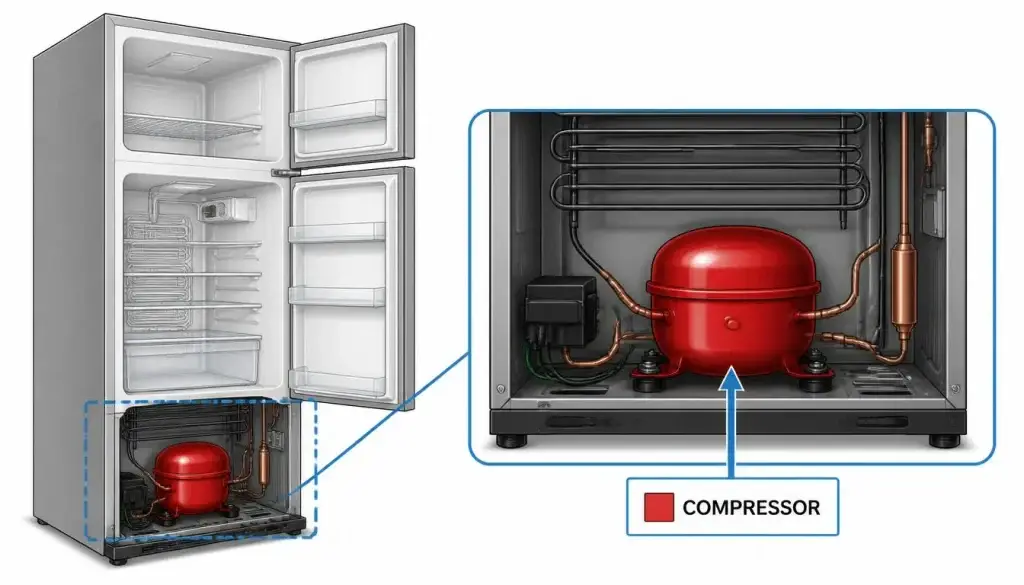
On most refrigerators, the compressor is near the bottom rear of the appliance.
It usually looks like a black, rounded metal container. Nearby, you may also find:
- The condenser fan
- Condenser coils
- Drain pan
- Refrigerant tubing
- Electrical components
A sound from this area does not automatically mean the compressor is bad.
Listen to Where the Noise Comes From
Try to narrow down the location.
Noise from the lower back may come from the compressor, condenser fan, drain pan, or loose rear panel.
Noise from inside the freezer is more likely to involve the evaporator fan.
A short buzz near the ice maker may come from the water inlet valve.
Rattling near the wall can simply be caused by tubing or the refrigerator cabinet vibrating against another surface.
What If the Noise Stops When You Open the Door?
This is a useful clue.
On many refrigerators, the evaporator fan slows or stops when the door opens. If the noise suddenly disappears when you open the refrigerator or freezer door, the fan may be the source instead of the compressor.
That simple test can save you from troubleshooting the wrong part.
Is Refrigerator Compressor Noise Normal or a Sign of a Problem?
Not every compressor sound means something is wrong.
Modern refrigerators cycle differently depending on the model, room temperature, food load, and cooling demand.
Normal Refrigerator Compressor Sounds
The following sounds can be normal:
- Low humming
- Gentle buzzing
- Mild vibration
- A short click when a cooling cycle starts or stops
- Slight changes in pitch
- Longer operating periods during hot weather
The sound may also become more noticeable at night because the room is quieter.
Compressor Sounds You Should Not Ignore
Pay more attention when the sound:
- Suddenly becomes much louder
- Changes from a smooth hum to harsh rattling
- Includes repeated clicking
- Sounds like metal knocking
- Includes grinding or scraping
- Comes with poor cooling
- Appears with a burning smell
- Is accompanied by frequent compressor starting and stopping
A major change from the refrigerator’s normal sound is often more important than the sound itself.
Is Inverter Compressor Noise Different?
It can be.
Traditional compressors often turn fully on and off. Inverter or variable-speed compressors can change speed depending on cooling demand.
Because of this, you may hear changes in humming, pitch, or vibration throughout the day.
A changing sound does not always mean the compressor is failing. What matters is whether the refrigerator is cooling normally and whether the sound is smooth or unusually harsh.
How Loud Should a Refrigerator Compressor Normally Be?
There is no single noise level that applies to every refrigerator.
A large French-door refrigerator may sound different from a compact fridge. An older refrigerator may also sound different from a newer inverter model.
Instead of focusing only on volume, compare the current sound with how the refrigerator normally behaves.
Usually less concerning:
- Soft steady hum
- Light vibration
- Short buzz during operation
- Occasional click
- Smooth changes in sound
More concerning:
- Sudden increase in volume
- Heavy knocking
- Repeated hard clicking
- Grinding
- Harsh mechanical rattling
- Loud noise combined with weak cooling
If the refrigerator has always produced a mild hum and continues cooling correctly, that sound may simply be part of normal operation.
Why Is My New Refrigerator Compressor Louder Than My Old One?
A new refrigerator can sometimes sound surprisingly different from the appliance it replaced.
That does not automatically mean something is wrong.
High-Efficiency Compressors May Run Longer
Many newer refrigerators use high-efficiency compressors that run for longer periods at lower output.
Instead of switching on loudly for a short time and then stopping, the compressor may run more steadily.
This can make the sound seem more noticeable, even when the refrigerator is working correctly.
Why Refrigerator Noise Seems Louder at Night
At night, background sounds from traffic, televisions, air conditioners, and conversations are lower.
A compressor that seemed quiet during the afternoon can suddenly sound much louder in a silent kitchen.
Before assuming there is a fault, listen again during normal daytime activity.
When New Refrigerator Noise Is Abnormal
A new refrigerator should still be checked if you hear:
- Strong metal-on-metal noise
- Very heavy vibration
- Repeated clicking
- Grinding
- Loud knocking
- Poor cooling
Also make sure the appliance was installed level and has enough clearance around it.
How to Reduce Refrigerator Compressor Noise: 10 Fixes
Start with the easiest fixes. Do not replace the compressor before checking simple causes of vibration and airflow.
1. Level the Refrigerator
An uneven refrigerator can create far more noise than expected.
If one foot is slightly higher or lower than the others, compressor vibration may travel through the cabinet and floor.
Try gently pushing the refrigerator from different corners. It should feel stable rather than rock back and forth.
Use the adjustable leveling feet to correct the position.
A properly leveled refrigerator can reduce:
- Rattling
- Floor vibration
- Cabinet movement
- Compressor vibration noise
Check your owner’s manual because some models should be slightly higher at the front to help the doors close properly.
2. Move the Refrigerator Away From the Wall
A refrigerator that touches the wall can transfer normal compressor vibration into the wall.
That can make a quiet hum sound much louder.
Check behind the appliance for contact with:
- The wall
- Cabinets
- Baseboards
- Water supply lines
- Power cords
- Nearby furniture
Move the refrigerator enough to prevent contact while still following the ventilation clearance recommended by the manufacturer.
Do not push the appliance tightly into a small space just to hide the noise.
3. Clean the Condenser Coils
Dusty condenser coils can make the refrigerator work harder.
When heat cannot escape efficiently, the compressor may run longer than necessary.
Before cleaning, unplug the refrigerator.
Depending on the model, the condenser coils may be behind the refrigerator or underneath it.
Use:
- A soft condenser brush
- Vacuum cleaner with brush attachment
- Dry cloth for accessible dust
Remove pet hair and thick dust carefully.
Do not bend refrigerant tubing or force tools into tight areas.
Some newer refrigerators use enclosed condenser systems that require little or no user cleaning, so always check the manual first.
4. Clean and Inspect the Condenser Fan
The condenser fan is close to the compressor on many refrigerators. Because of its location, fan noise is often mistaken for compressor noise.
A dirty fan may produce:
- Buzzing
- Rattling
- Scraping
- Whirring
With the refrigerator unplugged, check the accessible fan area for dust, pet hair, packaging material, or other debris.
Look for anything touching the blades.
If the fan blade is damaged, loose, or rubbing against its housing, the fan may need repair or replacement.
Do not place your fingers near the fan while the refrigerator is powered.
5. Secure the Drain Pan and Loose Panels
A loose drain pan can vibrate whenever the compressor runs.
The sound may seem like it is coming directly from the compressor even though the compressor is operating normally.
Check any accessible drain pan or rear cover for looseness.
Also look for:
- Loose screws
- Thin metal panels
- Plastic covers
- Water lines touching panels
Tighten loose fasteners carefully.
Do not overtighten plastic parts because they can crack.
6. Reduce Floor Vibration
Sometimes the refrigerator is not especially loud, but the floor amplifies the vibration.
This is common on hard flooring such as:
- Tile
- Hardwood
- Laminate
Make sure all refrigerator feet sit firmly on the floor.
If vibration is still noticeable, appliance-rated anti-vibration pads may help reduce sound transfer.
Choose pads designed to support the weight of a refrigerator.
Avoid thick or unstable foam that could make the appliance uneven.
7. Check the Compressor Mounts and Rubber Grommets
The compressor is usually mounted with rubber supports that help absorb vibration.
Over time, these parts can become worn, loose, or damaged.
A mounting problem may create:
- Excessive vibration
- Rattling
- Movement when the compressor starts
- Noise transmitted into the refrigerator frame
You can visually inspect accessible mounting points after unplugging the refrigerator.
However, do not disconnect refrigerant lines, electrical compressor connections, or sealed-system components.
If a compressor mount appears damaged, appliance repair is the safer option.
8. Improve Airflow Around the Refrigerator
Poor ventilation can increase compressor workload.
Make sure the refrigerator has the clearance required by the manufacturer.
Check that ventilation openings are not blocked by:
- Dust
- Boxes
- Bags
- Wall contact
- Cabinets
- Other appliances
Good airflow allows heat to leave the refrigerator more efficiently.
That may reduce how long the compressor needs to operate.
9. Reduce How Hard the Compressor Has to Work
A compressor will naturally run more when the refrigerator struggles to maintain temperature.
Check several simple things.
Make sure the doors close completely.
Inspect the door gasket for dirt, cracks, or loose areas.
Avoid leaving the doors open longer than necessary.
Do not set the temperature unnecessarily cold.
Make sure food containers are not blocking internal air vents.
After loading a large amount of warm food, expect the compressor to run longer for a while.
Reducing unnecessary cooling demand can lower both energy use and compressor noise.
10. Use Sound-Dampening Materials Safely
If the refrigerator is working normally but its vibration is still noticeable, sound-dampening methods may help.
Safe options can include:
- Appliance anti-vibration pads
- Preventing contact with nearby cabinets
- Treating a nearby wall with sound-absorbing material
- Securing vibrating panels
Do not wrap the compressor in foam, blankets, or insulation.
Do not block ventilation openings.
The compressor and condenser system must release heat. Trapping that heat can create a more serious problem than the original noise.
Why Is My Refrigerator Compressor Running Constantly and Making Noise?
A refrigerator that seems to run all the time is not always faulty.
Newer energy-efficient refrigerators often use longer cooling cycles.
However, constant operation can also happen when the refrigerator is struggling to maintain temperature.
Possible causes include:
- Hot room temperature
- Frequent door opening
- Large amount of recently added food
- Temperature set too cold
- Poor door seal
- Dirty condenser area
- Blocked ventilation
- Refrigerator placed too close to a heat source
If the compressor runs almost constantly but the refrigerator maintains the correct temperature, the behavior may be normal for the model.
If it runs constantly and the refrigerator still feels warm, troubleshooting is needed.
Refrigerator Compressor Noise Troubleshooting by Sound
Different sounds point toward different possible causes.
The sound alone cannot confirm a failed compressor, but it can help you decide what to inspect first.
Refrigerator Compressor Humming Noise
A low hum is one of the most common refrigerator sounds.
If the hum is smooth and the refrigerator is cooling properly, it is usually not a major concern.
A humming sound deserves more attention if it becomes much louder or is combined with poor cooling.
Refrigerator Compressor Buzzing Noise
Short buzzing can happen during normal refrigeration cycles.
Buzzing may also come from:
- Condenser fan
- Water inlet valve
- Ice maker
- Vibrating tubing
- Loose panels
Locate the sound before assuming the compressor is responsible.
Refrigerator Compressor Rattling Noise
Rattling is often related to vibration rather than internal compressor damage.
Check:
- Leveling feet
- Drain pan
- Rear panels
- Water lines
- Compressor mounts
- Contact with the wall
Start with these areas before considering expensive repairs.
Refrigerator Compressor Clicking Noise
An occasional click can be normal when the compressor starts or stops.
Repeated clicking every few moments is different.
Possible causes can include:
- Start relay problem
- Compressor struggling to start
- Electrical issue
- Condenser fan problem
If repeated clicking is combined with poor cooling, professional diagnosis is recommended.
Refrigerator Compressor Knocking or Clunking Noise
A strong knocking or clunking sound deserves attention, especially if it is new.
First rule out:
- Loose panels
- Tubing hitting the cabinet
- Uneven installation
- Loose drain pan
If the sound clearly comes from inside the compressor housing, have the appliance inspected.
Refrigerator Compressor Grinding Noise
Grinding is not a sound to ignore.
Before blaming the compressor, make sure a fan blade is not scraping against ice, debris, or its housing.
If the grinding definitely comes from the compressor area and continues after other sources are ruled out, arrange professional service.
Refrigerator Compressor High-Pitched Noise
Some variable-speed compressors and fans can create a higher-pitched sound as their speed changes.
A smooth high-pitched sound may be part of normal operation.
A sudden, harsh, or extremely loud high-pitched noise should be checked.
Refrigerator Compressor Pulsating Noise
A pulsating sound can happen when the speed of a compressor or fan changes during cooling.
Check whether the refrigerator is stable and away from the wall.
If the pulsating becomes severe or is paired with poor cooling, investigate further.
Refrigerator Compressor Whining Noise
Whining may come from the compressor, but fans can produce a similar sound.
Listen carefully around the freezer and lower rear area.
If opening the door changes the sound, the evaporator fan may be responsible.
How to Tell Whether the Compressor or Fan Is Making the Noise
Knowing the source can prevent unnecessary repairs.
Compressor Noise
Compressor noise usually comes from the lower rear of the refrigerator.
It often follows the cooling cycle.
Common sounds include:
- Hum
- Buzz
- Mild vibration
Condenser Fan Noise
The condenser fan may also be located near the lower rear.
It can make:
- Whirring
- Rattling
- Scraping
- Buzzing
Fan noise often becomes worse when dust or debris touches the blades.
Evaporator Fan Noise
The evaporator fan is normally inside the freezer section.
A noisy evaporator fan may sound like:
- Whining
- Scraping
- Humming
- Rattling
If the sound changes when you open the freezer door, inspect this area before blaming the compressor.
Ice Maker and Water Valve Noise
A refrigerator can also buzz when the water valve operates.
Ice dropping into the bin may create sudden knocking or clunking sounds.
These sounds are usually short and happen at intervals rather than continuously.
What If the Compressor Is Loud and the Refrigerator Is Not Cooling?
Noise becomes more important when cooling performance also changes.
If the refrigerator is loud and warm, do not focus only on reducing the sound. You need to find the cause of the cooling problem.
Check Whether the Compressor Is Running
Listen near the lower rear.
A compressor that is operating normally usually creates some vibration and sound.
Repeated attempts to start followed by silence may point to another problem.
Watch for Repeated Clicking
Repeated clicking can indicate that the compressor is trying to start but cannot stay running.
A start relay or another electrical component may be involved.
This is different from an occasional normal click.
Check the Condenser Fan
If the refrigerator uses a condenser fan, make sure it is not blocked or damaged.
A failed fan can reduce heat removal and make the cooling system work harder.
Check the Condenser Coils
If your model has user-cleanable condenser coils, heavy dust can reduce cooling efficiency.
Clean them according to the manufacturer’s instructions.
Could the Start Relay Be Failing?
The start relay helps the compressor begin operating on many refrigerator designs.
A failing relay may cause repeated clicking or failed compressor starts.
Testing electrical components should be left to someone who understands appliance electrical safety.
When the Compressor Needs Professional Diagnosis
If the compressor itself is confirmed as the source and the refrigerator is not cooling, professional diagnosis is usually the best next step.
Compressor replacement involves the sealed refrigerant system and requires specialized tools and training.
Can You Soundproof a Noisy Refrigerator Compressor?
You can reduce some refrigerator noise, but you should not completely enclose or wrap the compressor.
Safe ways to reduce sound include:
- Leveling the refrigerator
- Using appliance-rated vibration pads
- Preventing wall contact
- Tightening loose panels
- Adding sound absorption to a nearby wall
Avoid placing foam directly around the compressor.
Avoid blocking rear, bottom, or side ventilation areas.
The goal is to reduce vibration without trapping heat.
When Should You Call a Refrigerator Repair Technician?
DIY troubleshooting makes sense for leveling, cleaning, vibration, and loose panels.
Call a qualified technician when:
- The refrigerator stops cooling
- The compressor repeatedly clicks
- You hear grinding from the compressor
- Heavy knocking continues after loose parts are ruled out
- You smell burning
- Electrical parts appear damaged
- Compressor mounts require repair
- Refrigerant-system work is needed
- The refrigerator trips a breaker
- Noise suddenly becomes much worse
Do not open or cut refrigerant lines.
Repair or Replace a Noisy Refrigerator Compressor?
A noisy refrigerator does not automatically need a new compressor.
First compare:
- Age of the refrigerator
- Repair cost
- Overall condition
- Cooling performance
- Warranty coverage
- Cost of a replacement refrigerator
If the problem is only a fan, mount, relay, loose panel, or vibration issue, repair may be relatively simple.
If an older refrigerator needs an expensive sealed-system or compressor repair, replacement may make more financial sense.
Ask for a diagnosis before making the decision.
How to Prevent Refrigerator Compressor Noise From Coming Back
A few basic habits can help keep refrigerator noise under control.
Keep the refrigerator level.
Maintain the recommended space around the appliance.
Keep accessible condenser areas clean.
Check door seals occasionally.
Do not block internal air vents with food.
Avoid placing the refrigerator against cabinets or walls.
Pay attention when a familiar sound suddenly changes.
Small vibration problems are often easier to correct before they become louder.
Frequently Asked Questions
Why Is My Refrigerator Compressor So Loud?
A loud refrigerator compressor may be caused by normal heavy cooling demand, cabinet vibration, poor leveling, restricted airflow, worn mounts, or an actual compressor problem. First confirm that the sound is coming from the compressor and not a nearby fan or loose part.
How Can I Make My Refrigerator Compressor Quieter?
Start by leveling the refrigerator, giving it proper wall clearance, cleaning accessible condenser components, securing loose panels, and reducing floor vibration. If the compressor itself produces harsh mechanical noise, get it inspected.
Is a Noisy Refrigerator Compressor Dangerous?
A normal hum is usually not dangerous. However, burning smells, electrical problems, grinding, repeated failed starts, or overheating combined with poor cooling should be taken seriously.
Is It Normal for a Refrigerator Compressor to Hum?
Yes. A low and steady hum is common while the compressor is running. A sudden major change in volume or a harsh mechanical sound is more concerning.
Why Is My Refrigerator Compressor Humming Constantly?
Modern refrigerators may run for long periods, especially in warm rooms or after frequent door opening. Constant humming can also happen when the refrigerator is struggling because of poor ventilation, dirty condenser areas, bad door seals, or incorrect temperature settings.
Why Does My Refrigerator Compressor Buzz at Night?
The refrigerator may not actually be louder at night. Background noise in the home is lower, making normal compressor operation easier to hear.
Why Is My Refrigerator Clicking After a Power Outage?
A refrigerator may click as its cooling system tries to restart after power is restored. If clicking continues repeatedly and the refrigerator does not begin cooling normally, it should be inspected.
Can Dirty Condenser Coils Make a Refrigerator Noisy?
They can contribute to longer compressor operation on refrigerators with exposed, user-cleanable condenser coils. Always follow the manufacturer’s cleaning instructions because not every modern refrigerator requires coil cleaning.
Will Anti-Vibration Pads Make a Refrigerator Quieter?
They can help when sound is being transferred through a hard floor. Use pads designed for heavy appliances and make sure the refrigerator remains level and stable.
How Do I Know If My Refrigerator Compressor Is Failing?
Possible warning signs include poor cooling, repeated failed starts, unusual mechanical noise, or a major change from normal operation. These symptoms do not prove compressor failure because fans, relays, and other components can cause similar problems.
Is It Normal for a Refrigerator Compressor to Be Hot?
Compressors produce heat while operating, so warmth is expected. Avoid touching or testing a hot compressor directly. If excessive heat appears together with poor cooling, burning smells, or unusual noise, professional inspection is recommended.
Can I Soundproof the Back of My Refrigerator?
You can reduce reflected sound around the refrigerator, but never block its ventilation or wrap the compressor. Air must be able to move around the cooling components.
Final Thoughts
Learning how to reduce refrigerator compressor noise starts with finding the real source of the sound.
Begin with simple fixes. Level the refrigerator, move it away from the wall, clean accessible condenser areas, check the fans, secure loose parts, and reduce vibration.
Also remember that some humming and buzzing are normal, especially with modern high-efficiency refrigerators.
The most important warning sign is not simply that the refrigerator makes noise. It is when the sound suddenly changes, becomes harsh, or appears together with poor cooling, repeated clicking, electrical problems, or a burning smell.
In those situations, stop focusing on soundproofing and have the refrigerator properly diagnosed.

Hi, I’m the lead researcher and appliance enthusiast behind RefrigeratorSolve. With years of hands-on experience troubleshooting cooling systems and testing home appliances, I am dedicated to bringing you honest reviews, energy-saving tips, and practical solutions to keep your refrigerator running perfectly.