A refrigerator can make strange noises when its compressor, fans, ice maker, water valve, or automatic defrost system is operating. Soft humming, occasional clicking, gentle gurgling, brief buzzing, and a few pops or cracks are often normal. These sounds usually come and go as the refrigerator cools, defrosts, circulates air, or produces ice.
A new, loud, continuous, or worsening noise deserves closer attention. Grinding may mean a fan blade is hitting ice. Repeated clicking can indicate that the compressor is struggling to start. Rattling may come from an uneven floor, a loose drain pan, or a water line vibrating against the cabinet.
The fastest way to identify the problem is to answer four questions:
- What does the noise sound like?
- Where is it coming from?
- When does it happen?
- Is the refrigerator still cooling properly?
This guide will help you work through those clues, complete the safest checks first, and decide whether the sound is normal or needs professional repair.
Quick Answer: Why Is My Refrigerator Making Strange Noises?
Your refrigerator may be making strange noises because the compressor or fans are running, refrigerant is moving through the cooling lines, defrost water is draining, or the ice maker is filling and releasing ice. These are often normal operations.
The noise is more likely to indicate a problem when it is unusually loud, continues without stopping, becomes worse over time, or occurs with poor cooling, heavy frost, leaking water, repeated electrical clicking, or a burning smell.
Refrigerator Noise Diagnosis Chart
Use this chart to narrow down the likely cause before moving the refrigerator or removing any panels.
| Sound | Most Likely Source | Usually Normal? | First Thing to Check | Urgency |
|---|---|---|---|---|
| Soft humming | Compressor or fan | Yes | Confirm that cooling is normal | Low |
| Brief buzzing | Ice-maker water valve | Often | Check the water connection | Low |
| Loud continuous buzzing | Fan, compressor, water valve, or vibration | Not always | Check the location and cooling performance | Medium |
| Occasional clicking | Controls, thermostat, or compressor cycle | Often | Notice how frequently it happens | Low |
| Repeated click-hum-click | Start relay, overload protector, or compressor | Usually not | Check whether the refrigerator is cooling | High |
| Light rattling | Water line, drain pan, loose item, or refrigerant flow | Sometimes | Move the refrigerator away from the wall | Medium |
| Grinding or scraping | Fan hitting ice, debris, or a worn motor | Usually not | Check for frost in the freezer | High |
| Squealing or screeching | Fan motor, hinge, or air movement | Sometimes | Identify whether it comes from a door or fan | Medium |
| Knocking or banging | Ice maker, water line, tubing, or compressor movement | Sometimes | Note whether it happens during water filling | Medium |
| Popping or cracking | Thermal expansion or defrost cycle | Usually | Monitor the timing and cooling | Low |
| Gurgling or bubbling | Refrigerant or defrost water | Usually | Check for leaks or cooling loss | Low |
| Hissing or sizzling | Defrost water contacting the heater | Usually | Confirm that it stops after a short time | Low |
| Whirring or whooshing | Circulation fan or changing compressor speed | Usually | Check for blocked interior vents | Low |
| Beeping | Door, temperature, power, or error alert | Depends | Check the display and every door | Medium |
| No sound and no cooling | Power, fan, control, or compressor problem | No | Confirm power and temperature | High |
Are Strange Refrigerator Noises Normal?
A refrigerator is not designed to be silent. It contains motors, valves, fans, tubing, moving air, flowing refrigerant, and components that change temperature throughout the day. Each of these can create a different sound.
The important question is not simply whether the refrigerator is making noise. It is whether the sound matches normal operation or represents a noticeable change.
Refrigerator Sounds That Are Usually Normal
The following sounds are generally harmless when they are brief, moderate in volume, and not accompanied by cooling problems:
- A low compressor hum
- Soft airflow or whirring
- An occasional click when cooling starts or stops
- Gentle gurgling or bubbling after a cooling cycle
- Hissing or sizzling during automatic defrosting
- Popping or cracking as interior materials change temperature
- Water dripping into the drain pan
- Ice cubes falling into an empty storage bin
- A short buzz while the ice maker fills
- A temporary increase in fan or compressor noise after adding groceries
- A brief high-pitched or pulsating sound as motor speed changes
Modern refrigerators may run differently from older models. A variable-speed compressor, for example, may operate for longer periods at a lower speed rather than repeatedly switching fully on and off.
Refrigerator Sounds That May Indicate a Problem
Investigate the sound more closely when:
- It started suddenly and is much louder than before.
- It continues without stopping.
- It changes from a soft hum to grinding, scraping, or drilling.
- The refrigerator clicks repeatedly but does not start cooling.
- The noise stops as soon as the freezer door opens.
- Thick frost is forming on the freezer’s interior wall.
- The refrigerator compartment is warm even though the freezer is cold.
- Water is leaking under or behind the appliance.
- The compressor area becomes unusually hot.
- The refrigerator trips a circuit breaker.
- You notice smoke, sparks, or a burning electrical smell.
A refrigerator that is noisy but maintaining a stable temperature is usually less urgent than one that is noisy and no longer cooling.
What Does Each Strange Refrigerator Noise Mean?
Different sounds point toward different parts of the appliance. Listen carefully before assuming the compressor has failed. Many refrigerator noises come from much simpler causes.
Why Is My Refrigerator Buzzing or Humming?
A soft, steady hum usually comes from the compressor or a circulation fan. It may become more noticeable after the doors have been open, warm food has been added, or the refrigerator has been switched on after a power interruption.
A brief buzz can also come from the water inlet valve when the ice maker or dispenser requests water. If the ice maker is turned on but the refrigerator is not connected to a water supply, the valve may buzz repeatedly as it attempts to fill.
Check the following:
- Is the refrigerator cooling normally?
- Does the buzz happen only during ice production?
- Is the water shutoff valve fully open?
- Is the water line kinked or trapped?
- Is the cabinet touching a wall or kitchen unit?
- Are items on top of the refrigerator vibrating?
- Are the interior air vents blocked?
- Is the refrigerator running constantly?
A loud hum that continues for hours while the refrigerator becomes warmer may indicate an overworked fan, compressor-start problem, or cooling-system fault.
For a closer look at this specific sound, see the guide to a refrigerator making a humming noise.
Why Is My Refrigerator Clicking, Ticking, Clattering, or Chattering?
An occasional click is usually part of normal operation. Controls and relays click when components switch on or off. You may also hear a click from the ice maker, water valve, defrost system, or air damper.
The pattern matters more than the individual click.
One click when the compressor starts or stops is usually harmless. A repeated click-hum-click pattern every few minutes is more concerning. It may mean the compressor is trying to start, drawing power, and then shutting down through its overload protector.
Repeated clicking deserves prompt attention when:
- The refrigerator is becoming warm.
- The compressor does not remain running.
- The rear of the appliance feels unusually hot.
- The clicking began after a power surge or outage.
- The appliance repeatedly starts and stops.
- You notice an electrical smell.
- The circuit breaker trips.
Clicking inside the freezer may come from a fan blade touching frost, a jammed ice-maker mechanism, or a damper that controls airflow.
For detailed diagnosis, follow this guide on how to fix a refrigerator clicking noise.
Why Is My Refrigerator Rattling or Vibrating?
Rattling often means something is loose, unstable, or touching another surface. It does not automatically mean an expensive part has failed.
Common causes include:
- The refrigerator is touching the wall.
- One leveling foot is not firmly on the floor.
- Glass bottles or containers are touching.
- A shelf, door bin, drawer, or ice bucket is loose.
- The water line is striking the rear panel.
- The drain pan is incorrectly positioned.
- A lower grille or exterior panel is loose.
- Debris is touching a condenser fan blade.
- Refrigerant tubing is transferring vibration to the cabinet.
Start by removing items from the top of the refrigerator and separating bottles inside. Pull the appliance slightly away from the wall and check whether it rocks when gently pressed at each corner.
If the rattling comes from inside the freezer and stops when the door opens, the evaporator fan may be hitting ice.
The complete refrigerator rattling causes and fixes guide can help you isolate rattling by location and timing.
Why Is My Refrigerator Grinding, Scraping, or Flapping?
Grinding and scraping are not sounds to ignore, especially when they continue after the ice dispenser has stopped.
A grinding sound inside the freezer commonly occurs when the evaporator fan blade contacts frost or ice. The noise may be rhythmic because the blade hits the obstruction on every rotation. Some people describe it as a playing card striking bicycle spokes.
Other possible causes include:
- A food package touching the fan area
- A bent or cracked fan blade
- A worn evaporator fan motor
- Debris touching the condenser fan
- A damaged condenser fan motor
- A jammed ice-maker ejector
- Frozen or clumped ice inside the dispenser
- A loose fan housing
Look for visible frost on the freezer’s rear interior panel. Do not use a knife, screwdriver, heat gun, or hair dryer to remove the ice. Sharp tools can puncture hidden cooling lines, while excessive heat can warp the plastic liner.
A full manual defrost may temporarily stop fan contact with ice, but frost that returns soon afterward points to an underlying door-seal, drainage, airflow, sensor, or defrost-system problem.
Why Is My Refrigerator Squealing, Screeching, Chirping, or Whistling?
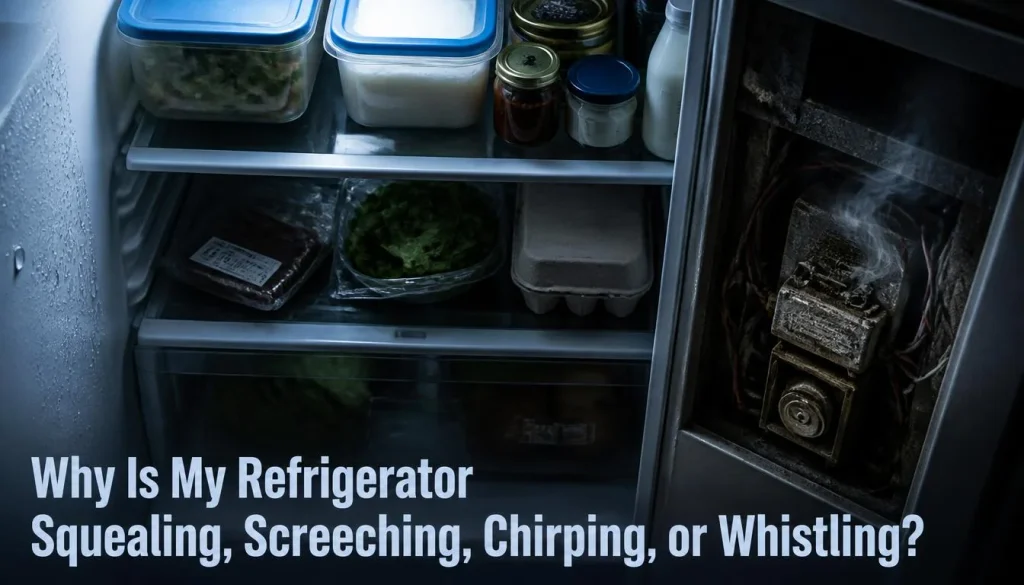
The source of a high-pitched noise may be a fan motor, moving air, an air damper, or a door component.
A brief whistle or pulsating tone can be normal when:
- A variable-speed compressor changes speed.
- Air moves through an interior vent.
- Refrigerant pressure equalizes.
- An air damper opens or closes.
- A tight door gasket releases.
A continuous squeal or screech is more likely to come from a fan motor with a worn bearing. The sound may become louder as the motor warms up or changes speed.
If the noise happens only when you open or close a door, inspect the hinge, door alignment, gasket, and any wiring cover near the hinge. A newly installed refrigerator may produce an occasional door squeak while its gasket and hinge components settle.
If the high-pitched sound comes from inside the freezer and stops when the door opens, suspect the evaporator fan rather than the door hinge.
Why Is My Refrigerator Knocking, Banging, Thumping, Clunking, or Hammering?
A single thump may simply be ice falling into an empty bin. Water lines can also move when the inlet valve opens or closes.
Possible sources include:
- Ice cubes dropping into the storage bucket
- The ice maker completing a harvest cycle
- A water line striking the wall
- Water hammer in the household plumbing
- Loose compressor mounting supports
- Refrigerant tubing touching another surface
- A shifting drain pan
- A loose rear panel
- A fan striking frost
- Internal compressor wear
A brief knock when the compressor starts or stops can be normal. Repeated metallic knocking from the lower rear area, especially with weak cooling, should be professionally diagnosed.
If the bang occurs exactly when water filling stops, the refrigerator may not be the only source. Sudden water-pressure changes in the household plumbing can create water hammer.
See the dedicated refrigerator knocking noise guide for a more detailed breakdown.
Why Is My Refrigerator Popping, Cracking, or Snapping?
Occasional popping is one of the most commonly misunderstood refrigerator sounds. It is usually caused by plastic liners, shelves, metal panels, and cooling components expanding or contracting as temperatures change.
You may hear it:
- When the refrigerator first begins cooling
- During or after an automatic defrost cycle
- After the doors have remained open
- After adding a large amount of warm food
- When the compressor starts or stops
- During the first days after installation
- When ice is released into the bin
A pop is usually harmless when cooling remains normal and the sound occurs only occasionally.
Investigate further if the popping becomes rapid or continuous, is followed by a loss of power, occurs with repeated compressor clicking, or is accompanied by a burning smell.
Learn more about normal and abnormal refrigerator popping noises.
Why Is My Refrigerator Gurgling, Bubbling, Dripping, or Sounding Like Running Water?
A gentle gurgling or bubbling sound usually comes from refrigerant moving through the sealed cooling system. The sound may be more noticeable when the compressor stops and pressures begin to equalize.
Running-water and dripping sounds may also come from melted frost draining during the automatic defrost cycle.
You may hear gurgling:
- After the compressor shuts off
- During or after defrosting
- Immediately after closing a door
- When water moves through a drain tube
- When refrigerant changes pressure
- As defrost water enters the drain pan
These sounds are generally normal if there is no water leaking onto the floor and the refrigerator maintains the correct temperature.
A refrigerator that gurgles while losing cooling may have a separate problem, but the sound alone does not prove that refrigerant is leaking.
Why Is My Refrigerator Hissing or Sizzling?
Hissing or sizzling often occurs when defrost water drips onto the defrost heater and evaporates. It may sound alarming, but it is usually a normal part of an automatic defrost cycle.
A faint hiss can also come from refrigerant moving through the cooling lines.
Pay closer attention when the sound is unusually loud, continues for a long time, or occurs with:
- Poor cooling
- An oily residue
- A chemical smell
- Water leaking
- Heavy frost
- A damaged interior panel
Do not open, bend, puncture, or attempt to repair refrigerant tubing. The sealed cooling system requires trained service equipment.
Why Is My Refrigerator Whirring, Whooshing, or Pulsating?
Whirring and whooshing are usually airflow sounds. The evaporator fan moves cold air through the refrigerator and freezer, while the condenser fan helps release heat near the compressor on models that use one.
The sound may temporarily become louder when:
- Warm groceries are added.
- The door has been open for a long time.
- The room is unusually hot.
- The refrigerator is recovering after a power interruption.
- The temperature setting was recently changed.
- A variable-speed fan or compressor increases speed.
Check that food packages are not blocking the interior vents. Overpacking the freezer or placing containers directly against vents can make airflow noisier and reduce cooling in the fresh-food compartment.
A rough, uneven, or wobbling whir may indicate a fan obstruction or worn motor rather than normal airflow.
Why Is My Refrigerator Beeping Even When the Door Is Closed?
Beeping is usually an alert rather than a mechanical noise. The refrigerator may think a door is open, detect a high internal temperature, report a power interruption, or display an error condition.
Check all refrigerator doors and freezer drawers. A door may look closed while a food package, shelf, ice buildup, or misaligned drawer prevents the gasket from sealing.
Inspect for:
- Food extending beyond the shelf edge
- A drawer that is not fully inserted
- A folded, dirty, or damaged gasket
- Frost preventing a freezer drawer from closing
- A refrigerator that leans forward
- A loose or misaligned door
- A displayed warning or error code
- A recent power interruption
- A warm interior
Clean the gasket with mild soapy water and dry it completely. If the doors seal properly but the alarm continues, consult the model’s manual for its specific door sensor and error-code procedure.
Where Is the Strange Refrigerator Noise Coming From?
The same sound can mean different things depending on its location. Spend a minute listening from several positions before moving anything.
Noise Coming From Inside the Freezer
The freezer contains the evaporator fan, ice maker, air ducts, and defrost components. Common freezer noises include:
- Fan whirring
- Grinding from a fan hitting ice
- Ice dropping into a bucket
- Clicking from the ice maker
- Popping during defrosting
- Gurgling from refrigerant
- Rattling from loose drawers or food packages
A noise that stops when the freezer door opens is an important clue. On many models, the internal fan stops or changes operation when the door switch detects an open door.
Noise Coming From the Refrigerator Compartment
A sound inside the fresh-food section may come from:
- The air damper
- An internal circulation fan
- Bottles touching each other
- A loose shelf or drawer
- Food blocking an air vent
- A vibrating water-filter housing
- A door gasket or hinge
A chirp, click, or short howl may occur as the damper adjusts airflow between the freezer and refrigerator compartments.
Noise Coming From the Back
The lower rear area contains several important components, depending on the model:
- Compressor
- Condenser fan
- Water inlet valve
- Drain pan
- Water line
- Power cord
- Rear cover
- Refrigerant tubing
Pull the refrigerator forward slightly. If the sound immediately becomes quieter, the cabinet, water line, power cord, or tubing may have been touching the wall.
Do not touch the compressor, exposed terminals, wiring, or refrigerant lines while the appliance is connected to power.
Noise Coming From Underneath
A sound under the refrigerator may come from:
- An uneven leveling foot
- The drain pan
- A condenser fan
- A lower grille
- Dust or debris
- Floor vibration
- A loose exterior panel
A flexible or uneven floor can amplify normal vibration. The appliance should remain stable when you gently press each corner.
Noise Coming From the Ice Maker or Water Dispenser
Ice and water systems naturally make several noises:
- A short buzz as the valve opens
- Water rushing into the ice mold
- A click or clunk during ice release
- Ice striking an empty bin
- Grinding while dispensing crushed ice
- Chattering from a restricted filter
- A bang caused by a moving water line
Noise that continues when no one is dispensing ice or water may point to a jam, restricted supply, ice buildup, or valve problem.
Noise Coming From the Door, Hinge, or Cabinet
Door-related noises may be caused by:
- A dry or worn hinge
- A loose handle
- Door misalignment
- A tight new gasket
- A door rubbing against a cabinet
- A loose door bin
- A freezer drawer rail
- An uneven refrigerator
Check the model manual before applying any lubricant. Use only a product approved for food-appliance hinges.
Compressor Noise vs. Fan Noise: How Can You Tell the Difference?
The compressor and fans can both hum, buzz, or rattle, but a few clues can help you separate them.
| Clue | Compressor or Lower Rear Area | Evaporator Fan | Condenser Fan |
|---|---|---|---|
| Typical location | Lower rear | Inside or behind freezer panel | Lower rear or underneath |
| Common sound | Hum, buzz, click, knock | Whir, scrape, grind, squeal | Rattle, buzz, scrape, whir |
| Changes when door opens | Usually no | Often stops or changes | Usually no |
| Related symptom | Repeated startup attempts or poor cooling | Frost, weak airflow, warm fridge section | Long run times or heat near compressor |
| Common obstruction | Not user-serviceable | Frost or ice | Dust, pet hair, or debris |
| DIY access | Limited | Often requires panel removal | Model-dependent |
A fan-related sound usually changes with airflow or door position. Compressor trouble is more likely when clicking, humming, and shutdown repeat without successful cooling.
For more guidance, see how to check refrigerator compressor and fan noise.
Match the Noise With Its Timing and Other Symptoms
Timing is often more useful than volume. Note exactly when the sound begins and what else the refrigerator is doing.
Why Does the Refrigerator Noise Stop When the Door Opens?
A noise that stops when the freezer door opens commonly points to the evaporator or circulation fan. The fan may stop when the door switch changes position.
Possible causes include:
- Fan blade hitting frost
- Loose fan blade
- Worn fan motor
- Loose evaporator cover
- Debris near the fan
- Heavy ice buildup
- Food package touching an air outlet
Look for frost around the freezer vents or rear interior wall. If the noise returns soon after a complete defrost, the underlying problem may involve the door seal, defrost system, sensor, drainage, or airflow.
Why Does My Refrigerator Make Noise Every Few Minutes?
A refrigerator may start and stop naturally, but a repeating pattern can reveal a problem.
Common patterns include:
| Noise Pattern | Possible Explanation |
|---|---|
| One click when cooling starts | Normal control or compressor operation |
| Click-hum-click every few minutes | Compressor-start or overload problem |
| Short buzz every 10–20 minutes | Ice maker attempting to fill |
| Brief valve sound at regular intervals | Model-specific cooling or water-valve operation |
| Grinding during ice-making cycles | Jammed ice or ice-maker mechanism |
| Scraping whenever the fan starts | Fan blade contacting frost or debris |
If the ice maker is not connected to water, turn it off. If the repeating noise comes from the compressor area and the refrigerator is warming, arrange professional diagnosis.
Why Is My Refrigerator Suddenly Making a Loud Noise?
A sudden change is more important than a sound that has been present since installation.
Check whether the refrigerator was recently:
- Moved
- Cleaned
- Releveled
- Loaded with groceries
- Disconnected from power
- Connected to a new water filter
- Pushed closer to a wall
- Exposed to unusually hot room temperatures
Moving the appliance can shift the drain pan, water line, power cord, shelves, and leveling feet. Warm food or hot weather can temporarily make the compressor and fans run faster.
A new grinding, screeching, or repeated clicking sound should not be dismissed as normal adjustment.
Why Is My Refrigerator Making Noise but Still Cooling?
If temperatures remain stable, the sound may be part of normal operation or an early-stage problem.
Start with the simple checks:
- Confirm the refrigerator is level.
- Move it away from the wall.
- Remove objects from the top.
- Separate bottles and jars.
- Secure shelves and drawers.
- Check the water line.
- Keep interior vents open.
- Listen for whether the noise is getting worse.
Continue monitoring the temperature with an appliance thermometer. A refrigerator should generally stay at 40°F or 4°C or below for safe food storage.
Even when cooling is normal, persistent grinding, scraping, metallic knocking, or high-pitched squealing deserves attention before the affected motor or fan stops completely.
Why Is My Refrigerator Making Noise and Not Cooling?
Noise combined with poor cooling is more urgent.
Possible causes include:
- Compressor failing to start
- Defective start relay or overload protector
- Failed evaporator fan
- Failed condenser fan
- Heavy frost blocking airflow
- Door not sealing
- Blocked vents
- Defrost-system problem
- Control or sensor fault
- Sealed cooling-system failure
Repeated clicking followed by silence is a particularly useful clue. It may indicate that the compressor is attempting to start but shutting down.
Keep the doors closed as much as possible and move perishable food to another refrigerator or an insulated cooler if the internal temperature is rising.
Why Is My Refrigerator Making Noise and Running Constantly?
A refrigerator may run longer during hot weather, after frequent door openings, or after a large grocery load. Newer variable-speed models may also operate for long periods at low power.
Continuous loud operation can be caused by:
- Dirty accessible condenser coils
- Blocked interior vents
- Damaged door gaskets
- A door that does not fully close
- Incorrect temperature settings
- A warm installation area
- Heavy frost
- Failed fan
- Temperature sensor problem
- Cooling-system fault
Check whether the temperature is stable and whether the door seals firmly. If the refrigerator never seems to slow down and the interior is becoming warmer, professional diagnosis may be necessary.
The guide on a refrigerator running constantly covers this symptom in more detail.
Why Is the Freezer Cold but the Refrigerator Warm and Noisy?
When the freezer remains cold but the refrigerator compartment is warm, the problem often involves airflow rather than complete cooling-system failure.
Possible causes include:
- Evaporator fan hitting ice or failing
- Frost blocking an air passage
- Food covering supply or return vents
- A stuck air damper
- Defrost-system failure
- Door-seal leakage
- A temperature sensor problem
Listen near the freezer’s rear interior wall. Grinding, scraping, or rapid tapping may indicate that the fan is hitting ice. A silent fan may have stopped completely.
See the guide on a refrigerator that is warm while the freezer stays cold for targeted airflow troubleshooting.
Why Is My Refrigerator Noisy With Frost or Ice Buildup?
Frost around an evaporator fan can create tapping, scraping, grinding, or rattling.
Ice may form because:
- A door was left partly open.
- The gasket is dirty, folded, or damaged.
- Food prevents the door from closing.
- Humid air repeatedly enters the freezer.
- A drain is blocked.
- The defrost heater, sensor, or control has failed.
- Interior vents are blocked.
- The temperature setting is unnecessarily cold.
A complete manual defrost can remove the immediate obstruction. However, it does not repair the cause of recurring frost.
Never chip ice away with a sharp tool.
Why Is My Refrigerator Making Noise and Leaking Water?
Noise and water leakage may be connected if the problem involves:
- A loose or damaged water line
- A leaking inlet valve
- A filter installed incorrectly
- A cracked filter housing
- A blocked defrost drain
- A displaced drain pan
- Ice melting after a fan or defrost problem
Turn off the refrigerator’s water supply if an active supply-line leak is visible. Disconnect power if water is reaching wiring, an outlet, or electrical components.
Do not continue operating the water dispenser until the source of the leak is identified.
Why Is My Refrigerator Making Noise After a Power Outage?
After power returns, the refrigerator may click, hum, and run longer as it restores the selected temperature. The ice maker and electronic controls may also restart.
Some temporary noise is expected. Investigate when:
- Clicking repeats without cooling starting.
- An error code remains on the display.
- The compressor becomes unusually hot.
- The appliance trips the breaker.
- The refrigerator does not begin cooling.
- You smell overheated wiring.
One model-approved power reset may clear a temporary control issue. Repeatedly unplugging and reconnecting a refrigerator that cannot start is not a repair and may delay proper diagnosis.
Why Is My Refrigerator Noisy After It Was Moved or Cleaned?
Moving the refrigerator can alter several things at once:
- Leveling feet
- Wall clearance
- Water-line position
- Drain-pan position
- Power-cord position
- Rear-cover alignment
- Shelf and drawer placement
- Ice-bin seating
Check that the refrigerator stands firmly without rocking. Make sure the water line and power cord are not trapped between the cabinet and wall.
If the appliance was transported on its side, follow the manufacturer’s instructions regarding how long it should stand upright before being powered on.
Why Is My New Refrigerator Making Strange Noises?
A new refrigerator may sound very different from the one it replaced. High-efficiency fans, valves, dampers, ice makers, and variable-speed compressors can produce unfamiliar sounds.
During initial cooling, you may hear:
- Longer compressor operation
- Changing fan speeds
- Humming
- Clicking
- Popping
- Gurgling
- Water filling
- Ice dropping
- Tight gasket squeaks
Check that all packaging and shipping materials have been removed. Confirm that the appliance is level, has the required ventilation clearance, and is not touching nearby cabinets.
Repeated clicking with no cooling, continuous grinding, leaking water, or an electrical smell is not normal simply because the refrigerator is new. Use the warranty or installation-support process rather than dismantling it.
Why Does My Refrigerator Make Noise When Dispensing Water or After Replacing the Filter?
A refrigerator may chatter, vibrate, buzz, or pulse during water dispensing if the filter or supply system is restricting flow.
Common causes include:
- Air trapped after filter replacement
- Filter not fully seated
- Incorrect replacement filter
- Clogged or overdue filter
- Kinked water line
- Partly closed shutoff valve
- Low or fluctuating water pressure
- Worn inlet valve
- Water line touching the cabinet
Flush a newly installed filter according to the manufacturer’s instructions. The sound should decrease as trapped air leaves the system.
Slow flow, cloudy ice, poor-tasting water, and clicking or buzzing during dispensing may also be signs the refrigerator water filter needs replacing.
A 5-Minute Refrigerator Noise Troubleshooting Checklist
Work through these steps in order. Do not begin by buying parts.
- Check the temperature. Use an appliance thermometer rather than relying only on how the food feels.
- Describe the sound. Decide whether it is humming, buzzing, clicking, rattling, grinding, squealing, knocking, popping, gurgling, or beeping.
- Find the location. Listen inside the freezer, in the refrigerator compartment, behind the appliance, and near the floor.
- Note the timing. Does it happen when cooling starts, when a door closes, when water dispenses, during ice production, or every few minutes?
- Remove loose objects. Take items off the top and separate bottles, jars, trays, shelves, and bins.
- Check wall clearance. Make sure the cabinet, power cord, and water line are not pressed against the wall.
- Test stability. Gently press each corner. Adjust the leveling feet according to the model manual if the refrigerator rocks.
- Inspect the water connection. Confirm that the supply valve is open, the line is not kinked, and the ice maker is turned off if no water is connected.
- Keep air vents clear. Rearrange food that blocks freezer or refrigerator vents.
- Look for frost. Check the freezer’s interior rear panel and vents for heavy ice buildup.
- Clean only accessible areas. With power disconnected, remove dust from user-accessible grilles or condenser areas as directed by the manual.
- Record the sound. A 20- to 30-second phone recording can help you compare changes and explain the problem to a technician.
Refrigerator Noise Safety Warning
Disconnect the refrigerator from power before inspecting any user-accessible rear or lower area.
Do not:
- Test live electrical terminals.
- Remove a compressor terminal cover.
- Touch a moving fan.
- Bend refrigerant tubing.
- Puncture an interior panel.
- Use a knife to remove freezer ice.
- Apply a heat gun or open flame.
- Attempt to add refrigerant.
- Continue operating an appliance that smells burnt or produces smoke.
Repairs involving the compressor, refrigerant circuit, control board, internal wiring, or inaccessible fan assemblies should be handled by a qualified technician.
When Should You Call a Refrigerator Repair Technician?
Arrange professional service when:
- The refrigerator is not maintaining a safe temperature.
- Repeated clicking occurs without successful compressor startup.
- Grinding or scraping continues after visible obstructions are removed.
- Fan noise returns soon after a complete defrost.
- Thick frost quickly rebuilds.
- A fan blade or motor appears damaged.
- Loud metallic knocking comes from the compressor area.
- The compressor is unusually hot.
- Water leaks near electrical components.
- An error code repeatedly returns.
- The circuit breaker trips more than once.
- The refrigerator smells burnt.
- You see sparks, smoke, damaged wiring, or melted plastic.
Use the following urgency guide:
| Situation | Recommended Action |
|---|---|
| Soft, occasional operating sound | Monitor |
| Loose item, wall contact, or mild vibration | Complete safe DIY checks |
| Persistent fan noise or recurring frost | Schedule service soon |
| Noise combined with weak cooling | Contact a technician promptly |
| Repeated clicking and no cooling | Stop repeated restart attempts and arrange diagnosis |
| Water near wiring or an outlet | Disconnect power safely and seek urgent help |
| Smoke, sparking, or burning smell | Stop using the appliance immediately |
Should You Repair or Replace a Noisy Refrigerator?
Noise alone is not enough to decide whether a refrigerator should be replaced. The correct decision depends on the failed component and the overall condition of the appliance.
Repair is often reasonable when:
- The refrigerator is relatively new.
- It is still under warranty.
- The problem is a fan, relay, valve, gasket, or loose component.
- Cooling remains reliable.
- Replacement parts are readily available.
- The appliance has not required repeated repairs.
Replacement may make more sense when:
- The refrigerator is older and has several ongoing problems.
- A sealed-system or compressor repair is expensive.
- Temperatures remain unstable after repair.
- Parts are difficult to obtain.
- The appliance has significant rust, door damage, or insulation problems.
- Recent repair costs are approaching the cost of a suitable replacement.
Ask for a written diagnosis before approving a major repair. A noise that sounds like a failing compressor may turn out to be a much cheaper fan, valve, water line, or leveling problem.
How to Prevent Unwanted Refrigerator Noises
Regular checks can prevent many rattles, vibrations, and fan problems.
- Keep the refrigerator stable and properly leveled.
- Maintain the ventilation clearance stated in the manual.
- Avoid storing objects on top of the appliance.
- Separate glass bottles and loose containers.
- Keep interior vents unobstructed.
- Clean accessible condenser areas as directed.
- Inspect the door gasket for dirt, tears, and gaps.
- Replace the water filter on the recommended schedule.
- Keep the water line free of kinks and wall contact.
- Turn off an unused ice maker if no water supply is connected.
- Avoid overpacking the freezer.
- Investigate new noises before they become louder.
Smart models may use additional fans, dampers, and electronic controls. The troubleshooting principles remain similar, but model-specific alerts and diagnostic tools may help. See the guide to a smart refrigerator making noise for more targeted information.
Frequently Asked Questions
Is It Normal for a Refrigerator to Make Noise?
Yes. Refrigerators normally hum, click, gurgle, pop, hiss, drip, and produce airflow sounds. Ice makers also buzz, click, and drop ice. A sound is more concerning when it becomes loud, continuous, metallic, or is accompanied by poor cooling, frost, leaking, or electrical symptoms.
Why Does My Refrigerator Sound Louder at Night?
The kitchen is quieter at night, so normal compressor, fan, refrigerant, and ice-maker sounds become easier to hear. Room temperature changes may also affect how long the refrigerator runs. Investigate the sound if it is genuinely new, is becoming louder, or interrupts normal conversation.
Why Does the Noise Stop When I Open the Freezer Door?
The freezer’s evaporator fan often stops or changes operation when the door opens. If the noise disappears immediately, the fan may be rubbing against frost, ice, debris, or a loose housing. Look for visible frost and monitor cooling in the refrigerator compartment.
Why Is My Refrigerator Clicking but Not Cooling?
Repeated clicking with no cooling may indicate a failed start relay, overload protector, compressor problem, or electrical-control fault. Confirm that the appliance has power, but do not repeatedly reset it. Compressor-start components and wiring should be professionally diagnosed.
Can I Keep Using a Refrigerator That Is Making Noise?
You can usually continue using it when the sound is soft, occasional, and cooling remains stable. Stop and seek help when the noise is accompanied by smoke, a burning smell, repeated breaker trips, water near electrical parts, severe overheating, or loss of cooling.
Should I Unplug a Noisy Refrigerator?
You do not need to unplug a refrigerator for every harmless hum or gurgle. Disconnect it before inspecting an accessible fan, drain pan, lower grille, or rear area. Unplug it immediately when it produces smoke, sparks, a burning smell, electrical arcing, or water near powered components—provided you can do so safely.
What Does a Failing Refrigerator Compressor Sound Like?
Possible signs include repeated click-hum-stop cycles, a harsh buzz, metallic knocking, excessive vibration, or unusual startup noise combined with poor cooling. However, sound alone cannot confirm compressor failure. Fans, tubing, panels, relays, and water valves can produce similar noises.
Why Did My Refrigerator Suddenly Go Quiet?
The refrigerator may be between cooling cycles, in a defrost cycle, or already at the selected temperature. Silence becomes concerning when the interior starts warming, lights or controls are off, the fan never runs, or the compressor repeatedly clicks without starting.
Why Does My Refrigerator Make Noise After the Door Closes?
Closing the door can restart an internal fan, change air pressure, move water in a drain-tube trap, or cause a damper to adjust. A short whoosh, gurgle, click, or fan sound may be normal. Scraping or grinding that starts after every door closure may indicate a fan contacting ice.
Why Does My Refrigerator Make Noise After Cleaning or Moving It?
The refrigerator may no longer be level, or its drain pan, water line, power cord, rear cover, shelves, or tubing may have shifted. Recheck stability, wall clearance, water-line placement, and interior storage parts.
How Loud Should a Refrigerator Be?
There is no single noise level that applies to every refrigerator design and room. Instead of relying on one decibel figure, focus on whether the sound has changed, can be heard from another room, disrupts conversation, continues constantly, or occurs with poor cooling.
Why Is My Refrigerator Beeping With the Door Closed?
The door may not be fully sealed even though it looks closed. Check food placement, drawers, frost, gasket condition, door alignment, and the freezer drawer. The alarm may also indicate a warm interior, power interruption, sensor problem, or model-specific error code.
Why Is My Refrigerator Making a Noise Every Hour?
A brief hourly sound may come from a valve, fan-speed adjustment, ice maker, air damper, defrost control, or another model-specific operation. Note the exact duration and location. A short sound with normal cooling is less concerning than repeated compressor clicking or grinding.
Can a Water Filter Make a Refrigerator Noisy?
Yes. A restricted, incorrectly installed, or newly replaced filter may cause chattering, pulsing, buzzing, or vibration during dispensing. Trapped air can also create temporary noise. Confirm that the filter is correctly seated and flush it according to the manufacturer’s instructions.
Does Refrigerator Noise Vary by Brand?
The basic causes are similar, but the exact sounds and components vary by model. Brand-specific guides are available for a Samsung refrigerator making noise, an LG refrigerator making noise, a GE refrigerator making noise, and a Whirlpool refrigerator making noise.
Final Thoughts
Your refrigerator is probably making strange noises because a compressor, fan, valve, ice maker, defrost system, water line, or loose component is operating. Soft humming, brief clicking, occasional popping, gentle gurgling, and short ice-maker sounds are usually normal when the appliance continues cooling properly.
Begin by identifying the sound, location, timing, and cooling condition. Then check the easy causes: loose containers, wall contact, uneven leveling, blocked vents, water-line problems, and visible freezer frost.
Do not ignore continuous grinding, repeated click-hum-stop cycles, severe rattling, electrical smells, leaking near wiring, or noise combined with rising temperatures. Those symptoms deserve prompt professional diagnosis before a small problem becomes a larger repair.

Hi, I’m the lead researcher and appliance enthusiast behind RefrigeratorSolve. With years of hands-on experience troubleshooting cooling systems and testing home appliances, I am dedicated to bringing you honest reviews, energy-saving tips, and practical solutions to keep your refrigerator running perfectly.