A sudden bang from your refrigerator can be alarming, especially when the kitchen is quiet. You may hear one loud thump, several repeated knocks, or a banging sound whenever the compressor, ice maker, or water dispenser starts working.
So, what causes a refrigerator to make banging noises?
In many cases, the cause is harmless. Ice may be falling into the storage bin, internal materials may be expanding as temperatures change, or a water line may be moving when the ice maker fills. However, repeated or unusually loud banging can also come from a fan, water inlet valve, compressor area, air damper, or another part that needs attention.
The best way to find the problem is to pay attention to where the noise comes from, when it happens, and whether the refrigerator is still cooling normally.
This guide will help you narrow down the cause, try the safest fixes first, and recognize when it is better to call a refrigerator technician.
Quick Answer: Why Is My Refrigerator Making a Banging Noise?
A refrigerator may make banging or knocking noises because of:
- Ice dropping into the ice bin
- An ice maker cycling or jamming
- Water hammer in the supply line
- A noisy water inlet valve
- A loose water line behind the refrigerator
- An evaporator fan hitting ice
- A condenser fan or loose rear component
- Compressor movement or vibration
- A sticking air damper
- Defrosting, temperature expansion, or refrigerant movement
An occasional bang with normal cooling is often harmless. A loud, repeated bang combined with poor cooling, grinding, electrical smells, excessive heat, or strong vibration deserves closer attention.
If the sound you hear is closer to knocking than banging, this guide on how to fix a refrigerator knocking noise covers that sound in more detail.
Refrigerator Banging Noise: Quick Diagnosis
Use the timing of the sound to narrow down the likely cause.
| What You Notice | Likely Cause | Should You Worry? | First Thing to Check |
|---|---|---|---|
| Bang when ice falls | Ice maker | Usually no | Ice bin |
| Bang when ice maker fills | Water line or valve | Sometimes | Water supply |
| Bang when using water dispenser | Water hammer or inlet valve | Sometimes | Water pressure and line |
| Bang when compressor starts | Compressor vibration | Depends | Rear/bottom area |
| Bang when compressor stops | Compressor mount or tubing | Depends | Compressor area |
| Noise stops when freezer door opens | Evaporator fan | Often needs checking | Frost around fan |
| Bang during defrost | Expansion or defrost activity | Usually no | Timing and frequency |
| Bang from rear of refrigerator | Compressor, fan, tubing, or water line | Depends | Rear components |
| Bang after refrigerator was moved | Leveling or tubing movement | Usually fixable | Position and leveling |
| Banging with poor cooling | Fan, compressor, or cooling problem | More serious | Cooling performance |
Do not diagnose the refrigerator by sound alone. The location and timing of the noise usually provide better clues.
1. Ice Is Dropping Into the Ice Bin
One of the simplest explanations is also one of the loudest.
When an automatic ice maker finishes a cycle, the cubes are released and fall into the storage bin. If the bin is empty, the cubes can hit the hard plastic bottom with a surprisingly loud bang or clunk.
You may notice this more:
- At night when the house is quiet
- After emptying the ice bin
- When several cubes fall together
- After turning the ice maker back on
- When the refrigerator has recently started making ice again
This is normally nothing to worry about if the bang happens occasionally and fresh ice appears in the bin afterward.
How to Confirm It
Listen for the next bang, then check the ice bin.
If new cubes have appeared, you have probably found the source.
You can also temporarily turn off the ice maker according to your refrigerator’s instructions. If the banging stops, the ice-making system is likely responsible.
2. The Ice Maker Is Jammed or Cycling Noisily
Not every ice-maker sound is caused by ice simply falling into the bin.
A jammed cube, frozen mechanism, or restricted water supply can cause repeated knocking, clicking, buzzing, or banging around the ice maker.
Look for:
- Ice stuck around the ejector
- Large clumps of frozen cubes
- A partially blocked ice chute
- An empty ice maker that repeatedly tries to operate
- Slow or stopped ice production
- Unusual noises during each ice-making cycle
Do not force moving ice-maker parts by hand.
If you can see loose ice blocking an accessible area, follow the manufacturer’s instructions for safely removing it. If the mechanism itself appears damaged or frozen solid, service may be the safer choice.
3. Water Hammer Is Shaking the Supply Line
If the bang happens when the ice maker fills or when you use the water dispenser, the refrigerator may not be the part actually making the noise.
The problem could be water hammer.
Water hammer happens when moving water suddenly stops or changes direction inside a plumbing line. That pressure change can make the pipe or refrigerator water line jump and hit a wall, cabinet, or nearby surface.
It may sound like:
- One sharp bang
- A short series of knocks
- A hammering sound behind the refrigerator
- A thump immediately after dispensing water
- A bang when the ice maker finishes filling
What You Can Check
First, pull the refrigerator forward carefully and inspect the water supply line.
Make sure:
- It is not tightly pressed against the wall
- It is not hitting the refrigerator cabinet
- It is not sharply kinked
- The supply valve is fully open
- The line is not being crushed behind the appliance
If the banging seems to come from your home’s plumbing rather than the refrigerator itself, unusually high water pressure or unsupported pipes may require a plumber.
4. The Water Inlet Valve Is Noisy
The water inlet valve controls water entering the refrigerator for the ice maker and water dispenser.
It normally operates for short periods, so a brief sound is not automatically a problem.
However, a worn valve or restricted water supply may cause noticeable buzzing, knocking, vibration, or banging.
Suspect the water system if the noise occurs mainly:
- When dispensing water
- When the ice maker fills
- Every time the refrigerator requests water
- Along with slow water flow
- Along with reduced ice production
Before blaming the valve, check the simpler possibilities.
Make sure the supply line is not kinked, the household water valve is open, and the water filter is installed correctly.
A clogged filter or restricted line can reduce water flow and change the sound made by the valve.
If your refrigerator makes more of a buzz than a bang, see our guide explaining why a refrigerator makes a buzzing noise.
5. A Loose Water Line Is Hitting the Wall or Cabinet
A refrigerator water line can also create noise even when the water pressure itself is normal.
When the compressor runs or water enters the refrigerator, a loose line may vibrate against:
- The wall
- A cabinet
- The back panel
- Another pipe
- The floor
The result can sound like light tapping, repeated knocking, or a louder bang.
Pull the refrigerator forward carefully and watch the line while someone briefly uses the dispenser, if your setup allows this to be done safely.
Repositioning the line so it does not strike a hard surface may solve the problem.
Avoid crushing or sharply bending the line when pushing the refrigerator back into place.
6. The Evaporator Fan Is Hitting Ice or Debris
The evaporator fan usually sits in or near the freezer compartment. Its job is to move cold air through the refrigerator.
A healthy fan generally produces a smooth airflow sound.
If frost or ice builds up around the fan blade, however, the blade may hit the ice every time it turns. Depending on the amount of buildup, you might hear:
- Knocking
- Tapping
- Clicking
- Scraping
- Grinding
- Repeated banging
Try the Door-Open Test
Pay attention to the noise while the freezer door is closed.
Then open the freezer door.
On many refrigerators, the evaporator fan stops or changes operation when the door is opened. If the banging immediately disappears, the evaporator fan area becomes a strong suspect.
Check for visible heavy frost around vents or accessible fan areas.
Do not chip ice away with a knife, screwdriver, or other sharp object. It is easy to puncture a liner, coil, or hidden refrigerant component.
If your refrigerator has several unusual noises and you are not sure which fan is responsible, our guide to checking refrigerator compressor and fan noise can help you narrow down the source.
7. The Condenser Fan or a Rear Component Is Loose
Some refrigerators use a condenser fan near the compressor at the lower rear of the appliance.
Dust, pet hair, packaging material, or a loose object near the fan can interfere with the blade and create a rhythmic knock or clatter.
Other nearby parts can also vibrate, including:
- Drain pan
- Rear access panel
- Tubing
- Water line
- Wiring clips
- Loose hardware
Safe Inspection
Unplug the refrigerator before inspecting any accessible mechanical area.
If your model has a user-removable lower cover, follow the owner’s manual before removing it.
Look for obvious debris or loose parts. Do not reach into electrical components or the sealed refrigeration system.
Sometimes the actual fan is fine and normal compressor vibration is simply causing another part to hit the cabinet.
8. The Compressor Is Starting, Stopping, or Vibrating
The compressor is located near the bottom rear of most refrigerators.
It circulates refrigerant through the cooling system and turns on and off as cooling is needed.
A small change in sound when the compressor starts or stops can be normal. A refrigerator does not need to be completely silent.
However, a strong clunk or bang can sometimes come from:
- Compressor vibration
- Worn or loose mounting components
- Nearby tubing touching the cabinet
- A loose rear panel
- Excessive movement during startup or shutdown
When Compressor Noise Needs More Attention
Be more cautious if the banging comes with:
- Repeated clicking
- Poor cooling
- Frequent failed startup attempts
- Strong shaking
- Excessive heat
- A sudden major increase in noise
The compressor is part of the sealed refrigeration system and is not a good DIY repair project.
If you think the sound is coming from this area, read our guide on how to reduce refrigerator compressor noise before assuming the compressor itself has failed.
9. The Air Damper Is Opening or Closing Noisily
Many refrigerators use an air damper to control how much cold air moves from the freezer into the fresh-food compartment.
The damper may open and close automatically as the refrigerator adjusts temperature.
Normally, you may barely notice it.
But a worn, sticking, obstructed, or damaged damper mechanism can produce:
- Repeated tapping
- Clicking
- Knocking
- Short thumping sounds
Damper noise is often heard inside the refrigerator rather than from the lower rear area.
You may also notice uneven temperatures if the damper is not opening or closing correctly.
Because damper location and design vary between models, consult your refrigerator manual before attempting to access it.
10. Defrosting, Temperature Changes, or Refrigerant Movement
Not every sudden pop, knock, or bang comes from a broken part.
A refrigerator repeatedly warms and cools different materials during normal operation.
Plastic liners, shelves, metal panels, tubing, and other components can expand and contract as temperatures change. This can create an occasional popping or cracking sound that may resemble a light bang.
Defrost Cycle Sounds
During automatic defrost, frost on the evaporator melts.
You may hear:
- Popping
- Cracking
- Dripping
- Sizzling
- Gurgling
- An occasional knock
These sounds are usually temporary.
After defrosting, cooling begins again and materials may contract as temperatures drop.
Refrigerant Movement
Refrigerant moving through tubing may also create gurgling, bubbling, flowing, or occasional knocking-like sounds.
If the refrigerator is cooling properly and the sound is brief, it may simply be normal operation.
If you want a broader explanation of normal and abnormal refrigerator sounds, read what it means when your refrigerator starts making noise.
Can an Uneven Refrigerator Cause Banging?
Yes.
A refrigerator that is not sitting firmly on the floor can amplify normal vibration.
Instead of hearing a mild compressor hum, you may hear the cabinet rock, a panel shake, or a nearby component knock against something.
Check whether the refrigerator:
- Rocks when gently pushed
- Leans heavily to one side
- Touches a wall or cabinet
- Sits on an uneven or flexible floor
- Has improperly adjusted leveling feet
Follow the manufacturer’s leveling instructions for your model.
The goal is to make the refrigerator stable so normal compressor and fan vibration cannot move the cabinet.
If shaking or vibration is the main problem, see our detailed guide to refrigerator vibrating noises and their causes.
Where Is the Banging Noise Coming From?
Finding the location can reduce a long list of possible causes to only a few.
Banging From the Back of the Refrigerator
Possible causes include:
- Compressor vibration
- Water supply line
- Water inlet valve
- Condenser fan
- Refrigerant tubing
- Rear access panel
Start by checking whether the refrigerator is touching the wall.
Then listen near the top and bottom of the rear panel to see whether the noise is coming from the plumbing or mechanical area.
Banging From Inside the Freezer
The most likely areas are:
- Evaporator fan
- Ice buildup
- Ice maker
- Ice cubes falling into the bin
Try the freezer-door test.
If the noise changes or stops when the door opens, inspect the evaporator fan area more closely.
Banging From the Bottom of the Refrigerator
Check:
- Compressor area
- Condenser fan
- Drain pan
- Leveling feet
- Floor stability
A loose drain pan can sometimes make a surprisingly loud sound as compressor vibration travels through it.
Banging Near the Ice Maker
Watch what happens immediately after the sound.
If ice drops into the bin, the noise may be normal.
If you hear repeated knocking without ice production, investigate for a jam or water-supply problem.
Banging Near the Water Dispenser
The most likely suspects are:
- Water hammer
- Water inlet valve
- Restricted water flow
- Kinked supply line
- Vibrating tubing
If the bang happens exactly when water stops flowing, water hammer becomes particularly worth investigating.
Diagnose the Banging Noise by When It Happens
Sometimes timing tells you more than location.
Refrigerator Bangs When the Compressor Starts
A short sound may come from normal startup movement.
If the cabinet strongly vibrates or the bang is new, check leveling, wall clearance, loose panels, tubing, and the compressor area.
Refrigerator Bangs When the Compressor Shuts Off
A single clunk at shutdown may be caused by movement in the compressor or nearby tubing.
If it has always happened and cooling is normal, monitor it.
If the sound suddenly becomes much louder or is accompanied by cooling trouble, professional inspection is a safer choice.
Refrigerator Bangs When the Ice Maker Fills
Check:
- Water supply line
- Water inlet valve
- Water pressure
- Ice maker
- Water filter
A bang immediately after water flow stops may be water hammer.
Refrigerator Bangs When Using the Water Dispenser
If the noise happens only during water use, you can usually focus your troubleshooting on the refrigerator’s water system rather than the cooling system.
Watch for weak flow, sputtering, a recently replaced filter, or a loose supply line.
Refrigerator Noise Stops When the Door Opens
This is a useful clue.
If the sound stops when the freezer door opens, the evaporator fan may be involved.
The fan could be:
- Hitting ice
- Rubbing against a housing
- Obstructed
- Developing a motor problem
Heavy frost around the freezer vents is another clue.
Refrigerator Bangs During or After the Defrost Cycle
Occasional popping, cracking, or light banging during temperature changes can be normal.
Monitor the refrigerator rather than immediately replacing parts.
Investigate further if the sound becomes constant or is accompanied by:
- Heavy frost
- Poor airflow
- Rising refrigerator temperatures
- Water where it should not be
Refrigerator Started Banging After a Power Outage
After power returns, a refrigerator may run longer than usual while it restores the correct temperature.
Fans and the compressor may operate differently during this recovery period.
First give the refrigerator time to stabilize and check whether cooling returns normally.
Repeated clicking, failed compressor starts, or a refrigerator that remains warm requires more attention.
If clicking becomes the dominant sound, our guide to refrigerator clicking noises explains the most common causes.
Refrigerator Started Banging After Being Moved
Moving a refrigerator can change:
- Leveling
- Wall clearance
- Water-line position
- Drain-pan position
- Tubing contact
- Items inside the refrigerator
Start with external checks.
Make sure the refrigerator is stable, has proper clearance, and is not pressing a water line or other component against the wall.
Is a Banging Noise From a Refrigerator Normal?
Sometimes.
The important question is not simply whether the refrigerator makes noise. It is whether the sound matches normal operation and whether anything else has changed.
Banging Sounds That Are Often Normal
Usually harmless examples include:
- Ice falling into an empty bin
- An occasional pop during temperature changes
- Brief noises during defrost
- A small sound when the compressor starts or stops
- Normal ice-maker operation
- Refrigerant moving through the system
These sounds should generally be brief and occasional.
Banging Sounds That May Indicate a Problem
Investigate when:
- The noise becomes much louder than before
- Banging continues repeatedly
- The refrigerator shakes strongly
- Cooling performance drops
- You hear grinding or scraping
- The sound stops whenever the freezer door opens
- Ice production suddenly changes
- Water flow becomes weak
- Clicking accompanies the banging
- Heavy frost develops
A sound that changes suddenly is often more useful diagnostically than a sound the refrigerator has made since it was installed.
Refrigerator Is Banging but Still Cooling
If the refrigerator is still holding the correct temperature, you probably have more time to investigate.
Possible causes include:
- Ice dropping
- Thermal expansion
- Water-line movement
- Cabinet vibration
- Uneven leveling
- Early fan wear
- Loose components
Do not ignore a rapidly worsening sound simply because cooling still works.
A fan motor, for example, may become noisy before it stops working completely.
Start with easy external checks and monitor whether the noise changes over the next cooling cycles.
Refrigerator Is Banging and Not Cooling
Banging becomes more concerning when the refrigerator is also getting warm.
Possible problems include:
- Evaporator fan failure
- Condenser fan problem
- Severe frost blocking airflow
- Compressor startup problem
- Compressor or sealed-system problem
- Electrical or control-related failure
Check whether both the refrigerator and freezer are warm.
Also listen for repeated attempts to start, unusual clicking, or a fan that appears unable to turn.
Avoid repeatedly unplugging and reconnecting the refrigerator in an attempt to force the compressor to start.
If the refrigerator is not keeping food safely cold, protect perishable food while arranging diagnosis.
For additional troubleshooting, see our guide on how to fix a refrigerator making loud noise.
How to Stop a Refrigerator From Making Banging Noises

Use a simple process rather than taking the refrigerator apart immediately.
Step 1: Identify the Timing
Ask yourself:
- Does it happen when ice drops?
- Does it happen while dispensing water?
- Does it start with the compressor?
- Does it occur during defrost?
- Does it happen continuously?
- Does opening the freezer door stop it?
Write down the pattern if necessary.
Step 2: Find the Location
Listen carefully around:
- Freezer
- Fresh-food compartment
- Ice maker
- Water dispenser
- Bottom
- Lower rear
- Water supply line
Do not remove covers while the refrigerator is connected to power.
Step 3: Move the Refrigerator Away From the Wall
A refrigerator touching the wall or cabinetry can turn a small vibration into a loud knock.
Make sure there is appropriate clearance according to the manufacturer.
Step 4: Check Whether the Refrigerator Is Level
Gently test whether the cabinet rocks.
If necessary, adjust the leveling feet according to the owner’s manual.
Step 5: Rearrange Loose Items
Check:
- Bottles
- Glass containers
- Shelves
- Drawers
- Door bins
- Items stored on top of the refrigerator
Sometimes two bottles vibrating together can sound surprisingly mechanical.
Step 6: Inspect the Water Line
Check for:
- Kinks
- Wall contact
- Cabinet contact
- Crushing
- Movement when dispensing water
Also confirm that the water supply is fully open.
Step 7: Check the Ice Maker
Look for:
- Jammed cubes
- Ice clumps
- Empty ice bin
- Water-supply issues
Temporarily turning the ice maker off can help confirm whether it is responsible.
Step 8: Try the Door-Open Test
If opening the freezer door changes the noise, focus on the evaporator fan and possible frost buildup.
Step 9: Inspect Safely Accessible Fan Areas
Unplug the refrigerator first.
Follow the owner’s manual before removing any panel.
Look for obvious debris, frost, or something touching a fan blade.
Step 10: Know When to Stop
Do not attempt DIY repairs involving:
- Refrigerant lines
- Compressor internals
- Sealed-system components
- Complex electrical wiring
- Components you cannot access safely
At that point, professional diagnosis is more appropriate.
Why Does My Refrigerator Make a Banging Noise at Night?
Your refrigerator does not necessarily operate differently at night.
The kitchen is simply quieter.
During the day, conversations, television, traffic, heating or air conditioning, and other appliances can hide small refrigerator sounds.
At night, you may suddenly notice:
- Compressor cycling
- Ice dropping
- Defrost popping
- Water-valve operation
- Refrigerant movement
If the sound happens only occasionally and the refrigerator is cooling correctly, observe when it occurs before assuming there is a fault.
Why Does My Refrigerator Bang Every Few Hours?
A repeating schedule often points to a component that operates in cycles.
Possible sources include:
- Ice maker
- Defrost system
- Compressor
- Water inlet valve
Try recording the time of each bang and what the refrigerator was doing immediately afterward.
If fresh ice appears after the sound, for example, the mystery may already be solved.
Why Is My New Refrigerator Making Banging Noises?
A new refrigerator can sound different from the appliance it replaced.
Modern refrigerators may use different compressor designs, multiple fans, automatic dampers, ice systems, and electronic controls.
During the first day, the refrigerator may also run more frequently while pulling down to its set temperature.
However, do not assume every loud bang is normal just because the refrigerator is new.
Check:
- Leveling
- Shipping material
- Wall clearance
- Shelf and bin installation
- Water-line routing
- Ice-maker setup
If the noise is unusually loud from the beginning, document it and contact the retailer or manufacturer while warranty coverage applies.
When Should You Call a Refrigerator Technician?
You do not need professional service for every refrigerator bang.
Consider arranging service when:
- The refrigerator is no longer cooling properly
- The noise becomes continuous or rapidly worse
- You hear metal grinding or scraping
- The compressor repeatedly attempts to start
- The refrigerator shakes heavily
- A fan cannot turn correctly
- Heavy frost repeatedly returns
- The ice maker appears mechanically damaged
- The banging persists after basic troubleshooting
Stop using the refrigerator and seek qualified help promptly if you notice a burning electrical smell, smoke, sparking, severe overheating, or repeated circuit-breaker trips.
How to Prevent Refrigerator Banging and Knocking Noises
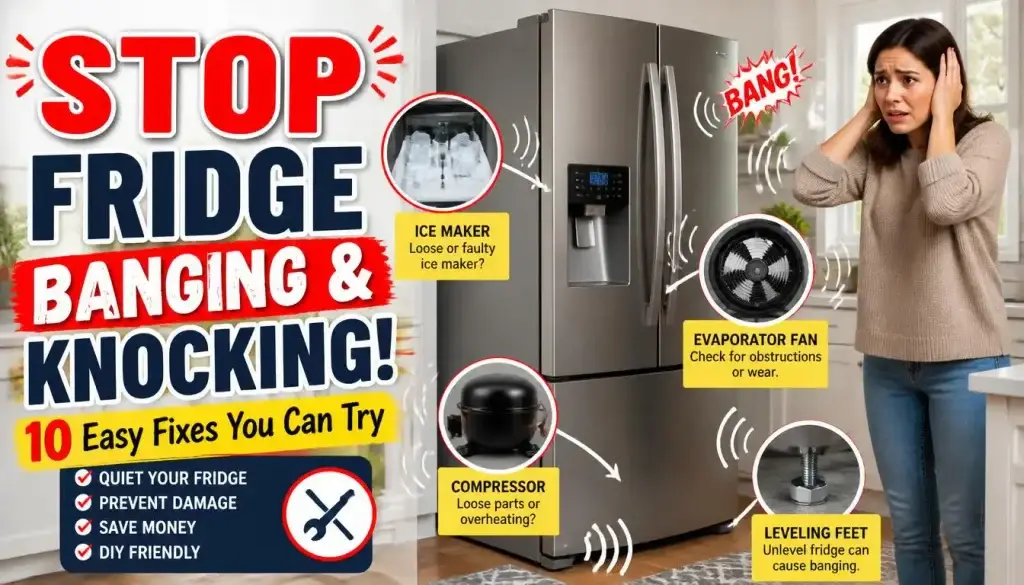
A little routine attention can prevent many noise problems.
Keep the Refrigerator Level
A stable refrigerator transfers less vibration into the floor and cabinet.
Maintain Proper Clearance
Do not let the appliance press tightly against a wall or surrounding cabinetry.
Keep the Water Line Properly Positioned
Prevent the line from hitting the wall or being crushed behind the refrigerator.
Keep Fan Areas Clean
Dust and debris around accessible condenser areas can affect airflow and sometimes contribute to noise.
Always disconnect power before cleaning near mechanical components.
Watch for Heavy Frost
Heavy frost can interfere with the evaporator fan.
If frost repeatedly returns after being cleared or defrosted according to the manufacturer’s instructions, there may be a deeper defrost or airflow problem.
Keep Shelves and Containers Secure
Avoid placing glass bottles tightly against each other or against interior walls.
Pay Attention to New Sounds
Knowing what your refrigerator normally sounds like makes it easier to notice a real change.
Frequently Asked Questions About What Causes a Refrigerator to Make Banging Noises
Why does my refrigerator make a loud bang randomly?
A random loud bang may be ice falling into the ice bin, plastic or metal expanding and contracting, a compressor starting or stopping, or a water line moving. Check what the refrigerator is doing when the sound occurs and whether cooling remains normal.
Why does my refrigerator make a knocking noise and then stop?
A brief knocking sound may come from the ice maker, compressor movement, water line, air damper, or thermal expansion. If it stops quickly and the refrigerator operates normally, monitor it. Repeated or worsening knocking deserves closer inspection.
Why does my refrigerator make a bang when the ice maker fills?
The sound may come from water hammer, a vibrating water line, or the water inlet valve. Check the water line for kinks and wall contact, and note whether the bang occurs when water starts or stops flowing.
Why does my refrigerator noise stop when I open the door?
If opening the freezer door stops the noise, the evaporator fan may be involved. Frost or ice may be touching the fan blade, or the fan motor itself may be becoming noisy.
Why does my fridge make a banging noise when the compressor turns off?
A short clunk can come from normal movement in the compressor or nearby tubing. A new, extremely loud bang combined with poor cooling or heavy vibration should be professionally inspected.
Can high water pressure make a refrigerator bang?
Yes. High or abruptly changing water pressure can contribute to water hammer when the refrigerator’s water valve closes. This may sound like a bang in the supply line or nearby household plumbing.
Is refrigerator banging dangerous?
Most occasional refrigerator banging is not dangerous. Ice dropping, temperature changes, defrost activity, and normal cycling can all create sudden sounds. Banging accompanied by smoke, burning smells, sparking, severe overheating, or repeated breaker trips should be treated as a safety issue.
Why is my refrigerator banging but still cooling?
If cooling is normal, the cause may be relatively minor, such as ice dropping, vibration, a water line, thermal expansion, or a loose component. Monitor whether the sound becomes louder or more frequent.
Why is my refrigerator banging and not cooling?
Banging plus poor cooling may point to a fan, compressor startup, airflow, frost, or sealed-system problem. This combination deserves faster investigation than noise alone.
Should I unplug my refrigerator if it makes a loud banging noise?
Not every loud noise requires unplugging the refrigerator. However, disconnect power before inspecting accessible mechanical parts. Unplug it immediately if you notice smoke, burning smells, electrical sparking, severe overheating, or another obvious electrical hazard.
Why did my refrigerator start banging after a power outage?
The refrigerator may run harder while restoring its normal temperature after power returns. Fans and the compressor may operate for longer periods. If the noise does not settle or the refrigerator fails to cool, further diagnosis is needed.
Why did my refrigerator start banging after I moved it?
Moving the refrigerator can change its leveling, water-line position, tubing clearance, or contact with nearby surfaces. Check that the refrigerator sits firmly and that nothing behind it is hitting the wall.
Final Thoughts
If you are wondering what causes a refrigerator to make banging noises, start with the simplest possibilities before assuming there is a major mechanical failure.
An occasional bang may simply be ice falling into the bin, the refrigerator expanding and contracting, or the compressor cycling. Banging during water use points more toward the supply line, water hammer, or inlet valve. A noise that stops when the freezer door opens may point toward the evaporator fan.
Pay the most attention when the sound is new, repeated, getting louder, or accompanied by poor cooling.
Start by identifying when and where the bang occurs. Check leveling, wall clearance, loose items, the water line, and the ice maker. Only move to internal inspection when it can be done safely.
A refrigerator that cools normally and makes an occasional harmless bang usually does not need emergency repair. A refrigerator that bangs, struggles to cool, shakes heavily, or shows electrical warning signs should be inspected by a qualified technician.

Hi, I’m the lead researcher and appliance enthusiast behind RefrigeratorSolve. With years of hands-on experience troubleshooting cooling systems and testing home appliances, I am dedicated to bringing you honest reviews, energy-saving tips, and practical solutions to keep your refrigerator running perfectly.