A refrigerator is never completely silent. You may hear a soft hum, an occasional click, water moving through a line, or ice dropping into the bin. These sounds are usually normal.
But when your refrigerator suddenly starts buzzing, grinding, rattling, squealing, or vibrating much louder than before, something may need attention.
The good news is that many refrigerator noise problems are easier to fix than they sound. A fridge may simply be sitting unevenly, touching a wall, vibrating against a cabinet, or have a fan blade hitting ice. Other problems, such as a failing compressor or electrical component, are better left to a qualified technician.
This guide explains how to fix a refrigerator making loud noise by looking at three things:
- What the noise sounds like
- Where the noise is coming from
- When the noise happens
Start with the simple checks first. They can save you from taking apart parts that are working perfectly well.
Why Is My Refrigerator Making a Loud Noise?
A loud refrigerator does not always mean a major part has failed.
Some common causes include:
- Refrigerator sitting unevenly
- Fridge touching a wall or cabinet
- Loose drain pan
- Bottles or shelves vibrating
- Dust around the condenser fan
- Fan blade hitting ice or debris
- Worn evaporator fan motor
- Worn condenser fan motor
- Water inlet valve noise
- Ice maker problems
- Compressor vibration
- Compressor start problems
The type of sound can often give you the first clue.
For example, rattling usually points toward vibration or loose parts. Grinding may come from a fan blade or motor. Repeated clicking may happen when a compressor tries to start.
Before assuming the worst, find out exactly where the sound is coming from.
First, Decide Whether the Noise Is Normal
Modern refrigerators make many sounds during normal operation.
You may hear:
- Soft humming
- Gentle buzzing
- Occasional clicking
- Water trickling
- Gurgling
- Hissing
- Ice dropping
- Short popping sounds
- Fans speeding up or slowing down
These sounds normally come and go.
A noise deserves more attention when it is:
- Much louder than before
- Constant for a long time
- Grinding or scraping
- Accompanied by poor cooling
- Paired with repeated clicking
- Causing strong vibration
- Coming with a burning smell
- Getting worse over time
A refrigerator that has always made a soft hum is usually less concerning than one that suddenly develops a loud metallic grinding sound.
Quick Checks Before Taking the Refrigerator Apart
Always begin with the easy fixes. Many noisy refrigerator problems come from the appliance itself vibrating rather than from a failed internal part.
Make Sure the Refrigerator Is Level
An uneven refrigerator can vibrate against the floor and make a loud humming or rattling sound.
Gently push on the refrigerator.
If it rocks from side to side, one or more leveling feet may need adjustment.
Use a level if you have one. Adjust the front feet until the refrigerator sits firmly on the floor.
The refrigerator should not wobble when you touch it.
Move the Refrigerator Away From the Wall
A refrigerator that sits too close to a wall can create surprisingly loud vibration.
Check whether:
- The rear panel touches the wall
- The water line hits the wall
- The power cord vibrates against something
- A cabinet touches the side of the fridge
Move the refrigerator slightly forward and listen again.
If the noise disappears, vibration was probably the problem.
Check Bottles, Shelves, and Door Bins
Glass bottles touching each other can create a loud rattling sound when the compressor or fan starts.
Check:
- Bottles
- Jars
- Shelves
- Ice bin
- Door bins
- Containers touching interior walls
Move them slightly apart.
Sometimes this simple adjustment fixes the problem immediately.
Check the Drain Pan
Many refrigerators have a drain pan near the bottom.
If the pan becomes loose, it may vibrate whenever the compressor runs.
Unplug the refrigerator before reaching underneath or removing a lower access panel.
Check whether the drain pan feels loose. Reposition it securely if needed.
Check Whether the Door Is Rubbing or Squeaking
If the noise only happens when opening or closing the refrigerator, the problem may be the door rather than the cooling system.
Look for:
- Door rubbing against a cabinet
- Uneven refrigerator position
- Dirty hinges
- Misaligned doors
- Loose hinge hardware
A door noise is usually easier to fix than a fan or compressor problem.
Identify the Refrigerator Noise Before You Fix It
Different sounds point toward different problems.
Loud Buzzing or Humming Noise
A soft hum is normal for most refrigerators.
A very loud buzzing noise may come from:
- Compressor
- Condenser fan
- Water inlet valve
- Ice maker
- Refrigerator vibration
If the buzzing only happens for a few seconds when the ice maker fills with water, the sound may be normal.
If the buzzing continues for a long time or becomes much louder than before, investigate further.
Rattling or Vibrating Noise
Common causes include:
- Refrigerator touching the wall
- Loose drain pan
- Loose rear panel
- Water line vibrating
- Bottles touching each other
- Uneven refrigerator
- Compressor vibration
Start by pulling the refrigerator slightly away from the wall.
Grinding Noise
Grinding is not a sound you should ignore.
Possible causes include:
- Evaporator fan hitting ice
- Condenser fan hitting debris
- Damaged fan blade
- Failing fan motor
If the sound stops when you open the freezer door, the evaporator fan should be one of the first parts you inspect.
Squealing or Chirping Noise
A squealing or chirping sound may come from a fan motor bearing.
The sound can appear when:
- Evaporator fan spins
- Condenser fan spins
- Motor bearing begins wearing out
If cleaning the area does not help, the motor may eventually need replacement.
Clicking Noise
Some clicking is normal.
You may hear a click when:
- Compressor turns on
- Compressor turns off
- Defrost cycle starts
- Ice maker operates
Repeated clicking every few seconds can be more serious, especially if the refrigerator is not cooling.
Possible causes include:
- Start relay problem
- Compressor struggling to start
- Electrical control problem
Knocking or Banging Noise
A single knocking sound may happen when:
- Ice drops into the bin
- Refrigerant pressure changes
- Tubing moves slightly
Repeated knocking may come from:
- Compressor area
- Loose tubing
- Ice maker
- Water line movement
Try to identify whether the sound is coming from the freezer, back, or bottom of the refrigerator.
Hissing or Gurgling Noise
Hissing and gurgling are often normal.
They may happen when:
- Refrigerant moves through the cooling system
- Water drains during defrost
- Ice melts
- Pressure changes inside the system
If the refrigerator is cooling normally and the sound is brief, you usually do not need to repair anything.
Popping or Cracking Noise
Plastic refrigerator parts expand and contract as temperatures change.
This can create occasional popping or cracking sounds.
A few short sounds are usually normal.
Constant loud cracking together with temperature problems deserves further inspection.
High-Pitched, Whining, or Pulsating Noise
Some modern refrigerators use variable-speed fans and compressors.
Their speed changes depending on cooling demand.
This can produce a high-pitched, whining, or pulsating sound.
If the sound has always been present and cooling is normal, it may simply be part of normal operation.
If the sound suddenly becomes much louder, check the fans and compressor area.
Find Where the Loud Refrigerator Noise Is Coming From
The location of the noise can narrow the problem quickly.
Noise Coming From Inside the Freezer
The evaporator fan is one of the most common causes of freezer noise.
Possible causes include:
- Ice around the fan
- Fan blade hitting frost
- Damaged fan blade
- Worn evaporator fan motor
- Loose fan cover
Try opening the freezer door.
If the noise stops shortly after opening the door, the evaporator fan may be involved.
Noise Coming From the Back of the Refrigerator
Noise from the rear may come from:
- Compressor
- Condenser fan
- Water inlet valve
- Loose tubing
- Rear cover panel
Listen carefully before removing anything.
A loose panel may produce a loud rattle that sounds much worse than the actual problem.
Noise Coming From Under the Refrigerator
Check:
- Drain pan
- Condenser fan
- Compressor mounting
- Debris near the fan
A small object or piece of dust buildup around a fan can create a surprisingly loud sound.
Noise Coming From the Ice Maker
The ice maker can create several normal sounds.
You may hear:
- Buzzing
- Clicking
- Water filling
- Ice dropping
- Motor movement
A buzzing ice maker becomes more suspicious when water is not reaching the refrigerator properly.
Does the Refrigerator Make the Noise Constantly or Intermittently?
When the noise happens is just as useful as where it happens.
Refrigerator Makes a Loud Noise Constantly
A constant noise may point toward something that runs for long periods.
Possible causes include:
- Fan motor
- Fan blade obstruction
- Heavy frost buildup
- Compressor running continuously
- Poor ventilation
- Dirty condenser area
- Cooling problem
If the refrigerator is also running almost all the time, check whether the doors are sealing properly and whether the condenser area needs cleaning.
Refrigerator Noise Comes and Goes
Intermittent sounds often happen during normal refrigerator cycles.
Possible causes include:
- Compressor turning on
- Defrost cycle
- Ice maker filling
- Water valve opening
- Fan speed changing
Pay attention to how long the sound lasts.
A five-second buzz every few hours is very different from a grinding sound that runs for 20 minutes.
How to Fix a Refrigerator Making Loud Noise
Once you know the sound and location, move through these fixes.
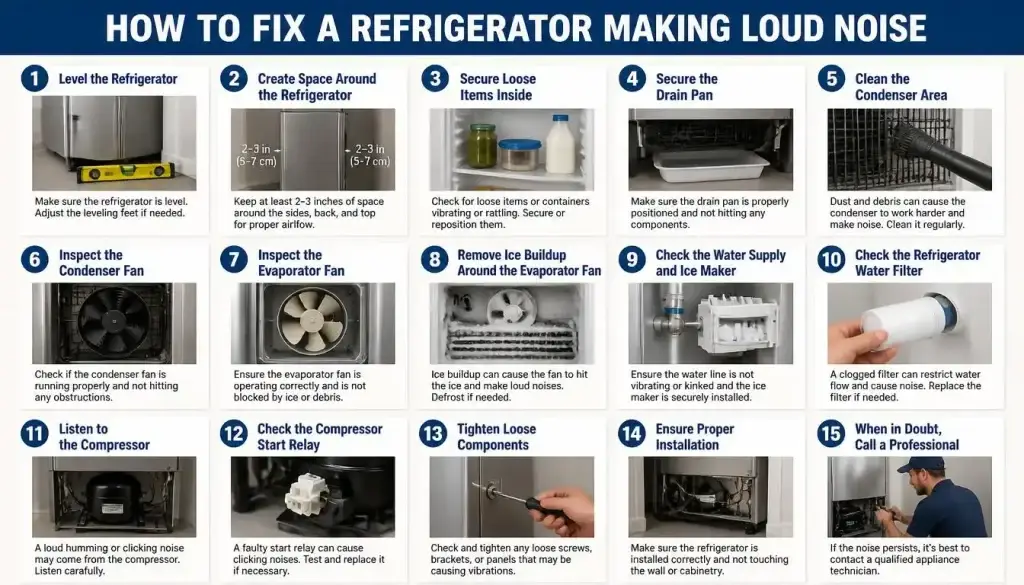
1. Level the Refrigerator
A refrigerator should sit firmly on the floor.
If it rocks:
- Pull the fridge slightly away from surrounding cabinets.
- Check the leveling feet.
- Adjust them until the refrigerator feels stable.
- Push gently on each corner.
- Listen for changes in vibration.
Do not place loose pieces of cardboard or other unstable material under the refrigerator.
2. Create Space Around the Refrigerator
Leave enough space so the refrigerator does not touch the wall or nearby cabinets.
Check the back for:
- Water lines
- Power cord
- Rear cover
- Tubing
Make sure nothing vibrates against the wall.
3. Secure Loose Items Inside
Rearrange bottles, jars, and containers.
Check whether:
- A glass shelf is loose
- The ice bin moves
- Door bins are seated correctly
- Containers touch one another
Run the refrigerator again and listen.
4. Secure the Drain Pan
Disconnect power before accessing the bottom of the refrigerator.
Check the drain pan.
If it is loose, reposition it properly.
A vibrating drain pan often creates a metallic rattling noise.
5. Clean the Condenser Area
Dust, pet hair, and debris can build up around the condenser area.
Depending on the refrigerator, the condenser coils may be at the back or underneath.
Before cleaning:
- Unplug the refrigerator.
- Pull it away from the wall.
- Remove the access cover if needed.
- Use a soft brush or vacuum attachment.
- Avoid damaging tubing or wires.
Cleaning the area can improve airflow and may reduce fan noise.
6. Inspect the Condenser Fan
Not every refrigerator has an exposed condenser fan, but many do.
With the refrigerator unplugged:
- Look for debris around the blade
- Check whether the blade appears damaged
- Make sure nothing touches the fan
- Gently rotate the blade
The blade should move freely.
Do not force it.
If it feels stiff, wobbles badly, or makes grinding sounds, the motor may need replacement.
7. Inspect the Evaporator Fan
The evaporator fan is usually located behind a panel inside the freezer compartment.
A noisy evaporator fan may produce:
- Grinding
- Scraping
- Squealing
- Loud humming
A useful clue is whether the sound changes when the freezer door opens.
If the noise stops when the fan stops, the evaporator fan or nearby ice buildup may be the cause.
Accessing this part varies by refrigerator model, so check the owner’s manual before removing freezer panels.
8. Remove Ice Buildup Around the Evaporator Fan
Ice can form around the fan and cause the blade to hit frost while spinning.
You may hear:
- Clicking
- Grinding
- Scraping
- Fast tapping
If you suspect ice buildup, unplug the refrigerator and allow the affected area to defrost safely.
Do not use a knife, screwdriver, or sharp tool to remove ice.
You could puncture an evaporator coil and turn a simple repair into an expensive sealed-system problem.
If the ice comes back soon after defrosting, the refrigerator may have a deeper defrost or airflow problem.
9. Check the Water Supply and Ice Maker
If the buzzing happens when the ice maker tries to fill, check the water supply.
Look for:
- Closed water valve
- Kinked water line
- Frozen water line
- Low water pressure
- Restricted filter
If your refrigerator is not connected to a water supply but the ice maker is switched on, turn the ice maker off.
Then listen to see whether the buzzing stops.
10. Check the Refrigerator Water Filter
A restricted or incorrectly installed water filter can affect water flow.
This may make the water inlet system sound louder.
Check:
- Filter installation
- Filter age
- Water flow from dispenser
- Manufacturer replacement interval
If the noise began shortly after changing the filter, remove and reinstall it correctly according to the refrigerator manual.
11. Listen to the Compressor
The compressor usually produces a soft hum while running.
A compressor may also sound slightly louder during startup.
Signs that deserve attention include:
- Very loud buzzing
- Strong knocking
- Repeated clicking
- Compressor trying to start and stopping
- Refrigerator not cooling
- Compressor area becoming unusually hot
Do not open or attempt to repair the compressor yourself.
Compressor and sealed refrigeration system work should be handled by a qualified technician.
12. Check the Compressor Start Relay
A faulty start relay can sometimes cause a refrigerator to click repeatedly without properly starting the compressor.
Common symptoms include:
- Click
- Short pause
- Another click
- Refrigerator not cooling well
- Compressor not staying on
Electrical testing and part replacement should only be done if you understand appliance electrical safety.
If you are unsure, call a technician.
Refrigerator Makes a Loud Noise When the Compressor Starts
If the sound appears only when the compressor starts, check for vibration first.
Possible causes include:
- Refrigerator touching wall
- Loose rear panel
- Tubing vibrating
- Drain pan rattling
- Compressor mounting vibration
- Start relay issue
Move the refrigerator slightly away from the wall.
If the sound becomes quieter, the compressor itself may be fine and the noise may simply be transferring through the cabinet.
A hard knock, repeated clicking, or very loud buzz together with poor cooling needs professional attention.
Refrigerator Makes a Loud Noise After the Door Closes
This symptom often points toward the evaporator fan.
When the freezer door closes, the fan may begin running again.
If frost has built up around the fan blade, you may hear a loud grinding or scraping noise.
Try this simple test:
- Listen while the refrigerator is noisy.
- Open the freezer door.
- Wait a few seconds.
- Notice whether the noise stops.
- Close the door again.
If the sound returns shortly after closing the door, inspect the evaporator fan area.
Heavy frost may mean the refrigerator also has a defrost problem.
Refrigerator Noise Stops When the Door Opens
This is another strong clue that the evaporator fan may be involved.
Common causes include:
- Ice hitting fan blade
- Damaged fan blade
- Worn fan motor
- Loose fan housing
Do not replace the fan immediately.
Inspect for ice and debris first.
A perfectly good fan can become noisy simply because the blade is hitting frost.
Refrigerator Making Loud Noise but Still Cooling
If your refrigerator still keeps food cold, the problem may not be urgent, but it should still be checked.
Possible causes include:
- Fan noise
- Loose drain pan
- Vibration
- Ice buildup
- Water valve
- Normal compressor cycling
Start with the simple external checks.
If the noise is getting louder every week, investigate before a small problem becomes a larger repair.
Cooling normally does not automatically mean every internal part is healthy.
Refrigerator Making Loud Noise and Not Cooling
Noise together with poor cooling deserves faster attention.
Check:
Check Whether the Fans Are Running
Both evaporator and condenser airflow can affect cooling.
A failed fan may cause poor cooling and unusual noise before it stops completely.
Check for Heavy Frost
Heavy frost inside the freezer can block airflow.
It may also interfere with the evaporator fan.
Listen for Repeated Clicking
Repeated clicking from the back of the fridge may suggest the compressor is struggling to start.
Check Whether the Compressor Runs
If the compressor repeatedly tries to start but stops, the problem may involve:
- Start relay
- Electrical supply
- Compressor
- Control system
At this point, professional diagnosis is usually the safest option.
Why Is My New Refrigerator Making a Loud Noise?
A new refrigerator can sound very different from an older model.
Modern refrigerators may use:
- Variable-speed compressors
- Multiple fans
- Electronic dampers
- Automatic ice makers
- High-efficiency cooling cycles
During the first several hours after installation, the refrigerator may run longer while pulling the interior down to the correct temperature.
You may hear more humming, airflow, clicking, or water-related sounds than expected.
Before calling for service:
- Make sure the fridge is level
- Remove shipping materials
- Check wall clearance
- Make sure the water line is not vibrating
- Read the normal sound section in the owner’s manual
However, a new refrigerator should not normally produce harsh grinding, metal scraping, burning smells, or repeated start failure.
Refrigerator Buzzing When Making Ice
A short buzzing sound during ice maker filling can be normal.
If the buzz is very loud, check the water system.
Possible causes include:
- Water valve partly closed
- Kinked supply line
- Restricted water filter
- Low water pressure
- Ice maker turned on without water connected
If the refrigerator has no water connection, switch the ice maker off.
Refrigerator Making Loud Noise at Night
Sometimes a refrigerator seems much louder at night simply because the house is quieter.
You may notice sounds that are hidden by daytime activity.
Normal nighttime sounds can include:
- Compressor hum
- Fan airflow
- Ice dropping
- Water filling
- Refrigerant movement
- Defrost sounds
The important question is whether the sound is actually new.
If the refrigerator has suddenly become louder than it was a week ago, investigate it even if you mostly notice the sound at night.
Which Refrigerator Noises Are Normal and Which Are a Problem?
Here is a quick comparison.
| Sound | Usually Normal? | What to Check |
|---|---|---|
| Soft humming | Yes | Compressor and fans |
| Short buzzing | Often | Ice maker or water valve |
| Light clicking | Often | Normal cycling |
| Gurgling | Usually | Refrigerant or drain water |
| Brief hissing | Usually | Refrigerant or defrost cycle |
| Ice dropping | Yes | Ice maker |
| Rattling | Sometimes | Wall, drain pan, bottles |
| Grinding | Usually needs checking | Fan and ice buildup |
| Scraping | Needs checking | Fan blade |
| Loud squealing | Needs checking | Fan motor |
| Repeated clicking with no cooling | No | Start system or compressor |
| Loud knocking from compressor area | No | Professional inspection |
Check Your Refrigerator Model Before Replacing Parts
Do not buy a replacement fan motor or relay based only on a YouTube video or another refrigerator that looks similar.
Two refrigerators from the same brand can use different:
- Fan motors
- Relays
- Sensors
- Water valves
- Control boards
Find the model number first.
Common locations include:
- Inside refrigerator wall
- Near crisper drawers
- Door frame
- Ceiling of fresh food section
- Rear identification label
Use the full model number when checking manuals or ordering replacement parts.
This small step can save you from buying the wrong part.
Is a Loud Refrigerator Dangerous?
Most noisy refrigerator problems are not immediately dangerous.
However, unplug the refrigerator and arrange professional service if you notice:
- Burning smell
- Smoke
- Melted wiring
- Electrical sparking
- Compressor repeatedly overheating
- Severe grinding near electrical components
- Circuit breaker repeatedly tripping
Do not continue resetting a breaker if it keeps tripping.
That can indicate an electrical fault that needs proper diagnosis.
When Should You Call a Refrigerator Repair Technician?
Some jobs are safe for a homeowner. Others are not.
You can usually handle:
- Leveling
- Moving the refrigerator away from the wall
- Rearranging bottles
- Cleaning accessible condenser areas
- Checking for visible debris
- Replacing a water filter
- Turning off an unused ice maker
Call a technician if:
- Compressor is extremely loud
- Refrigerator repeatedly clicks but will not cool
- Fan motor requires electrical testing
- Compressor needs replacement
- Refrigerant leak is suspected
- Wiring appears damaged
- Refrigerator stops cooling
- Ice buildup keeps returning
- You smell burning
- You are not comfortable removing electrical panels
A professional diagnosis can be cheaper than replacing several parts by trial and error.
How to Prevent Your Refrigerator From Becoming Noisy Again
A little maintenance can prevent many refrigerator noise problems.
Keep the Refrigerator Level
Check it again if you move the appliance or replace flooring.
Leave Enough Airflow
Avoid pushing the refrigerator tightly against the wall.
Keep the Condenser Area Clean
Dust buildup can reduce airflow and make cooling components work harder.
Avoid Overloading Shelves
Containers packed tightly together can vibrate and rattle.
Check the Water Line
Make sure it does not bend sharply or hit the wall.
Replace Water Filters When Needed
Restricted water flow can make filling sounds more noticeable.
Watch for Frost Buildup
If you see unusual ice around vents or freezer panels, investigate early.
Listen for Changes
You know what your refrigerator normally sounds like.
A new sound that appears suddenly is often more useful than how loud the appliance is overall.
Frequently Asked Questions
Why is my refrigerator suddenly making a loud noise?
A sudden loud noise may come from a fan hitting ice, a loose drain pan, vibration against a wall, a water valve, or a motor starting to wear out. First identify where the sound is coming from and whether it happens constantly or only during certain cycles.
Why is my fridge making a loud buzzing noise?
Buzzing can come from the compressor, water inlet valve, ice maker, or general vibration. A short buzz during ice filling may be normal. Continuous or unusually loud buzzing should be checked.
Why is my refrigerator making a loud humming noise?
A compressor and fan normally hum while running. If the humming is much louder than usual, make sure the refrigerator is level and not touching a wall. Then check the condenser fan and compressor area.
Why does my refrigerator sound like a motor running?
You may be hearing the compressor or one of the refrigerator fans. This is often normal. If the motor sound becomes rough, grinding, or unusually loud, inspect the fan areas and check whether cooling performance has changed.
Why is my refrigerator making a rattling noise?
Common causes include a loose drain pan, water line touching the wall, loose rear cover, uneven refrigerator, or bottles vibrating inside.
Why is my refrigerator making a grinding noise?
Grinding often points toward a fan blade hitting ice or debris, a damaged fan blade, or a worn fan motor. If opening the freezer door stops the sound, inspect the evaporator fan area.
Why does my refrigerator make noise but stop when I open the door?
The evaporator fan may stop when the door opens. If the noise disappears at the same time, the fan could be hitting frost, debris, or a damaged part.
Is it normal for a refrigerator compressor to be loud?
A compressor normally produces some humming. A sudden major increase in volume, repeated clicking, hard knocking, or poor cooling is not something to ignore.
Can a dirty condenser fan make a refrigerator noisy?
Yes. Dust and debris can interfere with airflow or contact the fan blade. Cleaning the condenser area may reduce the noise.
Why does my refrigerator make a loud noise when the compressor starts?
The compressor can create brief vibration during startup. Loose panels, tubing, a drain pan, or the refrigerator touching the wall may amplify the sound. Repeated clicking or very loud buzzing may require professional diagnosis.
Why is my fridge freezer making a loud noise?
A noisy fridge freezer may have frost around the evaporator fan, a worn fan motor, loose internal items, compressor vibration, or a problem near the condenser area. Start by finding whether the sound comes from the freezer, back, or bottom.
Should I unplug my refrigerator if it is making a loud noise?
Not every loud refrigerator needs to be unplugged. However, disconnect power if you smell burning, see smoke, hear severe electrical buzzing, notice sparking, or plan to remove a panel for inspection.
Final Thoughts on Fixing a Loud Refrigerator
The easiest way to fix a refrigerator making loud noise is to diagnose it in the right order.
Start with the sound.
Is it buzzing, rattling, grinding, clicking, squealing, or knocking?
Then find the location.
Is it coming from the freezer, back, bottom, or ice maker?
Finally, notice when it happens.
Does it run constantly, start when the compressor turns on, happen after the door closes, or only appear during the ice maker cycle?
Start with simple fixes such as leveling the refrigerator, creating more wall clearance, securing loose items, checking the drain pan, and cleaning the condenser area.
If the sound comes from a fan, inspect for ice or debris before replacing the motor.
If the refrigerator repeatedly clicks, stops cooling, smells hot or burnt, or makes severe noise from the compressor area, stop troubleshooting and call a qualified refrigerator repair technician.
A noisy refrigerator does not always mean an expensive repair. In many cases, finding the exact sound, location, and timing leads you straight to the real problem.

Hi, I’m the lead researcher and appliance enthusiast behind RefrigeratorSolve. With years of hands-on experience troubleshooting cooling systems and testing home appliances, I am dedicated to bringing you honest reviews, energy-saving tips, and practical solutions to keep your refrigerator running perfectly.