If you use the water dispenser on a KitchenAid refrigerator, you may assume the filter takes care of everything you do not want in your tap water. That is not quite how refrigerator filtration works.
KitchenAid refrigerator filters can reduce chlorine. In fact, KitchenAid currently states that its genuine Filter 1, Filter 2, Filter 3, and Filter 4 cartridges can reduce up to 97% of chlorine. Fluoride is different. Standard KitchenAid refrigerator filters should not be treated as fluoride-removal filters unless the performance data for your exact filter specifically lists a certified fluoride-reduction claim.
That difference matters if your goal is not simply better-tasting refrigerator water, but specifically reducing fluoride or other dissolved substances.
This guide explains what KitchenAid refrigerator filters actually do, why chlorine and fluoride behave differently during filtration, how to verify the claims for your specific filter, and what to consider if you want to reduce both chlorine and fluoride.
Quick Answer: Chlorine vs. Fluoride
Here is the short version:
| Substance | Do KitchenAid Refrigerator Filters Reduce It? | What You Need to Know |
|---|---|---|
| Chlorine | Yes | Current genuine KitchenAid Filters 1–4 advertise up to 97% chlorine reduction |
| Chlorine taste and odor | Yes | Chlorine taste/odor is a common target of refrigerator filtration |
| Fluoride | Do not assume so | Look for an explicit fluoride-reduction claim on the exact filter’s performance data sheet |
| Chloramine | Depends on the filter | Chlorine reduction does not automatically mean chloramine reduction |
| Lead | Yes, on current genuine Filters 1–4 | KitchenAid advertises up to 99% lead reduction |
| Minerals and hardness | Generally not the purpose of the filter | A refrigerator filter is not the same as a water softener |
| TDS | Not its primary function | Reverse osmosis is more commonly used when TDS reduction is required |
The most important point is simple: a filter should only be trusted to reduce a contaminant that is specifically included in its certified performance claims.
Do KitchenAid Refrigerator Filters Remove Chlorine?
Yes. Chlorine reduction is one of the main benefits of current genuine KitchenAid refrigerator water filters.
KitchenAid currently states that Filters 1, 2, 3, and 4 can reduce up to 97% of chlorine, along with other specifically tested contaminants. These filters are certified under NSF/ANSI Standards 42, 53, and 401 for specific reduction claims.
How Much Chlorine Can a KitchenAid Filter Reduce?
The exact performance depends on the filter model and test conditions, but KitchenAid advertises up to 97% chlorine reduction on its current genuine refrigerator Filters 1 through 4.
For example, the performance data sheet associated with KitchenAid Filter 4 lists an average reduction greater than 97.4% for chlorine taste and odor under the specified laboratory test conditions.
That does not mean every glass of water in every home will always have exactly 97% less chlorine. Actual performance can be affected by factors such as:
- Incoming water quality
- Filter age
- Water usage
- Flow rate
- Proper installation
- Whether the cartridge is genuine and correctly matched to the refrigerator
Still, chlorine is clearly one of the contaminants these filters are designed and certified to address.
Do KitchenAid Filters Remove Chlorine Taste and Odor?
Yes. This is one of the areas where refrigerator filtration is particularly useful.
Chlorine is commonly used by municipal water systems as a disinfectant. Even when the amount present in tap water is within drinking-water standards, some people notice a swimming-pool-like smell or an unpleasant taste.
NSF explains that NSF/ANSI 42 covers aesthetic effects such as chlorine and taste/odor reduction.
Reducing that chlorine taste and odor can make refrigerator water, ice, coffee, tea, and other drinks made from filtered water noticeably more pleasant.
What About Chloramine?
This is where it is important not to treat “chlorine” and “chloramine” as interchangeable terms.
Chloramine is formed using chlorine and ammonia and is also used by some water utilities for disinfection. The CDC notes that utilities may use chlorine or chloramine and, in some cases, may switch between them.
A filter that has a certified chlorine-reduction claim does not automatically have a certified chloramine-reduction claim.
If your local water provider uses chloramine, check the performance data sheet for your specific KitchenAid or everydrop cartridge and look specifically for the word chloramine.
This matters because chloramine is generally more persistent than free chlorine. EPA information has also noted that monochloramine can be more difficult to remove from drinking water than chlorine.
Do KitchenAid Refrigerator Filters Remove Fluoride?
You should not assume that a standard KitchenAid refrigerator filter removes fluoride.
KitchenAid’s current product information for its main Filter 1, Filter 2, Filter 3, and Filter 4 cartridges prominently lists chlorine and numerous other contaminant-reduction claims, but it does not advertise fluoride reduction on those product pages.
That distinction is important.
A filter may reduce dozens of contaminants and still allow fluoride to pass through. The number of contaminants a filter reduces does not tell you whether fluoride is one of them.
If fluoride reduction is important to you, look for the exact word “fluoride” in the certified contaminant-reduction information for the filtration system you are considering.
Does Fluoride Remain in KitchenAid Filtered Water?
If fluoride is present in the water entering your refrigerator and your particular filter does not have a verified fluoride-reduction claim, the safest assumption is that fluoride may remain in the filtered water.
Do not use taste as a test. Fluoride cannot be reliably detected by simply smelling or tasting the water.
The correct way to determine whether fluoride is being reduced is to:
- Identify your exact refrigerator filter.
- Find its official performance data sheet.
- Look for a specific fluoride-reduction claim.
- Check the certification associated with that claim.
If fluoride is not listed, do not assume the filter removes it.
Does Refrigerator Ice Still Contain Fluoride?
Potentially, yes.
In many refrigerators, water going to the ice maker passes through the same filtration system used by the water dispenser. If that filtration system does not have a verified fluoride-reduction claim, fluoride present in the incoming water may also be present in the ice.
However, refrigerator plumbing varies by model. Some designs route water differently, so check the owner’s manual for your exact KitchenAid refrigerator if this is important to you.
Why KitchenAid Filters Treat Chlorine and Fluoride Differently
The answer comes down to chemistry and filtration technology.
A contaminant does not disappear simply because water passes through a filter. The filter media must be capable of interacting with that specific contaminant, and the complete filter system must be tested for the reduction claim being made.
How Carbon-Based Filtration Helps With Chlorine
Activated carbon is widely used in drinking-water filtration because its large internal surface area can adsorb many compounds.
Current everydrop refrigerator filters approved for KitchenAid refrigerators describe a filtration system using a renewable coconut-shell-based activated-carbon core.
Carbon filtration is particularly useful for improving aesthetic qualities such as chlorine taste and odor, which aligns with the types of claims covered by NSF/ANSI 42.
Does Activated Carbon Remove Fluoride?
A typical refrigerator activated-carbon filter should not be assumed to remove fluoride.
There are many different filter-media formulations, and specialized systems may combine several technologies. So it would be too broad to say that every carbon-containing filtration system is incapable of affecting fluoride.
For a consumer, the practical rule is much simpler:
If fluoride reduction is not specifically listed and certified for the product, do not count on it.
This approach is more reliable than trying to judge a filter based only on phrases such as “activated carbon,” “multi-stage,” or “advanced filtration.”
Do All KitchenAid Refrigerator Filters Remove the Same Contaminants?
No.
KitchenAid sells multiple refrigerator filter types because different refrigerators use different cartridge designs, and their certified contaminant lists are not identical.
Current KitchenAid information shows:
| KitchenAid Filter | Model | Advertised Contaminant Reduction | Advertised Chlorine Reduction | Fluoride |
|---|---|---|---|---|
| Filter 1 | KAD1RXD1 | 70 contaminants | Up to 97% | Verify exact performance sheet |
| Filter 2 | KAD2RXD1 | 70 contaminants | Up to 97% | Verify exact performance sheet |
| Filter 3 | KAD3RXD1 | 74 contaminants | Up to 97% | Verify exact performance sheet |
| Filter 4 | KAD4RXD1 | 32 contaminants | Up to 97% | Verify exact performance sheet |
KitchenAid also advertises up to 99% lead reduction on these current genuine filter models.
The table also highlights an important lesson: KitchenAid Filter 3 reducing more listed contaminants than Filter 4 does not make it automatically compatible with a refrigerator designed for Filter 4.
Always use the filter type approved for your specific refrigerator.
KitchenAid Filter 1
KitchenAid Filter 1, model KAD1RXD1, is currently advertised as reducing 70 potentially harmful contaminants and impurities, including up to 97% of chlorine and 99% of lead. KitchenAid states that it is certified under NSF/ANSI Standards 42, 53, and 401 for specific contaminants.
KitchenAid Filter 2
KitchenAid Filter 2, model KAD2RXD1, is also advertised as reducing 70 contaminants, including up to 97% of chlorine and 99% of lead, with certification under NSF/ANSI 42, 53, and 401 for specific reduction claims.
KitchenAid Filter 3
KitchenAid Filter 3, model KAD3RXD1, currently advertises reduction of 74 contaminants, including up to 97% of chlorine and 99% of lead.
KitchenAid Filter 4
KitchenAid Filter 4, model KAD4RXD1, currently advertises reduction of 32 contaminants, including up to 97% of chlorine and 99% of lead. Its performance data also specifically lists chlorine taste/odor testing.
Again, these claims do not mean every filter reduces fluoride. Fluoride must be checked separately.
What About everydrop Filters Used in KitchenAid Refrigerators?
If you own a KitchenAid refrigerator, you may have also seen everydrop filters.
That is not necessarily an aftermarket alternative. KitchenAid’s own filter finder currently lists both KitchenAid-branded and everydrop-branded filters as approved options for compatible refrigerators, including corresponding Filter 1, 2, 3, and 4 cartridges.
Do everydrop Filters Remove Chlorine?
Compatible everydrop filters have their own certified contaminant-reduction specifications. Many are built to address chlorine along with other listed contaminants.
However, always check the specifications of the exact everydrop model rather than transferring the claims of one everydrop cartridge to another.
Do everydrop Filters Remove Fluoride?
The same rule applies here.
Do not assume an everydrop filter removes fluoride simply because it:
- Uses activated carbon
- Is NSF certified
- Reduces dozens of contaminants
- Fits a KitchenAid refrigerator
Look for an explicit fluoride-reduction claim for the specific cartridge.
KitchenAid’s current filter finder makes it easy to identify which KitchenAid and everydrop filter families are approved for particular refrigerator models.
What Else Do KitchenAid Refrigerator Filters Reduce?
Depending on the filter, KitchenAid refrigerator filters can target substantially more than chlorine.
The exact contaminant list varies by cartridge, so the performance sheet should always be your final reference.
Lead
Current KitchenAid Filters 1 through 4 advertise up to 99% lead reduction.
Lead reduction is different from chlorine taste reduction because lead is a health-related contaminant. NSF explains that NSF/ANSI 53 covers reduction claims involving contaminants with health effects.
VOCs, Pesticides, and Pharmaceuticals
Some KitchenAid and everydrop filters are certified for specific chemicals within these broad categories.
However, avoid assuming that a label such as “reduces pharmaceuticals” means every pharmaceutical compound is removed. Certification applies only to the specific substances included in the filter’s test data.
Microplastics
Some newer everydrop filters approved for use with KitchenAid refrigerators advertise certified microplastic reduction. For example, everydrop Filter 1 currently states that it is certified to reduce 99% of microplastics under the applicable test conditions.
That claim belongs to that specific filter and should not automatically be applied to every KitchenAid-compatible cartridge.
PFAS, PFOA, and PFOS
PFAS filtration is another area where reading the exact certification matters.
NSF explains that standards for PFAS reduction have evolved and that NSF/ANSI 53 and NSF/ANSI 58 can include relevant PFAS reduction claims.
But the presence of “NSF/ANSI 53” on a filter does not automatically mean that particular product is certified for every PFAS compound.
If PFAS is your concern, find the individual product listing or performance data sheet and confirm the specific PFAS claim.
Does a KitchenAid Filter Remove Minerals, Hardness, or TDS?
A normal refrigerator water filter should not be confused with a water softener or reverse-osmosis system.
NSF separates these technologies for a reason:
- NSF/ANSI 42 addresses aesthetic filtration claims such as chlorine taste and odor.
- NSF/ANSI 53 covers certain health-related contaminant-reduction claims.
- NSF/ANSI 44 applies to water softeners used to reduce hardness caused by calcium and magnesium.
- NSF/ANSI 58 applies to reverse-osmosis systems and includes TDS-reduction requirements.
So if your main problem is hard water, high TDS, scale, or a specific dissolved mineral, changing the refrigerator cartridge may not solve the underlying issue.
A refrigerator filter is primarily a point-of-use drinking-water filter, not a whole-home softening system.
Understanding NSF 42, 53, 401, and Fluoride Claims
Seeing “NSF certified” on a package is useful, but it is not the end of the research.
Different standards address different types of performance.
NSF/ANSI 42
NSF/ANSI 42 covers aesthetic effects in drinking water, including claims such as reduction of chlorine taste and odor.
This is especially relevant to refrigerator water because taste improvement is one of the reasons many people use a fridge filter in the first place.
NSF/ANSI 53
NSF/ANSI 53 applies to filtration claims involving contaminants that can have health effects.
A filter certified under Standard 53 must still be checked for its individual contaminant claims. The standard number alone does not mean it removes every substance covered anywhere within the standard.
NSF/ANSI 401
NSF/ANSI 401 is commonly associated with certain emerging contaminants.
Current KitchenAid Filters 1 through 4 are advertised as certified under Standards 42, 53, and 401 for the specific contaminants applicable to those cartridges.
What About NSF/ANSI 58 and Fluoride?
NSF/ANSI 58 applies to reverse-osmosis drinking-water treatment systems.
Importantly for anyone concerned specifically about fluoride, NSF lists fluoride reduction as an optional claim available under NSF/ANSI 58. A system must actually be tested and certified for that claim; being an RO system by itself is not enough to prove every individual reduction claim.
This leads to one of the most important rules in this guide:
“NSF certified” does not mean “certified to remove everything.”
Always look for the exact contaminant you care about.
How to Check Exactly What Your KitchenAid Filter Removes
You do not need to guess. A few minutes of checking can tell you far more than the marketing text on a filter box.
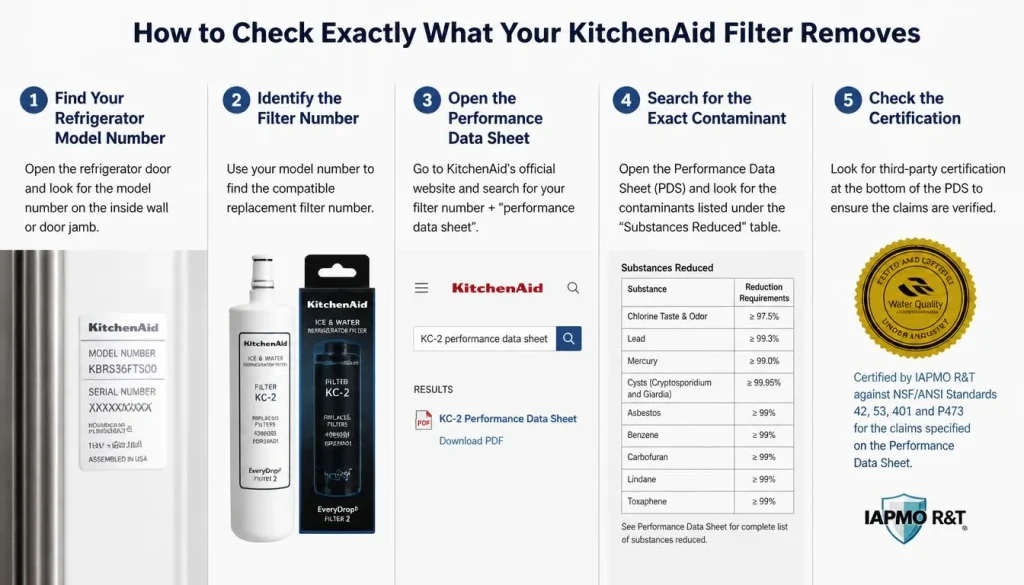
Step 1: Find Your Refrigerator Model Number
KitchenAid says the refrigerator model-number label may be found in places such as:
- The ceiling of the refrigerator compartment
- Interior refrigerator or freezer walls
- Behind drawers
- On the frame behind the open door
- Behind the kickplate
- On the back of the appliance
KitchenAid also provides an online filter finder where you can enter the refrigerator model number to identify compatible filters.
Step 2: Identify the Filter Number
Your refrigerator may use a filter such as:
- KAD1RXD1
- KAD2RXD1
- KAD3RXD1
- KAD4RXD1
Or it may use a compatible everydrop cartridge.
Do not choose a filter simply because the cartridge looks similar.
Step 3: Open the Performance Data Sheet
Find the official performance data sheet for that exact model.
This document is more useful than a generic list of “things refrigerator filters remove” because it tells you which substances were actually included in that filtration system’s certified testing.
Step 4: Search for the Exact Contaminant
If you care about fluoride, search for fluoride.
If you care about chloramine, search for chloramine.
If you care about PFAS, search for the individual PFAS reduction claim.
Do not substitute a similar word. “Chlorine” is not the same claim as “chloramine,” and “reduces contaminants” is not proof of fluoride reduction.
Step 5: Check the Certification
Make sure the contaminant claim is backed by a recognized certification or official performance data rather than vague wording such as:
- Purifies water
- Advanced filtration
- Removes impurities
- Premium carbon
- Multi-stage protection
Those terms may describe a product, but they do not tell you exactly how much of a specific contaminant has been reduced in standardized testing.
What If You Want to Reduce Both Chlorine and Fluoride?
If your goal is specifically to reduce both chlorine and fluoride, a refrigerator filter alone may not be the best complete solution.
You may need filtration upstream of the refrigerator.
Reverse Osmosis
Reverse osmosis is one of the most common technologies considered for reducing dissolved substances that conventional refrigerator carbon filtration does not specifically target.
NSF/ANSI 58 covers point-of-use reverse-osmosis systems and includes fluoride reduction among the optional performance claims that can be verified.
The important word is still certified.
Instead of buying any product labeled “RO,” look for a system that explicitly lists fluoride reduction if that is your goal.
Specialized Fluoride Filtration
Some filtration systems use media specifically selected for fluoride reduction.
Again, concentrate on certified performance rather than the name of the material alone. A system that says “fluoride filter” should have clear performance data explaining:
- How much fluoride it reduces
- The test concentration
- Filter capacity
- Replacement requirements
- Certification, where applicable
Can You Feed RO Water to a KitchenAid Refrigerator?
In some homes, an under-sink or centralized filtration system can supply treated water to the refrigerator.
That can allow the upstream system to handle contaminants such as fluoride while the refrigerator continues to dispense cold water and make ice.
However, do not connect an RO system without checking:
- Required refrigerator inlet pressure
- RO system output pressure
- Whether a storage tank or booster pump is needed
- Refrigerator manufacturer instructions
- Local plumbing requirements
Low supply pressure can reduce dispenser flow and affect ice production.
If you are modifying the refrigerator’s water supply, follow the manual for your exact model and use a qualified installer when necessary.
KitchenAid Refrigerator Filter vs. Reverse Osmosis
These two systems solve different problems.
| FeatureKitchenAid Refrigerator FilterReverse Osmosis System | ||
|---|---|---|
| Convenient cold drinking water | Excellent | Depends on installation |
| Chlorine reduction | Yes on current genuine Filters 1–4 | Often addressed with system prefilters; verify claims |
| Fluoride reduction | Do not assume | Available on systems specifically certified for fluoride |
| TDS reduction | Not the primary purpose | Core function of NSF/ANSI 58 systems |
| Installation | Usually simple | More involved |
| Space needed | Very little | Usually more |
| Filter replacement | Typically about every 6 months | Depends on system and components |
| Best use | Fridge water/ice and listed contaminants | Broader point-of-use treatment when properly specified |
There is no reason to call one technology universally “better.”
A KitchenAid filter can be ideal if your main concerns are convenience, chlorine taste, lead, and the other contaminants listed for your cartridge.
If your specific goal is fluoride or TDS reduction, you need a system whose certified performance covers those goals.
What This Means for Readers in the USA, UK, Canada, and Australia
Your KitchenAid filter’s tested capabilities do not change simply because you live in a different country, but the water entering the refrigerator can be very different.
Treatment methods and naturally occurring minerals can vary from:
- Country to country
- State or province to state or province
- City to city
- One water utility to another
- Municipal water to a private well
Even two nearby communities may not use exactly the same disinfectant.
For example, some utilities use chlorine while others use chloramine. The CDC notes that some U.S. utilities can even switch between disinfectants at different times.
Before buying extra filtration, find out what is actually in your water.
If you are in the United States, United Kingdom, Canada, or Australia, start with your local water supplier’s current water-quality report. If you use a private well, laboratory testing is more useful than assuming your water has the same characteristics as nearby municipal water.
Once you know what you want to reduce, compare that list with your filter’s certified performance claims.
That is a much better approach than buying the filter with the longest marketing list.
How Often Should You Replace a KitchenAid Refrigerator Water Filter?
KitchenAid recommends replacing refrigerator water filters approximately every six months.
Do not assume an old cartridge is still providing its original performance simply because water continues to flow through it.
Replacement may be needed sooner in homes with:
- High water consumption
- Heavy sediment
- Unusual incoming water quality
- Noticeably reduced dispenser flow
When installing a replacement, follow the instructions for your specific filter.
KitchenAid’s current replacement instructions for Filters 1 through 4 also direct users to flush approximately four gallons of water through the line after installing a new cartridge.
Signs Your KitchenAid Filter May Need Replacing
Six months is an easy schedule to remember, but your refrigerator may also give you practical warning signs.
Watch for:
- The filter indicator light turning on
- Slower water flow from the dispenser
- Chlorine taste or odor returning
- Water developing an unusual taste
- Ice tasting or smelling different
- The filter reaching its recommended replacement interval
A bad taste does not automatically mean the filter has “failed,” because incoming water conditions can change. But it is a good reason to check the cartridge age and local water quality.
Frequently Asked Questions
Do KitchenAid refrigerator filters remove chlorine?
Yes. Current genuine KitchenAid Filters 1, 2, 3, and 4 are advertised as reducing up to 97% of chlorine.
Do KitchenAid refrigerator filters remove fluoride?
Do not assume they do. KitchenAid’s current product pages for its main Filters 1–4 advertise chlorine and many other contaminant reductions but do not advertise fluoride reduction. If fluoride reduction matters to you, verify that your exact cartridge has an explicit certified fluoride-reduction claim.
How much chlorine does a KitchenAid refrigerator filter remove?
KitchenAid advertises up to 97% chlorine reduction for current genuine Filters 1–4. A performance sheet associated with Filter 4 reports average chlorine taste/odor reduction greater than 97.4% under its specified test conditions.
Does everydrop remove fluoride?
It depends on the exact everydrop filter and its certified performance claims. Do not assume fluoride reduction merely because an everydrop cartridge fits a KitchenAid refrigerator or is NSF certified. Look for fluoride specifically in the product’s performance data.
Does activated carbon remove fluoride?
A typical refrigerator activated-carbon filter should not be relied upon for fluoride reduction unless the complete filtration system has a specific verified fluoride-reduction claim. For fluoride, evaluate the performance certification of the finished product rather than the carbon material alone.
Does a KitchenAid refrigerator filter remove chloramine?
Do not assume that a chlorine-reduction claim also covers chloramine. Chlorine and chloramine are different disinfectants. Check the performance data for the exact filter and look specifically for a chloramine-reduction claim.
Does a KitchenAid filter remove lead?
Current genuine KitchenAid Filters 1–4 advertise up to 99% lead reduction, although you should still use the cartridge specified for your refrigerator.
Do KitchenAid filters remove PFAS?
This depends on the exact model and its certified contaminant list. NSF/ANSI 53 and NSF/ANSI 58 can include PFAS-related reduction claims, but a product carrying one of those standard numbers is not automatically certified for every PFAS compound. Verify the specific claim.
Do KitchenAid refrigerator filters remove microplastics?
Some approved everydrop filters used in KitchenAid refrigerators carry specific microplastic reduction claims. For example, current everydrop Filter 1 information advertises certified 99% microplastic reduction. Do not automatically apply that claim to every KitchenAid or everydrop cartridge.
Does KitchenAid filtered ice contain fluoride?
It can. If the water entering the refrigerator contains fluoride and the filtration system does not have a certified fluoride-reduction claim, you should not assume the fluoride is removed before the water reaches the ice maker.
Does a refrigerator filter remove TDS?
Standard refrigerator filtration is generally not intended to provide the type of TDS reduction associated with reverse osmosis. NSF/ANSI 58 requires TDS-reduction performance for RO systems.
Does a KitchenAid refrigerator filter soften hard water?
No standard refrigerator cartridge should be treated as a substitute for a water softener. NSF/ANSI 44 applies specifically to water softeners that reduce hardness caused by calcium and magnesium.
Does boiling water remove fluoride?
Boiling is not a dependable fluoride-removal treatment. CDC guidance emphasizes that boiling is used primarily to kill disease-causing microorganisms and does not make water safe by removing harmful chemical contaminants.
If fluoride reduction is your goal, use a treatment system with an explicit fluoride-reduction claim.
Does boiling remove chloramine?
EPA information states that boiling does not remove monochloramine from drinking water.
That is another reason not to assume that every treatment method used for ordinary free chlorine will work equally well for chloramine.
Is refrigerator-filtered water the same as reverse-osmosis water?
No.
A refrigerator filter and an RO system use different filtration approaches and are tested under different types of performance standards.
A refrigerator filter is convenient for improving water and ice while targeting its certified contaminant list. Reverse osmosis is designed for broader treatment that includes TDS reduction and may include certified fluoride reduction.
How do I know which KitchenAid refrigerator filter I need?
Find the model number on your refrigerator and enter it into KitchenAid’s filter finder. KitchenAid currently lists KitchenAid-branded and everydrop-branded approved filters for compatible models.
Do not choose a cartridge based only on appearance.
Final Verdict: Do KitchenAid Refrigerator Filters Remove Chlorine and Fluoride?
For chlorine, the answer is straightforward: yes. KitchenAid’s current genuine Filter 1, Filter 2, Filter 3, and Filter 4 cartridges advertise up to 97% chlorine reduction, and chlorine taste/odor is a well-established target of refrigerator filtration.
For fluoride, the answer requires more care.
Do not assume a KitchenAid refrigerator filter removes fluoride simply because it uses carbon, reduces dozens of contaminants, or carries NSF certification. Instead, look for a specific certified fluoride-reduction claim for the exact cartridge or treatment system.
If reducing both chlorine and fluoride is your goal, your KitchenAid refrigerator filter can handle the chlorine portion when used as specified, while fluoride may require an additional treatment system designed and certified for that purpose. NSF/ANSI 58 reverse-osmosis systems can carry a specific fluoride-reduction claim when tested and certified accordingly.
The simplest rule to remember is this:
Match the filter to your refrigerator, match the certification to the contaminant, and never assume that “NSF certified” means every substance in your water is removed.

Hi, I’m the lead researcher and appliance enthusiast behind RefrigeratorSolve. With years of hands-on experience troubleshooting cooling systems and testing home appliances, I am dedicated to bringing you honest reviews, energy-saving tips, and practical solutions to keep your refrigerator running perfectly.