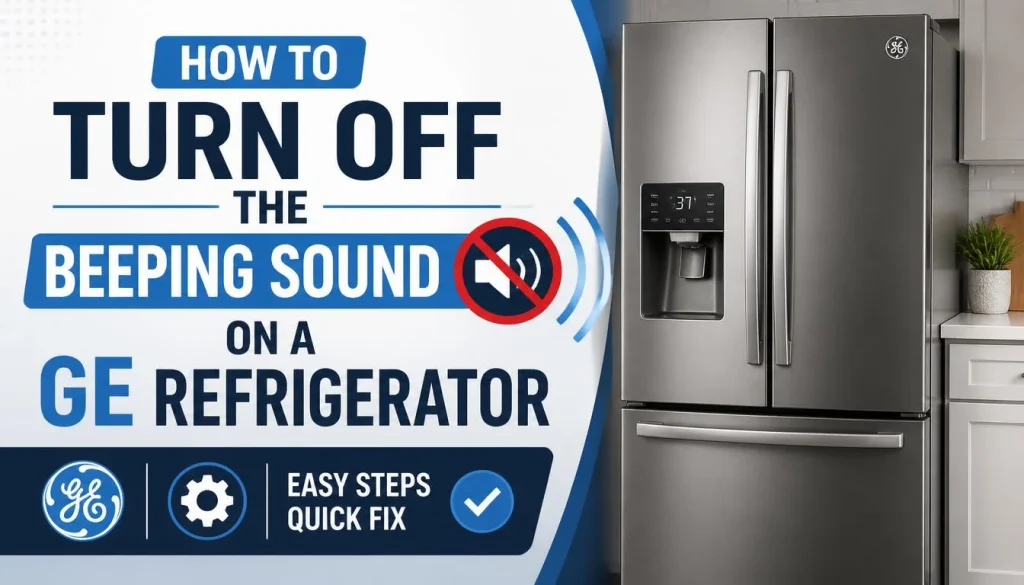
Is your GE refrigerator beeping constantly, even when the doors are closed? The sound may come from an open-door alarm, control panel button tones, a recent power outage, or a temperature warning. The right fix depends on why the refrigerator is beeping and which model you own.
In this guide, you’ll learn how to silence a GE refrigerator alarm, turn off button sounds on supported models, check common warning codes, and identify when the problem needs professional repair.
Quick Answer: How Do You Stop a GE Refrigerator From Beeping?
To stop a GE refrigerator from beeping, close every refrigerator door and freezer drawer, check for anything blocking the doors, and look at the control panel. If your model has a Door Alarm, Silence, or similar control, use the instructions in your owner’s manual. If the beeping continues, check the displayed warning or error code before resetting anything.
Why Is Your GE Refrigerator Beeping?
Before turning off the sound, try to identify what triggers it. A repeating alarm and a short tone every time you press a button usually have different causes.
Here are the most common possibilities.
| What you notice | Possible cause | What to check |
|---|---|---|
| Beeping after the door has been open | Door alarm | Close the door completely |
| Beeping with the door closed | Door obstruction, poor seal, or sensor issue | Check the gasket and door alignment |
| A short beep whenever you press a button | Button tones | Look for a Button Tones setting |
| Beeping after a power outage | Power interruption or temperature warning | Check the display and actual temperature |
| Beeping with flashing letters or numbers | Error or fault code | Identify the code in your model’s manual |
| Beeping while the refrigerator is not cooling properly | Temperature or cooling problem | Check the temperature and arrange service if needed |
GE refrigerator models do not all use the same controls or alarm timing. For example, GE’s guidance for certain side-by-side models describes a door alarm after three minutes, while certain bottom-freezer models use a two-minute interval. Check the instructions for your particular refrigerator rather than assuming every model behaves the same way.
How to Turn Off the Beeping Sound on a GE Refrigerator
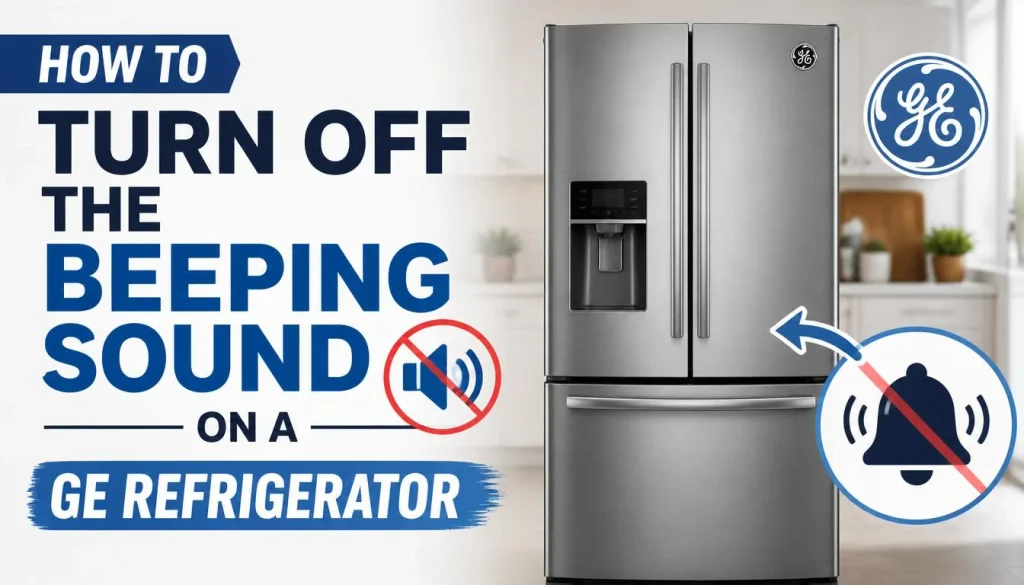
Follow these steps in order. Start with the simple checks before changing settings or attempting a reset.
Step 1: Close All Refrigerator Doors and Freezer Drawers
Open the refrigerator and freezer compartments only as needed, and then close every door and drawer firmly.
Check the following:
- The fresh-food compartment door is fully closed.
- The freezer drawer is pushed all the way in.
- No door has been left slightly open.
- The doors are aligned and make proper contact with their seals.
Wait briefly to see whether the alarm stops. On many models, the door alarm stops automatically after the door is properly closed.
Step 2: Check for Food Blocking the Door
Sometimes the door looks closed but cannot seal properly because something is in the way.
A large food container, tall bottle, misplaced shelf, or overfilled door bin may prevent the door from closing completely.
Move any obstructing items and close the door again. If the refrigerator has a pull-out freezer drawer, make sure food packages are not preventing it from sliding fully into place.
Do not force the door shut. This could damage the drawer, shelves, or door seal.
Step 3: Inspect the Door Gasket
The gasket is the flexible rubber seal around the edge of the refrigerator door. If it is dirty, damaged, folded, or loose, warm air may enter the refrigerator.
A poor seal can contribute to temperature changes and repeated door-related problems.
Clean the gasket with a soft cloth and mild soapy water, then dry it. Look for visible gaps, tears, or areas that no longer contact the cabinet evenly.
For a more detailed inspection, follow this guide to refrigerator door gasket problems, signs, and fixes.
If the doors appear to seal correctly but the alarm continues, the refrigerator may have a door-sensing or control problem. Do not replace a sensor without confirming that it is faulty.
Step 4: Press the Door Alarm or Silence Control
If your GE refrigerator has a dedicated Door Alarm or Silence button, check the owner’s manual for how it works.
Depending on the model, you may be able to:
- Press a Silence control to stop the current audible alert.
- Turn the Door Alarm feature off through a dedicated button.
- Open a settings menu and change the Door Alarm setting.
For some GE side-by-side refrigerators, the Door Alarm touch control switches the feature on or off. Certain GE Profile models also provide door-alarm controls through a touchscreen.
Read GE Appliances’ instructions for its side-by-side refrigerator door alarm or bottom-freezer refrigerator door alarm if either description matches your model.
Remember that silencing a current alarm does not necessarily fix the reason it started. If the door remains open or the refrigerator is too warm, the underlying problem still needs attention.
Step 5: Check Whether Your Model Has a Button Tones Setting
Does your GE refrigerator beep every time you touch the temperature control, dispenser setting, or touchscreen button?
The sound may be a normal button tone rather than a warning alarm.
Some GE refrigerators allow you to turn off these sounds in the control panel settings. On supported models with the relevant touchscreen menu, the process is:
- Select Settings on the home screen.
- Select System.
- Find Button Tones.
- Uncheck or switch off the setting, following the instructions displayed on your refrigerator.
GE Appliances describes this procedure in its official guide to turning off button tones.
These menu options are not available on every GE refrigerator. If your control panel looks different, consult the manual instead of trying random button combinations.
Also, turning off button tones does not necessarily disable the door alarm or other warning sounds.
Step 6: Check the Refrigerator Temperature
If the beeping is accompanied by a temperature warning, do not treat it as a simple sound problem.
A refrigerator may become too warm after a power outage, prolonged door opening, poor door sealing, or a cooling-system problem.
Check the temperature display, if your model has one. You can also use an appliance thermometer to confirm the temperature inside the compartment.
As a general food-safety guide, the refrigerator should remain at or below 40°F (4°C), and the freezer should be at 0°F (-18°C) or below.
If the temperature is rising, keep the doors closed as much as possible while you investigate. Avoid loading the refrigerator with additional warm food, and do not assume that turning off the alarm means the cooling problem is resolved.
For additional guidance, see this guide to the ideal refrigerator temperature setting.
Step 7: Check for a Power Outage Warning
If your GE refrigerator started beeping after a power cut or electrical interruption, look for a power-related alert on the control panel.
On certain GE refrigerators, the code PF indicates that power to the appliance has been interrupted.
After power returns, check whether the refrigerator and freezer are cooling normally. Give the appliance time to recover, keeping the doors closed as much as possible, and monitor the temperature rather than relying only on the sound.
Food safety matters here. According to FoodSafety.gov’s power-outage guidance, a closed refrigerator generally keeps food safe for up to four hours without power. Perishable food exposed to temperatures above 40°F (4°C) for more than two hours should generally be discarded.
Do not taste food to determine whether it is safe.
If a power-related warning remains on the display, follow the instructions in your model’s manual before attempting a reset.
GE Refrigerator Keeps Beeping With the Door Closed
If every door is closed but the beeping continues, work through these checks.
Check the Door Seal and Alignment
Inspect the gasket for dirt, cracks, folds, or gaps. Make sure the refrigerator is positioned correctly and that its doors or freezer drawer align properly.
If you find a seal problem, use the appropriate cleaning or repair method. A badly damaged gasket may need replacement.
Check the Door-Sensing System
Some refrigerators use a switch or sensor to detect whether the door is open or closed. If the system does not register the door’s position correctly, the refrigerator may continue to give an open-door warning.
First, confirm that the door physically closes and the gasket seals. If the alert continues despite proper closure, a sensor or related component may need testing.
Avoid bypassing the sensor or attempting electrical repairs without the necessary expertise.
Look for Flashing Lights or Error Codes
A flashing display can provide a more useful clue than the sound alone.
Note the exact letters or numbers shown. If possible, take a photo of the display before clearing the alert.
Use the model-specific troubleshooting instructions to identify the code. If the display shows a fault that requires service, repeated silencing or resetting is unlikely to resolve the cause.
GE Refrigerator Beeping Error Codes: What Should You Check?
GE Appliances publishes several common fault and function codes for refrigerators equipped with electronic dispenser controls. The codes below do not appear on every model, and their presence does not mean that every refrigerator will beep in the same way.
| Code | General meaning | Recommended next step |
|---|---|---|
| FF | Freezer temperature is rising too high | Check frozen food, door closure, and freezer temperature |
| PF | Power to the refrigerator was interrupted | Check the power supply and current temperatures |
| CI | Check the ice maker | Inspect the ice maker as directed by the manual |
| DE | Demo mode on supported models | Check whether cooling has been disabled and follow model-specific instructions |
| dE | Defrost system has not operated properly in the indicated period | Keep doors closed as much as possible and consult service guidance |
| CC | Refrigerator temperature is incorrect | Check the temperature controls and actual compartment temperature |
These meanings are based on GE’s official refrigerator error, fault, and function code guide.
Pay attention to capitalization. On applicable models, DE refers to Demo mode, while dE indicates a defrost-system problem. They should not be treated as interchangeable codes.
A displayed code is not always proof that a component must be replaced. Use the code to determine the next appropriate check. If it persists or the refrigerator is not cooling, contact GE support or a qualified appliance technician.
How to Turn Off a GE Refrigerator Alarm Permanently
Some GE refrigerator models allow the Door Alarm feature to be disabled. Others use different controls or provide only specific ways to silence an active alert.
Before disabling an alarm, consider why you need to turn it off.
If the alarm sounds while you load groceries or clean the refrigerator, temporarily silencing it may be reasonable when your model supports that option.
If the alarm sounds repeatedly during normal use, find and fix the cause instead. Turning off the warning may leave you unaware that a door is open or the temperature is too high.
For the correct procedure, find your refrigerator’s model number and look up its owner’s manual on the GE Appliances manuals and installation instructions page.
Do not assume that a permanent alarm-disable option exists simply because another GE model has one.
What to Do if Your GE Refrigerator Alarm Won’t Stop
If the sound continues after you have checked the doors, seal, settings, and display, follow this checklist:
- Record the exact model number and any displayed code.
- Confirm that the refrigerator and freezer are maintaining safe temperatures.
- Check the model’s manual for the alarm’s reset or silence procedure.
- If the alert returns, arrange professional diagnosis rather than repeatedly resetting the appliance.
Some control-panel warnings can be cleared after the condition has been corrected. Others require repair. Disconnecting power may clear certain displays on some models, but it is not a universal fix and should not replace troubleshooting the underlying fault.
Call a qualified appliance technician if the refrigerator is not cooling properly, a fault code persists, or the alarm continues despite proper door closure and the prescribed troubleshooting steps.
If you notice a burning smell or signs of an electrical problem, stop troubleshooting and seek qualified service. Do not open electrical compartments or handle internal wiring.
Frequently Asked Questions
How do I silence my GE refrigerator door alarm?
Close the refrigerator doors and freezer drawers fully. If the alarm continues, use the Door Alarm or Silence control according to your model’s instructions. Check for a warning on the display if the sound returns.
Why does my GE refrigerator keep beeping when the door is closed?
The refrigerator may detect a door that is not properly sealed, or it may be reporting a temperature warning, power interruption, or fault. Inspect the gasket and door alignment, then check the display for an alert or code.
Why does my GE refrigerator beep when I press a button?
Some GE models produce a short tone whenever you use the control panel. If your refrigerator has a Button Tones setting, you may be able to switch off these sounds without disabling important warning alarms.
Why is my GE refrigerator beeping after a power outage?
The refrigerator may be reporting a power interruption or a rise in temperature. Check the display, confirm that cooling has resumed, and monitor the actual temperature. Follow food-safety guidance if the outage lasted long enough to put perishable food at risk.
Can I permanently turn off the beeping sound on a GE refrigerator?
Some models allow users to disable the door alarm or button tones, but the available options vary. Do not assume that all warning sounds can be disabled, and do not turn off an alert to avoid addressing a cooling problem.
Does a beeping GE refrigerator mean it is not cooling?
Not necessarily. A beep can come from the door alarm or button tones. However, a temperature warning or certain fault codes may indicate a cooling problem. Check the display and verify the refrigerator’s temperature before assuming everything is working normally.
Conclusion
The best way to turn off the beeping sound on a GE refrigerator is to identify what triggers it. Start by closing the doors, checking for obstructions, and inspecting the display. Then use the correct Door Alarm, Silence, or Button Tones control if your model supports it.
If the beeping continues, check the relevant warning code and confirm that the refrigerator is maintaining a safe temperature. A recurring alarm is worth investigating, especially when it appears alongside flashing lights or poor cooling. Fixing the cause is more important than simply making the sound stop.

Hi, I’m the lead researcher and appliance enthusiast behind RefrigeratorSolve. With years of hands-on experience troubleshooting cooling systems and testing home appliances, I am dedicated to bringing you honest reviews, energy-saving tips, and practical solutions to keep your refrigerator running perfectly.