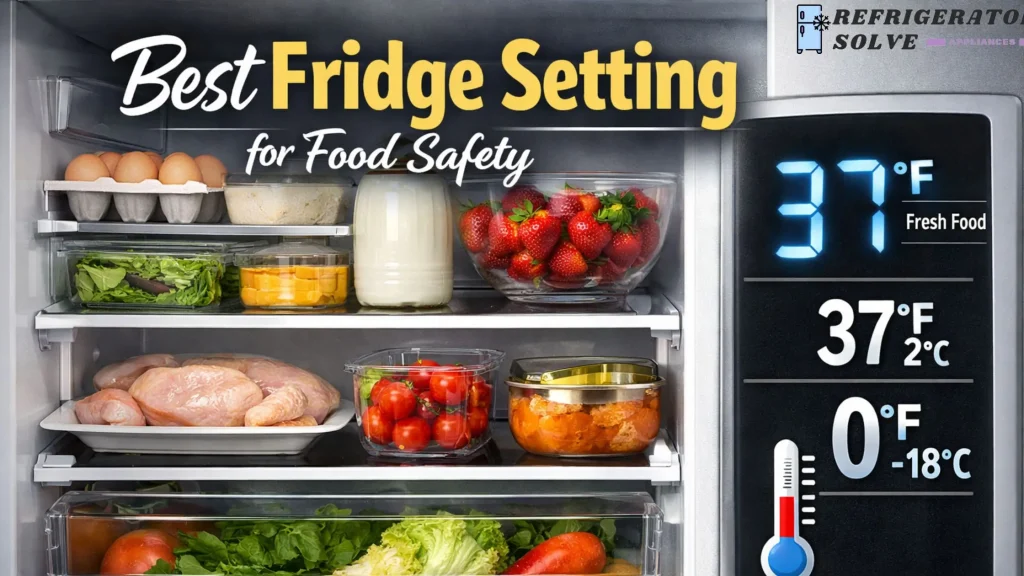
The best fridge setting for food safety is 37°F to 40°F (3°C to 4°C). If your refrigerator uses a numbered dial from 1 to 7, the ideal setting is usually between 3 and 4, as this maintains the temperature “sweet spot” that prevents bacteria growth without freezing your vegetables.
Why I Care About This Topic
I learned this the hard way a few years ago. I bought a week’s worth of groceries, shoved them into my fridge, and cranked the dial to the highest number, assuming “more” meant “better.” Two days later, my lettuce was a block of ice, but the milk on the door shelf felt lukewarm. It was frustrating and expensive.
Since then, I have spent a lot of time working with appliances and testing how different machines handle airflow and temperature. I realized that most of us just guess with these dials. We treat them like volume knobs, but they are actually thermostats. Getting this right isn’t just about saving a few dollars on spoiled milk; it is about knowing the food you serve your family is safe to eat.
Real User Pain Points
Most people I talk to struggle with the exact same issues when it comes to their refrigerator. It is rarely a mechanical failure; it is usually a misunderstanding of how the machine works.
1. The “1 to 7” Confusion You open the fridge, see a dial numbered 1 through 7, and have no idea what those numbers represent. Is 1 the coldest? Is 7 the coldest? It is not intuitive.
2. The “Frozen Salad” Syndrome You find a setting that keeps the milk cold, but suddenly the cucumber and spinach in the back of the drawer are frozen solid.
3. Summer Spoilage The setting that worked perfectly in January seems to fail in July. Milk goes sour faster, and the fridge seems to run constantly without cooling enough.
4. Uneven Temperature Zones You notice items on the top shelf feel fine, but items on the door or the bottom shelf are spoiling quicker than they should.
5. Fear of Adjustment Because you aren’t sure what the dial does, you are afraid to touch it. You leave it on the factory setting, even if your food isn’t lasting as long as it should.
How Each Pain Point Is Solved
Here is how we tackle these issues. I will break down the mechanics so you can stop guessing and start controlling your appliance.
Decoding the “1 to 7” Dial Mystery
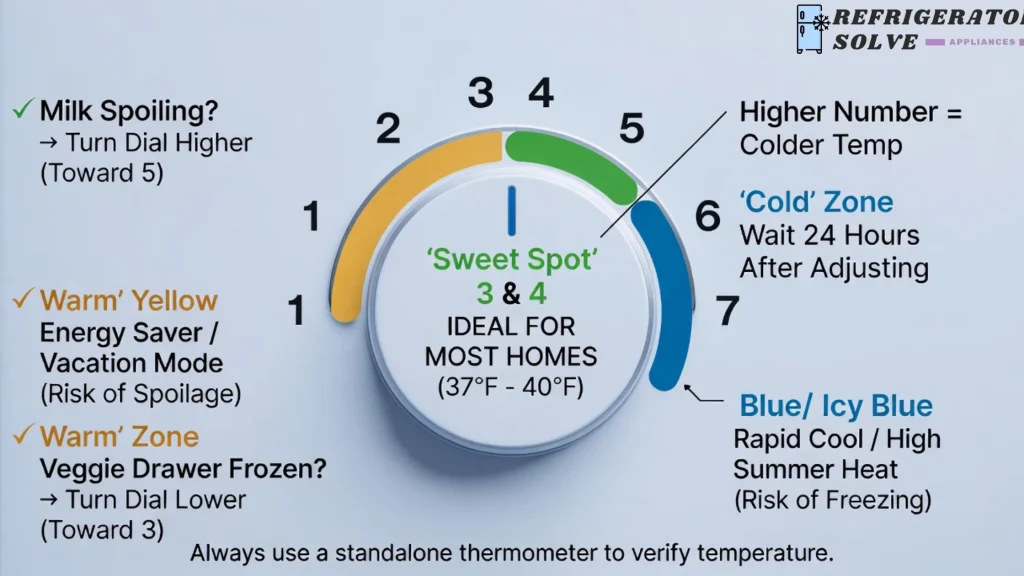
This is the most common frustration. Most manufacturers use a simple numbered scale, but they rarely explain it on the device itself. To clear up the fridge number settings meaning, you need to remember one rule: the numbers represent refrigerant power, not degrees.
A higher number usually means the compressor runs longer to make the fridge colder. So, does a higher number mean a colder fridge? In almost every standard model, yes. The dial controls the cooling intensity.
However, users often ask what does 1 to 7 mean on a refrigerator specifically?
- 1: The warmest setting (least cooling power).
- 7: The coldest setting (maximum cooling power).
If you are stuck wondering which is colder on fridge 1 to 7, the answer is 7. But be careful—setting it to 7 is rarely the right move for daily use.
Finding the Correct “Normal” Setting
If 7 is the coldest and 1 is the warmest, where should you be? For food safety, you need that internal temperature of 37°F-40°F.
Through trial and error, I found that the normal fridge setting number for most households is usually right in the middle. Setting the dial to 3 or 4 is typically sufficient for a standard kitchen environment.
If you are trying to figure out which fridge setting is coldest, remember that “coldest” isn’t always “best.” Cranking it to maximum can freeze up your circulation vents. I have seen many people ask, is 7 the coldest setting on a fridge? Yes, it is, but using it can cause the fridge too cold on setting 7 problem, where fresh produce gets destroyed by frost.
Adjusting for Seasons (The Summer Spike)
Pain point #3 is all about external heat. Your fridge has to work harder when the ambient temperature of your kitchen rises.
When a heatwave hits, the normal fridge setting number might not be enough. You might need to bump the dial up from 3 to 4 or 5.
If you are wondering what fridge setting should use in summer, the general rule is to increase the cooling intensity by one step. If you usually keep it at 3, move it to 4. Monitor it for 24 hours. Do not jump straight to 7, or you will overwork the compressor.
Understanding the Mechanics
To fix the issue of uneven cooling, it helps to know how fridge temperature settings work. The dial is connected to a thermostat that cuts the power to the compressor once the air reaches a certain temperature.
When you adjust the refrigerator temperature control numbers, you are telling the thermostat when to shut off. If you block the air vents with food, the thermostat gets confused. It might keep running because it thinks the fridge is warm, freezing the food near the vents while the rest of the fridge stays warm.
For those trying to get a grip on fridge temperature setting 1 to 7 explained in technical terms:
- Low Numbers (1-2): Short cooling cycles. High efficiency, but risk of warmth.
- High Numbers (6-7): Long cooling cycles. High energy use, risk of freezing.
If you are still debating is fridge colder on 1 or 7, check your specific manual, but 99% of the time, 7 is the intense option.
Country-Specific Context
How you manage your fridge varies depending on where you live. I have noticed distinct differences in how people in the US, UK, Canada, and Australia need to approach this.
United States
In the US, we tend to have massive fridges, often with digital displays in Fahrenheit. However, many apartment rentals still use the 1-7 dial. Since American kitchens often have central air conditioning, the ambient temperature is stable. You can usually set it and forget it. The focus here is often on bulk storage—don’t overstuff those massive shelves, or the air won’t circulate.
United Kingdom
In the UK, under-counter fridges are very common. These are smaller and impacted more easily by opening the door. Also, many UK homes lack air conditioning. During a “heatwave” (even 28°C/82°F), a UK fridge struggles more because the kitchen gets hot. You may need to be more aggressive with the dial in a British summer than an American one.
Canada
Canadians deal with extreme cold. If you keep a second fridge in the garage, you have a unique problem. If the garage drops below freezing, the fridge thermostat might think the inside is already cold enough and shut off, causing the freezer section to thaw out. Some modern fridges have “garage kits” or heater switches to trick the thermostat.
Australia
In Australia, the heat is a major factor. Kitchens can get very hot. Energy efficiency is also a huge topic due to electricity costs. Australian users should focus heavily on door seals. If you are wondering which number is colder in fridge 1 to 7, you will likely be using the higher numbers (5 or 6) more often than someone in London, just to combat the ambient heat.
Experience-Based Benefits
Once I actually took the time to learn understanding your fridge temperature control knob numbers, the changes were immediate.
My Produce Lasted Longer I stopped throwing away “wet” lettuce. By moving the dial from 6 down to 4, I found the balance where it was cold enough to inhibit bacteria but not so cold it destroyed cell walls in vegetables.
I Stopped Questioning Safety Knowing the fridge settings coldest number gave me peace of mind. I bought a cheap stand-alone thermometer (a vital tool) and verified that setting 4 kept my fridge at exactly 38°F. I no longer had to sniff the milk to see if it was okay.
Energy Bills Dropped Running a fridge on setting 7 is expensive. It forces the compressor to run almost non-stop. Dialing it back to the necessary setting, rather than the maximum setting, noticeably reduced my electricity usage.
Supporting Quotes
“People often mistake the dial for a volume control, thinking higher is better. In reality, it’s about finding the balance. Overcooling is just as wasteful as undercooling is dangerous.” — Sarah Jenkins, Home Economist and Appliance Specialist
“The single biggest mistake consumers make is blocking the airflow sensor. It doesn’t matter what number you dial in if the fridge can’t sense the air temperature properly.” — David Miller, Certified HVAC & Refrigeration Technician
” bacterial growth triples for every few degrees the temperature rises above 40°F. Precision with your settings isn’t just about taste; it is a critical safety barrier for your family.” — Dr. Emily Chen, Food Safety Consultant
Practical Tips for Best Results
Here are actionable steps you can take right now.
1. Buy a Fridge Thermometer This is the only way to be 100% sure. Dials can be inaccurate. Place a stand-alone thermometer in the middle shelf. Adjust the dial until that thermometer reads 38°F (3.5°C).
2. The “24-Hour Rule” When you change a setting—whether you are figuring out the fridge dial 1 to 7 which is coldest or adjusting for summer—wait 24 hours before checking the temperature again. Fridges stabilize slowly.
3. Do Not Block the Vents Locate the air vents in your fridge (usually in the back). Keep items at least two inches away from them. If you block them, you will create warm spots and freezing spots.
4. Check the Manual Fridge Temperature Settings If your dial has a “dot” or a “recommended” marker, start there. Manufacturers mark these for a reason.
5. Understand the Refrigerator Cooling Level Explained If you have a lot of food, the fridge holds “cold” better than empty air. If your fridge is empty, fill a few pitchers with water. This thermal mass helps stabilize the temperature so the compressor doesn’t cycle on and off as frequently.
6. Consult the Fridge Cold Control Settings Guide If your fridge has separate controls for the freezer and the fridge, remember they share air. Adjusting the freezer can sometimes impact the fridge temperature.
FAQs
Which number is the coldest on a fridge, 1 or 5?
In almost all standard models, 5 is colder than 1. The higher the number, the more cooling power the fridge uses.
Why is there ice on the back wall of my fridge?
This often happens if the setting is too high (too cold) or if the door seal is broken, letting in humid air. Try turning the dial down one number (e.g., from 5 to 4).
What is the best setting for a Samsung or LG fridge?
Digital fridges should be set to 37°F or 3°C. If they use bars or numbers, the midpoint is usually the manufacturer’s recommended setting.
Does a full fridge stay colder than an empty one?
Yes. Cold food helps keep the surrounding air cold. However, do not overfill it to the point where air cannot circulate.
How do I know if my dial is broken?
If you turn the dial to 1 and the compressor doesn’t turn off, or if you turn it to 7 and it doesn’t run longer, the thermostat might be faulty.
Should I change the setting if I put hot food in?
You should avoid putting hot food directly in the fridge. Let it cool to room temperature first. Adjusting the dial for temporary items is generally not necessary and can mess up the temperature for everything else.
I am still confused about the numbers. Is there a simple guide?
Yes, if you need a deep dive into the numbers, check out fridge temperature numbers explained for a breakdown of different brands.
Conclusion
Getting your fridge setting right is the foundation of a safe kitchen. While the numbers can be confusing, remembering that 37°F to 40°F is the goal simplifies everything. Whether your dial is set to 3, 4, or 5, the result matters more than the number on the knob.
By paying attention to how fridge temperature settings work and using a standalone thermometer, you ensure your food stays fresh, your electricity bill stays reasonable, and your family stays safe. Don’t stress about the dial—test the temperature, adjust slowly, and find what works for your specific home environment.
For more detailed safety guidelines on food storage, you can visit the FDA’s guide on Refrigerator and Freezer safety.

Hi, I’m the lead researcher and appliance enthusiast behind RefrigeratorSolve. With years of hands-on experience troubleshooting cooling systems and testing home appliances, I am dedicated to bringing you honest reviews, energy-saving tips, and practical solutions to keep your refrigerator running perfectly.