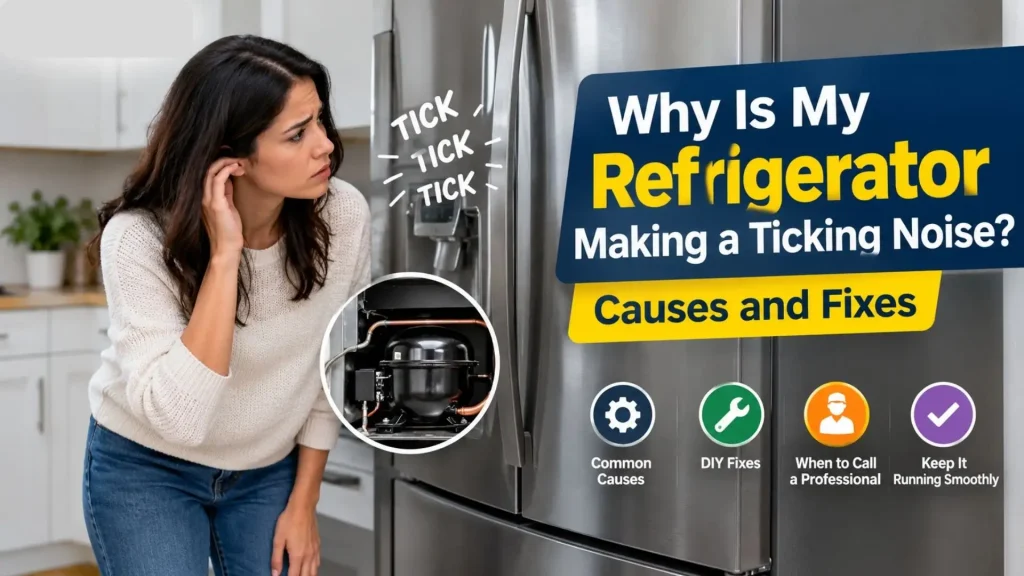
A refrigerator making a ticking noise is not automatically a sign that something is broken. A soft, occasional tick can happen as the compressor starts or stops, the refrigerator enters a defrost cycle, the ice maker operates, or plastic and metal parts expand and contract as temperatures change.
What deserves more attention is a repetitive ticking noise every few seconds, especially when the refrigerator is getting warmer or the compressor seems unable to start. In that situation, the problem may involve the compressor start relay, overload protector, fan, control board, or another component.
The easiest way to narrow down the cause is to pay attention to four things: what the ticking sounds like, where it comes from, when it happens, and whether the refrigerator is still cooling normally.
Quick Answer: Why Is My Refrigerator Making a Ticking Noise?
Here is a quick way to narrow down the problem.
| What You Hear | Possible Cause | Should You Worry? |
|---|---|---|
| Occasional soft tick | Normal expansion or control switching | Usually no |
| Tick when cooling starts or stops | Compressor or relay switching | Usually normal |
| Ticking every few seconds | Start relay, overload protector, or compressor | Investigate |
| Rhythmic ticking inside freezer | Fan hitting ice or an obstruction | Investigate |
| Ticking during ice production | Ice maker mechanism | Often normal |
| Ticking from the back | Compressor, relay, fan, or control board | Depends on frequency |
| Ticking plus poor cooling | Compressor/start-system problem | Needs prompt attention |
| Ticking plus burning smell | Electrical problem | Unplug and seek service |
If the refrigerator is cooling properly and the sound happens only occasionally, monitoring it may be all that is necessary. If the noise is persistent, getting louder, or accompanied by a temperature problem, troubleshoot it rather than ignoring it.
Is a Ticking Noise From a Refrigerator Normal?
Sometimes, yes.
Modern refrigerators contain compressors, fans, relays, dampers, ice makers, valves, defrost components, and electronic controls. These parts do not operate continuously in exactly the same way. They switch on and off throughout the day, and those changes can produce small clicks or ticks.
Normal Refrigerator Ticking Sounds
A ticking sound is more likely to be normal when:
- It happens only occasionally.
- The refrigerator and freezer are maintaining normal temperatures.
- The sound lasts for only a moment.
- It occurs when the compressor starts or stops.
- It appears around a defrost cycle.
- It comes from the ice maker while ice is being produced.
- It sounds like a light tick, pop, or crack as the cabinet temperature changes.
If you have noticed several different sounds rather than just ticking, our guide to what it means when your refrigerator starts making noise can help you separate normal operating sounds from warning signs.
When Ticking May Indicate a Problem
Take a closer look when:
- The ticking repeats every few seconds.
- You hear a tick followed by a short hum and then another tick.
- The refrigerator has stopped cooling normally.
- The compressor repeatedly attempts to start.
- The ticking suddenly becomes louder than before.
- The noise comes with grinding, scraping, or rattling.
- The compressor area becomes unusually hot.
- You notice a burning or electrical smell.
- A circuit breaker trips repeatedly.
The sound alone rarely identifies the failed part. The pattern and the refrigerator’s cooling performance provide much better clues.
Ticking vs. Clicking: What Is the Difference?

People often use “ticking” and “clicking” to describe the same refrigerator sound.
A tick usually sounds lighter and may repeat rhythmically, similar to a clock. A click is often sharper and more noticeable when an electrical relay or compressor switches on or off.
For example, a rhythmic ticking from inside the freezer may come from a fan blade touching frost. A sharp click from the bottom rear of the refrigerator may be associated with the compressor start circuit.
The distinction is not always clear, so do not diagnose a part based only on the word you use to describe the sound.
If your refrigerator produces a sharper clicking sound rather than a light tick, see our detailed guide on why a refrigerator makes a clicking noise.
10 Reasons Your Refrigerator Is Making a Ticking Noise
Several refrigerator components can produce a ticking sound. Some are harmless; others need attention.
1. Normal Expansion and Contraction
Refrigerator temperatures change throughout the day. When the cooling system runs or the appliance enters and exits a defrost cycle, plastic liners, metal panels, pipes, and other materials can expand or contract slightly.
That movement may sound like:
- Ticking
- Popping
- Cracking
- Light snapping
These sounds may be more noticeable at night because the kitchen is quieter.
If the refrigerator is maintaining safe temperatures and the ticking occurs only occasionally, thermal expansion is usually not a reason to replace anything.
2. The Compressor Is Starting or Stopping
The compressor cycles on and off to maintain the selected temperature.
You may hear a brief click or tick immediately before the compressor begins running or shortly after it stops. That can be part of normal operation.
The important question is what happens after the tick.
If you hear:
Tick → compressor starts → refrigerator cools normally
the sound is usually less concerning.
If you hear:
Tick → short hum → tick → silence → repeat
the compressor may be struggling to start.
Because sounds from the compressor area can easily be confused with nearby fan noises, see our guide on how to check refrigerator compressor and fan noise before assuming the compressor itself has failed.
3. The Compressor Start Relay Is Failing
The start relay helps provide the conditions the compressor needs to start.
When the start relay begins failing, you may hear repetitive clicking or ticking from the bottom rear of the refrigerator.
Typical clues include:
- A tick or click every few seconds or minutes
- A short humming sound before the click
- The compressor trying repeatedly to start
- Refrigerator temperature beginning to rise
- Freezer items becoming softer
- Compressor area becoming unusually hot
A failed start relay can sometimes prevent the compressor from running altogether.
Do not immediately assume a repeated tick means the compressor needs replacement. A technician may need to test the start device, electrical supply, overload protector, and compressor before identifying the actual fault.
4. The Compressor Overload Protector Is Cycling
The overload protector is designed to protect the compressor if operating conditions become unsafe.
If the compressor draws excessive current or becomes too hot, the overload may open the circuit. After it cools, it may reset and allow another start attempt.
That process can create a repeating pattern:
click → pause → attempt to start → click
Possible reasons include:
- Faulty start components
- Compressor overheating
- Poor condenser airflow
- Electrical problems
- Internal compressor problems
If the ticking continues and the refrigerator is not cooling, professional diagnosis is appropriate.
5. The Evaporator Fan Is Hitting Ice
A very regular ticking sound from inside the freezer often points toward a moving fan blade contacting something.
The evaporator fan circulates cold air through the refrigerator. If frost or ice builds up around the fan, the blade may strike it each time it rotates.
The sound can become:
- Tick-tick-tick
- Scraping
- Clicking
- Light grinding
A useful clue is what happens when you open the freezer door.
On many refrigerators, opening the door stops or changes evaporator-fan operation. If the ticking disappears immediately when the door opens and returns after the door closes, inspect the freezer fan area for frost or obstruction.
Do not attack ice around the evaporator with a knife, screwdriver, or other sharp tool. You could damage the fan housing, evaporator, wiring, or refrigerant tubing.
6. The Condenser Fan Is Hitting Debris
Many refrigerators have a condenser fan near the compressor.
Dust, pet hair, packaging material, a loose wire, or other debris near the fan can create a repetitive ticking sound as the blade turns.
You may hear the noise near the bottom or back of the refrigerator.
Before inspecting accessible areas:
- Disconnect the refrigerator from power.
- Follow the manufacturer’s instructions for removing any user-accessible panel.
- Look for obvious debris around the fan.
- Check whether anything is touching the fan blade.
- Do not disturb refrigerant tubing or electrical wiring.
A damaged or worn condenser fan motor can also become noisy.
Our guide to checking refrigerator compressor and fan noise explains how to distinguish fan noise from compressor noise more accurately.
7. The Defrost System Is Switching
Automatic-defrost refrigerators periodically warm the evaporator area to remove accumulated frost.
Depending on the model, a timer, control board, sensor, relay, or other electronic component manages this process.
A brief tick or click when the refrigerator enters or leaves a defrost cycle may be normal.
You should investigate further if the ticking becomes constant or appears together with:
- Excessive freezer frost
- Poor airflow
- Warm refrigerator temperatures
- Fan blades hitting ice
- Repeated failed cooling cycles
Those symptoms may indicate that the problem is more than normal defrost switching.
8. The Ice Maker Is Operating
An automatic ice maker contains moving parts. During a harvest cycle, gears or a small motor move the ejector mechanism to release ice into the bin.
You may hear:
- Ticking
- Clicking
- A short buzz
- Ice dropping
- Water entering the ice maker
A brief ticking sound during an ice-making cycle can therefore be normal.
Investigate the ice maker if the noise is constant, the mechanism appears jammed, ice production has stopped, or the sound continues despite the ice maker not completing a cycle.
If you do not use the ice maker, turning it off according to the manufacturer’s instructions can also help determine whether it is responsible for the noise.
9. The Main Control Board Relay Is Switching
Modern refrigerators use electronic control boards to operate the compressor, fans, defrost system, dampers, heaters, and other components.
Electrical relays on the board can produce a small click when switching.
An occasional relay click does not automatically indicate a failed board.
However, repeated ticking from the control-board area combined with components repeatedly starting and stopping may require professional diagnosis.
Do not replace an expensive control board based only on sound. A power-supply problem, compressor start issue, sensor fault, or another component can cause the control board to switch repeatedly.
10. A Loose Panel, Water Line, Drain Pan, or Nearby Part Is Vibrating
Not every ticking sound comes from an electrical component.
Normal compressor or fan vibration can make a nearby object tap against another surface.
Possible sources include:
- A loose rear access panel
- Water tubing touching the cabinet
- A drain pan that has shifted
- Refrigerator touching the wall
- A loose shelf or bin
- Items sitting on top of the refrigerator
- Refrigerant tubing contacting another surface
- An uneven refrigerator
If the ticking changes when you gently move the refrigerator away from the wall, vibration may be the real cause.
Do not bend or reposition sealed refrigerant tubing.
Where Is the Ticking Noise Coming From?
Location is one of the best diagnostic clues.
Ticking From the Back of the Refrigerator
Possible sources include:
- Compressor
- Compressor start relay
- Overload protector
- Condenser fan
- Control board
- Water line
- Loose rear panel
Move the refrigerator away from the wall, if it can be done safely, and listen again.
If the sound is a repetitive click or tick accompanied by poor cooling, pay particular attention to compressor operation.
Ticking From the Bottom of the Refrigerator
A noise low to the floor may come from:
- Compressor
- Start device
- Condenser fan
- Drain pan
- Loose tubing
- Leveling feet
Sometimes a vibration noise that sounds electrical turns out to be a loose drain pan or panel.
Ticking From Inside the Refrigerator
Possible sources include:
- Damper mechanism
- Interior plastic contracting
- Airflow components
- Ice maker
- Fan system
Check whether the noise changes when a door is opened.
Ticking From the Freezer
A regular ticking from the freezer deserves attention because the evaporator fan is located there in many designs.
Look for:
- Heavy frost
- Ice around vents
- A rhythmic sound that changes with fan speed
- Ticking that stops when the door opens
- Reduced airflow into the fresh-food section
Ticking Near the Compressor
If the ticking clearly comes from the compressor area, note whether the compressor actually starts afterward.
Repeated failed starts can involve:
- Start relay
- Overload protector
- Power supply
- Compressor
- Electronic control system
The refrigerator may eventually stop cooling if the compressor cannot run.
Ticking Near the Ice Maker
Watch whether the sound occurs just before or after ice drops.
If it happens only during an ice-making cycle and the system continues working normally, it may simply be the motor or gears operating.
Ticking Behind the Control Panel
An occasional click may come from an electronic relay.
Repeated switching, a flashing display, cooling problems, or components cycling on and off unexpectedly can point to an electrical or control issue requiring deeper diagnosis.
Why Is My Refrigerator Making a Ticking Noise Every Few Seconds?
A tick every few seconds is more important than one occasional tick.
First determine whether you are hearing a pattern such as:
Tick → hum → tick → pause → repeat
That pattern may occur when the compressor attempts to start but cannot remain running.
Possible causes include:
- Faulty compressor start relay
- Overload protector cycling
- Compressor overheating
- Compressor start problem
- Electrical supply issue
- Control-board relay cycling
Check whether the refrigerator is still cooling.
If temperatures are rising, do not continue treating the noise as a harmless operating sound.
If the lights are working but the appliance is getting warm, our guide on why a fridge is not cooling even though the light is on covers several additional causes worth checking.
Why Does My Refrigerator Sound Like a Clock Ticking?
A refrigerator that sounds like a clock usually has a repetitive sound rather than an occasional click.
The rhythm can provide a clue.
A rapid, evenly spaced tick from the freezer may come from a rotating fan blade touching frost or another object.
A slower:
click…pause…click…pause
from the back may be associated with the compressor start circuit or electrical switching.
A quiet, irregular ticking or popping that happens only occasionally may simply be cabinet materials expanding or contracting.
Try to identify both the location and rhythm before replacing any parts.
Refrigerator Ticking but Still Cooling: Is It Safe?
If your refrigerator is ticking but still cooling correctly, there may not be an immediate failure.
Start by checking actual temperatures instead of judging by touch alone.
A refrigerator compartment is generally intended to remain at about 40°F (4°C) or below, while the freezer is commonly set around 0°F (-18°C).
If temperatures are stable and you hear only an occasional soft tick, monitor the appliance.
Pay closer attention if:
- The ticking becomes more frequent.
- The compressor starts and stops repeatedly.
- The refrigerator runs much longer than usual.
- Food no longer feels as cold.
- Freezer items begin softening.
- The compressor area becomes excessively hot.
- A new buzzing or humming sound appears before each tick.
A part can begin failing before cooling stops completely, so a new repetitive sound is worth tracking even while temperatures remain normal.
Refrigerator Ticking and Not Cooling
Ticking becomes much more significant when the refrigerator stops cooling.
Check Whether the Compressor Is Running
The compressor is usually located near the bottom rear of the refrigerator.
During a cooling cycle, you may hear or feel a steady low hum or vibration.
If you repeatedly hear a click followed by silence, the compressor may not be starting.
Do not touch exposed wiring or remove compressor electrical covers while the refrigerator is plugged in.
Listen for the Buzz-Click Pattern
A repeating:
buzz → click → silence → buzz → click
often points toward a compressor start problem rather than a harmless cabinet noise.
Possible causes still need to be tested rather than guessed.
Check Whether the Fans Are Running
A failed evaporator fan can reduce cold-air circulation.
A failed condenser fan can cause excessive heat around the compressor and condenser area.
Either problem can eventually affect cooling.
Look for Excessive Freezer Frost
Heavy frost around the freezer’s rear interior panel can interfere with airflow and, in some cases, cause a fan blade to hit ice.
Avoid dismantling sealed or electrical areas unless the refrigerator’s service instructions explicitly allow it.
Measure the Temperature
Use a refrigerator thermometer if possible.
If food temperatures are rising, protect perishable food rather than waiting for the noise to resolve by itself.
Why Does My Refrigerator Tick When I Open or Close the Door?
A ticking sound associated with door movement does not always come from the cooling system.
Opening the door changes:
- Internal temperature
- Air pressure
- Fan operation
- Door hinge position
- Cabinet stress
- Damper operation
A brief tick after closing the door may result from temperature changes or an internal component returning to operation.
If the noise happens at exactly the same point each time the door physically moves, inspect the hinge, door-closing mechanism, alignment, and gasket instead.
Our guide on why a refrigerator door makes a popping noise explains door-related hinge and alignment noises in more detail.
Ticking Stops When I Open the Refrigerator Door
This is an especially useful clue.
On many refrigerators, the evaporator fan stops when a door is opened. If the ticking disappears at exactly the same time, the evaporator fan area should be considered.
Possible causes include:
- Fan blade touching frost
- Ice buildup around the fan
- Loose fan housing
- Damaged fan blade
- Worn fan motor
- Another obstruction touching the blade
Close the door and listen to see whether the sound returns after fan operation resumes.
Do not place your fingers near a moving fan or defeat door switches while working around exposed electrical components.
Why Is My Refrigerator Ticking at Night?
Your refrigerator does not necessarily operate differently at night. Your home is simply quieter.
Sounds that disappear beneath conversation, television, traffic, and other daytime activity become easy to notice late at night.
You may hear:
- Compressor cycling
- Defrost-system switching
- Ice dropping
- Ice-maker gears
- Refrigerant moving
- Plastic contracting
- Relays switching
Occasional sounds with normal cooling are generally less concerning.
A new repetitive tick every few seconds should still be investigated, regardless of the time of day.
Why Is My Refrigerator Ticking After a Power Outage?
After power returns, several refrigerator systems may restart or reset.
The compressor may not start instantly because many appliances include a delay intended to protect the system.
A few temporary clicks while controls reset do not necessarily indicate damage.
Pay attention if:
- Repeated ticking continues for an extended period.
- The compressor never begins running.
- The refrigerator does not cool.
- The display repeatedly resets.
- Lights flicker.
- A breaker trips.
- Other appliances also show signs of unstable voltage.
Persistent electrical problems after a power outage should be handled cautiously. Do not repeatedly unplug and reconnect the refrigerator in an attempt to force the compressor to start.
Why Is My Ice Maker Making a Ticking Noise?
If the ticking clearly comes from the ice-maker area, observe when it happens.
The mechanism may make brief noises while:
- Rotating the ejector
- Harvesting ice
- Releasing cubes
- Returning gears to their starting position
- Activating the water-fill process
Investigate further if:
- The ticking never stops.
- Ice is jammed.
- The ejector cannot complete a cycle.
- Ice production has stopped.
- The mechanism repeatedly attempts to move.
If your model allows it, temporarily turn the ice maker off and see whether the sound disappears.
How to Diagnose a Refrigerator Ticking Noise in a Few Minutes
You can often narrow down the problem without disassembling the refrigerator.
Step 1: Listen to the Rhythm
Determine whether the sound is:
- One occasional tick
- Rapid rhythmic ticking
- Click-pause-click
- Hum-click
- Tick followed by normal compressor operation
Write down the pattern if necessary.
Step 2: Locate the Sound
Listen near:
- Freezer
- Fresh-food compartment
- Ice maker
- Bottom rear
- Compressor area
- Control panel
Location dramatically reduces the number of likely causes.
Step 3: Open the Door
If the ticking stops immediately, the evaporator fan may be involved.
If the sound occurs specifically while the door moves, inspect the hinge and door mechanism instead.
Step 4: Check Cooling Performance
Measure refrigerator and freezer temperatures.
Normal cooling makes an occasional ticking sound much less concerning than ticking accompanied by rising temperatures.
Step 5: Observe Compressor Behavior
Listen to what happens after the tick.
Does the compressor begin running normally, or does it attempt to start repeatedly?
Step 6: Check for Frost or Fan Obstruction
Look through accessible vents and visible freezer areas for abnormal frost.
Do not dismantle the evaporator area or chip ice away with sharp tools.
Step 7: Check the Ice Maker
Temporarily disable it if your owner’s manual permits it.
If the ticking disappears, you have narrowed the problem to the ice-making system.
Step 8: Check for Vibration
Make sure:
- The refrigerator is level.
- It is not touching the wall.
- Nothing is resting against the cabinet.
- Accessible panels are secure.
- Water tubing is not tapping against another surface.
Refrigerator Ticking Noise Diagnosis Chart
| Symptom | Most Likely Area to Check | First Action |
|---|---|---|
| Occasional soft ticking | Cabinet/control switching | Monitor |
| Tick when compressor starts | Compressor/start system | Confirm normal cooling |
| Tick every few seconds | Start relay/overload/compressor | Check cooling immediately |
| Hum followed by click | Compressor start circuit | Arrange diagnosis if repeated |
| Rhythmic ticking in freezer | Evaporator fan | Look for frost |
| Ticking stops when door opens | Evaporator fan | Inspect fan area |
| Ticking while ice is made | Ice maker | Observe harvest cycle |
| Ticking from bottom | Fan/compressor/drain pan | Locate exact source |
| Ticking plus warm refrigerator | Cooling system | Troubleshoot promptly |
| Ticking plus burning smell | Electrical problem | Disconnect power |
How to Fix a Refrigerator Making a Ticking Noise
The correct fix depends on the cause.
Move the Refrigerator Away From the Wall
If the cabinet, tubing, or rear panel is touching the wall, ordinary vibration can create a tapping or ticking sound.
Leave the clearance recommended by the manufacturer.
Level the Refrigerator
An uneven refrigerator can increase vibration and place additional stress on doors and cabinet components.
Follow the owner’s manual when adjusting leveling feet.
Secure Accessible Loose Parts
With the refrigerator unplugged, check user-accessible items such as:
- Rear cover
- Drain pan
- Shelves
- Bins
- Exterior water tubing
Do not tighten or move refrigerant tubing.
Clean the Condenser Area
Dust and debris can reduce heat removal and make cooling components work harder.
Clean only the condenser areas your manufacturer identifies as user-serviceable.
Remove Accessible Fan Obstructions
If visible debris is touching a fan, disconnect power before removing it.
If the obstruction is behind an evaporator cover or requires electrical disassembly, professional service may be safer.
Address Excessive Frost
Frost interfering with a fan is not solved permanently by repeatedly removing the ice. You also need to determine why excessive frost is forming.
Potential causes can involve door sealing, airflow, drainage, sensors, heaters, or the defrost system.
Turn Off an Unused Ice Maker
If the ticking stops with the ice maker disabled, investigate the ice maker rather than the compressor.
Replace a Faulty Start Relay Only After Diagnosis
A compressor start relay is less expensive than a compressor, but replacing parts based only on sound can waste money.
Confirm the diagnosis before replacing components.
Have Compressor or Control-Board Problems Professionally Tested
Compressor circuits, sealed refrigeration systems, and control-board diagnosis may involve hazardous voltage and specialized testing.
These are not good areas for trial-and-error repairs.
What Not to Do When Troubleshooting a Ticking Refrigerator
A strange sound can tempt you to start dismantling the appliance immediately. Avoid that.
Do not:
- Work around exposed wiring with the refrigerator plugged in.
- Bypass the compressor overload protector.
- Keep repeatedly power-cycling a compressor that will not start.
- Chip freezer ice with a knife or screwdriver.
- Bend refrigerant tubing.
- Open the sealed refrigeration system.
- Replace the compressor based only on a ticking sound.
- Replace an expensive control board without testing other causes.
- Continue using the refrigerator if you smell burning or see smoke.
Safe diagnosis is more valuable than fast guesswork.
When Is a Refrigerator Ticking Noise Dangerous?
Most ticking sounds are not dangerous.
Disconnect the refrigerator from power and seek qualified service if the ticking is accompanied by:
- Burning smell
- Smoke
- Sparking
- Melted wiring or plug
- An unusually hot electrical outlet
- Repeated circuit-breaker trips
- Loud electrical popping
- Severe overheating
- Loss of power after each click
Do not continue resetting a breaker that repeatedly trips when the refrigerator runs.
When Should You Call a Refrigerator Repair Technician?
Professional service makes sense when:
- The refrigerator ticks every few seconds and will not cool.
- The compressor repeatedly attempts to start.
- The compressor becomes excessively hot.
- The start device requires electrical testing.
- The fan motor is inaccessible.
- Heavy frost repeatedly returns.
- The main control board appears to be switching components abnormally.
- You suspect a sealed-system problem.
- Electrical symptoms accompany the sound.
- A basic inspection does not identify the source.
If the refrigerator makes knocking as well as ticking or clicking, our guide to fixing refrigerator knocking noise covers additional mechanical and compressor-related causes.
How Much Does It Cost to Fix a Refrigerator Ticking Noise?
There is no single repair price because “ticking noise” is a symptom rather than a specific failure.
The repair may be as simple as removing an obstruction or securing a loose panel. At the other extreme, it may involve a compressor or electronic control system.
Typical repair categories include:
- Service/diagnostic visit
- Start relay or start-device replacement
- Evaporator fan repair
- Condenser fan repair
- Ice-maker repair
- Defrost-system component replacement
- Control-board replacement
- Compressor or sealed-system repair
Costs vary significantly between the United States, United Kingdom, Canada, and Australia, as well as by refrigerator brand, model, labor rates, parts availability, warranty status, and accessibility.
Get a diagnosis before comparing repair costs.
How to Prevent Refrigerator Ticking Problems
You cannot eliminate every normal refrigerator sound, but basic maintenance can reduce preventable noise.
Keep the Refrigerator Level
An uneven appliance can create vibration and door-alignment problems.
Maintain Proper Ventilation
Follow the manufacturer’s clearance requirements around the refrigerator.
Restricted heat removal can make cooling components work harder.
Keep Accessible Condenser Areas Clean
Dust and pet hair can restrict airflow around heat-removal components.
Keep Air Vents Clear
Do not pack food tightly against internal air vents.
Poor airflow can contribute to uneven temperatures and frost problems.
Watch for Excessive Frost
A thin amount of frost in some areas may be normal, depending on the design. Heavy frost around the evaporator area or vents needs investigation.
Keep Door Gaskets Clean
A poorly sealing door allows warm, humid air inside and can increase cooling demand and frost formation.
Pay Attention to New Sounds
A refrigerator that has always made a quiet tick is different from one that suddenly develops a loud repetitive ticking sound.
Changes are often more useful diagnostically than the sound itself.
Ticking Noise by Refrigerator Brand
The underlying causes are broadly similar across refrigerator brands, but component locations and control logic vary by model.
Samsung Refrigerator Ticking Noise
Check whether the noise comes from the ice maker, freezer fan, compressor area, or electronic controls. Repetitive ticking with poor cooling deserves investigation.
LG Refrigerator Ticking Noise
LG refrigerators can produce normal compressor, fan, defrost, and expansion sounds. A new repetitive tick should be evaluated based on location and cooling performance.
For more model-specific troubleshooting, see our guide to why an LG refrigerator makes noise.
Whirlpool Refrigerator Ticking Noise
Start by identifying whether the ticking comes from the freezer fan, ice maker, compressor area, or cabinet. Model-specific service information is important before replacing electrical components.
GE Refrigerator Ticking Noise
A tick from the compressor area may be related to normal switching or the compressor start system. If your GE refrigerator makes a buzz as well, our guide to why a GE refrigerator makes a loud buzzing noise may help distinguish the symptoms.
Frigidaire Refrigerator Ticking Noise
Check cooling performance, fan areas, the ice maker, and the compressor/start-device area before assuming a major component has failed.
KitchenAid Refrigerator Ticking Noise
KitchenAid refrigerators can produce various operating sounds from the compressor, fans, ice maker, and defrost system. You can compare the sound with the symptoms in our guide to KitchenAid refrigerator noises and their causes.
Frequently Asked Questions
Is it normal for a refrigerator to make a ticking noise?
Yes, an occasional ticking sound can be normal. Compressor cycling, electronic relays, defrost operation, an ice maker, and expansion or contraction of refrigerator materials can all create brief ticks. Repetitive ticking accompanied by poor cooling should be investigated.
Why is my refrigerator ticking every few seconds?
Ticking every few seconds may indicate repeated compressor start attempts, a faulty start relay, an overload protector cycling, an electrical issue, or a control-board problem. Check whether the compressor is running and whether temperatures are rising.
Why does my fridge sound like a clock ticking?
A rhythmic clock-like tick can come from a rotating fan blade touching ice or another obstruction. If the noise comes from the back and follows a slower click-pause-click pattern, the compressor start circuit may be involved.
Why is my refrigerator ticking but still cooling?
If cooling is normal and the ticking is occasional, the sound may be normal operation. If the ticking is new, repetitive, or becoming more frequent, monitor temperatures and determine where the noise originates.
Why is my refrigerator ticking and not cooling?
Repeated ticking plus no cooling often points toward a compressor start problem, fan failure, electrical fault, or another cooling-system issue. A click or tick followed by a short hum and another click is particularly worth investigating.
Why is the ticking coming from the back of my refrigerator?
The compressor, start relay, condenser fan, control board, water tubing, and rear panels are commonly located toward the back or bottom. Identify whether the tick is accompanied by fan movement or compressor operation.
Why is my freezer making a ticking noise?
A rhythmic freezer tick can occur when an evaporator fan blade hits frost or another obstruction. The ice maker can also make ticking or clicking sounds during operation.
Why does the ticking stop when I open the refrigerator door?
If opening the door immediately stops the noise, the evaporator fan may be involved because fan operation changes when the door switch is activated on many models. Check for frost or an obstruction near the fan.
Can a refrigerator fan make a ticking noise?
Yes. A fan blade can make repetitive ticking if it touches frost, debris, loose wiring, or its housing. A worn or damaged fan motor may also create unusual rhythmic sounds.
Can ice buildup cause a refrigerator to tick?
Yes. Ice around an evaporator fan can contact the rotating blade, producing ticking, clicking, scraping, or grinding sounds.
Can a bad start relay cause ticking?
Yes. A failing compressor start relay can contribute to repetitive clicking or ticking when the compressor repeatedly attempts to start.
Does a failing compressor make a ticking noise?
It can, but ticking does not prove the compressor itself has failed. The start relay, overload protector, electrical supply, control board, or other components can create similar symptoms. The compressor should be tested before replacement is considered.
Why is my ice maker ticking?
Ice-maker motors and gears can make brief ticking or clicking noises during an ice-harvest cycle. Constant ticking, jammed ice, or failure to complete a cycle may indicate a problem.
Why does my refrigerator tick after I close the door?
Closing the door can change internal pressure and temperature, restart a fan, or trigger other normal operation. If the sound occurs specifically as the physical door moves, also inspect the hinge and door-closing mechanism.
Why does my refrigerator tick at night?
Refrigerator sounds often seem louder at night because your home is quieter. Compressor cycling, defrosting, ice-making, and temperature-related expansion can all become easier to hear.
Should I unplug my refrigerator if it keeps ticking?
Not necessarily for an occasional harmless tick. However, disconnect power if the ticking comes with smoke, burning odors, sparking, repeated breaker trips, severe overheating, or another electrical warning sign. Persistent ticking with no cooling also deserves prompt diagnosis.
Final Verdict: Should You Worry About Refrigerator Ticking?
A refrigerator making an occasional soft ticking sound while cooling normally is usually not an emergency. The sound can come from normal compressor cycling, defrost operation, an ice maker, electrical switching, or materials expanding and contracting.
The pattern changes the diagnosis.
Occasional ticking + normal cooling: Usually monitor it.
Rhythmic ticking from the freezer: Check for fan interference or frost.
Ticking that stops when the door opens: Investigate the evaporator fan area.
Ticking during ice production: The ice maker may be responsible.
Repeated tick or click every few seconds + short hum: Investigate the compressor start system.
Repeated ticking + refrigerator not cooling: Treat it as a fault rather than normal operating noise.
Ticking + burning smell, smoke, or breaker trips: Disconnect the refrigerator and arrange professional service.
The best approach is not to replace the first part that seems suspicious. Identify the sound’s location, observe its timing, check actual refrigerator temperatures, and then diagnose the component responsible.

Hi, I’m the lead researcher and appliance enthusiast behind RefrigeratorSolve. With years of hands-on experience troubleshooting cooling systems and testing home appliances, I am dedicated to bringing you honest reviews, energy-saving tips, and practical solutions to keep your refrigerator running perfectly.