
A refrigerator is designed to make some noise while it runs, so hearing a soft hum or the sound of moving air is usually not a reason to panic. The problem starts when the fan suddenly becomes much louder, begins rattling, grinding, buzzing, scraping, or squealing, or runs differently from how it normally does.
So, why is my refrigerator fan making noise?
In most cases, the cause is something fairly specific: ice or frost touching the fan blade, dirt or debris around the fan, a loose or damaged blade, excessive vibration, or a fan motor that is beginning to wear out. The tricky part is that refrigerators can have more than one fan, and sounds from the compressor, ice maker, water valve, or loose panels can sometimes sound like fan noise.
The best approach is not to replace a part immediately. First locate the sound, identify which fan is involved, pay attention to the type of noise, and then inspect the most likely cause.
This guide walks you through that process and explains what you can safely check at home.
Why Is My Refrigerator Fan Making Noise?
The most common reasons a refrigerator fan makes unusual noise include:
- Ice or frost is hitting the evaporator fan blade.
- Dust, pet hair, or debris is interfering with the condenser fan.
- The fan blade is bent, cracked, loose, or rubbing against its housing.
- The fan motor bearings are wearing out.
- A fan mounting bracket or nearby panel is loose.
- The refrigerator is vibrating because it is not level or is touching a wall or cabinet.
- The fan is working harder because airflow around the refrigerator is restricted.
- The sound is actually coming from another component and only appears to be a fan problem.
A normal refrigerator may produce a gentle hum, airflow noise, occasional clicking, or other operating sounds. A new sound that is noticeably louder, persistent, repetitive, or accompanied by poor cooling deserves closer attention.
Before doing anything else, try to answer one question:
Where is the noise coming from?
That one observation can narrow the problem down considerably.
How to Identify Which Refrigerator Fan Is Making the Noise
Most refrigerators with two fan systems have an evaporator fan and a condenser fan. They perform different jobs and are located in different areas.
Evaporator Fan
The evaporator fan is usually located inside the freezer compartment behind an interior panel. Its job is to circulate cold air through the freezer and, depending on the refrigerator design, into the fresh-food section.
An evaporator fan is a strong suspect when:
- The sound seems to come from inside the freezer.
- You hear scraping, grinding, or repeated tapping.
- The noise changes when you open the freezer door.
- You can see heavy frost or ice around the rear freezer panel.
- Airflow from the refrigerator vents seems weaker than normal.
Condenser Fan
The condenser fan is commonly located near the compressor and condenser area at the lower rear of the refrigerator.
It helps move air through the condenser area so the refrigerator can release heat.
A condenser fan is more likely when:
- The noise comes from the bottom or back of the refrigerator.
- You hear rattling, buzzing, grinding, or repetitive ticking.
- The sound gets louder as the refrigerator runs.
- Dust or pet hair has accumulated around the lower rear area.
- The fan appears to wobble or vibrate.
For a more detailed explanation of how to distinguish the compressor from the condenser fan, see how to check refrigerator compressor fan noise.
A Quick Location Test
Walk slowly around the appliance and listen from different positions.
Check:
- Inside the freezer
- Inside the refrigerator compartment
- Behind the refrigerator
- Underneath the refrigerator
- Near the lower rear mechanical area
Do not assume the loudest part of the cabinet is necessarily the source. Walls, flooring, panels, and nearby cabinets can amplify vibration and make a sound seem as though it is coming from somewhere else.
What Different Refrigerator Fan Sounds Usually Mean
The type of noise can give you another important clue.
Humming
A soft, steady hum is often normal. Refrigerators use fans and compressors continuously or intermittently, so some humming is expected.
A much louder hum may point to:
- Fan vibration
- A dirty condenser area
- A fan motor under strain
- Compressor operation
- Another component transmitting vibration through the cabinet
The key is to compare the current sound with what your refrigerator normally sounds like.
Buzzing
A light buzz can occur during normal operation, but a loud or persistent buzzing sound deserves attention.
Possible causes include:
- Condenser fan vibration
- Fan motor problems
- Compressor operation
- Water inlet valve operation
- Loose panels or tubing
Because several components can create a buzzing sound, location and timing are important.
Rattling
Rattling often means something is loose or vibrating.
Possible sources include:
- Fan blades
- Loose fan brackets
- Rear access panels
- Drain pans
- Water lines
- The refrigerator touching a wall
- Uneven flooring
- Items stored on top of the refrigerator
A refrigerator that is not level can amplify an otherwise minor vibration.
Scraping or Grinding
Scraping and grinding are more concerning than a normal hum.
Common causes include:
- Ice touching the evaporator fan blade
- A damaged fan blade
- A blade rubbing against the fan shroud
- A worn fan motor
- Debris caught near a fan
If the sound is repetitive and matches the rotation of the blade, a fan obstruction or damaged moving part becomes more likely.
Squealing or Whining
A high-pitched squeal may indicate a fan motor or bearing problem.
This can happen when the motor is still operating but its internal components are becoming worn.
A fan can therefore be faulty even when it continues spinning normally.
Why Does My Refrigerator Fan Keep Running or Won’t Stop?
A refrigerator fan does not necessarily run continuously. Its operating pattern depends on the refrigerator’s design, temperature demand, defrost cycle, and control system.
If your fan appears to run almost constantly, first consider whether the refrigerator is working harder than usual.
Possible reasons include:
- The doors are being opened frequently.
- Warm food was recently placed inside.
- The room is unusually warm.
- Air vents inside the refrigerator are blocked.
- The condenser area is dirty.
- Door seals are allowing cold air to escape.
- The refrigerator is struggling to maintain temperature.
- A control or sensor issue is affecting fan operation.
The important question is whether the refrigerator is cooling normally.
A fan running for a long period in a warm kitchen does not automatically mean the fan has failed. However, continuous fan operation combined with poor cooling, unusual noise, heavy frost, or excessive heat is more concerning.
Why Is My Refrigerator Fan Not Spinning?
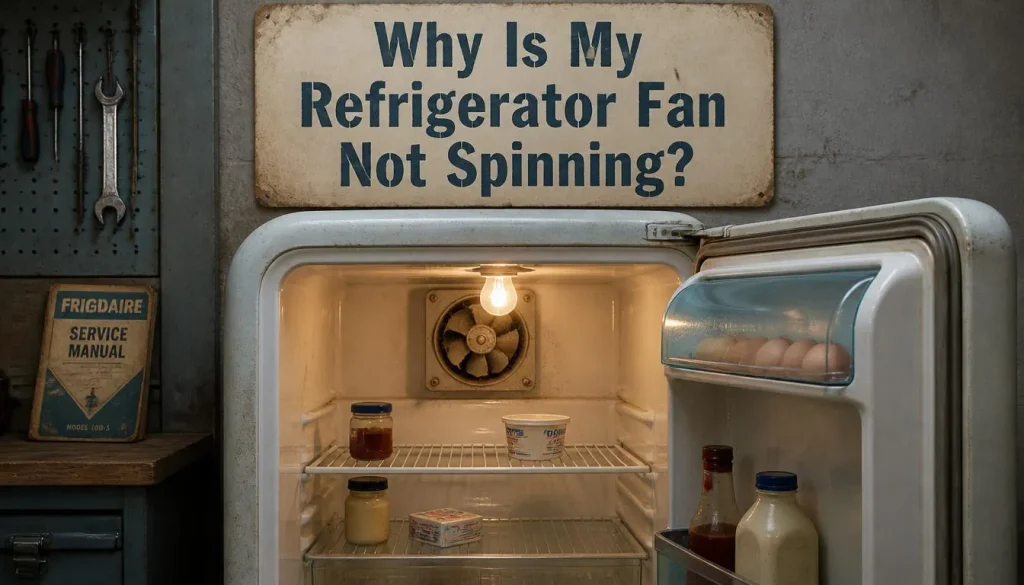
A refrigerator fan that is not spinning can have several possible causes.
Depending on the model, the fan may be:
- Blocked by ice
- Obstructed by debris
- Mechanically seized
- Damaged
- Experiencing a motor failure
- Affected by an electrical or control problem
Do not assume every refrigerator should have a visible condenser fan. Refrigerator designs vary, so check your specific model before concluding that a missing or stationary fan is defective.
If the refrigerator has a condenser fan and the compressor is operating while the fan remains stationary, the fan deserves inspection.
With the refrigerator disconnected from power, check for:
- Physical obstructions
- A damaged blade
- Excessive resistance
- Wobbling
- Grinding
- A loose blade
- Signs of motor damage
Electrical diagnosis should be left to a qualified technician if it requires live voltage testing.
Why Is the Fan Noisy but Still Spinning?
This is a common mistake when troubleshooting.
A refrigerator fan does not have to stop spinning to be faulty.
A fan that continues to rotate can still have:
- Worn motor bearings
- A loose blade
- A bent blade
- Debris around the blade
- A damaged mounting point
- Excessive vibration
If the fan is spinning but produces a grinding, squealing, scraping, or rough mechanical sound, inspect it rather than assuming it is healthy.
The important distinction is between normal airflow noise and mechanical noise.
What Causes Ice or Frost Around the Evaporator Fan?
Ice contacting the evaporator fan is one of the most recognizable causes of refrigerator fan noise.
When frost builds up around the fan area, the blade can strike the ice each time it rotates. The result may sound like:
- Scraping
- Grinding
- Repeated clicking
- Tapping
- Buzzing
You may also notice reduced airflow from the refrigerator vents or uneven temperatures.
Simply removing visible ice may provide temporary relief, but it does not necessarily solve the reason the ice formed.
If heavy frost keeps returning, the underlying issue may involve the defrost system, airflow, door sealing, or another cooling-related problem.
Do not use sharp objects to chip ice away from the evaporator area. Doing so can damage hidden components.
Can a Dirty Condenser Fan Cause Noise?
Yes.
Dust, pet hair, and debris can accumulate around the lower rear of a refrigerator, particularly in homes with pets.
When debris reaches the fan blade, it may cause:
- Rattling
- Ticking
- Scraping
- Vibration
- Unbalanced rotation
A dirty condenser area can also restrict heat removal and make the refrigerator work harder.
Before cleaning or inspecting the fan, disconnect the appliance from power. Avoid putting your hands near a moving fan.
How to Diagnose a Noisy Refrigerator Fan Step by Step
You can often narrow down the problem without immediately replacing any parts.
Step 1: Describe the Sound
Listen carefully and classify it:
- Humming
- Buzzing
- Rattling
- Scraping
- Grinding
- Squealing
- Clicking
- Tapping
Also ask whether the noise is constant or comes and goes.
Recording a short audio clip on your phone can be useful if you eventually need professional service.
Step 2: Find the Location
Determine whether the noise comes from:
- The freezer
- The refrigerator compartment
- The bottom
- The rear
- The area around the compressor
Location is one of the best first clues.
Step 3: Open the Freezer Door
Listen to what happens when you open the freezer door.
If the sound becomes quieter or stops, the evaporator fan may be involved.
This is a useful clue, but it is not a universal test because fan behavior varies between refrigerator designs.
Step 4: Check for Frost or Ice
Look at the rear freezer panel.
Heavy frost, unusual ice buildup, or evidence that a blade may be contacting ice strengthens the case for an evaporator fan problem.
Step 5: Unplug the Refrigerator Before Inspecting Mechanical Parts
If you need to remove a panel or reach a fan blade, disconnect the refrigerator from electrical power first.
Never place your hands near a moving fan or exposed electrical components while the refrigerator is powered.
Step 6: Inspect the Condenser Fan Area
If the sound is coming from the lower rear area, inspect the condenser fan after disconnecting power.
Look for:
- Dust
- Pet hair
- Debris
- Loose wires
- Bent blades
- Cracked blades
- Objects touching the fan
- A loose fan mounting point
Step 7: Check the Fan Blade
With power disconnected, gently inspect the blade.
Look for:
- Wobbling
- Resistance
- Scraping
- Grinding
- Cracks
- Looseness
A blade that does not move smoothly deserves further attention.
Step 8: Check for Vibration
Make sure the refrigerator:
- Is level
- Is not touching the wall
- Is not rubbing against a cabinet
- Does not have loose items on top
- Does not have loose panels or tubing
Sometimes the fan is working properly, but the vibration is being transferred to another part of the refrigerator.
Step 9: Check Cooling Performance
Ask yourself:
- Is the freezer still freezing normally?
- Is the refrigerator compartment cold enough?
- Is airflow coming from the vents?
- Are temperatures becoming inconsistent?
- Is the compressor unusually hot?
- Is the refrigerator running much longer than normal?
A noisy fan plus poor cooling requires more attention than a noisy fan with otherwise normal operation.
How to Fix a Noisy Refrigerator Fan
The correct repair depends on the actual cause.
Clean the Condenser Fan Area
If dust and debris are interfering with the fan, clean the surrounding area carefully after disconnecting power.
Keep the fan blade and nearby components free from loose debris.
Remove the Source of Physical Interference
If a piece of debris, insulation, paper, or another object is touching the fan blade, remove it only after the refrigerator is unplugged.
Defrost Ice Around the Evaporator Fan
If ice is contacting the evaporator fan, the refrigerator may need to be defrosted.
However, repeated ice buildup should not be treated as a permanent solution. If the ice returns, the underlying cause needs to be investigated.
Secure Loose Panels or Mounting Points
A loose bracket, fan mount, rear panel, or drain pan can create a surprisingly loud rattling sound.
Tightening the appropriate fastener may solve the vibration.
Level the Refrigerator
If the appliance rocks or vibrates against the floor, wall, or cabinets, correct the leveling problem.
Reducing vibration can make a refrigerator dramatically quieter.
Replace a Damaged Fan Blade
A blade that is cracked, bent, or permanently warped should generally be replaced with the correct part for the refrigerator model.
Do not try to reshape a damaged blade and assume the problem is solved. An unbalanced blade can continue to create vibration.
Replace a Worn Fan Motor
A noisy motor that has a clean blade, no obstruction, and proper mounting may simply be wearing out.
Common signs include:
- Grinding
- Squealing
- Rough rotation
- Excessive vibration
- Intermittent operation
- Increasing noise over time
Always match the replacement part to the exact refrigerator model.
Why Is My Refrigerator Fan Noisy but the Refrigerator Is Still Cooling?
A refrigerator can continue cooling even when a fan is beginning to fail.
For example, a condenser fan may still spin while its bearings are becoming noisy. An evaporator fan may still circulate air while its motor begins producing a squealing or grinding sound.
That means “it is still cooling” does not automatically mean the fan is fine.
On the other hand, a temporary increase in fan noise does not always mean a major failure.
Look at the full picture:
Noise only + normal cooling: monitor and investigate.
Noise + worsening vibration: inspect the fan and mounting.
Noise + frost buildup: inspect the evaporator area and possible defrost issue.
Noise + poor cooling: treat the problem as a broader refrigeration issue.
For more general troubleshooting, you can also read how to fix a refrigerator making loud noise.
Is It Really the Fan? Other Parts That Can Make Similar Sounds
Not every refrigerator noise is caused by a fan.
This is one of the most important things to remember before ordering a replacement part.
Compressor
The compressor normally produces a low hum, but unusual buzzing, repeated clicking, strong vibration, or excessive heat combined with poor cooling can indicate a problem.
Ice Maker
The ice maker may create buzzing, clicking, knocking, or popping noises during normal operation.
Water Inlet Valve
A water valve can produce a short buzzing sound when the refrigerator is filling the ice maker or dispensing water.
Drain Pan
A loose drain pan can rattle or vibrate.
Water Line or Tubing
A water line touching the cabinet can produce a repetitive vibration or knocking noise.
Defrost Cycle
Some refrigerators make sizzling, popping, or crackling noises when frost melts during defrost.
Loose Panels or Cabinet Parts
A small vibration can sound surprisingly loud when transferred through a metal panel.
This is why identifying the exact location and timing of the noise is so important.
Refrigerator Fan Noise vs. Other Refrigerator Noises
| Noise | Possible Source | What to Check |
|---|---|---|
| Soft hum | Fan or compressor | Usually normal |
| Loud hum | Fan, compressor, vibration | Location and cooling |
| Buzzing | Fan, compressor, water valve | Timing and location |
| Rattling | Fan, panel, tubing, drain pan | Loose or vibrating parts |
| Scraping | Fan blade and ice/housing | Inspect fan area |
| Grinding | Fan motor or blade | Mechanical condition |
| Squealing | Fan motor or bearing | Motor condition |
| Clicking | Ice maker, compressor control, relay | Timing |
| Hissing | Refrigerant flow | Often normal |
| Gurgling | Refrigerant or drain activity | Usually cycle-related |
| Knocking | Tubing, ice maker, compressor movement | Find exact source |
When Should You Replace the Refrigerator Fan Motor?
Fan motor replacement becomes more likely when:
- The fan is mechanically noisy after cleaning.
- The blade is not obstructed.
- The blade is properly mounted.
- The motor rotates roughly.
- Grinding or squealing continues.
- The fan intermittently stops.
- The refrigerator develops airflow or cooling problems.
- The noise progressively gets worse.
Before ordering a replacement, find your refrigerator’s exact model number.
A similar-looking fan motor may have the wrong electrical characteristics, connector, mounting pattern, or shaft configuration.
Is It Safe to Keep Running a Refrigerator With a Noisy Fan?
It depends on the cause.
A mild operating hum with normal cooling is generally not alarming.
A persistent grinding, scraping, or squealing noise should not be ignored, especially if the sound is getting louder.
Stop troubleshooting and seek professional help when you notice:
- Burning smells
- Damaged electrical wiring
- Severe overheating
- Repeated electrical clicking
- Poor or rapidly worsening cooling
- A compressor that will not start
- A fan that requires electrical testing
- Heavy frost that repeatedly returns
- Any situation where accessing the component would expose you to live electrical parts
If you are not comfortable removing refrigerator panels or diagnosing electrical components, professional appliance service is the safer option.
When Should You Call a Refrigerator Repair Technician?
Call a qualified technician when:
- The noise remains after basic cleaning and inspection.
- The fan motor appears to have failed.
- Electrical testing is required.
- A control board or sensor may be involved.
- The refrigerator is not cooling properly.
- Heavy frost continues to return.
- The compressor is unusually hot or repeatedly clicking.
- You suspect a sealed-system or compressor problem.
A technician can test the motor, wiring, controls, and cooling system instead of replacing parts based only on the sound.
How to Prevent Refrigerator Fan Noise
You can reduce the likelihood of fan-related noise by keeping up with basic refrigerator maintenance.
Keep the Condenser Area Clean
Dust and pet hair can accumulate near the lower rear mechanical area.
Keep Internal Air Vents Clear
Do not pack food directly against the refrigerator’s internal air vents.
Keep the Refrigerator Level
A level refrigerator is less likely to develop unnecessary cabinet vibration.
Leave Adequate Clearance
Follow the manufacturer’s installation recommendations so heat can escape properly.
Pay Attention to New Sounds
Small changes are easier to diagnose before they become larger mechanical problems.
Check Frost Buildup Early
Unusual frost around the freezer’s rear panel should not be ignored, especially when it affects fan noise or airflow.
Frequently Asked Questions
Why is my refrigerator fan suddenly so loud?
A sudden increase in fan noise can be caused by ice, debris, a damaged blade, a loose mounting point, vibration, or a fan motor beginning to fail. Start by identifying where the sound comes from.
Why does my refrigerator fan stop when I open the door?
On many refrigerators, the evaporator fan changes or stops when the door is opened. When the noise changes with the freezer door, the evaporator fan becomes a stronger suspect.
Why is my refrigerator fan making a grinding noise?
Grinding often points to a moving part rubbing against something. Common possibilities include ice contacting the evaporator fan, a damaged blade, or worn fan motor bearings.
Why is my refrigerator fan making a rattling noise?
Rattling may be caused by a loose fan blade, debris, a loose mounting bracket, rear panel vibration, tubing, a drain pan, or the refrigerator touching another surface.
Why is my refrigerator fan making a buzzing noise?
Buzzing can come from the fan motor, compressor, water inlet valve, or vibration. The exact location and when the sound occurs are important clues.
How do I know if my refrigerator fan motor is bad?
Signs include grinding, squealing, rough rotation, excessive vibration, intermittent operation, or a fan that does not start correctly. A fan can still spin and have a failing motor.
How do I know if my refrigerator condenser fan is bad?
Check whether it spins normally when the refrigerator design calls for a condenser fan. With power disconnected, inspect the blade for obstruction, damage, wobbling, or unusual resistance.
Can ice cause a refrigerator fan to make noise?
Yes. Ice or frost can contact the evaporator fan blade and create scraping, grinding, clicking, or tapping sounds. If frost repeatedly returns, investigate the underlying cause rather than repeatedly removing the ice.
Can a noisy refrigerator fan affect cooling?
Yes. A failing or obstructed fan can reduce airflow or heat removal, depending on which fan is affected. Noisy fan operation combined with poor cooling deserves prompt attention.
Why is my refrigerator fan running all the time?
Continuous operation can occur when the refrigerator is under heavy cooling demand, but it can also be related to dirty condenser areas, blocked airflow, door-seal problems, temperature issues, or a control problem. Check cooling performance along with the fan behavior.
Can I run a refrigerator with a noisy fan?
A mild operating sound with normal cooling may not indicate an emergency. Persistent grinding, scraping, squealing, strong vibration, overheating, or poor cooling should be investigated rather than ignored.
How much does it cost to replace a refrigerator fan motor?
The total cost varies considerably by refrigerator model, motor type, labor rates, and location. The part itself may be relatively modest compared with a service call, but exact pricing should be based on the refrigerator’s model number and the required fan assembly.
Final Takeaway
If your refrigerator fan is making noise, do not start by assuming the motor has failed.
Start with the basics:
Locate the sound → Identify the fan → Describe the noise → Check for ice or debris → Inspect the blade and mounting → Check cooling performance.
A scraping sound from inside the freezer often points toward the evaporator fan or ice buildup. A rattling or grinding sound from the lower rear area may involve the condenser fan, compressor area, or loose components. And sometimes what sounds like a fan is actually an ice maker, water valve, drain pan, tubing, or compressor.
The good news is that many refrigerator fan noise problems can be identified with a careful inspection. The key is to diagnose the source before replacing parts.
For additional refrigerator noise troubleshooting, see what it means when your refrigerator starts making noise and, when the sound seems to come from the compressor or condenser area, how to check refrigerator compressor fan noise and fix a noisy fridge.

Hi, I’m the lead researcher and appliance enthusiast behind RefrigeratorSolve. With years of hands-on experience troubleshooting cooling systems and testing home appliances, I am dedicated to bringing you honest reviews, energy-saving tips, and practical solutions to keep your refrigerator running perfectly.