A humming sound from an LG refrigerator is often completely normal. The compressor, condenser fan, evaporator fan, and other operating components can all produce a low hum while the refrigerator is cooling. The sound may also become more noticeable after you add warm food, open the doors frequently, or when the appliance is working harder to maintain its temperature.
However, a new, unusually loud, constant, or rough humming noise deserves a closer look—especially if your LG refrigerator is also struggling to cool, vibrating excessively, clicking repeatedly, or making another unusual sound.
The key is to determine where the humming is coming from, when it happens, and whether the refrigerator is still cooling normally.
This guide explains the most common causes of an LG refrigerator humming noise, how to identify the source, what you can safely check yourself, and when professional service is the better option.
Is It Normal for an LG Refrigerator to Make a Humming Noise?
Yes. A refrigerator is not designed to operate silently.
A soft, steady humming sound is commonly produced by the compressor as it circulates refrigerant through the cooling system. Fans may also create a gentle humming or whirring sound as they move air through the refrigerator and freezer.
You may notice the sound more clearly at certain times, including when:
- The compressor first starts running
- The refrigerator is recovering after the doors have been open
- Warm food has recently been placed inside
- The kitchen is unusually warm
- The refrigerator has recently been plugged in
- The appliance is recovering from a defrost cycle
Modern refrigerators can also change their operating speed depending on cooling demand, so the pitch or volume of the hum may vary.
A useful rule is simple: a quiet hum with normal cooling is usually less concerning than a sudden loud hum accompanied by another problem.
For a broader comparison of refrigerator sounds, see our guide to how to check refrigerator compressor and fan noise.
Normal Humming From the Compressor
The compressor is responsible for moving refrigerant through the refrigerator’s cooling system. While it is operating, a low hum or buzz is expected.
The sound may become temporarily louder when the compressor needs to work harder. For example, frequent door opening or adding a large amount of warm food increases the cooling demand.
Normal Humming From the Fans
LG refrigerators use fans to move air through the appliance and, depending on the model, to help cool the condenser area.
The evaporator fan is generally associated with the freezer compartment, while the condenser fan is typically located near the compressor and condenser area.
A soft fan hum is normal. Grinding, scraping, or squealing is different and may indicate that the fan is obstructed or developing a mechanical problem.
Why Does My LG Refrigerator Sound Louder at Night?
Many people notice refrigerator noises more at night simply because the kitchen is quiet.
There may also be periods when the compressor or fans are operating more noticeably because the refrigerator is maintaining its temperature or recovering from earlier cooling demand.
If the sound is a normal low hum and the refrigerator is cooling correctly, nighttime noise alone does not necessarily indicate a fault.
When Does Normal Humming Become a Problem?
Pay closer attention when the sound:
- Suddenly becomes much louder than before
- Continues at an unusually high volume
- Changes from a smooth hum to a rough buzz or grinding sound
- Is accompanied by repeated clicking
- Comes with excessive vibration
- Occurs together with poor cooling
- Is accompanied by an electrical or burning smell
- Appears after the refrigerator has developed heavy frost or ice
The change in behavior is usually more important than the mere presence of a humming sound.
Why Is My LG Refrigerator Making a Humming Noise?
There are several possible causes. The best way to narrow them down is to match the sound with its location and timing.
1. The Compressor Is Running
This is one of the most common explanations for a humming LG refrigerator.
A normally operating compressor can create a low, steady hum from the rear or lower portion of the appliance. The sound may become more noticeable when the refrigerator is working harder to cool the interior.
You may hear a stronger hum after:
- Opening the doors repeatedly
- Loading warm food
- Adjusting the temperature
- Starting the refrigerator after it has been off
- Returning to normal operation after a defrost cycle
A louder compressor sound does not automatically mean the compressor has failed.
What matters is whether the refrigerator is still reaching its normal temperature and whether the noise is smooth rather than harsh or accompanied by other symptoms.
2. The Condenser or Evaporator Fan Is Running
Fans can easily be mistaken for compressor noise because both are part of the cooling system.
The condenser fan is generally located near the compressor and condenser area. The evaporator fan is typically located inside the freezer section behind an interior panel.
If the noise seems to come from inside the freezer, the evaporator fan becomes a more likely source.
If you hear humming along with rattling, scraping, or grinding, inspect for possible obstruction rather than assuming that the compressor is the problem.
Frost can sometimes interfere with a fan blade, while a worn fan motor or loose part can create abnormal noise.
3. The Refrigerator Is Not Level
An LG refrigerator that is slightly uneven can vibrate more than expected.
That vibration can amplify an otherwise normal compressor or fan hum. It may also cause the refrigerator cabinet, doors, shelves, drain pan, tubing, or surrounding surfaces to resonate.
Check whether the refrigerator rocks when you gently push it.
If it does, proper leveling may reduce the noise significantly.
4. The Refrigerator Is Touching a Wall or Cabinet
Your refrigerator needs some clearance around the cabinet.
If the back or side of the appliance is pressed against a wall, cabinet, countertop, or another hard surface, normal compressor vibration can transfer directly into that surface.
The result can sound much louder than the refrigerator actually is.
Check for contact points around the refrigerator and remove anything resting against the cabinet.
You can also read our guide on what causes a refrigerator to make a vibrating noise for more ways to identify vibration-related sounds.
5. Frost or Ice Is Affecting the Evaporator Fan
A humming sound that changes into a scraping or buzzing noise may come from the evaporator fan.
When frost or ice builds up around the fan area, the blade may contact the ice or surrounding housing.
Common clues include:
- Noise coming from the freezer
- Humming mixed with scraping
- Noise that changes when the freezer door is opened
- Visible frost or ice buildup
- Reduced airflow
- Cooling problems
Do not remove interior panels or work around electrical components while the refrigerator is powered.
If heavy frost repeatedly returns, the underlying issue may involve the defrost system, airflow, door seal, or another component rather than simply the visible ice.
6. The Ice Maker Is Operating Without a Water Supply
The ice maker can also create buzzing or humming sounds.
If your LG refrigerator has an ice maker connected to a water supply, you may hear a brief sound as the appliance fills or cycles.
If the ice maker is switched on but there is no water supply, the valve may operate without actually filling the ice maker.
If the sound occurs mainly during ice-making cycles, check whether the water line is connected correctly and whether the household water supply is available.
7. The Water Inlet Valve Is Making the Noise
A refrigerator may produce a buzzing or humming sound when the water inlet valve opens.
This is particularly relevant if the noise occurs when you use the water dispenser or when the ice maker requests water.
If the sound happens only during water dispensing or ice filling, the valve and water supply deserve attention before you start diagnosing the compressor.
A noise that appears exclusively during dispenser operation is less likely to be a continuous compressor problem.
8. The Ice Dispenser or Auger Is Struggling
If the refrigerator has an ice dispenser, the motor and auger can make a temporary humming or buzzing sound when you request ice.
A jammed mechanism or clumped ice may cause the motor to work harder than normal.
If the noise appears only while dispensing ice, check the ice bucket for large frozen clumps and make sure the dispenser mechanism can operate freely.
9. Airflow or Dirty Components Are Making the Refrigerator Work Harder
Restricted airflow can increase cooling demand.
Depending on the refrigerator design, dust around accessible condenser areas, blocked ventilation, poor installation clearance, or an environment that is excessively warm can contribute to longer compressor operation.
The result may be a refrigerator that seems to hum more often or for longer periods.
Regular maintenance can help the cooling system operate efficiently.
For more refrigerator maintenance ideas, see our guide to reducing refrigerator compressor noise.
10. A Fan Motor or Compressor May Be Developing a Problem
Sometimes the humming really does indicate a component problem.
This becomes more likely when the sound is accompanied by:
- Repeated clicking
- Grinding
- Scraping
- Excessive vibration
- Weak cooling
- A compressor that repeatedly starts and stops
- Excessive heat
- An electrical or burning smell
Do not immediately assume that the compressor needs replacement. The condenser fan, evaporator fan, mounting hardware, tubing, or another nearby component may be the actual source.
Does the Humming Stop When You Open the Refrigerator Door?
This is one of the most useful clues when troubleshooting an LG refrigerator.
If the sound changes or stops when the refrigerator or freezer door is opened, the internal evaporator fan becomes a possible source.
Listen carefully and compare:
- Refrigerator door closed
- Refrigerator door opened
- Freezer door closed
- Freezer door opened
Also pay attention to the exact location of the sound.
A humming noise from inside the freezer points you toward the evaporator fan area. A deep hum from the bottom rear points more toward the compressor or condenser area.
If the sound disappears when the door is opened and then returns after the door closes, fan operation should be considered.
Do not remove an internal panel simply to reach the fan unless you are comfortable working safely on appliances and have followed the appropriate model-specific instructions.
Why Is My LG Refrigerator Humming but Not Cooling?
A humming refrigerator that is not cooling properly is more concerning than a quiet refrigerator that is functioning normally.
Start by checking the obvious possibilities.
The Compressor Is Running but Cooling Is Weak
The compressor may be operating while another part of the cooling system is not working correctly.
Possible areas include:
- Condenser airflow
- Evaporator fan
- Defrost system
- Sealed cooling system
- Temperature controls
- Door seal
- Airflow passages
Frost May Be Blocking Airflow
Heavy frost around the evaporator section can restrict airflow and interfere with the fan.
If the freezer develops significant frost and the refrigerator section becomes warmer, the issue may involve more than a simple noise problem.
The Condenser Fan May Not Be Working Correctly
If the condenser fan is obstructed or failing, the refrigerator may struggle to release heat efficiently.
That can contribute to longer compressor operation and increased noise.
A Sealed-System Problem Is Possible
A refrigerator that runs frequently but cannot maintain the correct temperature may have a sealed-system issue or another refrigeration fault.
These problems generally require proper diagnostic equipment and professional service.
Why Is My LG Refrigerator Humming and Vibrating?
Humming and vibration often occur together because the compressor and fans generate mechanical movement.
However, the vibration may become much louder when that movement is transferred into another surface.
Check these areas first:
- Refrigerator feet
- Flooring
- Wall clearance
- Cabinet clearance
- Drain pan
- Tubing
- Loose rear cover or panel
- Items sitting on top of the refrigerator
A refrigerator does not have to be mechanically failing to sound loud. Poor positioning can make a normal operating sound seem surprisingly severe.
Why Does My LG Refrigerator Hum When I Use the Water or Ice Dispenser?
The timing of the noise is the biggest clue.
Water Dispenser
If the humming starts when you press the water dispenser, inspect the water supply, water line, and inlet valve.
A brief humming sound while water is being dispensed can be part of normal operation.
Ice Maker
If humming happens during an ice-making cycle, the water inlet valve may be operating.
If it happens when you request ice, the dispenser motor or auger may be involved.
Look for:
- Frozen or clumped ice
- A blocked dispenser
- A restricted water line
- A missing water connection
- Unusual buzzing that continues after dispensing stops
Why Is My LG Refrigerator Humming After a Power Outage or Startup?
After a power interruption, the refrigerator has to return to its target temperature.
The compressor may run for an extended period while the appliance cools down again. The sound can therefore be more noticeable shortly after power is restored.
A similar situation can occur after installation or after the refrigerator has been switched off for some time.
The important question is whether the noise gradually returns to normal as cooling stabilizes.
If the refrigerator remains excessively loud, does not cool correctly, or repeatedly clicks on and off, further troubleshooting is appropriate.
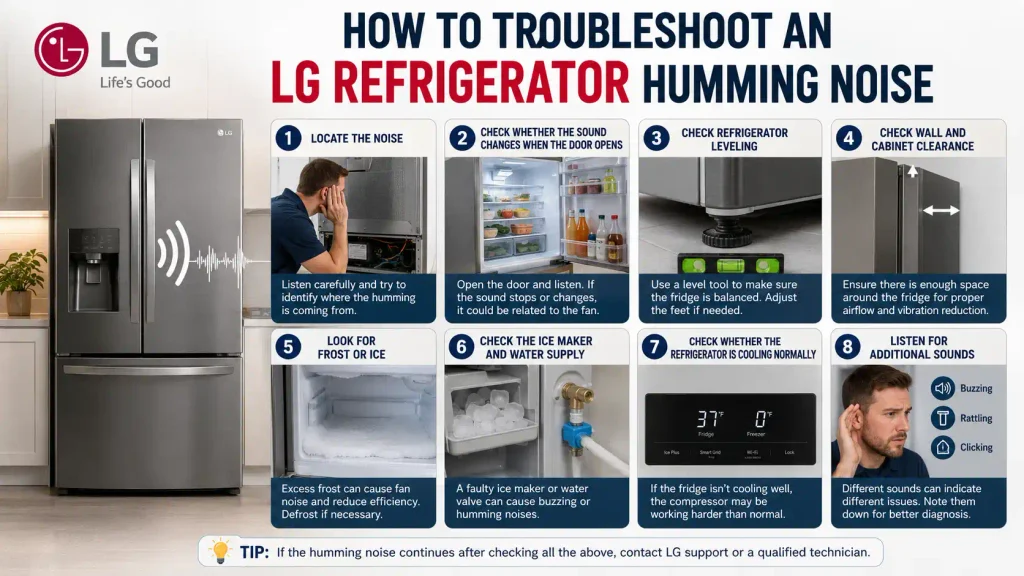
How to Troubleshoot an LG Refrigerator Humming Noise
You can narrow down most refrigerator noises without immediately replacing parts.
Step 1: Locate the Noise
Stand near the refrigerator and determine whether the sound appears to come from:
- Bottom rear
- Top rear
- Inside the refrigerator compartment
- Inside the freezer
- Water dispenser
- Ice maker
- Side or rear cabinet
Location is one of the fastest ways to separate a compressor problem from a fan, valve, or vibration problem.
Step 2: Check Whether the Sound Changes When the Door Opens
Open the refrigerator and freezer doors one at a time.
Listen for a noticeable change.
If the sound stops when a particular door is opened, an internal fan may be involved.
Step 3: Check Refrigerator Leveling
Gently test whether the refrigerator rocks.
If it is uneven, correct the leveling according to the manufacturer’s installation instructions.
Step 4: Check Wall and Cabinet Clearance
Make sure the refrigerator is not pressed tightly against a wall or surrounding cabinet.
Also check whether a water line, cord, panel, or other object is vibrating against the cabinet.
Step 5: Look for Frost or Ice
Inspect the freezer for unusual frost buildup.
If you see ice around vents or suspect the fan is contacting ice, do not ignore it.
Repeated frost problems require further diagnosis.
Step 6: Check the Ice Maker and Water Supply
If the noise occurs during ice-making or water dispensing, verify that:
- The water supply is turned on
- The water line is properly connected
- The ice dispenser is not jammed
- Ice is not clumped inside the bucket
Step 7: Check Whether the Refrigerator Is Cooling Normally
This is critical.
A humming sound by itself is often harmless. A humming sound plus a refrigerator that is not maintaining temperature deserves much more attention.
Check the actual interior temperature rather than relying only on how cold the air feels.
Step 8: Listen for Additional Sounds
A smooth hum is different from:
- Grinding
- Scraping
- Repeated clicking
- Sharp buzzing
- Knocking
- Squealing
The combination of sounds can provide much more information than the word “humming” alone.
LG Refrigerator Humming vs. Other Noises
| Sound | Possible Source | Usually Normal? |
|---|---|---|
| Low humming | Compressor or fan | Often |
| Light buzzing | Compressor, fan, water valve | Sometimes |
| Clicking | Compressor cycle or controls | Often, depending on pattern |
| Rattling | Loose item, tubing, panel, vibration | Sometimes |
| Grinding | Fan or motor problem | Usually not |
| Scraping | Fan contacting frost or housing | Usually not |
| Gurgling | Refrigerant movement | Often |
| Hissing | Refrigerant, airflow, defrost | Often, depending on circumstances |
| Popping or cracking | Thermal expansion | Often |
| Repeated loud clicking | Compressor/start or control issue | Concerning |
The important point is that the refrigerator can make several different sounds during normal operation.
For a broader guide, read what to do when a refrigerator starts making noise.
When Is an LG Refrigerator Humming Noise a Serious Problem?
Contact a qualified appliance technician when the humming is accompanied by a significant performance or safety symptom.
Professional diagnosis is especially appropriate when:
- The refrigerator is not cooling
- The freezer is becoming warm
- The compressor repeatedly clicks on and off
- A grinding or scraping noise continues
- The cabinet vibrates excessively
- The compressor becomes unusually hot
- There is a burning or electrical smell
- The noise suddenly becomes much louder
- The problem continues after basic checks
- An error code appears
Do not open sealed refrigeration components or attempt electrical repairs unless you have the required technical knowledge and equipment.
A refrigerator may contain high-voltage electrical components and a pressurized refrigeration system, so some repairs are better left to a trained technician.
How to Make an LG Refrigerator Quieter
You may be able to reduce normal operating noise by addressing vibration and airflow problems.
Start with these simple checks:
- Make sure the refrigerator is properly leveled.
- Keep the appliance from touching surrounding walls or cabinets.
- Remove objects that are vibrating against the cabinet.
- Keep ventilation areas unobstructed.
- Check for unusual frost buildup.
- Make sure the ice maker has a functioning water supply.
- Keep the door seals clean and closing properly.
- Monitor whether the refrigerator is maintaining its normal temperature.
You can also review how to fix a refrigerator making loud noise for additional troubleshooting ideas.
Frequently Asked Questions
Why is my LG refrigerator making a loud humming noise?
A loud humming noise may come from the compressor, condenser fan, evaporator fan, or vibration against a surrounding surface. If the noise is new or much louder than before, check the refrigerator’s leveling, clearance, fan area, and cooling performance.
Why is my LG refrigerator humming but not cooling?
The compressor may be running while another component is preventing proper cooling. Possible areas include the evaporator fan, condenser fan, defrost system, airflow, door seal, or sealed refrigeration system.
Why does my LG refrigerator stop humming when I open the door?
If the noise stops when the door opens, an evaporator fan may be involved. The fan can change or stop operation when the door is opened, depending on the refrigerator’s design.
Why does my LG refrigerator hum at night?
The kitchen is generally quieter at night, so normal compressor and fan sounds can seem much louder. If the refrigerator is cooling normally and the hum remains smooth, nighttime noise alone does not necessarily indicate a problem.
Why is my LG refrigerator humming after a power outage?
After power is restored, the compressor may run longer while the refrigerator returns to its normal temperature. A temporary increase in operating noise can occur during this recovery period.
Why does my LG refrigerator hum when dispensing water?
The water inlet valve can make a humming or buzzing sound while it opens to allow water to flow. If the noise is unusually loud or continues after dispensing stops, check the water supply and line.
Why does my LG refrigerator hum when making ice?
The ice maker and water inlet valve can make brief operating sounds during an ice-making cycle. If the ice maker is turned on without a water supply, abnormal or louder buzzing may also occur.
Is LG refrigerator compressor humming normal?
A low, steady compressor hum is generally normal. It becomes more concerning when the sound is unusually loud, rough, or accompanied by poor cooling, repeated clicking, excessive heat, or strong vibration.
How long should an LG refrigerator hum?
There is no single time period that applies to every LG refrigerator. Compressor runtime changes with room temperature, door opening, food load, temperature settings, and the refrigerator’s cooling demand.
How do I stop my LG refrigerator from humming?
You usually do not need to eliminate a normal compressor or fan hum. Instead, focus on reducing abnormal vibration, ensuring proper leveling and clearance, checking for frost, and identifying whether a fan, valve, ice maker, or other component is creating the sound.
Final Takeaway
If your LG refrigerator is making a humming noise, do not assume that something is broken simply because you can hear it. A soft, consistent hum is often part of normal compressor or fan operation.
The best way to diagnose the problem is to ask four questions:
Where is the sound coming from?
When does it happen?
Does it change when you open a door or use the dispenser?
Is the refrigerator still cooling normally?
If the humming is smooth and the refrigerator is maintaining temperature, there is often little reason for concern. But a loud or changing hum combined with poor cooling, repeated clicking, grinding, scraping, excessive vibration, or an electrical smell should be investigated promptly.
Finding the source before replacing parts can save you time and money—and can prevent a minor issue from becoming a larger refrigerator repair.

Hi, I’m the lead researcher and appliance enthusiast behind RefrigeratorSolve. With years of hands-on experience troubleshooting cooling systems and testing home appliances, I am dedicated to bringing you honest reviews, energy-saving tips, and practical solutions to keep your refrigerator running perfectly.