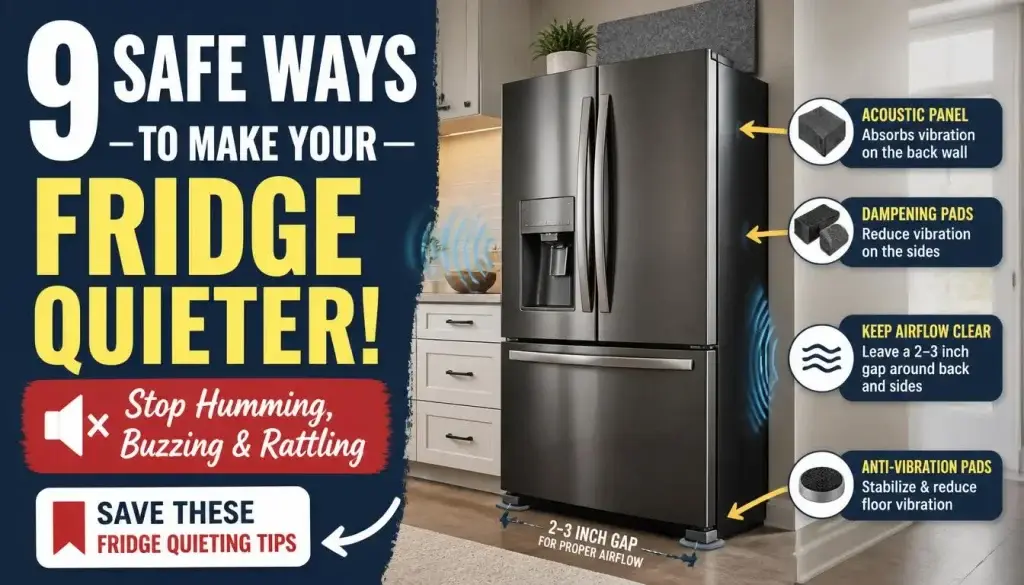
A refrigerator is supposed to run in the background, not become the loudest appliance in your kitchen. If yours produces a constant hum, vibration, rattle, or low-frequency buzz, noise insulation can sometimes make a noticeable difference.
The key is knowing what you are trying to reduce.
Some refrigerator noise travels through the air. Some vibration travels through the floor, wall, or nearby cabinets. And sometimes the problem is not sound insulation at all—a loose drain pan, uneven refrigerator, dirty fan, or mechanical fault may be responsible.
If you want to know how to noise insulate a refrigerator, start by finding the source of the sound. Then reduce vibration, prevent the appliance from transferring noise to surrounding surfaces, and add sound-dampening material only where it can be used safely.
This guide walks you through the process without blocking the airflow your refrigerator needs to operate properly.
Quick Answer: How Do You Noise Insulate a Refrigerator?
The safest way to noise insulate a refrigerator is to reduce vibration first and then treat the surfaces around the appliance.
Start with these steps:
- Make sure the refrigerator is level and stable.
- Keep it from touching the wall or surrounding cabinets.
- Place suitable anti-vibration pads under the feet.
- Consider a firm vibration-dampening appliance mat if the floor transfers noise.
- Secure rattling shelves, bottles, panels, tubing, and the drain pan.
- Check the condenser and evaporator fan areas for dirt, debris, or ice.
- Inspect accessible compressor mounts for excessive movement or deterioration.
- Add sound-absorbing or sound-blocking material to the wall around the refrigerator, not over its ventilation openings.
- Maintain the clearances specified by the refrigerator manufacturer.
Never wrap the compressor, cover ventilation openings, or pack acoustic material tightly around the refrigerator. Trapping heat can create a bigger problem than the noise you are trying to solve.
How Loud Should a Refrigerator Normally Be?
No refrigerator is completely silent.
Depending on the design, you may hear the compressor, circulation fans, refrigerant, water valve, ice maker, or defrost system operating at different times of the day.
Normal sounds can include:
- A low, steady hum
- Gentle fan noise
- Short buzzing sounds
- Occasional clicks
- Gurgling or bubbling
- Light popping as materials expand and contract
- Ice dropping into the storage bin
- Brief water-flow sounds
The important question is not simply, “Can I hear my refrigerator?”
Ask whether the sound has become new, unusually loud, constant, rough, or accompanied by another symptom.
For example, a soft compressor hum that has sounded the same for years may be perfectly normal. A sudden grinding noise combined with poor cooling deserves attention.
If your refrigerator has become noticeably louder, use this guide on how to fix a refrigerator making loud noise to narrow down the cause before adding insulation.
Refrigerator Sounds That May Indicate a Problem
Investigate further if you hear:
- Grinding
- Metal scraping
- High-pitched squealing
- Repeated loud clicking
- Heavy knocking
- Violent vibration
- A fan repeatedly striking something
You should also be cautious if the noise appears together with poor cooling, excessive frost, unusual heat, electrical problems, or a burning smell.
Noise insulation may reduce ordinary operational sound, but it cannot repair a damaged component.
Refrigerator Soundproofing vs. Sound Absorption vs. Vibration Isolation
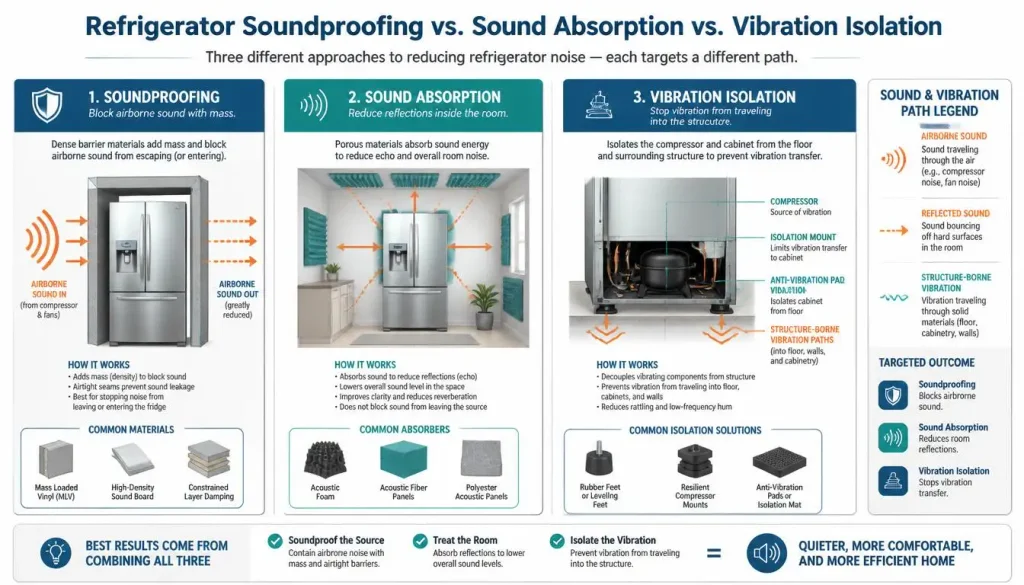
These terms are often used interchangeably, but they solve different problems.
Sound Absorption
Sound-absorbing materials reduce reflections and echoes.
For example, if your refrigerator sits inside a hard-walled kitchen alcove, the surrounding surfaces may reflect compressor and fan noise back into the room. An appropriate acoustic treatment on the surrounding wall can reduce some of that reflection.
Sound Blocking
Dense materials are used to reduce how easily sound passes through a surface.
Mass-loaded vinyl, dense boards, and properly constructed sound barriers can help in some situations, especially when noise is traveling toward an adjacent room.
However, refrigerator soundproofing should normally be applied to the surrounding structure, not wrapped around the appliance.
Vibration Isolation
This is often the most useful approach for a noisy refrigerator.
Compressors and fans create small amounts of vibration during operation. If that vibration transfers into a hard floor, cabinet, wall, or loose panel, the surrounding material can act like a speaker and make the noise seem much louder.
Rubber isolation pads, proper leveling, adequate clearance, and securing loose objects can reduce this structure-borne noise.
For many homes, vibration control produces a better result than covering the kitchen with acoustic foam.
First, Identify Where the Refrigerator Noise Is Coming From
Before buying soundproofing material, spend a few minutes listening.
The location and timing of the sound can tell you a lot.
| Where You Hear the Noise | Possible Source | First Thing to Check |
|---|---|---|
| Lower back | Compressor, condenser fan, tubing | Clearance, dust, vibration |
| Bottom | Feet, drain pan, floor vibration | Leveling and stability |
| Inside freezer | Evaporator fan, frost, ice maker | Fan noise and ice buildup |
| Side panel | Cabinet resonance | Wall/cabinet contact |
| Inside refrigerator | Bottles, shelves, drawers | Loose items |
| Near water connection | Supply line or inlet valve | Tubing and water flow |
| Whole refrigerator | Uneven floor or strong vibration | Leveling and feet |
Noise From the Back of the Refrigerator
The compressor, condenser fan, tubing, water line, and rear panel are common sources.
A low hum may simply be compressor operation. A rattle may come from tubing or a loose panel touching another surface.
If the sound seems strongest around the compressor area, read the detailed guide on how to reduce refrigerator compressor noise before assuming the compressor itself has failed.
Noise From the Bottom
A refrigerator that rocks slightly can transfer vibration into the floor.
You may also have a loose drain pan or another component vibrating underneath the appliance.
Noise From Inside the Freezer
A scraping, grinding, or rough buzzing sound may involve the evaporator fan.
In some cases, ice builds up near the fan blade and makes contact as the fan spins.
Noise From the Sides
If a refrigerator is pushed tightly against a cabinet, countertop, or wall, normal compressor vibration can make the surrounding structure rattle.
Try gently pressing the side panel while the refrigerator is making noise. If the sound changes, resonance or contact vibration may be involved.
Noise From Inside the Refrigerator
Sometimes the solution costs nothing.
Glass bottles touching each other, a loose drawer, a poorly seated shelf, or containers resting against an interior wall can produce surprisingly loud rattling.
If vibration is the main symptom, the guide to common causes of refrigerator vibrating noise can help you isolate the exact source.
Best Materials for Noise Insulating a Refrigerator
You do not need to use every soundproofing material available. Choose the product based on the type of noise you have.
| Material | Best Use | Airborne Noise | Vibration | Difficulty |
|---|---|---|---|---|
| Anti-vibration pads | Under refrigerator feet | Low | High | Easy |
| Rubber appliance mat | Floor vibration | Low | High | Easy |
| Acoustic panel | Wall reflections | Moderate | Low | Easy |
| Mass-loaded vinyl | Sound transmission through surrounding structure | High | Low | Moderate |
| Dense barrier board | Wall or alcove treatment | Moderate to High | Low | Moderate |
Anti-Vibration Pads
These small pads sit underneath the refrigerator’s feet.
They are useful when vibration is traveling into hardwood, tile, laminate, or another hard floor.
Choose pads designed to support the weight of heavy appliances. After installation, check that the refrigerator remains stable.
Rubber Appliance Mat
A dense appliance mat can provide a larger isolation surface than individual pads.
It may be useful when the entire floor seems to resonate.
Avoid thick, soft materials that make the refrigerator unstable.
Mass-Loaded Vinyl
Mass-loaded vinyl, often called MLV, is a dense flexible sound-blocking material.
For refrigerator noise, it makes more sense as part of a wall or alcove treatment than as something attached directly to the appliance.
Do not drape MLV over the rear of a refrigerator or use it to obstruct ventilation.
Acoustic Panels
Acoustic panels can help reduce sound bouncing off a hard wall behind or beside the refrigerator.
They are most useful for airborne noise and reflected sound rather than strong mechanical vibration.
Acoustic Foam
Acoustic foam is often the first thing people think of when they hear “soundproofing,” but it is not a universal fix.
Foam is primarily used to absorb reflected sound. It does not provide much mass for blocking low-frequency compressor noise, and it will not stop vibration traveling through a floor.
If you use an acoustic product near a refrigerator, make sure it is appropriate for the location and does not interfere with airflow, heat dissipation, electrical equipment, or manufacturer-required clearances.
How to Noise Insulate a Refrigerator Step by Step
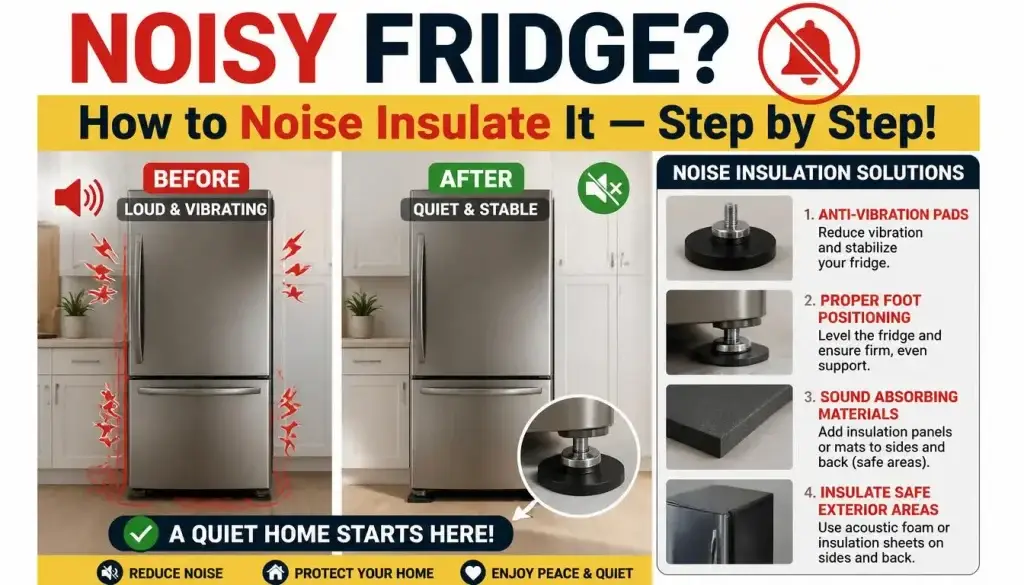
The following order works well because it starts with simple, low-cost fixes before moving to additional sound treatment.
1. Level the Refrigerator
Start here.
A refrigerator that is not sitting firmly on the floor can rock slightly every time the compressor or fan operates.
To check it:
- Place a level on top of the refrigerator if you have one.
- Gently push opposite corners and check for rocking.
- Adjust the leveling feet according to the owner’s manual.
- Confirm that the refrigerator feels stable.
- Open and close the doors to make sure the appliance does not move.
Some manufacturers specify a slight front-to-back position for proper door operation, so follow your model’s installation instructions rather than trying to make adjustments by guesswork.
Run the refrigerator afterward and listen again.
Sometimes leveling alone eliminates most of the annoying vibration.
2. Move the Refrigerator Away From the Wall and Cabinets
The refrigerator should not vibrate directly against surrounding surfaces.
Check:
- Rear wall
- Side cabinets
- Countertop
- Baseboards
- Water line
- Power cord
You do not need to create an excessive gap. Use the clearances specified by your refrigerator manufacturer.
The goal is simply to prevent unwanted contact while preserving ventilation.
3. Install Anti-Vibration Pads
If the refrigerator is stable but you can feel vibration in the floor, isolation pads may help.
Place one appropriately rated pad under each contact point or leveling foot.
After placing them:
- Check stability again.
- Confirm the refrigerator does not rock.
- Recheck door alignment.
- Make sure the appliance has not shifted too close to the wall.
Anti-vibration pads are especially useful when a refrigerator sits on a hard floor that readily transmits low-frequency vibration.
4. Put a Vibration-Dampening Mat Under the Refrigerator
If individual pads are not enough, a dense appliance mat may help isolate a larger area.
A mat can be useful in:
- Apartments
- Open-plan homes
- Kitchens above living areas
- Kitchens with resonant wooden flooring
The mat should be firm enough to support the refrigerator safely.
Avoid creating an unstable surface or interfering with airflow underneath models that require it.
5. Secure Loose Shelves, Bottles, Panels, and Door Bins
Before making expensive modifications, empty or rearrange anything that can rattle.
Check:
- Glass bottles touching each other
- Containers resting against interior walls
- Door bins
- Freezer baskets
- Ice bins
- Shelves
- Items stored on top of the refrigerator
- Accessible exterior panels
Run the refrigerator while listening.
You may find that what sounded like compressor noise was actually a bottle vibrating against another bottle.
6. Stop Water Lines, Drain Pans, and Tubing From Vibrating
Refrigerators with an ice maker or water dispenser have additional tubing and valves that can produce noise.
Look behind the refrigerator for a water supply line touching:
- The wall
- Rear refrigerator panel
- Cabinet
- Floor trim
Reposition visible tubing gently so it does not knock or vibrate against a hard surface.
Do not kink, crush, sharply bend, or disconnect the water line unless you know how to do so safely.
A drain pan near the bottom of the refrigerator can also rattle if it is loose or incorrectly positioned.
If you hear a buzz rather than a simple vibration, this guide to refrigerator buzzing noise can help determine whether the water system, fan, compressor, or another component is responsible.
7. Clean the Condenser Area and Check the Fans
A refrigerator cannot be soundproofed effectively if a fan is noisy because it is dirty, obstructed, or damaged.
Unplug the refrigerator before cleaning accessible mechanical areas.
Depending on the model, check for:
- Dust
- Pet hair
- Loose debris
- Objects near the fan
- Dirty condenser coils
Do not reach into moving parts or disassemble electrical and sealed refrigeration components.
If you are unsure whether the sound is coming from the fan or compressor, use this guide on how to check refrigerator compressor fan noise before replacing anything.
8. Check Compressor Mounts and Rubber Grommets
The compressor normally produces some vibration while it runs.
Rubber mounting components help prevent that vibration from transferring directly into the refrigerator frame.
If a mount becomes loose, cracked, compressed, or deteriorated, vibration may become more noticeable.
You can visually inspect safely accessible mounting areas after unplugging the refrigerator, but avoid removing or modifying the compressor or refrigerant system.
If the refrigerator is strongly shaking, repeatedly clicking, or failing to cool properly, call a qualified appliance technician.
9. Add Sound-Dampening Material Behind the Refrigerator
Once mechanical and vibration problems have been addressed, you can consider treating the surrounding wall.
The safest concept is:
Treat the room around the refrigerator rather than wrapping the refrigerator itself.
For example, a suitable acoustic panel or properly installed sound barrier on the wall behind an appliance alcove may reduce reflected sound.
Leave all required ventilation space open.
Never cover:
- Compressor area
- Condenser fan
- Coils
- Intake openings
- Exhaust openings
- Electrical components
A soundproofing solution that traps heat is not a good refrigerator soundproofing solution.
How to Reduce Refrigerator Noise on Hardwood, Tile, or Laminate Floors
Hard floors can make refrigerator vibration more noticeable because the vibration may transfer through the structure instead of being absorbed.
Start with three things:
Level the refrigerator. All supporting feet should make stable contact.
Isolate vibration. Use properly rated rubber pads or a suitable appliance mat.
Check surrounding contact. A refrigerator vibrating through the floor and touching a cabinet can create two noise paths at the same time.
If you live in an apartment, structure-borne vibration may also be noticeable in the room below or along a shared wall.
In that situation, treating the floor contact usually makes more sense than sticking acoustic foam to the refrigerator.
How to Noise Insulate a Refrigerator in an Alcove or Cabinet
A refrigerator placed inside a tight alcove can seem louder because hard surfaces surround it.
The cavity may reflect noise while the refrigerator panels transfer vibration into the cabinetry.
Prevent Cabinet Contact
Check both sides, the top, and the rear.
The refrigerator should have the installation clearance required for your specific model.
Treat the Rear Wall
If there is sufficient safe clearance, an appropriate wall-mounted acoustic treatment can reduce reflected sound.
The material should remain part of the wall treatment rather than touching hot or moving refrigerator components.
Reduce Side-Wall Reflections
Hard side walls can reflect compressor and fan noise into the room.
Acoustic treatment may help, but do not reduce the ventilation gap below the manufacturer’s requirement.
Check Cabinet Vibration
Sometimes the refrigerator itself is quiet, while a loose cabinet panel vibrates in response to it.
Listen while lightly pressing on nearby trim or cabinet panels. A noticeable change in sound may reveal the source.
Where Should You Put Soundproofing Around a Refrigerator?
Safe refrigerator noise treatment usually focuses on the surrounding structure.
Behind the Refrigerator
A properly installed wall treatment can reduce reflected sound, provided the refrigerator still has adequate clearance and ventilation.
Under the Refrigerator
Use stable anti-vibration pads or a mat designed for heavy appliances.
On Nearby Walls
This can be helpful if a refrigerator shares a wall with a bedroom, office, or living space.
For significant sound transmission through the wall, proper wall construction is usually more effective than lightweight foam.
Around a Refrigerator Alcove
Treating hard reflective surfaces may reduce perceived noise, but keep every required ventilation path clear.
Where You Should Never Put Soundproofing Material
Noise reduction should never compromise appliance safety.
Do Not Block Refrigerator Vents
A refrigerator needs airflow to remove heat.
Do not cover ventilation grilles or air passages.
Do Not Cover the Condenser Fan
If your refrigerator uses a condenser fan, it must be able to move air freely.
Do Not Wrap the Compressor
A compressor produces heat while operating.
Wrapping it in foam, blankets, MLV, or other improvised insulation can interfere with heat dissipation and access for service.
Do Not Seal the Refrigerator Inside a Cabinet
A refrigerator alcove is not a recording studio.
Packing insulation around every gap may restrict the airflow the appliance requires.
Always follow the installation clearances in the owner’s manual.
Do Not Place Loose Material Near Moving or Electrical Parts
Keep loose foam, fabric, insulation fibers, and other materials away from fans, wiring, coils, and hot components.
Refrigerator Noise Insulation vs. Repair: Which Do You Need?
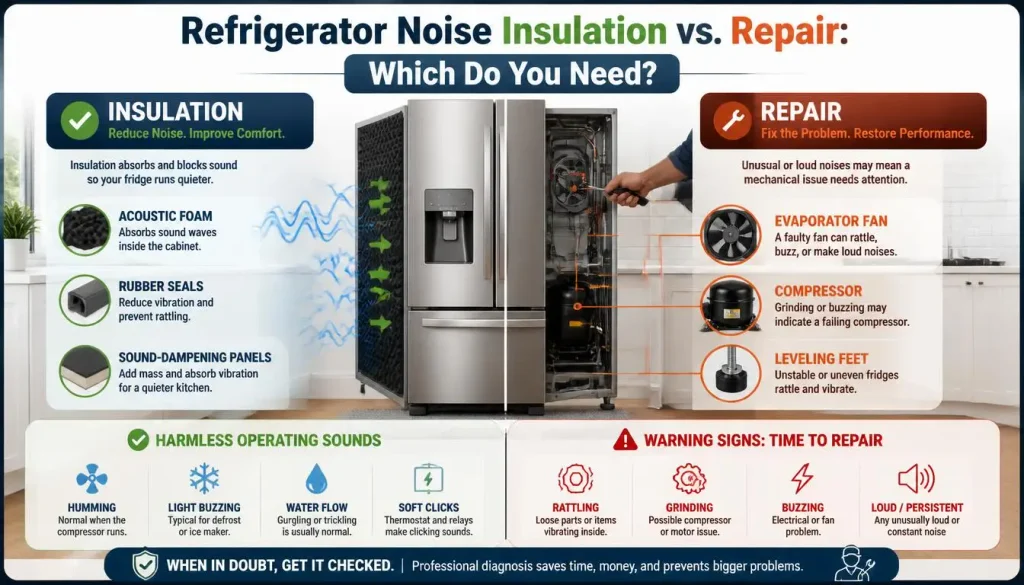
Sound insulation is most useful when the refrigerator is operating normally but its ordinary hum or vibration is being amplified by the surrounding room.
Noise That Insulation or Isolation May Reduce
You may have good results with:
- Normal compressor humming
- Mild vibration
- Floor resonance
- Cabinet resonance
- Reflected sound from a refrigerator alcove
- Light rattling caused by contact with nearby surfaces
Noise That Usually Needs Troubleshooting or Repair
Do not try to hide these noises with soundproofing:
- Grinding
- Screeching
- Metal scraping
- Repeated loud clicking with cooling problems
- Severe shaking
- Fan blades striking something
- Sudden unusually loud compressor noise
A persistent loud humming noise from a refrigerator should also be diagnosed if it is new, excessive, or accompanied by changes in cooling performance.
How to Make a Refrigerator Quieter Without Soundproofing
You may not need any acoustic material at all.
Try this checklist first:
- Level the refrigerator.
- Move it away from surrounding surfaces.
- Remove objects stored on top.
- Separate bottles and containers.
- Seat shelves and bins correctly.
- Secure visible tubing.
- Check the drain pan.
- Clean accessible condenser areas.
- Look for ice interfering with a freezer fan.
- Turn off an unused ice maker if the refrigerator is not connected to water, following the manufacturer’s instructions.
After each change, allow the refrigerator to operate normally and listen again.
Making one change at a time makes it easier to identify what actually solved the problem.
Why Is My Refrigerator Still Loud After Noise Insulation?
If the refrigerator remains loud after you have isolated it from the floor and surrounding walls, sound transmission may not be the main problem.
Consider these possibilities.
The Fan Is Damaged or Obstructed
A worn motor, damaged blade, frost, or debris can create noise that no acoustic panel will fix.
Compressor Vibration Is Excessive
Some compressor sound is normal, but a noticeable change may require diagnosis.
Compressor Mounts Are Worn
If the mounts no longer isolate vibration effectively, the refrigerator chassis may amplify the sound.
The Refrigerator Is Still Touching Something
Check:
- Wall
- Cabinet
- Countertop
- Water line
- Cord
- Baseboard
Even a small contact point can transmit vibration.
The Floor Is Resonating
A flexible wooden floor can carry vibration farther than expected.
Isolation at the refrigerator feet may be more useful than wall treatment in this case.
You Are Hearing Normal Operation
Sometimes the refrigerator is operating exactly as designed, especially if the room is extremely quiet.
A kitchen that is silent at night can make a normal compressor sound seem much more noticeable than it does during the day.
How Much Noise Can Refrigerator Insulation Reduce?
There is no reliable universal percentage.
Results depend on:
- Refrigerator design
- Type of compressor
- Fan design
- Floor construction
- Wall construction
- Room acoustics
- Whether the noise is airborne or structure-borne
- Whether there is an underlying mechanical fault
Be cautious of promises that one mat, foam panel, or soundproofing product will make a refrigerator “silent.”
A more realistic goal is to eliminate unnecessary rattles and vibration and make normal operating sounds less intrusive.
Is It Safe to Soundproof a Refrigerator?
Yes, if you focus on vibration isolation and surrounding surfaces while respecting the refrigerator’s ventilation requirements.
A safe approach includes:
- Unplugging the refrigerator before inspecting accessible mechanical areas.
- Following manufacturer clearance requirements.
- Keeping vents and fans clear.
- Using materials suitable for the installation area.
- Keeping loose materials away from electrical components.
- Avoiding modifications to the sealed refrigeration system.
- Maintaining a stable appliance position.
When in doubt, check your refrigerator’s installation manual before adding material behind, beside, or underneath it.
When Noise Insulation Is Not Worth It
Sometimes adding more sound treatment is the wrong investment.
Consider diagnosis or replacement instead if:
- The refrigerator is very old.
- Cooling performance has declined.
- The compressor repeatedly struggles to start.
- Major mechanical repairs are needed.
- The sound has become progressively worse.
- Repair costs are approaching the value of the appliance.
If quiet operation is especially important in an open-plan apartment or studio, noise level can also be part of your decision when choosing your next refrigerator.
Some modern refrigerators use variable-speed or inverter-style compressor systems that can operate differently from traditional start-stop designs, but no compressor technology guarantees complete silence.
When Should You Call a Refrigerator Repair Technician?
Stop troubleshooting and consider professional service if:
- The refrigerator is not cooling properly.
- You smell something burning.
- A breaker repeatedly trips.
- You hear loud electrical buzzing.
- The compressor repeatedly clicks but does not run normally.
- Grinding or scraping continues.
- The refrigerator is shaking severely.
- A fan blade appears damaged.
- You suspect a sealed-system problem.
- The appliance becomes abnormally hot.
- The noise suddenly becomes much louder without an obvious cause.
Do not open sealed refrigerant lines or perform live electrical testing unless you are qualified to do so.
Frequently Asked Questions
Can You Soundproof a Refrigerator?
You can reduce the amount of refrigerator noise you hear, but completely soundproofing an operating refrigerator is neither realistic nor desirable.
The appliance requires ventilation, so it cannot simply be sealed inside a soundproof box.
The safest approach is to reduce vibration at the feet, eliminate rattles, maintain clearance from surrounding surfaces, and treat nearby walls when necessary.
What Is the Best Soundproofing Material for a Refrigerator?
For vibration, dense rubber anti-vibration pads are often more useful than traditional acoustic foam.
For reflected airborne sound, acoustic wall panels may help.
For sound passing through a wall, heavier barrier systems such as mass-loaded vinyl may be useful when correctly incorporated into the surrounding structure.
The best material depends on how the noise is traveling.
Can I Put Acoustic Foam Behind a Refrigerator?
Potentially, but only when the product is suitable for the environment and installation does not interfere with ventilation, heat dissipation, electrical components, or manufacturer-required clearances.
Mounting an appropriate acoustic treatment to a wall is generally safer than attaching material directly to the refrigerator.
Do not pack foam around the compressor, condenser, or ventilation openings.
Is Mass-Loaded Vinyl Good for Refrigerator Noise?
MLV can help block airborne sound when incorporated into a wall or barrier system.
It is much less useful for vibration traveling directly through the refrigerator feet and floor.
Do not wrap MLV around the refrigerator or compressor.
Can I Put a Rubber Mat Under My Refrigerator?
A suitable heavy-appliance mat can help reduce vibration transfer, especially on hard flooring.
Make sure the mat can safely support the refrigerator, does not make it unstable, and does not block any model-specific ventilation beneath the appliance.
Do Anti-Vibration Pads Work for Refrigerators?
They can work well when floor vibration is part of the problem.
They will not repair a damaged compressor or fan, but they can reduce structure-borne vibration transmitted from a normally operating refrigerator into the floor.
Can You Soundproof a Refrigerator Compressor?
You should not wrap or enclose the compressor with improvised soundproofing material.
Instead, reduce vibration through correct leveling, floor isolation, proper clearance, intact mounts, and sound treatment on nearby surfaces.
If the compressor itself has become unusually loud, have the refrigerator diagnosed.
How Do I Reduce Refrigerator Compressor Noise?
Start by confirming the sound actually comes from the compressor.
Then check refrigerator leveling, wall clearance, floor vibration, nearby tubing, condenser cleanliness, and accessible compressor mounts.
Persistent loud clicking, grinding, excessive heat, or poor cooling requires professional diagnosis.
How Do I Stop My Fridge From Vibrating on the Floor?
Level the refrigerator first.
Then check whether all feet are firmly supported. If the floor continues to transmit vibration, install stable anti-vibration pads or a properly rated appliance mat.
Also make sure the refrigerator is not simultaneously touching a cabinet or wall.
Why Is My Refrigerator Louder at Night?
The refrigerator may not actually be running louder.
At night, background noise from traffic, conversations, televisions, HVAC equipment, and other appliances often decreases. Normal refrigerator humming therefore becomes more noticeable.
However, if the refrigerator is objectively becoming louder or running much longer than before, inspect it rather than assuming the difference is only environmental.
How Do I Stop Refrigerator Noise Through a Wall?
First eliminate direct vibration between the refrigerator and the wall or cabinetry.
For persistent airborne noise, improving the wall assembly with appropriate sound-blocking materials can be more effective than placing lightweight foam behind the refrigerator.
If vibration is entering the building structure through the floor, isolate the refrigerator feet as well.
How Do I Quiet a Refrigerator in an Apartment?
Start with renter-friendly solutions:
- Level the refrigerator.
- Create proper wall and cabinet clearance.
- Use suitable anti-vibration pads.
- Remove loose items.
- Secure the water line.
- Treat reflected sound without permanently modifying the appliance.
If the noise travels into another unit, floor vibration and shared-wall transmission deserve particular attention.
Can a Refrigerator Touch the Wall or Cabinets?
A refrigerator should be installed according to the clearance specifications for its particular model.
Direct contact with a wall or cabinet can also transfer vibration and create rattling.
If your refrigerator is touching another surface, reposition it while maintaining all required installation clearances.
How Much Space Should I Leave Around a Refrigerator?
There is no single clearance measurement that applies to every refrigerator.
Requirements vary by brand, model, ventilation design, and whether the refrigerator is freestanding or built-in.
Check the installation manual for your exact model and follow the listed top, rear, and side clearances.
Final Thoughts
Learning how to noise insulate a refrigerator is less about surrounding the appliance with soundproofing and more about controlling how its normal vibration and sound travel into your home.
Start with the simple fixes.
Level the refrigerator, keep it from touching walls and cabinets, secure anything that rattles, inspect accessible fans and tubing, and isolate vibration at the floor. Only after those steps should you consider adding acoustic treatment to the surrounding walls or refrigerator alcove.
Most importantly, never sacrifice ventilation for a quieter kitchen.
If the refrigerator makes a normal hum but the room amplifies it, vibration isolation and careful acoustic treatment can help. If the sound is grinding, scraping, repeatedly clicking, or accompanied by poor cooling, solve the mechanical problem instead of trying to cover it up.
A quieter refrigerator starts with finding the real source of the noise—not simply adding more insulation.

Hi, I’m the lead researcher and appliance enthusiast behind RefrigeratorSolve. With years of hands-on experience troubleshooting cooling systems and testing home appliances, I am dedicated to bringing you honest reviews, energy-saving tips, and practical solutions to keep your refrigerator running perfectly.