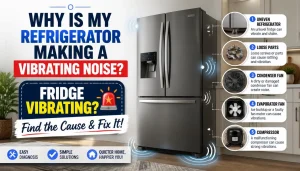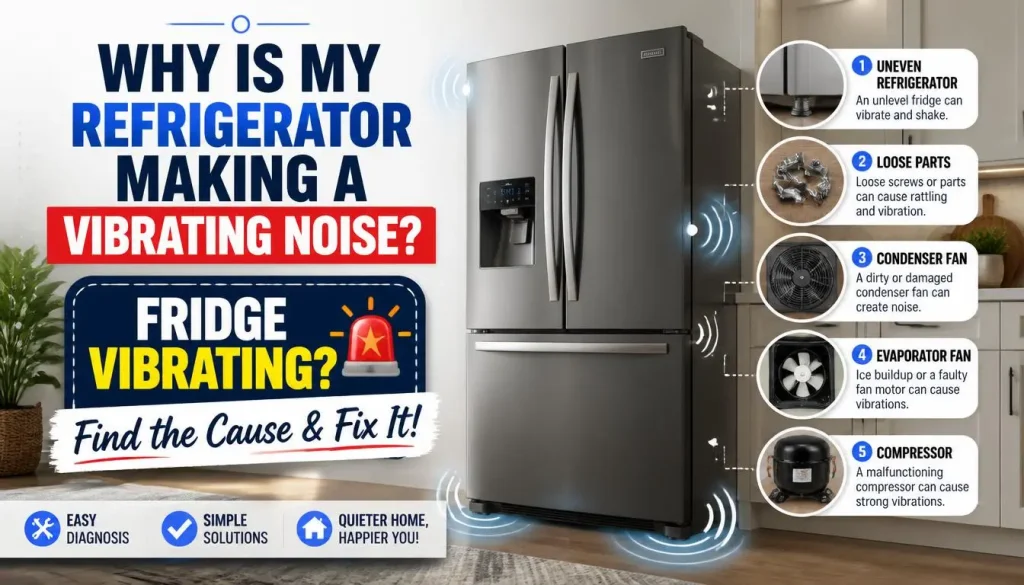
If your refrigerator is making a vibrating noise, the cause may be as simple as an uneven floor, bottles touching each other, or the fridge sitting too close to a wall. The sound can also come from the compressor, condenser fan, evaporator fan, ice maker, water line, or another moving part.
A small amount of vibration is normal when a refrigerator is running. The compressor and fans create some movement as they cool the appliance. What matters is whether the vibration is new, unusually loud, constant, or happening along with another problem such as poor cooling.
The best way to find the cause is to pay attention to three things: where the vibration comes from, when it happens, and whether the refrigerator is still cooling normally.
This guide will walk you through the most common causes and help you decide which problems you can check yourself and which ones need professional attention.
Is It Normal for a Refrigerator to Vibrate?
Yes, light refrigerator vibration can be completely normal.
Your refrigerator has several moving parts. The compressor turns on to circulate refrigerant, while fans move air through the refrigerator and freezer. These parts can create a soft hum or gentle vibration.
You may notice more vibration when:
- The compressor starts.
- The refrigerator is cooling after the doors were left open.
- You recently added a large amount of food.
- The room temperature is high.
- The ice maker is filling with water.
- A variable-speed compressor changes speed.
- The refrigerator is newly installed and cooling down for the first time.
The sound becomes more concerning when it suddenly gets louder, changes into grinding or scraping, continues for long periods, or happens together with weak cooling.
If your refrigerator is producing several different sounds instead of only vibration, see our guide on how to fix a refrigerator making loud noise to identify the sound more accurately.
10 Common Reasons Your Refrigerator Is Making a Vibrating Noise
A vibrating refrigerator does not automatically mean an expensive part has failed. Start with the simple causes before assuming there is a serious mechanical problem.
1. The Refrigerator Is Not Level
An uneven refrigerator is one of the easiest causes of vibration to check.
If one corner is slightly higher or lower than the others, normal movement from the compressor and fans can travel through the refrigerator cabinet and into the floor. This can turn a mild hum into an annoying vibration or rattling sound.
Gently press on different corners of the refrigerator. If it rocks or moves, the leveling feet may need adjustment.
Use a level across the top of the appliance if you have one. Adjust the leveling feet according to your refrigerator’s owner’s manual until the fridge sits firmly without rocking.
Do not assume the floor itself is level. Tile, wood, concrete, and older kitchen floors can all have small height differences.
2. The Refrigerator Is Touching the Wall or Cabinet
Your refrigerator may be working normally while the cabinet around it is making the noise sound much worse.
If the refrigerator touches a wall, kitchen cabinet, countertop, or another appliance, normal compressor vibration can transfer into that surface.
This often creates a buzzing, humming, or rattling sound.
Pull the refrigerator slightly away from surrounding surfaces and listen again. Also check behind the appliance. A power cord, water line, rear cover, or other part may be touching the wall.
Always follow the clearance requirements listed in the installation instructions for your refrigerator model.
3. Bottles, Shelves, or Containers Are Vibrating
Sometimes the refrigerator itself is not the real source of the noise.
Glass bottles placed next to each other can vibrate when the compressor starts. A loose shelf, drawer, bin, container, or item sitting on top of the refrigerator can do the same thing.
Open the refrigerator and check for anything that can move.
Separate glass bottles and jars slightly. Make sure shelves and drawers are seated correctly. Remove objects from the top of the fridge for a few minutes and see whether the sound changes.
This simple test can save you from inspecting parts that are working perfectly well.
4. The Condenser Fan Is Dirty or Obstructed
Many refrigerators have a condenser fan near the compressor at the lower back or bottom of the appliance.
The fan helps remove heat from the condenser and compressor area.
Dust, pet hair, dirt, or debris around the fan can sometimes create extra noise. A fan blade may also touch debris or another nearby part.
If the noise sounds like buzzing, rattling, scraping, or vibration from the lower rear area, the condenser fan deserves attention.
Unplug the refrigerator before accessing any fan or mechanical area. If the fan is safely accessible according to your owner’s manual, inspect the surrounding area for visible debris.
Do not bend the fan blade or remove electrical parts unless you know the correct service procedure.
If you are unsure whether the sound is coming from a fan or the compressor, our guide on how to check refrigerator compressor fan noise explains how to tell these sounds apart.
5. The Evaporator Fan Is Hitting Ice or Debris
A vibrating or buzzing sound coming from inside the freezer may point to the evaporator fan.
This fan moves cold air through the refrigerator. If frost or ice builds up around the fan housing, the spinning blade may begin touching it.
The result may sound like vibration, buzzing, clicking, scraping, or rattling.
One useful clue is what happens when you open the refrigerator or freezer door.
On many refrigerators, the evaporator fan stops when the door opens. If the vibrating noise stops almost immediately when you open the door and returns after you close it, the fan area becomes a strong suspect.
Heavy frost around the freezer panel may also indicate a defrost or airflow problem rather than a simple loose part.
6. The Compressor Is Vibrating
The compressor is normally located near the bottom rear of the refrigerator. It is responsible for circulating refrigerant through the cooling system.
A compressor naturally creates some vibration while running.
A smooth low hum with gentle vibration is usually normal, especially if the refrigerator is cooling properly.
Pay closer attention if the compressor area suddenly develops:
- Strong vibration
- Loud rattling
- Metallic knocking
- Repeated clicking
- A much louder hum than before
- Excessive heat
- Poor refrigerator or freezer cooling
The compressor may not always be the actual problem. Nearby tubing, the drain pan, a fan, or mounting components can make it sound like the compressor is failing.
Before considering an expensive repair, read our detailed guide on how to reduce refrigerator compressor noise and rule out the simpler causes.
7. The Ice Maker or Water Inlet Valve Is Vibrating
Does the vibration happen for only a few seconds at certain times?
The ice maker or water inlet valve may be responsible.
When an automatic ice maker needs water, the refrigerator opens the water inlet valve. The valve can produce a short buzz or vibration while water flows into the ice maker.
This is often normal.
However, the noise can become more noticeable if:
- The water supply valve is partly closed.
- The supply line is kinked.
- The refrigerator has low water pressure.
- The ice maker is turned on without a connected water supply.
- The water line is vibrating against the refrigerator or wall.
If your refrigerator has an ice maker but no water line is connected, check your owner’s manual and turn the ice maker off if appropriate.
8. The Water Line or Refrigerant Tubing Is Vibrating
Several tubes and lines run through or behind a refrigerator.
A water supply line may touch the wall, cabinet, rear panel, or another tube. When water flows through it, the contact can create a noticeable vibration.
Refrigerant also moves through sealed tubing as part of normal cooling. Changes in pressure and flow may cause gentle humming, gurgling, pulsating, or vibrating sounds.
Check visible external water lines for contact with nearby surfaces.
Do not bend, loosen, cut, or attempt to repair sealed refrigerant tubing yourself. Refrigeration-system work should be handled by a qualified technician.
9. The Drain Pan Is Loose
The drain pan collects water produced during the refrigerator’s defrost process. Depending on the design, it is normally located near the bottom of the refrigerator.
If a removable drain pan is loose or sitting incorrectly, normal compressor vibration can cause it to rattle.
The sound may appear to come directly from the compressor because the two components can be close together.
Check your owner’s manual before trying to access the pan. Some refrigerators use drain pans that are not designed to be removed by the owner.
If the pan is accessible and clearly out of position, secure it according to the manufacturer’s instructions.
10. A Panel, Tube, or Other Part Is Touching the Cabinet
A refrigerator contains many components packed into a relatively small space.
A rear panel, tube, water line, drain pan, cover, or other component can sometimes vibrate against the refrigerator cabinet.
This type of sound often follows the compressor cycle. The vibration begins when the compressor starts and disappears when it stops.
Try to locate the sound without immediately taking anything apart.
If pushing lightly on an exterior panel changes the noise, a panel or nearby component may be vibrating. Do not remove electrical covers while the appliance is connected to power.
Where Is the Vibrating Noise Coming From?
Finding the location of the sound can quickly narrow down the possible cause.
Vibrating Noise From the Back of the Refrigerator
A vibration from the back may come from the compressor, condenser fan, water supply line, tubing, rear cover, or contact with the wall.
Start by checking whether the refrigerator has enough space behind it.
Then listen near the top and bottom of the rear area without touching electrical or moving components.
A sound near the lower back usually points toward the compressor, condenser fan, drain pan, or nearby tubing.
Vibrating Noise From the Bottom of the Refrigerator
A vibration from underneath the fridge may be caused by uneven leveling feet, the compressor, condenser fan, drain pan, or the refrigerator cabinet transferring vibration into the floor.
Push gently on the corners of the refrigerator.
If the sound changes when you apply light pressure, check the leveling first.
Vibrating Noise From Inside the Refrigerator
A vibration inside the fresh-food section often comes from bottles, jars, shelves, bins, or other stored items.
Move items apart and make sure all shelves and drawers are properly fitted.
If the sound continues even after the contents are rearranged, listen for a fan or air damper.
Vibrating Noise From the Freezer
A vibrating noise from the freezer deserves a closer look at the evaporator fan.
Ice or frost around the fan may cause the blade to hit something as it spins.
Listen to what happens when the door opens. If the noise stops with the door open and returns after the door closes, a fan-related problem is more likely.
Refrigerator Vibrating Against the Wall
Move the refrigerator slightly forward.
If the vibration immediately becomes quieter, the appliance, water line, cord, or tubing may have been touching the wall.
Do not push the refrigerator tightly back into place after fixing the problem. Maintain the clearance required for your model.
Refrigerator Vibration Through the Floor
Some floors make refrigerator vibrations easier to hear.
Hard flooring can transmit a low-frequency hum into nearby rooms. An unlevel appliance can make this worse.
First make sure all leveling feet are stable and the refrigerator does not rock.
Avoid placing unstable homemade materials under the fridge. Use only appropriate leveling methods recommended for the appliance and flooring.
Why Is My Refrigerator Making a Loud Vibrating Noise?
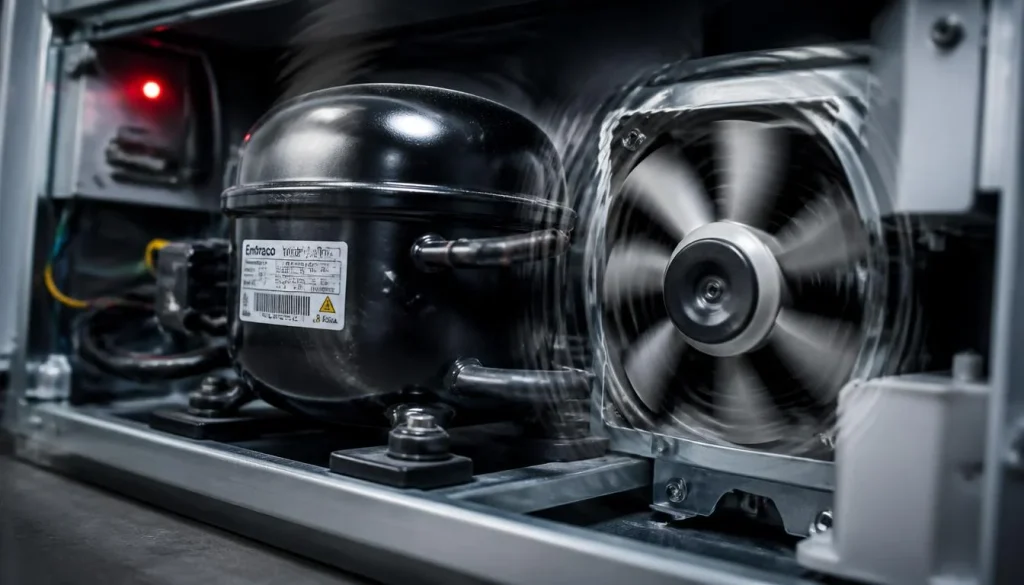
A loud vibration is different from the mild hum that refrigerators normally produce.
If the refrigerator suddenly sounds much louder than it did before, check for a recent change.
Maybe the appliance moved slightly while the floor was cleaned. A bottle could now be touching another bottle. The water line may have shifted against the wall. Frost may have formed near the evaporator fan.
A loud vibrating noise can also come from a worn fan motor, damaged fan blade, loose component, or compressor-related problem.
Start with the external checks first because they are safer and easier.
If the noise remains loud after you level the refrigerator, move it away from surrounding surfaces, rearrange the contents, and check visible water lines, the problem may need deeper inspection.
Why Does My Refrigerator Vibrate When the Compressor Turns On?
If the vibration starts at the same time as the compressor, the compressor itself is only one possible cause.
The compressor creates movement as it starts and operates. That movement can transfer to another part of the refrigerator.
Possible sources include:
- Refrigerator cabinet touching a wall
- Uneven leveling feet
- Loose drain pan
- Rear panel
- Refrigerant tubing
- Water line
- Compressor mounting area
If the vibration is mild and disappears after the compressor stops, it may simply be normal operation.
If it has become much stronger than before, sounds metallic, or is paired with poor cooling, have the compressor area professionally inspected.
Why Does the Vibrating Noise Stop When I Open the Refrigerator Door?
This clue can be especially useful.
Many refrigerators turn one or more internal fans off when a door is opened. If the vibration stops almost immediately when you open the door and returns shortly after you close it, the evaporator fan may be involved.
Frost buildup around the fan housing is one possible cause. A worn motor or damaged fan blade can also create unusual noise.
Check for visible frost around the freezer’s rear interior panel.
Do not remove panels or reach toward a fan while the refrigerator is powered.
If heavy frost keeps returning, the problem may involve the defrost system or another component and should be diagnosed properly.
Why Is My Refrigerator Vibrating After Moving or Cleaning?
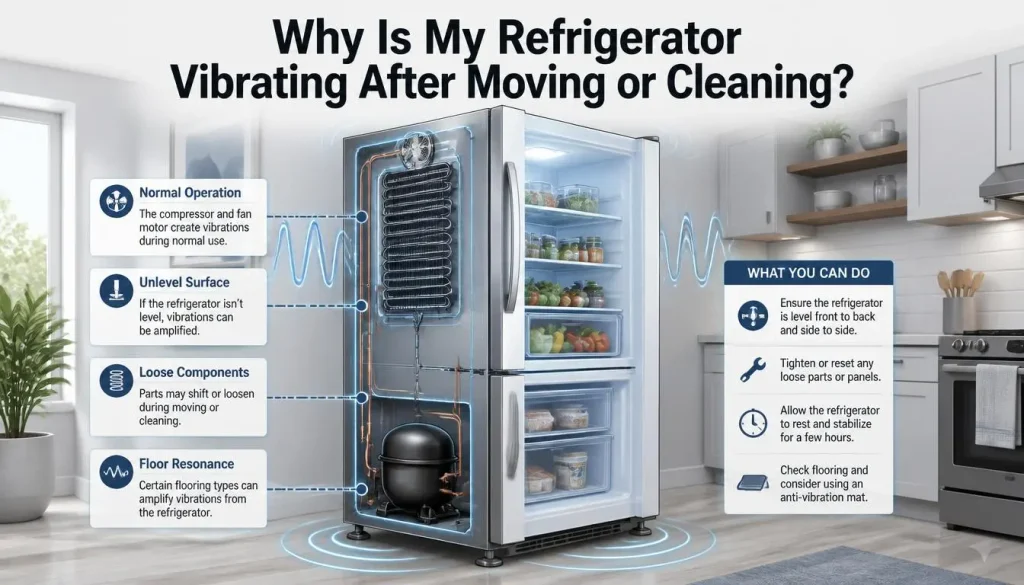
A refrigerator may develop a new vibration after it has been pulled out for cleaning, moved to another room, or installed in a new home.
The appliance may no longer be sitting level.
The water line may now touch the wall. A rear panel or power cord may have shifted. The refrigerator may also have been pushed too close to a cabinet.
Check the installation before looking for a failed part.
Make sure the refrigerator sits firmly, has proper clearance, and has no visible external lines or cords trapped against nearby surfaces.
If the refrigerator was transported, follow the manufacturer’s instructions about positioning and restarting the appliance.
Why Is My New Refrigerator Making a Vibrating Noise?
A new refrigerator may sound different from the appliance you replaced.
Modern refrigerators often use multiple fans, high-efficiency compressors, electronic dampers, automatic ice makers, and variable-speed components.
They may also run longer during the first cooling period after installation.
Some humming and vibration can therefore be normal.
However, a new refrigerator should still be installed correctly.
Check that:
- All shipping materials have been removed.
- The refrigerator is properly leveled.
- It has enough clearance around it.
- The water line is not touching the wall.
- The ice maker is correctly connected or switched off.
- Shelves and bins are installed correctly.
If a new appliance produces severe vibration, grinding, scraping, repeated clicking, poor cooling, or a burning smell, contact the retailer or manufacturer rather than taking the refrigerator apart yourself.
Refrigerator Buzzing and Vibrating at the Same Time
Buzzing and vibration often occur together because several refrigerator parts use motors or valves.
A short buzz may happen when the water inlet valve fills the ice maker. A soft buzz or hum may come from the compressor. Fans can also create buzzing if they are dirty, obstructed, or touching frost.
First identify the location.
A buzz from the freezer points you in a different direction from one coming from the lower rear of the refrigerator.
Also pay attention to timing.
A five-second buzz every few hours is different from constant loud buzzing that lasts throughout the cooling cycle.
Refrigerator Rattling and Vibrating
Rattling usually suggests that vibration is moving something.
Look for loose bottles, shelves, the drain pan, rear panels, water lines, or contact with cabinets and walls.
If the rattling follows the compressor cycle, check parts around the compressor rather than assuming the compressor itself has failed.
A grinding or scraping sound is more concerning than a simple rattle because it may indicate that a fan blade is contacting ice or another object.
How to Stop a Refrigerator From Vibrating
Use a simple process instead of replacing parts at random.
Step 1: Find the location.
Listen carefully to determine whether the vibration comes from the freezer, inside the refrigerator, underneath it, or from the back.
Step 2: Check the refrigerator’s position.
Make sure the appliance is not touching a wall, cabinet, countertop, or another appliance.
Step 3: Test the leveling.
Press gently on each corner. If the refrigerator rocks, adjust the leveling feet according to the owner’s manual.
Step 4: Check items inside.
Separate bottles and jars. Reseat loose shelves, drawers, and bins. Remove items stored on top temporarily.
Step 5: Inspect visible external lines.
Look behind the fridge for a water line or power cord vibrating against a wall or panel.
Step 6: Pay attention to timing.
Does the vibration happen when the compressor starts, when the ice maker fills, or only when the doors are closed?
Step 7: Check accessible fan areas safely.
If your owner’s manual allows access, unplug the refrigerator first and inspect for visible debris or frost.
Step 8: Check cooling performance.
A noisy refrigerator that still maintains normal temperatures is less concerning than one that is becoming warm.
Step 9: Stop if the repair requires sealed-system or electrical work.
Compressor, refrigerant, electrical, and complex fan repairs should be handled by someone qualified to perform them.
Quick Refrigerator Vibration Troubleshooting Table
| What You Notice | Likely Area to Check | First Thing to Do |
|---|---|---|
| Vibration from the back | Compressor, condenser fan, tubing | Check clearance behind refrigerator |
| Vibration from the bottom | Leveling, drain pan, compressor | Check whether refrigerator rocks |
| Vibration inside fridge | Bottles, shelves, bins | Rearrange loose items |
| Vibration from freezer | Evaporator fan or frost | See whether noise stops when door opens |
| Noise starts with compressor | Compressor area or loose components | Check leveling, wall contact, panels and lines |
| Short buzz during ice making | Water valve or ice maker | Check water supply |
| Noise after moving fridge | Leveling or changed clearance | Recheck installation |
| Refrigerator shakes strongly | Leveling or mechanical problem | Stabilize appliance and locate source |
| Buzzing plus poor cooling | Fan, compressor or cooling system | Arrange diagnosis |
| Noise stops when door opens | Internal fan area | Check for frost and fan-related symptoms |
When Should You Worry About a Vibrating Refrigerator?
A mild vibration by itself is usually not an emergency.
You should take the problem more seriously when the vibration is accompanied by another warning sign.
Arrange further inspection if:
- The refrigerator suddenly becomes much louder.
- The entire appliance shakes strongly.
- You hear grinding, scraping, or metallic knocking.
- The refrigerator is no longer cooling properly.
- Food is becoming warmer than normal.
- The freezer is developing unusual frost buildup.
- The compressor repeatedly clicks but does not stay running.
- A fan appears to be striking something.
- The refrigerator has a burning or electrical smell.
- The power cord, plug, or outlet feels unusually hot.
- The vibration continues after basic installation checks.
- The noise is getting progressively worse.
If you smell burning, see smoke, notice damaged wiring, or believe there is an electrical hazard, stop using the appliance and seek qualified help.
Is a Vibrating Refrigerator Dangerous?
Most refrigerator vibration is not dangerous.
Normal compressor and fan operation can create small amounts of vibration throughout the day.
The concern is not simply that the refrigerator vibrates. It is what happens with the vibration.
A refrigerator that gently hums while holding the correct temperature is very different from one that suddenly shakes, smells burnt, repeatedly trips a breaker, or stops cooling.
Use the vibration as a clue rather than a diagnosis.
Can an Unlevel Refrigerator Cause Vibration?
Yes.
An unlevel refrigerator can rock slightly as the compressor and fans run. The cabinet may then transfer that movement to the floor, wall, or surrounding cabinets.
The problem can sound much louder than the actual vibration inside the appliance.
Correct leveling also helps the refrigerator sit securely and can affect how the doors operate.
Always follow the leveling procedure for your specific model rather than assuming every refrigerator adjusts in the same way.
Why Is My Fridge Vibrating but Still Cooling?
If your fridge is vibrating but still cooling normally, start with the simpler causes.
Check the leveling, wall clearance, bottles, shelves, drain pan, water line, and other parts that can transfer normal compressor vibration.
A refrigerator can continue cooling normally even when a fan, panel, or other component has started making noise.
Normal cooling is a positive sign, but it does not mean every new noise should be ignored.
If the vibration becomes stronger, changes sound, or continues getting worse, investigate it before another symptom appears.
Why Does My Refrigerator Make More Vibrating Noise at Night?
Your refrigerator may not actually be louder at night.
Homes are usually quieter, so compressor hums, ice maker cycles, fan sounds, and refrigerant movement become easier to notice.
Ask yourself whether the noise is genuinely new.
If you have heard the same soft vibration for months and the refrigerator cools properly, it is likely part of normal operation.
If the vibration appeared suddenly or has become noticeably louder, check it even if you mainly notice it at night.
How to Prevent Refrigerator Vibrating Noises
You cannot make a refrigerator completely silent, but simple maintenance can prevent many avoidable noises.
Keep the refrigerator properly leveled and give it the clearance required by the manufacturer. Avoid pushing it tightly against a wall or cabinet.
Keep bottles and glass containers from touching each other. Make sure shelves and bins are seated correctly.
Keep accessible condenser areas clean according to your owner’s manual, especially if you have pets that shed hair.
Check the water supply line occasionally to make sure it is not kinked or vibrating against the wall.
Most importantly, learn what your refrigerator normally sounds like. A change in sound is often more useful than the sound itself.
When Should You Call a Refrigerator Repair Technician?
Call a qualified appliance technician when basic checks do not solve the problem or when the vibration appears to involve a part that should not be serviced without proper training.
Professional diagnosis is a good idea if the refrigerator has:
- Persistent fan noise
- Recurring frost around a fan
- Compressor knocking or severe vibration
- Repeated compressor clicking
- Weak or no cooling
- Electrical smells
- Damaged wiring
- A suspected sealed-system problem
- Noise that continues to get louder
Replacing parts based only on the sound can become expensive quickly. Proper diagnosis helps avoid replacing a compressor when the real problem is a loose panel, fan, drain pan, or water line.
Frequently Asked Questions
Why is my refrigerator suddenly making a vibrating noise?
A sudden vibrating noise may come from an uneven refrigerator, wall contact, loose bottles or shelves, a water line, drain pan, fan, or compressor area. Think about what changed recently. If the appliance was moved, cleaned, loaded with food, or developed frost in the freezer, that change may help identify the cause.
Why is my refrigerator making a loud humming and vibrating noise?
A compressor and refrigerator fans can normally hum. If the hum is much louder than before, first check the leveling, wall clearance, condenser fan area, and parts around the compressor. Loud humming combined with poor cooling deserves professional diagnosis.
Why does my refrigerator vibrate when the compressor starts?
The compressor naturally creates some movement when it starts. That movement can make an uneven refrigerator, loose drain pan, tube, rear panel, water line, or nearby cabinet vibrate. A mild vibration may be normal. A new severe vibration should be investigated.
Why does my refrigerator stop vibrating when I open the door?
If the sound stops when the door opens, an internal fan may be responsible because some refrigerator fans stop when a door is opened. Frost around the evaporator fan is one possible cause. A worn fan motor or damaged blade can also produce unusual vibration.
Why is my refrigerator vibrating against the wall?
The appliance may be installed too close to the wall, or a water line, cord, tube, or rear part may be touching it. Pull the refrigerator slightly forward and see whether the sound changes. Follow the manufacturer’s clearance requirements when repositioning it.
Can a refrigerator compressor cause vibration?
Yes. Compressors normally produce some vibration while operating. A smooth, mild vibration can be normal. Strong shaking, metallic knocking, repeated clicking, poor cooling, or a sudden major increase in noise should be checked.
Can a dirty refrigerator fan cause vibration?
Yes. Dirt or debris can interfere with a fan, and frost can interfere with an evaporator fan. A damaged or worn fan motor may also make buzzing, rattling, grinding, or vibrating sounds.
Why is my freezer making a vibrating noise?
A freezer vibration can come from the evaporator fan, ice buildup, ice maker, or stored items touching each other. If the sound stops when the door opens, pay particular attention to the fan area.
Why does my fridge vibrate after I moved it?
The refrigerator may no longer be level, or a water line, power cord, rear panel, or cabinet may now be touching another surface. Recheck the installation before assuming that an internal part failed.
Is it normal for a new refrigerator to vibrate?
Some light vibration can be normal, especially while a new refrigerator is cooling down for the first time. Modern compressors and fans may also sound different from older appliances. Severe shaking, grinding, scraping, repeated clicking, burning smells, or poor cooling are not sounds to ignore.
How do I stop my refrigerator from vibrating?
Start by leveling the refrigerator, creating proper clearance around it, rearranging bottles and shelves, removing objects from the top, and checking visible water lines. Then determine whether the vibration comes from a fan, compressor, ice maker, or another component.
Final Thoughts
If you are asking, “Why is my refrigerator making a vibrating noise?”, do not start by assuming the compressor has failed.
Begin with the simple things.
Check whether the refrigerator is level. Make sure it is not touching the wall. Separate bottles and containers. Check the water line and listen for where the vibration begins.
Then pay attention to timing.
A noise that appears when the compressor starts points toward a different group of causes than a vibration that stops when you open the freezer door. A short buzz during ice maker filling is also different from a constant grinding vibration.
Most mild refrigerator vibrations have a straightforward explanation. What matters most is identifying the location, timing, and other symptoms before deciding what to repair.
If the refrigerator is still cooling properly and the vibration is mild, start with the basic checks. If the noise becomes severe, cooling drops, electrical symptoms appear, or the problem involves the compressor or sealed cooling system, contact a qualified refrigerator repair technician.

Hi, I’m the lead researcher and appliance enthusiast behind RefrigeratorSolve. With years of hands-on experience troubleshooting cooling systems and testing home appliances, I am dedicated to bringing you honest reviews, energy-saving tips, and practical solutions to keep your refrigerator running perfectly.