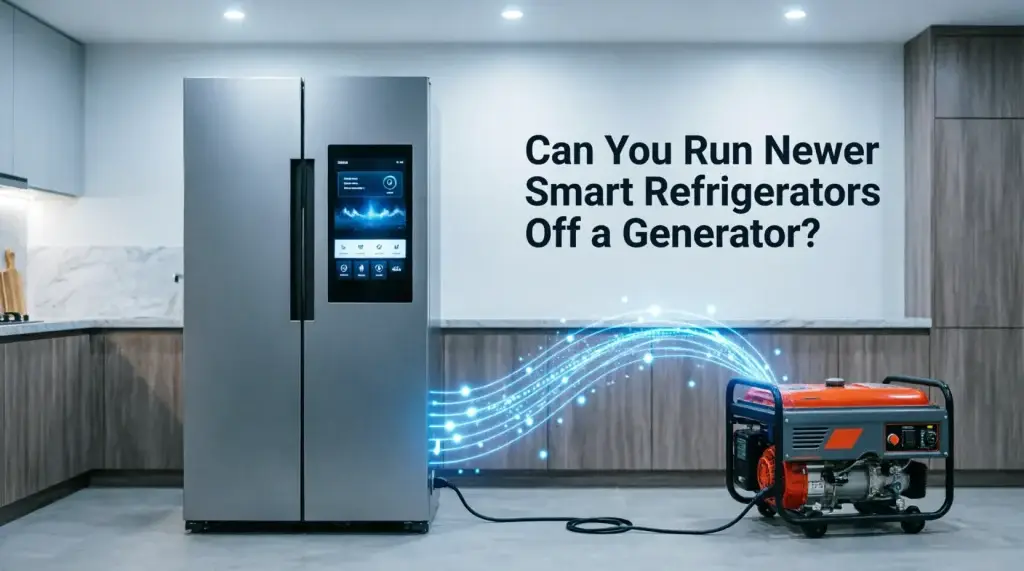
Yes, you can run most newer smart refrigerators off a generator. The key is matching your fridge’s starting wattage (surge power) and running wattage to the generator’s output, while ensuring you use a generator with pure sine wave technology to protect sensitive electronic components.
The power goes out. You panic about the $300 worth of groceries sitting in your smart fridge. Then you remember that generator in the garage. But now you’re wondering: Will plugging my expensive, Wi-Fi-connected refrigerator into a generator fry its circuit boards?
I’ve helped hundreds of homeowners navigate backup power for their appliances, and this question comes up constantly. Smart refrigerators aren’t your grandma’s icebox. They have sensitive electronics, digital displays, and compressors that need clean, stable power.
Here’s the good news: You absolutely can run your smart fridge on a generator. But you need to know three specific things first. I’ll walk you through exactly what you need, step by step.
Pain Points & Solutions
Problem 1: “I Have No Idea How Much Power My Fridge Needs”
Most people look at their fridge and see… a fridge. They don’t see a machine that needs a sudden burst of power every time the compressor kicks on.
Why this happens: Refrigerators have two power numbers. The running wattage keeps things cool once the compressor is going. The starting wattage (or surge) is 2–3 times higher and lasts only a second when the compressor fires up . Smart fridges also have control boards that sip power constantly.
The solution: Find your fridge’s label. Open the fresh food compartment and look on the inside left wall . You’ll see volts and amps. Here’s the simple math:
- Running watts = Volts × Amps (running)
- Starting watts = Running watts × 2.5 (estimate)
Most full-size refrigerators need 100–400 running watts and 1,200–2,400 starting watts . Mini fridges are much smaller—around 70–90 running watts.
Problem 2: “I’m Afraid My Generator Will Destroy the Electronics”
This fear is justified. Cheap generators can deliver “dirty power” with voltage fluctuations that damage sensitive smart fridge components.
Why this happens: Traditional generators don’t regulate power perfectly. The fluctuations are fine for old appliances but can fry circuit boards, Wi-Fi modules, and digital displays.
The solution: You need a generator with pure sine wave output . This delivers power that’s just as clean as what you get from your wall outlet. Here are your options:
- Buy a generator with a built-in inverter
- Attach an external inverter to a conventional generator
- Use a UPS (Uninterruptible Power Supply) between the generator and fridge
Pro Tip: Look for “pure sine wave” on the box. If it just says “modified sine wave,” keep looking—that’s the dirty power that causes problems.
Problem 3: “The Generator Keeps Tripping When My Fridge Starts”
You plug everything in. It runs for five minutes. Then the compressor tries to start and click—the generator shuts down.
Why this happens: Your generator’s surge rating isn’t high enough to handle the fridge’s startup draw. Generator companies love advertising the bigger surge number, but you need to pay attention to both ratings .
The solution: Check your generator’s specs for both numbers:
- Starting watts (surge) – Must exceed your fridge’s starting wattage
- Running watts – Must exceed your fridge’s running wattage
For a typical fridge needing 1,800 starting watts, you want a generator rated for at least 2,000 starting watts and 500+ running watts. If you’re also powering lights or a phone charger, add those to the running total .
How to Find Your Fridge’s Exact Power Numbers
Before you buy or borrow a generator, do this 5-minute check:
Step 1: Locate the specification label inside your fridge. It usually looks like a small sticker.
Step 2: Note the voltage (in the US/Canada, it’s 120V) . Note the amperage—look for “Amps” or “A.”
Step 3: Calculate running watts. Multiply volts × amps. Example: 120V × 3.5A = 420 running watts.
Step 4: Estimate starting watts. Multiply running watts × 2.5. Example: 420 × 2.5 = 1,050 starting watts.
Step 5: Add 20% for safety. Newer fridges can have slightly higher surges. So 1,050 × 1.2 = 1,260 watts needed.
| Appliance Type | Typical Running Watts | Typical Starting Watts | Generator Needed |
|---|---|---|---|
| Mini / Compact Fridge | 70–100 | 280–400 | 500W+ surge |
| Standard Full-Size Fridge (newer) | 100–400 | 1,200–2,000 | 2,000W+ surge |
| Older Full-Size Fridge | 400–800 | 2,000–2,400 | 2,500W+ surge |
| Deep Freezer (chest) | 300–700 | 900–2,100 | 2,000W+ surge |
Data source: NB Power and EcoFlow
What Size Generator Do You Actually Need?
Let’s say you have a newer Samsung or LG smart fridge. It uses about 200 running watts and 1,600 starting watts .
The simple answer: A generator rated for 2,000 starting watts and 1,000 running watts will run just your fridge easily.
But here’s where people mess up: They want to run the fridge plus lights, a TV, phone chargers, and maybe a space heater. All those add to the running watt total. A space heater alone can pull 1,500 watts .
Pro Tip: Start your fridge first, let it run for 30 seconds, then plug in other devices one at a time. This prevents the generator from getting hit with multiple startup surges at once .
The “Pure Sine Wave” Rule Is Non-Negotiable for Smart Fridges
I can’t say this strongly enough: Do not plug a smart refrigerator into a generator that doesn’t have pure sine wave output.
Smart fridges have:
- Digital control boards
- Touch screens on some models
- Wi-Fi and Bluetooth modules
- Variable speed compressors (inverter fridges)
All of these expect clean, stable power. Modified sine wave or “dirty” generator power can cause:
- Glitching displays
- Compressor failure over time
- Fried control boards (expensive repair)
Many newer power stations and solar generators automatically include pure sine wave inverters . If you’re buying a gas generator, look for the word “inverter” in the model name—those are the clean power units.
Fuel Generators vs. Solar Generators vs. Battery Power Stations
You have three real options for backup power. Here’s how they compare:
| Feature | Gas/Propane Inverter Generator | Solar Generator (Power Station) | Conventional Gas Generator |
|---|---|---|---|
| Power quality | Pure sine wave (inverter models) | Pure sine wave | Modified or dirty |
| Safe for smart fridge | Yes (inverter type only) | Yes | No |
| Runtime | As long as you have fuel | Limited (4–18 hours) | As long as you have fuel |
| Noise | Moderate | Silent | Loud |
| Maintenance | Oil, fuel, spark plugs | None | Oil, fuel, spark plugs |
| Best for | Long outages (days) | Short outages (hours) | Older appliances only |
A 3000Wh power station can run a typical fridge for about 12–15 hours in real-world conditions . A 5,000W gas generator with a full tank can run your fridge for 8–12 hours, longer if you refuel.
Pro Tip: If you live in an area with frequent short outages (1–8 hours), a solar generator is quiet, easy, and safe. If you face multi-day outages from storms, a gas inverter generator gives you unlimited runtime with extra fuel cans.
Real-World Quotes from the Experts
“Starting watts indicate the maximum number of watts available to cover that surge. For example, a refrigerator may only need around 400 watts to run continuously, but it will quickly draw two to three times more power (up to 1,200 watts) when its compressor starts up.”
— David Dritsas, Reviews Editor at Popular Mechanics
“Pure sine wave inverter output is critical for compressor-driven appliances, because a modified sine wave can cause motor inefficiency or damage.”
— EcoFlow Technical Team, Solar Generator Manufacturer
“Some generators do not have a power regulator, which means power may not be consistently delivered to the unit. This ‘dirty’ power can damage your fridge.”
— Samsung Support, Official Appliance Manufacturer
Safety First: Generator Placement
Here’s a warning I give every client: Never run a gas or propane generator inside your home, garage, basement, or near open windows.
Carbon monoxide poisoning kills hundreds of people each year from improper generator use. The official recommendation from manufacturers and safety agencies is to keep generators at least 15 feet away from your home .
For more information on safe generator installation and electrical requirements, the Electrical Safety Office provides comprehensive guidelines for connecting portable generators to household appliances .
Frequently Asked Questions
Will a 2000-watt generator run a smart refrigerator?
Yes, a 2000-watt generator with pure sine wave output will run most newer smart refrigerators. Check your fridge’s starting wattage first—most need 1,200–1,800 starting watts, which fits within 2000. Just don’t plug in anything else at the same time .
Do I need a special generator for an inverter refrigerator?
Yes, inverter refrigerators (which have variable speed compressors) are even more sensitive to power quality. You absolutely need a pure sine wave generator. Most standard non-inverter generators will cause problems for these energy-saving models.
Can I plug my smart fridge into any generator?
No. Only plug into generators that specifically say “pure sine wave” or “inverter generator.” Conventional generators deliver dirty power that can damage smart fridge electronics .
How long will a generator run a refrigerator on a tank of gas?
A standard 5,000-watt inverter generator running only a fridge (200–400 watts) will typically run 8–12 hours on a full tank. Running at partial load extends runtime. Always turn the generator off to cool down and check oil according to the manual.
Will a power outage reset my smart fridge settings?
Most smart fridges have short-term memory backup, but extended power loss may require reconnecting Wi-Fi and resetting the clock. The food safety is what matters—keep the fridge at or below 40°F (4°C). A generator running 8 hours on, 4 hours off is usually fine since fridges hold cold well when closed.
Conclusion
Here’s what you need to remember:
- Check your fridge’s numbers – Find the label and calculate both running and starting watts before buying a generator.
- Buy pure sine wave – Whether it’s an inverter gas generator or a solar power station, clean power protects your smart fridge’s expensive electronics.
- Size up slightly – A 2,000–3,000 watt generator gives you room for the startup surge plus maybe a light or phone charger.
You’ve got this. Being prepared for a power outage doesn’t have to be complicated or expensive. Start by finding that label inside your fridge right now—it takes two minutes and tells you everything you need to know.
Have you run your fridge on a generator before, or are you shopping for your first backup power setup? Drop a comment below—I’d love to hear what’s working for you.

Hi, I’m the lead researcher and appliance enthusiast behind RefrigeratorSolve. With years of hands-on experience troubleshooting cooling systems and testing home appliances, I am dedicated to bringing you honest reviews, energy-saving tips, and practical solutions to keep your refrigerator running perfectly.