
Switching from smart fridge to normal fridge means moving from a feature-heavy, internet-connected appliance to a simpler, mechanical refrigerator focused mainly on cooling performance and reliability. In many cases, I’ve found that switching makes sense when repair costs rise, software support ends, or smart features no longer add real value to daily life.
A few years ago, I loved the idea of owning a smart refrigerator.
Touchscreen display.
WiFi connection.
App alerts.
Voice assistant integration.
Internal cameras.
It felt modern and convenient.
But over time, I started asking myself a serious question:
Is all this technology actually helping me or adding stress?
If you’re considering switching from smart fridge to normal fridge, you’re probably dealing with one or more of these issues:
- Frequent error codes
- App connection failures
- Expensive repair costs
- Software support ending
- Rising maintenance costs
- Concerns about long-term reliability
Let me walk you through everything I’ve learned, especially for homeowners in the USA, UK, London, Canada, and Australia.
Why People Consider Switching
From what I’ve seen, people rarely switch for no reason. There’s usually frustration behind the decision.
Here are the most common customer pain points.
1. Repair Costs Keep Increasing
Smart refrigerators contain:
- Control boards
- WiFi modules
- Touchscreen display panels
- Firmware-based systems
- Sensors and smart diagnostics
When these fail, repair cost can climb quickly.
If you’re curious about actual maintenance numbers, this breakdown explains long-term expenses clearly: smart-refrigerator-maintenance-cost
In many cases, a single control board replacement costs as much as half the price of a new normal refrigerator.
That’s when people start rethinking their choice.
2. Software Problems Are Constant
I’ve spoken with many homeowners who say:
“The fridge cools fine, but the smart features keep breaking.”
Common software-related issues include:
- App not connecting
- Touchscreen freezing
- Voice assistant failure
- Firmware update glitches
- Notification errors
If you’re already noticing deeper problems, this guide may help: smart-fridge-repair-problems
After repeated resets and technician visits, frustration builds.
3. Signs the Smart Fridge Is Dying
Sometimes switching isn’t about preference it’s about decline.
If your fridge shows:
- Loud compressor noise
- Inconsistent cooling
- Water leaks
- Error codes returning frequently
You may already be seeing serious warning signs.
Here’s a detailed list to compare your situation: 15-clear-signs-your-smart-fridge-is-dying
If multiple symptoms exist, replacing it with a simpler model may provide peace of mind.
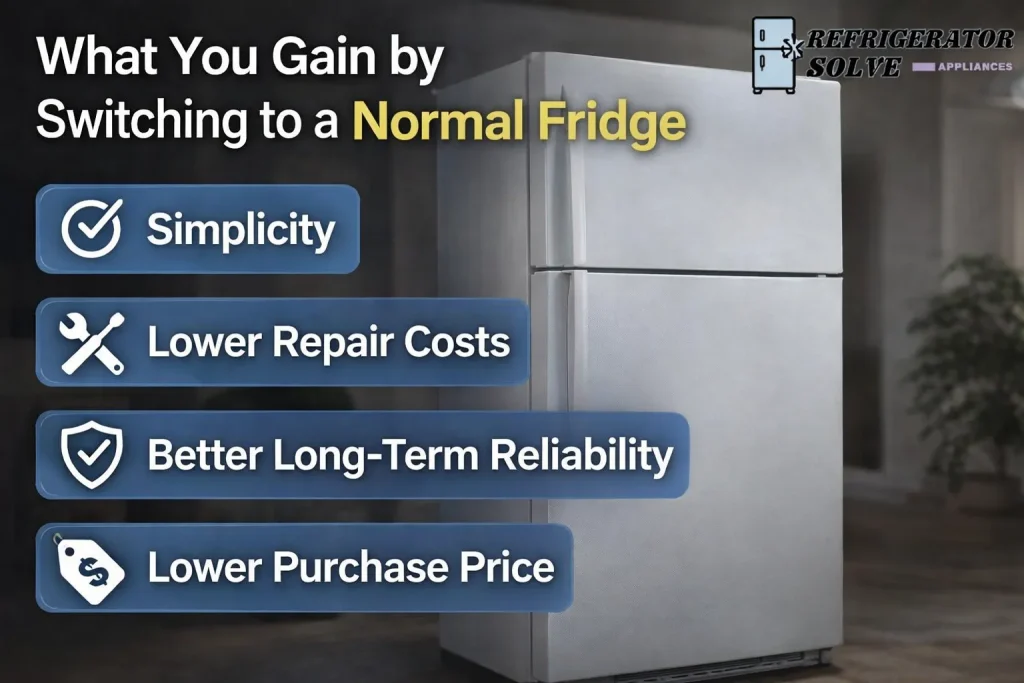
What You Gain by Switching to a Normal Fridge
Now let’s talk about benefits.
When I switched from a smart fridge to a standard refrigerator, here’s what I noticed immediately.
1. Simplicity
A normal refrigerator focuses on:
- Cooling system
- Temperature control
- Insulation
- Compressor efficiency
No cloud service.
No firmware updates.
No WiFi drops.
That simplicity reduces stress.
Consumer expert Clark Howard once said:
“The simpler a product is, the fewer ways it can break.”
That idea stuck with me.
2. Lower Repair Costs
Standard refrigerators typically cost less to repair because:
- Parts are widely available
- No proprietary touchscreen panels
- No complex software integration
Spare parts for traditional units are easier to source in the USA, UK, Canada, and Australia.
That matters when labor cost is high — especially in London or major Australian cities.
3. Better Long-Term Reliability
Smart appliances combine hardware lifespan with software lifespan.
Traditional refrigerators depend mainly on mechanical components.
Without software support dependency, long-term usability improves.
Technology reviewer Marques Brownlee once noted:
“Longevity depends heavily on support.”
If there’s no software layer, there’s no software support risk.
4. Lower Purchase Price
A new smart fridge can cost:
- $1,800–$4,000+ in USA
- £1,500–£3,500 in UK
- $2,000–$4,500 in Canada
- $2,500–$5,000 in Australia
A high-quality normal refrigerator often costs significantly less.
That difference can be invested elsewhere in your home.
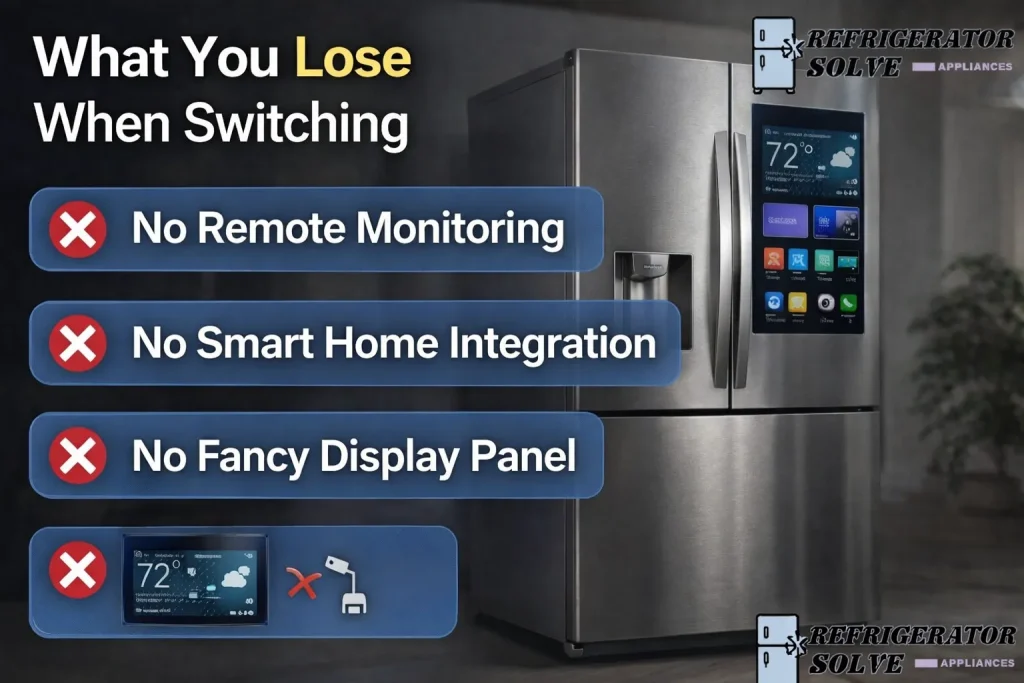
What You Lose When Switching
Let’s be honest.
There are trade-offs.
1. No Remote Monitoring
You won’t be able to:
- Check temperature from your phone
- View internal cameras
- Get door-open alerts
For some families, this matters.
For others, it doesn’t.
2. No Smart Home Integration
If your fridge connects with Alexa or Google Assistant, that convenience disappears.
But I’ve found most people rarely use voice commands for their refrigerator long-term.
3. No Fancy Display Panel
You lose:
- Digital family calendar
- Recipe display
- Grocery inventory system
Ask yourself honestly:
Did you use those features weekly or occasionally?
Cost Comparison: Smart vs Normal Fridge
Here’s how I compare financially.
Smart Fridge
- Higher initial cost
- Higher repair cost
- Software support risk
- Potential firmware issues
Normal Fridge
- Lower purchase price
- Lower maintenance cost
- Fewer electronic failure points
- Stable cooling system
If repair cost exceeds 40–50% of replacement cost, switching often makes financial sense.
For energy efficiency comparison standards in North America and UK, visit: energystar.gov
Energy Star certified normal refrigerators can match smart units in energy savings.
Emotional Side of Switching
I understand something important:
Switching feels like stepping backward.
You might think:
- “Am I giving up modern convenience?”
- “Will I regret losing smart features?”
- “Did I waste money on my old fridge?”
Investor Warren Buffett once said:
“Price is what you pay. Value is what you get.”
If the smart features no longer provide value, switching is not a downgrade it’s a practical adjustment.
When I Recommend Switching
I personally recommend switching from smart fridge to normal fridge if:
- Repair costs are frequent and expensive
- Software support has ended
- Touchscreen failures keep returning
- Fridge is over 8–10 years old
- You rarely use smart features
- Energy efficiency is outdated
If cooling performance is stable and you love smart features, keeping your current unit might still make sense.
USA, UK, Canada, Australia Considerations
USA
Repair services are widely available but electronic repairs are costly.
UK & London
Labor rates are high. Replacement may be cheaper long term.
Canada
Cold climate increases compressor stress. Reliability matters.
Australia
Parts shipping delays sometimes affect smart models.
Regional repair cost and spare parts availability play a major role in decision-making.
Real Customer Pain Points (Solved Clearly)
“I’m tired of app glitches.”
Switching removes software dependence entirely.
“Repair costs keep coming.”
Traditional models are cheaper to maintain.
“I worry about food safety.”
Focus on a high-quality compressor and temperature stability.
“I don’t trust software updates anymore.”
A normal fridge eliminates firmware risk.
Frequently Asked Questions
Is switching from smart fridge to normal fridge a downgrade?
Not necessarily. It depends on whether smart features truly improve your daily life.
Are normal refrigerators more reliable?
Generally yes, because they have fewer electronic components.
Do normal fridges save electricity?
Modern Energy Star models can match or exceed smart fridge efficiency.
Will I miss smart features?
Only if you actively use them regularly.
Is resale value affected?
Smart appliances depreciate faster when software support ends.
My Personal Decision Framework
When deciding, I evaluate:
- Appliance age
- Repair cost vs replacement cost
- Frequency of issues
- Software stability
- Energy efficiency
- Parts availability
- Daily usage habits
If stress outweighs benefit, I switch.
If value still exists, I repair.
Final Thoughts: Switching From Smart Fridge to Normal Fridge
Switching from smart fridge to normal fridge is often about reliability, simplicity, and financial sense rather than technology preference. If your smart appliance causes repeated repair costs, software frustration, or declining performance, moving to a standard refrigerator can restore stability and reduce long-term expense.
I’ve learned that appliances should support daily life not complicate it.
If you’re weighing this decision right now, step back and ask yourself:
- Does the smart functionality still serve me?
- Is repair cost reasonable?
- Will I feel more secure with a simpler appliance?
There’s no universal answer. But there is a practical one the choice that gives you dependable cooling, predictable costs, and peace of mind.
And for many households across the USA, UK, Canada, and Australia, that answer is often simplicity.

Hi, I’m the lead researcher and appliance enthusiast behind RefrigeratorSolve. With years of hands-on experience troubleshooting cooling systems and testing home appliances, I am dedicated to bringing you honest reviews, energy-saving tips, and practical solutions to keep your refrigerator running perfectly.