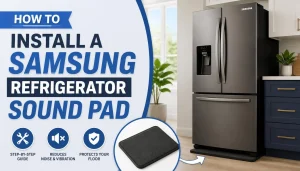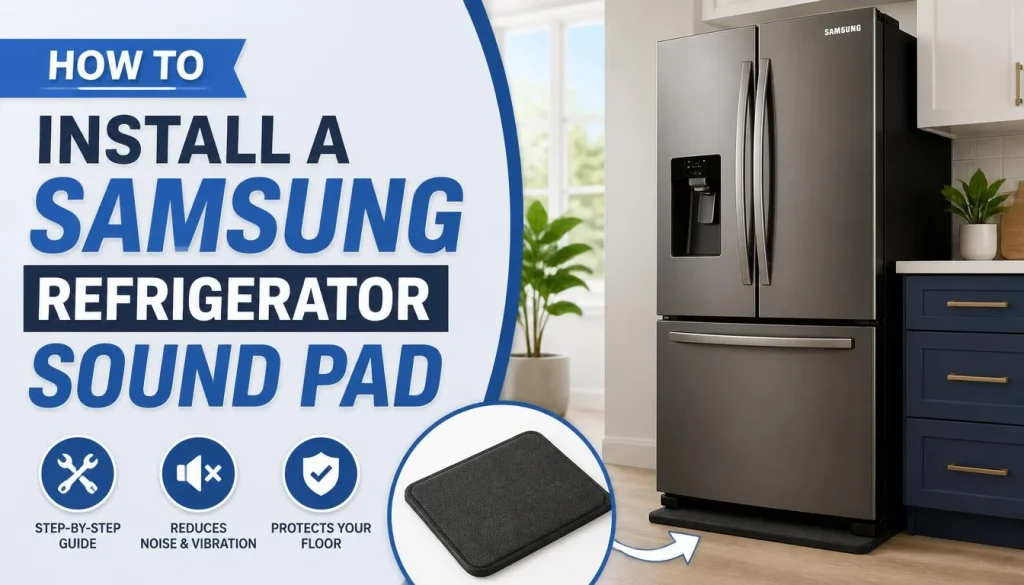
A Samsung refrigerator sound pad may help reduce certain types of noise, but the correct installation method depends on the pad and your refrigerator model. Before installing anything, identify whether you need a replacement insulation pad inside the appliance or an anti-vibration pad beneath its feet.
The safest approach is to check your Samsung model number, confirm the correct replacement part, and follow the manufacturer’s instructions. Adding foam in the wrong place can block ventilation, interfere with components, or make a noisy refrigerator harder to repair.
What Is a Samsung Refrigerator Sound Pad?
A refrigerator sound pad is a material designed to absorb sound or reduce vibration. However, the term can refer to several different products, and they are not interchangeable.
1. Factory-Installed Sound Insulation Pad
Some refrigerators use specially shaped insulation or acoustic materials in designated areas. These materials are designed for the appliance’s construction and may be positioned near specific components or cabinet panels.
If your original pad is damaged, missing, or loose, you may need a compatible replacement. Its location and installation method must be confirmed using your refrigerator’s model-specific documentation.
2. Replacement Sound-Dampening Pad
A replacement sound-dampening pad is intended to replace a particular component or insulation piece. It may use clips, fasteners, or another model-specific attachment method.
Do not assume that a generic foam sheet will work as a replacement. The material, thickness, shape, and location all matter.
3. Anti-Vibration Pads
Anti-vibration pads are placed beneath approved contact points or feet to reduce vibrations transmitted to the floor. They can be useful when a refrigerator produces a rattling sound because of an uneven surface or vibration against nearby cabinets.
These pads do not replace internal sound insulation and cannot repair a faulty fan, compressor, or other mechanical component.
If you want to reduce general refrigerator noise without opening the appliance, read this guide to how to noise insulate a refrigerator safely.
How to Find the Correct Sound Pad for Your Samsung Refrigerator
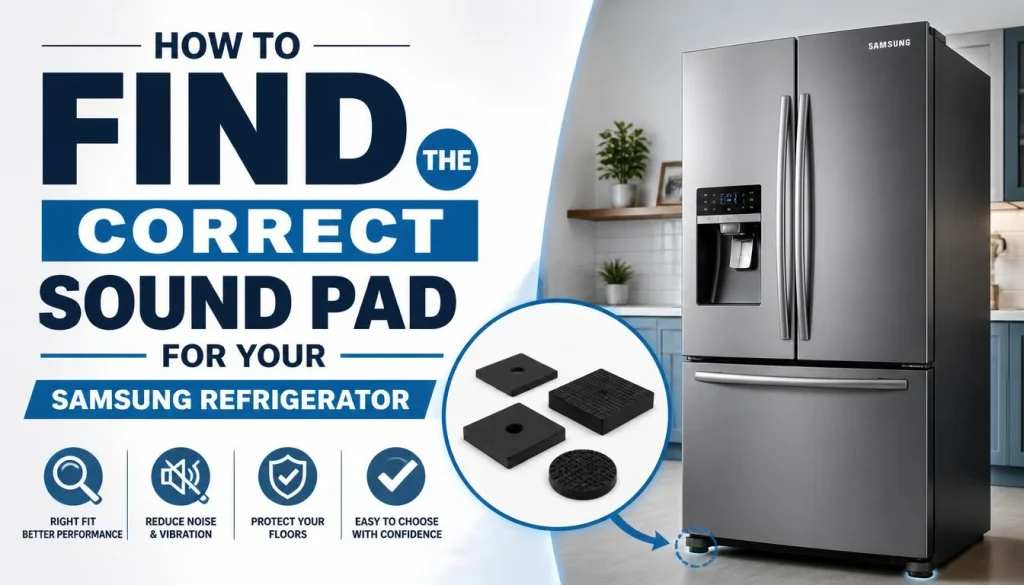
Before purchasing a replacement, identify the exact refrigerator model. This step helps prevent ordering a part that looks similar but does not fit your appliance.
Find Your Samsung Refrigerator Model Number
Look for the model label on your refrigerator. Its location varies by model, but it is often inside the refrigerator compartment, on a side wall, or near the door area.
Write down the complete model code, including any letters and numbers after the main model designation.
Avoid ordering a part based only on the refrigerator’s appearance or the words “Samsung sound pad.”
Check the Part Number and Compatibility
Use the model code to find your refrigerator’s documentation and available replacement parts. Samsung provides a manuals and software search page where you can search using a product name or model code.
Before ordering, check:
- Whether the part is listed for your exact model.
- Whether the item is an internal sound-insulation component or an external anti-vibration pad.
- Whether the manufacturer specifies particular fasteners, clips, or installation instructions.
- Whether the part is intended for consumer installation or professional service.
If you cannot confirm the part number or installation location, contact Samsung Support or an authorized appliance technician.
Tools and Safety Precautions Before Installation
The tools you need depend on the type of sound pad. An external anti-vibration pad may require no assembly, while an internal replacement component may require specialized tools and access to the appliance’s service area.
For a basic inspection, you may need a flashlight, a tape measure, a clean cloth, and the correct refrigerator manual. A screwdriver or other tool should be used only when the manufacturer specifies it.
Follow these precautions before beginning:
- Read the installation instructions for your exact model.
- Unplug the refrigerator before any work that requires access to internal electrical or mechanical components, provided the service procedure permits it.
- Protect the floor and avoid pulling or twisting the power cord and water line.
- Never work on an unstable refrigerator or attempt to lift it alone.
- Do not remove sealed-system components, electrical covers, or internal panels unless the model-specific instructions authorize the work and you are qualified to do it.
If the work requires moving a heavy refrigerator or accessing the compressor area, professional assistance is the safer option.
How to Install a Samsung Refrigerator Sound Pad Step by Step
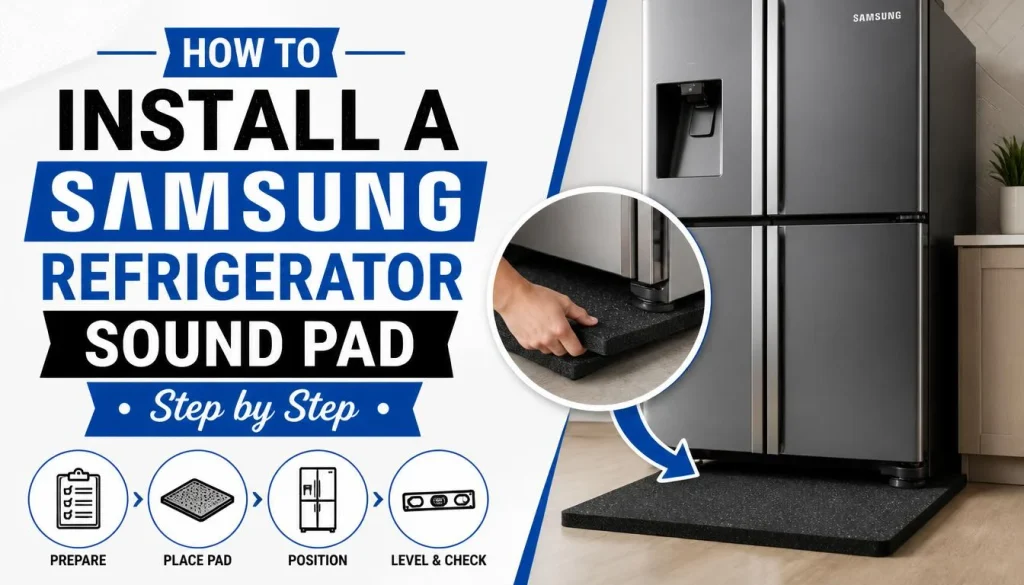
There is no single sound-pad installation procedure for every Samsung refrigerator. The following steps explain how to approach the job safely without assuming that every model uses the same pad, mounting point, or fasteners.
Step 1: Identify the Type of Sound Pad
First, determine which component you are installing.
If you have a replacement factory insulation pad, confirm its location and part number using the model-specific parts documentation or service instructions.
If you have anti-vibration pads designed for the refrigerator’s feet, follow the separate installation guidance in the next section.
Do not begin removing panels until you know which type of component you are dealing with.
Step 2: Prepare the Refrigerator
Move loose items away from the work area and make sure you have enough room to inspect the appliance safely.
For internal component replacement, follow the manufacturer’s shutdown and disconnection instructions. Disconnect the power when required, and shut off the water supply if the procedure involves a connected water line.
For an external inspection, avoid moving the refrigerator unless necessary. If it must be moved, use an appropriate appliance-moving method and protect the floor, plug, and water connections.
Step 3: Locate the Approved Installation Area
Use the installation diagram or service instructions to identify the exact location of the replacement pad.
Do not guess based on where the noise seems loudest. Sound can travel through the cabinet, floor, and nearby furniture, so the apparent source may not be the actual source.
If the pad is fitted behind a cabinet panel or near the compressor, fan, wiring, or refrigerant tubing, stop if the instructions do not clearly authorize homeowner access.
Step 4: Remove the Old Pad, If Applicable
Remove an existing pad only when the model-specific procedure describes how to access it.
Use the specified method for releasing clips or removing fasteners. Do not pull hard on a pad that appears stuck, cut away surrounding insulation, or force a panel open.
If the existing material is attached to wiring, tubing, or another component, leave it in place until a qualified technician can inspect it.
Step 5: Fit the Replacement Pad
Compare the replacement with the original component. Check its shape, dimensions, attachment points, and part number before fitting it.
Install it in the designated position and secure it using the manufacturer’s specified fasteners or attachment method.
Do not improvise with household glue, adhesive tape, expanding foam, or extra insulation. These materials may not tolerate the location’s temperature or operating conditions.
If the replacement does not fit without bending, cutting, or forcing it, stop and recheck compatibility.
Step 6: Reinstall Covers and Check Clearances
If the approved procedure requires removing an exterior cover, reinstall it exactly as instructed. Make sure all required fasteners are secure and no wires or tubes are trapped.
Check that the work has not blocked ventilation openings or created contact between moving parts and the new material.
Never wrap the compressor or cover a fan, motor, or ventilation passage with generic soundproofing foam.
Step 7: Restore Power and Test the Refrigerator
Once the work area is clear and any required covers have been secured, restore power according to the manufacturer’s instructions.
Listen for changes during normal operation. Check for new rattling, scraping, or vibration, and confirm that the refrigerator continues cooling normally.
If the refrigerator develops an unusual noise, stops cooling properly, or shows another warning sign, stop testing and seek qualified assistance.
How to Install Anti-Vibration Pads Under a Samsung Refrigerator
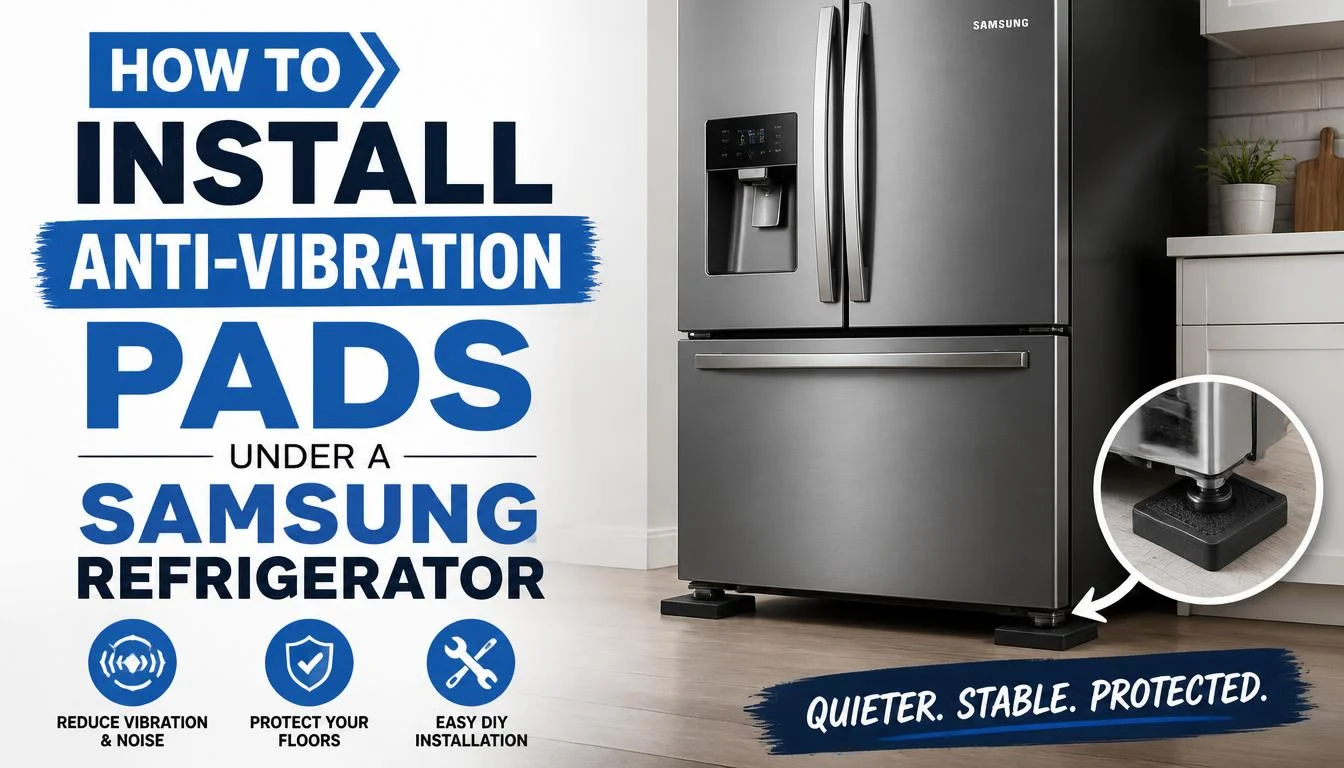
If your main concern is vibration travelling through the floor, anti-vibration pads may be a more suitable solution than replacing internal insulation.
The correct procedure depends on the pad design and your refrigerator’s feet, wheels, weight, and installation requirements.
Step 1: Choose Compatible Pads
Select pads explicitly rated for the refrigerator’s weight and intended use. Check their dimensions, load capacity, and compatibility with the floor surface.
Avoid soft or unstable materials that could allow the appliance to rock or shift.
Step 2: Check the Refrigerator’s Position
Look for obvious signs that the refrigerator is uneven or touching a wall or cabinet. Confirm that it has the clearances specified in its manual.
Samsung explains why correct positioning matters in its guide to leveling a Samsung refrigerator.
An incorrectly positioned refrigerator may vibrate even when no additional sound insulation is needed.
Step 3: Position the Pads Safely
Follow the anti-vibration pad manufacturer’s instructions for placement.
Do not tilt a heavy refrigerator onto an unsupported edge or try to lift it while placing pads underneath. Use suitable appliance-moving equipment and assistance from qualified personnel when required.
Never place pads beneath arbitrary points on the cabinet or use them in a way that prevents the refrigerator from standing securely.
Step 4: Recheck Stability
After installation, confirm that the refrigerator is stable, correctly leveled, and not rocking when the doors are opened or closed.
Check door operation and make sure the appliance has the required ventilation clearance.
If the pads make the refrigerator unstable or interfere with leveling, remove them using a safe procedure and choose a suitable alternative.
Common Sound Pad Installation Mistakes to Avoid
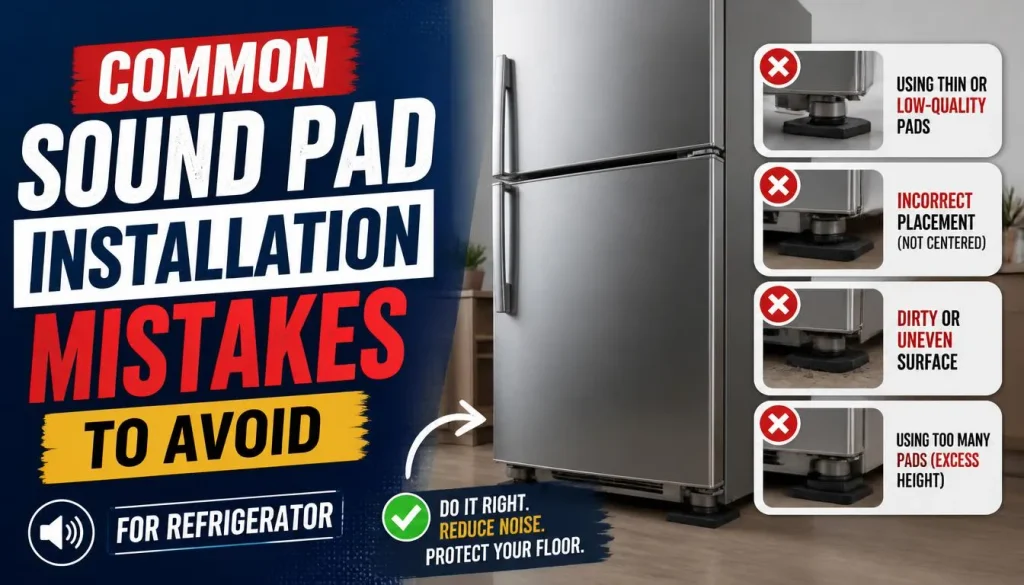
A sound pad should reduce an identified noise problem without interfering with normal refrigerator operation.
Blocking Ventilation Openings
Refrigerators need adequate airflow around designated vents and heat-dissipation areas. Covering these spaces can interfere with proper operation.
Always preserve the clearances specified in the user manual.
Using the Wrong Foam
Household upholstery foam, carpet padding, and general-purpose soundproofing materials are not automatically suitable for refrigerators.
Their thickness, heat resistance, moisture resistance, attachment method, and fire characteristics may differ from those of the specified component.
Use only materials approved for the intended location and application.
Covering the Compressor or Fan
Do not wrap the compressor in foam or place insulation against a moving fan. Doing so may interfere with heat dissipation or mechanical operation.
If you suspect that the compressor or fan needs an insulation component, confirm the correct replacement and installation instructions first.
Ignoring the Actual Source of the Noise
A sound pad will not fix every noise. Loose panels, uneven leveling, vibrating containers, an ice-maker issue, or a failing fan may be responsible.
Installing additional material before identifying the cause can waste money and make the original problem more difficult to diagnose.
Ignoring Warranty and Service Requirements
Before opening an appliance or replacing an internal component, check the applicable warranty terms and service requirements. Unauthorized work may affect coverage, depending on the circumstances.
If the work is not covered by a consumer self-repair procedure, consider an authorized technician.
How to Tell Whether the Sound Pad Is Working
Once the installation is complete, compare the refrigerator’s noise before and after the change.
Use the same listening position and pay attention during similar operating conditions. A phone recording can help you compare sounds, although it is not a reliable substitute for calibrated noise measurement.
Check for the following:
- Reduced vibration from the floor or nearby cabinets.
- Less rattling at the specific location addressed by the pad.
- No new scraping, clicking, or contact noise.
- Normal cooling and airflow.
- Stable positioning and normal door operation.
Do not expect a sound pad to make a refrigerator completely silent. Compressors, fans, refrigerant flow, and defrost cycles can all produce normal operating sounds.
If you still hear persistent buzzing, read this guide to Samsung refrigerator buzzing noise to help identify other possible causes.
What If Your Samsung Refrigerator Is Still Noisy?
If the sound does not improve after the installation, investigate the noise itself rather than adding more insulation.
Check Leveling and Surrounding Clearance
Make sure the refrigerator stands securely on a suitable surface and does not touch nearby cabinets or walls in a way that causes vibration.
Check the manufacturer’s clearance requirements. Do not assume that moving the refrigerator closer to a wall or adding thicker padding will solve the problem.
Check for Loose Items
Glass containers, shelves, accessories, and items stored on top of or beside the refrigerator can vibrate during operation.
Move loose objects away and check whether the noise changes.
Consider Fan or Compressor Noise
A loud whirring, grinding, or buzzing sound may have nothing to do with the sound pad.
Read how to fix fan noise in a Samsung refrigerator if the noise appears to come from a cooling fan. If the main symptom is a persistent hum, this guide to Samsung refrigerator humming constantly provides further troubleshooting information.
A steady hum can be normal, but an unusually loud sound, a new grinding noise, or a noise accompanied by cooling problems deserves further attention. Samsung’s official refrigerator noise guidance explains several common operating sounds and when service may be needed.
Contact Samsung Support or an appropriately qualified appliance technician if the source remains unclear.
Frequently Asked Questions
Can I Install a Samsung Refrigerator Sound Pad Myself?
It depends on the component. An external anti-vibration pad may be suitable for a careful DIY installation when the pad is compatible and the refrigerator can be handled safely. An internal insulation component may require model-specific access or professional service.
Always check the instructions before beginning.
Where Does the Sound Pad Go on a Samsung Refrigerator?
There is no universal location. A factory-installed insulation pad belongs in its designated position for that model, while an anti-vibration pad may sit beneath approved support points.
Check the relevant part diagram or installation instructions rather than guessing.
Can a Sound Pad Stop Compressor Noise?
A suitable pad may help reduce vibration transmitted to surrounding surfaces, but it will not repair a faulty compressor.
Some compressor humming is a normal part of refrigerator operation. Loud, unusual, or worsening noise should be diagnosed before additional insulation is installed.
Are All Samsung Refrigerator Sound Pads the Same?
No. The correct component depends on the refrigerator model and the purpose of the part. Always verify compatibility before ordering a replacement.
Can I Use Universal Soundproofing Foam on My Refrigerator?
Do not use generic foam inside the appliance or near electrical parts, the compressor, moving fans, or ventilation openings unless the material is specifically approved for that application.
A compatible, purpose-made component is safer than improvising with household insulation.
Should I Replace a Sound Pad if My Refrigerator Is Still Noisy?
Not automatically. First determine whether the original pad is damaged, missing, loose, or actually responsible for the noise.
An uneven refrigerator, a vibrating panel, a fan problem, or normal compressor operation may explain the sound. Identifying the cause is more useful than replacing parts without a diagnosis.
Final Thoughts
Installing a Samsung refrigerator sound pad starts with identifying the correct component, checking model compatibility, and following the appropriate instructions. There is no single installation method that applies to every Samsung refrigerator.
If the problem is vibration from the floor, compatible anti-vibration pads may help. If an internal sound-insulation component needs replacement, use the correct part and the model-specific installation procedure.
Most importantly, do not cover ventilation openings, wrap the compressor in generic foam, or dismantle internal components based on guesswork. The right solution is the one that reduces the identified noise while keeping your refrigerator safe, stable, and cooling properly.

Hi, I’m the lead researcher and appliance enthusiast behind RefrigeratorSolve. With years of hands-on experience troubleshooting cooling systems and testing home appliances, I am dedicated to bringing you honest reviews, energy-saving tips, and practical solutions to keep your refrigerator running perfectly.