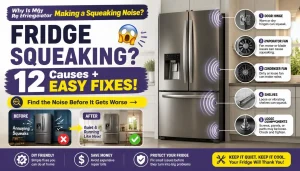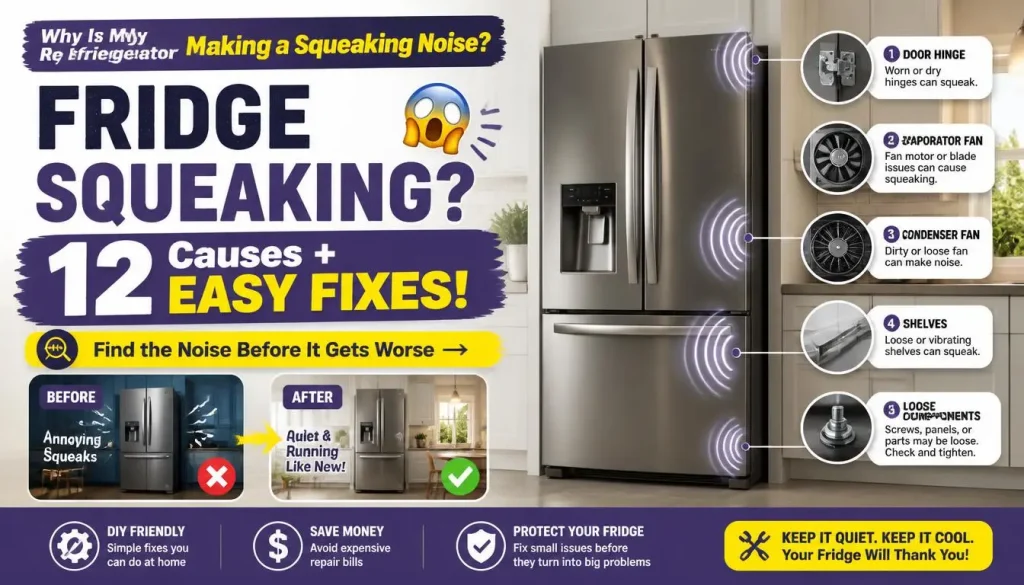
A refrigerator making a squeaking noise can be irritating, but the sound does not always mean the appliance is about to fail. A dry door hinge, a sticky gasket, an unlevel cabinet, frost touching a fan blade, or debris near a motor can all create a similar high-pitched sound.
The quickest way to find the cause is to notice when the squeak happens, where it comes from, and whether the refrigerator is still cooling normally. A squeak that occurs only when the door moves points to a very different problem than one that starts every time the cooling cycle begins.
Quick answer: If your refrigerator squeaks when you open or close the door, inspect the hinges, door gasket, alignment, and surrounding cabinets. If it squeaks while running, the evaporator fan, condenser fan, air damper, ice maker, or water inlet valve may be responsible. A squeak accompanied by poor cooling, heavy frost, a burning smell, or repeated electrical problems requires prompt professional attention.
Safety first: Unplug the refrigerator before cleaning near a fan, coil, access panel, wire, or mechanical component. Do not touch refrigerant tubing, compressor terminals, exposed wiring, or sealed-system parts. Follow the instructions in the owner’s manual for your exact model.
Is a Squeaking Refrigerator Normal or a Warning Sign?
A brief squeak is not always a fault. A new refrigerator may squeak when the door opens because the gasket is still firm and creating a tight seal. Some motorized air dampers also make a short chirping or creaking sound as they adjust airflow between compartments.
The sound deserves closer attention when it:
- Continues throughout the cooling cycle
- Becomes louder over several days or weeks
- Changes from a light squeak to scraping or grinding
- Comes with heavy freezer frost
- Is accompanied by weak airflow or rising temperatures
- Appears with a burning smell, smoke, sparking, or breaker trips
- Comes directly from the compressor area
Refrigerators naturally produce humming, clicking, gurgling, and airflow sounds. For help identifying noises that are not true squeaks, see this broader guide to common refrigerator noises and their causes.
Start Here: When and Where Does the Squeak Happen?
Before ordering a replacement part, listen to the refrigerator through one complete cooling cycle. The timing and location of the noise will often narrow the problem to one or two components.
Does It Squeak Only When You Open or Close the Door?
Inspect the following areas:
- Upper and lower door hinges
- Hinge cam or plastic bushing
- Door gasket
- Door alignment
- Cabinets or countertops beside the refrigerator
- French-door center flap or mullion
- Heavily loaded door bins
A door-related squeak normally follows the movement of the door exactly. It stops as soon as the door stops moving.
Does It Squeak While the Refrigerator Is Running?
A squeak that appears during a cooling cycle is more likely to involve a moving component, such as:
- Evaporator fan
- Fresh-food circulation fan
- Condenser fan
- Fan motor bearing
- Air damper motor
- Compressor mounting component
Notice whether the sound begins at the same time as the compressor or airflow.
Is the Noise Coming From Inside the Freezer?
A rhythmic squeak, chirp, scrape, or ticking sound from behind the freezer’s rear panel often points toward the evaporator fan.
Possible causes include:
- Frost touching the fan blade
- Food packaging pressing against a vent
- Debris near the fan
- A bent or damaged fan blade
- A worn fan motor bearing
- Recurring ice caused by a defrost-system problem
Is the Noise Coming From the Back or Bottom?
The lower rear area contains several components that can produce or transmit noise:
- Condenser fan
- Drain pan
- Water supply tubing
- Rear access panel
- Compressor mounting grommets
- Compressor
Do not assume the compressor is failing simply because the sound comes from the back. A loose panel, dirty fan, or vibrating water tube is usually easier and less expensive to address.
Does It Happen During Ice Making or Water Dispensing?
A squeal, chatter, vibration, or strained hum during a water-fill cycle may involve:
- Water inlet valve
- Restricted water filter
- Kinked supply tube
- Partially closed shutoff valve
- Low or fluctuating water pressure
- Ice-maker motor
- Ice-bin auger
- Jammed ejector mechanism
Turn the ice maker off temporarily and monitor the refrigerator. If the sound disappears, the water or ice-making system deserves closer inspection.
Does the Squeak Stop When You Open the Freezer Door?
On many refrigerators, opening the freezer door stops the evaporator fan. If the squeaking stops immediately with the door open and returns after the door closes, frost around the fan, a damaged blade, or a worn fan motor may be responsible.
This test is not conclusive for every refrigerator because fan behavior varies by model. Do not remove the freezer panel or bypass safety switches unless the manufacturer specifically instructs you to do so.
Does It Begin Just After You Close the Door?
A sound that starts a few seconds after closing the door may come from:
- The evaporator fan restarting
- An air damper changing position
- Frost touching a rotating fan
- Door-closing vibration
- A water-filled drain trap
- Normal pressure equalization
Listen carefully to determine whether the sound is a true mechanical squeak or a brief whoosh, gurgle, or creak.
Did the Noise Start After Moving or Installing the Refrigerator?
After relocation, check for:
- An unlevel cabinet
- A door installed incorrectly
- A rear panel left loose
- A water line touching the wall
- The refrigerator touching a cabinet
- A power cord trapped against the rear cover
- Uneven flooring beneath one corner
Even slight cabinet movement can turn normal motor vibration into an obvious squeak or rattle.
Is Cooling Performance Affected?
Check the refrigerator with an appliance thermometer rather than relying only on the control-panel display. The fresh-food compartment should remain at 40°F or 4°C or below, and the freezer should be close to 0°F or -18°C.
A squeak with normal temperatures may be caused by a hinge, gasket, early fan wear, or loose component. A squeak combined with warming food, weak airflow, or heavy frost may indicate a fan or defrost-system problem. If your freezer remains cold but the refrigerator compartment is warm, follow this guide to a refrigerator not cooling while the freezer still works.
Refrigerator Squeaking Noise Diagnosis Table
| When or where the sound occurs | Likely source | First safe check |
|---|---|---|
| Only when opening or closing the door | Hinge, hinge cam, gasket, alignment, or cabinet contact | Open the door slowly and identify the exact friction point |
| From inside the freezer while cooling | Evaporator fan, frost, debris, or fan motor | Look for frost on the freezer’s rear interior wall |
| Stops when the freezer door opens | Evaporator fan or ice around the fan | Confirm whether the sound returns after the door closes |
| Begins shortly after closing the door | Fan restarting, air damper, or door vibration | Listen near the freezer vent and upper refrigerator vent |
| From the lower rear area | Condenser fan, drain pan, rear panel, or compressor mount | Unplug the refrigerator and inspect user-accessible areas |
| From the upper fresh-food compartment | Air damper, diffuser, or circulation fan | Listen near the air vent and check for temperature changes |
| During ice-making cycles | Water valve, ice-maker motor, fill tube, or ejector | Turn the ice maker off temporarily and monitor the noise |
| While dispensing water | Filter, supply line, water pressure, or inlet valve | Check water flow, filter installation, and visible line kinks |
| Started after moving the refrigerator | Leveling, cabinet contact, water line, or loose panel | Reposition and level the appliance according to its manual |
| Squeak with poor cooling | Fan obstruction, fan failure, recurring frost, or compressor issue | Protect perishable food and arrange prompt diagnosis |
Is It a Squeak, Squeal, Chirp, or Scraping Noise?
People often use different words to describe the same sound. Matching the sound pattern can make diagnosis easier.
| Sound description | What it may indicate |
|---|---|
| Squeak that follows door movement | Dry hinge, worn hinge cam, sticky gasket, or door misalignment |
| Rhythmic chirp during a cooling cycle | Fan motor bearing or a rotating blade touching something |
| High-pitched squeal from the freezer | Evaporator fan motor or frost around the blade |
| Scraping or grinding | Fan blade contacting ice, debris, or its housing |
| Brief chirp, creak, or “woof” near an upper vent | Air damper opening or closing |
| Squeal or chatter during water flow | Water inlet valve, restricted filter, or pressure problem |
| Sound only during ice dispensing | Ice-bin auger, jammed ice, or dispenser mechanism |
A gentle hum, occasional click, soft gurgle, or short cracking sound may be normal. This article focuses specifically on squeaking and closely related high-pitched mechanical noises.
12 Reasons a Refrigerator Makes a Squeaking Noise
1. The Door Hinge, Hinge Cam, or Bushing Is Dry or Worn
A door hinge is the first place to check when the refrigerator squeaks only while opening or closing. The noise may come from the hinge pin itself, a plastic hinge cam, a worn bushing, or dirt trapped between moving surfaces.
Open the door slowly while listening near the upper and lower hinge. Remove heavy containers from the door bins and test it again. Excess weight can exaggerate friction or make a slightly misaligned door sag.
Clean visible dirt with a soft cloth. Use only a lubricant approved by the manufacturer for that hinge. Do not spray a general-purpose lubricant around food-storage surfaces, wiring, plastic trim, or the door gasket.
A cracked cam, sagging door, loose hinge assembly, or visibly worn bushing may require replacement. Because refrigerator doors are heavy, ask another person to support the door if the manufacturer’s procedure involves hinge adjustment.
2. The Door Gasket Is Sticky, Dirty, or Sealing Very Tightly
The rubber seal around the door can squeak as it slides across the refrigerator frame. This is particularly common on a new appliance because the gasket is still firm.
Inspect the seal for:
- Sticky food residue
- Grease or dirt
- Folded corners
- Loose sections
- Cracks or tears
- Areas rubbing unusually hard against the cabinet
Clean the gasket with warm water and a soft cloth, then dry it completely. Avoid abrasive cleaners, strong chemicals, and unapproved oils, which may damage the rubber.
If the gasket is torn, badly twisted, or pulling away from the door, cleaning may not be enough. The complete refrigerator door gasket replacement guide explains how to identify a failed seal and decide whether adjustment or replacement is appropriate.
3. The Door Is Misaligned or Rubbing Against a Cabinet
A refrigerator door may squeak because its edge, handle, hinge cover, or center mullion is rubbing against another surface.
Check the clearance around the entire door while opening it slowly. Look for marks on nearby cabinets, countertops, walls, and trim. On a French-door refrigerator, inspect the center flap to make sure it folds and enters its guide correctly.
Misalignment may result from:
- Incorrect installation
- Loose hinge hardware
- An uneven floor
- Excessive weight in the door bins
- A refrigerator cabinet that has twisted slightly
- A freezer drawer that is not seated evenly
Do not force the door into position. Follow the model-specific alignment instructions because adjustment methods differ between top-freezer, side-by-side, French-door, and built-in refrigerators.
4. The Refrigerator Is Not Level
An unlevel refrigerator can place uneven pressure on hinges, twist the cabinet, and amplify normal vibration. The door may rub, squeak, or fail to close smoothly.
Place a bubble level on a stable part of the cabinet and check it from side to side and front to back. Gently press each corner to see whether the appliance rocks.
Adjust only the leveling legs or rollers identified in the owner’s manual. Some models require a slight rearward tilt for proper door operation, while others have different installation requirements. Do not apply a universal angle to every refrigerator.
Because full-size refrigerators are heavy and can tip, use two people when moving or leveling one. For a more detailed procedure, see how to level a double-door refrigerator safely.
5. Frost or Debris Is Touching the Evaporator Fan
The evaporator fan circulates cold air through the freezer and refrigerator compartments. When frost reaches the fan blade, each rotation may create a squeak, chirp, tick, or scrape.
Signs of fan obstruction include:
- Noise from behind the freezer’s rear interior panel
- Visible frost on the rear freezer wall
- A sound that changes when the freezer door opens
- Weak airflow from interior vents
- Uneven refrigerator temperatures
- A noise that becomes gradually louder
Check that bags, boxes, and food packaging are not pressed against the freezer vents. If heavy frost is visible, move food to another refrigerator or an insulated cooler, unplug the appliance, open the doors, and allow the ice to melt naturally.
Never chip freezer ice with a knife, screwdriver, or other sharp object. Do not use a heat gun or pour boiling water onto plastic panels. Either method can damage the liner, wiring, or refrigerant tubing.
If the squeak returns soon after a complete defrost, the underlying problem may involve the defrost heater, thermostat, sensor, timer, control board, door seal, or drainage system. This guide to a refrigerator that is not defrosting properly covers those recurring-frost problems in more detail.
6. The Evaporator or Circulation Fan Motor Is Wearing Out
If the fan area is free of frost and debris but the high-pitched noise remains, the motor bearing may be wearing out.
A failing fan motor may produce:
- Rhythmic chirping
- A continuous squeal
- Changing pitch as the fan changes speed
- Intermittent startup noise
- Weak or inconsistent airflow
- Poor cooling in the fresh-food compartment
Some refrigerators have more than one internal fan, including a freezer evaporator fan, fresh-food fan, or temperature-controlled drawer fan. The sound’s location matters.
Fan-motor replacement usually requires removing interior panels and handling wiring. Unless the owner’s manual identifies the part as user-serviceable, arrange for a qualified appliance technician or appliance engineer to inspect it.
7. The Condenser Fan Is Dirty, Obstructed, or Failing
Many refrigerators have a condenser fan near the compressor at the lower rear of the appliance. Dust, pet hair, packaging, or a loose wire tie can touch the blade and create a squeak or scrape.
The noise will often:
- Come from the bottom or back
- Start when the compressor runs
- Change as the fan speeds up
- Continue with the doors open
- Be accompanied by longer cooling cycles
Unplug the refrigerator before inspecting the lower rear area. Remove only the grille or cover the owner’s manual allows users to remove. Clean accessible dust with a vacuum and soft brush, then check that nothing is touching the fan.
Condenser dirt also makes the cooling system work harder. Follow the site’s instructions on how to clean refrigerator coils effectively without damaging fins, wiring, or tubing.
If the fan blade wobbles, does not turn freely, or continues squealing after cleaning, the motor may require replacement.
8. The Air Damper or Diffuser Motor Is Noisy
The air damper controls how much cold air moves from the freezer into the refrigerator compartment. Depending on the brand, it may also be called an air diffuser, baffle, damper door, or motorized vent.
Damper noise usually comes from the upper or rear section of the fresh-food compartment. A short chirp or creak as the damper changes position may be normal. A continuous squeak, repeated struggling sound, or noise accompanied by temperature problems may indicate:
- Ice around the damper
- Food packaging blocking the vent
- A cracked plastic flap
- A worn drive motor
- A damaged gear
- A faulty temperature sensor sending incorrect commands
Keep food away from the vent and look for visible frost without inserting tools into the opening. A damper assembly is often located behind interior trim, so diagnosis and replacement may require professional service.
9. The Water Inlet Valve Is Squealing or Chattering
A refrigerator’s water inlet valve opens when the ice maker fills or the dispenser is used. Users sometimes describe valve chatter or vibration as a squeak.
Check whether the noise appears only during water flow. Then inspect the simple causes:
- Make sure the household shutoff valve is fully open
- Check visible supply tubing for kinks
- Confirm the water filter is installed correctly
- Replace an overdue filter with the correct compatible model
- Flush air from the system after a filter change
- Confirm that household pressure meets the manufacturer’s requirement
If the refrigerator is not connected to a water supply, turn the ice maker off according to the owner’s manual. Leaving it on may cause the valve to attempt repeated fill cycles.
A valve that remains unusually loud despite normal water flow, correct filter installation, and a clear supply line may need professional diagnosis.
10. The Ice Maker Motor, Ejector, or Auger Is Straining
An ice maker contains several moving parts. A jammed cube, frozen fill tube, worn motor, stiff ejector arm, or obstructed dispenser auger can produce a squeak, squeal, click, or grind.
Notice exactly when the noise occurs:
- While the tray fills
- During the ice-harvest cycle
- When cubes drop into the bin
- Only while dispensing ice
- After the bin has become overfilled
Turn the ice maker off temporarily. Remove the ice bin and inspect it for clumped ice, foreign objects, or cubes frozen around the auger. Do not force the auger or insert a tool into the dispenser mechanism.
If normal cleaning and bin reseating do not solve the problem, follow the full guide to troubleshooting a refrigerator ice maker before replacing parts.
11. The Drain Pan, Rear Panel, or Water Tube Is Loose
A loose component can rub or vibrate as the compressor starts. The resulting sound may be described as squeaking even though the original source is vibration.
Common examples include:
- Drain pan sitting incorrectly in its track
- Rear access cover with loose screws
- Toe grille not clipped into place
- Water supply tube touching the wall
- Power cord resting against a metal panel
- Refrigerant tubing touching another surface
- Items vibrating on top of the refrigerator
Start with the exterior. Remove items from the top, pull the refrigerator slightly away from surrounding surfaces, and listen again.
After unplugging the appliance, check only user-accessible panels and tubing. Do not bend copper or aluminum refrigerant lines. If tubing inside the mechanical compartment appears to be touching another component, leave the adjustment to a technician.
12. The Compressor or Its Mounting Components Have a Problem
A compressor is less likely than a hinge or fan to produce a true squeak, so it should not be the first part you blame.
Noise from the compressor area may actually come from:
- Rubber mounting grommets
- A nearby drain pan
- Condenser fan
- Rear panel
- Water tube
- Start or stop vibration
A compressor-related problem becomes more concerning when the noise is combined with:
- Poor cooling
- Repeated failed startup attempts
- Loud knocking or clanking
- Excessive cabinet heat
- Continuous operation
- An electrical or burning smell
Do not touch the compressor, terminals, or sealed tubing. These areas can be hot and may carry electrical hazards. A refrigerator that rarely stops running may have a separate airflow, gasket, coil, fan, sensor, or cooling-system problem; review the guide explaining why a refrigerator runs constantly before assuming the compressor has failed.
How to Fix a Squeaking Refrigerator Safely
Work from the simplest and safest checks toward the more technical possibilities.
Step 1: Record the Sound
Use your phone to record 15 to 30 seconds of the noise. Note:
- The time it happened
- Whether a door was moving
- Whether the compressor was running
- Whether the ice maker or dispenser was active
- Where the sound was loudest
- Whether cooling was normal
A recording is often more useful to a technician than describing the sound from memory.
Step 2: Check the Temperature
Place an appliance thermometer in the refrigerator and freezer.
If the refrigerator rises above 40°F or 4°C, protect perishable food rather than spending hours experimenting with repairs. A freezer should normally remain around 0°F or -18°C.
Step 3: Eliminate External Friction and Vibration
Check for:
- Contact with a wall or cabinet
- Objects vibrating on top
- A water line touching the wall
- A loose toe grille
- A trapped power cord
- Uneven flooring
- A rocking cabinet
Move the refrigerator carefully and maintain the clearances specified by the manufacturer.
Step 4: Inspect the Door, Hinges, and Gasket
Open the door slowly and listen near each hinge. Clean the hinge area and gasket, remove excessive weight from door bins, and check for rubbing.
Use only a model-approved lubricant. Do not spray oil around the refrigerator door and hope it reaches the correct point.
Step 5: Confirm the Refrigerator Is Level
Use a bubble level and adjust only the legs or rollers described in the installation manual. Have another adult help stabilize the appliance.
After adjustment, confirm that the refrigerator no longer rocks and that the doors move without contacting nearby surfaces.
Step 6: Look for Frost or Blocked Vents
Inspect the freezer’s rear wall and interior air vents. Move food away from vents and look for unusually thick frost.
If a manual defrost is needed:
- Move food to safe cold storage.
- Unplug the refrigerator.
- Leave the doors open.
- Place towels around the appliance.
- Allow the ice to melt naturally.
- Dry the compartments before restarting.
Do not use sharp tools, open flames, boiling water, or high-powered heaters.
Step 7: Clean User-Accessible Condenser Areas
With the refrigerator unplugged, vacuum dust and pet hair from user-accessible coils, grilles, and fan areas. Use a soft appliance brush where appropriate.
Do not remove sealed covers or disturb wiring and refrigeration tubing.
Step 8: Isolate the Ice and Water System
If the squeak follows an ice-making or dispensing cycle:
- Turn the ice maker off temporarily
- Check the water filter
- Inspect the visible supply line
- Confirm the shutoff valve is open
- Remove and reseat the ice bin
- Clear loose or clumped ice
If the sound disappears while the ice maker is off, the water valve or ice-making mechanism is a likely source.
Step 9: Test During the Next Cooling Cycle
Restart the refrigerator and listen through at least one normal cooling cycle. Check:
- Whether the squeak returns
- Whether the pitch changes
- Whether airflow feels normal
- Whether frost begins returning
- Whether temperatures remain safe
- Whether the refrigerator runs continuously
Do not repeatedly unplug and restart the appliance within a few minutes. Follow the restart instructions in the owner’s manual.

When Should You Stop DIY Troubleshooting?
Unplug the refrigerator and contact a qualified technician when:
- You smell burning plastic or electrical insulation
- Smoke, sparks, or melted wiring is visible
- The outlet or circuit breaker repeatedly trips
- The refrigerator is no longer maintaining a safe temperature
- A loud metal-on-metal sound continues
- The squeak comes from inaccessible wiring or a sealed component
- Heavy freezer frost returns soon after a complete defrost
- A fan continues squealing after visible debris and ice are removed
- Water is leaking near an electrical part
- The suspected problem involves the compressor or refrigerant system
- Moving or disassembling the appliance would be unsafe
A service call is less expensive than replacing a punctured evaporator, damaged control board, or refrigerator that was made unsafe by an incorrect repair.
Can You Keep Using a Refrigerator That Is Squeaking?
You may be able to monitor the refrigerator briefly when:
- The sound occurs only as the door moves
- Cooling remains stable
- There is no burning smell or electrical problem
- No water is leaking
- The noise is mild and not becoming louder
- The likely source is a gasket or external vibration
Stop relying on the refrigerator and arrange prompt service when:
- Food is becoming warmer
- The freezer is developing heavy frost
- Interior airflow is weak
- The fan sounds strained
- The compressor area is unusually loud
- The appliance trips the breaker
- The sound is accompanied by smoke, sparking, or a burning odor
When cooling performance is uncertain, use an appliance thermometer. Do not judge food safety by touch, appearance, or smell alone.
How to Prevent Refrigerator Squeaking
A few routine checks can prevent many noise problems:
- Keep the refrigerator stable and level
- Maintain the manufacturer’s required wall clearance
- Avoid overloading door bins
- Clean sticky residue from door gaskets
- Keep food packaging away from interior vents
- Deal with unusual frost before it reaches a fan
- Clean user-accessible condenser areas as directed
- Replace water filters at the recommended interval
- Keep the water supply line free from kinks
- Turn off the ice maker if no water supply is connected
- Make sure panels and grilles are properly reseated after cleaning
- Investigate a new sound before it becomes louder
The best time to diagnose a squeak is while the refrigerator is still cooling normally. Once a struggling fan stops completely, the problem becomes more urgent and may affect food storage.
Frequently Asked Questions
Why does my refrigerator squeak only when I open or close the door?
A squeak that follows door movement usually comes from a dry or worn hinge, hinge cam, plastic bushing, sticky gasket, misaligned door, or contact with a nearby cabinet. Open the door slowly to locate the friction point. Clean the gasket and hinge area, remove excess weight from the door bins, and use only a lubricant approved by the refrigerator manufacturer.
Why does the squeaking stop when I open the freezer door?
On many models, the evaporator fan stops when the freezer door opens. If the squeak stops immediately and returns after closing the door, the fan blade may be touching frost or debris, or the fan motor bearing may be wearing out. Fan operation varies between models, so confirm the behavior in your owner’s manual before drawing a final conclusion.
Why does my refrigerator squeak after I close the door?
Closing the door may restart the evaporator fan or cause the air damper to adjust. A squeak immediately afterward may come from frost around the fan, a worn fan motor, damper movement, or vibration caused by the door closing. A brief whoosh, gurgle, or creak may also be normal pressure or airflow movement rather than a mechanical failure.
Why is the squeaking noise coming from inside the freezer?
The evaporator fan is a common source of squeaking inside a freezer. Frost may be touching the fan blade, food packaging may be obstructing a vent, or the fan motor may be wearing out. Look for heavy frost on the rear freezer wall and check whether the sound changes when the door opens. Do not remove ice with a knife or screwdriver.
Why is my refrigerator squeaking from the back or bottom?
Possible sources include the condenser fan, drain pan, rear panel, water line, power cord, compressor mounting grommets, or compressor area. Unplug the appliance and inspect only user-accessible components. Make sure nothing is touching the wall and that visible tubing is not vibrating against the cabinet. Do not bend refrigerant lines or touch compressor terminals.
Why does my refrigerator squeak every few minutes?
An intermittent squeak may follow a cooling cycle, air-damper adjustment, ice-maker fill, or fan startup. Record the time between sounds and notice which system is operating. If it occurs with water flow, check the filter and supply line. If it follows compressor operation, listen near the fans. Repeated noise with rising temperatures requires professional diagnosis.
Why does my refrigerator seem louder at night?
The refrigerator may not actually be louder. Normal fan, compressor, ice-maker, and airflow sounds are easier to notice when the house is quiet. However, a new high-pitched squeal, rhythmic scrape, or sound that is gradually worsening should not be dismissed simply because it is most noticeable at night.
Why is my refrigerator squeaking but still cooling?
A refrigerator can continue cooling while a door hinge rubs, a gasket sticks, a loose component vibrates, or a fan bearing begins to wear. Stable cooling does not always mean the noise should be ignored. Locate the source, check temperatures with a thermometer, and monitor whether the sound becomes louder or airflow weakens.
Why is my refrigerator squeaking and not cooling?
Squeaking combined with poor cooling may indicate an obstructed evaporator fan, failing fan motor, heavy frost, defrost-system fault, condenser-fan problem, or compressor-area issue. Move perishable food to safe cold storage and check for airflow and frost. If the refrigerator cannot remain at 40°F or 4°C or below, arrange professional service promptly.
Can the ice maker or water inlet valve cause a squeaking noise?
Yes. A water inlet valve may chatter, vibrate, or squeal when water pressure is inconsistent, the filter is restricted, the supply line is kinked, or the shutoff valve is not fully open. An ice-maker motor, ejector, or dispenser auger can also squeak when jammed or worn. Turn the ice maker off temporarily to see whether the sound stops.
What causes a high-pitched squealing or chirping refrigerator noise?
A rhythmic squeal or chirp usually involves a rotating component, particularly an evaporator or condenser fan. The blade may be touching frost or debris, or the motor bearing may be deteriorating. A brief chirp from the upper refrigerator compartment can also come from an air damper. The location and timing of the sound are the strongest diagnostic clues.
Why is my new refrigerator making a squeaking noise?
A new refrigerator may squeak because the door gasket is firm, the door needs alignment, the appliance is not level, or part of the cabinet is touching a nearby surface. Check the installation instructions and allow the gasket time to become more flexible. Contact the retailer or manufacturer if the sound is persistent, loud, or accompanied by cooling problems.
Is a squeaking refrigerator dangerous?
A simple hinge or gasket squeak is not usually dangerous. The situation becomes more serious when the sound is accompanied by a burning smell, sparking, smoke, repeated breaker trips, overheating, leaking water near electrical parts, or rising food temperatures. Unplug the refrigerator and call a professional if any electrical or severe mechanical warning sign appears.
Can I use WD-40 on a squeaky refrigerator door?
Do not apply a general-purpose spray unless the refrigerator manufacturer specifically approves it for that hinge. Overspray can reach food-storage surfaces, wiring, plastic trim, and the gasket. Clean the hinge first, then use only the lubricant and application method listed in the appliance manual or the manufacturer’s official service guidance.
Should I repair or replace a squeaking refrigerator?
The decision depends on the refrigerator’s age, overall condition, warranty, repair history, cooling performance, and the failed component. A hinge, gasket, fan, or loose panel is generally more practical to repair than a major sealed-system problem. Obtain a professional estimate before replacing an otherwise reliable refrigerator, especially if the appliance is still covered by a parts or compressor warranty.
Final Takeaway
When a refrigerator makes a squeaking noise, begin with the timing and location instead of guessing which part has failed.
A squeak that appears only when the door moves usually points to the hinge, gasket, alignment, or cabinet contact. A rhythmic squeak during cooling is more likely to involve a fan, frost, or motor bearing. Noise during water or ice cycles may come from the inlet valve, filter, supply line, or ice-maker mechanism.
Start with the safe checks: confirm temperatures, remove external contact, clean the gasket, level the cabinet, clear vents, and inspect for visible frost. If the sound persists with poor cooling, recurring ice, an electrical warning sign, or compressor-area noise, stop troubleshooting and arrange professional service.

Hi, I’m the lead researcher and appliance enthusiast behind RefrigeratorSolve. With years of hands-on experience troubleshooting cooling systems and testing home appliances, I am dedicated to bringing you honest reviews, energy-saving tips, and practical solutions to keep your refrigerator running perfectly.