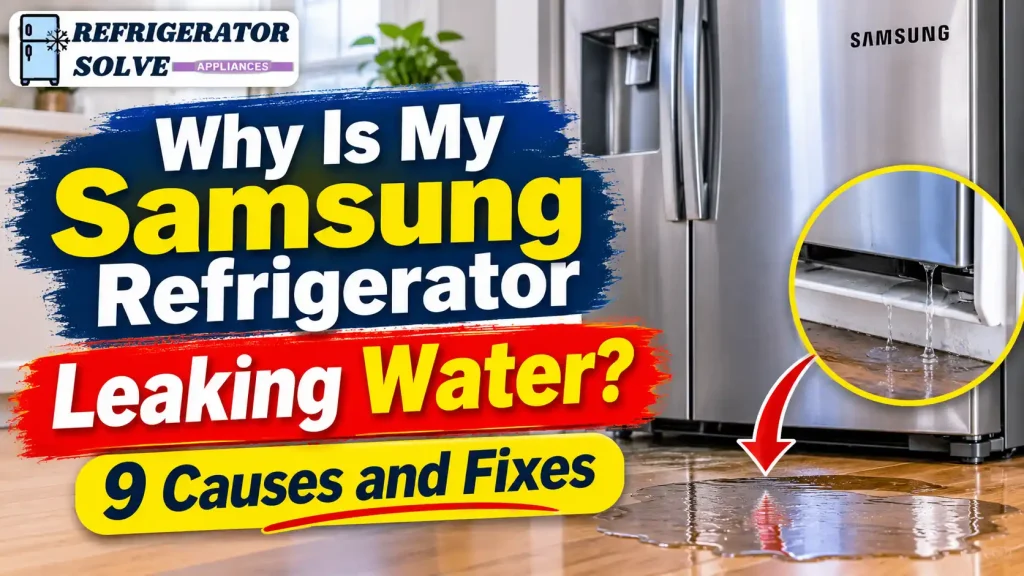
If your Samsung refrigerator is leaking water, the problem could be a clogged defrost drain, a loose water filter, a damaged water line, or an issue with the ice maker. The location of the water often provides the first clue about what is wrong.
Before replacing any parts, check where the water is coming from. This guide explains nine possible causes, how to identify them, and what you can safely do to stop the leak.
Why Is My Samsung Refrigerator Leaking Water?
A Samsung refrigerator can leak water for several reasons. Some problems involve the water supply system, while others are related to automatic defrosting, drainage, or condensation.
The first thing I recommend is checking where the water appears. Water underneath the crisper drawers usually points toward a drainage problem, while water behind the refrigerator may indicate a loose supply line or a leaking connection.
Here is a quick guide to help you narrow down the cause.
| Where You Find Water | Possible Cause |
|---|---|
| Under the crisper drawers | Clogged or frozen defrost drain |
| Under the refrigerator | Drain pan overflow or damage |
| Behind the refrigerator | Loose water supply line or inlet valve |
| Around the water filter | Incorrect installation or damaged filter housing |
| Inside the Autofill compartment | Leaking or incorrectly assembled pitcher |
| Around the water dispenser | Trapped air or dispenser problem |
| Near the ice maker | Leaking fill tube or water connection |
| Around the refrigerator doors | Condensation or poor door sealing |
Keep in mind that water does not always appear directly below the faulty component. It can travel along the refrigerator’s base before reaching the floor.
9 Common Reasons Your Samsung Refrigerator Is Leaking Water
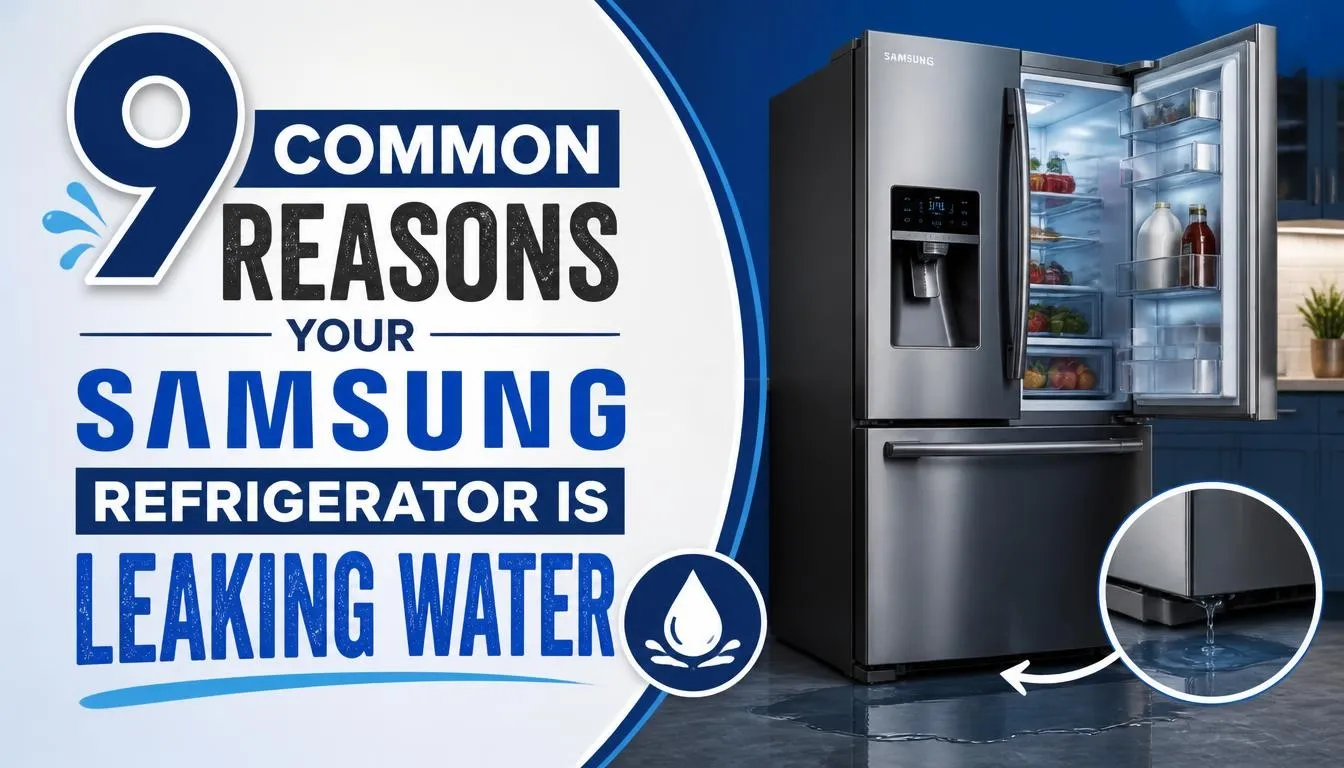
Let’s look at the problems that can cause water to collect inside or around a Samsung refrigerator.
1. Clogged or Frozen Defrost Drain
A clogged or frozen defrost drain is one of the first things to investigate when you find water under the vegetable or crisper drawers.
Your Samsung refrigerator automatically removes frost during its defrost cycle. The melted ice travels through a small drainage opening and eventually reaches the drain pan underneath the appliance.
If food particles, debris, or ice block the drainage system, water cannot flow out properly. Instead, it collects inside the refrigerator and may eventually leak onto the floor.
Common signs of a blocked defrost drain include:
- Water collecting underneath the crisper drawers.
- A layer of ice forming on the refrigerator floor.
- Repeated moisture appearing inside the fresh-food compartment.
- Water leaking after the automatic defrost cycle.
How to check it:
- Remove the food and drawers necessary to inspect the affected area.
- Look for visible water, ice, or debris around the drainage opening.
- Check your Samsung refrigerator’s user manual to locate the defrost drain.
- Follow the model-specific cleaning instructions if the drain is designed for user maintenance.
Some Samsung models have drainage components that require professional attention. Do not remove internal panels or force sharp objects into the drain.
If water keeps returning, the drain tube may be blocked farther inside the appliance.
For more detailed troubleshooting, read our guide on how to fix a clogged Samsung refrigerator drain hole.
You can also follow Samsung’s official refrigerator water leak troubleshooting guide for model-specific advice.
2. Incorrectly Installed or Damaged Water Filter
If you notice water leaking around the water filter, the filter itself or its housing may be responsible.
Samsung refrigerators with built-in water dispensers and ice makers rely on a properly installed water filter. When the filter is not seated correctly, water may escape around its connection.
A damaged filter seal, incompatible replacement cartridge, or cracked filter housing can also cause leakage.
This problem is particularly worth checking if the leak started shortly after you replaced the water filter.
Common signs include:
- Water droplets around the filter compartment.
- Moisture underneath the filter housing.
- Water leaking shortly after replacing the cartridge.
- The filter does not lock into position correctly.
- Water continues leaking even after reinstalling the filter.
How to fix it:
- Turn off the refrigerator’s water supply if there is an active leak.
- Remove the filter according to your model’s instructions.
- Inspect the cartridge and its sealing surfaces for visible damage.
- Check the filter housing for cracks or other damage.
- Reinstall a compatible filter correctly without forcing it into place.
Use a Samsung-approved or manufacturer-specified compatible filter. Do not assume that every filter with a similar appearance will fit your refrigerator.
Samsung recommends replacing a damaged or unsuitable filter. If water continues leaking with the filter removed, the housing may need professional service.
For additional information, see our guide on how often to replace a refrigerator water filter.
3. Loose or Damaged Water Supply Line
A loose or damaged water supply line can cause your Samsung refrigerator to leak water onto the kitchen floor.
The water supply line connects the refrigerator to your household plumbing. It supplies water to components such as the ice maker and dispenser.
Over time, the tubing or its connections may become loose, cracked, or damaged.
This problem is especially worth investigating if you recently moved your refrigerator, installed a new appliance, or had its doors removed for transportation.
Look for these signs:
- Water collecting behind the refrigerator.
- Moisture around the water supply connection.
- A visible crack or damaged section of tubing.
- Water leaking from underneath the refrigerator.
- Dripping near the lower rear section.
How to fix it:
First, turn off the water supply using the accessible shutoff valve.
Carefully inspect the visible tubing and connections without pulling or bending the refrigerator’s water line.
If you find a loose connection, follow the installation instructions for that specific fitting. Damaged tubing should be replaced with a compatible water line.
Some Samsung refrigerator models also have water-line couplers near the door hinges.
If the doors were recently removed, check whether the water couplers were reconnected correctly. A poorly connected coupler can allow air into the water system and contribute to dispenser dripping.
Do not disconnect internal water lines unless you understand the model-specific procedure.
If the leak is difficult to access, contact a qualified appliance technician or plumber.
For more information, read our step-by-step guide on how to fix a refrigerator water line leak.
4. Leaking Samsung Autofill Water Pitcher
Does your Samsung refrigerator have an Autofill water pitcher?
If so, the pitcher compartment could be the source of the leak.
Some Samsung refrigerators include an Autofill feature that automatically fills a water pitcher inside the refrigerator. If the pitcher, lid, or drainage area is not assembled correctly, water may collect inside the compartment.
Common causes include:
- An incorrectly installed pitcher lid.
- A cracked or damaged pitcher.
- A pitcher that is not positioned correctly.
- A wet or incorrectly assembled drainage area.
- A stuck spring-loaded button behind the pitcher.
How to check and fix it:
- Remove the Autofill pitcher and dry it with a clean towel.
- Inspect the pitcher and lid for cracks or visible damage.
- Check that the lid components fit together properly.
- Reinstall the pitcher according to the refrigerator’s instructions.
- Check whether the spring-loaded button behind the pitcher moves freely.
On models equipped with a rubber drain cap, Samsung provides instructions for draining the Autofill compartment. Follow the procedure for your model rather than removing parts at random.
Also, make sure the pitcher is correctly positioned and its pouring spout faces the direction specified in the user manual.
If the pitcher continues leaking even when removed from the refrigerator, it may need replacement.
For complete instructions, refer to Samsung’s official water leak troubleshooting guide.
Remember that not every Samsung refrigerator has an Autofill pitcher. Skip this check if your model does not include that feature.
5. Water Dispenser Dripping or Leaking
A dripping water dispenser is another possible reason you may notice water around your Samsung refrigerator.
However, a few drops immediately after dispensing water do not necessarily mean something is broken.
According to Samsung, it is normal for the dispenser to release a few remaining drops for approximately 3–5 seconds after dispensing. The issue becomes more concerning when water continues dripping for an extended period.
Possible causes include:
- Air trapped inside the water line.
- An incorrectly installed water filter.
- A water line that was recently disconnected.
- A damaged dispenser component.
- Problems with water pressure.
How to troubleshoot it:
Start by checking whether the dripping began after installing a new filter or moving the refrigerator.
If the water filter was recently replaced, trapped air may be responsible. Follow Samsung’s instructions for flushing the water system.
For example, some Samsung dispenser systems require several dispensing cycles before the water stream becomes steady. Use the exact flushing procedure and quantity recommended for your model.
Next, inspect the visible dispenser area for unusual moisture or damage.
If the dispenser continues dripping after the water line has been properly flushed, the valve or another internal component may require service.
You can also read Samsung’s official water dispenser troubleshooting guide.
6. Ice Maker or Ice Chute Problems
If water appears around the ice maker or dispenser opening, the problem may involve the ice-making system.
Samsung refrigerators use different ice maker designs, so the cause depends on the model.
Possible problems include:
- A damaged or incorrectly positioned ice maker fill tube.
- A loose water connection.
- Water entering the ice mold incorrectly.
- Ice buildup around the dispenser chute.
- A poor seal between the ice bucket and chute.
For example, if the ice chute does not seal properly, warm air can enter the ice maker compartment. This may cause accumulated ice to melt and water to drip around the dispenser.
What should you check?
Open the refrigerator door and inspect the visible ice chute area.
Look for ice buildup, moisture, or a damaged seal. Also check whether the ice bucket appears properly positioned.
Do not use sharp tools to remove frozen ice. Follow the cleaning instructions for your model.
If you notice water leaking directly from the ice maker, the fill tube, inlet valve, or internal water connection may need professional inspection.
We have a separate guide covering Samsung ice maker leaking water and how to troubleshoot it.
This is worth reading if the leak appears only when the refrigerator produces or dispenses ice.
7. Overflowing or Damaged Drain Pan
Your Samsung refrigerator has a drainage system that collects water produced during automatic defrosting.
The melted frost normally travels into a drain pan near the bottom of the refrigerator. Under normal conditions, the collected water evaporates gradually.
However, the drain pan may become overwhelmed or damaged.
This can happen when too much water enters the pan, evaporation is reduced, or the pan develops a crack.
Common signs include:
- Water collecting underneath the refrigerator.
- Moisture around the lower rear section.
- A drain pan that appears unusually full.
- Visible cracks or damage to the pan.
High humidity or poor ventilation can affect how quickly water evaporates from the drain pan.
How to check it:
First, consult your refrigerator’s manual to find out whether the drain pan is accessible.
If it is designed for user maintenance, inspect it for excessive water, dirt, displacement, or cracks.
Some Samsung models allow the drain pan to be cleaned, while others require a technician to access it.
If the pan is full, follow the manufacturer’s cleaning instructions. If it is cracked or damaged, arrange a compatible replacement.
Do not force the pan out of the refrigerator or remove service panels simply to reach it.
For additional information, read Samsung’s official guide to water leaking from the refrigerator drain tray.
8. Improper Refrigerator Leveling
Incorrect refrigerator positioning can contribute to water pooling or leaking.
Samsung refrigerators are generally designed to have a slight backward tilt rather than being perfectly level from front to back.
This positioning helps the doors close properly and supports the intended drainage process.
If the appliance is tilted forward or installed on an uneven surface, water may not drain as intended.
It can also affect the alignment of certain ice maker and dispenser components.
How to check the refrigerator:
- Make sure the refrigerator is sitting on a stable, flat surface.
- Check its position using a suitable level.
- Inspect whether the appliance appears to lean forward.
- Follow the leveling instructions in your Samsung user manual.
- Adjust the front leveling legs only as directed by the manufacturer.
Avoid making large adjustments without checking the manual. Different Samsung models can have different leveling arrangements.
If you recently installed or moved the refrigerator, checking its position is particularly important.
You can find further instructions in Samsung’s refrigerator water leak support guide.
9. Faulty Water Inlet Valve
The water inlet valve controls how water enters the refrigerator.
It supplies water to components such as the ice maker and water dispenser. When the refrigerator needs water, the valve opens and closes as required.
If the valve becomes damaged, develops a leak, or fails to close properly, water may escape or continue entering the system.
In some cases, unsuitable household water pressure can also interfere with the valve’s operation.
Possible warning signs include:
- Water leaking near the back of the refrigerator.
- Unusual dripping even when the dispenser is not being used.
- Water entering the ice maker unexpectedly.
- Moisture around the inlet valve connections.
- Repeated leakage despite replacing the water filter.
What should you do?
If you suspect a faulty inlet valve, turn off the refrigerator’s water supply.
Look for visible moisture around accessible connections, but do not remove the valve or attempt internal electrical repairs.
A qualified technician can check the valve, water pressure, and related components.
Replacing the valve without confirming the cause may not solve the leak.
If the problem continues, arrange a professional inspection.
How to Fix a Samsung Refrigerator That Is Leaking Water
Before replacing any component, follow these basic troubleshooting steps.
Step 1: Identify the exact leak location
Look inside the refrigerator, around the water filter, near the ice maker, and underneath the appliance.
Dry the visible water with a towel and observe where it appears again.
Step 2: Stop an active water supply leak
If water is escaping from the supply line or a water connection, close the accessible water shutoff valve.
Do not continue using the dispenser or ice maker until the leak has been identified.
Step 3: Inspect the water filter
Check whether the filter is installed correctly and whether its housing shows visible damage.
Use only a replacement compatible with your refrigerator model.
Step 4: Check the visible water connections
Look for loose, damaged, or kinked tubing behind the refrigerator.
Pay extra attention if the appliance was recently moved or its doors were removed.
Step 5: Inspect the defrost drain and drain pan
Look for visible water buildup or ice around the drainage area.
Only clean accessible components using the method approved for your refrigerator.
Step 6: Check the ice maker and dispenser
If your model has an ice maker, Autofill pitcher, or water dispenser, inspect the relevant components.
A few drops after dispensing water can be normal, but continuous dripping needs attention.
Step 7: Monitor the refrigerator
After completing a safe repair, restore the water supply carefully and check the affected area for fresh moisture.
If the leak returns, stop using the affected water feature and arrange professional service.
Is It a Water Leak or Just Condensation?
Sometimes, what looks like a refrigerator water leak is actually condensation or an accidental spill.
This distinction matters because the solution may be much simpler than replacing a component.
Here are a few possibilities.
Condensation after a power interruption
If your Samsung refrigerator was recently unplugged or experienced a power outage, moisture may collect on cold surfaces as the temperature changes.
Once normal cooling returns, observe whether the water disappears or continues returning.
A damaged or poorly sealing door gasket
A door that does not close properly can allow warm, humid air to enter the refrigerator.
When this air meets cold interior surfaces, moisture can form.
Inspect the rubber door gasket for dirt, gaps, tears, or loose sections.
Our guide on why a refrigerator door may not seal properly explains how to identify sealing problems.
Spilled food or melting ice
Sometimes a container leaks or a few ice cubes fall onto the floor beneath the refrigerator.
Clean the area and monitor it before assuming the appliance has a mechanical problem.
If water continues returning from the same area, investigate the refrigerator itself.
When Should You Call a Samsung Refrigerator Repair Technician?
Not every water leak is suitable for a DIY repair.
Some problems involve internal water connections, electrical components, or drainage parts that require professional attention.
Contact a qualified technician if:
- Water continues leaking after checking the filter and visible connections.
- The water inlet valve appears damaged.
- The filter housing is cracked.
- The internal drainage system repeatedly becomes blocked.
- Water leaks near electrical components.
- The ice maker or dispenser continues leaking.
- The refrigerator stops cooling properly.
- You cannot identify where the water is coming from.
If water reaches electrical wiring, an outlet, or the power cord, do not touch wet electrical parts or attempt to unplug the appliance while standing in water. Isolate power from a safe, dry location if possible and arrange professional assistance.
If your refrigerator is still covered by its warranty, check Samsung’s warranty terms before arranging independent repairs.
How to Prevent Water Leaks in Your Samsung Refrigerator
A few maintenance habits can help reduce the likelihood of recurring water leaks.
Check the water filter regularly: Make sure the installed filter is compatible and correctly seated. Follow the replacement schedule recommended for your model.
Inspect visible water connections: Check accessible tubing and fittings occasionally, especially after moving the refrigerator.
Keep the refrigerator properly positioned: Follow Samsung’s leveling instructions to maintain the correct door alignment and drainage.
Keep the Autofill pitcher clean: If your model has this feature, make sure its lid and other removable parts are correctly assembled and completely dry.
Check the ice dispenser: Remove accessible ice buildup according to the manufacturer’s instructions and make sure the chute and bucket seal correctly.
Maintain the door seals: Clean the rubber gaskets and check for tears, gaps, or other damage.
Avoid unnecessary door opening: Frequently opening the refrigerator can increase moisture entering the compartment, particularly in humid environments.
A little attention to these areas can help you identify small problems before they cause more serious water damage.
Frequently Asked Questions
Why Is My Samsung Refrigerator Leaking Water Onto the Floor?
A Samsung refrigerator may leak water onto the floor because of a clogged defrost drain, damaged water supply line, overflowing drain pan, faulty inlet valve, or leaking ice maker.
Start by checking whether the water appears behind, beneath, or inside the refrigerator. Its location can help you narrow down the possible cause.
Why Is My Samsung Refrigerator Leaking Water Under the Crisper Drawers?
Water under the crisper drawers often points to a clogged or frozen defrost drain.
When melted frost cannot pass through the drainage system, it collects at the bottom of the refrigerator.
Check the drain opening and follow your model’s cleaning instructions. If the blockage is inside an inaccessible section, arrange professional service.
Why Is My Samsung Refrigerator Leaking Water From the Bottom?
Water leaking from the bottom may indicate an overflowing drain pan, damaged drainage component, loose water connection, or another internal leak.
Dry the area and check whether the water returns. If the source is not visible, a technician can inspect the lower drainage and water supply components.
Why Is My Samsung Refrigerator Water Filter Leaking After Replacement?
This can happen when the new filter is not seated correctly, the cartridge is incompatible, or its sealing surface is damaged.
Remove and inspect the filter according to the user manual. Reinstall the correct cartridge without forcing it.
If water continues leaking with the filter removed, the filter housing may need professional service.
Why Does My Samsung Refrigerator Water Dispenser Keep Dripping?
A few drops for approximately 3–5 seconds after dispensing water are generally normal.
Continuous dripping may indicate trapped air in the water line, an improperly installed filter, an ice chute sealing problem, or a faulty water valve.
Follow the model-specific instructions to flush the water system. Contact Samsung service if the dripping continues.
Why Is My Samsung Refrigerator Leaking Water When Dispensing Ice?
Water dripping when you dispense ice may be related to ice buildup around the ice chute or a poor seal between the ice chute and ice bucket.
Inspect the accessible chute area and bucket alignment.
Some Samsung models also have specific water-line arrangements that can cause unusual dispensing behaviour if the lines are connected incorrectly. Check the model-specific instructions or arrange professional service.
Can a Clogged Defrost Drain Cause a Samsung Refrigerator to Leak?
Yes. A clogged or frozen defrost drain prevents melted frost from flowing into the drain pan.
Water may collect underneath the crisper drawers, freeze inside the refrigerator, or eventually leak onto the floor.
The correct cleaning procedure depends on your Samsung model. Do not force tools into the drainage system.
Should I Turn Off My Samsung Refrigerator If It Is Leaking Water?
You should stop the water supply if an active water-line leak is occurring and it is safe to access the shutoff valve.
If water reaches electrical parts, the power cord, or an outlet, do not touch the wet appliance or plug. Isolate electricity from a safe, dry location if possible and contact a qualified professional.
For a minor condensation issue without an electrical hazard, the refrigerator may not need to be switched off.
Final Thoughts
Finding water underneath your Samsung refrigerator can be frustrating, but it does not automatically mean the appliance needs an expensive repair.
The most useful first step is to identify where the water is coming from. A clogged defrost drain, incorrectly installed water filter, loose water line, leaking Autofill pitcher, or dispenser problem can each produce different symptoms.
Start with the visible and accessible components. Follow the instructions for your specific Samsung model, and avoid removing internal panels or repairing electrical parts yourself.
If the leak continues after basic checks, contact a qualified appliance repair technician.
Identifying the actual source of the leak is more important than replacing parts at random. It can save you time, prevent unnecessary repair costs, and help keep your Samsung refrigerator working properly.

Hi, I’m the lead researcher and appliance enthusiast behind RefrigeratorSolve. With years of hands-on experience troubleshooting cooling systems and testing home appliances, I am dedicated to bringing you honest reviews, energy-saving tips, and practical solutions to keep your refrigerator running perfectly.