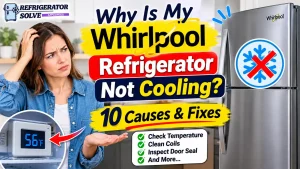
Opening your Whirlpool refrigerator and finding warm food instead of cold air can be frustrating, especially when the appliance seems to be running normally. The cause could be something simple, such as an incorrect temperature setting or blocked air vent, but it may also involve a fan, defrost system, sensor, or compressor problem.
Before replacing parts or scheduling an expensive repair, check the basic settings and airflow first. This guide explains why your Whirlpool refrigerator may not be cooling, how to identify the likely cause, and which troubleshooting steps are safe to try at home.
Quick Answer: Why Is My Whirlpool Refrigerator Not Cooling?
A Whirlpool refrigerator may stop cooling because its cooling function is turned off, Demo Mode is active, the temperature settings are incorrect, or airflow is restricted. Dirty condenser coils, damaged door seals, faulty fans, defrost problems, temperature sensors, and compressor issues can also affect cooling. Start with simple checks before considering component repairs.
First Checks Before Troubleshooting Your Whirlpool Refrigerator
Before assuming a major part has failed, check these items. They can help you rule out several common causes without taking the refrigerator apart.
1. Check Whether the Refrigerator Has Power
Start by checking whether the interior light and control panel work.
If neither responds, the refrigerator may not be receiving power. Check the power cord, wall outlet, and household circuit breaker. If the breaker has tripped repeatedly, do not keep resetting it. An electrical fault may need professional attention.
If the interior light works but the refrigerator is warm, that does not necessarily mean the cooling system is operating correctly. The light and cooling system use different components.
For more information about this symptom, see our guide on why a fridge is not cooling even though the light is on.
2. Make Sure the Cooling Function Is Turned On
Some Whirlpool refrigerators have a dedicated cooling control. It is possible to turn cooling off accidentally while leaving the interior lights and some other functions available.
Look at the control panel for a message or indicator such as “Cooling Off.” The exact wording depends on the model.
Check your refrigerator’s Use and Care Guide before changing any control settings. Do not assume that every Whirlpool refrigerator uses the same button combination.
3. Check for Demo or Showroom Mode
Demo Mode, also called Showroom Mode on some models, is designed for refrigerators displayed in retail stores.
When this mode is active, the refrigerator may appear to operate normally. The interior lights and display can work even though normal cooling has been disabled.
Look for an indicator such as “Showroom” or “Demo” on the display. If you find one, follow the instructions in your model’s manual to exit the mode.
Whirlpool explains this feature in its official control panel troubleshooting guide.
4. Check the Temperature Settings
An incorrect temperature setting can make food feel warmer than expected.
For general food safety, keep the refrigerator at or below 40°F (4.4°C) and the freezer at or below 0°F (-18°C). A refrigerator setting around 37°F (3°C) is a common target, but always check the instructions for your model.
Some Whirlpool refrigerators use digital temperature controls, while others have numbered settings. A higher or lower number does not mean the same thing on every model.
After changing a setting, give the refrigerator enough time to respond. Whirlpool advises waiting at least 24 hours between temperature adjustments on the models covered by its troubleshooting guidance. Avoid changing the setting repeatedly because that makes it harder to judge whether cooling is improving.
5. Check the Air Vents and Door Seals
Look inside the refrigerator and freezer for food packages blocking the air vents.
Cold air needs room to circulate. Pushing containers tightly against the vents or filling the compartments too heavily can create uneven temperatures.
Also inspect the door gaskets. Look for cracks, tears, dirt, or areas that no longer sit against the cabinet properly. Clean a dirty gasket with mild soap and water, then dry it.
If the door does not close fully, check whether a shelf, drawer, or food package is preventing it from shutting.
10 Common Reasons Your Whirlpool Refrigerator Is Not Cooling
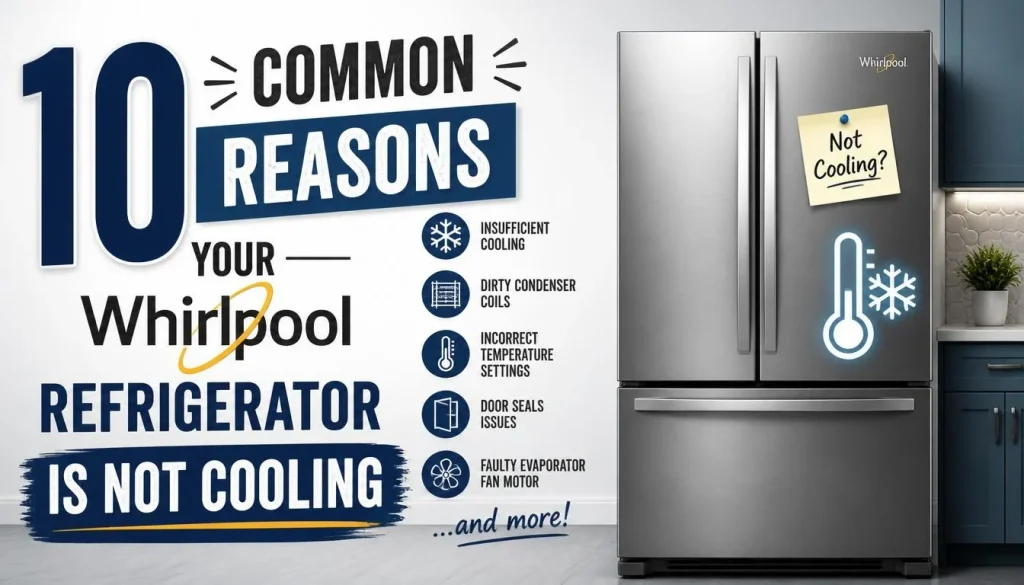
If the initial checks do not solve the problem, one of the following causes may be responsible.
1. Cooling Off or Demo Mode Is Active
A Whirlpool refrigerator may have power but still fail to cool when its normal cooling function has been switched off.
This can happen after someone changes the control settings, during installation, or when Demo Mode is accidentally activated.
What to check:
- Look for a Cooling Off, Demo, or Showroom indicator.
- Review the control panel instructions in your owner’s manual.
- Confirm that the cooling function is enabled.
- Allow time for the temperature to recover after normal cooling resumes.
Do not use a reset procedure from a different Whirlpool model. The correct control sequence can vary.
2. Incorrect Temperature Settings
If the refrigerator and freezer are both warmer than expected, the temperature controls deserve attention.
Someone may have changed the settings accidentally, or the refrigerator may not have been given enough time to stabilize after an adjustment.
What to do:
- Check the current refrigerator and freezer settings.
- Compare them with the recommendations in your owner’s manual.
- Adjust the temperature gradually.
- Measure the actual temperature with an appliance thermometer.
- Allow sufficient time for the temperature to stabilize.
If the refrigerator remains warm despite correct settings, another problem may be affecting cooling.
3. Blocked Air Vents or Poor Air Circulation
Most refrigerators rely on airflow to distribute cold air throughout the compartments.
Depending on the Whirlpool model, cold air may move from the freezer into the refrigerator through a system of vents and ducts.
When food blocks these openings, some areas may remain cold while others become too warm.
Possible signs include:
- The freezer is cold but the refrigerator is warm.
- Food near the vents freezes while food on other shelves feels warm.
- Cooling varies between different areas.
- The refrigerator struggles after being heavily loaded with groceries.
Move food containers away from the air openings. Avoid overfilling the compartments, and leave enough room for air to circulate.
4. Dirty Condenser Coils
The condenser releases heat from the refrigeration system. When dust, grease, and pet hair collect around the condenser area, heat cannot escape as effectively.
As a result, the refrigerator may need to work harder and may struggle to maintain the correct temperature.
Signs of dirty condenser coils can include:
- Longer compressor run times.
- Poor cooling performance.
- Excess heat around the lower or rear area.
- Cooling problems in a dusty or high-traffic household environment.
How to clean accessible condenser coils:
- Unplug the refrigerator before cleaning.
- Check your owner’s manual to locate the condenser and identify the correct access method.
- Remove the base grille only if your model’s instructions allow it.
- Use a suitable vacuum attachment or soft brush to remove dust.
- Reinstall the grille and restore power as instructed.
Do not force open sealed panels or touch electrical parts. Coil location and cleaning instructions vary by model.
Whirlpool provides additional instructions in its official refrigerator not-cooling troubleshooting guide.
5. Damaged Door Gasket or Poor Door Alignment
The door gasket creates a seal between the refrigerator door and its cabinet. If it is damaged or does not make proper contact, warm air can enter while cold air escapes.
This makes it harder for the refrigerator to maintain a stable temperature.
Common warning signs include:
- Visible cracks or tears in the rubber gasket.
- Condensation around the door.
- Frost or moisture in unusual areas.
- A door that does not close properly.
- Cooling performance that gets worse over time.
Inspect the entire gasket, including the corners. Clean away dirt and check whether the door closes evenly.
If the gasket is torn or no longer seals correctly, replacement may be necessary. Use the correct part for your exact Whirlpool model.
6. A Faulty Evaporator or Condenser Fan
Refrigerators use fans to move air and help remove heat. Depending on the design, the evaporator fan circulates cold air inside the compartments, while the condenser fan helps move air around the condenser and compressor area.
A failed or obstructed fan can affect cooling.
Signs of an evaporator fan problem:
- Weak airflow from refrigerator vents.
- Unusual buzzing, grinding, or scraping sounds.
- A freezer that stays colder than the refrigerator.
- Frost buildup near the fan area.
Signs of a condenser fan problem may include:
- Poor cooling in both compartments.
- Unusual noise from the lower rear area.
- A fan that does not operate when it should.
Some fan behavior is controlled by door switches and temperature demands, so a fan that stops temporarily is not automatically defective.
Never put your fingers near a moving fan. Unplug the refrigerator before inspecting an accessible fan area. If the motor, wiring, or control circuit needs testing, use a qualified technician.
7. A Malfunctioning Air Damper
The air damper regulates how much cold air moves into the refrigerator compartment on models that use this design.
If the damper becomes stuck closed or its motor fails, the freezer may remain cold while the refrigerator section warms up.
A stuck-open damper can cause the opposite problem: the refrigerator may become too cold and some food may freeze.
What to look for:
- Freezer temperature appears normal.
- Refrigerator temperature remains too high.
- Airflow from the refrigerator vents is weak.
- Temperature differences persist after blocked vents are cleared.
Damper locations and designs vary. Do not force the damper open or remove its housing without model-specific instructions.
8. Defrost System Failure and Frost Buildup
A frost-free refrigerator periodically removes ice from the evaporator area. If the defrost system stops working correctly, frost can accumulate and restrict airflow.
The refrigerator may gradually become warmer even though the compressor and fans appear to be operating.
Possible causes include:
- A faulty defrost heater.
- A defective defrost thermostat or sensor.
- A wiring problem.
- A control-board fault.
A heavily frosted rear freezer panel can be a useful warning sign, but it does not identify the failed component by itself.
Start by observing visible frost or ice. Do not use knives, screwdrivers, or sharp objects to remove it. Persistent frost buildup should be diagnosed properly.
For a more detailed explanation, read our guide on why a refrigerator may not be defrosting.
9. A Faulty Thermistor or Temperature Sensor
A thermistor measures temperature and sends information to the refrigerator’s control system.
If the sensor gives inaccurate readings or its wiring is damaged, the refrigerator may not respond to the actual temperature inside the compartments.
Possible symptoms include:
- Incorrect or unstable temperatures.
- Cooling that starts or stops at unexpected times.
- A refrigerator that remains warm despite normal settings.
- Temperature differences that do not match the control display.
A thermistor cannot be diagnosed reliably from symptoms alone. Testing usually requires the correct service information for the model and knowledge of its resistance-versus-temperature specifications.
Avoid replacing a sensor simply because the refrigerator is warm. A blocked vent, fan issue, or another component may produce similar symptoms.
10. Compressor, Start Components, or Sealed-System Problems
The compressor helps circulate refrigerant through the sealed cooling system. If it cannot start or operate correctly, the refrigerator may lose cooling in one or both compartments.
A problem with the compressor’s starting components can produce a repeated pattern of buzzing followed by clicking.
However, these sounds do not prove that the compressor itself has failed.
Other possible causes include:
- A faulty compressor start component.
- A damaged compressor.
- A control-board problem.
- A sealed-system or refrigerant issue.
Compressor and sealed-system diagnosis requires specialized tools and training. Do not open refrigerant lines or attempt to replace compressor components yourself.
Whirlpool Refrigerator Not Cooling? Identify the Problem by Symptoms
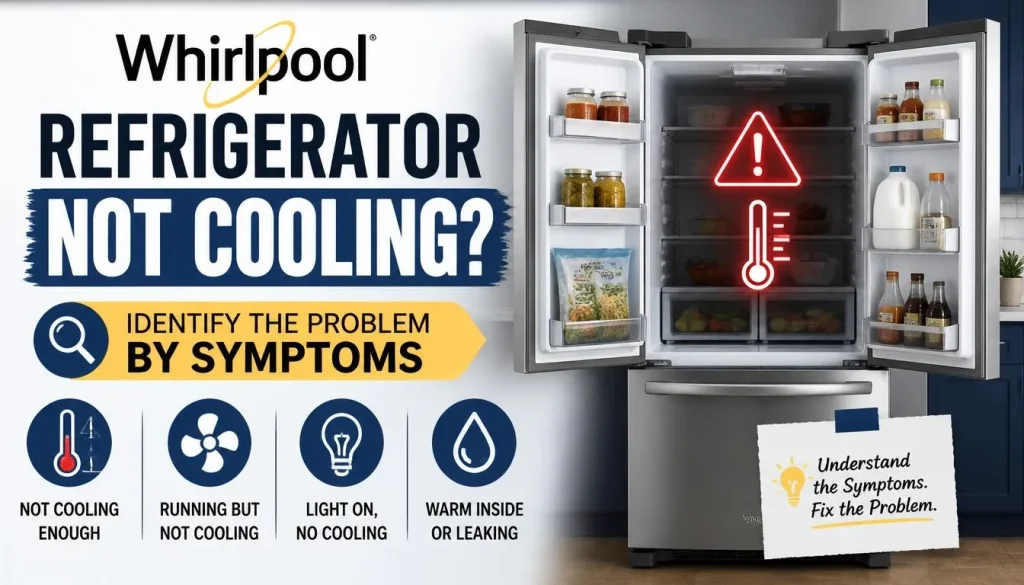
The way your refrigerator behaves can help narrow down the possible cause.
Both the Refrigerator and Freezer Are Warm
When both compartments become warm, check the main cooling controls, power supply, surrounding ventilation, and temperature settings first.
If these checks are fine, a condenser fan, compressor starting component, control board, or sealed-system fault may be involved.
Do not assume that a working interior light means the cooling system is working.
The Freezer Works but the Refrigerator Is Not Cooling
This is one of the most common refrigerator cooling complaints.
When the freezer is cold but the refrigerator compartment is warm, possible causes include:
- Blocked air vents.
- Evaporator fan problems.
- A stuck air damper.
- Frost buildup caused by a defrost issue.
- A temperature sensor problem.
Check for blocked vents and visible frost first. If the airflow remains weak, professional diagnosis may be needed.
We explain this particular problem in more detail in our guide to a refrigerator that is not cooling while the freezer is working.
The Lights Are On but the Refrigerator Is Not Cooling
Working lights only show that part of the electrical system has power. They do not confirm that the compressor, fans, or other cooling components are operating properly.
Check whether the display shows Cooling Off or Demo Mode, then inspect the temperature settings and airflow.
If the refrigerator remains warm, use the symptom-specific checks in the section above rather than replacing parts immediately.
The Compressor Runs but the Refrigerator Stays Warm
A running compressor does not guarantee that the refrigerator is cooling properly.
Possible explanations include:
- Dirty condenser coils.
- Restricted airflow.
- A faulty fan.
- A sealed-system problem.
- A compressor that is not operating effectively.
Because several faults can create similar symptoms, a technician may need to check the refrigeration system before recommending a repair.
The Refrigerator Makes Clicking or Buzzing Sounds
A brief hum or occasional click can be part of normal operation.
However, repeated buzzing followed by clicking, especially when the refrigerator is not cooling, deserves attention.
Possible causes include a fan obstruction, compressor starting problem, or water inlet valve issue.
For a Whirlpool-specific explanation, see our guide to a Whirlpool refrigerator making a loud buzzing noise.
What Does the PO or Power Outage Indicator Mean?
Some Whirlpool refrigerators display a PO message or Power Outage indicator after an interruption in electricity.
On the models covered by Whirlpool’s guidance, the indicator can appear when power has been interrupted and the freezer temperature rises to 18°F (-8°C) or higher.
This alert does not automatically mean the compressor has failed. It tells you that the refrigerator experienced a power interruption and that the freezer became warmer than its specified alert threshold.
What should you do?
- Check whether the electricity supply has returned to normal.
- Read the PO alert instructions for your model.
- Acknowledge the alert using the controls specified in the manual.
- Check the actual refrigerator and freezer temperatures.
- Protect any food that may have become too warm.
The button sequence for acknowledging the alert can differ by model. See Whirlpool’s official PO error code guidance for an example.
How to Check the Actual Temperature of Your Whirlpool Refrigerator
The temperature displayed on the control panel may represent the selected setting rather than the precise temperature of the food compartment.
An appliance thermometer gives you a more useful measurement.
Follow these steps:
- Place a refrigerator thermometer in the middle of the refrigerator compartment.
- Avoid placing it directly against a cold-air vent or next to the door.
- Allow the temperature to stabilize according to the thermometer’s instructions.
- Check the reading and compare it with the recommended food-storage temperature.
- Measure the freezer separately if necessary.
The refrigerator should remain at or below 40°F (4.4°C), while the freezer should be at or below 0°F (-18°C).
The USDA explains how to use an appliance thermometer to check refrigerator temperature.
How to Fix a Whirlpool Refrigerator That Is Not Cooling
After identifying a possible cause, follow the appropriate safe steps.
Start with these checks:
- Confirm that the cooling function is on.
- Exit Demo or Showroom Mode using model-specific instructions.
- Adjust the temperature according to the owner’s manual.
- Move food away from blocked air vents.
- Clean accessible condenser areas as directed by Whirlpool.
- Check whether the doors close and seal correctly.
- Allow enough time for the temperature to recover.
If the control panel is not responding, a power reset may help with certain control-related problems. Whirlpool’s guidance for the models covered by its reset instructions recommends disconnecting power for one minute, restoring power, and confirming that cooling is turned on.
Only follow that procedure if it is appropriate for your model. A reset will not repair a failed fan, compressor, sensor, or sealed cooling system.
Do not repeatedly unplug the refrigerator in an attempt to force it to cool.
How Long Does a Whirlpool Refrigerator Take to Cool?
The recovery time depends on what happened and which refrigerator model you own.
If the refrigerator has just been installed, Whirlpool advises allowing up to 24 hours for it to cool completely on the models covered by its guidance.
After adding a large amount of food or beverages, the temperature may take several hours to stabilize. Frequent door opening can also slow recovery.
After adjusting the temperature, avoid making another change immediately. Whirlpool recommends waiting at least 24 hours between adjustments in its troubleshooting guidance.
If the refrigerator remains warmer than 40°F (4.4°C) after an appropriate recovery period, investigate further rather than assuming it only needs more time.
Is Your Food Safe When a Whirlpool Refrigerator Stops Cooling?
Food safety should come before appliance troubleshooting.
If your refrigerator is not cooling, move perishable food to another working refrigerator or a properly iced cooler whenever possible.
Keep the refrigerator and freezer doors closed as much as you can while dealing with a power interruption.
According to FoodSafety.gov:
- A refrigerator can generally keep food cold for about four hours if the door remains closed during a power outage.
- Perishable food that has been above 40°F (4°C) for more than two hours should be discarded.
- Never taste food to decide whether it is safe.
These time limits matter when deciding what to keep after a power outage or cooling failure. Check the FoodSafety.gov guide to food safety during a power outage for detailed advice.
When Should You Call a Whirlpool Refrigerator Repair Technician?
Basic checks are useful, but some faults require professional diagnosis.
Arrange service if:
- Both compartments remain warm after basic troubleshooting.
- The compressor repeatedly buzzes and clicks.
- A fan motor appears to have stopped working.
- Heavy frost keeps returning.
- The control panel shows an unfamiliar fault indication.
- A refrigerator trips the household circuit breaker.
- You notice a burning smell or signs of electrical damage.
- Cooling does not recover after the recommended waiting period.
Before arranging service, note your Whirlpool model number, the symptoms, any display messages, and whether the refrigerator or freezer is affected.
This information can help the technician narrow down the problem.
For a refrigerator that is still under warranty, review the manufacturer’s service guidance before attempting repairs that could affect warranty coverage.
Frequently Asked Questions
Why is my Whirlpool refrigerator running but not cooling?
A Whirlpool refrigerator may continue running without cooling effectively because of dirty condenser coils, blocked airflow, a failed fan, a defrost problem, or a sealed-system fault. Check the controls, vents, and condenser area first. If temperatures continue rising, arrange professional diagnosis.
Why is my Whirlpool refrigerator not cooling but the freezer works?
This often indicates a problem with cold-air circulation between the freezer and refrigerator compartments. Blocked vents, an evaporator fan issue, a stuck damper, or frost buildup can cause this symptom. The exact cause depends on the refrigerator’s design.
Why are my Whirlpool refrigerator lights on but it is not cooling?
Interior lights can work even when the compressor or cooling controls are not operating correctly. Check the Cooling Off setting, Demo Mode, temperature controls, and airflow. If the refrigerator stays warm, a component fault may need diagnosis.
How do I reset a Whirlpool refrigerator that is not cooling?
The reset procedure depends on the model and the problem. Whirlpool provides a one-minute power reset for certain control-panel problems, followed by restoring power and checking that cooling is enabled. Consult your owner’s manual before using this procedure.
Why is my Whirlpool refrigerator not cooling after a power outage?
A power interruption may have affected the refrigerator’s settings or cooling operation. Some models also display a PO alert after the freezer temperature rises to the specified threshold. Confirm power has returned, check the controls, and measure the actual temperature.
Can dirty condenser coils cause a Whirlpool refrigerator to stop cooling?
Yes. Dust, grease, and pet hair around the condenser can reduce heat removal and affect cooling performance. Follow the cleaning instructions for your model and disconnect power before cleaning accessible areas.
Can a bad door seal cause a Whirlpool refrigerator to stop cooling?
A damaged gasket can allow warm air into the refrigerator. This makes it harder to maintain a stable temperature and may increase frost or condensation. Inspect the entire gasket and replace it if it is damaged or no longer seals properly.
Why is my Whirlpool refrigerator not cooling in the garage?
The surrounding temperature may be outside the operating range specified for your refrigerator. Some models are designed for indoor use only, while others may have different installation requirements. Check the model’s installation guide before using it in an unheated or unusually hot garage.
How do I know if my Whirlpool refrigerator compressor is bad?
Repeated clicking, buzzing, overheating, and poor cooling can suggest a compressor or starting-system problem, but these symptoms do not confirm compressor failure. A qualified technician should test the relevant components before recommending compressor replacement.
What temperature should my Whirlpool refrigerator be set to?
A common refrigerator target is about 37°F (3°C), with the actual compartment temperature kept at or below 40°F (4.4°C). The freezer should be at or below 0°F (-18°C). Follow your model’s manual and confirm temperatures with an appliance thermometer.
Final Thoughts
When your Whirlpool refrigerator is not cooling, start with the simplest possible explanations. Check the cooling function, temperature controls, air vents, condenser area, and door seals before assuming that an expensive component has failed.
Pay attention to the symptoms, too. A cold freezer with a warm refrigerator suggests a different problem from two compartments that are both getting warmer. A PO indicator after a power interruption also provides useful information.
Most importantly, do not replace parts based on guesswork. Use your exact Whirlpool model number when checking repair instructions, protect food that may no longer be at a safe temperature, and contact a qualified technician when the problem involves electrical components, the compressor, or the sealed cooling system.

Hi, I’m the lead researcher and appliance enthusiast behind RefrigeratorSolve. With years of hands-on experience troubleshooting cooling systems and testing home appliances, I am dedicated to bringing you honest reviews, energy-saving tips, and practical solutions to keep your refrigerator running perfectly.