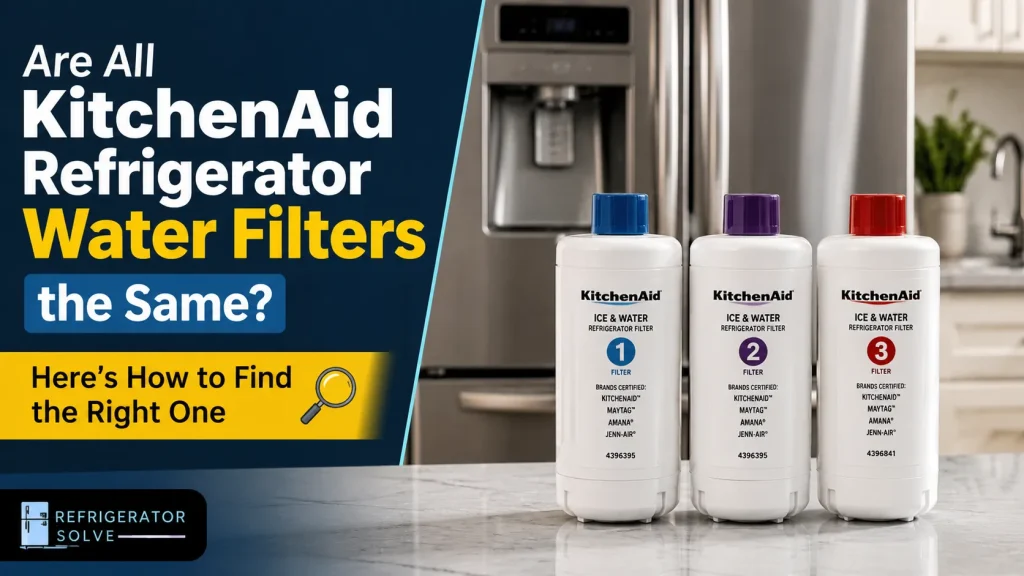
No, all KitchenAid refrigerator water filters are not the same. Different KitchenAid refrigerator models can require different filter types, sizes, fittings, and part numbers. Even when two filters look almost identical, that does not automatically mean you can swap one for the other.
The safest way to choose a replacement is to identify your refrigerator’s exact model number, check the number on your existing filter, and then confirm compatibility before buying.
KitchenAid currently lists several water-filter families, including KitchenAid-branded Filters 1 through 4 and EveryDrop options including Filter A and Filters 1 through 6. That alone is a good indication that there is no single universal KitchenAid refrigerator water filter.
If you are standing in front of a shelf full of filters wondering why they all look so similar, don’t worry. Below, we’ll break down what actually matters and show you how to find the right filter without guessing.
Are All KitchenAid Refrigerator Water Filters the Same?
No. KitchenAid refrigerator water filters are model-specific rather than universally interchangeable.
A Filter 1 is not automatically a substitute for Filter 2, Filter 3, or Filter 4. Likewise, an EveryDrop Filter A, 5, or 6 should only be used when it is listed as compatible with your refrigerator.
The differences may include:
- Cartridge length and diameter
- Connection points
- Locking or twist mechanisms
- Filter-housing design
- Installation location
- Replacement part number
- Filtration performance and certification
- Refrigerator-model compatibility
This is why choosing a filter simply because it looks like your old one can cause problems.
Quick answer: Match the filter to your refrigerator’s model number or approved replacement part number, not just its appearance.
Why Do KitchenAid Refrigerators Use Different Water Filters?
KitchenAid has produced many refrigerator designs over the years, including French-door, side-by-side, bottom-freezer, built-in, and other configurations. Their internal water systems have also changed.
As a result, one filter cartridge cannot necessarily fit every refrigerator.
Different Filter Housings
Some filters slide straight into a compartment. Others need to be twisted into position, attached to a reusable cap, or locked into a base-grille housing.
KitchenAid’s own replacement instructions differ depending on whether you have Filter 1, 2, 3, or 4. For example, Filter 1 is typically inserted differently from Filter 3, which can use an eject-button and filter-cap system on compatible refrigerators.
Different Physical Dimensions
Two cartridges may look similar in an online photo but differ slightly in length, width, grooves, tabs, or connection design.
Those small differences matter because the filter has to create a proper seal inside the refrigerator’s filter housing.
Different Refrigerator Generations
An older KitchenAid refrigerator may use a filter family that is different from the one used in a recently released model.
This is one reason you should not assume that your friend’s KitchenAid refrigerator uses the same filter as yours—even if both refrigerators are similar in size.
Different Filtration Specifications
Filter performance can also vary. Depending on the specific filter, certified reduction claims may cover different substances.
For example, current performance documentation for certain Filter 1, Filter 2, and Filter 4 systems lists certification against NSF/ANSI Standards 42, 53, and 401 for the specific contaminants identified in their performance data sheets.
Always check the performance sheet for the exact filter you intend to use rather than assuming every KitchenAid-compatible filter removes the same contaminants.
KitchenAid Refrigerator Water Filter Types Explained
KitchenAid’s current U.S. filter page includes multiple KitchenAid and EveryDrop filter options. Here is a quick overview.
| Filter Type | Common Current Part Number | What You Need to Know |
|---|---|---|
| Filter A | EDRARXD1 | Used only with compatible refrigerator models |
| Filter 1 | KAD1RXD1 / EDR1RXD1 | KitchenAid and EveryDrop versions are available for compatible systems |
| Filter 2 | KAD2RXD1 / EDR2RXD1 | Requires a refrigerator designed for the Filter 2 system |
| Filter 3 | KAD3RXD1 / EDR3RXD1 | Common on certain compatible built-in and other models |
| Filter 4 | KAD4RXD1 / EDR4RXD1 | Different connection and installation design from other filter families |
| Filter 5 | EDR5RXD1 | Model-specific; not interchangeable with Filters 1–4 simply because it is an EveryDrop filter |
| Filter 6 | EDR6D1 | Designed for specific compatible refrigerator systems |
Important: This table is not a universal refrigerator compatibility chart. The filter number tells you which filter family you are looking at; your refrigerator model number tells you whether that filter actually fits.
KitchenAid Refrigerator Water Filter Compatibility Chart: How to Use One Correctly
A compatibility chart can save time, but it should never be used based only on refrigerator style.
For example, don’t assume:
- Every French-door KitchenAid uses Filter 2
- Every built-in KitchenAid uses Filter 3
- Every side-by-side refrigerator uses the same cartridge
- A newer-looking filter must replace an older one
Instead, use this process:
| What to Check | Why It Matters |
|---|---|
| Refrigerator model number | Most reliable way to identify compatibility |
| Existing filter number | Helps identify the filter family already installed |
| Owner’s manual | Usually lists approved replacement filters |
| Replacement-filter listing | Confirms compatible models or replacement numbers |
| Filter housing | Helps catch an obviously incorrect cartridge before installation |
KitchenAid specifically notes that your refrigerator’s model number is different from its serial number, so make sure you are entering the correct number when looking up parts.
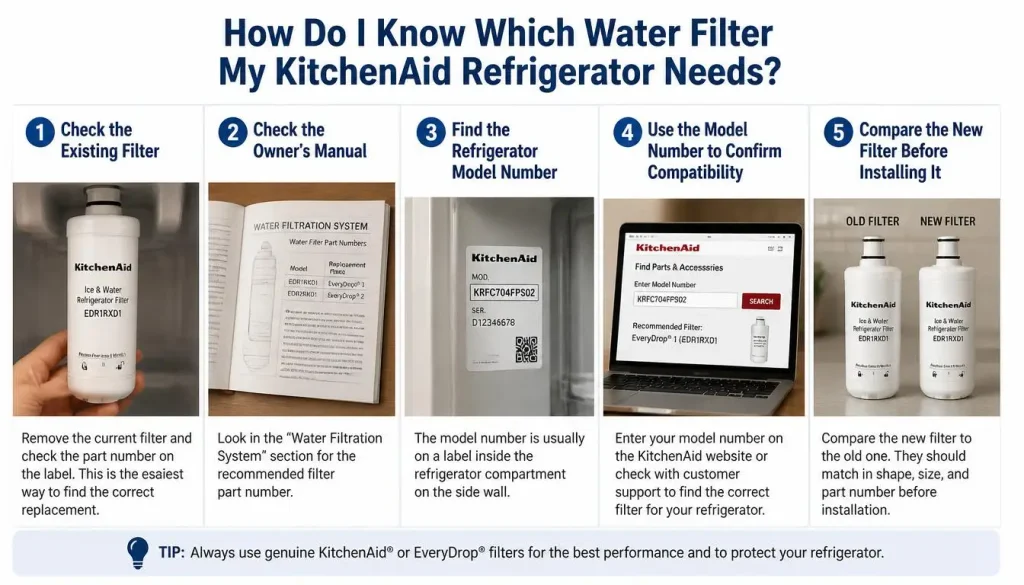
How Do I Know Which Water Filter My KitchenAid Refrigerator Needs?
If you are unsure which water filter fits your KitchenAid refrigerator, don’t start by searching for “KitchenAid water filter” and buying the first result.
Use these steps instead.
Step 1: Check the Existing Filter
If a filter is already installed, remove it according to your refrigerator’s instructions and look for the part or filter number printed on the cartridge.
KitchenAid Product Help states that the water-filter number can often be found directly on the side of the removed filter.
Write the complete number down. Don’t rely on memory, especially if several characters look similar.
Step 2: Check the Owner’s Manual
Look in the accessories, replacement parts, maintenance, or water filtration section.
KitchenAid says the filter number may be listed in the Accessories section of the owner’s manual.
If you no longer have the printed manual, search for the manual using the refrigerator’s complete model number.
Step 3: Find the Refrigerator Model Number
The model label is usually somewhere inside the refrigerator cabinet, although its exact location varies by model.
Check areas such as:
- Interior side walls
- Ceiling area
- Door frame
- Around or behind crisper drawers
- Lower interior sections
Use the model number, not the serial number.
Step 4: Use the Model Number to Confirm Compatibility
Once you know the model number, look up the recommended water filter through KitchenAid’s filter or appliance-support resources.
This step is more reliable than shopping by refrigerator appearance.
Step 5: Compare the New Filter Before Installing It
Before removing packaging or forcing the cartridge into the housing, compare:
- Filter number
- Length and shape
- Connector end
- Tabs and grooves
- Cap design
- Installation arrows
If something looks noticeably different, stop and verify the part again.
KitchenAid Filter A vs 1 vs 2 vs 3 vs 4 vs 5 vs 6: What’s the Difference?
The number or letter identifies a filter family, not a quality ranking.
Filter 4 is not automatically “better” than Filter 2 because it has a higher number. Likewise, Filter A is not necessarily newer or more powerful than all numbered filters.
The most important difference is compatibility.
Filter A
EveryDrop Filter A, commonly identified as EDRARXD1 in KitchenAid’s current filter catalog, is intended for refrigerators designed around that filter system.
It should not be substituted for Filter 1 or Filter 2 unless your exact refrigerator documentation specifically allows it.
Filter 1
Current KitchenAid materials list KAD1RXD1 and EveryDrop EDR1RXD1 within the Filter 1 family. Performance documentation for compatible Filter 1 systems also identifies both of these numbers as replacement options.
Filter 2
Filter 2 includes KitchenAid KAD2RXD1 and EveryDrop EDR2RXD1 for compatible refrigerators.
KitchenAid documentation for certain refrigerators specifically lists either KAD2RXD1 or EDR2RXD1 as the appropriate Filter 2 replacement.
Filter 3
Filter 3 includes KAD3RXD1 and EDR3RXD1 in KitchenAid’s current catalog.
KitchenAid’s instructions for some built-in refrigerators list either of these Filter 3 options as appropriate replacements.
Filter 4
Filter 4 includes KAD4RXD1 and EDR4RXD1. Performance documentation for compatible systems identifies these as replacement filters within the same system family.
Filter 5 and Filter 6
KitchenAid’s current filter catalog also includes EveryDrop EDR5RXD1 and EDR6D1.
These should be treated as separate filter families. Don’t try to use one simply because your refrigerator uses another EveryDrop cartridge.
KitchenAid KAD vs EveryDrop EDR Water Filters
This is one of the areas that causes the most confusion.
You may search for a KitchenAid filter and find both a KAD part number and an EDR EveryDrop part number.
For example:
- KAD1RXD1 and EDR1RXD1
- KAD2RXD1 and EDR2RXD1
- KAD3RXD1 and EDR3RXD1
- KAD4RXD1 and EDR4RXD1
For compatible refrigerator systems, KitchenAid documentation can list the corresponding KAD and EDR products as approved replacement options in the same filter family.
So, if your manual specifies Filter 2, for example, you may encounter both KitchenAid and EveryDrop versions.
The key point is this:
Match the complete approved replacement specification for your refrigerator. Do not assume that any EDR or KAD filter will work simply because the brand is associated with KitchenAid.
Are KitchenAid Refrigerator Water Filters Interchangeable?
Not universally.
Some KitchenAid and EveryDrop cartridges within the same approved filter family may be listed as replacement options for the same filtration system. But Filter 1, Filter 2, Filter 3, and the other filter families should not be treated as interchangeable.
If your refrigerator requires Filter 2, buying Filter 4 because it is cheaper or easier to find is not a safe substitution.
Even if you manage to partially insert an incorrect cartridge, that does not mean it is properly compatible.
Are Filters Interchangeable If They Look the Same?
No.
Visual similarity is one of the easiest ways to buy the wrong refrigerator filter.
Many cartridges use a long cylindrical design, but the connector, grooves, O-rings, locking mechanism, and internal specifications may be different.
Think of it like a key: two keys can look almost identical at first glance, but one small difference can prevent the lock from turning.
With a refrigerator filter, those small differences can affect both fit and water flow.
Does My New Filter Number Have to Match the Old Filter Exactly?
Not always character for character.
Manufacturers sometimes update part numbers or list multiple approved replacement numbers for the same filtration system.
That means an older cartridge number may have a current replacement that looks different on the packaging.
Instead of demanding an identical printed number, verify that the newer part number is officially listed as a replacement for your refrigerator model or filtration system.
Never rely only on a marketplace seller saying “compatible with KitchenAid.”
Can You Use Any Water Filter in a KitchenAid Refrigerator?
No.
A replacement filter needs to match the refrigerator’s filtration system.
Using the wrong cartridge can lead to:
- A filter that will not insert completely
- A filter that will not lock into position
- No water from the dispenser
- Slow water flow
- Reduced ice production
- Leaking around the filter housing
- An improperly sealed connection
- A filter-status problem after replacement
KitchenAid Product Help notes that a clogged or incorrectly installed filter can reduce water flow to the dispenser and ice maker, potentially causing smaller ice cubes, lower ice production, or longer dispensing times.
Can I Use an EveryDrop Filter in a KitchenAid Refrigerator?
Yes, when the EveryDrop filter is approved for your specific KitchenAid refrigerator.
KitchenAid’s current water-filter catalog lists multiple EveryDrop filters, and its refrigerator documentation commonly identifies compatible EveryDrop EDR filters alongside KitchenAid KAD filters.
However, “EveryDrop compatible” does not mean every EveryDrop cartridge fits every KitchenAid refrigerator.
You still have to choose the correct filter number.
Can I Use a Whirlpool Filter in a KitchenAid Refrigerator?
Possibly, but only when the exact replacement filter is specified as compatible with your refrigerator.
Don’t choose a filter based only on the appliance brand printed on the box.
Part-number and model compatibility are what matter.
If a Whirlpool-branded, EveryDrop, or another manufacturer-approved cartridge is officially cross-listed for your refrigerator’s filtration system, it may be an appropriate replacement. Otherwise, don’t assume it will fit.
OEM vs Generic KitchenAid Refrigerator Water Filters
You will usually see two broad choices when shopping: manufacturer-approved filters and lower-priced third-party “compatible” filters.
Both categories deserve a closer look.
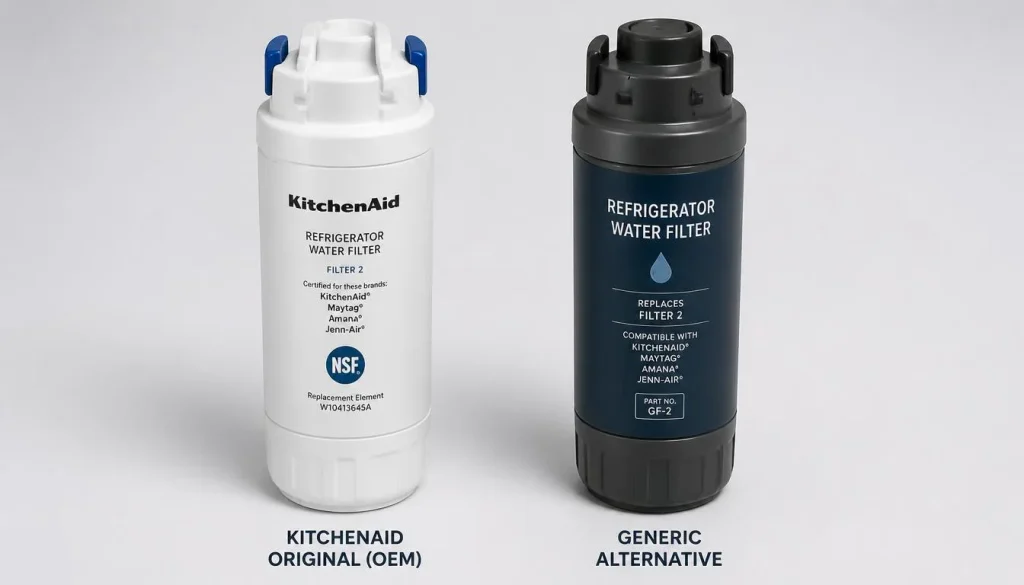
Genuine KitchenAid and Approved EveryDrop Filters
The biggest advantage is straightforward compatibility when you choose the correct part number.
You can also review official performance data for contaminant-reduction claims and certification information rather than relying only on advertising language.
The downside is price. Genuine or manufacturer-approved filters may cost more than generic replacements.
Third-Party Compatible Filters
Aftermarket filters can be cheaper, and some may perform well. But quality and testing are not identical across every brand.
Before buying one, check:
- Exact refrigerator model compatibility
- Full replacement part numbers
- Independent certification information
- What contaminants the certification actually covers
- Seller reputation
- Return policy
- Installation instructions
Be cautious with vague phrases such as “NSF tested,” “NSF material,” or “designed to NSF standards.” Those statements are not necessarily the same as certification of a particular filtration system for specific reduction claims.
Which One Should You Choose?
If you want the simplest route, use the manufacturer-recommended filter listed for your model.
If you choose an aftermarket filter to save money, verify its compatibility and certification carefully rather than selecting the cheapest option.
Are KitchenAid Refrigerator Water Filters NSF Certified?
Some KitchenAid-compatible filtration systems are certified under NSF/ANSI standards for specific contaminant-reduction claims.
For example, current performance documentation for certain Filter 1, Filter 2, and Filter 4 systems identifies testing and certification under NSF/ANSI Standards 42, 53, and 401.
However, don’t turn that into a blanket statement that every cartridge removes the same substances.
Certification must be checked for the exact filter and filtration system.
Depending on the standard and filter, testing may relate to things such as:
- Chlorine taste and odor
- Particulates
- Lead
- Certain chemicals
- Certain emerging contaminants
The performance data sheet is the best place to see what a specific filter is certified to reduce.
How Long Does a KitchenAid Refrigerator Water Filter Last?
KitchenAid generally recommends replacing its refrigerator water filter about every six months, when the filter indicator tells you to change it, or sooner when needed.
Six months is a guideline, not a promise that every filter will perform exactly the same for every household.
You may need to replace the filter sooner if:
- Your household uses a large amount of water
- Water contains a high level of sediment or minerals
- Water flow becomes noticeably slower
- Ice production drops
- Water develops an unusual taste or odor
- The refrigerator’s filter indicator tells you to replace it
Some KitchenAid filtration-system documentation specifies a 200-gallon (757-liter) rated capacity for particular filter systems, but capacity can depend on the specific system.
Check your own filter’s documentation instead of assuming every KitchenAid filter has the same gallon rating.
Signs You May Have Installed the Wrong KitchenAid Water Filter
A wrong filter isn’t always obvious the moment you open the box.
Here are some warning signs.
The Filter Won’t Slide In
Don’t force it.
KitchenAid’s Filter 1 instructions specifically caution against forcing the filter if it does not slide in easily; alignment should be checked instead.
If proper alignment still doesn’t help, verify the filter number.
The Filter Won’t Lock
A cartridge that enters the housing but never locks or clicks into its proper position may be the wrong design.
Remove it and compare the connector and tabs with the old filter.
Water Stops Dispensing
First check that the new cartridge is fully seated.
If the problem started immediately after the filter change, incorrect installation or an incompatible cartridge is a strong possibility.
Water Flow Becomes Very Slow
Reduced flow can be caused by a clogged filter, installation issue, or other refrigerator/water-supply problem.
KitchenAid notes that clogged or incorrectly installed filters can restrict water flow.
Water Leaks Around the Filter
Remove the cartridge and inspect the O-rings and installation position.
Don’t continue using a filter that will not create a secure seal.
The Filter Indicator Doesn’t Reset
The indicator light is not necessarily proof that the physical filter is wrong. Many models require a separate reset procedure after installation.
Check your refrigerator’s manual for the correct reset steps.
How to Replace a KitchenAid Refrigerator Water Filter
The exact method depends on the filter type and refrigerator model, so your owner’s manual should always take priority.
In general, the process looks like this.
1. Identify the Correct Replacement
Confirm both the refrigerator model and filter number before opening the new cartridge.
2. Remove the Old Filter
Depending on the refrigerator, you may need to:
- Pull it straight out
- Twist it counterclockwise
- Press an eject button
- Remove and reuse a filter cap
Keep a towel nearby because a small amount of water may remain inside the old cartridge.
3. Prepare the New Filter
Remove protective covers while making sure the O-rings remain correctly positioned.
4. Install the New Cartridge
Align the arrows, grooves, tabs, or locking points exactly as directed for your filter type.
Never force a cartridge that clearly does not fit.
5. Flush the Water System
KitchenAid’s current replacement instructions for Filters 1 through 4 instruct users to run four gallons of water through the line after replacement to flush the new filter.
6. Reset the Filter Status
If your refrigerator has a filter indicator, reset it according to the instructions for your exact model.
KitchenAid Water Filter vs Air Filter: They Are Not the Same Thing
Some KitchenAid refrigerators may have both a water filter and an air filter.
They perform completely different jobs.
A water filter treats water going to the refrigerator’s dispenser or ice-making system.
An air filter is designed to help manage odors and air quality inside the fresh-food compartment.
So, if your refrigerator tells you to replace an air filter, don’t confuse that notification with your water-filter replacement schedule.
Can a KitchenAid Refrigerator Work Without a Water Filter?
Some KitchenAid refrigerator systems can operate in bypass mode when the filter is removed, allowing water to continue flowing without being filtered.
KitchenAid Product Help notes this behavior when discussing a clogged filter, but you should still check the owner’s manual for your exact refrigerator because water-system designs can vary.
If the refrigerator is operating without a filter in bypass mode, remember that the dispensed water is not receiving the filtration provided by the cartridge.
Buying the Right KitchenAid Filter in the USA, Canada, UK, and Australia
The basic compatibility process is the same regardless of where you live:
- Find the refrigerator model number.
- Identify the current filter.
- Check the owner’s manual.
- Confirm the approved replacement.
- Buy from a reputable retailer.
However, refrigerator model ranges, packaging, product codes, and available replacements can vary by country.
USA
KitchenAid’s U.S. filter catalog provides model-based filter resources and lists multiple KitchenAid and EveryDrop options.
Use your complete refrigerator model number before ordering.
Canada
Canadian models can share filter families with U.S. refrigerators, but don’t assume that every model or package is identical.
Use the Canadian KitchenAid support information or your appliance manual to verify the filter.
UK
For a UK refrigerator, use the model number and documentation supplied for your regional model. Avoid buying a North American cartridge simply because the product image appears identical.
Australia
The same rule applies in Australia. Check the local model documentation and approved replacement number before purchasing.
Regional compatibility is especially important when buying through international marketplaces, where listings may combine several countries in one product description.
Quick Checklist Before Buying a KitchenAid Refrigerator Water Filter
Before clicking “Buy Now,” take 60 seconds to check the following:
- Do I know my refrigerator’s complete model number?
- Did I check the number printed on my current filter?
- Does the replacement listing explicitly support my refrigerator or filter number?
- Am I buying Filter A, 1, 2, 3, 4, 5, or 6 based on compatibility rather than appearance?
- If choosing KAD or EDR, is it the correct filter family?
- Have I checked the filter’s certification and performance claims?
- Is the seller reputable?
- Can I return it if the compatibility information is incorrect?
Those checks can save you from opening a cartridge that doesn’t fit and then discovering it cannot be returned.
Frequently Asked Questions
Are all KitchenAid refrigerator water filters interchangeable?
No. KitchenAid refrigerators use different filter families, and compatibility depends on the specific refrigerator model and filtration system. Always verify the approved filter number before purchasing.
Which water filter fits my KitchenAid refrigerator?
Find your refrigerator model number and use it to check the owner’s manual or KitchenAid’s filter resources. You can also inspect the number printed on your existing cartridge.
How do I find my KitchenAid refrigerator water filter number?
KitchenAid says you can commonly find it in the Accessories section of the owner’s manual, printed on the filter itself, or through a filter-finder tool.
What is the difference between KitchenAid Filter 1, 2, 3, 4, 5, and 6?
They are different filter families intended for different compatible refrigerator systems. The higher number does not mean better filtration. Your refrigerator model determines which one you need.
What is KitchenAid Filter A?
Filter A is another filter family included in KitchenAid’s current EveryDrop filter catalog. One current part number is EDRARXD1. It should only be used with compatible refrigerator models.
Is KAD1RXD1 the same as EDR1RXD1?
They are KitchenAid and EveryDrop replacement options within the Filter 1 family, and performance documentation for compatible Filter 1 systems lists both as replacement filter numbers. Always confirm that your refrigerator uses Filter 1 before ordering.
Can I use EveryDrop filters in a KitchenAid refrigerator?
Yes, if the specific EveryDrop filter is approved for your KitchenAid refrigerator model. KitchenAid currently lists several EveryDrop filter families.
Do all KitchenAid refrigerators use EveryDrop filters?
No single EveryDrop filter fits every KitchenAid refrigerator. You still need to select the correct EveryDrop filter number for your model.
Can I use a generic water filter in my KitchenAid refrigerator?
You may find third-party filters advertised as compatible, but verify the exact replacement number, fit, certification, and manufacturer information before buying. A generic “fits KitchenAid” claim by itself is not enough.
Are KitchenAid filters interchangeable if they look the same?
No. Similar appearance does not guarantee compatible connectors, dimensions, locking mechanisms, or filtration specifications.
Does the replacement filter number need to match the old filter?
Not necessarily character for character because approved replacement part numbers can change. The new number must, however, be officially compatible with your refrigerator or filtration system.
Where is the water filter located in a KitchenAid refrigerator?
The location depends on the model. Common areas include an upper corner inside the refrigerator or the lower base-grille area. Your owner’s manual will show the exact location.
How often should I change my KitchenAid refrigerator water filter?
KitchenAid generally recommends replacement every six months, when the filter indicator comes on, or sooner if needed.
How many gallons does a KitchenAid refrigerator filter last?
Some KitchenAid filtration-system documentation specifies a 200-gallon capacity, but you should check the performance data for your exact filter because capacity can vary by system.
Are KitchenAid refrigerator filters NSF certified?
Certain KitchenAid-compatible filtration systems have certifications under NSF/ANSI Standards such as 42, 53, and 401 for specified reduction claims. Certification and contaminant claims should be checked for the exact filter you are buying.
What happens if I put the wrong filter in my KitchenAid refrigerator?
It may not fit, lock, seal, or allow normal water flow. You could also experience leaks, slow dispensing, reduced ice production, or no water from the dispenser.
Why isn’t my KitchenAid refrigerator dispensing water after changing the filter?
Start by checking whether the filter is the correct model and whether it is fully installed. Also check the household water supply. KitchenAid notes that incorrect filter installation can restrict water flow.
Should I replace my filter before six months if water flow becomes slow?
Yes, it may be necessary. KitchenAid recommends earlier replacement when water flow noticeably decreases because that can indicate a clogged filter.
Final Verdict: Are All KitchenAid Refrigerator Water Filters the Same?
No—KitchenAid refrigerator water filters are not all the same, and you should not treat them as universally interchangeable.
KitchenAid refrigerators can use several different filter families, including Filter A and Filters 1 through 6. The correct cartridge depends on your refrigerator’s specific filtration system.
The easiest way to avoid buying the wrong one is simple: find your refrigerator model number, check the existing filter or owner’s manual, and verify the approved replacement before ordering.
Don’t choose a filter because it looks right. Don’t assume every KitchenAid refrigerator uses the same EveryDrop cartridge. And don’t force a replacement that doesn’t fit properly.
A few minutes spent checking the model and part number can save you the hassle of a leaking filter, weak water flow, or an expensive cartridge you can’t use.

Hi, I’m the lead researcher and appliance enthusiast behind RefrigeratorSolve. With years of hands-on experience troubleshooting cooling systems and testing home appliances, I am dedicated to bringing you honest reviews, energy-saving tips, and practical solutions to keep your refrigerator running perfectly.