
A refrigerator is one of the first appliances you worry about when the power goes out. A short outage is usually manageable, but once the blackout stretches for hours, keeping food cold becomes much more important.
The good news is that you do not necessarily need a huge whole-house generator just to keep a refrigerator running. For many standard refrigerators, a compact inverter generator in roughly the 2,000- to 2,500-watt class can provide useful backup capacity. The important part is checking both your refrigerator’s running watts and compressor starting watts before choosing a generator.
I compared portable inverter generators based on usable output, portability, fuel options, runtime, noise, power quality, and safety features. All six models below had active Amazon listings or buying options when checked, although availability can change.
Affiliate Disclosure: RefrigeratorSolve participates in the Amazon Services LLC Associates Program. We may earn a commission from qualifying purchases at no additional cost to you.
Quick Comparison: Best Portable Generators for Refrigerator Backup
| Product | Starting Watts | Running Watts | Fuel | Best For |
|---|---|---|---|---|
| Westinghouse iGen2550DFc | 2,550W | 1,900W | Gas/Propane | Best Overall |
| Generac GP2500i | 2,500W | 2,200W | Gasoline | Extra Running-Watt Headroom |
| WEN 56235i | 2,350W | 1,900W | Gasoline | Best Value |
| Champion 201183 | 2,500W | 1,850W Gas | Gas/Propane | Best Dual-Fuel Alternative |
| Honda EU2200i | 2,200W | 1,800W | Gasoline | Premium Choice |
| GENMAX GM2200i | 2,200W | 1,800W | Gasoline | Budget Compact Pick |
1. Westinghouse iGen2550DFc – Best Overall Portable Generator for Refrigerator
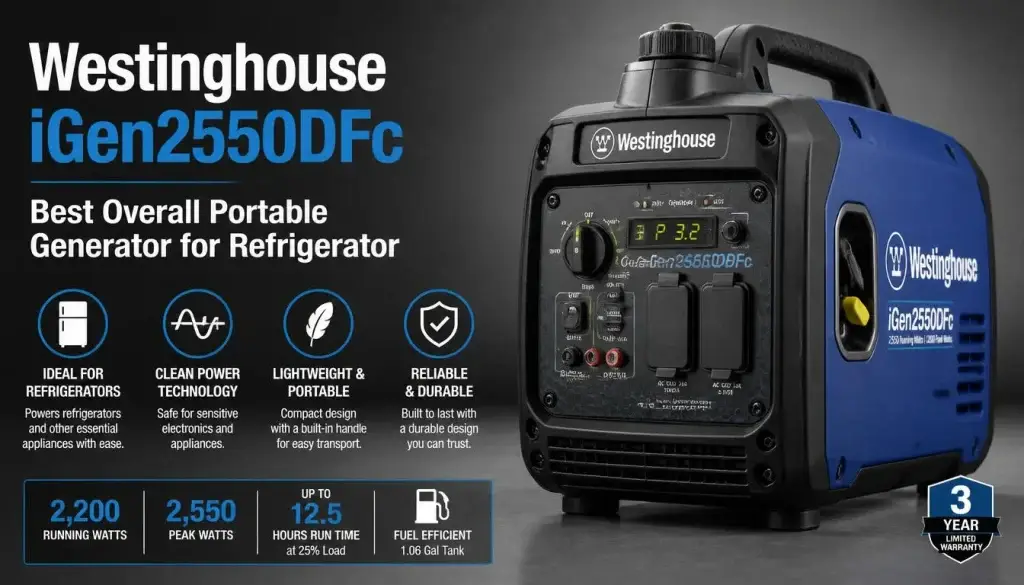
The Westinghouse iGen2550DFc hits a particularly useful sweet spot for refrigerator backup. It produces up to 2,550 peak watts and 1,900 running watts while keeping the unit compact enough to move without turning generator setup into a major job.
Its biggest advantage is dual-fuel operation. You can run it on gasoline or propane, which gives you another option during long outages when one fuel may be difficult to find.
Westinghouse also lists less than 3% THD, making the output suitable for sensitive electronics in addition to appliances. The generator weighs about 42 pounds, offers an economy mode, and can run for up to 12 hours under lighter loads.
Pros
- ✓ 2,550 peak watts provide useful compressor-starting headroom
- ✓ Runs on gasoline or propane
- ✓ Compact and relatively lightweight
- ✓ Low-THD inverter power
- ✓ Economy mode helps reduce fuel consumption
- ✓ CO sensor included
- ✓ RV-ready outlet adds versatility
Cons
- ✗ Propane output may differ from gasoline performance
- ✗ Costs more than some gasoline-only budget generators
- ✗ Still requires outdoor fuel storage and engine maintenance
My Take
For most homeowners searching specifically for the best portable generator for refrigerator backup, this is the model I would put near the top of the list.
The power level makes sense for refrigerator duty without forcing you into an oversized generator, and dual-fuel capability is genuinely useful during an emergency. If gasoline becomes difficult to find after a storm, having propane as a second option can make a big difference.
2. Generac GP2500i – Best for Extra Running-Watt Headroom
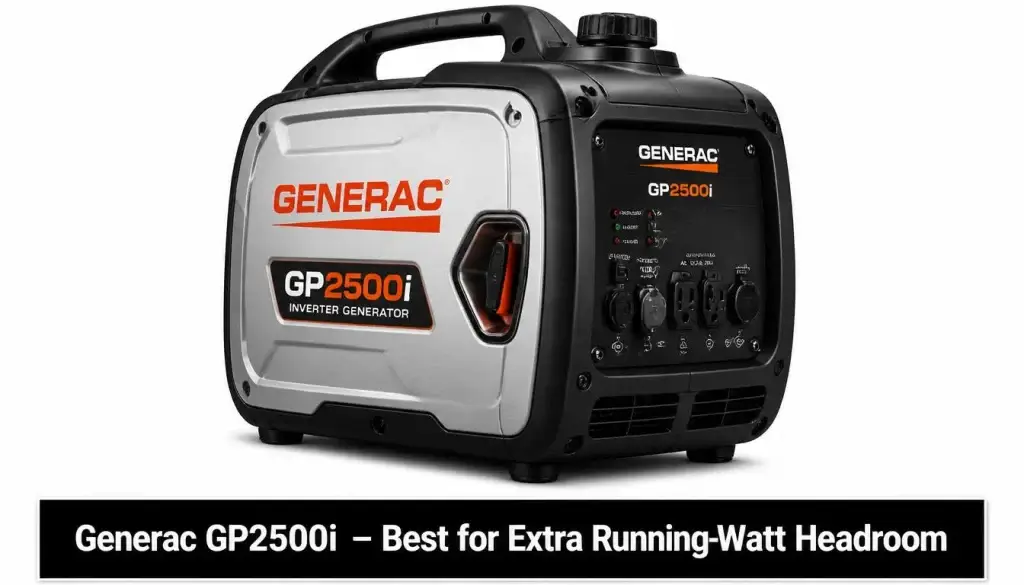
If you want a little more continuous output, the Generac GP2500i deserves a close look.
It delivers 2,500 starting watts and 2,200 running watts. That 2,200-watt continuous rating gives you more breathing room than several compact competitors, particularly if you want to keep the refrigerator running while occasionally charging phones, powering a router, or using a few LED lights.
Generac specifies less than 3% THD through its TruePower system. The GP2500i also includes economy mode, COsense carbon-monoxide monitoring, and approximately 53 dB(A) operation at 25% load. Amazon lists the unit at roughly 46.6 pounds.
Pros
- ✓ Strong 2,200-watt continuous output
- ✓ 2,500 starting watts
- ✓ Low-THD inverter power
- ✓ COsense automatic CO monitoring
- ✓ Economy mode
- ✓ Parallel capable
- ✓ Household outlets and USB charging
Cons
- ✗ Gasoline only
- ✗ Not as light as the smallest options
- ✗ More capacity than necessary if you only have a tiny refrigerator
My Take
The GP2500i makes sense when you want your refrigerator to be the priority but do not want every additional device to eat up your available power immediately.
That extra running capacity makes it one of the more flexible compact generators in this comparison.
3. WEN 56235i – Best Value Portable Generator for a Refrigerator
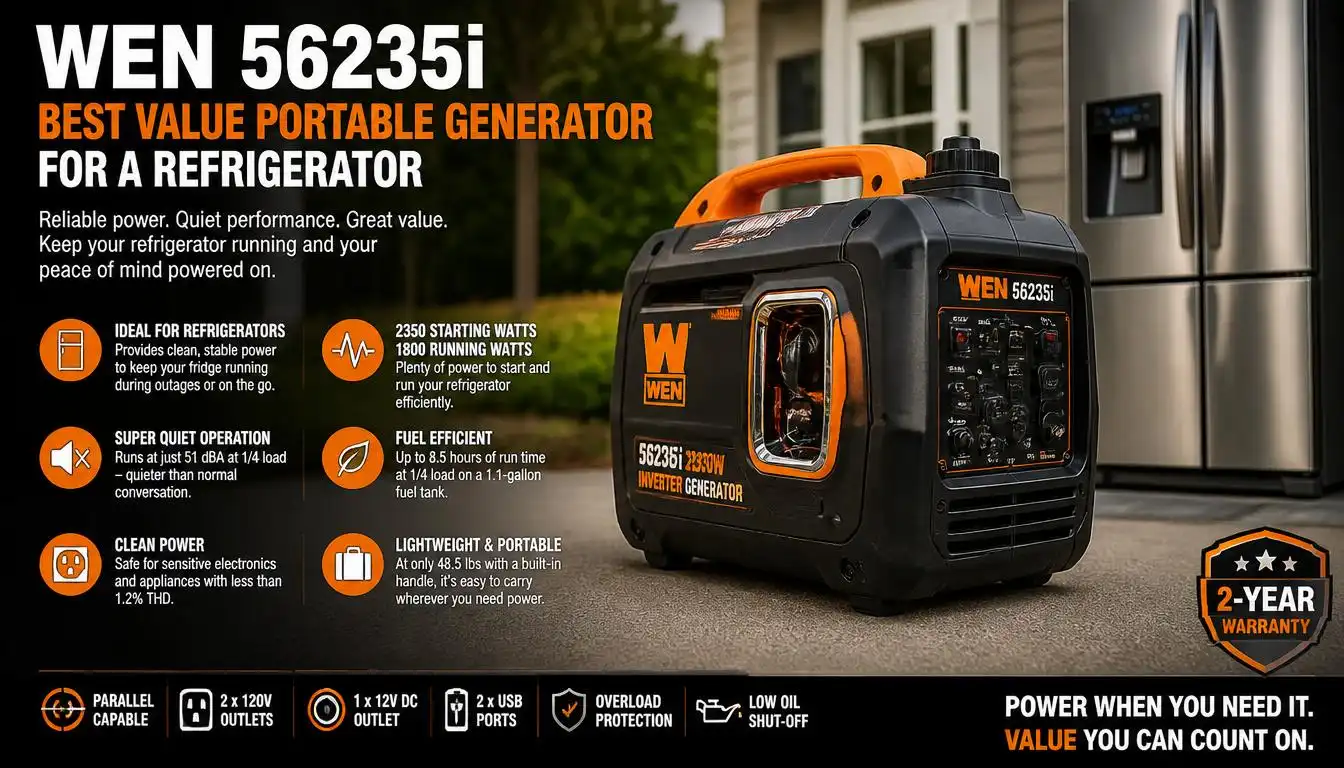
You do not need to spend premium-generator money to get a useful refrigerator backup solution.
The WEN 56235i produces 2,350 surge watts and 1,900 rated watts. It weighs about 39 pounds, making it one of the easiest options here to carry from a garage or storage area when an outage hits.
WEN also specifies approximately 51 dB at quarter load. Its fuel-shutoff feature allows the generator to use the remaining fuel in the carburetor before shutting down, which can make storage and maintenance a little easier.
Pros
- ✓ 2,350 surge watts
- ✓ 1,900 rated watts
- ✓ Only about 39 pounds
- ✓ Very quiet for a gasoline generator
- ✓ Clean inverter output
- ✓ Fuel-shutoff function
- ✓ Usually positioned as a value-oriented option
Cons
- ✗ Gasoline only
- ✗ Less starting capacity than Westinghouse or Generac
- ✗ No dual-fuel flexibility
My Take
The WEN is one of the easiest recommendations for someone who mainly wants to protect refrigerated food during occasional outages.
It gives you enough output to be genuinely useful while remaining compact enough that you will not dread moving it outside every time the utility power disappears.
For an older refrigerator with unusually high startup demand, though, check the appliance specifications carefully before buying.
4. Champion 201183 – Best Dual-Fuel Alternative

The Champion Power Equipment 201183 is another strong choice if fuel flexibility matters more to you than squeezing out the maximum possible running wattage.
On gasoline, it provides 2,500 starting watts and 1,850 running watts. On propane, Champion specifies 2,500 starting watts and 1,665 running watts.
The generator weighs about 39 pounds and includes Champion’s CO Shield shutoff system. Champion also lists approximately 53 dBA operation at 23 feet and less than 3% THD. Runtime can reach 11.5 hours at 25% load on gasoline and considerably longer when connected to a suitable propane tank.
Pros
- ✓ Gasoline and propane capability
- ✓ Lightweight at around 39 pounds
- ✓ 2,500 starting watts
- ✓ CO Shield safety system
- ✓ Low-THD inverter output
- ✓ Parallel capable
- ✓ Long potential propane runtime
Cons
- ✗ Lower running output when using propane
- ✗ No electric start
- ✗ Larger additional loads require careful wattage management
My Take
If you already keep propane cylinders at home, the Champion becomes particularly attractive.
Propane stores differently from gasoline and gives you another fuel source during extended outages. Just remember that its continuous output drops when running on propane, so calculate your refrigerator and additional appliance load accordingly.
5. Honda EU2200i – Best Premium Portable Generator for Refrigerator Backup
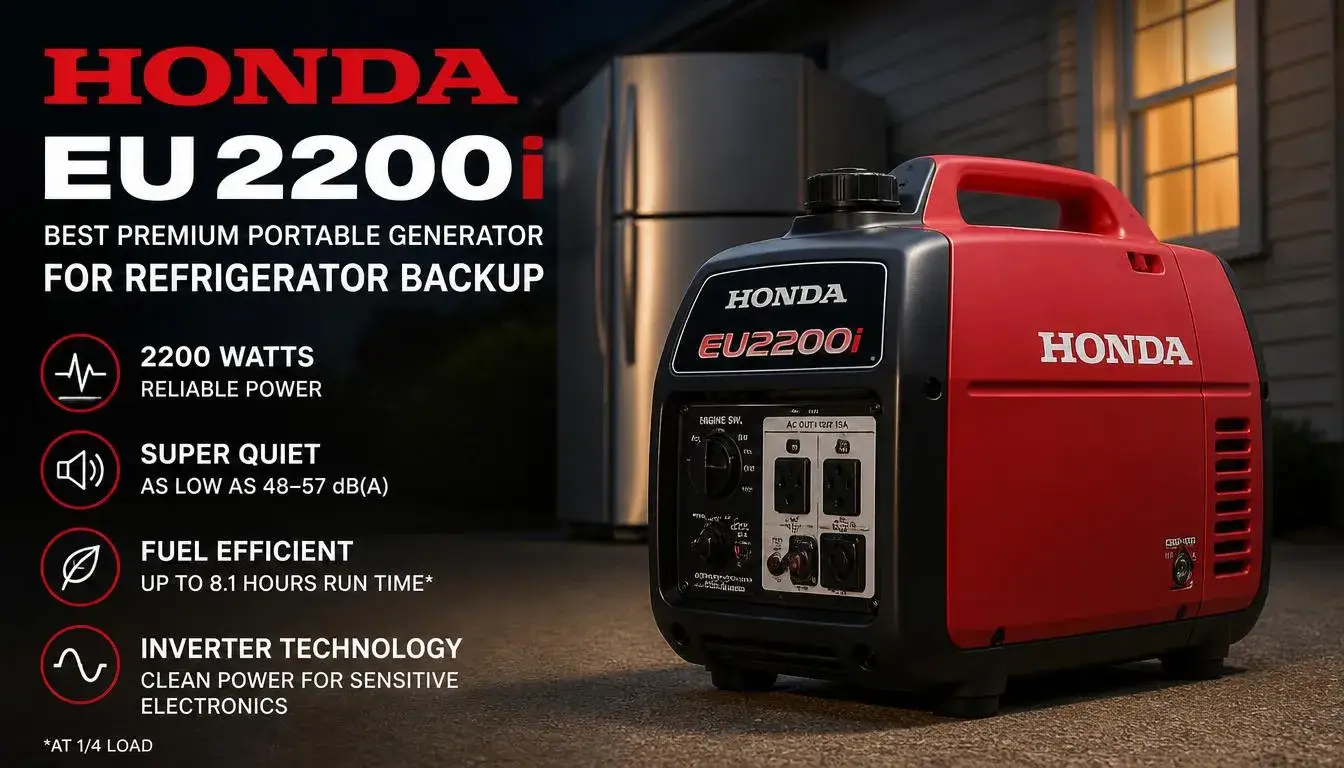
The Honda EU2200i is a familiar name in the compact inverter-generator category, especially for shoppers who care about noise, portability, and straightforward operation.
The EU2200i provides 2,200 watts of peak output and about 1,800 watts of continuous output. Honda’s Amazon listing specifies approximately 48 to 57 dB(A) operation, a 0.95-gallon fuel tank, and up to 8.1 hours of runtime depending on load.
It also includes Honda’s CO-MINDER system and Bluetooth connectivity through the My Generator app.
Pros
- ✓ Quiet operating range
- ✓ Compact inverter design
- ✓ Suitable for many standard refrigerator backup situations
- ✓ CO-MINDER safety system
- ✓ Bluetooth monitoring features
- ✓ Good fuel efficiency under lighter loads
Cons
- ✗ Premium price
- ✗ Gasoline only
- ✗ 1,800 running watts gives less headroom than the Generac GP2500i
My Take
The EU2200i is difficult to ignore if noise and overall refinement are high on your priority list.
However, buying strictly for refrigerator backup changes the value calculation. Less-expensive generators provide similar or slightly higher wattage.
Choose the Honda when you expect to use the generator regularly for camping, RV trips, home backup, or other situations where its quieter operation and compact design will matter beyond a single refrigerator.
6. GENMAX GM2200i – Best Budget Compact Generator
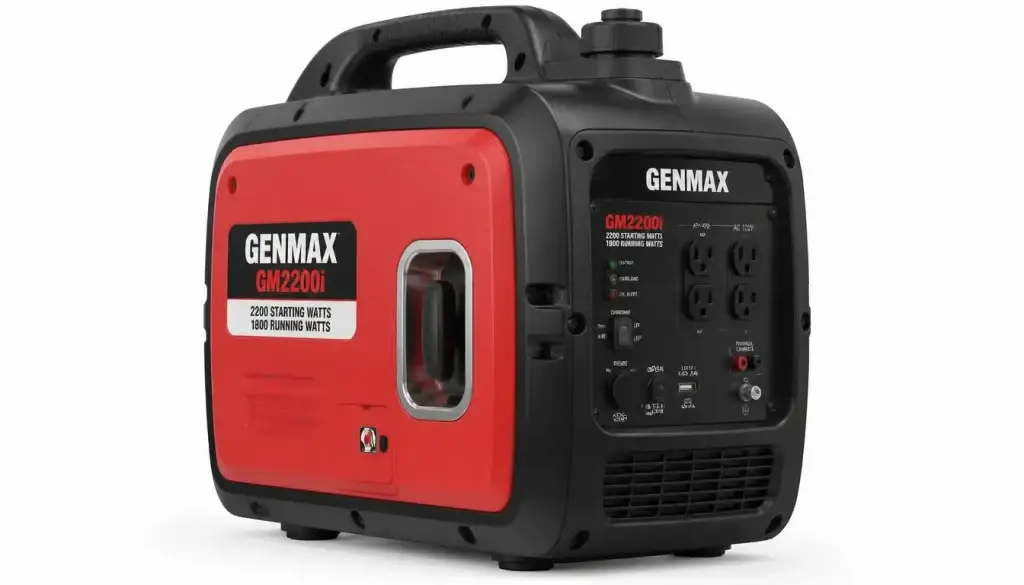
The GENMAX GM2200i is worth considering when you want compact inverter power without moving into the premium end of the market.
It provides 2,200 starting watts and 1,800 running watts from a 79.7cc four-stroke engine. Amazon lists the generator at about 41.8 pounds with less than 3% THD, economy mode, a CO shutdown sensor, and parallel capability.
GENMAX specifies noise as low as 58 dBA and up to six hours of operation at 50% load.
Pros
- ✓ 2,200 starting watts
- ✓ 1,800 continuous watts
- ✓ Relatively lightweight
- ✓ Less than 3% THD
- ✓ Economy mode
- ✓ CO shutdown sensor
- ✓ Parallel capable
Cons
- ✗ Gasoline only
- ✗ Less output headroom than the 2,500-watt models
- ✗ Runtime depends heavily on load
My Take
The GM2200i is best suited to someone who wants a simple emergency generator primarily for a refrigerator and a few low-wattage essentials.
Its 1,800-watt continuous rating means you will need to be more disciplined about what else gets plugged in while the refrigerator compressor is operating.
What Size Generator Do You Need to Run a Refrigerator?
There is no single wattage number that applies to every refrigerator.
A refrigerator may consume relatively little electricity once the compressor is running, but the compressor can briefly demand considerably more power when it starts. This is why starting watts or surge watts matter.
Before choosing a generator:
- Find the refrigerator’s electrical label or owner’s manual.
- Identify its normal operating requirement.
- Check whether the manufacturer provides starting or surge requirements.
- Choose a generator that can handle the compressor surge as well as the continuous load.
- Leave extra capacity if you plan to power anything else.
For many ordinary household refrigerators, a compact inverter generator around the 2,000- to 2,500-watt class is a practical starting point, but the refrigerator’s actual specifications should always make the final decision.
Buyer’s Guide: 5 Things to Consider Before Buying a Refrigerator Generator
1. Starting Watts Matter More Than Most People Expect
Do not shop using only a generator’s continuous watt rating.
A refrigerator compressor needs extra power for a short period when it starts. If your generator cannot handle that surge, it may overload or shut down even though the refrigerator consumes much less electricity after the compressor is running.
Look at both:
- Starting/peak/surge watts
- Running/rated watts
Then compare both numbers with your refrigerator’s requirements.
2. Inverter Generators Make Sense for Home Essentials
Every generator in this guide is an inverter model.
An inverter generator regulates its output electronically and is designed to provide cleaner electricity than many basic conventional generators. That also makes these generators useful when you want to power a refrigerator along with electronics such as a router, laptop, phone charger, or television.
Several models here specify less than 3% total harmonic distortion.
3. Gasoline vs. Dual Fuel
A gasoline generator is simple and widely available, but dual-fuel generators give you more options.
Models such as the Westinghouse iGen2550DFc and Champion 201183 can operate on gasoline or propane.
That flexibility can be useful during storms and extended outages when local fuel availability becomes unpredictable.
Just remember that generator output can change depending on which fuel you use.
4. Portability Matters During an Actual Outage
A generator may look portable on a product page until you need to carry it outside in bad weather.
For refrigerator-only backup, I generally prefer compact inverter generators over unnecessarily large open-frame machines.
The WEN and Champion models in this guide weigh around 39 pounds, while the Westinghouse is roughly 42 pounds.
That makes setup considerably easier for many homeowners.
5. Carbon Monoxide Safety Is Non-Negotiable
A portable fuel-burning generator should never be operated inside your home, garage, basement, shed, carport, or another enclosed or partially enclosed area.
The U.S. Consumer Product Safety Commission advises operating portable generators outdoors at least 20 feet from homes and buildings, with the exhaust directed away from windows, doors, and vents.
A built-in CO shutoff sensor is useful, but it does not make indoor generator use safe.
If you are connecting a generator to household wiring rather than running an appliance through an appropriately rated cord, use a properly installed transfer switch. Connecting a generator directly to household wiring can create dangerous backfeeding.
Frequently Asked Questions
Can a 2,000-Watt Generator Run a Refrigerator?
It can run many refrigerators, provided both the refrigerator’s continuous consumption and compressor starting surge stay within the generator’s limits.
Do not assume that every refrigerator will work simply because the generator says “2,000 watts.” Check the refrigerator’s electrical requirements first.
If the compressor has a high startup demand, moving into a 2,200- to 2,500-watt generator may give you a more comfortable margin.
Is a 2,500-Watt Generator Enough for a Refrigerator?
For many standard household refrigerators, a 2,500-watt inverter generator provides useful backup capacity and some room for small additional loads.
The Generac GP2500i, for example, is rated at 2,500 starting watts and 2,200 running watts, while the Champion 201183 provides 2,500 starting watts with 1,850 running watts on gasoline.
Your refrigerator’s actual startup requirement remains the deciding factor.
Can I Run a Refrigerator and Freezer on the Same Generator?
Possibly, but calculate the loads carefully.
Both appliances use compressors, and both can create startup surges. The worst-case situation occurs when the two compressors try to start at nearly the same time.
If you intend to power a refrigerator, separate freezer, lights, electronics, and other household essentials, a larger generator may make more sense than the compact models covered here.
Should I Buy an Inverter Generator for My Refrigerator?
For a small emergency-backup setup, an inverter generator is often a practical choice.
They are typically compact, relatively quiet, fuel efficient under changing loads, and capable of producing clean power for other electronics you may need during an outage.
Can I Plug My Refrigerator Directly Into a Generator?
A refrigerator may be powered from a properly sized generator using the correct connection method and an appropriately rated grounded extension cord where permitted by the appliance and generator manufacturers.
The Electrical Safety Foundation International recommends using extension cords rated for the intended load, with three-prong plugs, and inspecting cords for damage.
Never plug a portable generator into a wall outlet to try to power the house. That can cause dangerous backfeeding.
How Far Should a Generator Be From My House?
CPSC guidance says portable generators should be operated outside, at least 20 feet away from the home, with exhaust directed away from buildings and openings.
Even a generator equipped with an automatic CO shutoff system must still be operated outdoors in a safe location.
Is a Dual-Fuel Generator Worth It for Refrigerator Backup?
It can be.
For occasional emergency use, having gasoline and propane options gives you more flexibility. The Westinghouse iGen2550DFc and Champion 201183 are especially attractive for this reason.
A gasoline-only model still makes sense if you want the simplest setup and know you can maintain a safe fuel supply.
Final Verdict: Which Portable Generator Should You Buy for a Refrigerator?
For most people, the Westinghouse iGen2550DFc offers the best overall balance. Its 2,550-watt peak output, 1,900-watt running capacity, inverter design, dual-fuel capability, compact weight, and CO sensor make it well suited to emergency refrigerator backup.
If you want more continuous wattage for a refrigerator plus a few additional essentials, the Generac GP2500i stands out with 2,200 running watts.
For value, the WEN 56235i is hard to overlook. And if quiet operation and a premium compact design matter more than price, the Honda EU2200i remains an appealing option.
Whichever generator you choose, check your refrigerator’s actual wattage requirements before buying. A little extra capacity is much better than discovering during a blackout that the generator can run the fridge but cannot handle the compressor when it tries to restart.
CHECK PORTABLE GENERATOR PRICES ON AMAZON

Hi, I’m the lead researcher and appliance enthusiast behind RefrigeratorSolve. With years of hands-on experience troubleshooting cooling systems and testing home appliances, I am dedicated to bringing you honest reviews, energy-saving tips, and practical solutions to keep your refrigerator running perfectly.