
A refrigerator thermostat helps control the cooling system by responding to changes in temperature inside the appliance. Traditional refrigerators use a mechanical thermostat to switch cooling on and off, while many newer models rely on electronic sensors and a control board to manage the same job.
Understanding how this system works can help you make sense of temperature changes, unusual compressor activity, and common refrigerator cooling problems. It can also help you avoid replacing the wrong part when your refrigerator is not keeping food cold.
What Does a Refrigerator Thermostat Do?
The main job of a refrigerator thermostat is to help maintain the selected temperature inside the refrigerator. It monitors temperature and controls when the cooling system needs to operate.
Think of it as a temperature regulator. When the inside of the refrigerator becomes warmer than the control system allows, it calls for cooling. Once the temperature drops to the required level, it reduces or stops the demand for cooling.
Depending on the refrigerator design, the thermostat or electronic control system may help manage:
- When the compressor starts and stops.
- How long the cooling system operates.
- The temperature of the refrigerator compartment.
- Separate refrigerator and freezer temperature settings.
- The operation of fans or other cooling components in some models.
The thermostat does not create cold air by itself. It controls the cooling process. The compressor, refrigerant, condenser, and evaporator work together to remove heat from inside the refrigerator.
How Does a Refrigerator Thermostat Work?
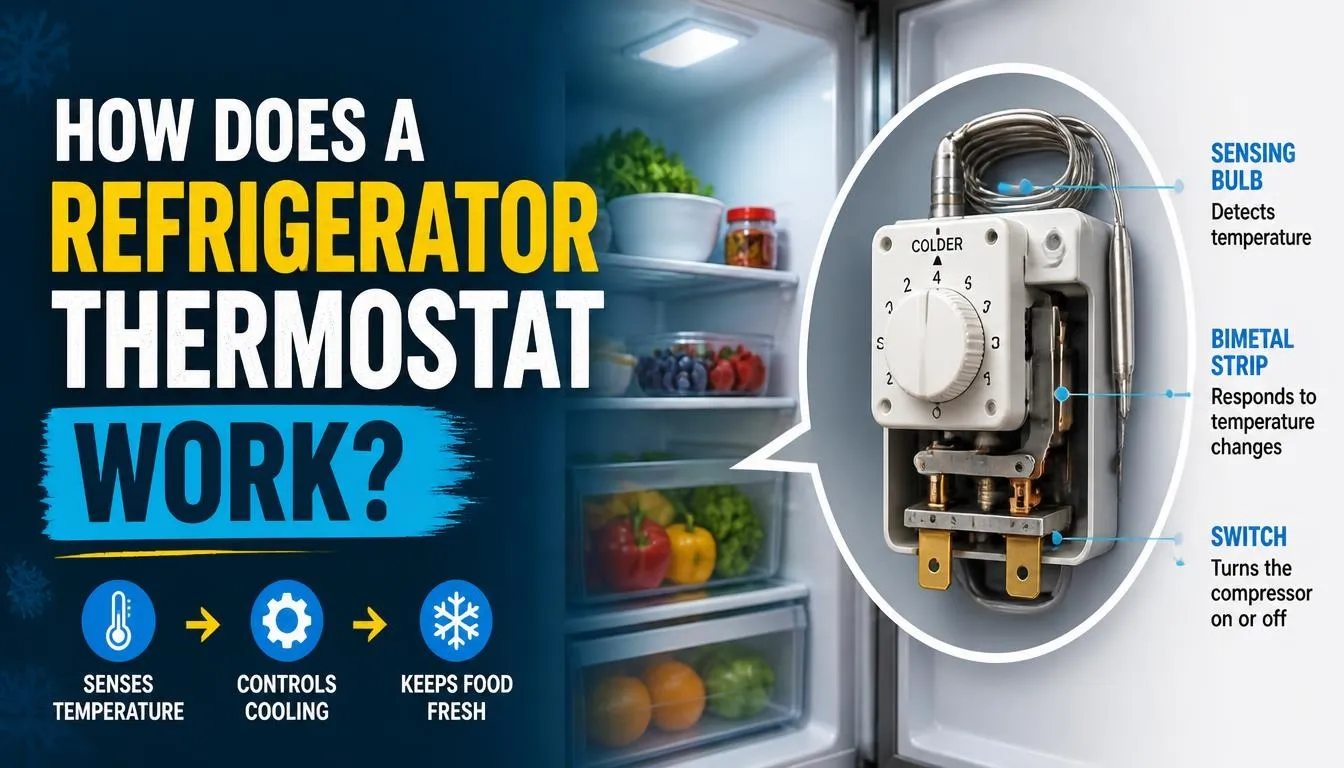
The basic idea is straightforward: the refrigerator senses its temperature, compares it with the selected setting, and operates the cooling system when necessary.
Here is how a typical cooling cycle works:
1. The refrigerator temperature rises.
Every time you open the door, add warm food, or allow cold air to escape, the temperature inside can increase. Even with the door closed, the temperature changes naturally as the refrigerator operates.
2. The thermostat or temperature sensor detects the change.
A mechanical thermostat responds directly to temperature changes through its sensing element. In an electronic system, a thermistor measures temperature and sends information to the control board.
3. The control system calls for cooling.
When the temperature reaches the point at which cooling is needed, the thermostat’s electrical contacts or the electronic control system allow the compressor to operate.
4. The compressor starts the cooling process.
The compressor circulates refrigerant through the refrigeration system. The refrigerant absorbs heat from inside the appliance and releases it through the condenser.
5. The refrigerator reaches the required temperature.
When the temperature falls to the control system’s stopping point, the mechanical thermostat opens its contacts or the electronic system reduces or stops the cooling demand.
6. The cycle repeats.
As the temperature rises again, the system calls for cooling. This cycle helps keep the refrigerator within its intended temperature range.
This is the general operating principle. The exact control sequence depends on the refrigerator’s design. Whirlpool’s explanation of refrigerator operation describes how modern temperature sensors and electronic controls work with the compressor to manage cooling.
How Does a Mechanical Refrigerator Thermostat Work?
A mechanical refrigerator thermostat uses a temperature-sensitive component to control an electrical switch. You will commonly find this design in older refrigerators and some basic compact models.
One important part is the capillary tube or sensing phial. It contains a gas or other temperature-sensitive fluid in a sealed system.
Here is what happens:
- The sensing phial responds to the temperature inside the refrigerator.
- As the temperature rises, the gas or fluid inside the sensing system expands and its pressure changes.
- This pressure moves a bellows or diaphragm inside the thermostat.
- The movement operates an electrical switch.
- The switch allows the compressor to run and cool the refrigerator.
- As the temperature falls, the pressure changes in the opposite direction, allowing the switch to stop the compressor when the required temperature is reached.
The cycle starts again when the refrigerator warms up.
The mechanism is relatively simple because the sensing element and switch work together without needing a digital display or a separate electronic control board.
Beko’s refrigerator guide explains how a gas-filled phial, bellows, and switch mechanism operate in a traditional mechanical thermostat.
How Do Electronic Refrigerator Temperature Controls Work?
Many modern refrigerators do not use the traditional mechanical thermostat found in older models. Instead, they use electronic controls, temperature sensors, and a control board.
The most common temperature-sensing component is a thermistor.
A thermistor is a small electrical component whose resistance changes when its temperature changes. The refrigerator’s control board reads this change and uses the information to manage cooling.
The process generally works like this:
- A thermistor measures the temperature in a particular area of the refrigerator.
- Its electrical resistance changes as the temperature changes.
- The control board interprets the sensor reading.
- The board determines whether more cooling is needed.
- It controls the compressor and, depending on the model, other cooling components such as fans or dampers.
- The system continues monitoring the temperature and adjusts operation as needed.
For example, when the fresh-food compartment becomes warmer than its target temperature, the control board may increase cooling demand. Once the temperature returns to the required range, it can reduce or stop that demand.
Some refrigerators also use variable-speed compressors. These models may adjust compressor speed rather than simply switching between fully on and fully off. That is one reason a newer refrigerator may sound different from an older model.
Whirlpool explains the use of electronic controls and temperature sensors in modern refrigerators.
What Is the Difference Between a Thermostat and a Thermistor?
These two components are related, but they are not the same thing.
A thermostat is a temperature-control device. A traditional mechanical thermostat senses temperature and operates an electrical switch to control cooling.
A thermistor is a temperature sensor. It changes its electrical resistance in response to temperature changes and sends information to an electronic control system.
Here is a simple comparison:
| Feature | Thermostat | Thermistor |
|---|---|---|
| Main purpose | Controls temperature-related operation | Measures temperature |
| How it works | Mechanical or electronic switching/control | Changes electrical resistance |
| Common use | Older or basic refrigerator designs | Many modern refrigerators |
| Works with | Electrical contacts or control system | Usually an electronic control board |
| Controls compressor directly? | A mechanical thermostat can switch the compressor circuit | Usually sends readings to the control board |
In many newer refrigerators, the thermistor does not switch the compressor on and off by itself. The control board uses its readings to decide how the cooling system should operate.
This distinction matters during troubleshooting. A refrigerator that is not cooling may have a faulty sensor, control board, compressor, fan, or another problem. Replacing a thermostat when the appliance actually uses a thermistor-based electronic system may not solve the issue.
You can learn more about these components in iFixit’s refrigerator parts and terms glossary.
Where Is the Thermostat Located in a Refrigerator?
The location depends on the refrigerator’s brand, model, age, and control design. There is no single location that applies to every refrigerator.
In a traditional refrigerator, the mechanical thermostat is often connected to the temperature-control dial or knob. The control assembly may be inside the refrigerator compartment, commonly near the top or along an interior control housing.
The sensing phial or capillary tube extends from the thermostat to a location where it can respond to the refrigerator’s temperature.
In a modern refrigerator, you may not find a separate mechanical thermostat behind the dial. Instead, temperature sensors are installed at different points in the appliance and connected to the electronic control system.
Depending on the model, sensors may monitor:
- The fresh-food compartment.
- The freezer compartment.
- The evaporator area.
- Other locations used by the refrigerator’s cooling and defrost controls.
A side-by-side refrigerator, French-door model, and top-freezer refrigerator can all use different sensor arrangements.
How can you find the exact location?
Check the owner’s manual or the model-specific parts diagram. Search using the complete model number, which is usually printed on a label inside the refrigerator compartment or around the door frame.
Do not remove interior panels just to search for a sensor. Some components are connected to electrical circuits, and accessing them may expose wiring or sharp metal edges.
How Many Thermostats Does a Refrigerator Have?
There is no universal number because refrigerator designs are different.
An older refrigerator with a mechanical temperature control may use one main thermostat to regulate cooling. Some models have separate temperature controls for the refrigerator and freezer compartments.
Modern refrigerators may use several thermistors instead of multiple mechanical thermostats.
According to iFixit’s refrigerator parts glossary, newer refrigerators commonly use two or more thermistors to monitor different areas, including the fresh-food compartment, freezer, and defrost system.
It is important not to count every thermistor as a separate thermostat. They perform different roles.
For example, a refrigerator might have:
- A sensor for the fresh-food compartment.
- A sensor for the freezer.
- A sensor near an evaporator.
- A separate sensor or thermostat used during defrost operation.
The number and arrangement depend on the model. Your refrigerator’s parts diagram is the best way to confirm the exact setup.
How Accurate Is a Refrigerator Thermostat?
A refrigerator thermostat helps control temperature, but it does not mean the entire compartment stays at one exact temperature every second.
There are several reasons for this:
- The compressor switches between cooling and resting periods on many models.
- Opening the door allows warmer air to enter.
- Adding fresh food temporarily changes the temperature.
- Air circulation can create warmer and cooler areas.
- The control display may show the selected temperature rather than a live reading.
For that reason, a refrigerator’s displayed setting is not always the same as the actual temperature of the food inside.
To check the real temperature, use a separate appliance thermometer. One practical approach is to place the thermometer in a glass of water inside the refrigerator and follow the thermometer manufacturer’s instructions for taking a stable reading.
The Electrolux temperature troubleshooting guide explains that air temperature can fluctuate during normal compressor cycles. It also recommends checking refrigerator temperature with a thermometer.
For food safety, the U.S. Food and Drug Administration (FDA) recommends keeping the refrigerator at 40°F (4°C) or below and the freezer at 0°F (-18°C).
You can also read our guide to the ideal refrigerator temperature setting for more information about keeping food safely chilled.
What Is Refrigerator Thermostat Sensitivity?
Thermostat sensitivity describes how the temperature-control system responds to changes in temperature.
A mechanical thermostat usually has two important operating points:
- Cut-in temperature: The point at which the thermostat calls for cooling as the refrigerator warms.
- Cut-out temperature: The point at which the thermostat stops calling for cooling after the refrigerator becomes cold enough.
The difference between these points is sometimes called the differential.
This difference is important because a refrigerator does not need to switch its compressor on and off every time the temperature changes by a tiny amount. A suitable operating range helps prevent excessive switching.
Electronic systems use programmed control logic and sensor readings to manage temperature. Their operation may be more complex than a simple mechanical switch.
If your refrigerator seems to cycle too often, runs for unusually long periods, or struggles to maintain temperature, do not assume that thermostat sensitivity is the cause. A dirty condenser, damaged door seal, blocked air vent, faulty sensor, or compressor issue can also affect cooling.
Some modern refrigerators use variable-speed compressors designed to run for extended periods. Therefore, long compressor operation alone does not prove that the thermostat is defective.
Can You Adjust or Calibrate a Refrigerator Thermostat?
You can usually adjust the refrigerator’s temperature setting, but that is not the same as calibrating the thermostat or temperature sensor.
A mechanical refrigerator may have a dial or knob. A digital model may let you select a temperature through its control panel.
Calibration is different. It involves checking the temperature measurement against a reliable reference and correcting an offset when the specific model supports that feature.
Most household refrigerators do not provide a general user-accessible calibration setting. Some specialized or commercial refrigeration systems have service-level temperature calibration options, but those settings should not be changed without the manufacturer’s instructions.
If the displayed setting and actual temperature seem different, take these steps first:
- Check the temperature with a separate appliance thermometer.
- Make sure food is not blocking the air vents.
- Check that the refrigerator door closes properly.
- Avoid frequent door openings while checking temperature.
- Allow enough time for the refrigerator to stabilize after changing a setting.
For many household refrigerators, the manufacturer recommends allowing time for the temperature to settle after an adjustment. GE Appliances says that a refrigerator can take about 24 hours to reach a stable temperature after initial startup or a temperature-control change. See its temperature stabilization guidance.
Do not bend a capillary tube, alter a mechanical thermostat’s internal screws, or change hidden service settings unless the model’s service documentation specifically directs you to do so.
For help with ordinary temperature adjustments, see our guides to how fridge temperature settings work and manual fridge temperature settings.
What Does a Refrigerator Thermostat Look Like?
The appearance depends on the type of temperature-control system.
Mechanical thermostat: A traditional thermostat is usually a small control component connected to a temperature dial. It may have electrical terminals and a thin capillary tube or sensing phial extending from its body.
Electronic temperature sensor: A thermistor is usually a much smaller component attached to electrical wires. It may look like a small probe or enclosed sensor, depending on the manufacturer.
Digital temperature control: The display or control panel is what you see from outside. It is not necessarily the thermostat itself. The actual temperature sensors may be installed behind interior panels.
If you are comparing a replacement part with the component in your refrigerator, use the full model number and verify the part number before ordering. Similar-looking sensors are not automatically interchangeable.
What Happens When a Refrigerator Thermostat Stops Working?
A faulty temperature-control component can cause several problems. The exact symptoms depend on whether the refrigerator uses a mechanical thermostat or an electronic control system.
Common warning signs include:
The refrigerator is too warm. The cooling system may not receive the correct signal to start or continue cooling.
The refrigerator becomes too cold. A control problem may cause cooling to continue longer than it should.
The compressor does not start. A faulty thermostat, sensor, control board, start component, or compressor can prevent normal operation.
The compressor runs unusually long. This may be related to a control problem, but it can also happen because of warm room conditions, frequent door openings, dirty condenser coils, or a variable-speed compressor’s normal operating design.
The temperature changes unexpectedly. A faulty sensor or control system may contribute to inconsistent cooling. Blocked vents and poor door sealing can produce similar symptoms.
Before deciding that the thermostat has failed, check the simple things first: the temperature setting, door seal, air vents, and condenser area.
For a wider troubleshooting guide, read Why Is My Fridge Not Cooling But the Light Is On?. The article covers several possible causes, including thermostat, compressor, and airflow problems.
If the refrigerator remains too warm or too cold, a qualified appliance technician can test the correct component for your model.
How Can You Tell If a Refrigerator Thermostat Is Working?
You can make a few basic observations without opening the refrigerator or handling electrical components.
Check the actual temperature. Place an appliance thermometer inside the refrigerator and compare its reading with the temperature you expect.
Watch how the refrigerator behaves. Notice whether it cools normally, becomes too warm, or freezes food in the fresh-food compartment.
Listen for normal cooling activity. A mechanical thermostat may make a faint click when its contacts change state, but the absence of an audible click does not prove that every type of thermostat is faulty. Electronic systems may operate differently.
Check for other possible causes. Make sure air vents are clear, the door closes properly, and the condenser area is not covered in dust.
A multimeter test may be needed to check a mechanical thermostat’s electrical continuity. However, testing procedures differ by component and model. Electronic thermistors require different tests and resistance specifications.
Do not bypass the thermostat or connect its wires together to force the compressor to run. That can create an electrical hazard and may damage the refrigerator.
If you need a definitive diagnosis, use the model-specific service information or ask a qualified technician to test the component.
What Is the Difference Between a Refrigerator Thermostat and a Defrost Thermostat?
These components have different jobs, even though their names sound similar.
A refrigerator’s main temperature-control system regulates cooling inside the fresh-food and freezer compartments.
A defrost thermostat, on the other hand, monitors temperature during the defrost process. In many designs, it helps stop the defrost heater when the evaporator area becomes warm enough.
The defrost system prevents excessive frost from building up on the evaporator coils. Without proper defrost operation, frost can restrict airflow and reduce cooling performance.
A defrost thermostat is therefore not a replacement for the main refrigerator temperature-control thermostat.
iFixit’s explanation of the defrost thermostat describes how it helps control defrost temperature and switches off the defrost heater when the temperature becomes too high.
Frequently Asked Questions
Is there a thermostat in every refrigerator?
Every refrigerator needs some form of temperature regulation, but not every refrigerator uses a separate traditional mechanical thermostat. Many modern models use thermistors and electronic control boards instead.
Can a refrigerator work without a thermostat?
A refrigerator needs a temperature-control system to regulate cooling. A traditional mechanical thermostat may be replaced by electronic sensors and control logic in modern models, but the appliance still needs a way to manage temperature.
Does a refrigerator thermostat control the freezer too?
That depends on the refrigerator design. Some models use one main mechanical control, while others have separate compartment controls or multiple temperature sensors. Check your model’s manual to understand how its refrigerator and freezer temperatures are managed.
Do refrigerator thermostats wear out?
Yes. Mechanical thermostats can wear out or develop electrical or sensing problems over time. Electronic temperature sensors can also fail. A technician should confirm the faulty component before you order a replacement.
How soon should the compressor start after increasing the thermostat setting?
There is no single start time that applies to every refrigerator. The compressor may start when the control system detects that cooling is needed. The actual timing depends on the temperature, current cooling cycle, and control design.
If you have just installed the refrigerator or changed its setting, remember that reaching a stable temperature takes much longer than the compressor’s initial start. GE Appliances says stabilization can take about 24 hours under typical conditions.
What temperature should a refrigerator thermostat be set to?
The control setting depends on the refrigerator model. As a food-safety reference, the FDA recommends keeping the refrigerator at 40°F (4°C) or below and the freezer at 0°F (-18°C). Use an appliance thermometer to check the actual temperature rather than relying only on a dial number or display.
Can a refrigerator thermostat be adjusted?
Most household refrigerators allow you to adjust the cooling setting through a dial or digital control panel. That does not mean the internal thermostat or sensor can be calibrated. Check the owner’s manual before attempting any service-level adjustment.
Is a refrigerator thermostat the same as a temperature sensor?
No. A thermostat controls temperature-related operation, while a temperature sensor measures temperature. A thermistor is a common type of sensor used in modern refrigerators. Its readings are usually processed by an electronic control board.
Final Thoughts
A refrigerator thermostat or electronic temperature-control system helps maintain the right cooling conditions by responding to temperature changes and managing the compressor.
Older refrigerators may use a mechanical thermostat with a sensing phial and switch. Many newer models use thermistors and an electronic control board instead. Knowing the difference can help you understand your refrigerator’s operation and avoid confusing one component with another.
If your refrigerator is not maintaining the correct temperature, check the actual temperature with an appliance thermometer and look for simple airflow or door-seal problems first. When the symptoms continue, confirm the exact component used in your model before attempting a repair or ordering replacement parts.

Hi, I’m the lead researcher and appliance enthusiast behind RefrigeratorSolve. With years of hands-on experience troubleshooting cooling systems and testing home appliances, I am dedicated to bringing you honest reviews, energy-saving tips, and practical solutions to keep your refrigerator running perfectly.