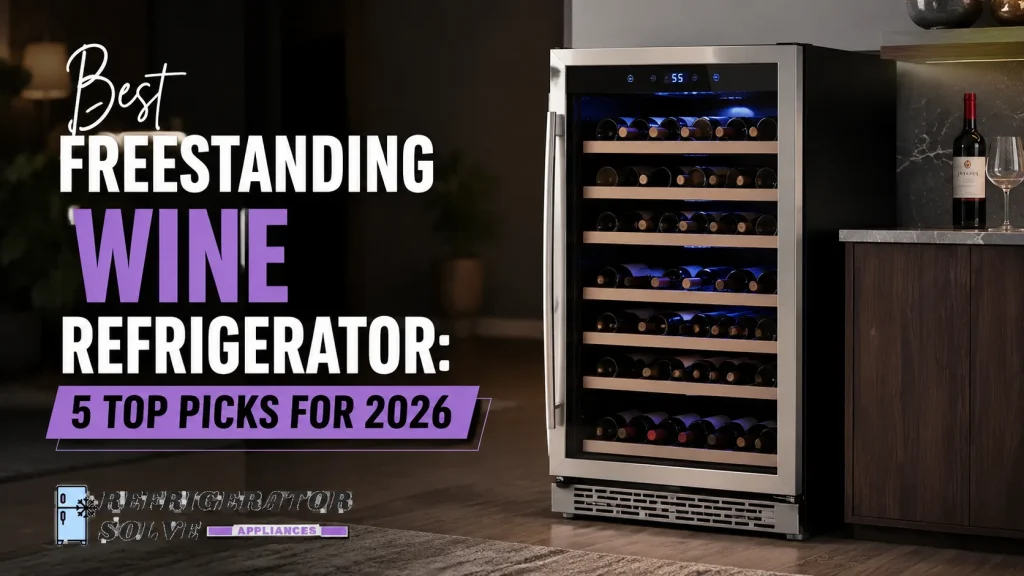
A few bottles tucked beside the milk may seem harmless, but an ordinary kitchen refrigerator is not designed for wine. It is usually colder than necessary, frequently opened, and filled with food odors. More importantly, its shelves rarely make good use of standard wine bottles.
A freestanding wine refrigerator provides a dedicated, temperature-controlled space without requiring a cabinet renovation. You can place one in a dining room, kitchen, home bar, pantry, or entertainment area, provided there is enough ventilation around it.
The challenge is choosing the right size. An 18-bottle cooler may be perfect for someone who buys a few bottles at a time, while a growing collection can quickly overwhelm anything smaller than a 50- or 100-bottle unit.
After comparing current Amazon listings, storage capacity, temperature controls, shelving, dimensions, and independent testing, I selected five models for different households and collection sizes.
All five products had active Amazon.com listings when checked on August 4, 2026. Inventory, seller availability, delivery dates, and delivery eligibility can vary by ZIP code.
Affiliate Disclosure: As an Amazon Associate, RefrigeratorSolve earns from qualifying purchases. This does not increase the price you pay.
Best Freestanding Wine Refrigerators at a Glance
| Product | Advertised Capacity | Temperature Zones | Best For | Check Price |
|---|---|---|---|---|
| Wine Enthusiast 32-Bottle Dual Zone MAX Wine Cooler | 32 bottles | 2 | Best overall | View on Amazon |
| Ivation 18-Bottle Compressor Wine Cooler | 18 bottles | 1 | Small spaces | View on Amazon |
| BLACK+DECKER BD61536 26-Bottle Wine Cellar | 26 bottles | 1 | Simple controls | View on Amazon |
| FOVOMI 91-Bottle Dual Zone Wine Refrigerator | 91 bottles | 2 | Growing collections | View on Amazon |
| Tylza 180-Bottle Dual Zone Wine Refrigerator | 180 bottles | 2 | Extra-large collections | View on Amazon |
1. Wine Enthusiast 32-Bottle Dual Zone MAX Wine Cooler — Best Overall
Credit: Amazon
Check the Current Price on Amazon
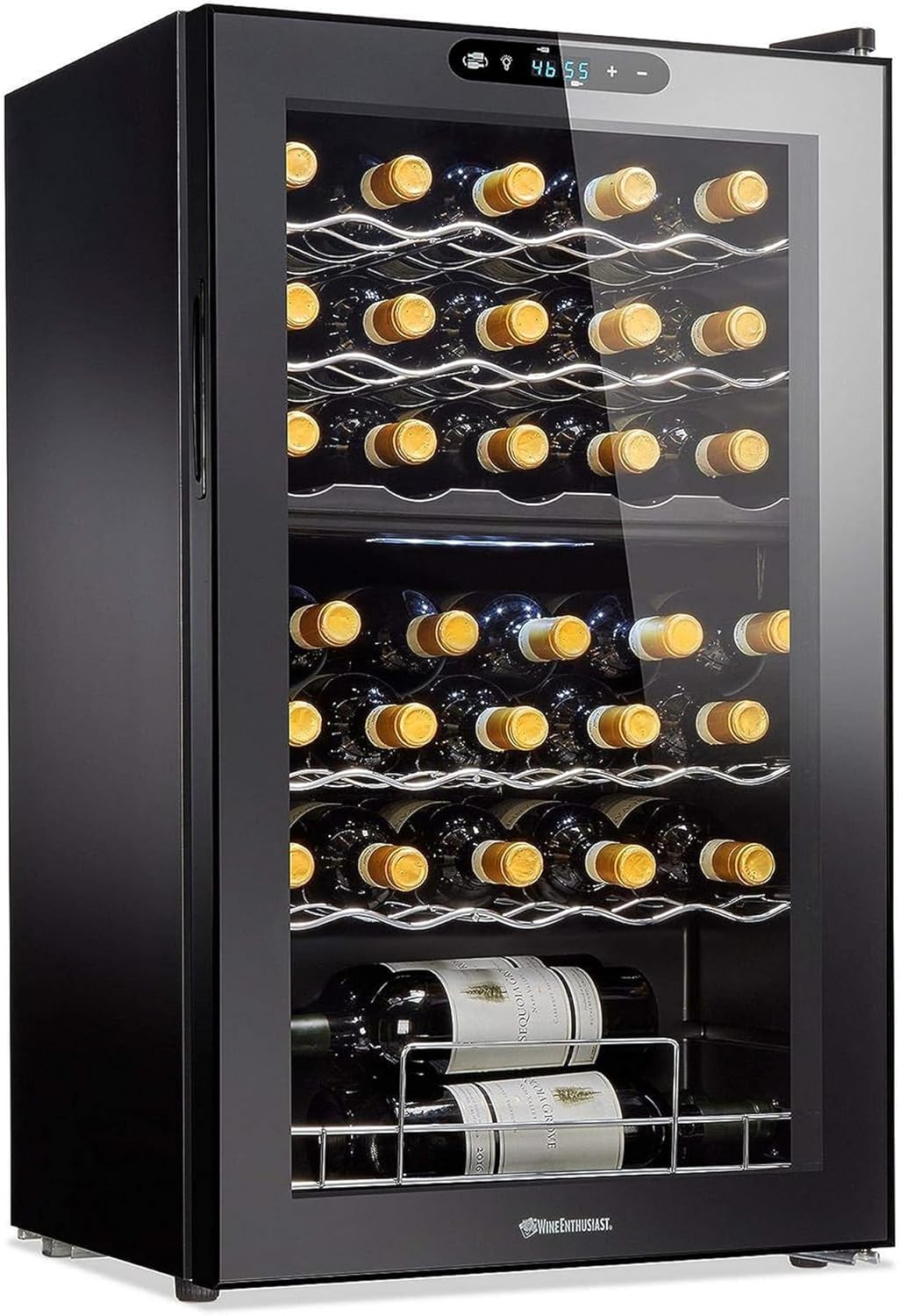
The Wine Enthusiast 32-Bottle Dual Zone MAX is the easiest model to recommend for most wine drinkers. It provides enough room for a useful collection without occupying as much floor space as a full-height wine cellar.
Its two independently controlled sections let you organize bottles by temperature. You could keep white, sparkling, and rosé wines colder in one compartment while maintaining reds at a warmer setting in the other.
The advertised operating range is approximately 41°F to 64°F. Its compressor-based cooling system is designed to maintain temperature more consistently than many small thermoelectric coolers, particularly when the surrounding room becomes warm.
Food & Wine selected this model as its best overall wine fridge after months of testing. Its reviewers praised the capacity and temperature stability, although they noted that the shelves are better suited to conventional bottles than oversized or unusually shaped ones.
Pros
- Advertised 32-bottle capacity
- Two independently controlled temperature zones
- Broad 41°F to 64°F temperature range
- Compressor-based cooling
- Compact footprint for its capacity
- Digital temperature controls
- Suitable for mixed red-and-white collections
- Independent testing found stable temperature performance
- Clean black and stainless-steel appearance
Cons
- Requires ventilation space around the cabinet
- Cannot be pushed tightly against a wall
- Shelves are designed mainly for standard wine bottles
- Champagne and Burgundy bottles reduce practical capacity
- Not designed for enclosed under-counter installation
My Honest Opinion
This model hits the sweet spot between size and flexibility.
An 8- or 12-bottle wine cooler is easy to outgrow, while a 100-bottle unit requires a serious commitment of floor space. A 32-bottle capacity is large enough to separate everyday bottles, special-occasion wines, and several chilled whites without turning your dining room into a commercial cellar.
The dual-zone layout is also useful rather than decorative. Buyers who regularly drink both reds and whites will get more value from it than they would from a similarly sized single-zone unit.
The main concern is bottle shape. The advertised capacity assumes a carefully arranged collection of mostly standard bottles. Several Champagne or wide Burgundy bottles will require shelf adjustments and reduce the total count.
Best for: Most households, mixed wine collections, couples, casual collectors, and buyers who want useful dual-zone storage without a full-height cabinet.
2. Ivation 18-Bottle Compressor Wine Cooler — Best for Small Spaces
Credit: Amazon
Check the Current Price on Amazon
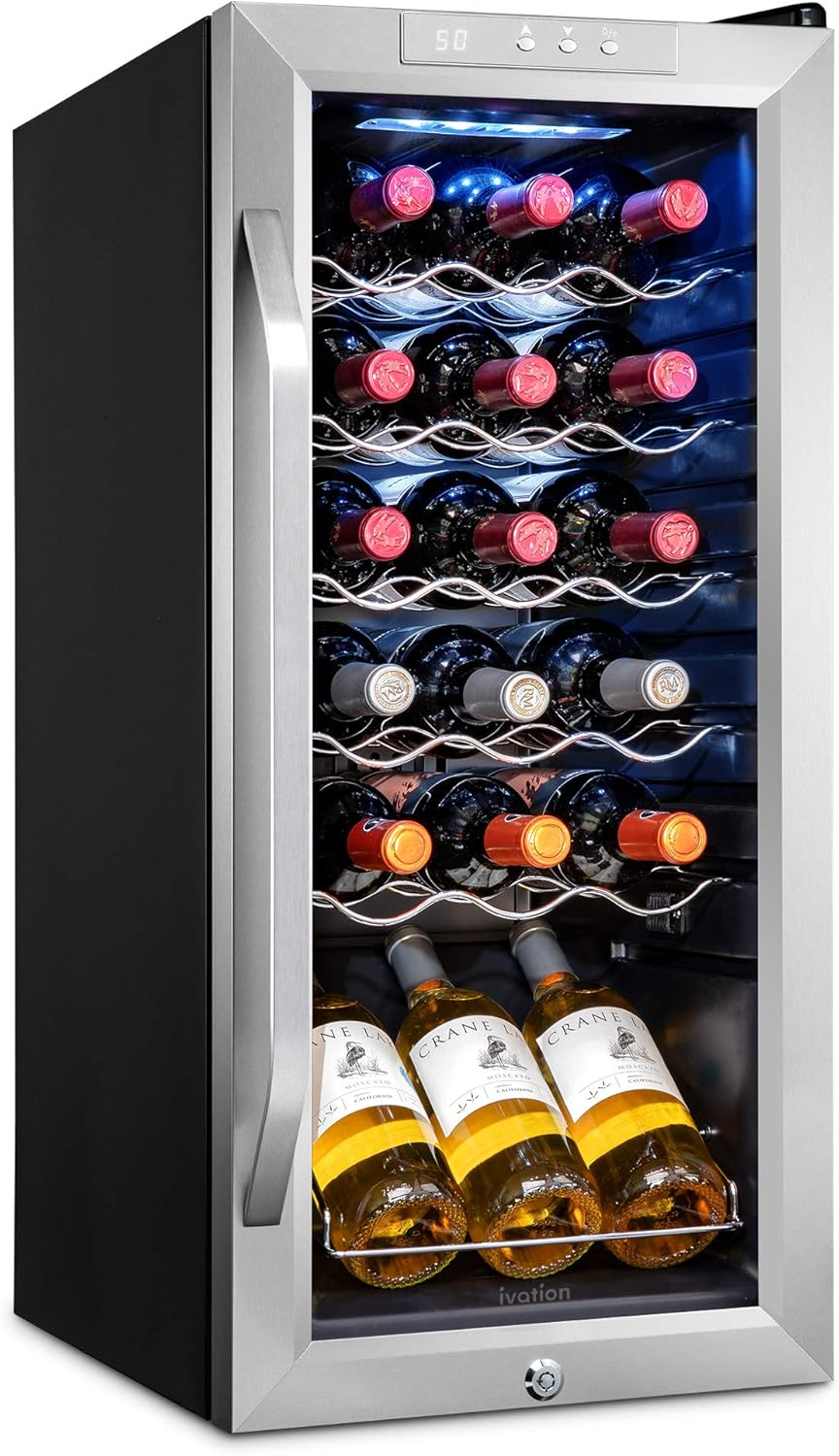
The Ivation 18-Bottle Compressor Wine Cooler is a practical choice for an apartment, condominium, office, or small dining area.
At approximately 13.58 inches wide, it takes up considerably less floor space than most medium-capacity models. Its dimensions are listed at roughly 17.72 inches deep, 13.58 inches wide, and 30.31 inches high.
The single temperature zone operates from approximately 41°F to 64°F. That range provides flexibility for white, rosé, sparkling, or red wine, although you must choose one temperature for the entire collection.
The cooler also includes a lock, removable racks, digital controls, interior lighting, and compressor cooling. Food & Wine identified Ivation’s freestanding model as its best small wine refrigerator.
Pros
- Narrow cabinet works in limited spaces
- Advertised 18-bottle capacity
- Wide 41°F to 64°F temperature range
- Compressor cooling
- Digital temperature display
- Built-in lock
- Removable shelving
- Suitable for apartments and home offices
- Easier to reposition than a full-size wine cellar
Cons
- Only one temperature zone
- Easy to outgrow if you buy wine by the case
- Large Champagne bottles reduce capacity
- Still needs open space for proper ventilation
- Not suitable for enclosed cabinetry
- Taller bottles may require removing a shelf
My Honest Opinion
The Ivation makes sense when you want a genuine wine refrigerator but do not have room for a wide appliance.
Its narrow design is the main attraction. It can fit beside a cabinet, in a dining-room corner, or against an open wall without dominating the room.
The single zone is not necessarily a disadvantage. When most of your collection consists of one wine style—or when you use the cooler primarily for stable storage rather than immediate serving—a single temperature can be perfectly adequate.
However, an 18-bottle refrigerator fills faster than many buyers expect. Two mixed cases already exceed its advertised capacity. Buy it for a deliberately small collection, not because you assume you will never purchase more wine.
Best for: Apartments, small kitchens, offices, occasional wine drinkers, and collections of fewer than two cases.
3. BLACK+DECKER BD61536 26-Bottle Wine Cellar — Best Simple Single-Zone Option
Credit: Amazon
Check the Current Price on Amazon
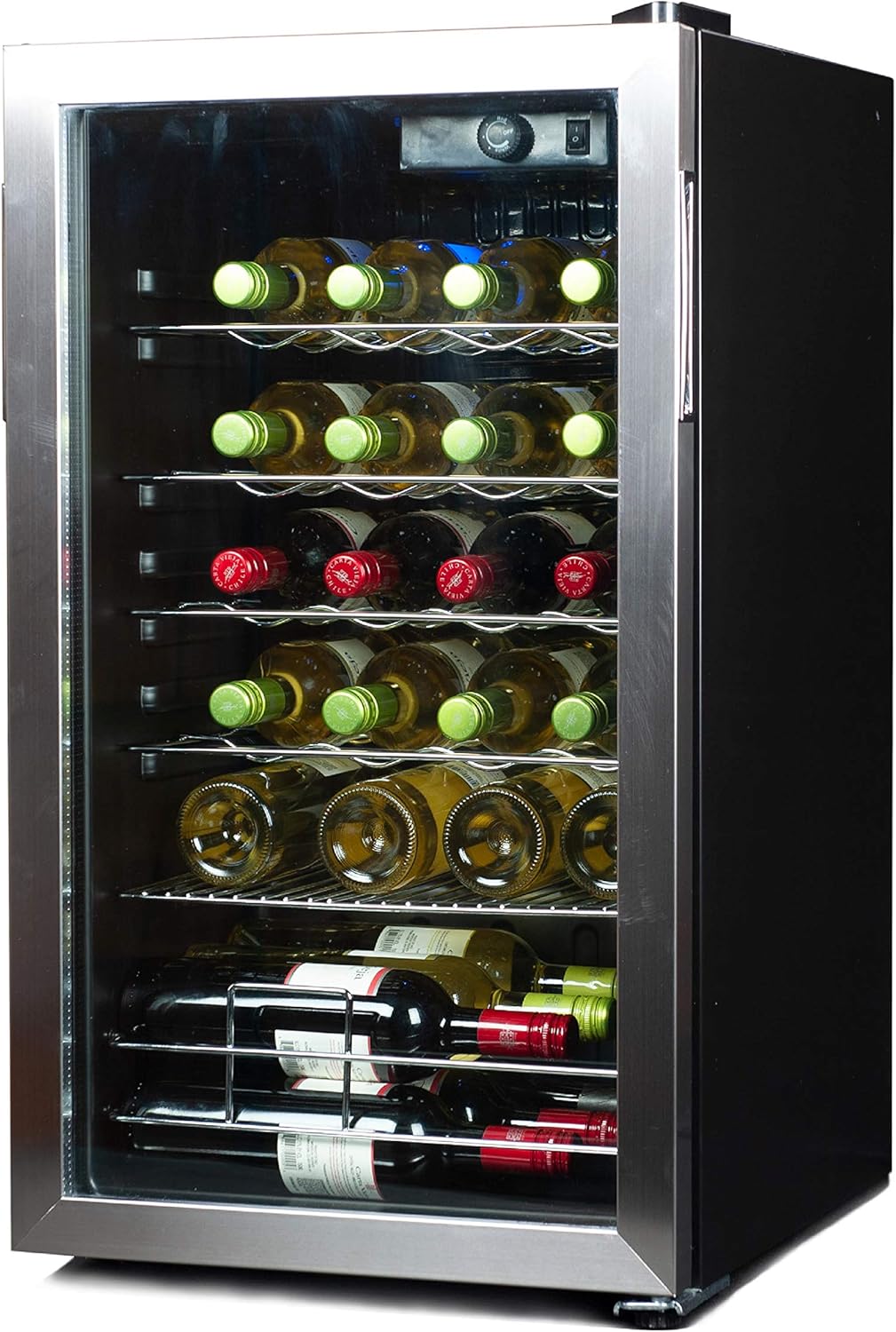
The BLACK+DECKER BD61536 is intended for buyers who prefer straightforward operation over multiple cooling zones and complicated settings.
It has an advertised capacity of 26 bottles and a listed temperature range of approximately 40°F to 64°F. Instead of separating the interior into two compartments, it maintains one selected temperature throughout the cabinet.
The appliance measures approximately 19.7 inches deep, 17.5 inches wide, and 31.5 inches high. Its interior includes chrome racks, a flat shelf, lighting, and additional lower space that can help accommodate larger bottles.
The Amazon listing identifies it as a freestanding, compressor-cooled wine cellar with a double-pane glass door and manual temperature control.
Pros
- Advertised 26-bottle capacity
- Straightforward single-zone operation
- Wide 40°F to 64°F temperature range
- Compressor cooling system
- Double-pane glass door
- Removable chrome racks
- Interior light
- Lower space for larger bottles
- Moderate footprint
- Suitable for buyers who do not need app controls
Cons
- No separate zones for red and white wine
- Manual control is less precise-looking than a digital panel
- Chrome shelving feels less premium than wood
- Capacity decreases with wide bottles
- Requires open ventilation space
- Cannot maintain two serving temperatures simultaneously
My Honest Opinion
Not everyone needs dual zones, Wi-Fi, touchscreens, or multiple lighting modes.
If your main goal is to move wine out of the kitchen refrigerator and into a dedicated, stable environment, this BLACK+DECKER model covers the essentials. Its 26-bottle capacity gives you more breathing room than a compact 12- or 18-bottle cooler without requiring a full-height cabinet.
The single zone works particularly well when you primarily collect red wine or intend to store mixed wines near a cellar-style temperature and adjust individual bottles before serving.
Its styling is functional rather than luxurious. The chrome racks and manual control may not satisfy buyers creating a high-end display cellar, but they help keep the design simple.
Best for: First-time wine-fridge buyers, single-style collections, straightforward home storage, and buyers who prefer simple controls.
4. FOVOMI 91-Bottle Dual Zone Wine Refrigerator — Best for a Growing Collection
Credit: Amazon
Check the Current Price on Amazon
Once your collection grows beyond a few cases, smaller wine coolers become frustrating. Bottles end up stacked, labels become difficult to see, and every new purchase requires rearranging the entire cabinet.
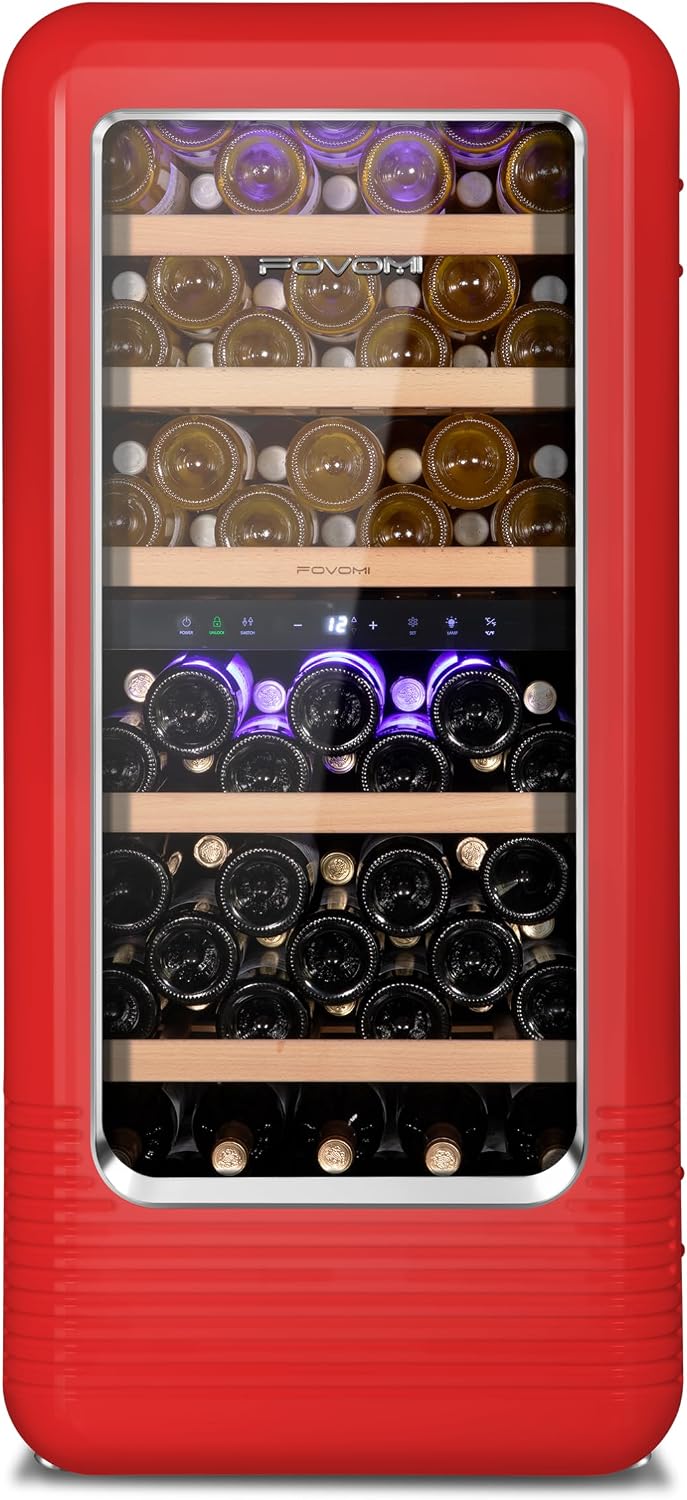
The FOVOMI model addresses that problem with an advertised capacity of 91 bottles. Its 20-inch-wide freestanding design provides significantly more storage than a typical 30-bottle cooler without becoming as wide as many 24-inch commercial-style models.
The listing describes it as a dual-zone wine refrigerator and includes beechwood and wire shelving, on-screen controls, temperature memory, and a control-lock function. The manufacturer also advertises operating noise below 41 decibels, although perceived sound will depend on placement and room acoustics.
Pros
- Advertised capacity of up to 91 bottles
- Two temperature zones
- Narrower than many full-size cellar cabinets
- Combination of beechwood and wire shelves
- Temperature-memory function
- Control-lock feature
- Compressor-based cooling
- Better suited to case purchases
- Provides room for a collection to grow
Cons
- Advertised capacity assumes standard bottle shapes
- Several large bottles can reduce usable storage substantially
- Heavier and harder to reposition than small coolers
- Requires more ventilation and floor space
- Less suitable for a very small household
- Large collections require careful organization
My Honest Opinion
This is where a wine refrigerator starts feeling like a proper home cellar rather than a beverage appliance.
The 91-bottle rating provides room for multiple cases, long-term bottles, everyday wines, and separate red-and-white sections. It is a meaningful step up for someone who has already outgrown a 30-bottle refrigerator.
Do not assume you will fit exactly 91 bottles, though. Manufacturer capacities are normally based on standard 750-milliliter Bordeaux bottles arranged in a specific pattern. Champagne, Burgundy, Pinot Noir, and unusually tall bottles take up more room.
A more realistic approach is to treat the advertised capacity as a best-case reference and purchase with extra space in mind.
Best for: Growing collections, case buyers, dedicated home bars, serious hobbyists, and households that need more than 50-bottle storage.
5. Tylza 180-Bottle Dual Zone Wine Refrigerator — Best Extra-Large Model
Credit: Amazon
Check the Current Price on Amazon
The Tylza 180-Bottle Wine Refrigerator is built for buyers whose collections have moved well beyond a few shelves.
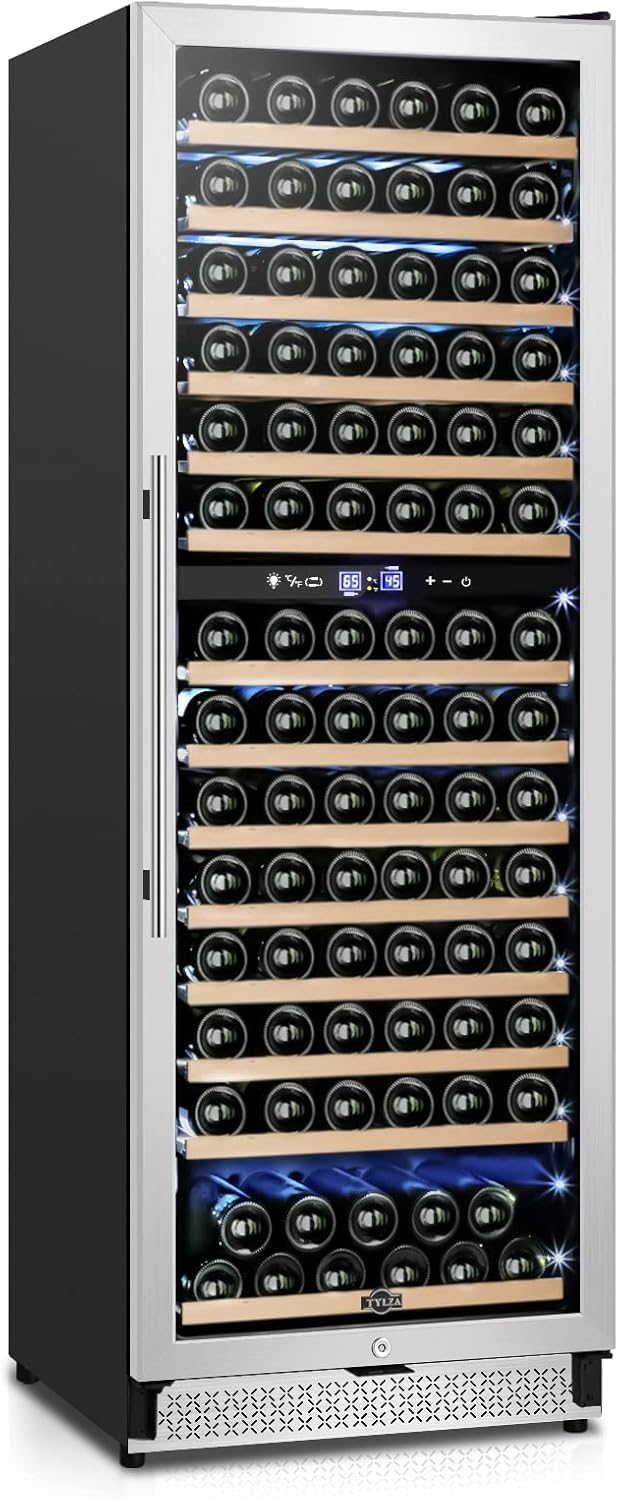
It measures approximately 27.16 inches deep, 23.54 inches wide, and 65.74 inches high. This is a full-height freestanding appliance rather than a compact cooler, so it needs a dedicated installation area.
The Amazon listing advertises storage for as many as 180 standard Bordeaux bottles across 14 beechwood shelves. The upper zone operates from approximately 40°F to 55°F, while the lower zone runs from approximately 55°F to 65°F.
Its compressor and internal fan circulate cooled air through the cabinet. A temperature-memory function restores the previous setting after a power interruption, and the listing identifies the unit as frost-free and freestanding.
Pros
- Advertised capacity of up to 180 bottles
- Separate upper and lower temperature zones
- Upper range of approximately 40°F to 55°F
- Lower range of approximately 55°F to 65°F
- Fourteen beechwood shelves
- Compressor and fan cooling
- Temperature-memory function
- Frost-free operation
- Full-height cellar-style appearance
- Suitable for long-term collection growth
Cons
- Requires considerable floor space
- Heavy and difficult to move after installation
- Advertised capacity depends on standard Bordeaux bottles
- Wide Champagne and Burgundy bottles reduce capacity
- Higher purchase cost than compact models
- Excessive for casual wine drinkers
- Requires careful measurement of doorways and delivery routes
My Honest Opinion
This is not the model to buy for six bottles of weekend wine. It is designed for someone who already owns a substantial collection or knows that one is coming.
Its biggest advantage is consolidation. Instead of operating two or three small refrigerators, you can organize a large collection inside one full-height cabinet with separate temperature sections.
The size deserves serious consideration. Measure not only the final installation space but also every doorway, hallway, corner, and stairway along the delivery route. A wine refrigerator can fit perfectly in a room and still be impossible to move through the entrance.
The 180-bottle figure should also be treated as a maximum based on standard bottles. A varied collection will almost certainly hold fewer.
Best for: Serious collectors, wine rooms, large home bars, case storage, and buyers replacing multiple smaller refrigerators.
Buyer’s Guide: How to Choose a Freestanding Wine Refrigerator
The best freestanding wine refrigerator is not necessarily the model with the largest capacity or the longest list of features. It is the one that matches your collection, available space, and preferred wine styles.
1. Understand What “Freestanding” Means
A freestanding wine refrigerator releases heat around the cabinet, usually through the back or sides. It needs open space for air circulation.
Do not place a freestanding-only model tightly inside an enclosed kitchen cabinet. Restricted airflow can trap heat, force the compressor to work harder, and interfere with cooling performance.
A built-in wine refrigerator usually has front ventilation, allowing it to sit beneath a counter. Some models support both installation types, but you should always follow the manufacturer’s clearance instructions.
2. Buy More Capacity Than You Currently Need
Count your existing bottles, then consider how often you purchase wine.
An advertised 18-bottle cooler may be adequate when you normally keep eight or ten bottles at home. It can feel restrictive when you begin buying full cases.
A practical approach is to leave approximately 20% to 30% of the advertised capacity unused for future purchases, larger bottles, and easier organization.
3. Treat Bottle Capacity as an Estimate
Wine-fridge capacities are generally calculated using standard 750-milliliter Bordeaux bottles.
Your real capacity will be lower when the collection includes:
- Champagne bottles
- Burgundy bottles
- Pinot Noir bottles
- Rhône-style bottles
- Magnum bottles
- Tall Riesling bottles
- Decorative or unusually shaped bottles
Removable shelves create flexibility, but every removed shelf also reduces the total number of bottles you can store.
4. Choose Between Single-Zone and Dual-Zone Cooling
A single-zone refrigerator maintains one temperature throughout the cabinet. It is generally simpler and can provide more uninterrupted storage.
Single-zone cooling works well when:
- You mainly collect one wine style
- You use the unit for long-term storage
- You are comfortable adjusting bottles before serving
- Maximum capacity matters more than temperature separation
A dual-zone refrigerator has two independently controlled sections. It is useful when you regularly keep both red and white wine ready to serve.
Dual zones add flexibility, but the divider and cooling layout may reduce usable space compared with a similarly sized single-zone model.
5. Check the Full Temperature Range
Do not assume every wine refrigerator gets equally cold.
Some models reach approximately 40°F, making them suitable for chilled sparkling wine and crisp whites. Others begin closer to 46°F or 50°F.
For mixed storage, many collectors use a stable setting near 55°F and adjust individual bottles before serving. The most important factor is consistency rather than changing the controls every day.
A dedicated wine refrigerator is designed differently from an ordinary food refrigerator and generally operates at a warmer temperature while controlling conditions suitable for wine.
6. Measure More Than the Empty Floor Space
Record the appliance’s width, height, and depth, but do not stop there.
Check:
- Manufacturer-required ventilation clearance
- Door-swing direction
- Space needed to pull shelves forward
- Handle projection
- Nearby baseboards
- Electrical outlet position
- Distance from ovens or radiators
- Walking space with the door open
- Delivery-route width
- Stairway and hallway turns
Leave enough room to open the door fully. A wine fridge can fit between two pieces of furniture while still preventing its shelves from sliding out.
7. Consider Shelf Material and Layout
Wooden shelves often provide a smoother, more premium presentation. They may also hold bottles more gently when sliding in and out.
Wire shelves are lighter and can be easier to reposition, but some bottle shapes may roll or sit awkwardly.
Check whether shelves are:
- Removable
- Adjustable
- Fully or partially extendable
- Spaced for larger bottles
- Strong enough for a full load
- Designed to keep labels visible
Shelf flexibility matters more than decorative lighting when your collection contains several bottle shapes.
8. Look for UV-Resistant Glass
Light exposure can negatively affect wine over time. A tinted or UV-resistant glass door provides additional protection while still allowing you to view the collection.
Even with protected glass, avoid placing the appliance in direct sunlight. Sunlight also heats the cabinet and makes the cooling system work harder.
A solid door offers stronger light protection but removes the visual display that attracts many buyers to a wine refrigerator.
9. Think About Noise Before Choosing a Location
Compressor models produce some sound when the compressor starts, stops, or circulates cooled air. This is normal.
Noise becomes more noticeable in:
- Bedrooms
- Studio apartments
- Quiet home offices
- Reading rooms
- Media rooms
- Open-plan living areas
A refrigerator that sounds unobtrusive in a kitchen may be distracting beside a desk or bed.
10. Check Door Locks and Control Locks
A physical door lock can help prevent children, guests, or shared-house occupants from accessing the collection.
A control lock prevents accidental temperature changes but does not necessarily lock the door itself.
Read the listing carefully because manufacturers sometimes use the word “lock” without clearly distinguishing between these two features.
11. Consider Temperature Memory
Temperature memory allows the refrigerator to restore your selected setting after a brief power interruption.
This does not protect wine during a long outage, but it can prevent the appliance from restarting at an unsuitable default temperature when power returns.
12. Choose the Location Carefully
Place a freestanding wine refrigerator on a firm, level surface away from:
- Direct sunlight
- Ovens
- Cooktops
- Radiators
- Heating vents
- Damp outdoor areas
- Uninsulated garages with extreme temperatures
Room temperature affects how hard the appliance must work. Follow the manufacturer’s approved ambient-temperature range, especially when installing the unit in a basement or garage.
Frequently Asked Questions
What Is a Freestanding Wine Refrigerator?
A freestanding wine refrigerator is a standalone appliance designed to store wine at controlled temperatures.
Unlike a built-in model, it normally requires ventilation space around the sides, back, or top of the cabinet. It can be placed in an open kitchen, dining room, home bar, office, or pantry.
Can I Put a Freestanding Wine Refrigerator Under a Counter?
Not unless the manufacturer specifically approves built-in installation.
A freestanding-only model needs open airflow around its cabinet. Enclosing it beneath a counter can trap heat and interfere with its cooling system.
Choose a front-vented built-in or dual-installation model for enclosed cabinetry.
What Temperature Should a Wine Refrigerator Be Set At?
A stable temperature near 55°F is a common starting point for general wine storage.
White and sparkling wine can be kept colder when you want bottles ready to serve, while many reds are served at warmer temperatures. A dual-zone refrigerator makes maintaining those differences more convenient.
Is a Dual-Zone Wine Refrigerator Worth It?
Dual-zone cooling is worthwhile when you regularly keep both red and white wine ready for drinking.
It may be unnecessary when you mainly collect one wine style or use the refrigerator for long-term storage at one stable temperature.
Why Does My Wine Refrigerator Hold Fewer Bottles Than Advertised?
Advertised capacity is usually based on standard Bordeaux bottles arranged in an optimized pattern.
Champagne, Burgundy, Pinot Noir, magnum, and unusually tall bottles take up more space. You may also need to remove shelves, further reducing capacity.
Can I Store Champagne in a Wine Refrigerator?
Yes, provided the unit reaches a suitable temperature and its shelves can accommodate the wider bottles.
A lower shelf or adjustable rack is often the easiest location for Champagne. Expect practical bottle capacity to decrease when several sparkling-wine bottles are stored together.
Can I Store Beer and Soft Drinks in a Wine Refrigerator?
You can store other beverages when the available temperature range meets your needs.
However, wine refrigerators often do not become as cold as beverage coolers or household refrigerators. Check the minimum temperature before expecting ice-cold soda or beer.
Should Wine Bottles Be Stored Horizontally?
Bottles sealed with natural cork are traditionally stored horizontally so the wine remains in contact with the cork.
Horizontal shelving is also the most space-efficient arrangement for most wine refrigerators. Screw-cap and synthetic-closure bottles are less dependent on this position.
Does a Wine Refrigerator Need a Water Line?
No. A standard wine refrigerator does not produce ice or dispense water, so it only needs an appropriate electrical outlet.
How Much Ventilation Does a Freestanding Wine Refrigerator Need?
The required clearance varies by model.
Some manufacturers specify several inches behind and above the refrigerator, while others require side clearance as well. Follow the installation manual rather than using one universal measurement.
Are Freestanding Wine Refrigerators Noisy?
All compressor refrigerators create some operational sound.
You may hear the compressor, fan, refrigerant movement, or slight expansion noises. Excessive rattling can indicate an uneven floor, loose shelf, or contact between the cabinet and a nearby wall.
How Long Should I Wait Before Plugging in a New Wine Refrigerator?
Follow the manufacturer’s instructions.
When the refrigerator has been transported upright, the waiting period may be relatively short. If it was carried on its side or heavily tilted, the compressor oil may need longer to settle.
The Tylza listing, for example, instructs buyers to leave that particular unit standing for more than 24 hours before startup.
How Do I Clean a Wine Refrigerator?
Disconnect the appliance before a thorough interior cleaning.
Remove the bottles and shelves, then wipe the interior with a soft cloth and mild cleaning solution approved by the manufacturer. Avoid abrasive pads and harsh chemicals.
Dry every surface before reconnecting the refrigerator and returning the bottles.
Final Verdict: Which Freestanding Wine Refrigerator Should You Buy?
The Wine Enthusiast 32-Bottle Dual Zone MAX Wine Cooler is the best freestanding wine refrigerator for most households. It combines a manageable footprint, useful dual-zone controls, compressor cooling, and enough capacity for a meaningful mixed collection. Its strong performance in independent testing makes it easier to recommend than models supported only by manufacturer specifications.
Choose the Ivation 18-Bottle Compressor Wine Cooler when floor space is limited and your collection is unlikely to exceed two cases.
The BLACK+DECKER BD61536 26-Bottle Wine Cellar is the better option for buyers who want uncomplicated single-zone storage without paying for features they may never use.
For a collection that is expanding quickly, the FOVOMI 91-Bottle Dual Zone Wine Refrigerator provides considerably more breathing room.
The Tylza 180-Bottle Dual Zone Wine Refrigerator is the strongest fit for a serious collection that needs a full-height cellar-style cabinet.
Before ordering, measure the appliance area, ventilation space, door swing, and complete delivery route. Then estimate capacity using the bottle styles you actually own—not only the idealized number printed in the product title.
Check the Wine Enthusiast 32-Bottle Dual Zone MAX Wine Cooler on Amazon

Hi, I’m the lead researcher and appliance enthusiast behind RefrigeratorSolve. With years of hands-on experience troubleshooting cooling systems and testing home appliances, I am dedicated to bringing you honest reviews, energy-saving tips, and practical solutions to keep your refrigerator running perfectly.