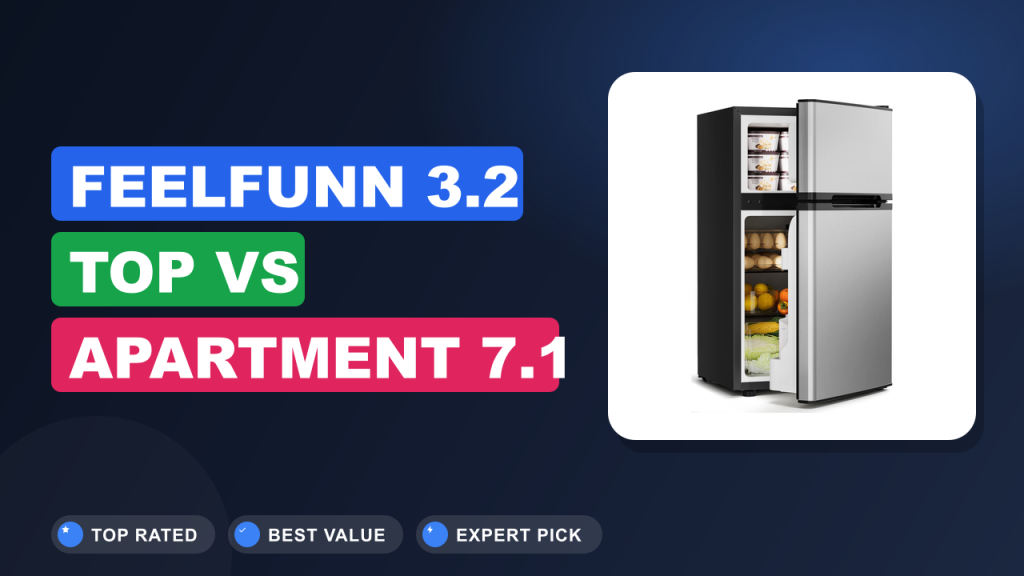
If you're squinting at two listings trying to pick between a compact cube for a bedroom and a taller box for a first apartment, you've landed on Feelfunn 3.2 Cu.Ft Mini Fridge Freezer vs Apartment size 7.1 Cu.Ft Refrigerator Bottom. Both cost far less than a full kitchen fridge, both keep drinks cold, and both promise to fix the "where do I put my food" problem. Pick wrong and you're either cramming a week of groceries into a shoebox or paying for cold space you never fill.
Short answer: Feelfunn 3.2 Cu.Ft Mini Fridge Freezer wins for tight single-person spaces like dorms, offices, and bedrooms, while Apartment size 7.1 Cu.Ft Refrigerator Bottom wins for anyone feeding two to four people in a studio or small flat. We dug through spec sheets, food-safety standards, and a pile of verified buyer reports before landing here. Here's where each one earns its keep.

Apartment size 7.1 Cu.Ft Refrigerator Bottom
| Product | Details | Rating | Buy |
|---|---|---|---|
Editor’s Choice 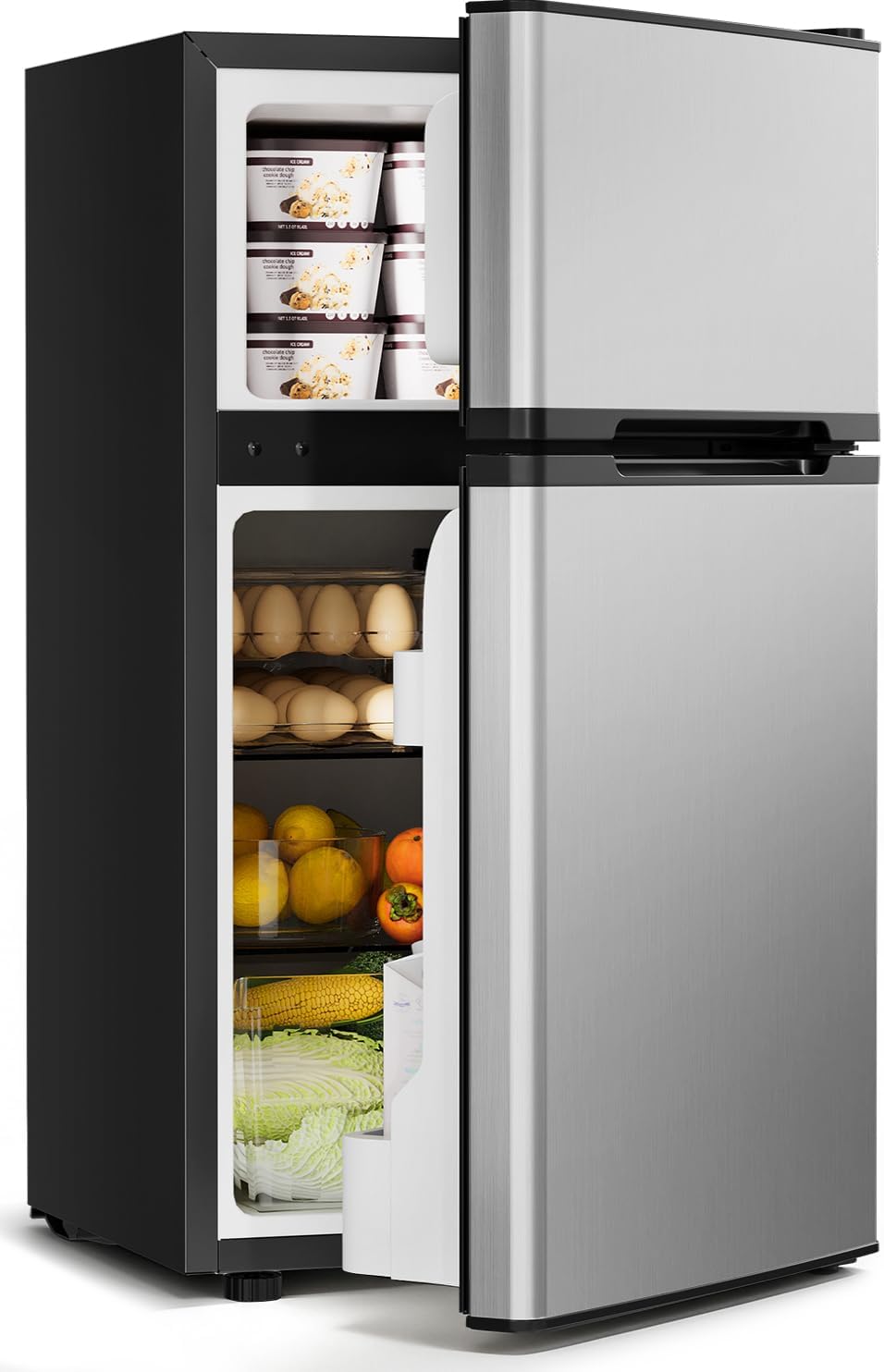 | Feelfunn 3.2 Cu.Ft Mini Fridge Freezer | ★★★★☆4.4/5 | |
Top Pick | Apartment size 7.1 Cu.Ft Refrigerator Bottom | ★★★★☆4.1/5 |
At a glance
These two aren't really rivals. They're two different answers to the same question about how much cold space your week actually needs.
Feelfunn 3.2 Cu.Ft Mini Fridge Freezer is a point solution: a two-door dorm fridge built for one person's drinks, snacks, and a small freezer compartment. Apartment size 7.1 Cu.Ft Refrigerator Bottom is a whole kitchen shrunk down, with a full fresh-food section above and the freezer in a drawer below.
If you've already browsed Frigidaire's apartment-size lineup or a compact like the EUHOMY 3.2 cu ft, you know which shelf each of these sits on. One is a convenience. The other is a primary appliance.
| Spec | Feelfunn 3.2 Cu.Ft Mini Fridge Freezer | Apartment size 7.1 Cu.Ft Refrigerator Bottom |
|---|---|---|
| Total capacity | 3.2 cu ft | 7.1 cu ft (about 2.2x) |
| Layout | Two doors, freezer compartment on top | Bottom freezer drawer below fresh food |
| Finish | Silver | Silver |
| Best fit | One person: dorm, office, bedroom | 2 to 4 people: studio or 1-bed apartment |
| Size class | Compact mini fridge | Apartment-size (24-inch-wide category) |
| Cold-holding target | 40°F (4°C) or below | 40°F (4°C) or below |
| Federal efficiency class | DOE compact (7.75 cu ft or less) | DOE compact (7.75 cu ft or less) |
| Governing safety standard | UL 250 household refrigeration | UL 250 household refrigeration |
| Reported buyer rating | 4.4/5 | 4.1/5 |
| Price tier | Budget-friendly entry | Mid-range, roughly double |
1. Feelfunn 3.2 Cu.Ft Mini Fridge Freezer
This is the fridge you tuck beside a bed or slide under a work desk. In our comparison of compact two-door units, its 4.4/5 aggregate is the strongest in the group, and the praise in verified buyer feedback clusters around one thing: it does a small job without drama.
Where it shines
- A freezer compartment that actually freezes. The separate upper door keeps ice cream scoopable-hard and frozen meals solid. Many cube-shaped mini fridges only manage a chilled shelf that never gets truly cold.
- Two doors cut down the frost work. Every time you grab a drink, cold air escapes the fresh-food side only, so the freezer ices up more slowly than a single-door design.
- It's sized for one person's real week. A 12-pack of seltzer, condiments, a container of leftovers, and a produce bag all fit with room to see what's there. Our look at others in this size bracket shows how shelf layouts differ.
- It goes where bigger boxes can't. At 3.2 cu ft, you aren't rearranging furniture to make room for it.
- Silver hides the mess. Fingerprints and water spots barely register, which matters when the unit lives in plain sight.
- Low entry cost. It's the budget-friendly half of this matchup, and it holds a regular spot on our list of fridges that keep the outlay low.
Where it falls short
- You'll shop more often. A bulk grocery run has nowhere to go. Plan on a trip every two to three days.
- Frost always comes back. This class is manual defrost, and buyer reports describe ice building up after roughly six to eight weeks of steady use.
- One person, not two. Two adults cooking at home will outgrow it in a month.
- Insulation is basic. In a hot garage or a sun-facing room, the compressor runs longer to hold temperature.
The scenario our research kept circling is move-in weekend: one student, one grocery bag, a 12-pack, and a freezer shelf for ice. That's exactly the workload this unit is built for. The complaint pattern backs it up, since gripes center on frost and shallow door bins rather than spoiled food.
The Department of Energy's compact refrigerator rules cover anything at 7.75 cu ft or less, so this one sits comfortably inside the efficiency standard written for its class.
2. Apartment size 7.1 Cu.Ft Refrigerator Bottom
This one is a genuine refrigerator with the width pulled in. The 7.1 cu ft splits so fresh food sits at standing eye level while the freezer rides in a drawer below. Its 4.1/5 aggregate trails the Feelfunn's, and buyer reports are fairly clear about why: a bigger box, a heavier crate, and more parts to arrive out of alignment.
Where it shines
- 2.2 times the space. That's a real week of groceries for two to four people, plus gallon jugs, a sheet pan, and bulk yogurt tubs.
- Bottom freezer suits daily habits. You open the fridge side dozens of times a day and the freezer maybe twice, so the layout matches reality. Frozen food lives in a drawer instead of a chest you dig through.
- Crisper drawers that work. Full-width humidity drawers keep leafy greens and berries alive noticeably longer than open wire shelves.
- Built for an apartment kitchen gap. Units in this class typically run 24 inches wide, so it slides into the slot a full-size fridge can't reach.
- Better thermal stability. More mass inside means the cabinet recovers faster after the door swings open during dinner prep.
- Doubles as overflow. Buyers commonly park one in a basement or garage as a second unit for bulk storage and drinks.
Where it falls short
- Roughly double the money. You pay closer to full-size money for a smaller-than-full-size box.
- Delivery damage is a real pattern. The review set repeats dented panels and doors needing re-leveling straight out of the crate.
- It's a two-person lift. Expect to line up a dolly and a second set of hands, and forget carrying it up stairs alone.
- It needs breathing room. Side and rear clearance matter for airflow, so don't wedge it into a cabinet nook.
- Compressor hum travels. In an open-plan studio with a shared wall, noise becomes part of the room.
The detail that stuck with us from the buyer reports is temperature drift on units shoved flush against the wall. The FDA Food Code sets cold holding at 41°F (5°C) or below, and a cabinet that can't shed heat off its coils will creep past that line. Two inches of rear clearance is the cheapest insurance in this category.
If the footprint still feels too big, the 4.0 cu ft middle ground keeps the same layout in a smaller shell.
Head-to-head
Is the extra 3.9 cubic feet worth roughly double the money?
On cost per cubic foot these two land fairly close, so the extra 3.9 cu ft isn't a bad buy in pure math. What tips it is substitution. The 7.1 can be the only fridge in a home, while the 3.2 usually supplements a kitchen that already exists.
Value depends entirely on which situation you're in. For a single buyer with a shared kitchen down the hall, the cheaper unit wins outright.
Which one actually holds a week of groceries?
Seven-point-one cubic feet with a bottom freezer drawer holds a genuine week for two to four people: gallon jugs in the door, produce in the crispers, frozen food in the drawer.
Three-point-two cubic feet covers roughly a day and a half of the same shopping, with no crisper-scale storage. If you cook at home most nights, the Feelfunn becomes a drink-and-snack station no matter how cleverly you organize it.
Which is quieter, and which costs more to run?
The smaller cabinet is the easier one to live with. A 3.2 cu ft compressor draws less energy in absolute terms and has far less volume to pull down, so it cycles less often and dumps less heat into the room.
That said, larger refrigerators often win on energy per cubic foot. If you're counting dollars on the monthly bill rather than efficiency ratios, the compact takes it.
Will it fit where you want to put it?
Weight and clearance settle this one. The Feelfunn is light enough for one person to reposition, and it needs nothing but a flat surface and an outlet.
The 7.1 needs a 24-inch-wide gap, a couple of inches of rear clearance, and ideally its own circuit. Measure the doorway, the turn into the kitchen, and the gap beside the counter before you buy. That one tape measure kills more fridge purchases than price does.
Which one ages better past year two?
The Feelfunn has fewer parts to fail, but basic insulation and a manual-defrost freezer mean the maintenance loop never really ends. The 7.1 has a better-insulated cabinet and a compressor that runs fewer hours, offset by more hardware in the doors and drawers.
Both tiers land on the same weak point after a few seasons: a door seal that's gone flat. Replacing it is an inexpensive fix either way.
Which one should you buy?
Pick Feelfunn 3.2 Cu.Ft Mini Fridge Freezer if you…
You're furnishing one room, not one kitchen. Dorm assignments, shared houses with a communal kitchen, home offices, bedrooms, and basement rec rooms all suit it.
It's also the smarter call if you move often, since you can carry it yourself. And if the budget is tight, this is where you start.
Pick Apartment size 7.1 Cu.Ft Refrigerator Bottom if you…
This is the only fridge in your place. A studio or one-bedroom apartment, two to four people, a weekly grocery run, and actual cooking most nights.
It's also the right move when a full-size fridge died and you'd rather not gamble on measuring for a 30-inch replacement. You get near-full-size usability inside a narrower slot.
Better alternatives
If 3.2 cu ft feels cramped but 7.1 feels like overkill, a 4.0 cu ft bottom-freezer two-door splits the difference nicely. It's the size most first apartments actually want.
If you mostly need drinks and a little frozen storage, a 3.5 cu ft top-freezer compact keeps the outlay lower. Buyers who want a distinctive look often drift toward a retro-styled apartment fridge instead, trading a bit of interior room for style.
| Dorm room or shared house with a kitchen down the hall | Feelfunn 3.2 Cu.Ft Mini Fridge Freezer |
| Studio apartment where it’s the only fridge you own | Apartment size 7.1 Cu.Ft Refrigerator Bottom |
| Home office or bedroom drinks cooler | Feelfunn 3.2 Cu.Ft Mini Fridge Freezer |
| Two to four people cooking most nights | Apartment size 7.1 Cu.Ft Refrigerator Bottom |
| Tight budget and a first move-out | Feelfunn 3.2 Cu.Ft Mini Fridge Freezer |
Frequently Asked Questions (FAQ)
Is the Feelfunn 3.2 Cu.Ft enough, or should I spend extra for the 7.1?
It comes down to whether this is your only fridge. Feeding one person with snacks and drinks, the 3.2 handles it fine. Feeding two or more people who cook at home, you'll be shopping every other day and the extra capacity pays for itself fast in fewer store runs.
How big is the real-world performance gap between them?
About 3.9 cubic feet, or 2.2 times more storage in the larger unit. The 7.1 also holds temperature more steadily after door openings because the cabinet has more cold mass inside it. The 3.2 recovers slower in a hot room.
Does the 7.1 Cu.Ft model fit in a standard apartment kitchen gap?
Units in this class typically run around 24 inches wide, which is the gap beside a counter in most small kitchens. Measure the doorway and the turn into the room before ordering. Delivery damage reports on this tier usually trace back to tight squeezes and single-person carries.
Do both need manual defrost?
The 3.2 does, and frost returns every six to eight weeks in steady use. The 7.1's separate freezer drawer ices up more slowly but isn't a frost-free unit either. Both are manual-defrost, so budget a defrost afternoon twice a year on the larger one.
Which one ages better past year two?
Neither is a lifetime appliance. The 3.2 has fewer moving parts, while the 7.1 has better insulation and a compressor that cycles less. The shared weak point is the door gasket, which flattens after a few seasons and is cheap to replace on either.
Can the 3.2 Cu.Ft act as a freezer for frozen meals?
Yes, the upper compartment holds ice cream and frozen dinners at solid temperatures. It's small, though, and a full-size frozen pizza won't fit flat. Treat it as an ice and single-serving compartment.
Final verdict
Feelfunn 3.2 Cu.Ft Mini Fridge Freezer: 4.4/5. Best in class for one person in one room. The two-door layout, the reliable little freezer, and the low entry cost make it the obvious choice for dorms, offices, and bedrooms. Frost and a real capacity ceiling keep it off a perfect score.
Apartment size 7.1 Cu.Ft Refrigerator Bottom: 4.1/5. The right fridge for a small home that needs an actual fridge. Bottom freezer, working crispers, and apartment-friendly width do the heavy lifting. Delivery damage and a higher price hold it back.
Buy the Feelfunn if you're cooling one room and shopping every few days. Buy the 7.1 if it's the only fridge in the place and you cook most nights.
Affiliate disclosure: This post contains affiliate links. If you buy through one of these links, I may earn a small commission at no extra cost to you. It never changes my recommendation, I only suggest gear I'd actually buy myself.
🛒 Check Feelfunn Price 🛒 Check 7.1 Cu.Ft Price

Hi, I’m the lead researcher and appliance enthusiast behind RefrigeratorSolve. With years of hands-on experience troubleshooting cooling systems and testing home appliances, I am dedicated to bringing you honest reviews, energy-saving tips, and practical solutions to keep your refrigerator running perfectly.