
Opening your Frigidaire refrigerator and finding warm food is frustrating, especially when the lights and display still work. A Frigidaire refrigerator may stop cooling because of incorrect temperature settings, blocked air vents, dirty condenser coils, a faulty fan, frost buildup, or a problem with its compressor.
The good news is that some cooling problems are simple to identify and correct. Before replacing any parts, start with the basic checks below. They can help you narrow down the cause and decide whether you can fix the problem yourself or need a professional repair.
Quick Answer: Why Is My Frigidaire Refrigerator Not Cooling?
A Frigidaire refrigerator may not cool properly because its temperature settings are incorrect, the air vents are blocked, the door gasket is damaged, or the cooling system is not circulating cold air. Start by checking the power supply, settings, airflow, and door seals. If both compartments remain warm after basic troubleshooting, a faulty fan, defrost component, control system, or compressor may need professional diagnosis.
What to Check First When Your Frigidaire Refrigerator Is Not Cooling
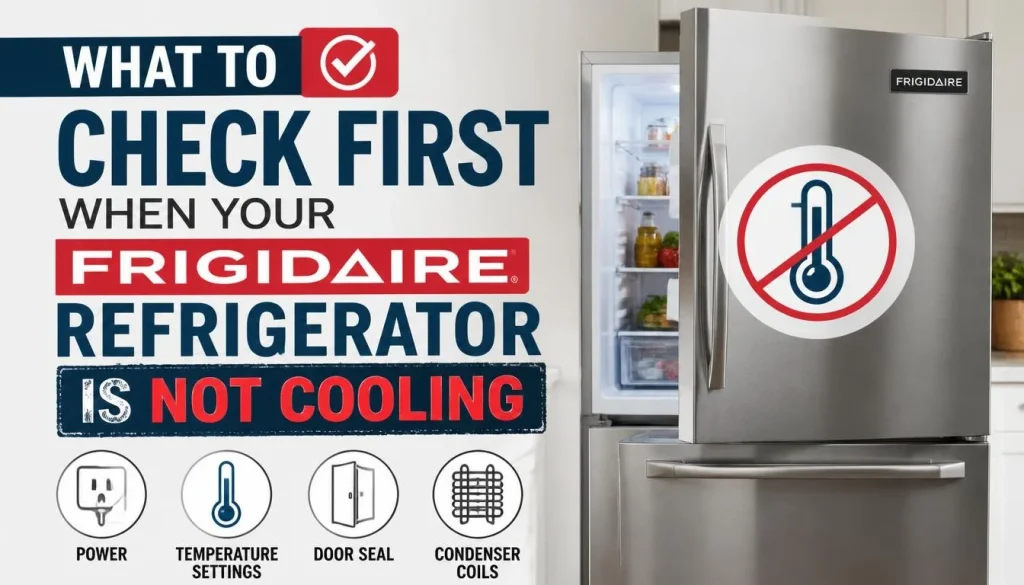
Before inspecting internal components, check a few simple things. These steps can help you avoid unnecessary repairs.
1. Check the Power Supply and Circuit Breaker
First, make sure your refrigerator is receiving electricity.
Look for these signs:
- Is the interior light working?
- Is the control panel displaying information?
- Is the refrigerator completely silent?
- Has the circuit breaker tripped?
- Is the outlet working correctly?
If the interior light and display are completely off, the refrigerator may have lost power. Check the electrical outlet and circuit breaker.
Some refrigerators have internal lights that continue working even when the compressor or another cooling component is not operating. Therefore, a working light does not always mean the cooling system is functioning.
For electrical safety, avoid opening the control panel or testing live wiring. If you notice a burning smell, damaged power cord, sparking, or repeated breaker trips, stop using the appliance and contact a qualified technician.
If your refrigerator has power but is still warm, see our guide on why a refrigerator light is on but the refrigerator is not cooling.
2. Check the Refrigerator and Freezer Temperature Settings
Incorrect temperature settings are one of the easiest problems to overlook.
For most Frigidaire refrigerators with electronic controls, the recommended starting settings are:
- Refrigerator compartment: 37°F
- Freezer compartment: 0°F
Some models have different recommendations. For example, certain Multi-Door models with a Custom-Flex temperature drawer have a different fresh-food setting. Models with dial controls may use a marked normal position instead of a digital temperature display.
Check your refrigerator’s Use and Care Manual before changing settings.
You can also place an appliance thermometer inside the refrigerator to confirm the actual temperature. Do not rely only on the displayed setting.
Frigidaire explains its recommended settings in its official refrigerator temperature guide.
3. Check Whether the Refrigerator Is in Demo Mode
Some Frigidaire refrigerators include a Demo Mode for store displays.
In this mode, the display can appear to work even though the functional cooling components are not operating normally. This can make the refrigerator look like it has power while the compartments remain warm.
On supported models, the display may show 77 77.
Frigidaire’s error-code guide gives a specific procedure for clearing this Demo Mode:
- Disconnect the refrigerator from power.
- Leave it unplugged for five minutes.
- Plug it back in.
- Check whether the display returns to its normal operating state.
This procedure is specifically for the supported Demo Mode condition. It is not a universal reset method for every Frigidaire refrigerator.
Read the official Frigidaire error codes and alarms guide for more details.
4. Check for Blocked Air Vents
Your refrigerator needs proper airflow to maintain an even temperature.
Cold air moves through vents between different areas of the appliance. If food containers, bags, or other items block these openings, cold air may not circulate properly.
Open the refrigerator and freezer compartments and look for:
- Food containers pressed against the air vents.
- Large packages blocking the rear wall.
- Items packed too tightly around the shelves.
- Ice buildup around the air openings.
Move anything that blocks the vents and leave enough space for air to circulate.
Avoid overloading the refrigerator. Even a working cooling system may struggle to maintain an even temperature when airflow is restricted.
5. Check the Door Seal and Refrigerator Installation
A damaged or poorly sealed door gasket allows warm air to enter the refrigerator.
This forces the appliance to work harder and can cause unstable temperatures.
Try this simple check:
- Open the refrigerator door.
- Place a dollar bill between the gasket and the cabinet.
- Close the door.
- Gently pull the bill.
You should feel some resistance. If the bill slides out very easily in one area, the gasket may not be sealing properly.
Inspect the entire gasket for dirt, cracks, loose sections, or damage. Clean it with warm, soapy water and dry it thoroughly.
Also, check whether food containers or shelves prevent the door from closing completely.
For a recently installed refrigerator, verify that the unit is connected correctly and has enough ventilation around it. Frigidaire recommends a properly grounded, dedicated electrical outlet and does not recommend installing the refrigerator where the surrounding temperature may fall below 55°F.
10 Common Reasons Why Your Frigidaire Refrigerator Is Not Cooling
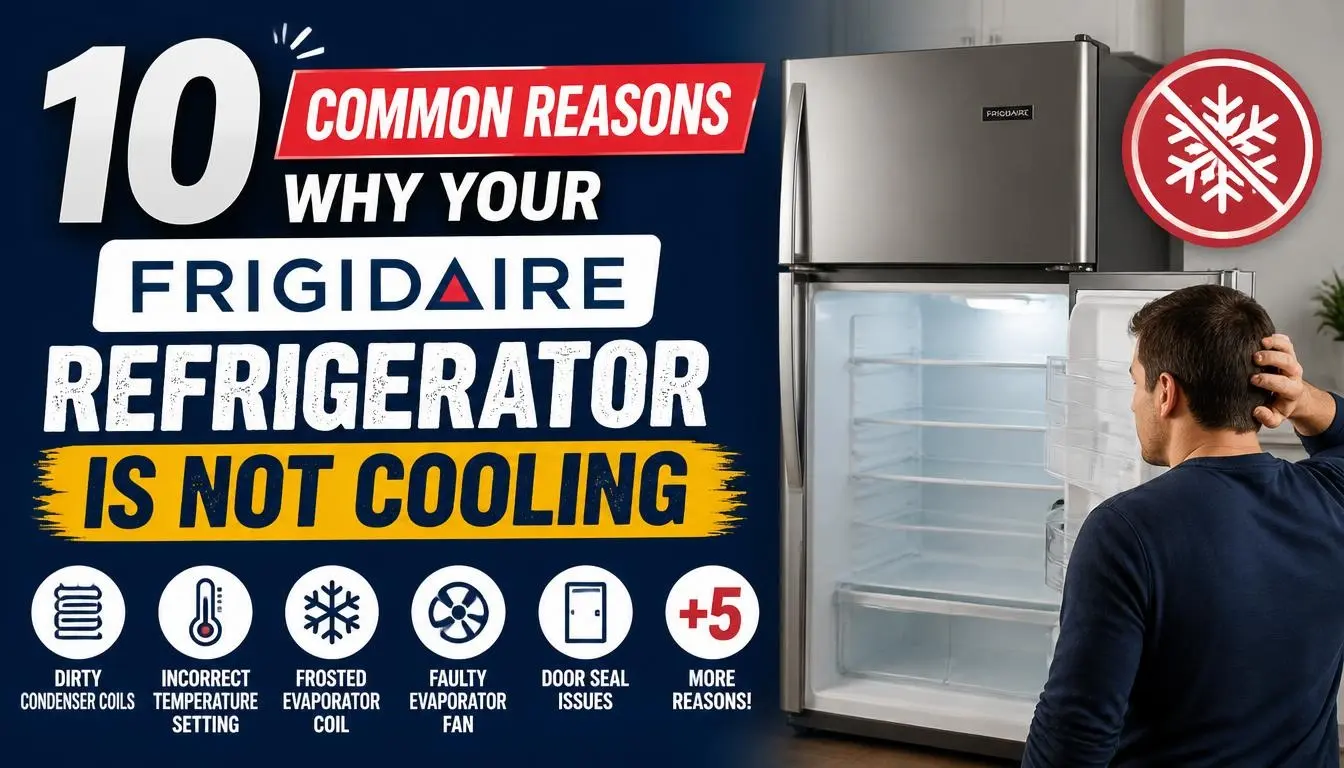
If the basic checks do not solve the problem, one of the following components or conditions may be responsible.
1. Dirty Condenser Coils
Condenser coils release heat from the refrigeration system. When dust, pet hair, and dirt collect around them, heat transfer becomes less effective.
You may notice:
- The refrigerator runs for long periods.
- The cabinet feels warmer than usual around the lower or rear areas.
- The refrigerator struggles to maintain the correct temperature.
- The compressor appears to work harder than usual.
How to check and fix it:
Unplug the refrigerator before performing any accessible cleaning. Check your model’s manual to find the condenser coil location and confirm whether the coils are user-accessible.
If cleaning is permitted, use a suitable refrigerator coil brush or vacuum attachment to remove loose dust. Be careful not to damage the coils, wiring, or nearby components.
Do not remove sealed-system parts or use water near electrical components.
If cleaning does not improve cooling, another component may be responsible.
2. Condenser Fan Motor Problems
Some Frigidaire refrigerators use a condenser fan to move air across the condenser coils and compressor area.
If the fan stops working, the system may struggle to release heat.
Possible warning signs include:
- Unusual noises from the lower or rear section.
- Excessive heat around the compressor compartment.
- Cooling problems affecting both compartments.
- A refrigerator that runs without reaching the selected temperature.
How to check:
Listen for unusual noises while the refrigerator is operating. However, fan operation varies by model and operating conditions, so the absence of fan noise does not prove that the motor has failed.
Unplug the appliance before any accessible visual inspection. Do not reach into the fan area while the refrigerator is connected to power.
A technician can check the fan motor, electrical connections, and control signals if necessary.
3. Faulty Evaporator Fan Motor
The evaporator fan moves cold air through the refrigerator and freezer compartments.
If it stops working or becomes obstructed by ice, airflow may become weak or disappear.
Common symptoms include:
- The freezer remains cold, but the refrigerator compartment becomes warm.
- You hear unusual scraping or rattling sounds.
- Airflow from the refrigerator vents is weak.
- Cooling becomes inconsistent.
What should you do?
First, check that food is not blocking the air vents.
Next, listen for unusual fan noises. A fan may also stop temporarily during certain operating cycles, so one silent inspection is not enough to confirm failure.
If the freezer is cold but the refrigerator is warm, read our detailed guide on why the refrigerator is not cooling but the freezer is working.
A technician can inspect the evaporator fan, wiring, and surrounding area if the airflow problem continues.
4. Blocked or Faulty Air Damper Control Assembly
The air damper regulates how much cold air moves from the freezer into the fresh-food compartment on models that use this arrangement.
If the damper becomes stuck closed, the freezer may remain cold while the refrigerator compartment becomes warm.
Possible symptoms include:
- Freezer temperature appears normal.
- Refrigerator temperature continues rising.
- Little or no cold air comes through the refrigerator vents.
- Airflow does not improve after rearranging food.
Start by checking the vents for food blockage.
If the vents are clear but the refrigerator still does not receive enough cold air, the damper assembly may need inspection.
A damaged motor, stuck door, or control problem can affect its operation. Because damper designs vary by model, use the correct parts diagram and service information before replacing anything.
5. Damaged Refrigerator Door Gasket
A worn, dirty, or damaged door gasket can allow warm air to enter continuously.
This affects cooling efficiency and may lead to frost or condensation around the compartment.
Check for:
- Torn or cracked gasket material.
- Loose sections around the door.
- Dirt or food residue on the sealing surface.
- Doors that do not close completely.
Clean the gasket and repeat the dollar-bill test described earlier.
If the gasket is torn, deformed, or unable to seal after cleaning, it may need replacement.
Make sure you select the correct gasket for your Frigidaire model. Different refrigerator models may use different parts.
6. Excessive Frost or Defrost System Failure
Frigidaire refrigerators use an automatic defrost system to prevent excessive frost from collecting on the evaporator.
If the system does not work properly, ice can build up around the evaporator and interfere with airflow.
Possible causes include:
- A defective defrost heater.
- A faulty defrost thermostat or sensor.
- A problem with the electronic control.
- Damaged wiring or connections.
Common warning signs include:
- Heavy frost on the freezer’s interior rear panel.
- Weak airflow from the refrigerator vents.
- The freezer becoming less effective over time.
- A refrigerator compartment that stays warm.
You can inspect the visible freezer area for unusual frost buildup. However, checking the evaporator itself may require removing an internal panel.
Do not use a knife, screwdriver, or other sharp object to remove ice. Avoid using a hairdryer near plastic liners, wiring, or electrical components.
If you suspect a defrost problem, our guide on why a refrigerator is not defrosting explains the common components involved.
7. Faulty Temperature Sensor or Thermistor
The thermistor measures temperature and sends information to the refrigerator’s control system.
If it provides incorrect readings, the refrigerator may not regulate cooling properly.
You may notice:
- Temperature changes without adjusting the controls.
- The refrigerator becomes warmer than expected.
- Cooling starts and stops irregularly.
- The display temperature does not match the actual temperature.
A technician can compare the sensor’s resistance with the model-specific temperature-resistance chart.
Do not use one universal resistance value for every Frigidaire refrigerator. Different models may use different sensors and specifications.
8. Temperature Control Thermostat or Electronic Control Board Failure
Depending on the refrigerator model, cooling operation may be controlled by a mechanical thermostat, electronic temperature sensors, and an electronic control board.
A faulty thermostat or control board may fail to send the correct operating signal to the compressor, fans, or other components.
Possible symptoms include:
- The refrigerator does not start cooling when needed.
- Temperature control becomes unresponsive.
- Cooling cycles behave irregularly.
- The compressor or fans do not operate as expected.
However, these symptoms can also result from other problems, such as a failed start device, wiring issue, or defective sensor.
Do not replace an electronic control board just because the refrigerator is warm.
A proper diagnosis should come first. You can also read our guide on how to replace a refrigerator thermostat to understand the role of temperature controls.
9. Compressor Start Problems
The compressor circulates refrigerant through the sealed cooling system.
If the compressor cannot start or keep running, the refrigerator may lose its ability to cool.
A compressor start relay or overload protector problem can sometimes prevent the compressor from operating correctly.
Common signs include:
- The compressor makes a buzzing sound and then clicks.
- The compressor repeatedly attempts to start.
- Both refrigerator and freezer compartments become warm.
- Cooling stops even though electrical power is available.
If you hear a repeated buzz-click pattern along with rising temperatures, do not assume the compressor itself has failed.
A technician should inspect the start device, overload protector, electrical supply, and compressor before recommending replacement.
For related symptoms, see our article on Frigidaire refrigerator buzzing but not cooling.
10. Compressor or Sealed System Failure
Sometimes the compressor or another part of the sealed refrigeration system stops working correctly.
A sealed-system problem may involve:
- A defective compressor.
- Refrigerant leakage.
- A restriction in the refrigerant circuit.
- A damaged refrigerant line.
When this happens, the refrigerator may run continuously without reaching the proper temperature.
Both compartments may become warm, although the exact symptoms depend on the type of failure.
These repairs require specialist tools, training, and the correct refrigerant-handling procedures. Do not attempt to open the sealed system or add refrigerant yourself.
Contact a qualified refrigerator technician for diagnosis and repair.
Frigidaire Refrigerator Not Cooling but Freezer Is Working
This is a particularly common troubleshooting situation.
The freezer may remain cold while the refrigerator compartment becomes warm because the two compartments depend on a controlled supply of cold air.
Depending on the model, the problem may involve:
- Blocked air vents.
- A faulty evaporator fan.
- A stuck or defective air damper.
- Excessive frost around the evaporator.
- A problem with the temperature sensor or control system.
How to Troubleshoot This Problem
Start with the following checks:
- Confirm the freezer is actually maintaining a cold temperature using an appliance thermometer.
- Check whether food is blocking the air vents.
- Make sure the refrigerator door closes and seals correctly.
- Look for visible frost buildup inside the freezer.
- Listen for unusual fan noises.
- Check whether cold air is coming through the refrigerator vents.
If the freezer is cold but the refrigerator remains warm, the evaporator fan and air damper deserve particular attention.
Do not assume that the compressor is defective simply because the refrigerator compartment is not cooling.
Our guide to refrigerators where the freezer works but the fridge does not covers the general troubleshooting process in more detail.
Frigidaire Refrigerator and Freezer Both Not Cooling
When both compartments become warm, the problem may affect the entire cooling system rather than only the refrigerator’s airflow.
Start with these checks:
- Confirm the refrigerator has electrical power.
- Check the circuit breaker and outlet.
- Verify that Demo Mode is not active on a supported model.
- Confirm the temperature settings.
- Make sure the condenser area has enough airflow.
- Check for unusual compressor noises.
If the refrigerator is running but neither compartment gets cold, a technician may need to inspect the compressor, start components, condenser fan, control board, and sealed system.
Do not repeatedly unplug the refrigerator or attempt to force the compressor to start. Repeated electrical cycling will not repair a defective component.
Frigidaire Refrigerator Not Cooling After a Power Outage
A power outage can interrupt normal refrigerator operation. After power returns, the unit may need time to recover its temperature.
What Does the PF Power Failure Indicator Mean?
Some Frigidaire refrigerators display PF or a Power Failure indicator after an interruption in electricity.
This warning indicates that the refrigerator detected a power failure or power-related event. It does not automatically mean that the compressor has failed.
Once power returns, acknowledge the alarm using the appropriate control for your model.
What Should You Check After Power Returns?
- Check the circuit breaker and power outlet.
- Confirm that the refrigerator display and interior lights are working.
- Check the refrigerator and freezer temperature settings.
- Make sure both doors are fully closed.
- Look for blocked air vents.
- Monitor the actual compartment temperatures with an appliance thermometer.
Frigidaire states that a newly installed or power-interrupted refrigerator may need time for its temperature to stabilize. Allow up to 24 hours for stabilization where appropriate, following your model’s instructions.
However, do not confuse the time needed for cooling recovery with food safety.
The FDA says an unopened refrigerator generally keeps food cold for about four hours during a power outage. Keep the doors closed as much as possible. Perishable foods that have been above 40°F for two hours or more should be discarded.
Read the FDA’s food safety advice during power outages before deciding whether food is safe to keep.
Frigidaire Refrigerator Not Cooling After Installation
A newly installed refrigerator may not reach its proper temperature immediately.
Before assuming something is broken, check the following:
Check the Electrical Connection
Frigidaire recommends using a dedicated, properly grounded electrical outlet that meets the model’s installation requirements.
Check the installation manual for the correct electrical specifications. Avoid using an extension cord unless the manufacturer specifically permits it.
Allow Time for Temperature Stabilization
Frigidaire recommends allowing approximately 24 hours for temperature stabilization after installation.
During this period, avoid repeatedly changing the temperature settings.
Check the Refrigerator’s Location
The refrigerator needs enough clearance around the areas specified in its installation guide.
Also, Frigidaire does not recommend placing the appliance where the surrounding temperature may drop below 55°F.
For model-specific setup instructions, consult the official Frigidaire refrigerator installation and troubleshooting resources.
What Do 77 77, Sb, PF, and H or HI Mean on a Frigidaire Refrigerator?
Frigidaire refrigerators may display different codes and indicators depending on the model.
Here are several you may encounter when investigating cooling problems.
77 77: Demo Mode
This display may indicate that the refrigerator is in Demo Mode.
On supported models, unplugging the refrigerator for five minutes and reconnecting it disables this mode.
Sb: Sabbath Mode
The Sb indicator means Sabbath Mode is active on supported models.
This mode disables certain appliance features, including lights, the dispenser, and parts of the control panel. It does not automatically mean the cooling system has failed.
Frigidaire explains that certain models can exit Sabbath Mode by holding the minus button and Temp F-C button simultaneously for five seconds.
Follow your own refrigerator’s manual because controls can vary by model.
See the official Frigidaire Sabbath Mode guide.
PF: Power Failure
The PF indicator means the refrigerator has detected a power failure or power surge.
Check the electrical supply and acknowledge the alert according to your model’s instructions.
H or HI: High Temperature Alert
The H or HI indicator warns that the refrigerator or freezer temperature has become too high.
Possible reasons include:
- A door left open.
- Incorrect temperature settings.
- A damaged door gasket.
- A recent power outage.
- A cooling problem.
Check the door seals and temperature settings first.
Frigidaire recommends 37°F for the fresh-food compartment and 0°F for the freezer on most electronic-control models.
The alert may be acknowledged or cleared using the appropriate control, but clearing the warning does not fix the underlying cooling problem.
Read the official Frigidaire H or HI high-temperature alert guide.
How to Reset a Frigidaire Refrigerator That Is Not Cooling
A reset may help when the refrigerator has experienced a temporary control or power interruption. However, it cannot repair a defective fan, damaged gasket, blocked airflow, failed compressor, or sealed-system problem.
When Should You Try a Reset?
Consider a reset when:
- The display is behaving unusually.
- An error indicator remains after power has returned.
- The refrigerator controls are temporarily unresponsive.
- Frigidaire’s troubleshooting instructions recommend a reset for your specific issue.
How to Perform a Basic Power Reset
For models where the manufacturer recommends a power reset:
- Remove or protect food as needed.
- Unplug the refrigerator safely.
- Wait for the period specified in the model’s instructions.
- Reconnect the refrigerator.
- Check whether the display and cooling operation return to normal.
Frigidaire’s general error-code guide suggests a 30-second power reset for certain alerts. Demo Mode, however, has a separate five-minute procedure.
Do not treat these procedures as interchangeable.
If the refrigerator does not respond or continues to get warmer, contact Frigidaire or a qualified appliance technician.
When Should You Call a Refrigerator Repair Technician?
Some refrigerator problems are not suitable for DIY repair.
Contact a qualified technician when:
- Both refrigerator and freezer compartments remain warm.
- The compressor repeatedly buzzes and clicks.
- The evaporator or condenser fan appears to have failed.
- Heavy frost continues to return.
- The refrigerator displays persistent error codes.
- The control board or electrical components need testing.
- You suspect a refrigerant leak or sealed-system problem.
- Cooling does not return after the recommended troubleshooting period.
If your refrigerator is recently installed, Frigidaire recommends contacting the installer for units installed within the past 30 days when the problem cannot be resolved through basic troubleshooting. For older installations, contact Frigidaire to arrange service.
When contacting a technician, have the refrigerator’s model and serial numbers ready. These details help identify the correct service information and replacement parts.
Frequently Asked Questions
Why Is My Frigidaire Refrigerator Running but Not Cooling?
Your refrigerator may be running without cooling because of blocked air vents, dirty condenser coils, a faulty evaporator fan, a damaged door gasket, or a compressor or sealed-system problem. Check the temperature settings and airflow first. If both compartments remain warm, professional diagnosis may be necessary.
Why Is My Frigidaire Refrigerator Not Cooling but the Light Is On?
The interior light and cooling system operate differently. A working light only confirms that some electrical power is available. A faulty fan, compressor start component, temperature control, or another cooling-system problem may prevent the refrigerator from getting cold.
Why Is My Frigidaire Freezer Cold but the Refrigerator Is Warm?
This often happens when cold air cannot circulate properly into the fresh-food compartment. Blocked vents, an evaporator fan problem, a faulty air damper, or excessive frost around the evaporator may be responsible.
Why Is My Frigidaire Refrigerator Compressor Running but Not Cooling?
A running compressor does not guarantee that the refrigerator can produce enough cold air. Dirty condenser coils, poor airflow, a cooling-system restriction, or a refrigerant-related problem may affect performance. A technician should diagnose the system before any major component is replaced.
Why Did My Frigidaire Refrigerator Suddenly Stop Cooling?
A sudden loss of cooling can result from a power interruption, changed temperature settings, an electrical problem, a failed fan, or a compressor-related issue. Check the power supply, settings, doors, and airflow before arranging professional service.
How Long Does a Frigidaire Refrigerator Take to Get Cold?
Frigidaire recommends allowing approximately 24 hours for temperature stabilization after installation. Cooling recovery after a power interruption may also take time. Use an appliance thermometer to monitor the actual temperature rather than relying only on the display.
What Temperature Should a Frigidaire Refrigerator Be Set At?
For most Frigidaire refrigerators with electronic controls, the recommended settings are 37°F for the fresh-food compartment and 0°F for the freezer. Some models have different recommendations, so check your owner’s manual.
Can Dirty Condenser Coils Cause a Frigidaire Refrigerator Not to Cool?
Yes. Dirty condenser coils can interfere with heat transfer and make the cooling system work harder. Cleaning accessible coils according to the manufacturer’s instructions may help, but persistent cooling problems require further diagnosis.
Why Is My Frigidaire Refrigerator Showing H or HI?
The H or HI indicator is a high-temperature warning. It may appear after a door has been left open, a power outage, incorrect settings, or a cooling problem. Check the door seal and actual temperatures before simply clearing the alert.
Will Unplugging My Frigidaire Refrigerator Fix the Cooling Problem?
Unplugging and reconnecting the refrigerator may help with certain temporary control issues. However, it will not fix a defective fan, blocked airflow, failed compressor, or damaged sealed system. Follow the reset procedure specified for your model.
Is It Worth Repairing a Frigidaire Refrigerator That Is Not Cooling?
It depends on the refrigerator’s age, overall condition, warranty coverage, repair cost, and the component that failed. A simple fan or door gasket repair may be more economical than replacing the appliance, while an expensive sealed-system repair may require a careful cost comparison.
Final Thoughts
When your Frigidaire refrigerator stops cooling, do not assume the compressor is the problem. Start with the power supply, temperature settings, air vents, door gasket, and visible frost buildup. These basic checks can help identify several common cooling problems without unnecessary part replacements.
If the freezer is cold but the refrigerator is warm, pay particular attention to the evaporator fan, air damper, and defrost system. If both compartments are warm, the issue may involve the electrical supply, compressor, or sealed cooling system.
Most importantly, use your refrigerator’s model-specific manual before attempting repairs. If the problem involves electrical components, refrigerant, or a sealed system, contact a qualified technician.
A careful diagnosis is usually a better starting point than replacing parts based on guesswork.

Hi, I’m the lead researcher and appliance enthusiast behind RefrigeratorSolve. With years of hands-on experience troubleshooting cooling systems and testing home appliances, I am dedicated to bringing you honest reviews, energy-saving tips, and practical solutions to keep your refrigerator running perfectly.