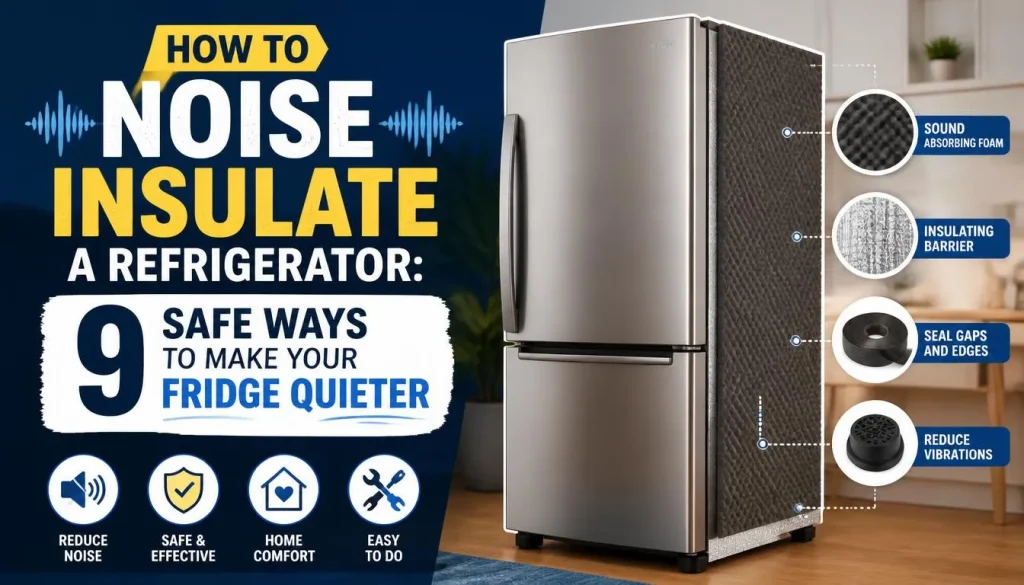
A loud refrigerator can be frustrating, especially when you hear it from your living room or bedroom at night. The good news is that you can often reduce the noise without replacing the appliance or spending money on expensive soundproofing materials.
The first step is to identify where the sound comes from. An uneven refrigerator, vibrating floor, loose shelf, or contact with a cabinet can make normal operating sounds seem much louder. However, persistent grinding, unusually loud knocking, or noise accompanied by poor cooling may indicate a mechanical problem that needs attention.
In this guide, you will learn how to block high-decibel sounds from a refrigerator, reduce vibration, choose suitable soundproofing materials, and make your kitchen quieter without restricting the appliance’s ventilation.
Quick Answer: To reduce loud refrigerator sounds, level the appliance, maintain the required clearance around it, secure loose shelves and containers, and consider suitable anti-vibration pads if floor vibration is the problem. Sound-absorbing materials on nearby walls may help with reflected noise. Never wrap the refrigerator in foam or blankets or block its ventilation openings.
Why Is Your Refrigerator So Loud?
Refrigerators contain several moving and operating components. The compressor helps circulate refrigerant, fans move air, and water valves and ice makers operate at different times. These processes can produce humming, buzzing, clicking, or other sounds during normal operation.
The problem begins when the noise becomes unusually loud, continues for long periods, or travels through your home’s walls, floor, or cabinets.
Before buying soundproofing materials, identify the type of noise you hear.
| Noise type | Possible cause | What to check |
|---|---|---|
| Humming or buzzing | Normal compressor operation, fan noise, or vibration | Leveling, clearance, and changes in sound |
| Rattling | Loose containers, shelves, drain pan, or nearby objects | Interior shelves and contact with cabinets |
| Knocking or banging | Vibration, operating cycles, or a component problem | When the noise occurs and whether it is repetitive |
| Grinding or squealing | Possible fan or other mechanical problem | Whether the sound persists or cooling is affected |
| Noise through the floor | Vibration transferring into a hard or resonant surface | Floor stability and appliance feet |
| Clicking or crackling | Relays, ice maker operation, or temperature changes | Whether the sound is occasional or unusually frequent |
These are possible explanations, not definitive diagnoses. If you need help identifying a particular sound, read our guide to what causes a refrigerator to make banging noises.
You can also consult LG’s guide to troubleshooting unusual refrigerator noises for examples of normal operating sounds and symptoms that may need service.
How to Block High-Decibel Sounds From a Refrigerator
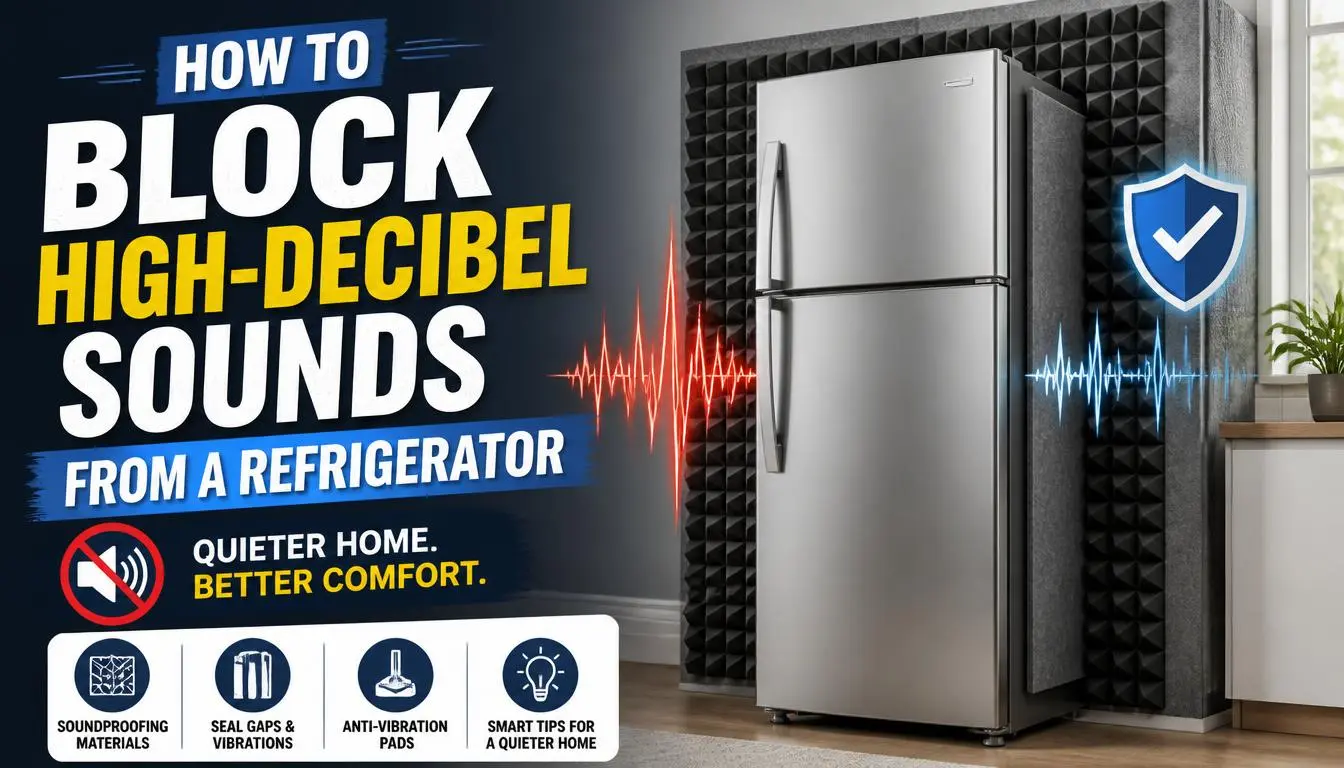
The most effective solution depends on how the noise reaches you. If the refrigerator vibrates against a cabinet, soundproofing a distant wall will not fix the main problem. Similarly, anti-vibration pads will not repair a damaged fan or noisy compressor.
Try these nine methods, starting with the simplest checks.
1. Level the Refrigerator on a Stable Floor
An uneven refrigerator can wobble slightly as its compressor and fans operate. That movement may cause the cabinet, shelves, or nearby surfaces to vibrate.
Check whether the appliance rocks when you gently push it. Look for an uneven floor or incorrectly adjusted leveling feet.
If adjustment is needed, follow your refrigerator’s installation manual. Make sure the appliance remains stable and the doors operate correctly.
Refrigerators can be extremely heavy, so do not attempt to tilt or move one alone. Ask another person for help or hire an appliance technician if access is difficult.
For model-specific instructions, see LG’s refrigerator leveling guide.
2. Keep the Refrigerator Away From Walls and Cabinets
A refrigerator does not need to touch surrounding surfaces to remain in position. In fact, contact with a wall, countertop, cabinet, or another appliance can amplify vibration.
Listen for the sound while checking whether the refrigerator’s sides or rear panel touch nearby objects.
If contact is causing the noise, adjust its position only as far as necessary and follow the manufacturer’s clearance requirements. Do not pull a built-in refrigerator out of its housing without checking the installation instructions.
Adequate space also supports airflow and heat removal. Leaving room around the appliance may reduce vibration while helping it operate as designed.
3. Remove Loose Objects That Rattle
Sometimes the loudest sound comes from something simple rather than a faulty refrigerator component.
Check the following areas:
- Glass bottles and jars that touch each other.
- Shelves or drawers that are not seated correctly.
- Containers leaning against the refrigerator’s interior walls.
- Objects stored on top of the appliance.
- Items touching the sides or rear of the refrigerator.
Rearrange the containers and make sure removable shelves and drawers are properly positioned.
This is one of the easiest ways to reduce rattling without purchasing anything. It also helps you identify whether the sound comes from the appliance itself or from objects responding to normal vibration.
4. Use Suitable Anti-Vibration Pads
Anti-vibration pads can help when the refrigerator transfers mechanical vibration into a hard floor. They sit beneath the appliance’s feet and can reduce direct contact between the feet and the supporting surface.
Before choosing pads, check the following:
- They are rated to support the refrigerator’s weight.
- Their dimensions suit the appliance’s feet.
- The refrigerator remains level and stable after installation.
- They do not interfere with wheels, leveling legs, ventilation, or drainage.
A properly fitted appliance isolation mat may also help in some installations, provided the manufacturer permits its use.
Keep expectations realistic. Anti-vibration pads are most useful for structure-borne vibration; they will not eliminate every hum, fan sound, or compressor noise.
If the refrigerator still rocks after installation, remove the unsuitable pads and correct the stability problem rather than accepting an unstable setup.
5. Treat the Wall Behind the Refrigerator
A hard wall can reflect sound back into the kitchen, making normal appliance noise more noticeable. Wall treatment may help reduce some of these reflections.
Acoustic panels designed for indoor use can absorb part of the sound that reaches their surface. However, they do not automatically block all refrigerator noise, especially low-frequency humming or vibration travelling through the building structure.
If you choose to install an acoustic panel, place it securely on a suitable wall surface, away from the refrigerator’s ventilation openings and service areas.
Do not attach foam or panels directly to the refrigerator. Do not cover electrical connections, the condenser fan, or any other component that needs airflow.
For noise passing through a shared wall, improvements to the wall’s sound-isolating construction may be more effective than placing a thin foam panel nearby.
6. Address Vibration Traveling Through the Floor
Sometimes a refrigerator sounds reasonable in the kitchen but becomes annoying in an adjoining room. This can happen when vibration transfers into flooring and nearby building structures.
Hard floors can transmit vibration, while a flexible or resonant floor may amplify it. The correct approach is to address the contact between the refrigerator and the floor first.
Check that the appliance is stable and that all feet rest as intended. If the manufacturer’s instructions allow it, suitable vibration-isolation pads may help.
Avoid putting a thick, soft rug or an unapproved cushion underneath the refrigerator. The appliance must remain level, stable, and properly ventilated.
If the vibration continues through the floor, especially in an apartment or multi-storey home, a qualified acoustic professional may be able to identify whether the floor structure needs further treatment.
7. Choose the Right Soundproofing Materials
Different materials solve different problems. Before purchasing anything, decide whether you need to reduce vibration, absorb reflected sound, or limit sound travelling through a wall.
| Material | Best use | Important limitation |
|---|---|---|
| Anti-vibration pads | Reducing vibration at appliance feet | Cannot repair internal mechanical faults |
| Appliance isolation mat | Suitable floor-vibration applications | Must not compromise stability or ventilation |
| Acoustic wall panels | Reducing reflected sound in a room | Do not provide complete sound isolation |
| Mass-loaded vinyl | Potential sound isolation when installed in an appropriate wall or barrier assembly | Not intended to wrap a working refrigerator |
| Acoustic foam | Absorbing some sound reflections | Does not replace a proper sound barrier or vibration control |
For most homeowners, correcting an uneven installation and stopping contact with cabinets are sensible first steps. Buying several acoustic products before identifying the noise source can waste money.
Mass-loaded vinyl and other dense barriers may be useful as part of a properly designed wall or enclosure assembly, but their performance depends on the complete construction. They should not be attached to the refrigerator itself.
8. Check Accessible Maintenance Issues and the Ice Maker
A fan obstruction, loose component, or poorly secured water line can create noise that no soundproofing material will solve.
Listen carefully to determine whether the sound starts when the ice maker fills, when ice drops into the bin, or when the compressor starts.
If your refrigerator has an ice maker that is not connected to a water supply, consult the owner’s manual about turning it off. Some models can make an amplified valve sound when the ice maker attempts to fill without water.
For routine cleaning, follow the manufacturer’s instructions. Unplug the appliance before owner-approved maintenance that requires disconnection, and never remove electrical or refrigerant-system components unless you are qualified to service them.
Do not assume that every loud fan or compressor is dirty. Persistent or worsening noise may require professional diagnosis.
9. Arrange Professional Repair When Noise Persists
Soundproofing is not a substitute for repairing a mechanical problem.
Contact an authorized appliance technician if you hear persistent grinding, scraping, squealing, or unusually loud repetitive knocking. Do the same if the noise becomes noticeably louder without an obvious reason or if the refrigerator stops cooling properly.
A technician can inspect components such as the fans, compressor mounting system, and other parts that may be responsible.
The Bosch refrigerator noise troubleshooting guide also recommends professional assistance when a possible compressor problem needs diagnosis.
If you notice smoke, a burning electrical smell, or another immediate electrical warning sign, stop using the appliance if you can do so safely and arrange urgent professional assistance.
How to Measure Refrigerator Noise in Decibels
If you want to know whether your changes are helping, compare the sound before and after making adjustments.
A decibel (dB) measurement describes sound level. A-weighted decibels, written as dBA, account for how human hearing responds to different frequencies.
You can use a smartphone sound-meter application to obtain a rough comparison, but the accuracy depends on the phone, microphone, application, and measurement conditions.
Follow these steps for a useful comparison:
- Measure the refrigerator before making changes.
- Place the phone in the same position for each test.
- Keep the distance and phone orientation consistent.
- Take readings while the refrigerator is in a similar operating state.
- Repeat the measurement after making a change.
For general background on sound measurement, see the CDC’s National Institute for Occupational Safety and Health (NIOSH) Sound Level Meter information. Its validated app is intended for workplace noise assessment and is available for iOS; it is not a refrigerator-specific noise-rating standard.
There is no single decibel threshold that proves every refrigerator is faulty. A sudden increase from the appliance’s usual sound level, the type of noise, and any accompanying cooling problems are more useful clues than one reading alone.
How to Reduce Refrigerator Noise in an Apartment or Alcove
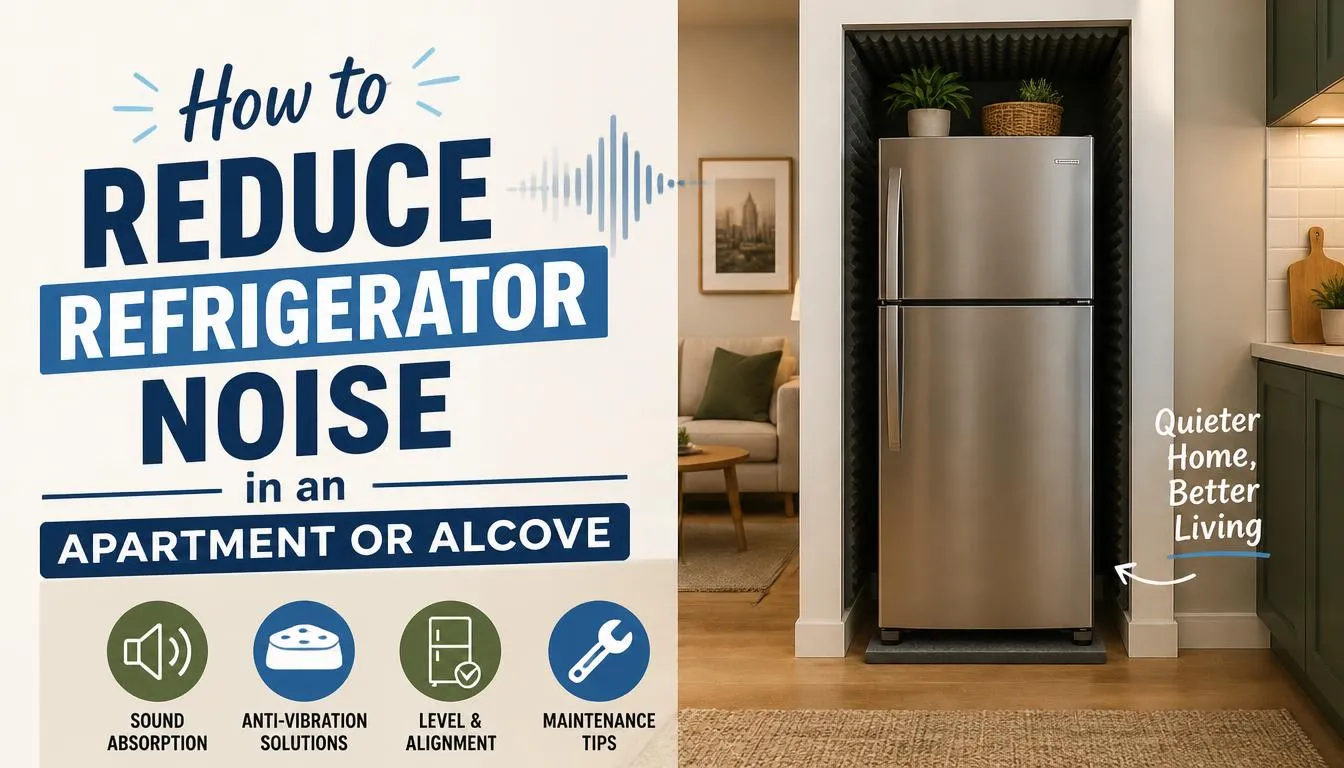
Small kitchens, open-plan homes, and apartments can make refrigerator noise more noticeable because there may be fewer places for sound to dissipate.
If the refrigerator sits in an alcove, check that its installation permits adequate clearance and airflow. A tightly enclosed space can reflect sound, but sealing it with soundproofing material may interfere with heat removal.
Consider these practical changes:
- Make sure the refrigerator does not touch the sides of its cabinet.
- Use suitable vibration isolation if the floor is carrying mechanical vibration.
- Treat nearby wall surfaces where reflected sound is a problem.
- Keep the refrigerator’s ventilation and service areas unobstructed.
- Ask a professional about wall or floor sound isolation if noise travels into another room.
Do not build an airtight enclosure around a refrigerator or cover the condenser area with acoustic foam, blankets, or insulation. The appliance needs the ventilation specified by its manufacturer.
If the main difficulty is hearing the refrigerator while trying to sleep, our guide to how to sleep through refrigerator noise explains additional ways to make a bedroom more comfortable while you investigate the source of the sound.
How Much Can Refrigerator Soundproofing Reduce Noise?
The result depends on the original problem.
If loose shelves or contact with a cabinet cause the noise, correcting those issues may make a noticeable difference. Suitable anti-vibration pads may help when vibration travels through the feet into the floor. Wall panels may reduce reflected sound, while a properly designed wall barrier can help with sound transmission between rooms.
However, none of these methods guarantees a specific reduction in decibels.
Low-frequency compressor noise can be particularly difficult to control with thin acoustic foam. If a motor, fan, or mounting component is faulty, fixing the underlying problem is usually more useful than adding insulation.
Start with low-cost checks, then consider additional treatment only when you know which part of the noise remains.
Refrigerator Soundproofing Mistakes to Avoid
A quieter refrigerator should still be able to cool food safely and operate as intended.
Avoid these common mistakes:
- Wrapping the refrigerator in foam or blankets: This may restrict heat dissipation and interfere with normal operation.
- Blocking ventilation openings: The refrigerator needs the clearances and airflow specified by its manufacturer.
- Using unstable pads: Soft or incorrectly sized supports can make the appliance rock or affect door alignment.
- Ignoring a sudden change in sound: A new grinding or knocking noise may indicate a problem that needs repair.
- Opening sealed mechanical components: Compressor and electrical-system work should be left to qualified professionals.
- Buying soundproofing products without identifying the source: A wall panel will not fix a loose component or damaged fan.
The safest strategy is to reduce unnecessary vibration and reflected sound while leaving the refrigerator’s operating parts unobstructed.
Frequently Asked Questions About How to Noise Insulate a Refrigerator
How can I block high-decibel sounds from my refrigerator?
Start by identifying the noise source. Level the refrigerator, maintain proper clearance, secure loose items, and consider suitable anti-vibration pads when floor vibration is responsible. Use wall-mounted acoustic treatment only when reflected sound is part of the problem.
What is the best material for reducing refrigerator noise?
There is no single best material for every situation. Anti-vibration pads can help with floor vibration, while acoustic panels may reduce reflected sound. Dense barrier materials may help when installed as part of a suitable wall assembly.
Can I put soundproof foam around my refrigerator?
No. Do not wrap the refrigerator in acoustic foam or cover its ventilation openings. If you use acoustic panels, install them on an appropriate nearby wall while maintaining the manufacturer’s required clearance.
Do anti-vibration pads really work?
They can help when vibration transfers from the refrigerator’s feet into a floor. They are less useful for airborne fan noise or an internal mechanical fault. Choose pads that support the appliance’s weight and keep it stable.
Why does my refrigerator sound louder at night?
Normal operating sounds may seem louder when the house is quiet. A compressor, fan, or ice maker may be more noticeable at night even when it is working normally. However, a sudden or persistent change in sound should be investigated.
Should I replace a refrigerator that makes a loud noise?
Not necessarily. First identify the cause and compare the likely repair cost with the age and condition of the appliance. A loose shelf or installation issue may be easy to correct, while a serious mechanical problem may require professional repair or a replacement decision.
Final Thoughts
Learning how to noise insulate a refrigerator starts with understanding the noise rather than covering the appliance with soundproofing material.
Check the leveling, maintain proper clearance, secure loose items, and consider appropriate vibration isolation. Treat nearby walls only when reflected sound is part of the problem, and never obstruct ventilation.
Most importantly, do not mistake a mechanical fault for a soundproofing problem. If the refrigerator suddenly becomes much louder, produces persistent grinding or banging, or struggles to keep food cold, have it checked by a qualified technician.
The goal is not to make every refrigerator completely silent. It is to reduce unnecessary noise safely while keeping your appliance stable, well ventilated, and working properly.

Hi, I’m the lead researcher and appliance enthusiast behind RefrigeratorSolve. With years of hands-on experience troubleshooting cooling systems and testing home appliances, I am dedicated to bringing you honest reviews, energy-saving tips, and practical solutions to keep your refrigerator running perfectly.