A refrigerator should never be completely silent. Fans move cold air, the compressor cycles on and off, refrigerant flows through the system, and the ice maker may operate throughout the day. A soft hum or gentle airflow sound is usually normal.
What is not normal is a refrigerator fan that suddenly starts rattling, grinding, buzzing, scraping, or causing the entire appliance to vibrate.
If you are trying to figure out how to fix refrigerator noise, fan vibration is often one of the first problems worth checking. In many cases, the cause is surprisingly simple: the refrigerator may be uneven, a fan blade may be touching ice, debris may have reached the condenser fan, or a loose panel may be amplifying normal vibration.
Other cases involve a worn fan motor or a problem that needs professional repair.
The easiest way to solve the problem is to identify where the noise is coming from, what it sounds like, and when it happens. This guide walks you through that process step by step.
Quick Answer: How Do You Stop Refrigerator Fan Vibration Noise?
If your refrigerator fan is vibrating or making an unusual noise, start with these checks:
- Unplug the refrigerator before accessing any fan or rear panel.
- Make sure the refrigerator is level and stable.
- Move it slightly away from the wall or surrounding cabinets.
- Check for loose shelves, bottles, panels, and the drain pan.
- Determine whether the sound comes from inside the freezer or the lower back of the refrigerator.
- Check the evaporator fan for ice buildup.
- Inspect the fan blade for cracks, bending, wobbling, or rubbing.
- Clean debris around an accessible condenser fan.
- Check fan mounting screws and brackets.
- Replace a damaged blade or failing fan motor when necessary.
If you are unsure whether the vibration actually comes from a fan, this guide to common causes of refrigerator vibrating noise can help you rule out leveling, wall contact, water lines, the compressor, and other sources first.
Why Is My Refrigerator Fan Making a Vibrating Noise?
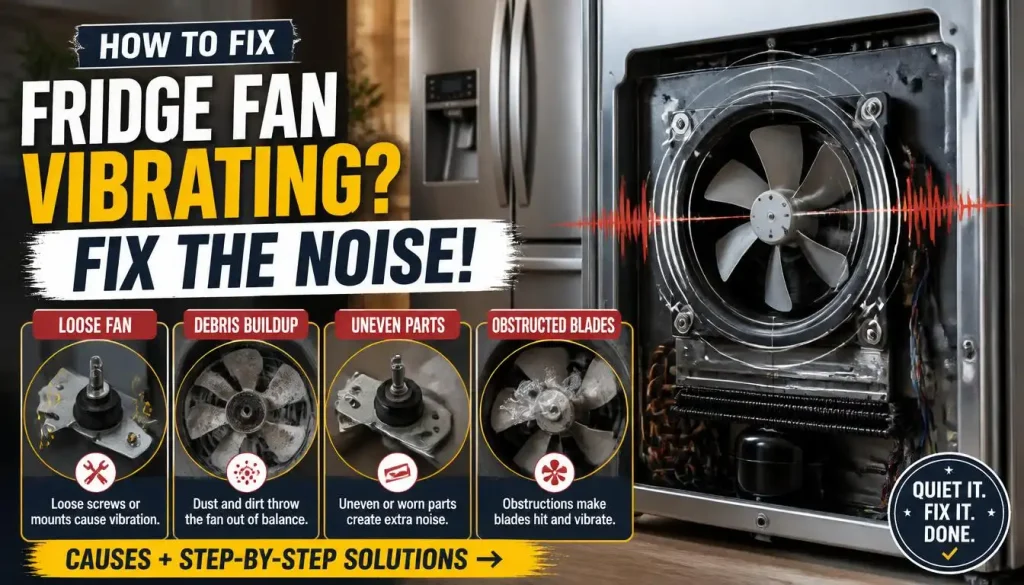
A refrigerator fan can create vibration whenever the rotating blade or motor is no longer moving smoothly.
Common causes include:
- Ice touching the evaporator fan blade
- Dust, pet hair, or debris around the condenser fan
- A loose fan blade
- A bent or cracked fan blade
- A blade rubbing against its housing
- Loose fan mounting screws
- A worn fan motor bearing
- A loose rear panel
- A wire or other object touching the fan
- An uneven refrigerator transferring vibration to the floor
- The refrigerator touching a wall or cabinet
The important thing is not to assume the fan motor has failed immediately. A perfectly functional fan can become noisy simply because the blade is touching ice or another object.
Is Refrigerator Fan Vibration Normal?
Some fan noise is completely normal.
Modern refrigerators use fans to move air across the evaporator and, on many models, across the condenser. Fan speed can change depending on temperature and cooling demand.
Normal Refrigerator Fan Sounds
You may normally hear:
- A low whirring sound
- Gentle airflow
- A soft hum
- A slight increase in fan speed after the door has been open
- Brief changes in sound as a cooling cycle starts or ends
These sounds are usually nothing to worry about if the refrigerator is cooling properly and the sound has not suddenly become louder.
Fan Noises That May Indicate a Problem
Investigate the refrigerator when you hear:
- Loud rattling
- Grinding
- Scraping
- Repeated clicking
- Harsh buzzing
- Squealing
- Chirping
- Excessive vibration
- A fan that repeatedly starts and stops
- A sudden increase in noise
A new sound matters more than a quiet operating sound that the refrigerator has always made.
How to Find Where the Refrigerator Vibration Noise Is Coming From
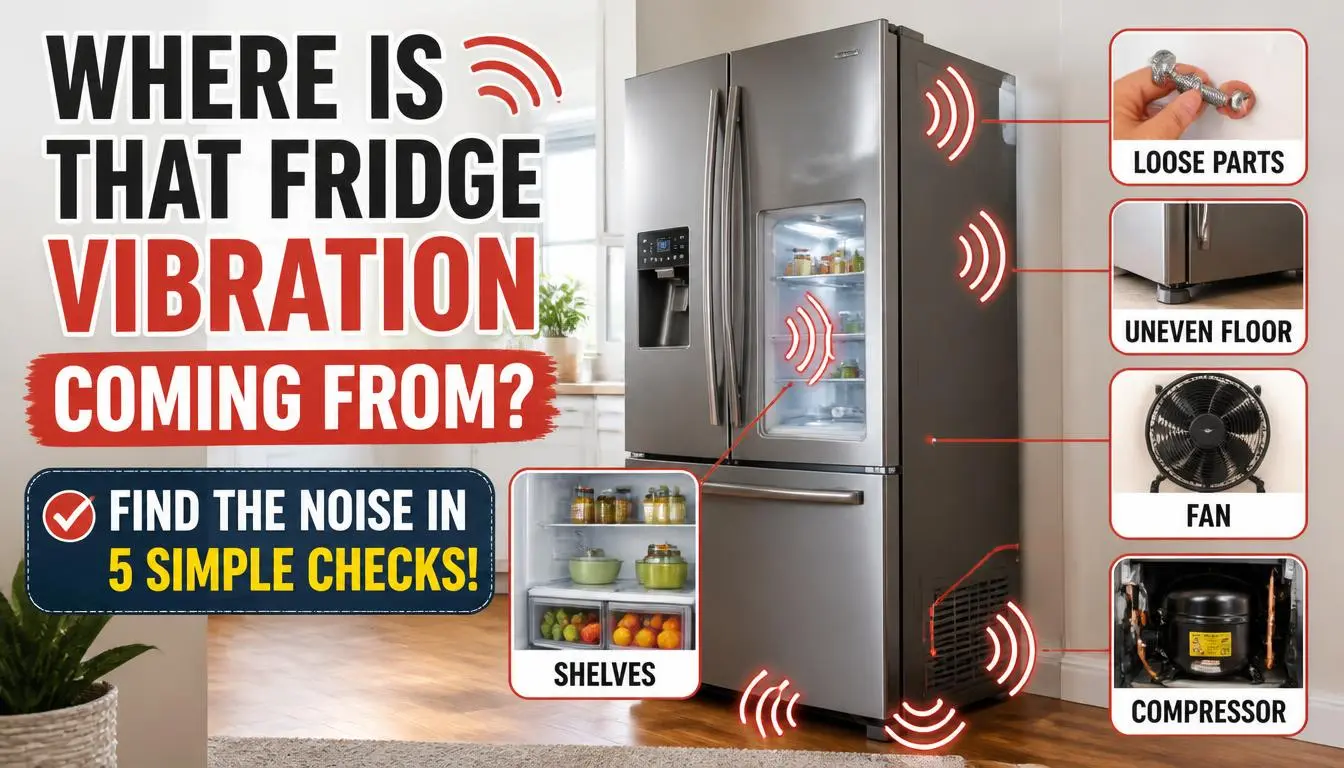
Before removing anything, spend a few minutes listening.
The location of the noise can eliminate several unnecessary repairs.
Noise Coming From Inside the Freezer
A noise from behind the rear wall of the freezer often points toward the evaporator fan.
The evaporator fan circulates cold air through the refrigerator and freezer compartments. Ice, a damaged blade, or a worn fan motor can cause rattling, scraping, grinding, or buzzing.
For more detailed freezer-specific troubleshooting, see the guide on how to fix fan noise in the freezer compartment.
Noise Coming From the Bottom or Back
A vibrating, rattling, or buzzing sound near the lower rear of the refrigerator may come from:
- The condenser fan
- Compressor
- Drain pan
- Refrigerant tubing
- Rear access panel
- Water supply line
Do not automatically assume the compressor is failing just because the sound comes from the back. The compressor and condenser fan are often located close together.
If you are having trouble telling them apart, use this guide to check refrigerator compressor and fan noise.
The Whole Refrigerator Seems to Vibrate
If vibration can be felt through the cabinet or floor, start with the easiest possibilities:
- Refrigerator is not level
- One leveling foot is not firmly touching the floor
- Refrigerator is touching the wall
- Cabinet is touching surrounding furniture
- Bottles are touching one another
- Something is sitting on top of the refrigerator
- A water line is vibrating against the rear panel
- A rear cover or drain pan is loose
This type of vibration does not necessarily mean there is anything wrong with the fan.
Refrigerator Fan Noise Stops When the Door Opens — What Does It Mean?
This is one of the most useful clues when diagnosing refrigerator fan noise.
On many refrigerators, opening the freezer or refrigerator door causes an internal fan to stop or change operation.
If a grinding, buzzing, scraping, or rattling sound disappears almost immediately when you open the freezer door and comes back after closing it, the evaporator fan deserves closer inspection.
Possible causes include:
- Ice touching the fan blade
- A bent fan blade
- A loose fan assembly
- Fan blade rubbing against the housing
- Worn evaporator fan motor bearings
Do not repeatedly open and close the door simply to stop the sound. Find the cause before a minor obstruction damages the fan blade or motor.
Refrigerator Fan Noise by Sound
The type of sound can provide another useful diagnostic clue.
| Sound | Possible Cause | First Thing to Check |
|---|---|---|
| Rattling | Loose blade, panel, bracket, or drain pan | Loose components |
| Grinding | Ice obstruction or worn fan motor | Fan blade and motor |
| Scraping | Fan blade hitting ice or housing | Blade clearance |
| Buzzing | Obstruction, vibration, fan motor, or compressor | Location of sound |
| Clicking | Blade hitting obstruction or another component cycling | Fan area and timing |
| Squealing | Worn motor bearing | Fan motor |
| Loud humming | Fan motor, compressor, or vibration | Source and cooling performance |
| Whirring | Often normal unless unusually loud | Compare with previous operation |
Refrigerator Fan Rattling Noise
Rattling usually suggests that something is loose.
Check for:
- Loose fan mounting screws
- Loose fan cover
- Wobbling blade
- Loose rear panel
- Drain pan
- Water line
- Refrigerator touching the wall
Try lightly pressing on an exterior panel while the refrigerator is running. If the noise changes, vibration may simply be transferring through the cabinet.
Refrigerator Fan Grinding Noise
Grinding deserves more attention.
A freezer fan may grind when:
- Ice surrounds the blade
- A blade is bent
- The fan shaft is damaged
- Motor bearings are wearing out
Do not allow a grinding fan to run indefinitely. Continuous contact can eventually damage the blade or motor.
Refrigerator Fan Buzzing Noise
Buzzing can come from several different parts, including a fan, compressor, water valve, or vibrating panel.
The location is therefore more important than the word “buzzing.”
If the sound is difficult to identify, the RefrigeratorSolve guide explaining why refrigerators make buzzing noises covers the other common sources worth checking.
Refrigerator Fan Squealing or Chirping
A squealing or chirping sound often suggests friction.
If the blade is not touching ice or another object, the motor bearing may be wearing out.
A fan motor that becomes progressively louder usually needs more attention than one that makes a brief, occasional sound.
How to Fix Refrigerator Fan Vibration Noise Step by Step

Start with the least invasive checks before taking panels apart.
Step 1: Unplug the Refrigerator
Disconnect power before reaching near a fan blade, electrical connection, or internal panel.
A fan may start automatically during a cooling cycle even if it was not spinning when you first checked it.
If your refrigerator must be moved, protect the floor and avoid pulling aggressively on the water supply line.
Step 2: Make Sure the Refrigerator Is Level
Place your hands on the cabinet and gently check whether the refrigerator rocks.
If it does:
- Adjust the leveling feet according to the manufacturer’s instructions.
- Make sure each foot contacts the floor securely.
- Check whether the floor itself is uneven or flexible.
A slightly uneven refrigerator can amplify normal compressor and fan vibration.
Step 3: Move the Refrigerator Away From the Wall
A refrigerator positioned too close to a wall or cabinet can turn a small vibration into a surprisingly loud noise.
Check that:
- The rear panel is not touching the wall.
- The side of the refrigerator is not vibrating against cabinetry.
- The water line is not repeatedly striking the wall.
- Power cords are not trapped between vibrating surfaces.
Follow your refrigerator manufacturer’s required ventilation clearances rather than guessing how much space it needs.
Step 4: Check Shelves, Bottles, Drawers, and Loose Parts
Sometimes the refrigerator itself is fine.
Move bottles and containers slightly apart. Make sure shelves, drawers, bins, and the ice bucket are correctly seated.
Remove anything sitting loosely on top of the appliance.
Then run the refrigerator again and listen for changes.
Step 5: Identify the Fan Causing the Noise
The two fans most commonly associated with cooling noise are the evaporator fan and condenser fan.
Evaporator fan: Usually located behind an internal freezer panel.
Condenser fan: On refrigerators that use one, it is usually near the compressor at the lower rear.
Noise from the freezer suggests starting with the evaporator fan. Noise from the lower back suggests checking the condenser fan area and nearby components.
Step 6: Check the Condenser Fan for Dust or Debris
If your model has an accessible condenser fan, inspect the area after disconnecting power.
Look for:
- Dust
- Pet hair
- Paper
- Packaging material
- Loose wires
- Other debris close to the blade
Clean only areas the manufacturer identifies as user-accessible.
Do not bend refrigerant tubing or disturb sealed cooling-system components.
Step 7: Inspect the Fan Blade
A refrigerator fan blade should rotate without striking surrounding parts.
With the refrigerator unplugged, visually inspect the accessible blade.
Look for:
- Cracks
- Bent sections
- Missing pieces
- Excessive wobble
- A loose connection to the shaft
- Contact with the housing
If a blade is physically damaged, replacement is generally better than attempting to reshape it.
Step 8: Check for Loose Fan Mounts or Covers
Even a healthy fan produces some vibration.
Its mounting system is supposed to keep that vibration under control.
Inspect accessible:
- Mounting screws
- Brackets
- Fan covers
- Shrouds
- Rear panels
A loose fan cover can sometimes sound much worse than the fan itself.
Do not overtighten plastic parts, as they can crack.
Step 9: Check the Evaporator Fan for Ice
If the noise comes from inside the freezer, ice is one of the first things to consider.
Signs include:
- Scraping behind the freezer panel
- Repetitive clicking
- Grinding that changes as the fan runs
- Visible frost around the rear freezer wall
- Noise that stops when the freezer door opens
Ice may build close enough to the evaporator fan for the blade to strike it every time it rotates.
Step 10: Defrost Ice Around the Fan Safely
If ice is interfering with the fan, follow the refrigerator manufacturer’s recommended defrost procedure.
Never use knives, screwdrivers, or other sharp tools to chip ice from an evaporator area. A punctured refrigerant line can turn a relatively simple repair into a major sealed-system problem.
Also avoid forcing a frozen fan blade.
Once the ice has melted, dry accessible moisture before restoring power.
Why Does Ice Keep Building Up Around the Refrigerator Fan?
Defrosting may stop the fan noise, but repeated frost should not be ignored.
If ice quickly returns, investigate why moisture or frost is accumulating.
Possible reasons include:
- Door gasket not sealing properly
- Door frequently left partly open
- Blocked air vents
- Heavy frost around the evaporator
- Defrost system problem
- Excess warm, humid air entering the freezer
In other words, removing the ice may treat the symptom without fixing the underlying problem.
If the fan becomes noisy again shortly after defrosting, further diagnosis may be necessary.
Is the Refrigerator Fan Blade Hitting Something?
A fan that sounds terrible may still have a perfectly functional motor.
The blade may simply be striking another surface.
Fan Blade Hitting Ice
This commonly produces:
- Scraping
- Clicking
- Grinding
- Repetitive tapping
The sound may become faster or slower as fan speed changes.
Fan Blade Rubbing Against the Housing
A blade can contact its housing when:
- The blade is bent
- Fan mount is loose
- Housing has shifted
- Motor shaft has excessive play
- A component was incorrectly reinstalled
Inspect alignment rather than immediately replacing the motor.
Wire or Debris Touching the Fan
A loose wire, piece of insulation, dust accumulation, or foreign object may contact the blade.
Disconnect power before attempting to move anything near a fan.
Bent or Wobbling Fan Blade
A wobbling blade creates vibration because its weight is no longer rotating evenly.
Replace a visibly cracked, damaged, or badly distorted blade rather than trying to balance it manually.
How to Fix a Vibrating Evaporator Fan
When the noise clearly comes from the freezer, concentrate on the evaporator fan area.
Start by checking for:
- Heavy frost on the rear freezer panel
- Ice around the fan
- Food blocking airflow vents
- Damaged fan blade
- Loose fan cover
- Loose mounting hardware
- Worn motor bearings
If the fan blade spins roughly or has noticeable shaft movement after obstructions have been eliminated, the evaporator fan motor may be failing.
Do not dismantle the freezer beyond the level recommended by the manufacturer unless you are comfortable working on appliances.
How to Fix a Vibrating Condenser Fan
When the noise comes from the bottom rear of the refrigerator, check the condenser area.
After disconnecting power:
- Remove accessible dust and pet hair.
- Look for debris touching the blade.
- Check whether the blade is cracked or bent.
- Inspect the fan shroud.
- Make sure nearby wires are secure.
- Check mounting points.
- Look for excessive motor shaft play.
Remember that the compressor is usually nearby. A low rear vibration does not automatically mean the condenser fan is responsible.
If you determine the compressor is actually generating the sound, see these safe ways to reduce refrigerator compressor noise before assuming the compressor needs replacement.
Refrigerator Fan Is Vibrating After Cleaning
If the refrigerator becomes noisy immediately after you cleaned it or worked around the fan, recheck anything that was moved.
Possible causes include:
- Fan cover incorrectly installed
- Wire touching the blade
- Blade accidentally bent
- Fan bracket left loose
- Rear panel not seated properly
- Debris moved into the fan
- Refrigerator pushed against the wall
Retrace your work before buying replacement parts.
Refrigerator Fan Is Vibrating but Still Spinning — Is the Motor Bad?
Not necessarily.
A fan motor can still rotate even when it is beginning to wear out, but vibration can also come from the blade, mount, or surrounding housing.
Check the simple mechanical causes first.
A failing motor becomes more likely when:
- The motor shaft has excessive play.
- The fan rotates unevenly.
- The motor produces grinding or squealing.
- The fan sometimes fails to start.
- Noise continues after ice and debris have been removed.
- The fan repeatedly slows down or stops.
- Cooling performance is also deteriorating.
Spinning alone does not prove the motor is healthy.
How to Tell If a Refrigerator Fan Motor Is Bad
A failing evaporator or condenser fan motor may show several symptoms at once.
Watch for:
- Grinding or squealing from the motor
- Fan not starting consistently
- Fan stopping unexpectedly
- Excessive shaft wobble
- Rough rotation
- Intermittent cooling
- Refrigerator or freezer temperature problems
- Unusual heat around the condenser area
- Fan noise that continues after cleaning and obstruction removal
A technician can test the motor and electrical supply if visual inspection does not reveal the problem.
Refrigerator Fan Is Humming but Not Spinning
A humming fan that does not rotate should not be ignored.
Possible causes include:
- Blade physically blocked
- Ice surrounding the blade
- Seized motor bearing
- Damaged motor
- Electrical problem
- Control or wiring problem
Disconnect power before inspecting for a physical obstruction.
If the blade is clear but the motor still cannot run, professional diagnosis may be the safest choice.
For refrigerators producing a broader humming sound, this explanation of why a refrigerator makes a loud humming noise can help distinguish fan noise from compressor and other operating sounds.
Refrigerator Fan Noise and Not Cooling — What Does It Mean?
Fan noise becomes more important when cooling performance changes at the same time.
Freezer Fan Is Noisy and Refrigerator Compartment Is Warm
The evaporator fan helps distribute cold air.
A blocked, slow, or failing fan may affect airflow, although blocked vents, frost accumulation, sensors, dampers, and other cooling problems can produce similar symptoms.
Fan Is Not Spinning
If a required cooling fan is not operating, do not assume the motor itself is automatically defective.
Check for:
- Ice obstruction
- Debris
- Physical damage
- Wiring problems
- Control issues
Heavy Frost and Poor Cooling
Heavy frost behind the freezer panel combined with fan noise may indicate a defrost or airflow problem.
Simply removing visible ice may not provide a permanent solution.
Refrigerator Is Getting Warm
If temperatures are rising, protect perishable food and prioritize diagnosis.
Fan vibration is no longer only a noise problem when the refrigerator cannot maintain safe temperatures.
Refrigerator Fan Noise or Compressor Vibration: How to Tell the Difference
Fans and compressors can produce similar humming, buzzing, or vibration.
Use these clues:
| Clue | Fan More Likely | Compressor More Likely |
|---|---|---|
| Noise comes from inside freezer | Yes | No |
| Noise changes when freezer door opens | Often | Usually not |
| Scraping against ice | Yes | No |
| Noise from lower rear | Possible | Possible |
| Low vibration during cooling cycle | Possible | Yes |
| Blade visibly wobbling | Yes | No |
| Repeated start-click cycle | Less likely | Possible compressor/start system issue |
Do not replace an expensive compressor based on sound alone.
If the noise source remains unclear, RefrigeratorSolve’s broader guide on how to fix a refrigerator making loud noise explains how to diagnose sounds by location and type.
Refrigerator Is Vibrating but the Fan Is Fine
Sometimes you inspect both fans and find nothing wrong.
In that case, look beyond the cooling fans.
Check Refrigerator Leveling
A refrigerator that rocks can transfer compressor vibration into the floor.
Check Wall and Cabinet Contact
Even light contact between the refrigerator and surrounding surfaces can amplify normal operating vibration.
Check the Water Line
The supply line may tap against the wall or refrigerator when water flows.
Check the Drain Pan
A loose drain pan can rattle while the compressor operates.
Check Containers and Shelves
Two glass bottles touching each other can produce a surprisingly loud vibration.
Check the Rear Panel
A slightly loose access panel may resonate whenever the compressor or condenser fan runs.
These simple possibilities are worth eliminating before replacing mechanical parts.
What Else Can Sound Like a Noisy Refrigerator Fan?
Not every whir, buzz, rattle, or vibration comes from a fan.
Other possible sources include:
- Compressor
- Compressor start components
- Ice maker
- Water inlet valve
- Damper
- Drain pan
- Refrigerant flow
- Water line
- Rear access panel
- Refrigerator cabinet
- Shelves and containers
Listen for when the noise occurs.
For example, a short buzz only when the ice maker fills suggests a different problem from grinding that continues while the evaporator fan runs.
Should You Lubricate a Refrigerator Fan Motor?
Do not automatically spray oil or lubricant into a refrigerator fan motor.
Many modern appliance fan motors are sealed and are not designed for routine lubrication.
Adding the wrong lubricant can attract dust, reach electrical components, damage plastic, or provide only a temporary improvement.
If a sealed fan motor has worn bearings and remains noisy after obstructions are eliminated, replacement is usually a more reliable repair.
Always follow the instructions for your specific refrigerator model.
When Should You Replace the Refrigerator Fan Blade?
Consider replacing the blade when it is:
- Cracked
- Chipped
- Warped
- Severely bent
- Loose on the motor shaft
- Wobbling even after correct installation
- Repeatedly rubbing against the housing because of physical damage
Use a replacement designed for your specific refrigerator model.
A blade that looks similar is not necessarily the correct diameter, pitch, or mounting type.
When Should You Replace the Refrigerator Fan Motor?
Motor replacement may be necessary when:
- Bearings are grinding or squealing.
- The shaft has excessive side-to-side movement.
- The fan struggles to start.
- The motor stops intermittently.
- The motor becomes unusually noisy despite having a clear blade.
- Cooling problems accompany poor fan operation.
Before replacing the motor, confirm that ice, debris, loose mounting hardware, and a damaged blade are not creating the symptoms.
When Should You Call a Refrigerator Repair Technician?
Many vibration problems can be diagnosed without major repairs, but some situations are better handled professionally.
Arrange service if:
- The refrigerator is not cooling properly.
- A fan does not run even though nothing blocks it.
- Heavy frost repeatedly returns.
- You smell burning.
- Electrical wiring appears damaged.
- The appliance repeatedly trips a breaker.
- The compressor is extremely hot or unusually noisy.
- Grinding continues after accessible obstructions are removed.
- Internal panels or electrical parts require testing beyond your comfort level.
- Refrigerant tubing appears damaged.
Do not attempt to open the sealed refrigeration system yourself.
How to Prevent Refrigerator Fan Vibration Noise
A little maintenance can prevent many noise problems.
Keep the Refrigerator Level
Check stability whenever the refrigerator is moved.
Keep Required Clearance Around the Appliance
Follow the manufacturer’s installation instructions so the refrigerator does not vibrate against surrounding surfaces and can ventilate properly.
Keep Accessible Condenser Areas Clean
Dust and pet hair can accumulate around lower refrigerator components.
Follow the manufacturer’s cleaning schedule and instructions for your model.
Keep Freezer Air Vents Clear
Do not pack food tightly against airflow vents.
Good airflow helps the refrigerator operate efficiently.
Check Door Seals
Make sure doors close fully and gaskets are clean and sealing properly.
Investigate New Noises Early
A minor rattling sound caused by a loose cover or ice touching a fan can become a more expensive problem if ignored.
Frequently Asked Questions
Why is my refrigerator fan vibrating loudly?
A refrigerator fan may vibrate loudly because the blade is hitting ice or debris, the blade is bent, a fan mount is loose, the motor bearing is worn, or normal vibration is being amplified by an uneven refrigerator or nearby surface.
Start by identifying whether the sound comes from inside the freezer or the lower back of the refrigerator.
Why does my refrigerator fan make a rattling noise?
Rattling often indicates something loose. Check the fan blade, mounting bracket, fan cover, rear access panel, drain pan, water line, and surrounding objects.
Why is my freezer fan making a grinding noise?
A grinding freezer fan often means the evaporator fan blade is hitting ice or the fan motor is wearing out.
Disconnect power and check for frost or interference before assuming the motor has failed.
Why does refrigerator fan noise stop when I open the door?
On many models, an internal evaporator fan stops or changes operation when the door opens. If the noise disappears at the same time, inspect the evaporator fan for ice buildup, blade damage, rubbing, or motor wear.
Can ice buildup make a refrigerator fan noisy?
Yes. Ice can reach the evaporator fan blade and create scraping, grinding, clicking, or buzzing.
If the ice repeatedly returns after defrosting, investigate the reason for the frost buildup rather than repeatedly removing it.
Can a refrigerator still cool with a bad fan?
It may continue cooling to some degree, depending on which fan is affected and the refrigerator design. However, poor fan operation can interfere with airflow or heat removal and may eventually cause temperature problems.
Why is my refrigerator fan humming but not spinning?
The blade may be blocked by ice or debris, or the motor may be seized or electrically faulty. Disconnect power before checking for a physical obstruction.
Is it safe to run a refrigerator with a noisy fan?
A mild, normal fan sound is not a concern. Grinding, severe vibration, a fan that is struggling to turn, burning smells, electrical symptoms, or poor cooling should not be ignored.
How do I know if my refrigerator evaporator fan is bad?
Possible signs include grinding or squealing behind the freezer panel, poor airflow, intermittent fan operation, excessive motor shaft play, or a fan that does not run despite having no visible obstruction.
How do I know if my refrigerator condenser fan is bad?
Possible symptoms include unusual noise near the compressor area, a fan that struggles or fails to spin, excessive shaft play, or overheating around the condenser area. Other cooling-system problems can create similar symptoms, so confirm the source before replacing the motor.
Why did my refrigerator fan noise return after defrosting?
If defrosting temporarily stops a scraping fan but the noise returns when frost builds again, the underlying problem may involve door sealing, airflow, or the refrigerator’s defrost system.
Why does my refrigerator vibrate when the compressor turns on?
Some brief vibration can occur as the compressor starts. Excessive vibration may be amplified by poor leveling, wall contact, a loose drain pan or rear panel, nearby tubing, or compressor mounting issues.
Final Thoughts
Refrigerator fan vibration noise does not automatically mean an expensive component has failed.
Start with the simplest possibilities: make sure the refrigerator is level, move it away from nearby surfaces, secure loose items, and identify exactly where the sound originates.
If the noise comes from the freezer, check for ice around the evaporator fan. If it comes from the bottom rear, inspect the condenser fan area and make sure you are not confusing fan vibration with compressor noise.
A fan blade hitting ice or debris can often be corrected without replacing the motor. A damaged blade, excessive shaft wobble, persistent grinding, or a fan that cannot start may require replacement.
Most importantly, pay attention when unusual fan noise appears together with poor cooling, repeated frost buildup, burning smells, or electrical symptoms. At that point, the problem is no longer just an annoying sound and professional diagnosis may be the safest next step.

Hi, I’m the lead researcher and appliance enthusiast behind RefrigeratorSolve. With years of hands-on experience troubleshooting cooling systems and testing home appliances, I am dedicated to bringing you honest reviews, energy-saving tips, and practical solutions to keep your refrigerator running perfectly.