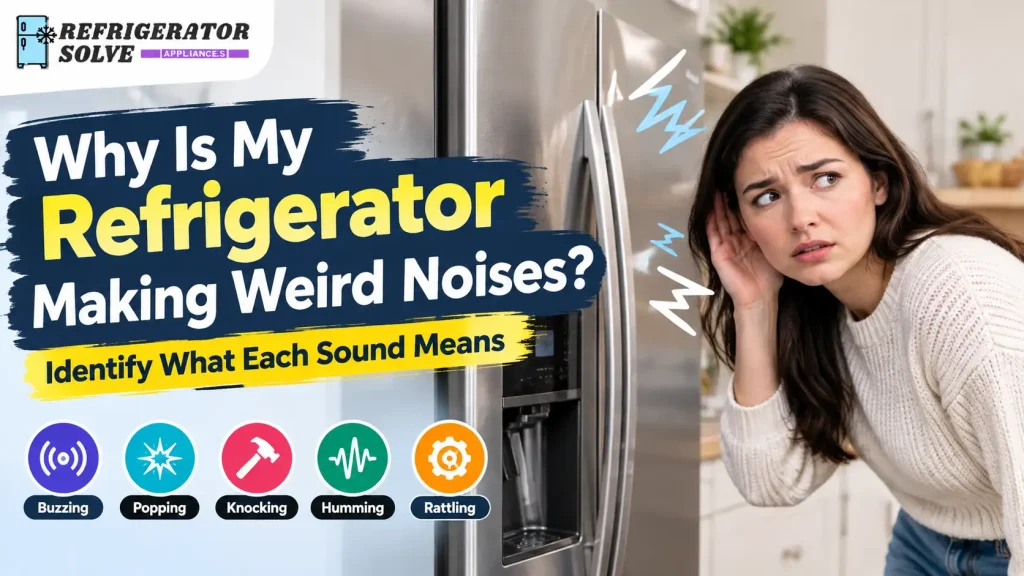
If you are standing in the kitchen wondering, “Why is my refrigerator making weird noises?”, the good news is that an unfamiliar sound does not automatically mean your fridge is failing. Refrigerators regularly hum, buzz, click, gurgle, pop, hiss, drip, and change pitch as the compressor, fans, refrigerant, defrost system, water valve, and ice maker cycle through normal operation.
What matters is whether the sound is new, unusually loud, persistent, or accompanied by another symptom such as poor cooling, heavy frost, leaking water, repeated starting and stopping, or a burning smell. A soft hum from the compressor may be completely normal, for example, while a harsh grinding noise from the freezer could mean a fan blade is rubbing against ice.
Instead of guessing from the noise alone, use four clues: what the sound is like, where it comes from, when it happens, and whether the refrigerator is still cooling normally.
This guide will help you identify common weird refrigerator noises, understand what they usually mean, perform safe basic checks, and know when it is better to call a refrigerator technician.
Quick Answer: Why Is My Refrigerator Making Weird Noises?
A refrigerator can make weird noises for perfectly normal reasons, including refrigerant moving through the cooling system, the compressor starting or changing speed, fans circulating air, an automatic defrost cycle, water entering an ice maker, or ice falling into the storage bin.
Unusual noises can also come from relatively simple problems such as an uneven refrigerator, bottles vibrating against one another, a water tube touching the cabinet, or the appliance sitting too close to a wall.
More concerning causes include:
- A fan blade hitting ice or debris
- A worn evaporator or condenser fan motor
- A loose drain pan or panel
- A struggling compressor or start component
- Heavy frost restricting airflow
- A water inlet valve or supply problem
- Internal mechanical or electrical faults
The fastest way to narrow it down is to listen carefully before touching anything.
Are Weird Refrigerator Noises Normal or a Warning Sign?
Some refrigerator sounds are expected. A refrigerator is not designed to be silent because several mechanical and fluid systems operate throughout the day.
Refrigerator Noises That Are Usually Normal
You may normally hear soft humming while the compressor runs, airflow from the fans, a short click when a component switches on or off, water trickling during defrost, refrigerant gurgling through tubing, an occasional pop as interior materials change temperature, or a brief buzz as the ice maker fills.
Modern refrigerators can sound noticeably different from older models. Variable-speed compressors and fans may speed up or slow down according to cooling demand, creating changing hums, whirs, or higher-pitched sounds.
Refrigerator Noises That Deserve More Attention
Pay closer attention when a noise:
- Appears suddenly after years of relatively quiet operation
- Is considerably louder than before
- Runs almost constantly
- Sounds like grinding, scraping, or metal rubbing
- Is followed by repeated clicking
- Causes strong vibration
- Comes with poor cooling
- Occurs with excessive freezer frost
- Is accompanied by leaking water
- Comes with an electrical or burning smell
- Becomes worse over several days or weeks
A refrigerator that makes a familiar low hum while maintaining temperature is a very different situation from one that repeatedly clicks, buzzes, and fails to cool.
If the main problem is simply excessive volume, see the detailed guide on how to fix a refrigerator making loud noise.
Refrigerator Weird Noise Diagnosis Chart
| Sound | Likely Source | Often Normal? | First Thing to Check |
|---|---|---|---|
| Humming | Compressor or fan | Yes | Is cooling normal? |
| Buzzing | Compressor, water valve, fan, ice maker | Sometimes | Note when the buzz occurs |
| Clicking | Compressor controls, relay, defrost, ice maker | Sometimes | Is it occasional or repetitive? |
| Rattling | Bottles, tubing, drain pan, wall contact | Usually fixable | Check for loose or touching items |
| Vibrating | Leveling, compressor, tubing | Sometimes | Check stability and clearance |
| Grinding | Fan blade, fan motor, ice buildup | Usually no | Check where the sound originates |
| Scraping | Fan touching ice or debris | Usually no | Check freezer fan area |
| Gurgling | Refrigerant or defrost water | Usually yes | Check cooling and leaks |
| Popping | Temperature expansion or defrost | Usually yes | Note frequency |
| Knocking | Ice maker, tubing, compressor area | Sometimes | Locate the source |
| Squealing | Fan motor or door hinge | Usually no if persistent | Check whether it happens with the door |
| Hissing | Refrigerant, pressure change, defrost | Often yes | Note duration and cooling |
| Whirring | Fans or compressor | Often yes | Listen for roughness or changes |
| Sizzling | Defrost water | Often yes | Check whether it occurs during defrost |
| Hammering | Water line or valve | Sometimes | Inspect the water supply line |
Use the chart as a starting point, not a final diagnosis. Two refrigerators can make similar sounds for completely different reasons.
What Weird Noise Is Your Refrigerator Making?
Learning to describe the sound is the first useful troubleshooting step.
Refrigerator Making a Humming Noise
A low, steady hum often comes from the compressor or one of the refrigerator fans.
The sound may become more noticeable when the refrigerator is working harder, such as after loading warm groceries, during hot weather, after a door has been left open, or after power has recently been restored.
A louder hum can also be amplified when the refrigerator is uneven or touching a cabinet.
If the humming has suddenly become much louder, check whether the refrigerator is still cooling correctly. A loud hum combined with repeated clicking or increasing interior temperature deserves further investigation.
Refrigerator Making a Buzzing Noise
Buzzing can come from several areas.
A brief buzz may occur when the water inlet valve supplies an automatic ice maker. The compressor may also create a low buzzing sound during operation.
More troublesome buzzing can result from a fan touching ice, a vibrating water tube, restricted water supply, a refrigerator touching the wall, or a compressor struggling to start.
The timing is particularly useful. If the sound appears only when the ice maker fills, look at the water system first. If it stops when you open the freezer door, the evaporator fan becomes a stronger suspect.
For a deeper diagnosis, see what causes a refrigerator buzzing noise.
Refrigerator Making Clicking or Ticking Noises
An occasional click can be completely normal. Refrigerators use switches, controls, relays, dampers, and other components that can click during normal cycling.
Repeated clicking every few seconds is different.
A pattern such as click → hum or buzz → click → silence → repeat may indicate that the compressor is trying unsuccessfully to start. A start component may be involved, although compressor problems can produce similar symptoms.
If you are hearing persistent clicking, the dedicated guide to a refrigerator making a clicking noise explains the possible causes in more detail.
Refrigerator Making a Rattling or Vibrating Noise
Rattling is often one of the easiest refrigerator noises to solve.
Start outside the appliance. Bottles may be touching, a shelf may not be seated properly, something may be sitting on top of the refrigerator, or the cabinet may be vibrating against a wall.
Next, check whether the refrigerator rocks when gently pushed. Poor leveling can transfer normal compressor vibration through the cabinet and floor.
A drain pan, rear tube, water line, or panel can also vibrate when the compressor operates.
If vibration is the main symptom, follow the more detailed troubleshooting steps in what causes a refrigerator to make a vibrating noise.
Refrigerator Making a Grinding or Scraping Noise
Grinding and scraping deserve attention because they often involve moving parts.
One common cause is an evaporator fan blade contacting accumulated frost or ice inside the freezer. A condenser fan near the lower rear of some refrigerators can also hit debris or become noisy as its motor wears.
Pay attention to whether opening the freezer door changes the noise. On many refrigerators, opening the door stops or changes evaporator fan operation. If the grinding disappears shortly after you open the freezer, the fan area is worth checking.
Do not reach toward a fan while the refrigerator is powered. Disconnect power before inspecting any accessible moving component.
Refrigerator Making Gurgling, Bubbling, or Water-Running Sounds
Gurgling is one of the refrigerator sounds that often sounds more alarming than it really is.
Refrigerant moves through tubing as the refrigerator cools, and pressure changes can create gurgling or bubbling sounds. Water from the automatic defrost system may also travel toward a drain pan.
A refrigerator with an ice maker or dispenser has additional water movement that can be heard during filling.
The sound becomes more concerning when it is accompanied by an actual water leak, a blocked drain, excessive ice buildup, or poor cooling.
Refrigerator Making Popping or Cracking Noises
Occasional popping or cracking often happens as plastic and other interior materials expand and contract with temperature changes.
You may notice these noises around cooling or defrost cycles.
A single sharp pop can sound surprisingly loud in a quiet kitchen, especially at night. If the refrigerator is maintaining temperature and the noise occurs only occasionally, it is usually less concerning.
Repeated violent banging or cracking, however, should be investigated further.
Refrigerator Making a Knocking or Banging Noise
A knock can come from several sources.
Ice dropping into a storage bin can make a short clunk. Refrigerant tubing or a water line can move slightly as pressure changes. A refrigerator touching a nearby cabinet can turn ordinary compressor vibration into a much louder knock.
Repeated knocking from the lower rear section may also come from the compressor area.
If knocking is your main symptom, see the full guide on how to troubleshoot refrigerator knocking noise.
Refrigerator Making Squealing, Squeaking, or Chirping Noises
First determine whether the sound occurs while the refrigerator is cooling or only when you open a door.
A squeak that happens every time the door moves may simply come from the hinge or door hardware.
A high-pitched squeal or chirp that appears while the refrigerator is running may come from an evaporator or condenser fan motor. Worn motor bearings can become noisier as the fan spins.
A fan can also make an irregular squeak if the blade is lightly contacting ice or another obstruction.
Refrigerator Making a Hissing or Whooshing Noise
Short hissing or whooshing sounds often occur as refrigerant pressure changes, air moves through vents, or the refrigerator enters or leaves a defrost cycle.
Some refrigerators also produce noticeable airflow noises as fans change speed.
The key question is whether the sound is brief and familiar or new and persistent.
A hissing sound alone does not prove a refrigerant leak. Refrigerant systems are sealed, and diagnosing or repairing them requires proper equipment and training.
Refrigerator Making a Whirring, Pulsating, Whining, or High-Pitched Noise
Modern refrigerator fans and compressors do not always run at a single fixed speed. Their operating speed may change according to temperature and cooling demand.
That can produce a soft whir, pulse, or higher-pitched tone that becomes more noticeable when the rest of the house is quiet.
If the sound has always been present and the refrigerator cools normally, it may simply be part of normal operation.
Investigate when a formerly smooth whir changes to scraping, squealing, grinding, or unusually loud whining. A worn fan motor or obstruction may be responsible.
When the sound seems to come from the lower rear of the appliance, the guide on checking refrigerator compressor and fan noise can help distinguish nearby components.
Refrigerator Making Sizzling, Dripping, or Trickling Sounds
These noises commonly appear during the automatic defrost process.
Frost melts from the evaporator area and the water drains away. Small amounts of moisture can create dripping, trickling, or brief sizzling sounds around warm defrost components.
Water-related noises deserve further investigation if you also find water under the refrigerator, water accumulating inside a compartment, or unusually heavy ice buildup.
Refrigerator Making a Thumping, Hammering, or Chattering Noise
If your refrigerator has an ice maker or water dispenser, check the water system.
A water inlet valve opening or closing can create a short thump. A supply tube can knock against the refrigerator or wall. Restricted or poorly positioned tubing can also vibrate or chatter while water flows.
If the noise occurs immediately when the ice maker fills or when someone dispenses water, that timing strongly points toward the water system rather than the compressor.
Where Is the Weird Refrigerator Noise Coming From?
Once you have identified the type of noise, locate it as accurately as possible.
Weird Noise Coming From Inside the Freezer
Likely sources include:
- Evaporator fan
- Ice buildup around the fan
- Automatic ice maker
- Air damper or airflow
- Ice falling into the bin
A scraping or grinding sound that changes when the freezer door opens often deserves inspection around the evaporator fan area.
Weird Noise Coming From the Refrigerator Compartment
Inside the fresh-food section, you may hear airflow, an electronic damper, water lines, shelves, bottles, or internal panels changing temperature.
Move containers slightly apart and make sure shelves and bins are seated correctly before assuming there is a mechanical problem.
Weird Noise Coming From the Back of the Refrigerator
The back or lower rear area may contain the compressor, condenser fan on applicable models, water tubing, drain pan, and refrigeration lines.
A soft hum in this area is normal while the compressor operates.
A harsh buzz, repeated click, heavy vibration, grinding, or knocking combined with poor cooling needs more attention.
For compressor-specific issues, see how to reduce refrigerator compressor noise.
Weird Noise Coming From the Bottom of the Refrigerator
A bottom-area noise can come from the compressor compartment, condenser fan, drain pan, leveling feet, or cabinet vibration.
Before removing panels, make sure the refrigerator is stable and has adequate clearance from nearby walls and cabinetry.
Weird Noise Coming From the Ice Maker or Water Dispenser
Listen for the exact moment the sound occurs.
A brief buzz as the ice maker fills or a clunk as cubes drop may be normal. Grinding while dispensing ice can come from the dispenser mechanism, while hammering during filling may involve the water line or inlet valve.
If the refrigerator has an ice maker that is turned on but does not have a working water supply, check your model’s instructions. The water system should not be allowed to repeatedly attempt normal operation under improper installation conditions.
When Does the Weird Refrigerator Noise Happen?
Timing can be even more useful than the sound itself.
When the Compressor Starts
A small increase in humming or vibration as the compressor starts can be normal.
If startup creates a violent shake, loud knock, buzz followed by clicking, or repeated failed start attempts, inspect the appliance more closely.
First make sure normal vibration is not being amplified by wall contact, an uneven floor, a loose pan, or tubing.
After You Close the Refrigerator or Freezer Door
Fans and airflow can change when a door closes.
If a grinding or scraping noise begins after the freezer door closes and stops when it opens, the evaporator fan area becomes a strong place to investigate.
Temperature and pressure changes after closing a door can also create brief harmless sounds.
When the Noise Stops After Opening the Door
This is one of the more useful diagnostic clues.
If an unusual noise consistently stops when you open the freezer door and starts again after closing it, listen closely to the evaporator fan area.
Possible causes include:
- Frost or ice touching the fan blade
- A worn fan motor
- A loose fan component
- Something interfering with airflow
The exact behavior varies by refrigerator model, so use the test as a clue rather than absolute proof.
During the Defrost Cycle
Defrost operation can produce dripping, sizzling, cracking, popping, and water-flow sounds.
If these noises occur occasionally and cooling remains normal, they may be part of normal operation.
During Ice Making or Water Dispensing
Ice makers add several sounds that refrigerators without water systems never make.
You may hear a valve buzz, water flow, ice release, cubes drop, or a dispenser motor operate.
If the noise appears only during one of those events, troubleshoot the water or ice system before focusing on the compressor.
At Night
Your refrigerator may seem louder at night even when nothing has changed mechanically.
The kitchen is quieter, so ordinary compressor, fan, refrigerant, and ice-maker sounds become easier to notice.
Cooling cycles can also happen at any hour. A noise that catches your attention at 2 a.m. is not necessarily a nighttime-specific refrigerator problem.
Why Did My Refrigerator Suddenly Start Making Weird Noises?
A sudden change deserves a quick inspection, but it does not always mean an expensive failure.
Something may have shifted. A bottle can begin vibrating against another container. The refrigerator may have moved slightly. A water tube may now touch the cabinet. Ice may have accumulated close enough to a fan blade to create a scraping sound.
A fan motor can also become noisier gradually until you suddenly notice it.
Start with the simple questions:
- Did the refrigerator recently move?
- Was it heavily loaded?
- Was a door left open?
- Did the power go out?
- Has frost increased?
- Does the sound change when a door opens?
- Is the refrigerator still cold?
The answers can narrow the problem much faster than taking parts apart.
Why Is My Refrigerator Constantly Making a Weird Noise?
A refrigerator that seems to run constantly may simply be responding to increased cooling demand.
Longer operation can happen after a large grocery load, frequent door opening, warm room temperatures, or a recent power interruption.
However, continuous operation can also happen when the door does not seal well, airflow is blocked, the condenser area is dirty on a model that requires cleaning, or the appliance is struggling to maintain temperature.
If the refrigerator runs almost continuously and the interior is warmer than it should be, treat the cooling issue as the priority rather than the noise.
Why Is My Refrigerator Making Weird Noises but Still Cooling?
If the refrigerator is maintaining the correct temperature, that is a reassuring sign, but it does not mean every sound should be ignored.
Normal compressor operation, fan speed changes, refrigerant movement, defrost cycles, ice making, and minor cabinet vibration can all occur while the refrigerator cools perfectly.
Early wear in a fan motor can also make noise before cooling noticeably changes.
Monitor whether the sound is becoming louder or more frequent. A mild, stable sound with normal cooling is much less urgent than a noise that progressively worsens.
As a general reference, many household refrigerators are commonly kept around 37°F (3°C) in the fresh-food compartment and 0°F (-18°C) in the freezer, although you should follow the settings and guidance for your specific model.
Why Is My Refrigerator Making Weird Noises and Not Cooling?
Noise becomes more important when cooling performance changes.
A refrigerator making unusual noises and failing to cool can have problems involving the evaporator fan, condenser fan, compressor start components, compressor, airflow, heavy frost buildup, or another part of the cooling system.
Certain combinations provide useful clues:
| Noise + Cooling Symptom | Possible Area to Investigate |
|---|---|
| Repeated clicking + warm refrigerator | Compressor start system or compressor |
| Grinding + heavy freezer frost | Evaporator fan and ice buildup |
| Fan noise + warm fresh-food compartment | Air circulation problem |
| Buzzing + poor cooling | Fan, compressor, or electrical/start issue |
| Loud lower-rear hum + poor cooling | Compressor/condenser area |
| Little airflow + freezer frost | Evaporator/defrost/airflow issue |
Do not continue repeatedly restarting a refrigerator that will not cool while making severe mechanical or electrical noises.
If food temperatures are rising, protect perishable food according to local food-safety guidance while arranging diagnosis.
Did the Noise Start After Something Changed?
Sometimes the event immediately before the noise is the best clue.
After a Power Outage
After power returns, the refrigerator may run longer while bringing both compartments back to temperature.
That can make compressor and fan sounds more noticeable.
If the refrigerator repeatedly clicks without starting, smells electrical, or fails to regain cooling, further diagnosis is needed.
After Moving or Installing the Refrigerator
Check installation before assuming a component failed.
The refrigerator may be uneven, too close to the wall, resting against cabinetry, or have a water tube touching the cabinet.
Newly positioned bottles, bins, and shelves can also vibrate.
After Loading Groceries
Adding a large amount of warmer food increases cooling demand. Fans and the compressor may run longer or faster.
Containers can also be pushed together and begin rattling.
Separate touching bottles and make sure food is not blocking the refrigerator’s internal air vents.
After Leaving the Door Open
Leaving a door open allows warm, humid air inside.
The refrigerator may run longer afterward, and additional moisture can contribute to frost formation in some situations.
Make sure the door now seals properly and give the refrigerator time to return to normal operation.
After Turning On the Ice Maker
If a new buzz, thump, water-flow sound, or clunk began when the ice maker was enabled, watch one complete ice-making cycle.
The sound may simply be associated with filling and releasing ice.
Why Is My New Refrigerator Making Weird Noises?
A new refrigerator can sound strange simply because it does not operate like your old one.
Modern models may use variable-speed compressors, multiple fans, electronic dampers, automatic defrost systems, water valves, and ice makers. The sound can change as cooling demand changes.
New refrigerators also tend to run more during initial cool-down.
Before assuming anything is defective, check that:
- Packing and shipping materials have been removed
- The refrigerator is level and stable
- Adequate clearance has been provided
- Shelves and bins are seated correctly
- The water connection is installed correctly
- The ice maker is configured for your setup
Consult the normal-sounds section of the owner’s manual as well. Manufacturers often describe model-specific noises that may sound unusual if you have never heard them before.
A new appliance should still be checked if it produces harsh metal scraping, severe vibration, repeated failed-start clicking, a burning smell, or poor cooling.
Could the Weird Noise Be Coming From the Ice Maker or Water System?
Refrigerators with water and ice features naturally have more possible noise sources.
Buzzing During Water Fill
A short buzz can occur as the water inlet valve opens.
If the sound becomes unusually loud, check for a kinked supply line, water supply issue, or vibration where tubing touches the refrigerator.
Clunking When Ice Drops
Ice falling into an empty plastic storage bin can sound surprisingly loud.
If the clunk happens only when a batch of ice releases, it may be normal.
Grinding While Dispensing Ice
Dispensers use a motor and mechanical components to move ice toward the chute.
A brief motor sound is expected. Persistent grinding, jamming, or inability to dispense should be investigated.
Water-Line Hammering or Chattering
Water tubing can move when flow starts and stops.
Make sure accessible tubing is not sharply kinked or striking a nearby surface. Plumbing-related water hammer elsewhere in the supply system may require a plumber rather than an appliance repair.
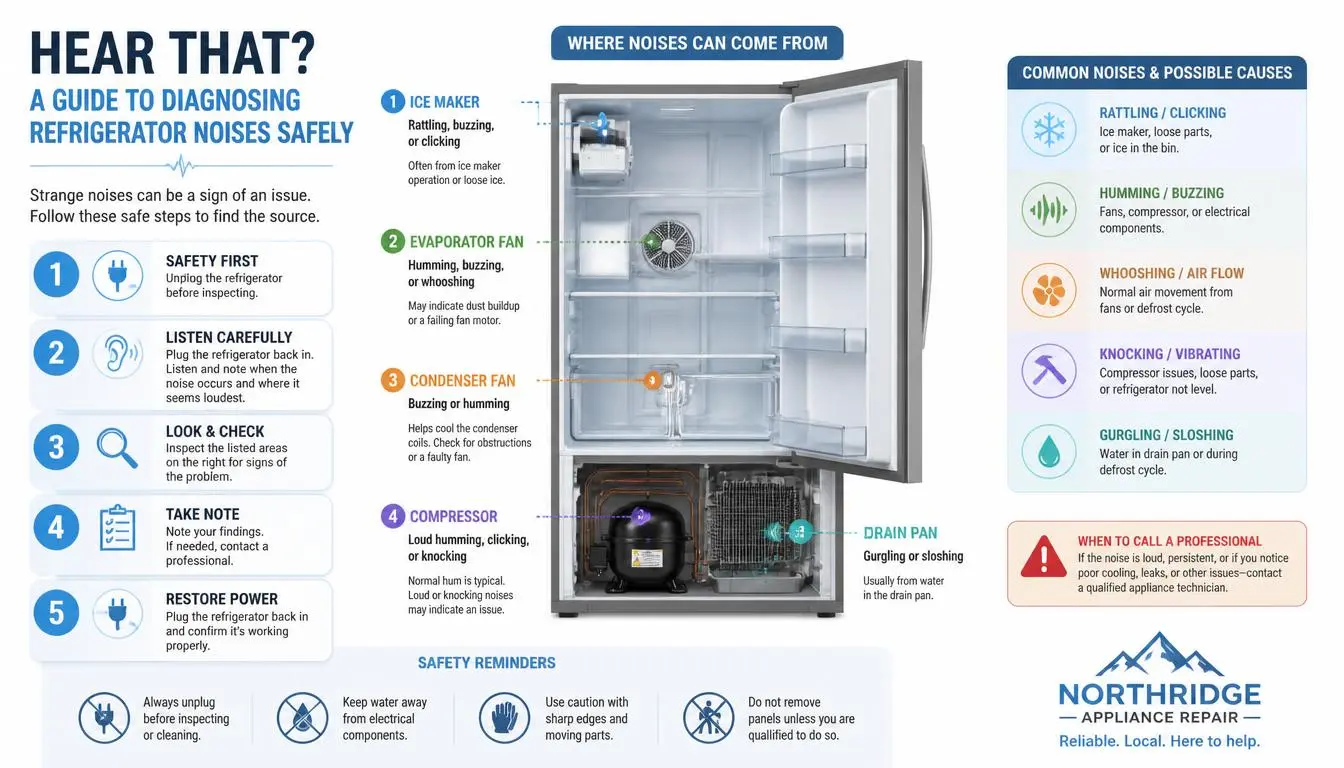
How to Diagnose a Weird Refrigerator Noise Safely
You can solve many noise mysteries without disassembling the refrigerator.
1. Describe the sound. Decide whether it is humming, clicking, buzzing, grinding, rattling, popping, gurgling, squealing, or another recognizable sound.
2. Locate it. Listen at the freezer, refrigerator compartment, ice maker, back, and lower section.
3. Note the timing. Does it happen continuously, only when cooling starts, after a door closes, during ice making, or while dispensing water?
4. Check cooling. A refrigerator that remains properly cold presents a different situation from one that is warming up.
5. Open and close the freezer door. Notice whether the sound changes. This can provide clues about fan operation.
6. Check for vibration. Make sure the refrigerator is level, stable, and not touching a wall, countertop, or cabinet.
7. Inspect obvious external causes. Separate bottles, reseat shelves, remove items from the top, and check accessible water tubing.
8. Look for unusual frost. Heavy frost near air vents or the evaporator area may be related to fan noise or airflow trouble.
9. Disconnect power before touching moving or electrical components. Never put your hand or a tool near a running fan.
10. Stop when the job exceeds a basic inspection. Compressor, refrigerant, sealed-system, and complex electrical work should be handled by a properly qualified technician.
What Weird Refrigerator Noises Can You Fix Yourself?
Some noise problems are simple enough for a homeowner or renter to address without appliance disassembly.
You can often correct noises caused by the refrigerator touching a wall, uneven leveling, bottles vibrating, poorly seated shelves, loose items on top, or accessible tubing resting against another surface.
Cleaning an accessible condenser area may also help on models whose manufacturers recommend routine coil or fan-area cleaning.
Always follow the owner’s manual because component access and maintenance requirements vary widely between models.
A noisy motor, failed electrical component, compressor problem, refrigerant issue, or internal sealed-system fault is different. Those repairs require more than basic household troubleshooting.
When Should You Worry About Weird Refrigerator Noises?
Treat the noise as more urgent when it is paired with another warning sign.
Arrange professional service when you notice severe grinding, metal-on-metal scraping, repeated failed-start clicking, rapidly worsening noise, major cooling loss, strong vibration that cannot be explained by installation, or persistent abnormal compressor-area sounds.
Disconnect the refrigerator from power if it is safe to do so when you notice a burning smell, smoke, sparking, damaged electrical wiring, an overheating plug or cord, or water creating an immediate electrical hazard. Do not handle a wet plug, outlet, or electrical component.
If there is no immediate electrical hazard but the refrigerator is not maintaining a safe food temperature, focus on protecting the food while arranging repair.
Quick Decision Guide: Is the Refrigerator Noise Normal or Serious?
A refrigerator noise is more likely to be normal when it is quiet to moderate, intermittent, linked to a recognizable operating cycle, and has not changed significantly. Normal cooling is another reassuring sign.
A noise is more likely to need investigation when it is new, loud, constant, progressively worsening, metallic, or accompanied by poor cooling, excessive frost, leaking, repeated clicking, unusual heat, or an electrical smell.
Do not judge the appliance by the sound name alone. “Buzzing” can describe both a completely normal water valve and a compressor that is having trouble starting.
Context is what makes the difference.
How to Prevent Unwanted Refrigerator Noises
A few habits can reduce avoidable refrigerator noise.
Keep the appliance level and provide the clearance recommended by the manufacturer. Avoid pushing it tightly against a wall or cabinet where normal vibration can be amplified.
Do not pack bottles so tightly that they constantly touch, and make sure shelves and bins are properly seated.
Keep internal air vents unobstructed. If your model requires condenser cleaning, follow the manufacturer’s maintenance schedule rather than allowing dust to accumulate.
Check water tubing periodically if your refrigerator has an ice maker or dispenser.
Finally, pay attention when a familiar refrigerator suddenly sounds different. Addressing a loose part, frost buildup, or fan obstruction early can prevent a minor annoyance from becoming a larger problem.
Frequently Asked Questions
Why is my fridge making noises all of a sudden?
A sudden refrigerator noise can come from a shifted bottle or shelf, vibration against a wall, ice reaching a fan blade, debris around a fan, a moved water line, or a component beginning to wear. First identify the location and check whether cooling has changed.
What refrigerator noises should I worry about?
Persistent grinding, scraping, repeated clicking, severe vibration, or unusually loud compressor-area noises deserve attention, particularly when they occur with poor cooling, heavy frost, a burning smell, or another abnormal symptom.
Why is my fridge making a weird noise but still cooling?
Many operating sounds occur while a refrigerator is cooling normally. Fans, the compressor, refrigerant, defrost water, and the ice maker can all make noise. If the sound is new or worsening, however, investigate before assuming it is harmless.
Why does my refrigerator noise stop when I open the door?
If a noise consistently stops when the freezer door opens, it may be related to evaporator fan operation. Ice around the fan or a worn fan motor are possible causes, although exact fan behavior varies by refrigerator model.
Why does my refrigerator make noise after I close the door?
Closing the door can change fan operation, airflow, and pressure inside the appliance. If a grinding or scraping sound begins every time the freezer closes, inspect the evaporator fan area for ice or another obstruction.
Why does my refrigerator sound louder at night?
Normal refrigerator sounds are often easier to hear at night because your home and kitchen are quieter. A compressor, fan, defrost cycle, or ice maker can operate at any time of day.
Can a refrigerator compressor make weird noises?
Yes. A compressor normally produces some humming and vibration. Unusually loud buzzing, knocking, repeated clicking, or a major change in compressor sound can require further diagnosis. Remember that a nearby condenser fan or vibrating tube may sound as though it is coming from the compressor.
Why is my refrigerator constantly making noise?
The refrigerator may be operating for long periods because of high cooling demand, warm surroundings, frequent door opening, poor sealing, blocked airflow, or another cooling problem. Variable-speed systems can also run for longer at lower speeds. Check whether the appliance is maintaining temperature.
Why is my refrigerator suddenly beeping?
Beeping is usually an alert rather than a mechanical noise. Common reasons include an open door, elevated internal temperature, or another model-specific warning. Check the display and owner’s manual for the meaning of the alert.
Should I unplug a refrigerator that is making a strange noise?
Not every strange noise requires unplugging the refrigerator. Normal humming, gurgling, popping, or ice-making sounds usually do not. Disconnect power before inspecting accessible moving or electrical parts, and unplug the appliance if it is safe to do so when there is smoke, sparking, a burning electrical smell, damaged wiring, or another immediate electrical hazard.
Final Thoughts
So, why is my refrigerator making weird noises? The answer is often much easier to find once you stop focusing on the noise alone. Listen to what it sounds like, where it comes from, when it happens, and whether the refrigerator is still cooling properly.
A gentle hum, short buzz, occasional click, gurgle, pop, or drip can be completely normal. Rattling may come from something as simple as an uneven refrigerator or two bottles touching. On the other hand, repeated clicking, grinding, scraping, severe vibration, or a rapidly changing noise can point to a fan, compressor, ice buildup, water system, or another component that needs attention.
Start with the easy external checks, avoid opening sealed refrigeration components, and involve a qualified technician when the noise is accompanied by poor cooling, electrical symptoms, or a problem that goes beyond safe basic troubleshooting.

Hi, I’m the lead researcher and appliance enthusiast behind RefrigeratorSolve. With years of hands-on experience troubleshooting cooling systems and testing home appliances, I am dedicated to bringing you honest reviews, energy-saving tips, and practical solutions to keep your refrigerator running perfectly.