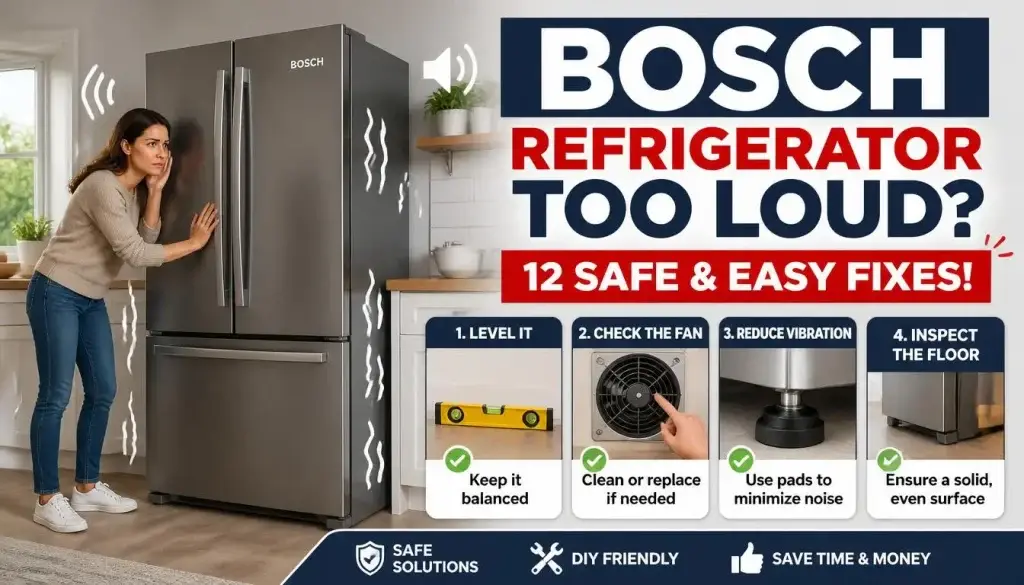
A Bosch refrigerator should not be completely silent. Humming from the compressor, gentle airflow from a fan, occasional clicking, or gurgling from refrigerant moving through the system can all happen during normal operation.
What deserves attention is a sound that is new, unusually loud, constant, or accompanied by poor cooling.
If you are trying to figure out how to reduce the noise of a Bosch refrigerator, start with the simple things first. An uneven floor, vibrating bottles, the refrigerator touching a cabinet, or frost around a fan can make a perfectly functional appliance sound much louder than it should.
More serious noises can come from the evaporator fan, condenser fan, ice maker, water inlet valve, or compressor.
This guide will help you identify the sound, locate its source, reduce unnecessary noise safely, and recognize when it is time to call a technician.
Quick Answer: How Do You Make a Bosch Refrigerator Quieter?
To reduce Bosch refrigerator noise:
- Make sure the refrigerator is level.
- Prevent it from touching walls or cabinets.
- Separate bottles and secure loose shelves.
- Check for a rattling drain or drip pan.
- Listen for evaporator fan noise inside the freezer.
- Check for frost or ice around the fan area.
- Inspect the condenser fan area if your model has an accessible fan.
- Check the ice maker and water supply.
- Make sure internal air vents are not blocked.
- Check whether Super Cooling or Super Freezing is active.
- Pay attention to repeated compressor-area clicking.
- Arrange professional service if the refrigerator is loud and no longer cooling properly.
If you are dealing with refrigerator noise in general, this guide on how to fix a refrigerator making loud noise can also help you narrow down the source.
Is It Normal for a Bosch Refrigerator to Make Noise?
Yes. A Bosch refrigerator normally makes some sound while cooling.
Bosch operating guidance describes humming from the compressor, bubbling or gurgling from refrigerant flow, clicking as controls switch components on and off, and airflow sounds from fan-equipped appliances as normal operating noises.
The important question is not simply, “Is my Bosch refrigerator making noise?”
Instead, ask:
- Has the sound suddenly become louder?
- Is it different from the sound the refrigerator normally makes?
- Does it continue for unusually long periods?
- Does it stop when a door is opened?
- Is the refrigerator still cooling correctly?
- Is there heavy frost or ice inside?
- Is there excessive vibration?
- Is an error or temperature warning appearing?
Those clues are often more useful than the sound itself.
Normal Bosch Refrigerator Sounds
Humming or Droning
A low hum usually comes from the compressor while the refrigerator is cooling.
The sound can briefly become more noticeable when the compressor starts or when the appliance needs to cool more aggressively.
If the humming has become much louder than before, see our detailed guide to refrigerator loud humming noise.
Bubbling or Gurgling
Refrigerant moving through the cooling system can create bubbling, gurgling, or flowing sounds.
These sounds are usually normal and do not mean water is leaking inside the refrigerator.
Clicking
Occasional clicking can happen as refrigeration controls switch components on and off.
Repeated clicking every few seconds, particularly when the refrigerator is not cooling, deserves more attention.
You can learn more about the difference between normal and abnormal clicking in our guide to refrigerator clicking noise.
Whirring or Airflow Noise
Bosch refrigerators that use internal fans can produce a soft whirring or hissing sound as air circulates.
A smooth fan sound is usually normal. Grinding, scraping, rattling, or a rough whirring noise is not something to ignore.
Cracking or Popping
Materials inside a refrigerator expand and contract as temperatures change. Defrost cycles can also produce occasional cracking or popping sounds.
An occasional sound is generally much less concerning than repeated heavy knocking.
Why Is My Bosch Refrigerator So Loud?
Use the sound and its location together to narrow down the cause.
| Sound | Possible Cause | First Thing to Check |
|---|---|---|
| Humming | Compressor or fan | Is cooling normal? |
| Buzzing | Compressor, fan, ice maker, or water valve | When does the buzz occur? |
| Rattling | Loose items, drain pan, wall contact | Level and reposition the refrigerator |
| Vibrating | Uneven floor or cabinet contact | Check all support points |
| Whirring | Fan or normal refrigerant flow | Check whether the sound changes when a door opens |
| High-pitched sound | Fan or compressor operation | Listen for changes in cooling |
| Grinding | Fan touching ice or debris | Check the freezer fan area |
| Scraping | Fan blade obstruction | Look for frost or ice |
| Clicking | Normal controls or compressor-start issue | Check frequency and cooling |
| Knocking | Ice maker, tubing, compressor vibration | Locate where the sound starts |
| Gurgling | Refrigerant flow | Usually normal if cooling is fine |
| Popping | Temperature expansion or defrosting | Monitor frequency and intensity |
If you are unsure what type of sound you are hearing, our guide explaining what it means when a refrigerator starts making noise provides a broader sound-by-sound diagnosis.
How to Reduce the Noise of a Bosch Refrigerator
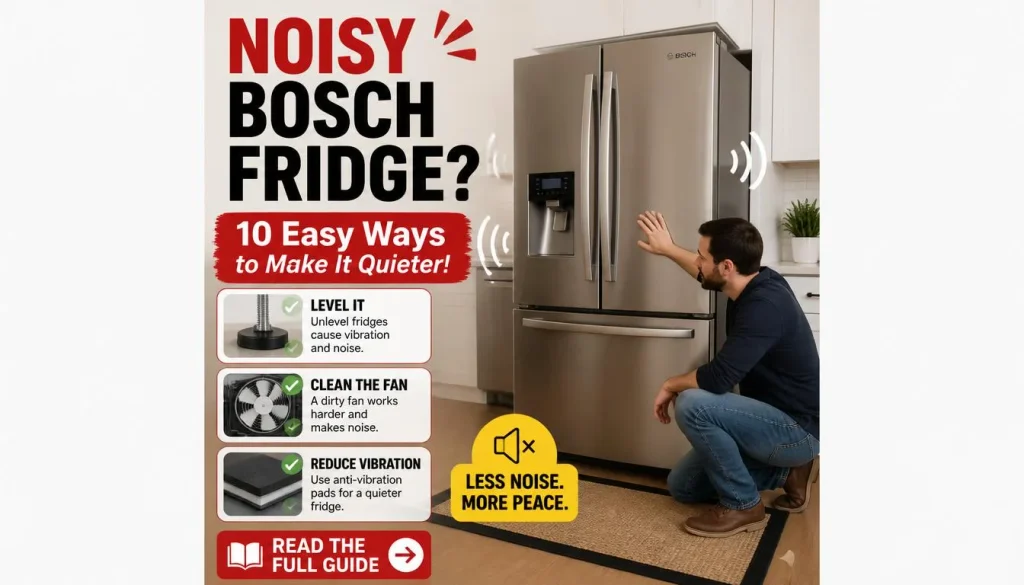
Work through the following steps in order. Starting with the simplest checks can prevent unnecessary disassembly or repair costs.
1. Make Sure Your Bosch Refrigerator Is Level
An uneven refrigerator can amplify a normal compressor or fan vibration until it sounds like a mechanical problem.
Stand in front of the refrigerator and gently press against different corners.
It should feel stable rather than rock from side to side.
If it moves:
- Check the leveling feet.
- Adjust them according to your Bosch installation instructions.
- Make sure the appliance sits firmly on the floor.
- Check whether the floor itself is uneven.
- Confirm that the refrigerator remains properly aligned with surrounding cabinetry.
Bosch operating guidance specifically lists an appliance that is not level as one potential cause of excessive operating noise.
A poorly leveled refrigerator can also transfer vibration through the floor. If vibration is your main problem, see this guide to refrigerator vibrating noise and its common causes.
2. Keep the Refrigerator From Touching Walls or Cabinets
Sometimes the Bosch refrigerator itself is operating normally, but its vibration is being transferred into something nearby.
Check whether any part of the refrigerator is touching:
- A kitchen cabinet
- The wall
- A countertop
- Baseboards
- Another appliance
- A water supply line
- A power cord
- An object stored beside or on top of the refrigerator
Even light contact can turn a mild compressor hum into an annoying buzzing or rattling sound.
Move the refrigerator enough to eliminate direct contact while still following the installation clearances specified for your exact Bosch model.
Do not assume every Bosch refrigerator needs the same clearance. Installation requirements can differ between freestanding, built-in, counter-depth, and other models.
3. Separate Bottles and Secure Loose Shelves
Before assuming a fan or compressor is failing, open the refrigerator and freezer and check what is stored inside.
Two glass bottles touching each other can create a surprisingly loud rattle whenever the compressor starts.
Check:
- Bottles
- Jars
- Food containers
- Door bins
- Shelves
- Freezer drawers
- Ice bins
- Removable trays
Move bottles slightly apart and make sure drawers and shelves are fully seated.
Bosch guidance also identifies touching bottles and loose removable fittings as possible causes of excessive refrigerator noise.
4. Check for a Loose Drain or Drip Pan
Depending on the model, a drain or evaporation pan may be located near the bottom of the refrigerator.
If it becomes loose or sits incorrectly, normal compressor vibration can make it rattle.
The sound will usually seem to come from the lower rear or bottom of the refrigerator.
Do not remove covers or reach around powered electrical components just to find the pan.
If inspection requires access to the rear service area, disconnect power first and follow the instructions for your specific model.
5. Check the Evaporator Fan
The evaporator fan is an important source to investigate when a Bosch refrigerator develops a loud grinding, scraping, buzzing, or rough whirring sound from inside the freezer area.
Bosch’s refrigerator-noise troubleshooting guidance recommends checking the evaporator fan when the appliance becomes unusually loud.
Possible problems include:
- Ice touching the fan blade
- Debris or packaging interfering with airflow
- A damaged fan blade
- A loose fan assembly
- A worn fan motor
- Heavy frost around the evaporator area
If the sound seems to come from the freezer, our detailed guide to fixing fan noise in a refrigerator freezer compartment explains how to narrow down the source safely.
Never place your fingers or tools near a moving fan.
Disconnect the refrigerator from power before physically inspecting an accessible fan area.
6. Check for Frost or Ice Around the Fan
One of the most recognizable refrigerator noises is a rhythmic scraping or grinding sound caused by a fan blade touching ice.
You may notice:
- Scraping from behind the freezer’s rear interior panel
- A rough buzzing sound
- Noise that gradually becomes louder
- Heavy frost around freezer vents
- Reduced airflow
- The noise stopping when a door opens
If frost is visible, do not chip hidden ice away with a knife, screwdriver, or another sharp object. Refrigerant lines and electrical parts may be located behind interior panels.
A full manual defrost may temporarily remove ice, depending on the model and manufacturer instructions.
However, if the frost quickly returns, the underlying cause may involve a door seal, airflow issue, sensor, drainage problem, or defrost system fault.
7. Check the Condenser Fan Area
Some refrigerators use a condenser fan near the compressor or lower rear section.
If your Bosch model has one, accumulated dust, pet hair, or debris near the fan can cause buzzing, rattling, or scraping.
A damaged fan blade or worn fan motor can create similar symptoms.
Before checking this area:
- Disconnect the refrigerator from power.
- Follow the access instructions in the model-specific manual.
- Avoid bending refrigerant tubing.
- Do not remove sealed-system components.
- Do not force the fan blade.
People sometimes describe every sound from the lower rear of a refrigerator as “compressor noise,” even when the nearby fan is responsible.
Our guide on checking refrigerator compressor and fan noise explains how to tell these sounds apart.
8. Check the Ice Maker and Water Supply
If your Bosch refrigerator includes an automatic ice maker or water dispenser, listen for when the noise occurs.
A short buzzing sound can happen while the water inlet valve opens and the ice maker fills.
Ice dropping into the storage bin can also sound surprisingly loud in a quiet kitchen.
Investigate further if:
- Buzzing continues much longer than usual.
- The ice maker is turned on but no water is connected.
- Water pressure seems unusually low.
- The ice maker is not producing ice.
- You hear grinding from the ice-making mechanism.
- The water line vibrates against the wall or cabinet.
- Buzzing is accompanied by a leak.
If buzzing is the main symptom, our guide to refrigerator buzzing noises and their causes covers the water valve, fans, compressor, and other common sources.
9. Check the Door Seal, Airflow, and Temperature Settings
A refrigerator may become more noticeable when it has to run longer than usual.
Check whether the doors close completely.
Look for:
- Food preventing a door from closing
- A dirty or damaged gasket
- Internal vents blocked by food
- Too many items packed against the rear wall
- Frequent door opening
- Large quantities of recently added food
- Unusually warm room conditions
Do not pack food tightly against air outlets.
Restricted circulation can make the cooling system work harder and may also create unusual airflow sounds.
If the refrigerator is running longer than expected, verify the temperature settings using the instructions for your exact Bosch model rather than continuously lowering the temperature in an attempt to make the refrigerator colder.
10. Check Whether Super Cooling or Super Freezing Is Running
This is especially important on Bosch refrigerators.
Depending on the model, Bosch refrigerators may include Super Cooling, Super Freezing, or automatic Super Freezing functions.
These modes deliberately increase cooling performance for a period of time.
Bosch manuals specifically note that increased operating noise may occur while Super Cooling or Super Freezing is active.
So, if your Bosch fridge suddenly seems louder after:
- Adding a large grocery load
- Activating Super Cooling
- Activating Super Freezing
- Adding fresh food to the freezer
check the display before assuming something has broken.
If the increased sound disappears after the appliance returns to normal cooling mode, it may simply have been temporary high-load operation.
11. Investigate Repeated Clicking From the Compressor Area
An occasional click is not necessarily a problem.
Repeated clicking or a pattern such as:
buzz → click → silence → buzz → click
is more concerning, especially when the refrigerator temperature starts rising.
Possible causes can include:
- Compressor-start components
- Electronic controls
- Inverter-related components on applicable models
- Compressor problems
Do not attempt to open a compressor or sealed refrigeration system yourself.
If you need help distinguishing normal clicking from a possible fault, read our guide to refrigerator clicking noise.
12. Check the Compressor Only After Eliminating Simpler Causes
The compressor is usually located toward the lower rear of the refrigerator.
A steady hum while it runs is generally expected.
However, professional diagnosis is worth considering if you hear:
- Heavy knocking
- Metallic grinding
- Extremely loud humming
- Repeated starting and stopping
- Buzzing followed by repeated clicking
- Noise accompanied by poor cooling
- Excessive heat around the compressor area
Bosch recommends professional assistance when refrigerator noise appears to involve the compressor.
Before assuming the compressor itself has failed, eliminate simpler vibration sources first.
Our detailed guide on how to reduce refrigerator compressor noise explains the difference between actual compressor trouble and noise being amplified by surrounding parts.
Why Does My Bosch Refrigerator Noise Stop When I Open the Door?
This is an extremely useful troubleshooting clue.
On many refrigerators, opening a door changes or temporarily stops internal fan operation.
If your Bosch refrigerator makes a grinding, buzzing, or whirring noise while the door is closed but becomes quiet immediately after you open it, an internal fan may be involved.
Possible causes include:
- Frost touching the evaporator fan
- Ice around the fan housing
- A damaged fan blade
- A loose component
- A worn fan motor
However, do not treat the door test as absolute proof.
Fan behavior differs between refrigerator models.
Use the change in sound as a clue, then check your Bosch model’s operating information before taking anything apart.
Bosch Refrigerator Making Noise and Not Cooling
Noise becomes more important when cooling performance changes at the same time.
If your Bosch refrigerator is making unusual noise and food is becoming warmer, investigate the problem promptly.
Possible causes include:
Evaporator Fan Problem
If the evaporator fan cannot circulate cold air properly, one compartment may become warmer even while the cooling system continues running.
A fan hitting ice may produce scraping or grinding.
Heavy Ice Buildup
Excess frost can restrict airflow and interfere with the evaporator fan.
A temporary defrost may remove the symptom, but frost that repeatedly returns suggests another problem needs diagnosis.
Condenser Fan Problem
On models equipped with one, a condenser fan problem can reduce heat removal and create unusual noise.
Compressor or Starting Problem
Repeated buzzing or clicking combined with rising interior temperatures can indicate that the cooling system is not starting or operating correctly.
At that point, professional diagnosis is safer than continuing to replace parts by guesswork.
Bosch Refrigerator Noise by Sound
Bosch Refrigerator Humming Noise
A gentle hum is normally associated with compressor or fan operation.
Check further if the humming:
- Suddenly becomes much louder
- Causes strong cabinet vibration
- Continues with repeated clicking
- Appears with poor cooling
Bosch Refrigerator Buzzing Noise
Buzzing can come from the compressor, fan, ice maker, water valve, water line, or vibrating cabinet.
Pay close attention to when it happens.
A five-second buzz while the ice maker fills is very different from continuous buzzing from the compressor area.
Bosch Refrigerator Rattling Noise
Start with simple vibration sources:
- Bottles touching
- Loose bins
- Wall contact
- Water-line movement
- Loose tray
- Uneven refrigerator
Bosch Refrigerator Vibrating Noise
Make sure the appliance does not rock and that all supporting feet are correctly positioned.
Also check for contact with surrounding cabinetry.
Bosch Refrigerator Grinding or Scraping Noise
This type of noise deserves attention.
The first place to investigate is usually a moving fan.
Ice, debris, a damaged blade, or worn motor can all create grinding or scraping.
Bosch Refrigerator Clicking Noise
Occasional clicks may be normal.
Repeated clicking every few seconds, particularly when the refrigerator is warming up, needs further investigation.
Bosch Refrigerator High-Pitched Noise
A high-pitched sound may come from a fan, airflow, or changing compressor operation depending on the refrigerator design.
Compare the sound with the refrigerator’s previous behavior.
If it is new, unusually loud, persistent, or associated with poor cooling, arrange diagnosis.
Bosch Refrigerator Whirring or Droning Noise
Soft whirring can come from airflow or refrigerant circulation.
A rough whir accompanied by scraping suggests a fan obstruction.
Bosch Refrigerator Knocking Noise
Knocking can come from:
- Ice falling
- Water line movement
- Compressor vibration
- Refrigerant tubing
- Loose components
For more possibilities, see our guide on how to fix refrigerator knocking noise.
Bosch Refrigerator Gurgling or Bubbling Noise
Gurgling and bubbling are usually associated with refrigerant moving through the cooling system.
If cooling remains normal and there are no leaks or error warnings, this sound alone is usually not a reason to panic.
Bosch Refrigerator Noise by Location
Knowing where the noise comes from can narrow the problem quickly.
Noise From Inside the Freezer
Common possibilities:
- Evaporator fan
- Fan hitting ice
- Frost buildup
- Airflow
- Ice maker
Noise From the Lower Back
Possible sources include:
- Compressor
- Condenser fan on applicable models
- Refrigerant tubing
- Water line
- Rear panel vibration
Noise From the Bottom
Check for:
- Drain or evaporation pan vibration
- Compressor vibration
- Leveling problems
- Floor vibration
Noise From the Ice Maker Area
Listen for:
- Ice dropping
- Water filling
- Valve buzzing
- Mechanical movement
- Grinding or jammed ice
Why Does My Bosch Refrigerator Get Louder at Certain Times?
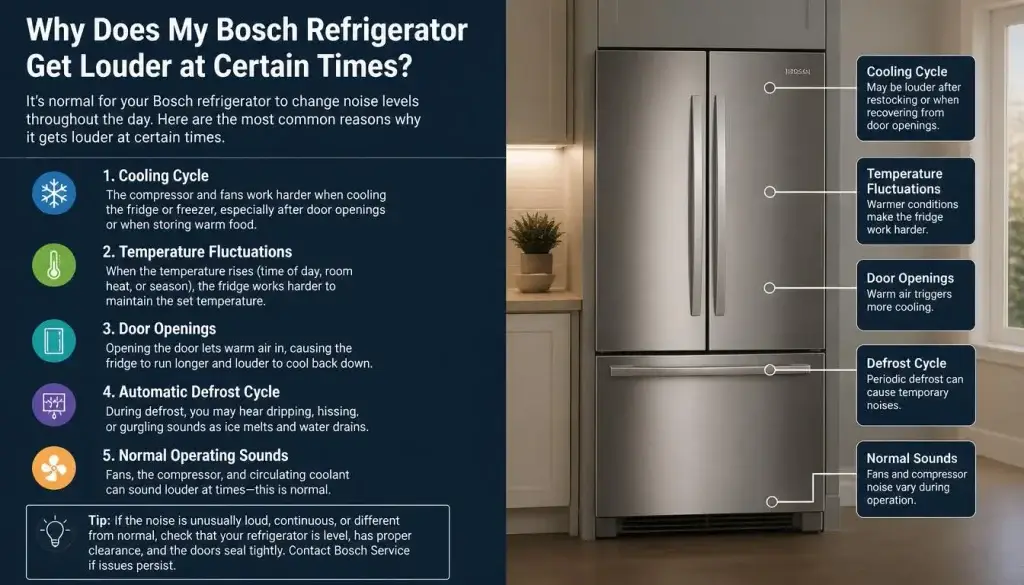
A refrigerator does not operate at exactly the same intensity all day.
It may become temporarily louder under several conditions.
After the Door Has Been Open
Warm air enters the refrigerator, so the cooling system may need to run longer after the door is closed.
After Adding Groceries
A large amount of room-temperature food increases the cooling load.
During Super Cooling
The refrigerator intentionally cools more aggressively.
During Super Freezing
The freezer works harder to lower temperatures quickly, and Bosch documentation notes that increased noise can occur during this mode.
During Automatic Defrost
Temperature changes and material expansion can produce occasional cracking or popping.
While Making Ice
You may hear water filling, mechanical movement, and ice dropping into the bin.
During Hot Weather
A warm kitchen can increase the cooling load, causing longer compressor run times.
At Night
Sometimes the refrigerator has not become louder at all.
The kitchen has simply become quieter.
With less background noise from conversation, television, traffic, or other appliances, normal compressor and fan sounds are easier to notice.
How Loud Should a Bosch Refrigerator Be?
There is no single correct noise level for every Bosch refrigerator.
Noise specifications vary by model and refrigerator type.
That means comparing your refrigerator to a random decibel figure from another Bosch model can be misleading.
Instead:
- Find the exact model number.
- Check the product specification or manual.
- Look for the listed airborne acoustic noise level if available.
- Compare the current noise with the refrigerator’s normal historical behavior.
A sudden change in sound is often more useful diagnostically than comparing two completely different models.
Why Is My New Bosch Refrigerator Making Noise?
A newly installed Bosch refrigerator may sound different from your previous refrigerator.
It may initially:
- Run for longer periods
- Cool down from room temperature
- Fill the ice maker
- Circulate air more frequently
- Activate intensive cooling functions
- Produce sounds you are not accustomed to
Before assuming there is a defect, check:
- The appliance is level.
- Shipping materials have been removed.
- Shelves and bins are properly installed.
- Water connections are correct.
- The refrigerator is not touching cabinetry.
- Doors are closing correctly.
- Ventilation requirements are being followed.
If a new refrigerator makes heavy grinding, repeated clicking, severe vibration, or fails to cool, contact the retailer or Bosch while warranty coverage applies.
How to Make a Bosch Fridge Freezer Quieter
If you are in the UK or Australia and refer to your appliance as a Bosch fridge freezer, the same troubleshooting process applies.
Start with these five checks:
- Level the fridge freezer.
- Prevent contact with surrounding cabinets.
- Rearrange touching bottles and containers.
- Listen for fan noise from the freezer.
- Check whether Super Cooling or Super Freezing is active.
Then investigate the fan, frost, ice maker, water system, or compressor depending on where the sound originates.
Noise-Reduction Methods You Should Avoid
Trying to make a refrigerator quieter can create a bigger problem if airflow or safety is compromised.
Do Not Block Ventilation
Never cover ventilation openings just to suppress sound.
The refrigerator needs proper airflow to remove heat.
Do Not Wrap the Refrigerator in Soundproofing Material
Wrapping the cabinet or compressor area with foam, blankets, or insulation can trap heat and interfere with ventilation.
Do Not Disable Cooling Fans
Fans are part of the refrigeration system.
If a fan is noisy, identify why rather than disconnecting it.
Do Not Chip Ice With Sharp Tools
Sharp objects can puncture hidden tubing or damage internal components.
Do Not Attempt Refrigerant Repairs
Compressor and sealed-system repairs require appropriate equipment and professional knowledge.
When Should You Call Bosch Service?
Basic troubleshooting is appropriate for vibration, leveling, loose containers, or obvious installation issues.
Professional help is a better choice when you notice:
- Persistent grinding or scraping
- Repeated loud clicking
- A fan that cannot rotate normally
- Heavy frost repeatedly returning
- New high-pitched mechanical noise
- Loud compressor knocking
- Refrigerator temperature rising
- Freezer no longer freezing properly
- An error code or temperature warning
- Electrical smell
- Smoke or visible sparking
- Excessive heat from an electrical component
- Noise that continues after simple causes are eliminated
If you smell burning, see smoke, or notice sparking, stop using the refrigerator and disconnect power if it is safe to do so.
Quick Bosch Refrigerator Noise Troubleshooting Checklist
When your Bosch refrigerator becomes unusually noisy, follow this order:
Identify the sound → Locate the sound → Check cooling → Open the door and listen → Check leveling → Check wall clearance → Rearrange loose items → Look for frost → Check the fan area → Check the ice maker and water supply → Check Super Cooling/Super Freezing → Consider compressor or professional service
This approach helps you diagnose the problem without immediately assuming the most expensive component has failed.
Frequently Asked Questions
Why is my Bosch refrigerator so loud?
Your Bosch refrigerator may sound loud because it is uneven, touching surrounding cabinets, working under a heavy cooling load, operating in Super Cooling or Super Freezing mode, or dealing with a fan, ice maker, water-line, or compressor-related issue. Identify where the sound comes from before replacing any parts.
Why is my Bosch refrigerator suddenly making a loud noise?
A sudden change can result from a bottle or shelf beginning to vibrate, ice forming around a fan, a water line moving, a fan motor wearing out, or the cooling system operating harder than usual.
Check simple external causes before assuming there is a mechanical failure.
Why is my Bosch refrigerator humming loudly?
A low compressor hum can be normal. It may temporarily become louder while the refrigerator is cooling aggressively.
If the hum is significantly louder than before, check leveling, cabinet contact, fan operation, and cooling performance.
Why is my Bosch refrigerator buzzing?
Buzzing can come from the compressor, fan, ice maker, water inlet valve, or vibration between the refrigerator and another surface.
Notice when the buzz occurs and where it comes from.
Why does my Bosch refrigerator make a high-pitched noise?
Some high-pitched operating sounds can be associated with fans or compressor operation. However, a new or extremely loud high-pitched noise should be investigated, especially if cooling performance has changed.
Why does my Bosch fridge make a whirring noise?
Soft whirring may simply be airflow or normal cooling-system operation.
A rough whirring sound that changes when you open the door may point toward an internal fan or ice around the fan area.
Why does my Bosch refrigerator stop making noise when I open the door?
Opening a refrigerator door can change internal fan operation. If buzzing, scraping, or grinding stops at the same moment, an evaporator fan or ice around the fan may be involved.
Use this as a diagnostic clue rather than definite proof because fan behavior varies by model.
Why is my Bosch refrigerator making noise and not cooling?
Noise combined with poor cooling can indicate restricted airflow, heavy frost, an evaporator fan problem, a condenser fan issue on applicable models, or a compressor/cooling-system fault.
Professional diagnosis is recommended if temperatures continue rising.
Why is my Bosch refrigerator making a grinding noise?
Grinding often points toward a moving component rubbing against something.
Check for ice or debris around the evaporator fan and, where applicable, the condenser fan.
Persistent mechanical grinding should not be ignored.
Why does my Bosch refrigerator keep clicking?
Occasional clicking is normal during control and cooling cycles.
Repeated clicking every few seconds, particularly if followed by buzzing or poor cooling, can indicate a starting or compressor-related problem.
Why does my Bosch refrigerator seem louder at night?
The refrigerator may not actually be operating any louder. Lower household background noise makes compressor, refrigerant, and fan sounds much easier to notice.
Is Bosch refrigerator fan noise normal?
A smooth airflow or gentle whir is usually normal.
Grinding, scraping, squealing, or a suddenly loud fan requires investigation.
How do I stop my Bosch refrigerator from vibrating?
Make sure it is level, keep it from touching nearby cabinets or walls, separate bottles and containers, secure loose shelves and trays, and check whether a water line or cord is vibrating against the rear panel.
Does Super Cooling make a Bosch refrigerator louder?
It can. Bosch manuals for multiple models state that increased operating noise may occur while Super Cooling is active. The sound should normally reduce after the refrigerator returns to normal operation.
Does Super Freezing make a Bosch freezer louder?
Yes, depending on the model. Bosch documentation notes that Super Freezing can cause increased operating noise because the appliance is cooling more intensively.
Can I soundproof a Bosch refrigerator?
You should not wrap the refrigerator, block vents, or add soundproofing materials around heat-producing or ventilated areas.
It is safer to reduce the source of vibration by correcting leveling, wall contact, loose components, or mechanical problems.
When should I call Bosch about refrigerator noise?
Call for professional service when noise is persistent, unusually loud, mechanical-sounding, associated with poor cooling, accompanied by an error warning, or remains after basic installation and vibration checks.
Final Thoughts
Learning how to reduce the noise of a Bosch refrigerator starts with one simple principle: find the source before trying to silence the sound.
Many Bosch refrigerator noises are completely normal. Humming, clicking, airflow, gurgling, and brief changes in operating volume can all occur as the refrigerator maintains its temperature.
When the sound becomes excessive, begin with the easy fixes. Level the refrigerator, make sure it is not touching surrounding surfaces, separate vibrating bottles, secure loose shelves, and check whether an intensive cooling mode is active.
If the noise comes from inside the freezer, pay closer attention to the evaporator fan and possible frost buildup. If it comes from the lower rear, distinguish between cabinet vibration, a fan, and the compressor before assuming an expensive repair is required.
Most importantly, do not ignore loud mechanical noise combined with poor cooling. That is the point where the problem has moved beyond simple noise reduction and deserves proper diagnosis.

Hi, I’m the lead researcher and appliance enthusiast behind RefrigeratorSolve. With years of hands-on experience troubleshooting cooling systems and testing home appliances, I am dedicated to bringing you honest reviews, energy-saving tips, and practical solutions to keep your refrigerator running perfectly.