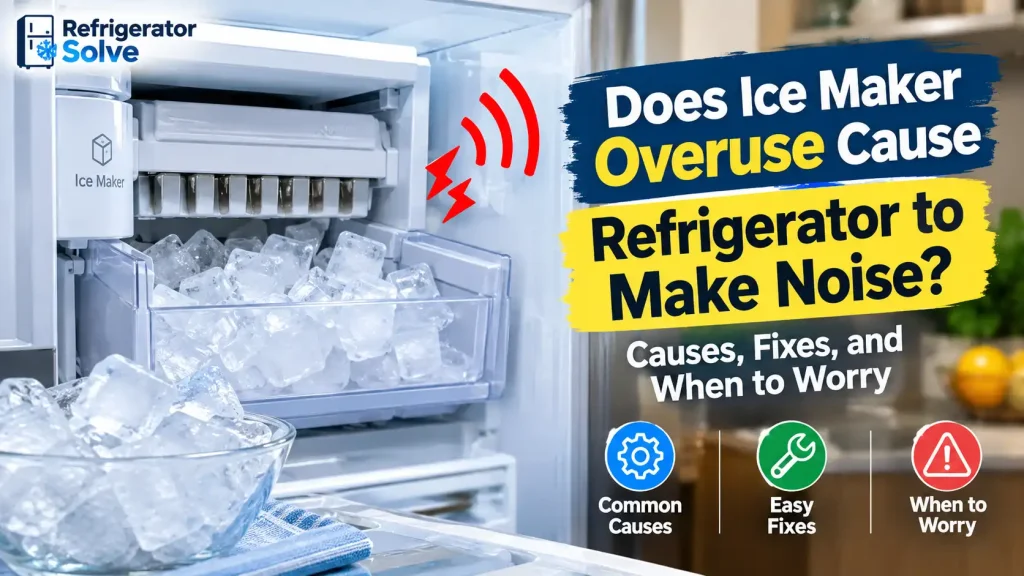
If your refrigerator seems noticeably louder after your household starts using more ice, it is reasonable to wonder: does ice maker overuse cause refrigerator to make noise? In most cases, heavy ice maker use does not damage the refrigerator or directly create an abnormal noise.
What it can do is make normal operating sounds happen more often. Every time the ice maker refills, freezes water, releases cubes, and rebuilds the supply, valves, motors, fans, and the cooling system may operate. That can mean more buzzing, clicking, humming, water-flow sounds, and the occasional thump of ice falling into the bin.
The key is separating frequent normal noise from a developing problem. A brief buzz while the tray fills or a loud clatter when cubes fall into an empty ice bin may be completely normal. Persistent grinding, scraping, squealing, repeated clicking with no ice production, or unusually loud buzzing deserves a closer look.
This guide will help you figure out what you are hearing, whether frequent ice use is really responsible, and what you can safely check before calling for service.
Quick Answer: Can Overusing an Ice Maker Make a Refrigerator Noisy?
Yes, using an ice maker heavily can make a refrigerator sound noisier more often, because the appliance has to complete more ice-making cycles.
Heavy ice demand may lead to more frequent:
- Water inlet valve operation
- Ice tray filling
- Ice harvesting and ejection
- Ice dropping into the storage bin
- Ice dispenser motor operation
- Freezer cooling cycles
However, normal heavy use should not cause a healthy refrigerator to develop constant grinding, harsh scraping, loud squealing, or other severe mechanical noises.
Think of it this way: heavy use can increase the frequency of normal sounds, but it should not dramatically change the quality of the sound.
If your refrigerator has become loud in general rather than only during ice production, our guide to how to fix a refrigerator making loud noise can help you troubleshoot other possible sources.
What Does “Overusing” an Ice Maker Actually Mean?
There is no universal number of ice cubes that counts as “overuse.” Ice makers are designed to operate automatically whenever the storage bin needs more ice.
In everyday terms, heavy ice maker use might include:
- Emptying most of the ice bin every day
- Making large amounts of ice for parties
- Filling coolers repeatedly
- Dispensing ice throughout the day
- Using crushed ice frequently
- Having several people use the ice dispenser
- Emptying the ice bin and immediately allowing it to refill
- Running the ice maker continuously during hot weather or busy periods
When the bin remains full, most automatic ice makers pause production. When you remove a large amount of ice, the system begins rebuilding the supply. That is why your refrigerator can suddenly seem more active after a party, family gathering, or hot weekend.
Why Does a Refrigerator Get Noisier When the Ice Maker Is Used Frequently?
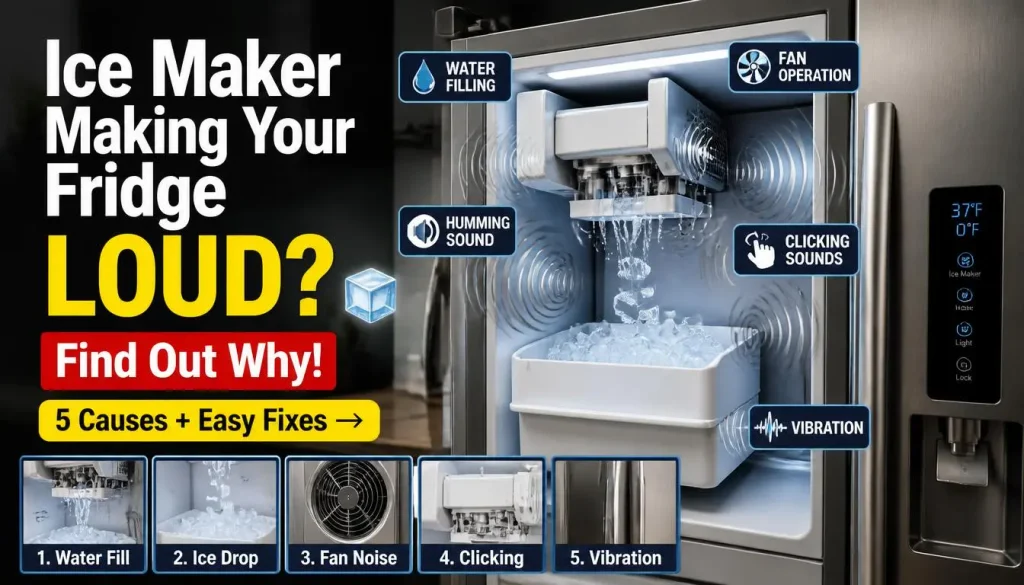
Several components operate during ice production. Heavy demand simply gives you more opportunities to hear them.
More Frequent Water Inlet Valve Cycles
Before your refrigerator can make another batch of ice, it needs water.
The water inlet valve opens briefly and allows water to flow into the ice maker. During this process, you may hear:
- Buzzing
- Humming
- A short vibration
- Water running
- A brief click
A short buzz during filling is commonly considered normal. GE, for example, identifies the ice maker and water valve as common sources of brief refrigerator buzzing during normal operation.
If the buzzing suddenly becomes much louder, lasts unusually long, or happens without water entering the ice maker, check the water supply.
For a deeper breakdown of this particular sound, see our guide to refrigerator buzzing noises and their causes.
The Ice Maker Motor Runs More Often
Once the water freezes, the ice maker has to release the cubes.
Depending on the refrigerator design, a small motor, gears, ejector mechanism, or rotating tray may help transfer the ice into the storage bin.
This can create:
- Clicking
- Short whirring
- Light mechanical movement
- Clacking
- Brief motor noise
If the sound is short and the ice maker continues producing normal cubes, it may simply be part of the harvest cycle.
Ice Drops Into the Storage Bin
Sometimes the loudest “problem” is not a problem at all.
When a batch of frozen cubes drops into a plastic or metal storage bin, the impact can create a surprisingly sharp:
- Bang
- Thud
- Clatter
- Rattle
- Knocking sound
LG specifically notes that ice dropping into the bin and water entering the ice maker are normal sources of ice-maker noise.
The noise is often much more noticeable when the bin is nearly empty.
The Refrigerator May Need More Cooling
Making ice requires the freezer to remove heat from incoming water until it freezes.
If you continually remove ice and force the system to make new batches, the freezer may spend more time maintaining the conditions needed for ice production.
You may therefore notice the:
- Compressor humming
- Evaporator fan running
- Airflow becoming more noticeable
- Refrigerator cycling for longer periods
This does not automatically mean the compressor is failing.
If the sound clearly comes from the bottom or back rather than the ice maker, our guide to reducing refrigerator compressor noise may be more relevant.
Normal Ice Maker Noises vs. Problem Noises
Use this table as a quick starting point.
| Sound | Usually Normal? | Possible Source |
|---|---|---|
| Brief buzzing | Often | Water inlet valve |
| Soft humming | Often | Valve, fan, or compressor |
| Water running | Usually | Ice maker filling |
| Single click | Often | Valve or ice maker cycle |
| Short whirring | Often | Ice maker motor |
| Ice clattering | Usually | Ice falling into bin |
| Brief thump | Often | Ice drop or water line movement |
| Grinding while dispensing | Sometimes | Auger moving ice |
| Constant grinding | No | Jam, motor, fan, or ice buildup |
| Metal scraping | No | Fan or moving component rubbing |
| Loud squealing | Usually not | Motor or mechanical component |
| Repeated clicking with no ice | Needs checking | Water supply, motor, valve, or control |
| Long, loud buzzing with no water | Needs checking | Restricted or unavailable water supply |
Do not diagnose a refrigerator by the sound alone. Location, timing, duration, ice production, water flow, and cooling performance matter just as much.
Is the Noise Coming From the Ice Maker or Ice Dispenser?
This distinction is easy to miss.
The ice maker produces the ice.
The ice dispenser moves stored ice from the bucket into your glass.
They use different components and can make different noises.
Noise While Making Ice
Noise that happens when nobody is pressing the dispenser may come from:
- Water inlet valve
- Ice maker motor
- Harvest mechanism
- Ice dropping into the bin
- Water supply tubing
Noise While Dispensing Ice
If the refrigerator becomes noisy only while you hold the dispenser paddle or button, look more closely at:
- Ice bucket
- Auger
- Auger motor
- Ice chute
- Crushed-ice mechanism
- Ice clumps
Why Is Crushed Ice Louder Than Cubed Ice?
Crushed ice often sounds rougher because the dispenser has to do more than simply move cubes forward.
Samsung notes that grinding during dispensing can be associated with the motor moving the ice and that crushed-ice operation may naturally sound louder than dispensing standard cubes.
A brief mechanical grinding sound while crushed ice is actually coming out can therefore be normal.
Grinding that continues when you are not dispensing ice, or grinding with no ice coming out, should be investigated.
Why Is My Refrigerator Suddenly Louder When Making Ice?
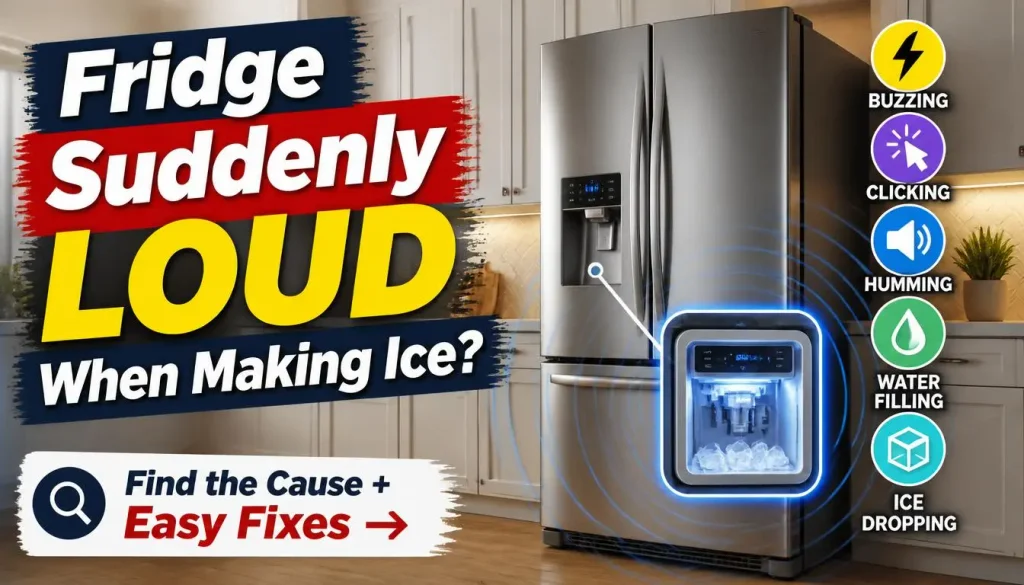
If the refrigerator used to make ice quietly and has suddenly become noticeably louder, consider what changed.
Common possibilities include:
- The ice bin was recently emptied
- Your household is using much more ice
- The water filter was recently changed
- The filter is becoming restricted
- The water supply valve is partially closed
- Water pressure has changed
- The supply tube moved against the cabinet
- Ice has clumped inside the bucket
- Frost has developed around a fan
- The refrigerator was recently moved
- The ice maker motor is aging
- A mechanical part has started wearing
A sudden change in sound is usually more informative than the simple fact that a refrigerator makes noise.
If you are hearing several unusual sounds rather than one specific ice-maker noise, you may also want to read our guide to why a fridge makes weird noises.
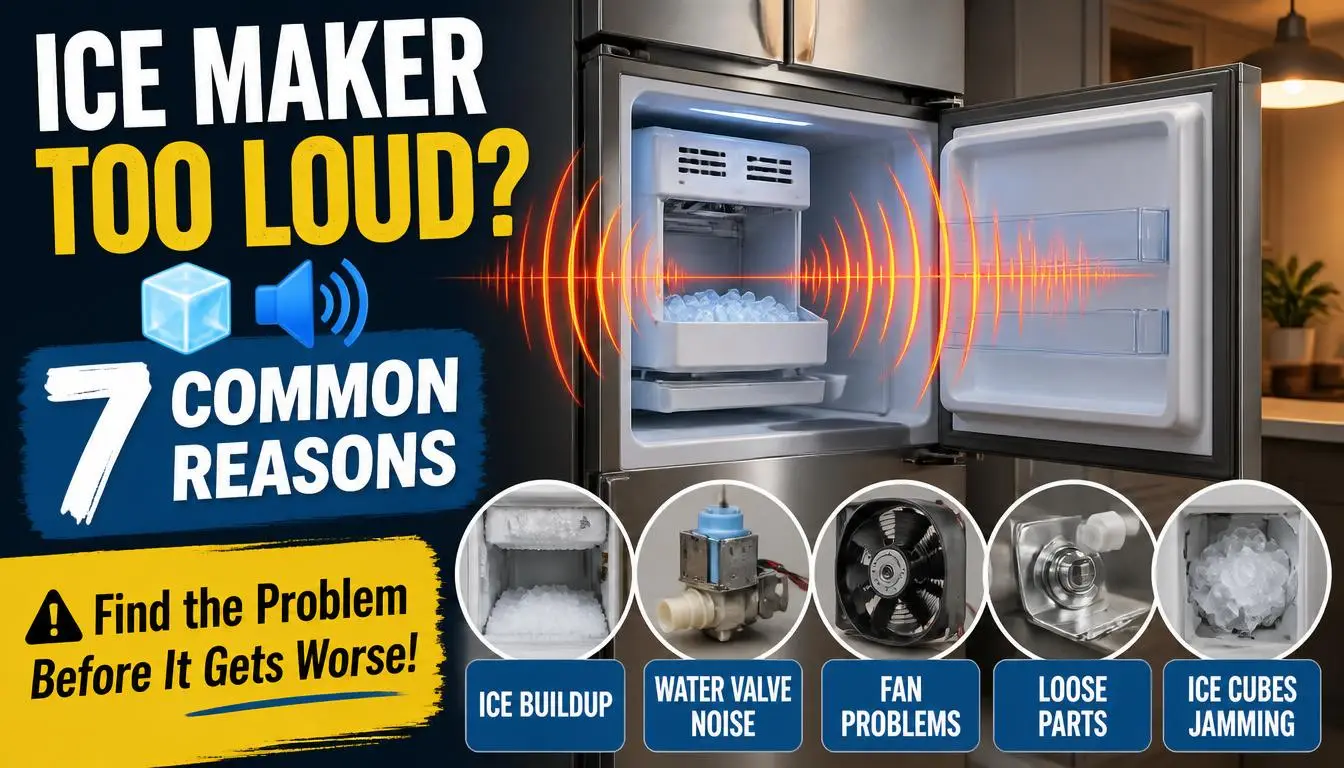
7 Common Reasons an Ice Maker Becomes Unusually Noisy
1. Restricted or Low Water Flow
An ice maker needs adequate water flow to fill properly.
Problems may develop when:
- The household supply valve is not fully open
- The refrigerator water line is kinked
- The line is pinched behind the appliance
- The filter is clogged
- Water pressure is unusually low
A struggling inlet valve may buzz, chatter, or sound louder than usual.
Check the visible water line and make sure the shutoff valve is fully open if your refrigerator installation instructions require it.
2. High Water Pressure
Low pressure is not the only possible issue.
Excessively high pressure can also make water-filling sounds more noticeable. Samsung notes that ice-maker filling can become louder when water pressure is too high.
Do not randomly adjust household plumbing pressure without knowing the specifications for your refrigerator. Check the owner’s manual or have a qualified plumber evaluate the supply if you suspect a pressure problem.
3. A Clogged or Incorrectly Installed Water Filter
A restricted filter can reduce water flow through the refrigerator.
You may notice:
- Slower water dispensing
- Smaller ice cubes
- Longer filling sounds
- Buzzing or chattering
- Reduced ice production
If the problem began shortly after a filter replacement, confirm that the filter is the correct type and is fully seated.
4. Ice Is Jammed in the Bucket or Mechanism
Heavy ice production can sometimes leave cubes stuck together, especially when ice sits long enough to partially melt and refreeze.
Clumped ice can interfere with:
- The auger
- Dispenser opening
- Ice chute
- Bucket mechanism
Samsung advises checking for fused or clumped cubes when ice will not dispense correctly.
Do not force the dispenser repeatedly against a hard jam. Remove the bin according to your refrigerator’s instructions and inspect it safely.
5. The Ice Maker or Auger Motor Is Wearing
A motor can become noisier as it ages.
Possible warning signs include:
- Grinding that becomes progressively louder
- Repeated clicking
- Motor noise without movement
- Ice failing to eject
- Dispenser motor running but ice not moving
Frequent use can mean more operating cycles, so an already worn component may become noticeable sooner during periods of heavy demand.
That does not mean normal ice consumption automatically damages a healthy motor.
6. Frost or Ice Is Touching a Fan
A noisy freezer fan can easily be mistaken for an ice maker problem.
Listen for:
- Scraping
- Rapid tapping
- Grinding
- A noise that changes when the freezer door opens
Samsung identifies ice buildup around a fan as a possible source of abnormal refrigerator noise.
Avoid using knives, screwdrivers, hair dryers, or other improvised tools to remove ice from internal refrigerator components. Follow the manufacturer’s defrost procedure instead.
7. The Refrigerator or Water Line Is Vibrating
Sometimes the ice maker is only triggering a vibration elsewhere.
When the water valve opens or the compressor starts, vibration can travel through:
- Water tubing
- Refrigerator panels
- Cabinets
- Flooring
- Shelves
- Items stored on top of the refrigerator
Make sure the appliance is stable and not pressed tightly against the wall or surrounding cabinetry.
For more troubleshooting ideas, see our guide to refrigerator vibrating noises.
Why Is My Ice Maker Noisy After Replacing the Water Filter?
A noise that appears immediately after a filter change deserves attention.
Possible causes include:
- Air trapped in the water system
- Filter not fully seated
- Incorrect filter installation
- A restricted replacement filter
- Changes in water flow
- Water line vibration
Follow the flushing procedure specified by the refrigerator manufacturer after installing a new filter. Flushing requirements vary by brand and model, so your owner’s manual should take priority over a generic amount of water.
If both the water dispenser and ice maker have weak flow after the filter change, the filter or water supply is a strong place to start troubleshooting.
Why Does My Ice Maker Make a Knocking or Hammering Noise?
A single thump when ice falls is usually less concerning than repeated hammering while water enters the refrigerator.
Knocking or chattering during filling can be associated with:
- Water pressure changes
- Supply tubing moving
- A partially closed valve
- Restricted water flow
- Water line striking the refrigerator cabinet
First inspect the visible tubing behind the refrigerator.
Make sure it is not:
- Crushed
- Sharply bent
- Pulled extremely tight
- Trapped beneath the appliance
- Repeatedly hitting the wall
If the knocking is violent, plumbing-related, or accompanied by leaks, professional plumbing help may be appropriate.
Why Is My Ice Maker So Loud After I Empty the Ice Bin?
This is one of the easiest refrigerator noises to misinterpret.
When the bin is full, new cubes land on other ice, which cushions the impact.
When the bin is empty, cubes may fall directly onto the hard bottom of the container. The result can sound much louder.
Emptying the bin also tells the refrigerator that more ice is needed, so you may hear several additional production cycles while it rebuilds the supply.
That means heavy ice use can create a combination of:
more frequent filling + more harvest cycles + louder ice drops into an empty bin.
It can sound dramatic even when the ice maker is working normally.
How Often Should an Ice Maker Make Noise?
There is no single schedule that applies to every refrigerator.
Ice production frequency depends on:
- Refrigerator model
- Freezer temperature
- Ice maker design
- Amount of ice already in the bin
- Household ice consumption
- Room temperature
- Door openings
- Water supply
- Special settings such as “Ice Plus” or “Fast Ice”
What matters more than an exact interval is the pattern.
A brief noise followed by normal ice production is usually less concerning.
A refrigerator that repeatedly buzzes or clicks without producing ice needs further investigation.
How to Tell Whether the Ice Maker Is Actually Causing the Noise
Instead of replacing parts based on guesswork, isolate the source first.
Step 1: Identify Where the Sound Comes From
Listen near:
- Ice maker
- Freezer
- Dispenser
- Rear water connection
- Bottom compressor area
A sound from the lower back of the refrigerator is unlikely to be ice dropping into the bin.
Step 2: Notice Exactly When It Happens
Ask:
- Does it happen immediately after ice drops?
- Does it happen while water enters?
- Only when dispensing?
- Only with crushed ice?
- Even when nobody uses the refrigerator?
- Does opening the freezer door change the sound?
Timing often provides the strongest clue.
Step 3: Temporarily Turn Off the Ice Maker
Use the refrigerator’s control panel, switch, or shutoff mechanism according to the owner’s manual.
Then observe the refrigerator.
If the suspicious noise disappears while other refrigerator functions remain normal, you have narrowed the source considerably.
Whirlpool also recommends turning the ice maker off when it is not connected to a water supply, because the water valve may otherwise buzz or click while trying to fill.
Step 4: Turn It Back On and Observe a Complete Cycle
If practical, pay attention to this sequence:
Water fill → freezing → harvest → ice drop → refill
Try to match the noise with one of these events.
Ice Maker Makes Noise but No Ice Comes Out: What Does It Mean?
First determine whether the refrigerator is failing to make ice or failing to dispense existing ice.
They are different problems.
Ice Maker Is Making Noise but Not Producing Ice
Possible causes include:
- Water supply turned off
- Kinked water line
- Restricted filter
- Frozen fill tube
- Inlet valve problem
- Ice maker mechanism problem
- Incorrect freezer temperature
If you hear buzzing but no water enters, start with the water supply.
GE notes that an ice maker can repeatedly buzz when it is switched on but its water supply is unavailable.
Ice Dispenser Motor Runs but No Ice Comes Out
Check for:
- Empty ice bucket
- Clumped cubes
- Improperly seated ice bucket
- Blocked chute
- Auger jam
- Dispenser lock
- Motor or gear problem
Remove and reinstall the ice bin according to your refrigerator manual before assuming the motor has failed.
Will Turning Off the Ice Maker Stop Refrigerator Noise?
It can—if the ice-making system is actually responsible.
Turning the ice maker off may stop sounds related to:
- Water filling
- Harvest mechanism
- Automatic ice production
- Ice dropping
It will not stop unrelated noises from the:
- Compressor
- Evaporator fan
- Condenser fan
- Defrost system
- Loose shelves
- Vibrating drain pan
- Refrigerator cabinet
If clicking continues after the ice maker has been disabled, our guide to refrigerator clicking noises can help narrow down other causes.
Can Frequent Ice Maker Use Wear Out Parts Faster?
Every mechanical component experiences some wear as it operates.
Heavy ice use means more cycles for parts such as the:
- Water inlet valve
- Ice maker motor
- Harvest mechanism
- Dispenser auger
- Dispenser motor
So, in a basic mechanical sense, a heavily used ice system may accumulate operating cycles faster than one that is rarely used.
But that is different from saying the ice maker has been “overused.”
Automatic ice makers are built to produce new batches when the bin needs them. Frequent household use by itself should not be treated as a fault condition.
A sudden grinding or failing motor is more likely to indicate a component problem than simply “too much ice.”
Can Heavy Ice Maker Use Make the Compressor Louder?
It may make normal cooling activity more noticeable.
When the refrigerator is replacing a large amount of ice, the freezer must maintain sufficiently cold conditions for repeated freezing cycles. Depending on the refrigerator, room conditions, and how often doors are opened, you may notice the compressor and fans operating more frequently or for longer periods.
A steady hum accompanied by normal cooling is very different from:
- Severe knocking
- Grinding from the compressor area
- Repeated start-stop clicking
- Excessive heat
- Refrigerator or freezer temperatures rising
Those symptoms should not be blamed on ice maker use alone.
How to Reduce Refrigerator Noise During Heavy Ice Maker Use
You cannot make an automatic ice maker completely silent, but you can prevent unnecessary noise.
Keep the Water Supply Fully Available
Make sure the supply valve and tubing meet the installation requirements for your refrigerator.
Replace a Restricted Water Filter
Use the correct compatible filter and follow the manufacturer’s replacement guidance.
Keep the Ice Bin Properly Installed
A poorly seated bin can interfere with dispensing.
Break Up or Remove Ice Clumps Safely
If cubes have fused together, follow your owner’s manual for removing and cleaning the bucket.
Check the Water Line Behind the Refrigerator
Prevent the tubing from vibrating against the wall or cabinet.
Make Sure the Refrigerator Is Stable
Adjust the leveling feet according to the installation instructions if the appliance rocks.
Leave Appropriate Clearance
Avoid allowing the refrigerator cabinet, rear tubing, or power cord to press against surrounding surfaces.
Do Not Run the Ice Maker Without Water
If your refrigerator is not connected to a water supply, switch the ice maker off according to its manual. Whirlpool warns that the valve can buzz or click while attempting to fill an ice maker without an active water connection.
Do Not Keep Forcing a Jammed Dispenser
Repeatedly holding the dispenser control while ice is stuck can put unnecessary load on the auger system.
When Is Ice Maker Noise Not Normal?
Arrange a closer inspection if you notice any of the following:
- Grinding that continues when no ice is being dispensed
- Metal scraping
- Loud squealing
- Repeated clicking with no ice production
- Continuous buzzing with no water flow
- Water leaking around the refrigerator
- Ice maker repeatedly jamming
- Burning smell
- Electrical smell
- Refrigerator losing cooling
- Noise becoming substantially louder over a short period
- Fan-like grinding that changes when the freezer door opens
If you smell burning, see damaged wiring, or notice water around electrical components, disconnect power if it is safe to do so and arrange qualified service.
When Should You Call an Appliance Technician?
Basic checks such as inspecting the ice bin, visible water tubing, filter installation, refrigerator leveling, and water supply are reasonable for most homeowners.
Professional diagnosis is a better choice when the suspected problem involves:
- Ice maker motor failure
- Electrical components
- Internal wiring
- Repeated water inlet valve failure
- Internal fan damage
- Persistent frost around a fan
- Compressor problems
- Refrigerant system
- Water leaks you cannot locate
- Disassembly beyond the instructions in the owner’s manual
If your refrigerator is still under warranty, check the manufacturer’s service terms before removing panels or attempting repairs.
Quick Ice Maker Noise Troubleshooting Checklist
| What to Check | What to Look For | What to Do |
|---|---|---|
| Ice bin | Empty or incorrectly installed | Reinstall correctly |
| Ice cubes | Clumped or fused | Remove jam safely |
| Water valve | Not fully open | Follow installation requirements |
| Supply line | Kinked or vibrating | Reposition carefully |
| Water filter | Old, clogged, or loose | Check or replace |
| Ice maker | Buzzing with no water | Check water supply |
| Dispenser | Motor runs but no ice | Check bin and chute |
| Refrigerator | Rocks or touches wall | Level and create clearance |
| Freezer fan | Grinding or scraping | Check for frost; seek service if needed |
| Cooling | Temperatures rising | Arrange diagnosis |
| Noise pattern | Constant or rapidly worsening | Do not assume it is normal |
Frequently Asked Questions
Is It Normal for a Refrigerator to Make Noise When Making Ice?
Yes. Short buzzing, clicking, water-flow sounds, motor movement, and ice dropping into the storage bin can all occur during normal ice-making cycles.
The noise becomes more concerning if it is extremely loud, constant, new, or accompanied by poor ice production or cooling problems.
Why Does My Refrigerator Buzz When the Ice Maker Runs?
A brief buzz commonly comes from the water inlet valve opening to fill the ice maker.
If the buzz is unusually loud or no water enters, check the water supply, filter, tubing, and valve.
Why Does My Ice Maker Make a Grinding Noise?
Grinding during actual ice dispensing can sometimes come from the auger moving cubes, particularly when crushed ice is selected.
Grinding when the dispenser is not being used may indicate an ice jam, fan problem, motor issue, or another mechanical fault.
Can a Clogged Water Filter Make an Ice Maker Noisy?
Yes. A restricted filter can reduce water flow and may contribute to unusual valve or water-flow sounds. It may also cause slow dispensing or reduced ice production.
Why Does My Ice Maker Make Noise but Not Make Ice?
Possible causes include insufficient water supply, a kinked line, restricted filter, frozen fill tube, inlet valve issue, or ice maker malfunction.
Start by confirming that water is actually reaching the refrigerator.
Why Is My Ice Maker Louder When the Bin Is Empty?
Ice landing directly on the hard bottom of an empty bin can sound much louder than ice landing on a pile of existing cubes.
An empty bin also triggers additional ice production, so you may hear the ice-making system more frequently.
Should I Turn Off My Ice Maker When I Am Not Using It?
You generally do not need to switch off a properly connected automatic ice maker simply because you are not actively dispensing ice.
However, if the refrigerator is not connected to a water supply, follow the manufacturer’s instructions for turning the ice maker off.
Does Making Lots of Ice Make a Refrigerator Work Harder?
It can increase ice-making and cooling activity because the appliance has to replace the ice you remove.
That may make normal operating sounds more noticeable, but it should not create severe mechanical noise in a healthy refrigerator.
Can Ice Maker Overuse Damage a Refrigerator?
Normal frequent household use is unlikely to damage a properly functioning refrigerator simply because you use a lot of ice.
If abnormal noise appears during periods of heavy use, look for a water-flow problem, jam, worn motor, filter restriction, vibration, or fan issue rather than assuming that ice consumption itself has damaged the appliance.
Final Verdict: Does Ice Maker Overuse Cause Refrigerator to Make Noise?
So, does ice maker overuse cause refrigerator to make noise? It can make your refrigerator sound busier, but heavy use is usually not the direct cause of an abnormal refrigerator noise.
When you use a lot of ice, the system has to refill, freeze, harvest, drop, and replace cubes more often. As a result, you may hear additional buzzing from the water valve, clicking or whirring from the ice maker mechanism, clattering as cubes hit the bin, and normal compressor or fan operation.
What heavy use should not produce is persistent grinding, scraping, squealing, violent knocking, continuous buzzing without water, or repeated mechanical noise accompanied by poor ice production or weak cooling.
If the sound is short, predictable, and tied to a normal ice-making event, your refrigerator may simply be doing its job. If the sound is new, steadily worsening, unusually loud, or paired with another symptom, troubleshoot the water supply, filter, ice bin, dispenser, fan, and ice maker components instead of blaming “overuse” alone.

Hi, I’m the lead researcher and appliance enthusiast behind RefrigeratorSolve. With years of hands-on experience troubleshooting cooling systems and testing home appliances, I am dedicated to bringing you honest reviews, energy-saving tips, and practical solutions to keep your refrigerator running perfectly.