
A refrigerator is never completely silent. Compressors hum, fans move air, water valves open, and ice makers cycle throughout the day. Most of these sounds are normal.
But there is a big difference between a gentle background hum and a refrigerator that rattles, vibrates, buzzes, or makes enough noise to disturb your kitchen, bedroom, or living space.
If you are wondering how to muffle refrigerator noise, start by finding out what is actually making the sound. Sometimes the solution is as simple as leveling the fridge, moving it slightly away from a wall, or separating two bottles that are vibrating against each other. Other noises may point to a dirty fan, loose drain pan, water line, or compressor-related problem.
Quick answer: To muffle refrigerator noise, make sure the appliance is level, prevent it from touching walls or cabinets, secure loose items, isolate floor vibration with suitable anti-vibration pads, inspect the water line and drain pan, and clean accessible fans and coils. If the noise is grinding, scraping, extremely loud, or accompanied by poor cooling, repair the underlying problem instead of trying to cover up the sound.
Why Is My Refrigerator So Loud?
Refrigerators make noise because several mechanical and electrical components operate at different times.
The compressor circulates refrigerant, fans move air, the automatic defrost system drains water, and models with ice makers or dispensers periodically operate water valves and motors.
A refrigerator can also seem louder when vibration transfers into the floor, wall, cabinet, or countertop.
If the sound has suddenly changed, identifying the type and location of the noise is more useful than simply trying to soundproof the refrigerator.
For a broader breakdown of common causes, see our guide to fixing a refrigerator that is making a loud noise.
Normal Refrigerator Sounds
These sounds are often part of normal operation:
- A low, steady hum
- Gentle buzzing
- Light clicking as components switch on or off
- Soft airflow or whirring
- Occasional gurgling
- Dripping during a defrost cycle
- Short popping or cracking sounds
- Ice dropping into the storage bin
- A brief buzz as the ice maker fills
The important question is whether the sound is new, unusually loud, continuous, or accompanied by another problem.
Refrigerator Noises That May Indicate a Problem
Investigate further if you hear:
- Harsh grinding
- Metal-on-metal scraping
- Loud repetitive knocking
- Strong cabinet vibration
- Squealing
- Repeated clicking without the compressor starting
- A suddenly much louder compressor
- Fan noise that continues to worsen
Noise combined with poor cooling, excessive heat, electrical smells, or smoke should never be ignored.
If your refrigerator has started producing several unfamiliar sounds, our guide on why a fridge makes weird noises can help you identify what you are hearing.
Airborne Noise vs. Vibration Noise
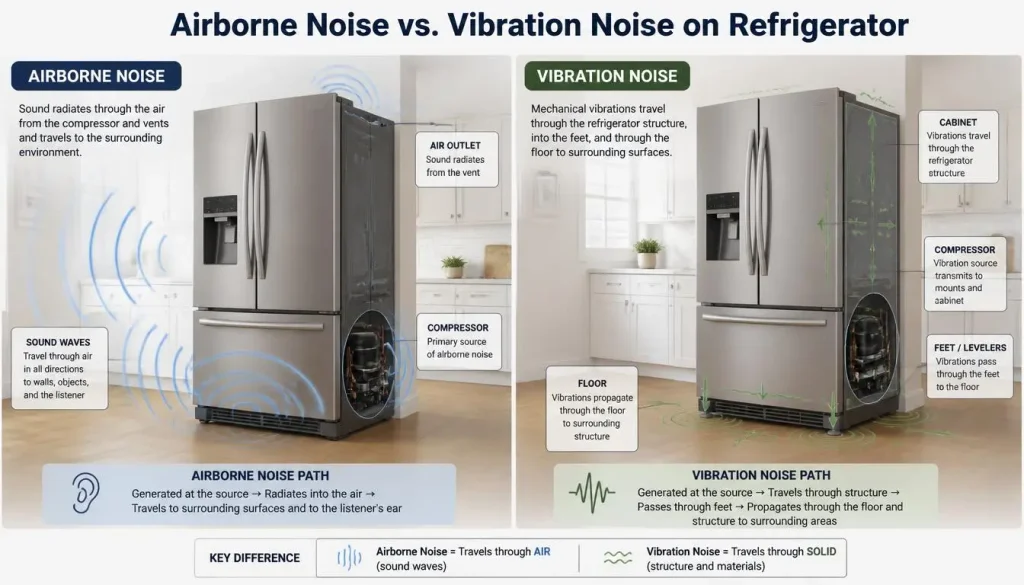
Before trying to muffle the sound, determine how the noise is reaching you.
Airborne noise comes directly from the appliance. Examples include the hum of a compressor, airflow from a fan, or an ice maker dropping cubes.
Vibration noise travels through another surface. A compressor may vibrate the refrigerator cabinet, which transfers that vibration into the floor, wall, countertop, or neighboring cabinetry.
The second type can sound surprisingly loud even when the refrigerator itself is operating normally.
Try lightly touching a side panel or nearby cabinet while the noise is happening. If the sound changes noticeably, vibration is probably contributing to the problem.
How Loud Should a Refrigerator Be?
There is no single noise level that applies to every refrigerator.
A modern refrigerator should generally blend into normal household background noise most of the time, although you will still hear it during compressor cycles, fan operation, defrosting, or ice production.
Instead of relying only on a sound-level number, watch for changes.
Ask yourself:
- Is it noticeably louder than it used to be?
- Can you suddenly hear it from another room?
- Is the noise rough, metallic, or irregular?
- Does it continue almost constantly?
- Has cooling performance changed?
If the refrigerator has always made a certain soft hum and still cools correctly, the sound may simply be part of its normal operation.
A new or unfamiliar loud noise deserves more attention.
Find Where the Refrigerator Noise Is Coming From
Location can narrow down the problem quickly.
Noise From Inside the Refrigerator
Check for:
- Bottles touching one another
- Loose shelves
- Drawers that are not fully seated
- Containers touching interior walls
- Items placed against air vents
Move these items and listen again.
Noise From the Freezer
A buzzing, scraping, grinding, or whirring noise from the freezer often leads you toward the evaporator fan or ice maker.
Ice buildup around the fan can sometimes allow the blades to strike frost.
If the noise changes when the freezer door is opened, the fan area deserves closer inspection.
Noise From the Back
Common sources include:
- Compressor
- Condenser fan
- Water supply line
- Refrigerant tubing
- Rear access panel
- Items touching the refrigerator
Do not immediately assume the compressor is failing. Several parts are located close together, so sounds from the rear can be difficult to distinguish.
Our guide to checking refrigerator compressor and fan noise explains how to tell these sources apart.
Noise From the Bottom
Look for:
- A loose drain pan
- Unstable leveling feet
- Floor vibration
- Condenser fan noise
- Compressor vibration
Noise Traveling Through the Floor or Wall
If the refrigerator sounds worse in another room, apartment, or downstairs space, structural vibration may be responsible.
In this situation, isolating vibration usually works better than trying to surround the refrigerator with soundproofing material.
How to Muffle Refrigerator Noise: 12 Effective Methods
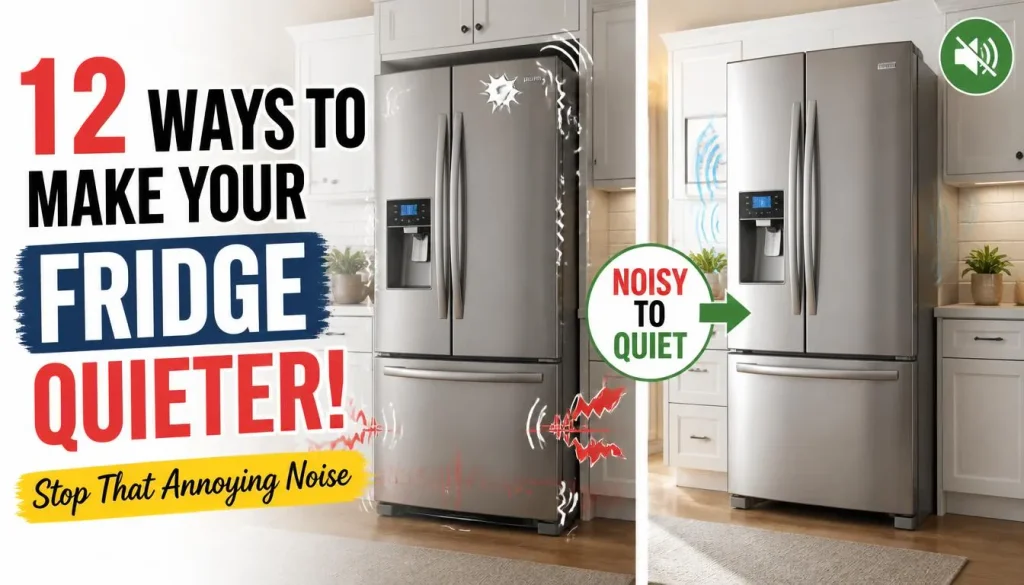
Start with the easiest fixes before opening panels or replacing parts.
1. Level the Refrigerator
An uneven refrigerator can rock slightly whenever the compressor or fans start.
That small movement can create a surprisingly loud vibration.
Check whether the appliance moves when you gently press opposite corners.
If it does:
- Check the leveling feet.
- Adjust them according to your refrigerator’s manual.
- Make sure each supporting point sits firmly on the floor.
- Test the refrigerator again.
Avoid stuffing cardboard, folded paper, or other unstable materials beneath the feet.
For more help with this specific problem, read our guide to refrigerator vibrating noise and its common causes.
2. Move the Refrigerator Away From Walls and Cabinets
A refrigerator that touches a wall, cabinet, countertop, or plumbing line can transfer normal operating vibration into those surfaces.
Even a tiny contact point can amplify the sound.
Carefully check the:
- Sides
- Back panel
- Water line
- Power cord
- Surrounding cabinets
Move the appliance enough to prevent direct contact while maintaining the installation and ventilation clearances specified by the manufacturer.
Do not push a noisy fridge tightly against a wall in an attempt to hide the sound. That can make vibration worse.
3. Use Anti-Vibration Pads
If the noise travels through a hard floor, suitable anti-vibration pads under the refrigerator’s supporting feet may help isolate the vibration.
They can be particularly useful on:
- Tile
- Wood
- Laminate
- Concrete floors
Choose pads designed to support heavy appliances and make sure they do not make the refrigerator unstable.
A thick, soft household rug is not a good substitute. Stability and ventilation still matter.
4. Stop Bottles, Shelves, and Containers From Rattling
Sometimes the refrigerator is not actually making the irritating noise.
Items inside it are.
When the compressor starts, mild cabinet vibration can cause:
- Glass bottles to touch
- Jars to rattle
- Loose shelves to vibrate
- Drawers to buzz
- Containers to tap against interior panels
Separate glass items slightly and make sure shelves and drawers are properly seated.
Also remove objects stored loosely on top of the refrigerator.
This takes less than a minute to check and can make an immediate difference.
5. Secure the Drain Pan
Many refrigerators have a drain pan near the bottom of the appliance.
If the pan has shifted or is loose, normal compressor vibration can make it rattle.
Unplug the refrigerator before accessing areas that contain electrical or moving components.
If your model allows easy access, check whether the drain pan appears to be correctly seated.
Do not force, glue, or modify it. If you are unsure how it is supposed to fit, consult the model’s manual.
6. Clean the Condenser Coils
Dust and debris around the condenser area can reduce airflow and make the cooling system work harder.
Depending on the model, the coils may be located underneath or at the rear.
Before cleaning:
- Unplug the refrigerator.
- Follow the manufacturer’s access instructions.
- Use an appropriate vacuum attachment or coil-cleaning brush.
- Avoid damaging tubing, wiring, or fan blades.
Some newer refrigerators have condenser designs that are not intended for routine owner cleaning, so check your manual before removing panels.
7. Inspect the Condenser Fan
If your model uses a condenser fan, debris or a damaged blade can produce buzzing, rattling, scraping, or grinding sounds.
With the appliance disconnected from power, inspect accessible areas for:
- Dust
- Pet hair
- Debris around the fan
- A loose obstruction
- Visible blade damage
Do not place your fingers near a powered fan.
If the blade is damaged or the motor itself is noisy, replacement may be a better solution than trying to muffle the sound.
8. Check the Evaporator Fan
The evaporator fan is commonly located around the freezer compartment.
A fan-related noise may sound like:
- Whirring
- Scraping
- Buzzing
- Grinding
- Squealing
Frost buildup around the fan housing can sometimes interfere with the blades.
Do not chip ice away with knives, screwdrivers, or other sharp tools. You could damage refrigerant tubing or internal panels.
If the fan repeatedly develops heavy frost around it, the underlying defrost, airflow, or door-sealing issue needs to be diagnosed.
Owners of Samsung appliances can also use our dedicated guide to fixing Samsung refrigerator fan noise.
9. Reduce Ice Maker Noise
Ice makers naturally make occasional sounds.
You may hear:
- A brief buzz when water enters
- Clicking during operation
- Ice dropping into the bin
- Short motor sounds
These are generally much different from constant grinding or repeated loud buzzing.
If your ice maker is switched on but the refrigerator is not connected to a working water supply, turn the ice maker off according to the manufacturer’s instructions.
Also check for obvious ice jams and make sure the storage bin is correctly installed.
10. Secure a Vibrating Water Supply Line
The tubing behind a refrigerator can create more noise than many people expect.
When water begins or stops flowing, a supply line that touches the wall, cabinet, or back of the refrigerator can vibrate.
Pull the refrigerator forward carefully and inspect the line.
Look for:
- Contact with the wall
- Sharp bends
- Kinks
- Pinched tubing
- Loose connections
Reposition the line gently if necessary without restricting water flow.
11. Reduce Compressor Vibration
A refrigerator compressor normally produces some humming and mild vibration.
First eliminate simpler causes such as:
- Poor leveling
- Wall contact
- Loose rear panels
- Vibrating tubing
- Drain pan movement
If the noise is definitely strongest around the compressor, worn mounting components can sometimes increase vibration.
The compressor and sealed refrigeration system are not good DIY repair areas. Do not wrap the compressor, open it, alter refrigerant tubing, or attempt sealed-system repairs without appropriate training and equipment.
If what you hear is mainly a low hum, our guide to why refrigerators develop a loud humming noise provides more targeted troubleshooting.
12. Add Sound-Absorbing Material Safely
This is where many attempts to muffle refrigerator noise go wrong.
You can reduce reflected sound in the surrounding room, but do not wrap the refrigerator in blankets, foam, insulation, carpet, or acoustic material.
A refrigerator needs airflow around specific areas to remove heat.
Safer approaches include improving the acoustics of nearby room surfaces without covering:
- Ventilation openings
- Compressor compartment
- Condenser area
- Electrical components
- Service panels
The goal is to reduce reflected noise, not trap the refrigerator inside an insulated box.
How to Soundproof a Refrigerator Without Blocking Ventilation
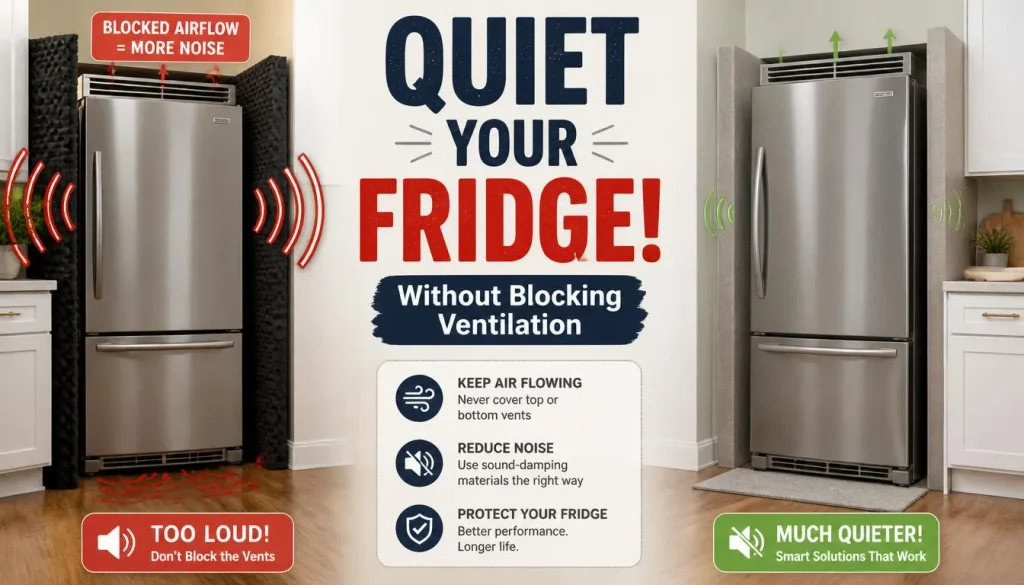
True refrigerator soundproofing is mostly about isolation and room acoustics, not wrapping the appliance.
Reduce Noise From the Wall Behind the Refrigerator
If a bare wall reflects compressor noise into the room, acoustic treatment elsewhere on that wall may reduce reflected sound.
Keep materials away from required ventilation zones and heat-producing components.
Reduce Noise Traveling Through the Floor
For floor-transmitted vibration:
- Level the refrigerator first.
- Confirm all supporting feet are stable.
- Use appliance-rated anti-vibration pads if appropriate.
- Fix loose flooring rather than trying to cushion an unstable appliance.
Reduce Noise Through a Shared Wall
If you live in an apartment or the refrigerator backs onto a bedroom wall, check whether the appliance or water line is physically touching that wall.
Breaking that direct vibration path may produce a bigger improvement than adding acoustic foam.
Acoustic Panels vs. Anti-Vibration Pads
They solve different problems.
Acoustic panels primarily reduce sound reflections within a room.
Anti-vibration pads help reduce mechanical vibration transferred into the floor.
If the fridge creates a deep hum that seems to travel through the building, vibration isolation is usually the first thing to investigate.
How to Fix Different Refrigerator Noises
The sound itself can provide another useful clue.
Refrigerator Humming Noise
A smooth, low hum is commonly associated with the compressor or fans.
Investigate when the hum:
- Suddenly becomes much louder
- Is accompanied by heavy vibration
- Continues with repeated clicking
- Appears with poor cooling
Refrigerator Buzzing Noise
Buzzing can come from the compressor, fan, water inlet valve, ice maker, or a vibrating panel.
If the buzz occurs specifically when the refrigerator dispenses water or makes ice, inspect the water system first.
You can find a more detailed diagnosis in our guide to refrigerator buzzing noises and their causes.
Refrigerator Vibrating Noise
Start with:
- Leveling
- Floor stability
- Wall clearance
- Water tubing
- Loose containers
- Drain pan
If the whole cabinet shakes strongly, the issue deserves closer investigation.
Refrigerator Rattling Noise
A rattling noise often comes from something loose rather than a major cooling component.
Check the:
- Drain pan
- Water line
- Rear cover
- Interior bottles
- Shelves
- Objects stored on top
Refrigerator Clicking Noise
Occasional clicking may happen as components cycle.
Repeated clicking becomes more concerning if the compressor appears unable to start or the refrigerator is not cooling.
Electrical and compressor-start components should generally be diagnosed by a qualified technician.
Refrigerator Grinding or Scraping Noise
Grinding and scraping should not simply be muffled.
Look for a fan blade striking:
- Frost
- Debris
- A loose wire
- A damaged fan housing
Persistent metal-like grinding requires repair.
Refrigerator Whirring or Pulsating Noise
Fans and variable-speed cooling components can change speed during operation, which may alter the sound.
A gentle changing airflow sound may be normal.
A new, rough, or extremely loud whirring sound is different and deserves inspection.
Refrigerator Gurgling, Hissing, or Dripping Noise
These sounds can occur as refrigerant moves through the system or water travels through the defrost drain.
A dripping sound without visible leakage may be normal.
If you see water collecting on the floor or inside the refrigerator, investigate the drainage and water supply instead of assuming the sound is harmless.
Refrigerator Popping or Cracking Noise
Temperature changes can cause plastic and metal components to expand or contract.
Occasional pops are often harmless.
Repeated violent banging or knocking, however, deserves further investigation.
For persistent knocking specifically, see our guide to fixing refrigerator knocking noise.
Refrigerator Water Line and Dispenser Noise
If the refrigerator becomes noisy only when someone uses the water dispenser or when the ice maker fills, start with the water supply.
Check:
- Household supply valve
- Water filter
- Supply tubing
- Kinks behind the fridge
- Connections
- Water flow from the dispenser
Air trapped after a new installation or filter change can also temporarily alter the sound of the water system.
If water flow is weak and the valve becomes unusually loud, a restriction somewhere in the supply system may be responsible.
Refrigerator Compressor Noise: What You Can and Cannot Fix
The compressor is usually located near the lower rear of the refrigerator and naturally makes some sound while running.
You can safely check surrounding conditions such as:
- Refrigerator leveling
- Clearance from nearby surfaces
- Loose panels
- Drain pan position
- Tubing touching the cabinet
You should not open the compressor or sealed refrigeration system.
A technician is recommended if you notice:
- Repeated clicking and failed starts
- Very loud knocking from the compressor area
- Excessive heat with poor cooling
- A sudden major increase in compressor noise
- Electrical or burning smells
Soundproofing is not a repair for a failing compressor.
Quick Refrigerator Noise Troubleshooting Chart
| Sound or Symptom | Likely Area | First Thing to Check | DIY or Technician? |
|---|---|---|---|
| Soft humming | Compressor/fan | Normal cooling cycle | Usually normal |
| Strong vibration | Feet/floor/cabinet | Leveling and wall contact | DIY |
| Interior rattling | Shelves/bottles | Rearrange loose items | DIY |
| Rattle underneath | Drain pan | Check pan position | Often DIY |
| Buzz during ice making | Water system | Water supply and filter | Usually DIY check |
| Buzz when dispensing | Water valve/filter | Flow and supply line | DIY check |
| Scraping from freezer | Evaporator fan | Ice around fan | Inspect carefully |
| Grinding | Fan/motor | Fan obstruction or wear | Often technician |
| Repeated clicking | Start system/compressor | Cooling performance | Technician |
| Knocking from rear | Tubing/compressor area | Vibration/contact | Inspect first |
| Dripping | Defrost system | Look for actual leaks | Usually normal if no leak |
| Popping/cracking | Interior materials | Observe frequency | Often normal |
What Not to Do When Trying to Muffle Refrigerator Noise
Some noise-reduction tricks can create bigger problems than the original sound.
Avoid these mistakes:
- Do not wrap the refrigerator in blankets.
- Do not cover ventilation openings.
- Do not cover condenser coils.
- Do not wrap the compressor in foam.
- Do not push the refrigerator tightly against a wall.
- Do not place it on an unstable soft surface.
- Do not use flammable material around heat-producing areas.
- Do not chip freezer ice with a knife.
- Do not open or modify the sealed refrigeration system.
- Do not ignore noise accompanied by electrical smells or smoke.
The safest strategy is always to eliminate unnecessary vibration and repair abnormal mechanical noise rather than trap it.
Why Does My Refrigerator Sound Louder at Night?
Your refrigerator may not actually become louder after dark.
At night, televisions, conversations, traffic, appliances, and other background sounds decrease. That makes the same refrigerator hum much easier to notice.
Floor and wall vibration can also be particularly noticeable in a quiet bedroom.
If the sound level itself has not changed and the refrigerator is cooling normally, nighttime awareness alone is not necessarily a sign of a fault.
If the appliance really is running longer or louder than before, investigate ventilation, room temperature, door sealing, dirty accessible condenser areas, and cooling performance.
When Should You Call a Refrigerator Technician?
Call a qualified appliance professional when the noise points to a problem that goes beyond simple installation or cleaning.
Examples include:
- Loud grinding that continues after checking for visible obstructions
- Repeated compressor clicking
- Severe compressor knocking
- A damaged fan motor
- Recurring ice buildup around the evaporator fan
- Noise combined with poor cooling
- Electrical burning smells
- Smoke or sparking
- Abnormally hot electrical components
- A water leak you cannot safely isolate
If you smell burning or see smoke or sparking, disconnect power only if it is safe to do so and arrange professional service.
When Is It Better to Replace a Noisy Refrigerator?
Noise alone does not mean a refrigerator needs replacement.
A loose pan, uneven floor, water line, or worn fan may be inexpensive to correct.
Replacement becomes more worth considering when:
- The refrigerator is older and already has multiple problems.
- A major sealed-system repair is required.
- Compressor failure is confirmed.
- Cooling performance is unreliable.
- Repair costs are high compared with the value of the appliance.
- Parts are difficult or impossible to obtain.
Get a diagnosis before assuming a noisy refrigerator has reached the end of its life.
How to Keep Your Refrigerator Quiet
A few routine habits can prevent minor noises from becoming irritating.
- Keep the refrigerator level.
- Maintain the manufacturer’s recommended clearances.
- Keep bottles and containers from touching.
- Inspect the water line occasionally.
- Keep accessible condenser areas clean when your manual recommends it.
- Avoid blocking internal air vents.
- Deal with unusual frost buildup early.
- Pay attention when a familiar sound suddenly changes.
Knowing your refrigerator’s normal sounds makes unusual ones much easier to spot.
Frequently Asked Questions
How can I make my refrigerator quieter?
Start by leveling it, moving it away from walls and cabinets, separating rattling items, checking the drain pan and water line, and isolating floor vibration. If the sound comes from a damaged fan or compressor, repair the problem rather than trying to cover the noise.
What can I put under my refrigerator to reduce noise?
Appliance-rated anti-vibration pads can help reduce vibration transmitted into a hard floor. They must support the refrigerator securely and should not make the appliance unstable.
Can I put acoustic foam behind my refrigerator?
Only if it is positioned in a way that does not interfere with ventilation, heat dissipation, wiring, service access, or manufacturer-required clearances. Never line the compressor or condenser compartment with acoustic foam.
Why is my new refrigerator so loud?
A new refrigerator may run more frequently while reaching its operating temperature, and its compressor and fan sounds may be different from your previous model. Check leveling, shipping materials, wall clearance, water connections, and the normal-sounds section of the owner’s manual.
Why is my refrigerator louder at night?
Background noise is lower at night, so normal refrigerator sounds become more noticeable. Vibration traveling through floors and walls may also stand out more in a quiet home.
How do I stop refrigerator vibration through the floor?
Level the refrigerator first and make sure every supporting foot is stable. If vibration remains, appliance-rated vibration-isolating pads may help reduce transmission into the floor.
Can a noisy refrigerator be dangerous?
Most refrigerator noises are not dangerous. However, noise accompanied by burning smells, smoke, sparking, severe overheating, or electrical problems requires immediate attention.
Why does my refrigerator hum constantly?
The compressor or fans may be running because the refrigerator needs additional cooling. Frequent door openings, warm room conditions, recently added groceries, or other operating conditions can increase run time. If the refrigerator runs almost continuously and cannot maintain temperature, it should be diagnosed.
Should I replace a refrigerator with a noisy compressor?
Not automatically. First confirm that the compressor is actually causing the noise. Nearby fans, tubing, panels, and the drain pan can imitate compressor noise. If a technician confirms major compressor failure, compare the repair cost with the refrigerator’s age and replacement value.
Why is my refrigerator noisy after moving it?
Moving can change the appliance’s leveling, wall clearance, drain pan position, water-line routing, or internal shelf placement. Check these areas first. If the refrigerator was transported improperly, follow the manufacturer’s instructions regarding how long it should remain upright before operation.
Final Thoughts
Learning how to muffle refrigerator noise starts with finding the source rather than simply hiding the sound.
Begin with the simple things: level the refrigerator, give it adequate clearance, stop loose items from rattling, inspect the water line, and reduce floor vibration. These fixes solve many annoying refrigerator noises without replacing a single major component.
If the sound comes from a dirty or obstructed fan, correcting the cause will usually work better than adding soundproofing around the appliance.
And remember that some humming, clicking, gurgling, airflow, and ice-maker noise is simply part of normal refrigerator operation.
The sounds worth worrying about are the ones that become unusually loud, rough, persistent, or arrive together with poor cooling, heavy vibration, leaks, or electrical symptoms.
Fix the source first. Muffle the vibration second. That is the safest and most effective way to get a quieter refrigerator.

Hi, I’m the lead researcher and appliance enthusiast behind RefrigeratorSolve. With years of hands-on experience troubleshooting cooling systems and testing home appliances, I am dedicated to bringing you honest reviews, energy-saving tips, and practical solutions to keep your refrigerator running perfectly.